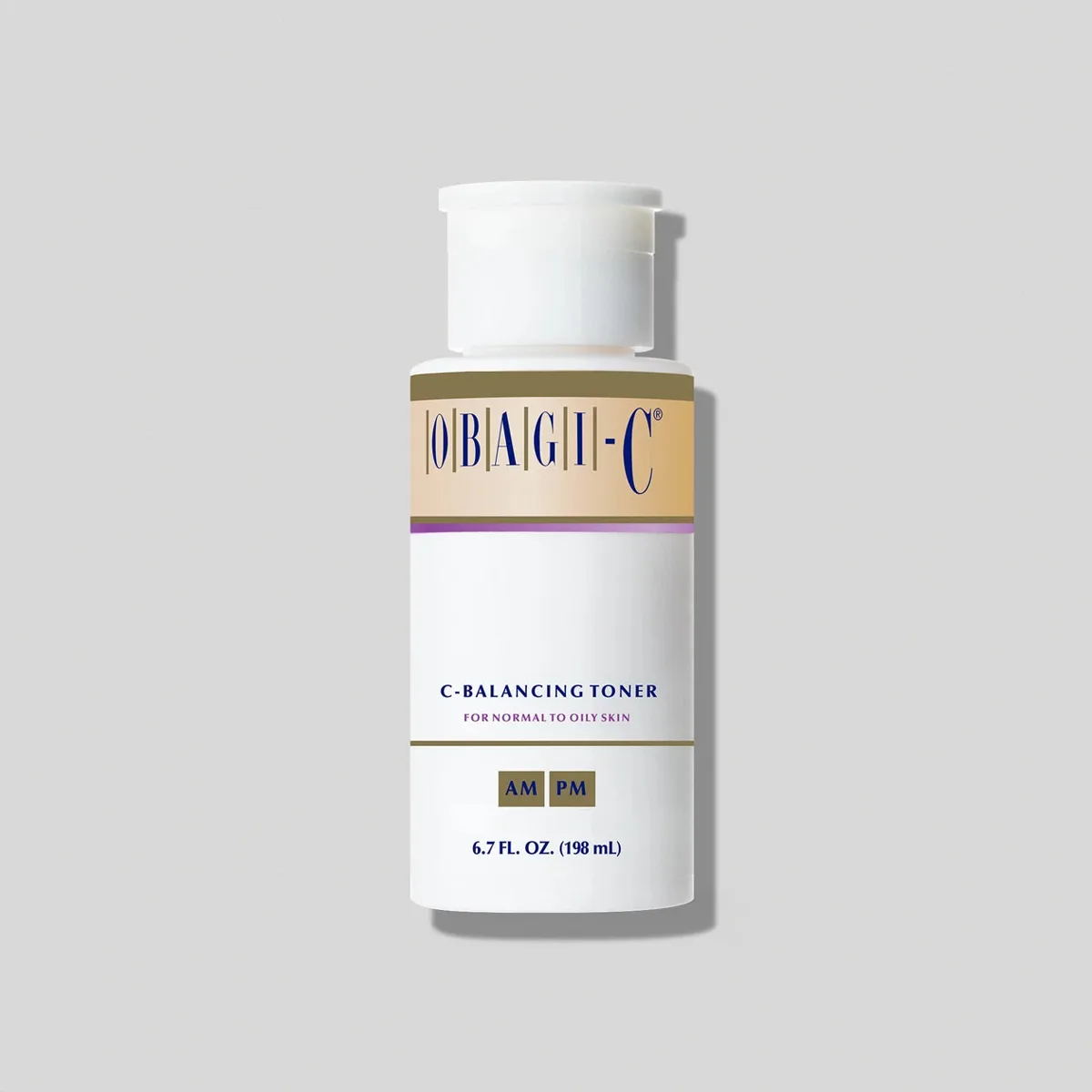
It is a ten-ingredient, alcohol-free witch hazel toner with a quaternary antiseptic in place of the usual ethanol, built two decades ago as the prep step before an L-ascorbic acid serum and never updated, which makes it one of the sparsest toners a physician brand still sells. Its distinction is the role it plays in the Obagi-C system rather than anything in the bottle.
A two-decade-old, ten-ingredient witch hazel toner that preps oily skin for the Obagi-C serum without alcohol, and does that small job reliably for its loyal users. It contains no vitamin C, its fifth ingredient is a quaternary antiseptic that patch-test clinics classify as an irritant and sensitiser, it carries a paraben, and fifty dollars for what a pharmacy bottle offers for five is a price the system commands, not the formula.
Listed for Excess Oiliness and Large Pores — the actives here (Witch Hazel, Sodium PCA, benzalkonium chloride, Panthenol (Vitamin B5) are in our research queue for those concerns; there is no verdict until their evidence rows are written. That is a gap in our table, not a mark against the product.
Falls shortJudged as a toner, it comes up short on: adds something real. Not measured from the label: restores skin pH, plays well with what follows.
A verdict is DermApproved’s assessment of how well a product’s ingredients fit a concern — never a claim about what the product treats. Evidence dots and collected reviews sit beside it and are never blended in.
Rules 0.5.1 · evidence table ev-2026.09-r228 · how we decide
Assessment
Pros & Cons
Pros
✓ Alcohol-free witch hazel astringency that mattifies without drying
✓ Sodium PCA and propylene glycol keep oily skin from feeling tight
✓ Aloe and panthenol add a modest soothing note
✓ Ten-ingredient formula with no fragrance, oils or silicones
✓ No acids, so it sits cleanly under the vitamin C serum
✓ Generous 6.7 oz bottle lasts about three months
✓ Twenty years of consistent use inside the Obagi-C system
Cons
✗ Benzalkonium chloride is a documented irritant and sensitiser, especially on compromised skin
✗ Contains no vitamin C despite the C in the name
✗ Fifty dollars for a formula pharmacy brands sell for a tenth of the price
✗ Methylparaben preservative dates the formula
✗ Stings on skin that is peeling from retinoids or procedures
✗ Nothing in it changes the skin over time
Review
Full Review
Ten ingredients is a short list for a fifty-dollar toner, and it makes the C-Balancing Toner unusually easy to read. Water, witch hazel water, propylene glycol, sodium PCA, benzalkonium chloride, aloe juice, panthenol, polyquaternium-10, phenoxyethanol, methylparaben. There is no vitamin C, which surprises people who assume the C on the label refers to an ingredient rather than to the Obagi-C system this has been the second step of since the mid-2000s. There is no alcohol, which is the product's main selling point and a legitimate one. And there is, fifth from the top, benzalkonium chloride, a quaternary ammonium antiseptic that dermatologists include in their standard patch-test series because a third of dermatitis patients react to it, and that is the ingredient the review has to be about.
The idea of the toner is old and sound. Witch hazel distillate, placed second, brings a mild tannin astringency that cuts surface oil and tightens the look of pores for a few hours without the ethanol that gives witch hazel its drying reputation. Propylene glycol and sodium PCA, the skin's own natural moisturising factor salt, pull the balance back toward hydration so oily skin feels refreshed rather than stripped. Aloe and panthenol add a soothing note, polyquaternium-10 leaves a faint conditioning film, and phenoxyethanol and methylparaben preserve. In a routine that goes cleanser, toner, L-ascorbic acid serum, day lotion, that is a sensible pad step for a shiny face: it removes cleanser residue, it mattifies briefly, and it does not compete with the acid serum that follows.
Benzalkonium chloride complicates the picture. It is there partly as a preservative and partly as a mild antiseptic against the surface bacteria on oily skin, and at the low levels cosmetics use it most intact skin tolerates it without complaint, which the toner's loyal reviews bear out. But a 2017 review in Dermatitis of 615 patients patch-tested for suspected allergic contact dermatitis found that thirty-two percent reacted to benzalkonium chloride, a tenth of them strongly, and concluded that products containing it should be used carefully by anyone with a compromised barrier. Obagi's own label restricts this toner to normal-to-oily skin and sells a separate, softer toner for sensitive faces, which is the brand quietly agreeing. For a healthy oily face the ingredient is a non-issue; for a face that is flaking from tretinoin, freshly peeled, or simply reactive, it is the reason the toner stings, and the reason to leave it out until the barrier settles. It is also a curious choice to have kept for twenty years in a product from a brand whose customers, by definition, are often mid-treatment.
In use, on the skin it is meant for, it is brisk and pleasant in a nostalgic way. A few presses of a cotton pad on the pump top, a wipe across the face, a cool witch-hazel moment, and a clean, matte, faintly tightened feel once it air-dries a minute later; shine holds off for a few hours and the serum goes on cleanly. The hundred-odd reviews at one clinical retailer, averaging around 4.7, are written mostly by people who have used it for years inside the Obagi-C routine and would notice if it were removed, and the ten on the brand's own site are unanimous. What none of them describe, because there is nothing to describe, is a change in the skin over time: no acid, no niacinamide, no vitamin C, nothing that does anything but repeat its small refreshing effect twice a day. That is not a criticism of the toner so much as of the category, and the pH-balancing phrase on the label deserves the same realism, since a mildly acidic liquid wiped over a face does not correct anything that a modern cleanser has not already left close to normal and that the skin would not restore on its own within the hour.
The price is where the spareness stops being a virtue. Fifty dollars for 6.7 ounces of water, witch hazel and a handful of common additives is a physician-channel figure attached to a formula that pharmacy brands have sold, alcohol-free, for a tenth of that for decades; the bottle lasts about three months, so the yearly cost is modest, but the per-ingredient cost is among the highest of any toner sold. What the money buys is the coherence of the Obagi-C system and the reassurance of its channel, both real, and not a better liquid. The methylparaben is safe at cosmetic levels and dates the formula rather than endangering anyone, but a reformulation that swapped the benzalkonium for a gentler preservative would make this toner recommendable to far more faces at no cost to its function.
For normal-to-oily skin already on the Obagi-C system, this is an unobjectionable, even pleasant, second step, and there is no reason for those users to change. For anyone else it is fifty dollars of witch hazel with an antiseptic that reactive skin should avoid, and the brand's own gentler toner, or a drugstore alcohol-free witch hazel, will serve better.
Formula
Key Ingredients
The hero actives that drive this product's performance.
Second on the list, directly after water, which makes this toner mostly witch hazel distillate; the alcohol-free water carries a mild tannin astringency that cuts surface oil and tightens the look of pores for a few hours, and its placement is why the product suits the normal-to-oily skin Obagi names on the label and reads as brisk rather than hydrating.
The skin's own natural moisturising factor salt, fourth on the list with propylene glycol above it, supplies the humectant counterweight that keeps a witch-hazel-heavy toner from leaving oily skin tight; it is the reason long-term users describe the finish as refreshed rather than stripped.
Not yet assessed
Benzalkonium Chloride
A quaternary ammonium antimicrobial, fifth on the list, doing double duty as a preservative and a mild antiseptic against surface bacteria on oily skin; it is also a documented irritant and sensitiser, especially on compromised skin, which is the strongest reason this toner is labelled for normal-to-oily faces and not for the reactive ones the brand's other toner serves.
With aloe juice just above it, panthenol is the soothing and humectant note that softens the astringent-and-antiseptic core; at seventh on a ten-item list it is present in a meaningful amount, and it is what lets the toner sit under the L-ascorbic acid serum that follows it in the Obagi-C routine without compounding the sting.
Not yet assessed
Ingredient standings describe the active at treatment-level doses and
vehicles; this product's own condition grades weigh its actual formula.
Wipe it over the face on a cotton pad after the C-Cleansing Gel, let it air-dry without rinsing, and follow with the vitamin C serum and then the day lotion or night cream, morning and evening; it has no acid, so it does not add to the exfoliation load. On skin that is peeling from a retinoid or a recent procedure, skip it until the barrier has settled, because the benzalkonium chloride bites on broken skin.
Results Timeline
The skin feels clean and slightly tightened as it dries, with shine held back for a few hours; the effect repeats with each use rather than building, and oily faces report a more balanced look within a week or two of twice-daily use. It does nothing over months on its own, and the brightening in the Obagi-C system belongs to the serum that comes next.
With ten ingredients and no active, the science of this toner is the science of its preservative-antiseptic. Benzalkonium chloride is a quaternary ammonium compound that disrupts microbial membranes, used in eye drops, nasal sprays, disinfectants and a range of personal care products, and it is one of the better-characterised irritants in contact dermatology. A 2017 retrospective review in Dermatitis by Isaac and Scheinman examined 615 patients patch-tested with a modified American Contact Dermatitis Society core series that included benzalkonium chloride at 0.1 percent aqueous; 198 patients, thirty-two percent, tested positive, and 64, ten percent, had strong or extreme reactions at the final reading, with positive patients on average using at least one product containing benzalkonium or a cross-reacting quaternary compound. The authors' conclusion was that widespread exposure to irritants in dermatitis patients predisposes to sensitisation and that products containing benzalkonium should be used carefully on compromised barriers. A toner is a leave-on applied twice daily across the whole face, and the relevant reading for this product is not that healthy oily skin will react, since most does not, but that the ingredient makes the toner unsuitable for the barrier-damaged, retinoid-peeling and atopic skin that dermatology patients frequently have, which the label's normal-to-oily restriction reflects.
The rest of the formula is conventional. Witch hazel water is a steam distillate of Hamamelis virginiana carrying a small tannin fraction with mild astringent and anti-inflammatory activity, without the alcohol that pharmacy extracts contain; its effect on pores and shine is transient surface contraction and sebum absorption lasting a few hours. Propylene glycol and sodium PCA are humectants, the latter a native natural moisturising factor component with strong water binding, and together they prevent the tightness that pure astringents produce. Aloe leaf juice contributes polysaccharides with mild soothing and hydrating action, panthenol adds humectancy and modest barrier support, and polyquaternium-10 is a cationic cellulose polymer that deposits a light conditioning film. Phenoxyethanol and methylparaben complete the preservative system; methylparaben is among the safest and least sensitising parabens at cosmetic levels, and its presence is a marker of the formula's age rather than a hazard. There is no vitamin C, no exfoliant and no sebum-regulating ingredient, and the pH-balancing claim describes the toner's own mild acidity rather than any durable effect on skin, which restores its acid mantle within an hour of cleansing unaided.
Dermatologists who dispense the Obagi-C system tend to hand this toner over without much comment, because on the normal-to-oily patients the system targets it behaves as a harmless, refreshing pad step, and its alcohol-free formulation spares them the drying that older toners caused. The comment comes when the patient's skin changes: once a retinoid, a peel or a course of the system's own vitamin C serum has the barrier flaking, clinicians commonly tell patients to pause the toner, since benzalkonium chloride is on every standard patch-test series precisely because it irritates and, with repeated exposure on damaged skin, sensitises. Practices treating atopic, rosacea or contact-allergic patients generally steer them to the brand's gentler SUZANOBAGIMD toner or to no toner at all. The broader clinical view is that a toner of this kind is optional, that its pH claim describes the liquid rather than a lasting change to the skin, and that the vitamin C benefits of the routine come entirely from the serum step; for a tolerant oily face already on the system it is a reasonable habit, and for anyone else it is a step that can be skipped without loss.
Guidance
Usage & Recommendations
How to Use
After cleansing with the C-Cleansing Gel or another cleanser, morning and evening, press a cotton pad onto the pump top three or four times and wipe gently over the whole face, avoiding the eyes and any broken skin, then let it air-dry completely without rinsing before applying the vitamin C serum and moisturiser. Use it only on intact, normal-to-oily skin; pause it while the face is peeling from a retinoid, a peel or the start of the system's serum, and reintroduce it once daily when the barrier has settled. If stinging or redness appears along the cheeks with regular use, stop, since that is the pattern of a benzalkonium reaction rather than something to push through.
Value Assessment
Fifty dollars for 6.7 ounces is a dermatology-office price for a ten-ingredient witch hazel toner, and the per-ingredient cost is among the steepest in the category; a bottle lasts about three months at twice-daily pad use, so the annual outlay is around two hundred dollars for a step with no active. What the money buys is the coherence of the Obagi-C system, whose value sits in the L-ascorbic acid serum rather than here, and the brand's physician-channel standing. What it does not buy is a better liquid, since alcohol-free witch hazel toners with humectants and aloe are a drugstore staple at a fraction of the price and without the benzalkonium chloride. For a patient on the full system it is a tolerable part of the kit; as a standalone purchase it is poor value.
Who Should Buy
Normal-to-oily skin already using the Obagi-C system that wants the matching alcohol-free prep step, and oily faces that like a brisk, mattifying witch hazel toner without ethanol and have no history of contact sensitivity. It suits long-time users of the routine who value consistency over ingredient novelty and do not mind paying the system's price for a simple step.
Who Should Skip
Sensitive, dry, atopic, rosacea-prone or barrier-compromised skin should avoid it because of the benzalkonium chloride, and anyone peeling from a retinoid or recovering from a procedure should at least pause it. Anyone expecting vitamin C, anyone who avoids parabens, and anyone unwilling to pay fifty dollars for water and witch hazel will be better served by the brand's gentler toner or a pharmacy alternative.
A clear, entirely water-thin liquid with no slip, that wipes across the skin on a pad, feels cool and faintly brisk for a few seconds, and air-dries in under a minute to a clean, matte, slightly tightened finish.
Scent
No added fragrance; a faint, clean witch hazel note that disappears as it dries.
Packaging
A 6.7 oz white bottle with a press-down pump-top dispenser and the gold-banded Obagi-C label; the pump top wets a cotton pad with a press or two, the bottle is generous enough for months of twice-daily use, and it is sold alone or inside the Obagi-C Fx kit for normal-to-oily skin.
Finish
mattefast-absorbinglightweight
What to Expect on First Use
The first wipe is brisk and old-fashioned in a reassuring way: cool, faintly witch-hazel-scented, no sting on intact oily skin, and a clean, matte, slightly tightened feel once it dries a minute later. There is nothing to adjust to and nothing visible happens beyond a little less shine by midday. On a face that is flaking from a retinoid or freshly treated, the same wipe will sting sharply, which is the benzalkonium chloride and the cue to pause it.
How Long It Lasts
About three months at three or four presses onto a pad twice daily; four months at a single daily use.
The Obagi-C system arrived in the mid-2000s as the brand's vitamin C counterpart to Nu-Derm, a three-to-five-step routine sold through dermatology offices in Rx and later hydroquinone-free Fx versions, and the C-Balancing Toner has been its second step for normal-to-oily skin from the beginning. Its formula, witch hazel, sodium PCA, benzalkonium chloride, aloe and panthenol, reads like a 2005 toner because it is one; Obagi has changed the packaging twice and the label once, dropping the Rx name, and has left the liquid alone.
About Obagi Legacy Brand (20+ years)
Obagi has been dispensed through dermatology offices since dermatologist Zein Obagi founded it in 1988, and the Obagi-C system, built around L-ascorbic acid serums, is one of its longest-running lines. This toner is the system's second step and one of its oldest, simplest formulas; it carries no vitamin C itself and no product-specific study, and is assessed on its ten-ingredient label.
Brand founded: 1988 · Product launched: 2005
Myth vs. Reality
Common Myths
Myth
The C-Balancing Toner contains vitamin C.
Reality
It does not. The C refers to the Obagi-C system it belongs to; the ten ingredients are water, witch hazel water, humectants, an antimicrobial, aloe, panthenol, a conditioning polymer and two preservatives. The vitamin C in the routine arrives with the serum that follows it.
Myth
An alcohol-free toner is automatically gentle.
Reality
This one has no ethanol, but its fifth ingredient, benzalkonium chloride, is a quaternary ammonium antiseptic that patch-test clinics identify as both an irritant and a sensitiser, particularly on compromised skin; the label's restriction to normal-to-oily skin is the brand acknowledging that reactive faces should use something else.
FAQ
Frequently Asked Questions
Does the Obagi C-Balancing Toner contain vitamin C?
No. Despite the name, none of its ten ingredients is a vitamin C derivative; the C refers to the Obagi-C system it belongs to, and the vitamin C comes from the C-Clarifying Serum applied after it.
What skin type is the Obagi C-Balancing Toner for?
Obagi labels it for normal to oily skin, and the formula agrees: witch hazel water second on the list and a quaternary antiseptic give it a brisk, oil-cutting, matte effect that dry and sensitive skin will find tight and, on any broken patches, stinging.
Is the Obagi C-Balancing Toner alcohol-free?
Yes, it contains no ethanol or denatured alcohol; the astringency comes from a witch hazel distillate and the antimicrobial role from benzalkonium chloride, so it does not dry the skin the way an alcohol toner does, though the benzalkonium can irritate compromised skin.
What is the difference between the Obagi C-Balancing Toner and the SUZANOBAGIMD Balancing Toner?
Both are alcohol-free witch hazel toners at the same price, but the C-Balancing Toner is a spare, brisk ten-ingredient formula with benzalkonium chloride for oily skin in the Obagi-C system, while the SUZANOBAGIMD version adds glycerin, licorice and more soothers for sensitive and combination skin. Reactive faces should choose the latter.
Can I use the Obagi C-Balancing Toner while on tretinoin or after a peel?
Better not while the skin is peeling or freshly treated. Benzalkonium chloride and propylene glycol both sting on a compromised barrier, and patch-test clinics flag benzalkonium as a sensitiser in exactly that situation; wait until the skin has settled, then reintroduce it once daily.
How do I use the Obagi C-Balancing Toner?
After cleansing with the C-Cleansing Gel, press a cotton pad onto the pump top three or four times, wipe gently over the whole face, and let it air-dry without rinsing before applying the vitamin C serum; use it morning and evening as the second step of the Obagi-C routine.
Reviews
What Reviewers Tend to Say
Recurring themes our editors read across retailer reviews of this product — summaries in our words, not quotations, and not a substitute for your own patch test.
The supplier specification for standard witch hazel water caps the tannin content — the fraction all the research is about — at a level indistinguishable from none. The tightness you feel is the solvent.
It's in half your products and headlines none of them. Provitamin B5 has the kind of boring, decades-deep barrier and wound-healing evidence that flashier actives can only envy.
The fourth most frequent positive patch test in North America is an oxidation product of a molecule that occurs naturally in lavender. Nobody synthesised it into your face cream.
Western sensitive skincare works by subtraction — remove the fragrance, remove the alcohol, shorten the list. Japan's answer adds a designed molecule back in, and one of the two bets has a trial literature.
Products, answers, therapy guides, tools and articles in one search. Brand names,
slang and abbreviations all work — accutane finds isotretinoin, bacne finds truncal acne.