Octocrylene and Homosalate: The Filters America Is Stuck With
The critics are right about the data gap, and they are right that it took two decades to move. What follows from that is not the conclusion most people draw.
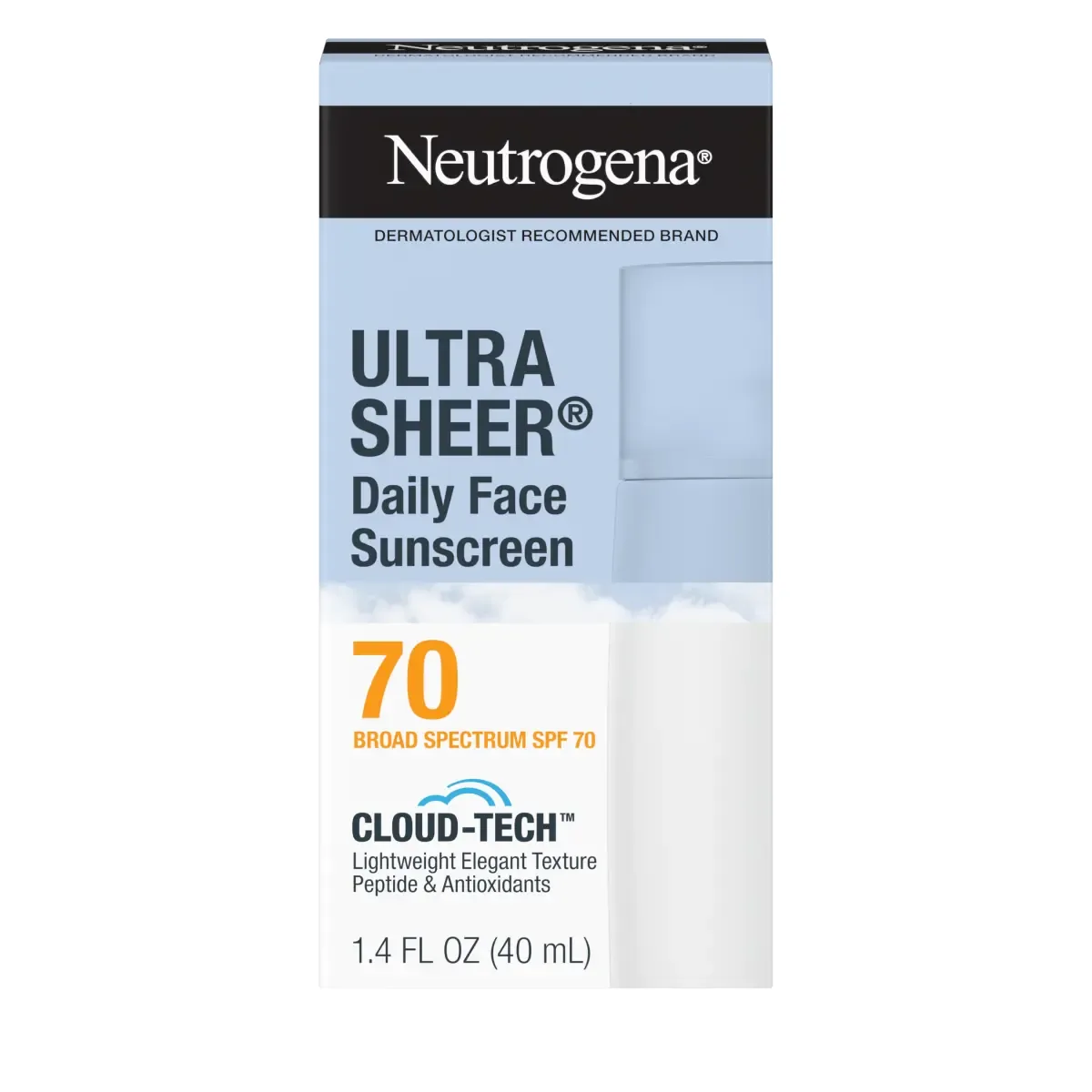
Every other Neutrogena face sunscreen stabilises its avobenzone with octocrylene; this one uses bemotrizinol, the broad-spectrum triazine filter that European and Korean sunscreens have leaned on since 2000 and that the FDA only admitted to the US monograph in June 2026. It is the first bemotrizinol formula to reach a drugstore shelf here, and it arrives with no octocrylene and no oxybenzone in a fluid that weighs less than the brand's older SPF 70 liquid.
The first drugstore sunscreen in America built on bemotrizinol, and it shows in the one place that matters: a photostable, octocrylene-free SPF 70 fluid that weighs almost nothing and leaves no cast. The rest of the formula is older than the headline, with homosalate at the US ceiling and no water resistance, so it is a strong everyday face sunscreen rather than the clean break the marketing suggests.
This entry was written on the second day the product existed, from the Drug Facts label and the brand's product page, with no retail reviews, no independent SPF testing and an unconfirmed price. Bemotrizinol's decades of use abroad and the familiar Ultra Sheer base give the formulation read a solid footing, but wear-time behaviour, pilling, stinging and how the fluid holds up in humidity are questions only the first few hundred wearers can answer, and this review will be revised once they have.
The case for it
Same rule for everyone. “Full protection” is the verdict on 2,288 of 45,024 concern verdicts across the catalog; rule P1 decided 2,232 of them. As of September 25, 2026, engine 5.1.1.
Brand or formulator? Disclose a concentration or correct a fact →
The studies behind the evidence row
The case for it
What would change this: A researched evidence row for the lead active would replace this with a verdict.
Same rule for everyone. “Full protection” is the verdict on 2,288 of 45,024 concern verdicts across the catalog; rule P1 decided 2,232 of them. As of September 25, 2026, engine 5.1.1.
Brand or formulator? Disclose a concentration or correct a fact →
The case for it
What would change this: A declared concentration would move this to a firmer reading of the dose.
Same rule for everyone. “Full protection” is the verdict on 2,288 of 45,024 concern verdicts across the catalog; rule P1 decided 2,232 of them. As of September 25, 2026, engine 5.1.1.
Brand or formulator? Disclose a concentration or correct a fact →
The studies behind the evidence row
The case for it
What would change this: A researched evidence row for the lead active would replace this with a verdict.
Same rule for everyone. “Basic protection” is the verdict on 175 of 45,024 concern verdicts across the catalog; rule P3 decided 68 of them. As of September 25, 2026, engine 5.1.1.
Brand or formulator? Disclose a concentration or correct a fact →
Does the jobDoes what a sunscreen is for: UVA coverage, kind to the skin wearing it. Not measured from the label: pleasant enough to actually use.
A verdict is DermApproved’s assessment of how well a product’s ingredients fit a concern — never a claim about what the product treats. Evidence dots and collected reviews sit beside it and are never blended in. Rules 0.5.1 · evidence table ev-2026.09-r228 · how we decide
For twenty-seven years the list of UV filters an American sunscreen could legally contain did not change. The last additions were made in 1999; Europe approved bemotrizinol in 2000, Australia and most of Asia followed, and by the late 2010s the Korean sunscreens that American shoppers were importing by the suitcase were built on a filter the FDA had never allowed. A 2014 act of Congress meant to unblock the pipeline did nothing of the kind. Then, on 10 June 2026, a final order added bemotrizinol to the sunscreen monograph at up to 6 percent, and on 17 September Neutrogena put this bottle on Amazon: the first mass-market American sunscreen to carry the filter, arriving about two weeks after a prestige brand got there first. That is the story, and it is a real one. The question for the reader is how much of the bottle is the story and how much is the Ultra Sheer face liquid Neutrogena has sold since the Obama administration with a new active swapped in.
Start with what is new, because it is substantial. Bemotrizinol at 6 percent is a triazine filter that absorbs across UVB and long-wave UVA in one molecule, does not break down in sunlight, and is large enough that it barely penetrates skin, which is a rare combination and the reason it cleared a review nothing else has cleared in a generation. Its second job in this formula is quieter and just as important: it stabilises avobenzone. Every previous Ultra Sheer face sunscreen kept its avobenzone alive with 10 percent octocrylene, the filter that has spent the last five years in the news for degrading into benzophenone in the bottle. Here the octocrylene is gone. There is no oxybenzone either. For an American drugstore sunscreen that is a genuine step forward in UVA protection and in the filter conversation at once.
Now what is not new. Homosalate is here at 15 percent, the US maximum and roughly double the 7.34 percent the European Union has allowed on the face since 2022, and octisalate at 5 percent alongside it; both remain on the FDA's list of filters it wants more absorption data on, and both were measured in the blood in the agency's 2020 trial. Below the actives the inactive list is close to a photocopy of the brand's earlier SPF 70 face liquid: water, butyloctyl salicylate as the solvent and quiet SPF booster, C12-15 alkyl benzoate, silica and starch to dry the finish, a triacontanyl PVP film former, the same preservative trio. That is not a criticism of the chemistry, which is well proven, but it does mean the 'next-generation sun protection' on the press release is one new filter in an old, competent vehicle. A skeptic who reads the Drug Facts panel will notice that Neutrogena could have reached for a lower homosalate dose and did not, presumably because 70 on the front sells better than 50.
On the face the vehicle earns its keep. It is a thin white milk that spreads in one pass, dries to a soft, dry-touch set in a couple of minutes and leaves nothing visible on any skin tone, because there is no mineral in it to leave. The brand's claim of being 50 percent lighter than leading sunscreens comes with no stated comparator, so take the number as marketing, but the sensation is real: this is one of the least perceptible SPF 70s a drugstore has sold, and it sits under foundation without slip or pilling once the layer beneath has dried. What it does not do is stay on through water. The label carries no water-resistance claim at all and the directions say so plainly, which makes this a desk-and-commute sunscreen rather than a beach one, and a curious omission for a brand whose whole Ultra Sheer identity was built on 80-minute water resistance.
The skincare claims on the box deserve the treatment every skincare claim on a sunscreen deserves, which is to look at where the ingredient sits. The 'patented Micro-Peptide Technology' is acetyl dipeptide-31 amide, the second-last ingredient on the list, ahead only of the pH adjuster; the feverfew juice, Neutrogena's house soothing botanical, sits one place above it; the vitamin E one above that. None of these is a reason to buy. The reason to buy is the SPF 70 with a modern UVA filter in front of them, and it happens that daily broad-spectrum sunscreen is the best-evidenced anti-ageing product there is, so the box's promise to 'visibly improve signs of aging' will probably come true for reasons that have nothing to do with the peptide.
One more thing a careful reader should know, and it is about language rather than chemistry. The launch materials call bemotrizinol 'the first new FDA-approved sunscreen filter in over 25 years'. The FDA does not approve sunscreen filters the way it approves drugs; it added bemotrizinol to the over-the-counter monograph by final order after reviewing the data, which makes the filter generally recognised as safe and effective and lets any manufacturer use it without product-by-product approval. That is a rigorous and legitimate route, and it is exactly what happened. But it is not approval in the sense the sentence invites you to hear, and a brand that leans on 'dermatologist recommended' as hard as this one does could afford to be precise.
Price is the one thing this review cannot pin down. Neutrogena's own site lists no price, early coverage has put it between seventeen and nineteen dollars, and the Amazon listing was not indexable on launch day; until a retailer page confirms it, the figure stays blank here. At either reported number, 1.4 ounces is a small bottle that empties in about five weeks of correct daily dosing, so the real cost is a subscription-sized one, and the value case rests on whether an octocrylene-free, cast-free SPF 70 is worth a few dollars more than the brand's older liquid to you. For most people who wear sunscreen under makeup every day, it probably is.
There are no reviews yet, which is worth saying out loud rather than hiding behind a rating. Everything above comes from the Drug Facts label, the brand's own product page, twenty-five years of bemotrizinol in other markets, and the behaviour of the same base in Neutrogena's earlier face liquids; the pilling, stinging and longevity questions that a few hundred wearers usually settle are open. Buy it if you want a genuinely light, invisible daily face sunscreen with the best UVA story a US drugstore has yet offered and you can live with full-strength homosalate. Wait for a water-resistant Cloud-Tech formula if you sweat or swim, and choose a zinc oxide sunscreen if your skin or your pregnancy makes the older filters a concern. Either way, note the date: this is the bottle that ended the longest freeze in American sun care, and the next few years of sunscreen will be measured against it.
The hero actives that drive this product's performance.
| Ingredient | Function | Evidence |
|---|---|---|
| Bemotrizinol 6% (6%) | The reason this bottle exists: a broad-spectrum triazine filter at the full 6 percent the FDA's June 2026 order allows, absorbing across UVB and UVA in one molecule and, crucially here, photostabilising the avobenzone beside it so that Neutrogena could drop octocrylene from the Ultra Sheer face formula for the first time. | Regulator-approved for Sun Damage · limited certainty |
| Avobenzone 3% (3%) | Still the long-wave UVA anchor, dosed at the US maximum, but for once not chaperoned by octocrylene; bemotrizinol takes on the job of quenching its excited state, which is what Helioplex360 amounts to on the ingredient list. | Regulator-approved for Sun Damage · emerging certainty |
| Homosalate 15% (15%) | The bulk UVB filter at the US ceiling and the part of this next-generation formula that is very much last generation: double the level the EU has allowed on the face since 2022, and one of the filters the FDA is still awaiting absorption data on, carried here because reaching SPF 70 with 6 percent bemotrizinol alone is not possible. | Regulator-approved for Sun Damage · limited certainty |
| Butyloctyl Salicylate + C12-15 Alkyl Benzoate | The solvent pair that dissolves bemotrizinol, which is a notoriously hard filter to keep in solution, and avobenzone into a light oil phase; butyloctyl salicylate also adds a little UVB absorbance of its own, unlabelled, which helps the 70 on the front. | Not yet assessed |
| Acetyl Dipeptide-31 Amide | The 'patented Micro-Peptide Technology' on the box, in the second-last position on the list ahead of only sodium hydroxide; it is a small synthetic peptide with supplier data for skin comfort and barrier support, and at this dose it is a label claim rather than a reason to expect visible anti-ageing results. | Limited for Aging |
| Chrysanthemum Parthenium (Feverfew) Juice | Neutrogena's house soothing botanical, a parthenolide-depleted feverfew extract the brand has used in its sensitive-skin lines for years to blunt UV-induced redness; it appears here near the bottom of the list as a calming gesture for a formula carrying three organic filters at maximum strength. | Not yet assessed |
Ingredient standings describe the active at treatment-level doses and vehicles; this product's own condition grades weigh its actual formula.
Active Ingredients: Avobenzone 3%, Bemotrizinol 6%, Homosalate 15%, Octisalate 5%. Inactive Ingredients: Water, Butyloctyl Salicylate, C12-15 Alkyl Benzoate, Silica, Triacontanyl PVP, Trilaureth-4 Phosphate, Aluminum Starch Octenylsuccinate, Phenoxyethanol, Hydroxyacetophenone, Sodium Acryloyldimethyltaurate/VP Crosspolymer, Glyceryl Stearate, Chlorphenesin, Disodium EDTA, Tocopheryl Acetate, Chrysanthemum Parthenium (Feverfew) Flower/Leaf/Stem Juice, Acetyl Dipeptide-31 Amide, Sodium Hydroxide
sunscreen
AM
Last skincare step in the morning, over a serum that has fully sunk in; the fluid is thin enough that it can be pressed on in two passes to reach the right dose without streaking. It is not labelled water resistant, so treat it as an office-day sunscreen and switch to a water-resistant formula for sport or swimming rather than trying to make it hold.
Protection is in place once the film sets, about fifteen minutes after application; the weightless feel and the absence of a cast are apparent on the first morning. The peptide and feverfew claims are cosmetic and any visible change to skin tone or fine lines is the long-run dividend of consistent daily UV protection, not something this formula delivers in weeks.
Bemotrizinol, bis-ethylhexyloxyphenol methoxyphenyl triazine, is a lipophilic triazine filter with two absorption maxima, one in the UVB around 310 nm and one in the UVA around 345 nm, which is why a single molecule at 6 percent contributes across the spectrum. Its distinguishing property is photostability: unlike avobenzone, it does not lose absorbance under irradiation, and in mixed systems it acts as a quencher for avobenzone's excited state, replacing the octocrylene that has historically done that job in US formulas. Its molecular weight, above 600 daltons, is the other reason it cleared review; percutaneous absorption is minimal, in contrast with the smaller salicylate and dibenzoylmethane filters. It has been permitted in the EU since 2000 and in Australia and much of Asia for nearly as long, so the human use record behind the FDA's June 2026 order is measured in decades rather than trials. The Medical Letter's August 2026 summary and a JAAD International review of the regulatory change both frame the order as the first meaningful update to the US filter list since 1999, made possible by the monograph reform of the 2020 CARES Act rather than the 2014 Sunscreen Innovation Act that failed to deliver.
The formulation problem bemotrizinol poses is solubility: it is difficult to keep in solution and crystallises out of poorly built oil phases, which is why butyloctyl salicylate and C12-15 alkyl benzoate sit second and third on the inactive list. Butyloctyl salicylate also absorbs UVB itself, an unlabelled contribution to the measured SPF.
What the new filter does not change is the status of the older ones beside it. Homosalate at 15 percent and avobenzone at 3 percent were among the filters that exceeded the FDA's 0.5 ng/mL plasma threshold in the agency's 2020 JAMA trial after four days of maximal use; the authors were explicit that absorption is not evidence of harm, and the FDA has asked for further data rather than removing them. The EU's 2022 reduction of homosalate to 7.34 percent in face products followed an endocrine-activity review by its scientific committee. A formula that pairs a large, minimally absorbed new filter with a full dose of a small, absorbed old one is a compromise between UVA quality and an SPF 70 label, and readers should understand it as one.
The dermatology literature spent the summer of 2026 writing editorials about bemotrizinol, and the tone in clinic is cautious enthusiasm: the filter offers better and more stable UVA coverage than the avobenzone-octocrylene systems US patients have relied on, with a molecular size that sidesteps the absorption questions hanging over the older filters, and its arrival at drugstore prices matters for the patients who were never going to import a Korean sunscreen. The counselling points do not change. A fluid this light is under-applied by almost everyone, so the guidance remains a quarter-teaspoon for the face and reapplication at midday; the absence of a water-resistance claim makes it an indoor-and-commute product, not a sport one. For patients with melasma or post-inflammatory hyperpigmentation the improved UVA story is the relevant advance, since long-wave UVA drives pigment more than UVB does. Practitioners treating rosacea or eczema will note that homosalate and avobenzone remain at full strength and will generally still reach for zinc oxide in reactive patients, and pregnancy remains an individual discussion given that only one of the four filters here has the absorption profile clinicians would like all of them to have.
Shake lightly, then dispense about a quarter-teaspoon, which for a fluid this thin is more than looks necessary; dot it across the face and down the neck and press outward in two passes rather than one thin wipe, since even coverage is what the SPF 70 depends on. Let any serum or moisturiser underneath absorb fully first to avoid pilling. Give it fifteen minutes before sun exposure and a couple of minutes before makeup. Reapply at least every two hours outdoors, and because it carries no water-resistance claim, swap to a water-resistant sunscreen for swimming, sport or a sweaty day rather than reapplying this one. At night a cleansing balm or micellar step before the regular cleanser removes the film completely.
No retailer price could be confirmed on launch day, so this rests on the seventeen-to-nineteen-dollar range reported in launch coverage. At that level a 1.4 ounce bottle that empties in about five weeks of correct daily dosing is a modest premium over Neutrogena's older face liquids and well under what imported bemotrizinol sunscreens have cost Americans for years, which is the honest comparison and the one that favours it. What you pay for is the filter and the finish, not the peptide; what you do not get is water resistance or a larger size. For a daily under-makeup wearer with medium to deep skin who has struggled with cast, it is good value even at the top of that range. For someone who needs a sunscreen to survive a run, it is money better spent on a water-resistant formula until Cloud-Tech grows one.
Daily under-makeup sunscreen wearers, particularly those with medium to deep skin tones who have been let down by mineral casts, and anyone who wants the stronger, more stable UVA coverage of bemotrizinol without importing it. People with melasma or dark spots, for whom long-wave UVA protection is the priority, have a specific reason to try it, as does anyone who wants to be rid of octocrylene.
Anyone who swims, runs or sweats through the day, since there is no water resistance claimed; reactive, rosacea-prone or eczema-prone skin that reacts to organic filters, because homosalate and avobenzone are at full strength; and readers who want to stay under the EU homosalate limit or want a pregnancy-conservative filter set, who are better served by a zinc oxide sunscreen. Those wanting proven anti-ageing actives should look past the peptide claim.
Ready to try Neutrogena Ultra Sheer Daily Face Sunscreen SPF 70?
Buy at Amazon ♥A thin white fluid closer to a milk than a lotion, spreading in a single pass and drying down to a soft, dry-to-the-touch finish without powderiness; the brand's 'cloud-light' language is marketing, but the weight is genuinely low for an SPF 70.
Nothing added and no noticeable filter smell once it has dried.
The familiar 1.4 oz Ultra Sheer face bottle, a squat squeeze flask with a narrow nozzle that dispenses a thin fluid in controlled beads; small enough for a pocket, small enough to empty in five weeks.
The first application is the whole pitch: it feels like almost nothing, sets fast, and leaves no cast on any tone because there is no mineral powder in it. Reactive skin should patch-test for a few mornings, since homosalate and avobenzone remain at full strength even though the octocrylene is gone. There is no adjustment period and no purging; the only habit to learn is dosing generously, because a fluid this light invites under-application.
Roughly five weeks of once-daily face-and-neck use at the labelled quarter-teaspoon; the 1.4 oz bottle is small for a daily sunscreen.
All Year
Bemotrizinol was approved in Europe in 2000 and became the backbone of the K-beauty sunscreens American shoppers have been importing for a decade, while the FDA's monograph system left the US filter list frozen since 1999. The Sunscreen Innovation Act of 2014 was meant to fix that and did not; a final order on 10 June 2026 finally added bemotrizinol at up to 6 percent. Ultra Violette shipped the first US formula at the end of August, and Neutrogena followed on 17 September with two Cloud-Tech launches, this one and a Clear Face SPF 60, on Amazon first and in stores from October.
Neutrogena, founded in 1930 and now part of Kenvue, has led US drugstore sun care for decades and runs its own photobiology research behind the Helioplex filter systems. With this September 2026 launch it became the first mass-market brand to sell a bemotrizinol sunscreen in the United States, weeks after the FDA's final order added the filter to the sunscreen monograph.
Bemotrizinol is FDA-approved, so this sunscreen has been through the same review as a new drug.
The FDA does not approve sunscreen ingredients the way it approves drugs. Bemotrizinol was added to the over-the-counter sunscreen monograph by a final order in June 2026 after a data review, which makes it generally recognised as safe and effective for that use; a product built on it is marketed under the monograph, not approved as an individual product. That is a legitimate and well-evidenced route, but the press language of approval overstates it.
A new-generation filter means the old concerns about chemical sunscreens no longer apply.
Bemotrizinol itself is a large molecule with a long safety record and minimal skin penetration, which is why it cleared review. But this formula still carries homosalate at 15 percent and avobenzone at 3 percent, both of which the FDA measured in the bloodstream in 2020 and is still awaiting further data on. The new filter improves the formula; it does not change what the older filters are.
The peptide on the box makes this an anti-ageing treatment as well as a sunscreen.
Acetyl dipeptide-31 amide is the second-last ingredient, listed only ahead of the pH adjuster, and the claim on the box is 'support healthy-looking skin', which is cosmetic language. Any anti-ageing effect from this bottle comes from the SPF 70 in front of it, which is the best-evidenced anti-ageing ingredient there is.
It is the first from a mass-market brand and the second overall. The FDA's final order adding bemotrizinol to the sunscreen monograph took effect in June 2026, Ultra Violette shipped a formula at the end of August, and Neutrogena's Ultra Sheer Daily Face SPF 70 and Clear Face SPF 60 followed on 17 September, on Amazon first and at drugstores from October.
It absorbs across both UVB and long-wave UVA in one photostable molecule, and it stabilises avobenzone, which is why this is the first Ultra Sheer face formula with no octocrylene. It is also a large molecule that barely penetrates skin, unlike the older filters the FDA measured in blood in 2020.
No. The label carries no water-resistance claim and the directions tell you to use a water-resistant sunscreen if swimming or sweating. It is built as an everyday, under-makeup sunscreen, so a beach or sport day still calls for one of the brand's water-resistant formulas.
No, because there is no zinc oxide or titanium dioxide in it; all four filters are dissolved organic molecules and the fluid dries clear on every tone. The trade-off is that it is a chemical sunscreen through and through, including homosalate at the US maximum.
Bemotrizinol has a reassuring profile because it is too large to absorb meaningfully through skin, but the formula also carries homosalate at 15 percent and avobenzone at 3 percent, both shown to reach the bloodstream in the FDA's 2020 trial and without pregnancy-specific data. Many obstetric dermatologists suggest a zinc oxide sunscreen for the duration; it is a conversation for your own clinician.
The label does not say, but acetyl dipeptide-31 amide is the second-last ingredient listed, ahead only of sodium hydroxide, which puts it at a trace level. Treat the peptide as a cosmetic flourish and judge the bottle on its filters.
Recurring themes our editors read across retailer reviews of this product — summaries in our words, not quotations, and not a substitute for your own patch test.
No review summary for this product yet.