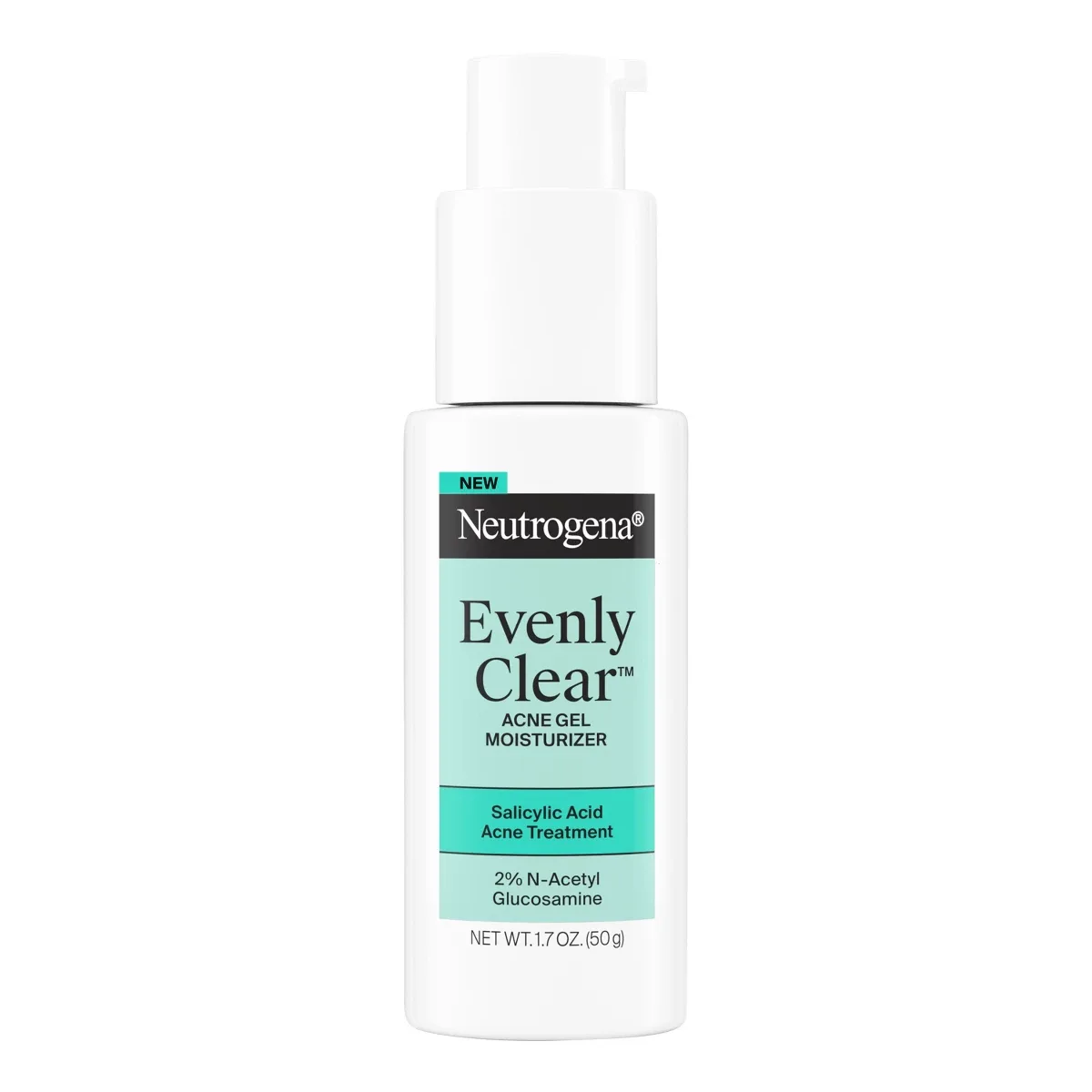
It is an acne moisturiser registered as an OTC drug at the lowest monograph dose of salicylic acid, half a percent, paired with a declared two percent N-acetyl glucosamine for post-acne marks on a glycerin-sugar-panthenol humectant base, oil-free, fragrance-free and vegan at a drugstore price. Most acne moisturisers are either plain hydrators or too strong to wear all day; this one is built for the middle.
An oil-free, fragrance-free acne moisturiser registered as an OTC drug at the monograph-minimum half a percent of salicylic acid, with a declared two percent N-acetyl glucosamine for post-acne marks on a glycerin-sugar-panthenol base. It hydrates oily, treated skin without clogging, helps keep new clogs down and evens tone slowly; it is not a treatment, the glucosamine works without its usual niacinamide partner, and dry or sensitive skin should not wear an acne active all day.
This gel has been on the market since November 2025 with a strong first-year review base and a DailyMed label fixing its active, but Neutrogena's one-week smoothness panel and its mark-fading claims come from unpublished in-house testing, so the assessment leans on the salicylic acid, N-acetyl glucosamine and humectant literature and on retailer feedback rather than independent trials. The hydration and maintenance judgements are confident; the brightening judgement is a reading of the published glucosamine studies applied to a formula that lacks their niacinamide pairing.
Verdicts
How well it fits each concern
Verdict by concern tap a concern for the case
Strong choicefor AcneIn your profileYou chose · Salicylic Acid is an approved or monograph active for acne; this gel cream carries it at 0.5%.Moderate evidenceStandard tolerabilityNo reviews collected yet
The case for it
Salicylic Acid 0.5% is a first-line active — approved, monograph-listed or named in current guidelines — for this concern.
It is present at an effective concentration, declared or high in the ingredient list.
The formula carries no trigger this concern is sensitive to, with the cautions noted.
Cautions: fungal-acne triggers.
Same rule for everyone. “Strong choice” is the verdict on 1,459 of 45,024 concern verdicts across the catalog; rule R2 decided 892 of them.
As of September 25, 2026, engine 5.1.1.
R2 — A regulator- or guideline-recognised first-line active, declared at an effective strength, in a form the claim supports. · the full register
Carrying active
Salicylic Acid 0.5%
Standing
first line — a regulator recognises it for this use; trials support it · per § 333.310 Acne active ingredients. (U.S. Food and Drug Administration — 21 CFR Part 333 Subpart D (Topical Acne Drug Products), Code of Federal Regulations via GovInfo), opened July 27, 2026
Form
adequate (declared 0.5%) — studied range 0.5–2%, from the OTC monograph or label; judge it after ~6 weeks
Tolerability
standard — fungal triggers
Row checked
against its sources on July 27, 2026 (evidence table ev-2026.09-r228)
Strong choicefor BlackheadsIn your profileYou chose · Salicylic Acid is an approved or monograph active for blackheads; this gel cream carries it at 0.5%.Moderate evidenceStandard tolerabilityNo reviews collected yet
The case for it
Salicylic Acid 0.5% is a first-line active — approved, monograph-listed or named in current guidelines — for this concern.
It is present at an effective concentration, declared or high in the ingredient list.
The formula carries no trigger this concern is sensitive to, with the cautions noted.
Cautions: fungal-acne triggers.
Same rule for everyone. “Strong choice” is the verdict on 1,459 of 45,024 concern verdicts across the catalog; rule R2 decided 892 of them.
As of September 25, 2026, engine 5.1.1.
R2 — A regulator- or guideline-recognised first-line active, declared at an effective strength, in a form the claim supports. · the full register
Carrying active
Salicylic Acid 0.5%
Standing
first line — a regulator recognises it for this use; trials support it · per 21 CFR § 333.350 - Labeling of acne drug products. (US Code of Federal Regulations (Legal Information Institute, Cornell Law School)), opened July 27, 2026
Form
adequate (declared 0.5%) — studied range 0.5–2%, from the OTC monograph or label; judge it after ~6 weeks
Tolerability
standard — fungal triggers
Row checked
against its sources on July 27, 2026 (evidence table ev-2026.09-r228)
The studies behind the evidence row
OTC monograph, Topical Acne Drug Products — salicylic acid 0.5–2% recognized as an acne treatment active — US Food and Drug Administration
Unprovenfor Excess OilinessIn your profileYou chose · Salicylic Acid has early or mechanistic evidence for excess oiliness — a reasonable bet, not a recommendation; the other actives here are not yet assessed for it.Moderate evidenceStandard tolerabilityNo reviews collected yet
The case for it
Salicylic Acid 0.5% has early or mechanistic evidence for this concern, not trial-backed standing.
It is present below the studied range.
The formula carries no trigger this concern is sensitive to, with the cautions noted.
Cautions: fungal-acne triggers.
What would change this: A concentration inside the studied range would raise this a step.
Same rule for everyone. “Unproven” is the verdict on 1,111 of 45,024 concern verdicts across the catalog; rule R9 decided 1,111 of them.
As of September 25, 2026, engine 5.1.1.
R9 — Plausible-tier actives alone do not earn a recommendation, and 'not for this' would overstate the case against them. 'Unproven' with the evidence dots lets the reader judge the bet (added 0.2.0 after the first shadow run put a 10% niacinamide serum at 'not for this' for hyperpigmentation). 0.5.0: the closing clause reads the other heroes — "nothing else here addresses it" only when every other active has a researched 'none' row; "not yet assessed" when that is the truth. Rows whose dots read moderate or better now reach R9p first. · the full register
Carrying active
Salicylic Acid 0.5%
Standing
plausible — trials support it
Form
sub threshold (declared 0.5%) — studied range 30%, from the trials on the row; needs leave-on contact; judge it after ~6 weeks
Tolerability
standard — fungal triggers
Row checked
against its sources on July 17, 2026 (evidence table ev-2026.09-r228)
Good choicefor DehydrationIn your profileYou chose · Glycerin is a reference standard by mechanism for dehydration; this gel cream carries it high in the ingredient list.Moderate evidenceGentleNo reviews collected yet
The case for it
Glycerin + Sucrose + Trehalose + Panthenol has trial-supported standing for this concern.
It is present at an effective concentration, declared or high in the ingredient list.
The formula carries none of the triggers this concern is sensitive to.
Same rule for everyone. “Good choice” is the verdict on 9,564 of 45,024 concern verdicts across the catalog; rule R5 decided 9,072 of them.
As of September 25, 2026, engine 5.1.1.
R5 — Trial-supported or guideline-supported active, adequately or plausibly dosed. · the full register
Carrying active
Glycerin + Sucrose + Trehalose + Panthenol
Standing
supported — its mechanism is established
Form
adequate — studied range 20%, from the trials on the row; needs leave-on contact; judge it after ~1 weeks
Tolerability
gentle
Row checked
against its sources on July 17, 2026 (evidence table ev-2026.09-r228)
The studies behind the evidence row
USP glycerin monograph / Fluhr et al., glycerol and the skin (review) — glycerin is the reference humectant, drawing and holding water in the stratum corneum — reference work
Also listed for Acne Scarring — the actives here (Salicylic Acid, Glycerin, Dimethicone, Succinic Acid) are in our research queue for that concern; there is no verdict until their evidence rows are written. That is a gap in our table, not a mark against the product.
Does the jobDoes what a moisturizer is for: draws in water, seals moisture in.
A verdict is DermApproved’s assessment of how well a product’s ingredients fit a concern — never a claim about what the product treats. Evidence dots and collected reviews sit beside it and are never blended in.
Rules 0.5.1 · evidence table ev-2026.09-r228 · how we decide
Assessment
Pros & Cons
Pros
✓ Monograph-minimum 0.5 percent salicylic acid, declared on a Drug Facts panel, for all-day wear
✓ Declared two percent N-acetyl glucosamine with published evidence for evening tone
✓ Glycerin, sucrose, trehalose and panthenol hydrate oily, treated skin without oil
✓ Succinic acid adds a gentle second pore-clearing route
✓ Oil-free, fragrance-free, dye-free, vegan and labelled non-comedogenic
✓ Sets matte and wears under sunscreen and makeup without pilling
✓ Fifteen dollars for two to three months of use
Cons
✗ Half a percent is a maintenance dose, not a treatment for active breakouts
✗ Acetyl glucosamine is studied paired with niacinamide, which this lacks
✗ Adds to retinoid and benzoyl peroxide dryness if not introduced gradually
✗ Too light for dry skin and wrong for sensitive skin to wear all day
✗ Olivate and polysorbate esters are not fungal-acne-safe
✗ Jar packaging at a price that warrants a pump
Review
Full Review
The FDA acne monograph lets salicylic acid be sold as a drug anywhere from 0.5 to 2 percent, and where a brand lands on that range is a statement of intent. Neutrogena's Evenly Clear Acne Gel Face Moisturizer sits at the floor: 0.5 percent, on a Drug Facts panel, registered on DailyMed in November 2025. That is not timidity. A moisturiser is worn all day under sunscreen and all night over a retinoid, and a leave-on acid at two percent in that role would strip most faces within a fortnight; half a percent with hours of contact does something a wash-off cannot, gentle, continuous maintenance at the pore openings, without the dryness that makes people abandon acne routines. The product is built for the middle of the routine, and the dose is the evidence.
The rest of the formula is arranged around that job. Glycerin is second, with sucrose, trehalose and panthenol behind it, an oil-free humectant bank that keeps acne-treated skin hydrated for the labelled 24 hours; dimethicone third gives slip and a breathable film, corn starch absorbs oil and sets the finish matte, and olive-derived olivate emulsifiers keep it mild. Succinic acid, fifth, is the quiet second acid, a dicarboxylic acid acne lines have adopted for mild antimicrobial and sebum-regulating in vitro data and for being far gentler than a hydroxy acid; it supports the salicylic without adding sting. Centella extract sits mid-list for the calming note. There is no fragrance, no dye, no oil and no alcohol, and the gel is vegan. On oily and combination skin it absorbs in a minute, sets soft and powdery-matte, wears under sunscreen and makeup without pilling, and over three or four weeks new clogs come less often. That is the whole promise of an acne moisturiser and the more than nine hundred Target reviews at four and a half stars agree that it keeps it.
The mark-fading claim is where the line's ambition shows, and it needs reading carefully. N-acetyl glucosamine, declared at two percent and fourth on the inactives, is an amino sugar that Neutrogena's parent has studied for years; the published split-face evidence shows it reduces facial hyperpigmentation over eight weeks, most convincingly when paired with niacinamide, and this gel carries it alone. That is a real mechanism at a real dose, and it is a slow, modest one: an evening of tone over two to three months with daily sunscreen, not the erasure of specific marks, which the line's adapalene retinoid and PHA exfoliant are there to do. The one-week improvement in smoothness and radiance that Neutrogena's panel measured is hydration and a light film, honest as far as it goes.
The practical cautions are the Drug Facts panel's own. Salicylic acid at any dose adds to the dryness of adapalene or benzoyl peroxide, and the label's instruction to start once daily and build up is the right one; people who apply it twice a day from the first night of a new retinoid are the ones who report flaking. Dry skin will find an oil-free gel with an acid in it too little and too much at once, and sensitive, rosacea-prone or barrier-compromised skin has no business wearing an acne active for sixteen hours a day. For strict fungal-acne routines the olivate and polysorbate esters are a mark against, though the base is oil-free. And it is a jar, at a price that suggests a pump.
The corn starch deserves a sentence, because it is the reason the gel behaves differently from the brand's Hydro Boost water gel that many buyers will compare it with. Starch absorbs surface oil as the film dries and sets the finish soft and powdery rather than dewy, which on an oily face reads as clean and on a dry one reads as chalky; it is also why makeup sits so well over it. Anyone who wants a dewy finish should look elsewhere, and anyone who has struggled to find an oil-free moisturiser that does not shine by noon has probably found it.
A note on the jar, since it comes up in the reviews. A screw-top jar for a product applied with fingers to acne-prone skin is not ideal, and the smaller tubes in the range are the more hygienic format; either way, clean hands or a spatula, and a lid closed promptly, are the habits that keep the second half of the jar as good as the first.
Fifteen dollars for 1.7 ounces, two to three months at a pea once or twice daily, is drugstore money for a formula that dermatologist-developed acne lines sell at twice the price with less transparency about the acid dose; the small tubes make trial cheap, and the whole Evenly Clear routine costs less than one prestige acne serum.
So the recommendation is for the skin and the role it was built for. Oily and combination acne-prone skin, on a retinoid or benzoyl peroxide or simply prone to clogging, that wants a light, oil-free, fragrance-free moisturiser that helps keep pores clear and slowly evens the marks left behind will find this a well-judged and inexpensive daily step, and people with deeper skin tones who have been burned by harsher acne moisturisers will appreciate the restraint. Anyone with an active breakout should look to the treatments, and anyone with dry or sensitive skin should look to a plain moisturiser and leave the acid to the treatment step.
Formula
Key Ingredients
The hero actives that drive this product's performance.
The lowest dose the FDA acne monograph allows, declared on a Drug Facts panel, chosen so a moisturiser can be worn all day without the dryness a two percent leave-on causes; at half a percent with hours of contact it does maintenance-level comedolysis, enough to help prevent new clogs on already-treated skin and not enough to clear an active breakout, which is the honest brief for an acne moisturiser.
Declared at two percent and fourth on the inactive list, the amino sugar with published split-face evidence for reducing hyperpigmentation, especially in combination with niacinamide, which this formula does not contain; it is the ingredient behind the mark-fading claim, at a dose that produces a gradual evening of tone over eight to twelve weeks rather than spot correction.
The humectant bank that makes a 0.5 percent salicylic gel a moisturiser: glycerin second, two sugars and panthenol hold water in oily, acne-treated skin without oil, and they are the source of the 24-hour hydration claim and the reason the gel offsets, rather than adds to, the dryness of a retinoid or benzoyl peroxide.
Established mechanismfor Dehydration · established mechanism
A dicarboxylic acid fifth on the inactive list, adopted by acne lines for its mild antimicrobial and sebum-regulating in vitro data and its gentleness relative to hydroxy acids; here it supports the salicylic acid quietly and gives the gel a second, softer route to keeping pores clear.
A silicone at third for slip and a breathable film, corn starch to absorb oil and matte the finish, and cetearyl and sorbitan olivate as mild olive-derived emulsifiers; together they are why an oil-free gel-cream sets non-greasy on oily skin and wears under sunscreen without pilling.
Not yet assessed
Ingredient standings describe the active at treatment-level doses and
vehicles; this product's own condition grades weigh its actual formula.
Use it as the moisturiser step after cleansing and any treatment, morning and evening; the Drug Facts say to start once daily and build up, which matters if adapalene or benzoyl peroxide are in the routine, since the salicylic acid adds to their dryness. In the morning it sits under sunscreen, which the mark-fading claim depends on.
Results Timeline
Skin feels hydrated and looks smoother and a little more radiant within a week, which is what Neutrogena's one-week panel measured and what glycerin, sugars and a light film produce. Fewer new clogs from the 0.5 percent salicylic acid take three to four weeks; the acetyl glucosamine's evening of post-acne marks is an eight-to-twelve-week effect that depends on daily sunscreen.
Pairs Well With
Neutrogena Evenly Clear Gentle Acne Foaming Face CleanserNeutrogena Evenly Clear Facial Retinoid at night, with this over itA non-comedogenic SPF 30+ every morning
Introducing benzoyl peroxide or adapalene at the same time rather than staggeredOther leave-on salicylic acid products on the same applicationStrong AHA exfoliants on sensitive skin
Neutrogena Evenly Clear Gentle Acne Foaming Face Cleanser
Neutrogena Evenly Clear Acne Gel Face Moisturizer
Non-comedogenic sunscreen
Sample PM Routine
Cleanser
Adapalene or benzoyl peroxide (staggered)
Neutrogena Evenly Clear Acne Gel Face Moisturizer
Evidence
Science & Expert Perspective
The Science
The gel combines a low-dose keratolytic with a brightening amino sugar on a humectant base, and each has a distinct evidence footing. Salicylic acid at 0.5 percent is the minimum concentration recognised in the FDA acne monograph; as a lipophilic beta-hydroxy acid it partitions into sebum and loosens corneocyte cohesion in the follicular infundibulum, and although the clinical trials supporting salicylic acid for comedonal acne are mostly at two percent, the monograph recognises the dose-response down to 0.5 percent for leave-on use, where prolonged contact partly compensates for concentration. The practical effect at this dose is a reduction in new comedone formation over weeks with a low incidence of dryness, which matches its role as a daily moisturiser rather than a treatment. Succinic acid, a dicarboxylic acid, has in vitro evidence for inhibiting Cutibacterium acnes growth and for modulating sebum, with early clinical support in acne formulations at low concentrations and a mild tolerability profile.
N-acetyl glucosamine at a declared two percent is the ingredient with the most specific literature. Vehicle-controlled studies published by Procter & Gamble researchers showed that two percent N-acetyl glucosamine reduced the appearance of facial hyperpigmentation over eight weeks, in a 2007 report in the Journal of Cosmetic Dermatology, and a 2010 randomised, double-blind, vehicle-controlled trial in the British Journal of Dermatology found that combining it with four percent niacinamide produced a greater effect; the mechanism is inhibition of tyrosinase glycosylation, which reduces melanin production. This gel provides the glucosamine at the studied dose without the niacinamide, so the expected effect is a modest, gradual evening of tone dependent on concurrent sun protection, not the fading of discrete post-inflammatory marks, for which retinoids and exfoliation have stronger evidence. The humectant system, glycerin at second with sucrose, trehalose and panthenol, has well-documented effects on stratum corneum hydration and on reducing the transepidermal water loss caused by retinoids and benzoyl peroxide, which is the mechanistic basis for pairing this gel with those treatments; dimethicone and corn starch provide a breathable, oil-absorbing finish. Tolerability is favourable, with no fragrance, dye, alcohol or oil, and the only flags are the acid for barrier-compromised skin and the olivate and polysorbate esters for Malassezia-restricted routines. The evidence supports the gel as a hydrating maintenance moisturiser for acne-prone skin with a slow, real brightening component.
Acne regimens fail more often from dryness than from lack of potency, and a moisturiser that carries a low-dose active while cushioning the retinoid or benzoyl peroxide underneath is the kind of product dermatologists have long assembled from separate bottles; this one packages it at a drugstore price with a Drug Facts panel, which makes it easy to recommend for oily and combination acne-prone patients as the hydration step. The half-percent salicylic acid is regarded as maintenance, useful for reducing new comedones and not a substitute for adapalene, benzoyl peroxide or a prescription, and the guidance to start once daily and build up is the same counsel clinicians give for any added acid. The N-acetyl glucosamine claim is treated as legitimate but modest, with the reminder that the published effect was strongest alongside niacinamide and that post-inflammatory hyperpigmentation in skin of colour is treated primarily with a retinoid, sun protection and, where needed, azelaic acid or hydroquinone. Patients with dry, atopic, rosacea-prone or barrier-compromised skin are advised not to wear a salicylic acid moisturiser continuously and to use a bland cream instead. Pregnancy poses no concern at 0.5 percent salicylic acid.
Guidance
Usage & Recommendations
How to Use
Cleanse and dry the skin, then apply a thin layer of the gel over the whole face, avoiding the eyes; the Drug Facts direct starting with one application a day and increasing to two or three if the skin tolerates it, and cutting back to once a day or every other day if dryness or peeling appears. In the morning apply it before sunscreen, which the mark-fading claim depends on, and at night apply it after any adapalene or benzoyl peroxide has absorbed, introducing those treatments a week or two apart from the gel rather than together. A pea-sized amount covers the face. Use clean fingers or a spatula with the jar, keep the lid closed, and use within twelve months of opening.
Value Assessment
Fifteen dollars for 1.7 ounces, two to three months at a pea-sized amount once or twice daily, is ordinary drugstore moisturiser pricing for a formula that carries a monograph acne active, a declared two percent brightener and a proper humectant system, all fragrance-free and vegan; dermatologist-developed acne moisturisers with a comparable brief cost twenty-five to forty dollars and rarely disclose their acid dose. Against a plain oil-free gel moisturiser it costs the same and adds the maintenance salicylic acid and the glucosamine; against a separate two percent salicylic leave-on plus a moisturiser it is cheaper and gentler, if less potent. The small tubes make trial cheap, and the whole Evenly Clear routine of cleanser, moisturiser and adapalene comes in under forty dollars. Very good value for oily and combination acne-prone skin, and no value at all for skin that should not be wearing an acid.
Who Should Buy
Oily and combination acne-prone skin that wants a light, oil-free, fragrance-free daily moisturiser with a maintenance dose of salicylic acid and a slow brightener for post-acne marks, especially anyone on adapalene or benzoyl peroxide whose skin needs hydration that does not clog. People with deeper skin tones building an Evenly Clear routine get the moisturiser the line was designed around.
Who Should Skip
A leave-on acid is the wrong choice for dry, sensitive, rosacea-prone, eczema-prone or barrier-compromised skin, which should not wear an acne active all day and should use a bland moisturiser, and anyone with active breakouts needs a treatment rather than a half-percent maintenance gel. Strict fungal-acne-safe routines will note the olivate and polysorbate esters, and anyone expecting marks to vanish should pair it with a retinoid and sunscreen and be patient.
Ready to try Neutrogena Evenly Clear Acne Gel Face Moisturizer with Salicylic Acid?
A light, translucent white gel-cream that spreads thin and cool, absorbs within a minute and sets to a soft, matte, powdery-smooth finish from the corn starch.
Scent
Fragrance-free with no perceptible smell.
Packaging
A 1.7-ounce white plastic jar with a screw lid in the Evenly Clear blue-and-white livery; a jar rather than a pump, so clean fingers matter, with smaller tubes sold for travel and trial.
Finish
mattelightweightfast-absorbing
What to Expect on First Use
The first application is a cool, light gel that vanishes into oily skin and leaves it matte and comfortable, with no sting and no scent; within a week the skin looks smoother and less shiny. There is no purging, since half a percent salicylic acid is a maintenance dose, but anyone adding it to a retinoid routine may feel extra dryness in the first fortnight and should follow the label's once-daily start.
How Long It Lasts
About two to three months at a pea-sized amount once or twice daily.
FDA OTC monograph acne drugNon-comedogenicFragrance-freeDye-freeVegan
Background
The Story Behind This Product
Neutrogena launched Evenly Clear in 2025 as its acne line for skin of colour and post-inflammatory marks, and added this gel moisturiser in November of that year as the hydration step of the routine, choosing the monograph-minimum salicylic dose so it could be worn daily under sunscreen and N-acetyl glucosamine, a brightener the company's research arm had studied for years, for the mark claim; it is the moisturiser the cleanser and the adapalene gel were designed to be paired with.
About Neutrogena Legacy Brand (20+ years)
Neutrogena, a Kenvue brand with nine decades of dermatologist-marketed skincare, registers this moisturiser as an FDA OTC acne drug with a DailyMed label fixing its salicylic acid at 0.5 percent. Evenly Clear is its 2025 line designed around post-acne marks on skin of colour, supported by in-house clinical panels that are cited in claims and not published.
Brand founded: 1930 · Product launched: 2025
Myth vs. Reality
Common Myths
Myth
A moisturiser with salicylic acid treats acne as well as a spot treatment.
Reality
At half a percent, the minimum the monograph permits, the acid does maintenance-level pore clearing across the whole face over weeks; a two percent leave-on or a benzoyl peroxide treats active lesions. Neutrogena's own directions call it a way to help prevent new breakouts, and the line's adapalene gel and benzoyl peroxide mask are the treatments.
Myth
Two percent acetyl glucosamine fades dark marks on its own.
Reality
The published evidence for N-acetyl glucosamine at two percent comes from split-face studies where it was paired with niacinamide, and the effect was a gradual reduction in hyperpigmentation over eight weeks, not spot erasure. This gel carries the glucosamine without the niacinamide, so expect a slow, modest evening of tone that depends on daily sunscreen and on the retinoid doing the rest.
FAQ
Frequently Asked Questions
How much salicylic acid is in the Neutrogena Evenly Clear Acne Gel Face Moisturizer?
Half a percent, the lowest dose the FDA acne monograph allows, declared on its Drug Facts panel and DailyMed listing. That is a maintenance dose designed to be worn all day under sunscreen to help prevent new clogs; it is not a treatment strength, and active breakouts still need adapalene, benzoyl peroxide or a two percent leave-on.
Does the Neutrogena Evenly Clear moisturizer fade dark spots and acne marks?
Slowly and modestly. It carries a declared two percent N-acetyl glucosamine, an amino sugar with published evidence for reducing hyperpigmentation over eight to twelve weeks, usually studied alongside niacinamide, which this formula lacks. Expect a gradual evening of tone with daily sunscreen rather than spot erasure, with the line's retinoid doing more of the work.
Can I use the Evenly Clear moisturizer with adapalene or benzoyl peroxide?
Yes; it is designed to be the moisturiser over the line's adapalene gel, and its glycerin, sugars and panthenol soften a retinoid's dryness. The Drug Facts warning about combining acne medications means dryness adds up, so follow the label: start the gel once daily, introduce the retinoid or benzoyl peroxide separately, and drop back if the skin flakes.
Is the Neutrogena Evenly Clear Acne Gel Face Moisturizer enough hydration on its own?
For oily and combination skin, yes; it is oil-free with a glycerin, sucrose, trehalose and panthenol humectant bank under a light silicone film, and Neutrogena claims 24-hour hydration. Dry skin in winter and anyone on an aggressive retinoid regimen may need a bland cream over it, and dry or sensitive skin generally should not wear an acne active all day.
Is the Evenly Clear moisturizer non-comedogenic and fungal-acne-safe?
It is oil-free, fragrance-free, dye-free and labelled non-comedogenic, and ordinary acne-prone skin tolerates it well. For Malassezia-prone skin the picture is mixed: the base is oil-free, but cetearyl olivate, sorbitan olivate and polysorbate 20 are fatty-acid esters that strict fungal-acne lists avoid.
How do you use the Neutrogena Evenly Clear Acne Gel Face Moisturizer?
Clean the skin, then apply a thin layer over the whole face once a day to start, building to twice daily if the skin tolerates it, as the Drug Facts direct; if dryness or peeling appears, cut back to once a day or every other day. In the morning follow with sunscreen, which the mark-fading claim depends on; at night apply it over any retinoid.
Reviews
What Reviewers Tend to Say
Recurring themes our editors read across retailer reviews of this product — summaries in our words, not quotations, and not a substitute for your own patch test.
Common Praise
Light, non-greasy and hydrating without clogging pores
Fewer breakouts while still feeling moisturised
Layers under sunscreen and makeup cleanly
Fragrance-free and does not sting
Common Complaints
Drying with twice-daily use alongside other acne treatments
The whole case for salicylic acid rests on one unglamorous fact of chemistry: it dissolves in oil. Understand that, and you know exactly when it beats a glycolic acid — and when it's overkill.
Adult hormonal acne and teenage acne are different beasts, yet grown women keep drying out deep jawline cysts with teenage products and wondering why it spreads.
Products, answers, therapy guides, tools and articles in one search. Brand names,
slang and abbreviations all work — accutane finds isotretinoin, bacne finds truncal acne.