Instead of a token splash of soothing extract, this cream is built on a 75% houttuynia-cordata base — heartleaf does the job water usually does. Stacking niacinamide, centella, guaiazulene and an eight-weight hyaluronic complex on top of that gives it three anti-redness actives and serious hydration in one feather-light gel-cream.
One of the better soothing gel-creams in K-beauty, built on a genuine 75% heartleaf base rather than a token splash of extract. Three anti-redness actives, a real niacinamide dose and an eight-form hyaluronic stack make it a reliable calm-and-hydrate step for reactive skin, all fragrance-free. Very dry winter skin may want more on top, and the tub is a minor gripe.
Good choicefor SensitivityIn your profileYou chose · No fragrance, drying alcohol, declarable allergens or sensitising preservatives in this gel cream — the profile sensitive skin looks for.Not yet assessedGentle3 reviews collected
The case for it
Centella Asiatica Extract has been researched for this concern and the evidence does not support it.
It is plausibly present at a working level, though the concentration is not declared.
The formula carries none of the triggers this concern is sensitive to.
What would change this: A declared concentration would move this to a firmer reading of the dose.
Same rule for everyone. “Good choice” is the verdict on 1,938 of 45,024 concern verdicts across the catalog; rule F2 decided 1,938 of them.
Unchanged since September 5, 2026, engine 5.1.1.
Supporting rolefor RosaceaIn your profileYou chose · Niacinamide has early evidence for rosacea, and barrier repair and gentle hydration is the recognised companion to treating it — a reasonable supporting choice, short of a recommendation.Limited evidenceGentle3 reviews collected
The case for it
Niacinamide has early or mechanistic evidence for this concern, not trial-backed standing.
It is plausibly present at a working level, though the concentration is not declared.
The formula carries none of the triggers this concern is sensitive to.
What would change this: A declared concentration would move this to a firmer reading of the dose.
Same rule for everyone. “Supporting role” is the verdict on 8,197 of 45,024 concern verdicts across the catalog; rule R8a decided 1,489 of them.
Unchanged since September 5, 2026, engine 5.1.1.
R8a — A plausible-tier active in a category with a supportive job: the sentence names the active instead of saying nothing targets the concern (the AmLactin / CeraVe SA case for keratosis pilaris, where no guideline and single trials leave the keratolytics at early evidence). · the full register
Carrying active
Niacinamide
Standing
plausible — trials support it
Form
plausible — studied range 2%, from the OTC monograph or label; needs leave-on contact; judge it after ~8 weeks
Tolerability
gentle
Row checked
against its sources on July 17, 2026 (evidence table ev-2026.09-r228)
Good choicefor DehydrationIn your profileYou chose · Hyaluronic Acid is a reference standard by mechanism for dehydration; this gel cream carries it.Moderate evidenceGentle3 reviews collected
The case for it
Hyaluronic Acid Complex has trial-supported standing for this concern.
It is plausibly present at a working level, though the concentration is not declared.
The formula carries none of the triggers this concern is sensitive to.
What would change this: A declared concentration would move this to a firmer reading of the dose.
Same rule for everyone. “Good choice” is the verdict on 9,564 of 45,024 concern verdicts across the catalog; rule R5 decided 9,072 of them.
Unchanged since September 5, 2026, engine 5.1.1.
R5 — Trial-supported or guideline-supported active, adequately or plausibly dosed. · the full register
Carrying active
Hyaluronic Acid Complex
Standing
supported — its mechanism is established
Form
plausible — studied range 0.1%, from the trials on the row; needs leave-on contact; judge it after ~1 weeks
Tolerability
gentle
Row checked
against its sources on July 17, 2026 (evidence table ev-2026.09-r228)
The studies behind the evidence row
Draelos ZD, Cosmetic Dermatology: Products and Procedures — hyaluronic acid classified as a humectant water-binding agent holding many times its weight in water — reference work
Good choicefor Compromised Skin BarrierIn your profileYou chose · Niacinamide is a reference standard by mechanism for compromised skin barrier; this gel cream carries it high in the ingredient list.Moderate evidenceGentle3 reviews collected
The case for it
Niacinamide has trial-supported standing for this concern.
It is present at an effective concentration, declared or high in the ingredient list.
The formula carries none of the triggers this concern is sensitive to.
Same rule for everyone. “Good choice” is the verdict on 9,564 of 45,024 concern verdicts across the catalog; rule R5 decided 9,072 of them.
Unchanged since September 5, 2026, engine 5.1.1.
Supporting rolefor AcneIn your profileYou chose · Niacinamide has early evidence for acne, and barrier care alongside acne treatment is the recognised companion to treating it — a reasonable supporting choice, short of a recommendation.Moderate evidenceStandard tolerability3 reviews collected
The case for it
Niacinamide has early or mechanistic evidence for this concern, not trial-backed standing.
It is plausibly present at a working level, though the concentration is not declared.
The formula carries no trigger this concern is sensitive to, with the cautions noted.
Cautions: fungal-acne triggers.
What would change this: A declared concentration would move this to a firmer reading of the dose.
Same rule for everyone. “Supporting role” is the verdict on 8,197 of 45,024 concern verdicts across the catalog; rule R8a decided 1,489 of them.
Unchanged since September 5, 2026, engine 5.1.1.
R8a — A plausible-tier active in a category with a supportive job: the sentence names the active instead of saying nothing targets the concern (the AmLactin / CeraVe SA case for keratosis pilaris, where no guideline and single trials leave the keratolytics at early evidence). · the full register
Carrying active
Niacinamide
Standing
plausible — trials support it
Form
plausible — studied range 4–5%, from the OTC monograph or label; needs leave-on contact; judge it after ~8 weeks
Tolerability
standard — fungal triggers
Row checked
against its sources on July 17, 2026 (evidence table ev-2026.09-r228)
Falls shortJudged as a moisturizer, it comes up short on: seals moisture in, supplies barrier lipids.
A verdict is DermApproved’s assessment of how well a product’s ingredients fit a concern — never a claim about what the product treats. Evidence dots and collected reviews sit beside it and are never blended in.
Rules 0.5.1 · evidence table ev-2026.09-r228 · how we decide
Assessment
Pros & Cons
Pros
✓ Built on a concentrated 75% heartleaf base, not a token splash
✓ Three anti-redness actives — heartleaf, centella and guaiazulene
✓ Real niacinamide dose adds barrier support and tone-evening
✓ Eight forms of hyaluronic acid hydrate despite the light feel
✓ Fragrance-free and gentle enough for reactive skin from day one
✓ Cooling gel-cream texture absorbs fast with no greasiness
✓ Generous 80g size lasts three to four months
Cons
✗ Too light on its own for very dry skin in winter
✗ Tub packaging is less hygienic than a tube or pump
✗ Plant oils make it unsuitable for fungal-acne sufferers
✗ Faint herbal scent may bother the most fragrance-averse
✗ No travel or mini size offered
Review
Full Review
For most of the last decade, if a Korean moisturizer wanted to whisper 'this will calm your skin down,' it reached for centella — cica, tiger grass, the green-tube aesthetic the whole category borrowed. Then heartleaf showed up. Houttuynia cordata had been sitting in Korean herbal tradition the entire time, and a wave of brands began repositioning it as the cica alternative for reactive skin. Neogen's Real Heartleaf Soothing Cream is one of the products that made the case most convincingly, and it did it by refusing to treat the new hero ingredient as a marketing garnish.
The headline number is the whole story: 75% houttuynia cordata. That figure means the extract is not riding near the bottom of the list as a claims ingredient — it has replaced most of the water that forms the base of nearly every cream. Every other active here is suspended in a foundation of anti-inflammatory heartleaf. That changes the character of the product. Where a typical soothing cream calms with one ingredient and hydrates with the rest, this one starts from a soothing base and then layers more soothing on top, which is either redundant or exactly the point depending on how reactive your skin is. For genuinely flush-prone, easily irritated skin, the redundancy is the point.
And it really does layer. Niacinamide sits sixth, high enough to be a working dose rather than a label note, quietly handling barrier support and tone-evening while the heartleaf calms. Centella asiatica turns up further down — a second classic soother stacked on the first — and guaiazulene, the azulene blue, adds a third anti-inflammatory angle mid-list. That is three distinct anti-redness actives in one jar. The hydration is handled with similar thoroughness: eight different molecular weights of hyaluronic acid cascade through the back half of the formula, from large surface-film types down to hydrolyzed fragments meant to reach deeper, plus glycerin and panthenol up top. It is a lot of hydration engineering for something that feels this light.
The texture is where the 'gel-cream' label earns itself. It is cooling on contact — a small relief in itself on stressed skin — spreads thin, and sinks in fast to a soft, non-greasy finish. There is a faint fresh-green herbal smell from the heartleaf and the fruit extracts, but no added fragrance, which matters enormously for the sensitive crowd this is aimed at. On reactive skin it tends to deliver an immediate hit of comfort with no tingle and no adjustment period; you put it on and skin simply feels calmer. Over a week or two visible redness settles, and the niacinamide's barrier and tone benefits accrue across the usual four-to-eight-week window.
The limitations are real but modest. This is a light gel-cream, and for all its hyaluronic acid, very dry skin — especially in winter — may find it under-delivers on its own and want a richer occlusive layered over the top at night. The 80g tub, while generous and easy to scoop, is the less hygienic and less travel-friendly choice next to a tube, and repeated finger-dipping is not ideal for a product aimed at compromised skin. And the macadamia and olive oils, pleasant as they are, mean this is not a clean pick for anyone specifically fighting fungal acne. None of these undo the core strengths; they just define who it is and is not for.
Value is straightforward and good. Twenty-eight dollars for 80g of a fragrance-free, genuinely well-built soothing cream is a fair price, and because a little of this light gel goes a long way, a tub stretches to three or four months of twice-daily use. You are paying for a formula that is doing real work — a concentrated active base, a meaningful niacinamide level, a thoughtfully layered hydration system — rather than for packaging or a trend tax, even though it happens to sit at the center of a trend. For sensitive, combination or normal skin that wants a reliable daily calm-and-hydrate step, it is an easy recommendation and a deserved bestseller. Only the very dry and the fungal-acne-prone have real reason to look elsewhere.
There is also a quiet versatility here that the bestseller status reflects. Because it is light, fragrance-free and built around soothing rather than treating, it plays well with almost anything else in a routine — you can layer it over an active serum to buffer irritation, use it as a daytime moisturizer under sunscreen, or lean on it as a simple calming step during a flare when you want to strip your routine back to essentials. That adaptability is part of why it has become a repeat-purchase for so many people: it is not a single-use specialist but a dependable workhorse that earns a permanent spot. Few products manage to be both broadly useful and genuinely good at their core job, and this one's balance of the two is the real reason it keeps selling.
Formula
Key Ingredients
The hero actives that drive this product's performance.
Replaces most of the water base at a headline 75%, so the entire cream is delivered on a foundation of this anti-inflammatory heartleaf extract — the soothing, anti-redness backbone that the niacinamide and centella then build on rather than carry alone.
Sits sixth on the list as a real active dose, reinforcing the barrier and evening out tone while the heartleaf base calms — a pairing that turns this from a simple soother into a cream that also does light brightening and barrier work.
Established mechanismfor Compromised Skin Barrier · established mechanism
Layers a second classic cica soother on top of the heartleaf, its triterpenes reinforcing the anti-redness effect so the cream tackles irritation from two botanical directions at once.
Eight different molecular weights of hyaluronic acid stacked at the tail of the formula draw water into multiple layers of the skin, giving this lightweight gel-cream its surprisingly long-lasting hydration without any heaviness.
Established mechanismfor Dehydration · established mechanism
The azulene blue tucked mid-list adds a third anti-inflammatory layer, the kind of redundant soothing redundancy that makes this cream a go-to for visibly reactive, flushed skin.
Not yet assessed
Ingredient standings describe the active at treatment-level doses and
vehicles; this product's own condition grades weigh its actual formula.
Use as the moisturizing step after serums; its light gel-cream weight means dry skin can layer a richer occlusive on top at night, while oily skin can wear it alone.
Results Timeline
Skin feels instantly calmer and more hydrated; visible redness settles over one to two weeks of daily use, with the barrier-strengthening and tone-evening benefits of niacinamide showing across four to eight weeks.
The cream's design rests on stacking soothing actives, and the evidence behind them is reasonably strong. Houttuynia cordata, the 75% base, has documented anti-inflammatory and antioxidant activity in laboratory and animal studies, attributed to flavonoids like quercitrin, which is the rationale for its rise as a calming skincare ingredient — though robust human clinical data specific to topical heartleaf is still building, which is why it rates as promising rather than fully established. The more settled science belongs to the supporting cast: niacinamide is extensively documented to strengthen the barrier by boosting ceramide and fatty acid synthesis and to reduce transepidermal water loss and uneven pigmentation, and centella asiatica's triterpenoids have well-characterized wound-healing and anti-inflammatory effects. The genuinely product-specific point is the layering logic — three botanical anti-inflammatories (heartleaf, centella, guaiazulene) addressing redness through overlapping pathways, paired with a barrier-building niacinamide dose and a multi-weight hyaluronic system that hydrates the surface and deeper layers simultaneously. That combination is what lets a featherlight gel-cream behave like a serious soothing moisturizer rather than a simple water-binder.
References
Anti-inflammatory effects of Houttuynia cordata and its bioactive compounds — Journal of Ethnopharmacology (2014)
Niacinamide: A B vitamin that improves aging facial skin appearance — Dermatologic Surgery (2005)
Dermatologist Perspective
Soothing gel-creams of this type are commonly suggested in clinical practice as supportive care for sensitive, reactive and barrier-compromised skin, where the priority is calming inflammation without adding fragrance or harsh actives. Houttuynia cordata is increasingly seen in such recommendations as a centella-adjacent botanical soother, with the caveat that its human evidence base is younger than centella's. Niacinamide is a broadly endorsed barrier-supporting active, and its presence at a working level here is a point in the cream's favor. Standard clinical guidance for the reactive skin this targets is to keep the routine simple and fragrance-free, layer a richer occlusive over a light gel-cream if dryness persists, and maintain daily broad-spectrum sunscreen, since a soothing moisturizer manages comfort but does not address the UV exposure that drives much facial redness and pigmentation.
Guidance
Usage & Recommendations
How to Use
Smooth a small amount over the face as your moisturizer, morning and night, after cleansing, toning and any serums. A little goes a long way given the light gel texture, so start with a modest scoop and add more only where needed. Oily and combination skin can wear it as the final hydrating step; dry skin can layer a richer cream or occlusive over it at night. In the morning, always follow with a broad-spectrum sunscreen, and to keep a tub hygienic for sensitive skin, use clean fingers or a small spatula.
Value Assessment
At $28 for 80g — often a little less on sale — this is fairly priced for a fragrance-free soothing cream doing genuine work. The concentrated active base, a real niacinamide level and a thoughtfully layered eight-form hyaluronic system mean the money is going into the formula rather than into packaging or a trend premium, even though heartleaf is very much a trend ingredient. Because the gel is light and a little spreads far, a tub realistically lasts three to four months of twice-daily use, which keeps the cost-per-day low. There is only the single 80g size, so no bulk saving exists, but the value is already strong. For sensitive and combination skin it is one of the better soothing-moisturizer buys in its price band.
Who Should Buy
This is a strong pick for sensitive, combination or normal skin that wants a daily calm-and-hydrate step, and especially for anyone whose skin flushes or reacts easily and needs fragrance-free soothing. Fans of cica skincare looking to try the heartleaf equivalent will find this one of the more convincing options.
Who Should Skip
Very dry skin, particularly in winter, may find it too light to use alone and should pair it with a richer occlusive or choose a heavier cream. Anyone specifically managing fungal acne should be cautious of the macadamia and olive oils, which can feed the yeast behind it.
Ready to try Neogen Real Heartleaf Soothing Cream?
A cooling, lightweight gel-cream that spreads thin and sinks in fast, leaving a soft hydrated finish rather than a heavy film.
Scent
A faint fresh-green herbal note from the heartleaf and plant extracts, with no added fragrance.
Packaging
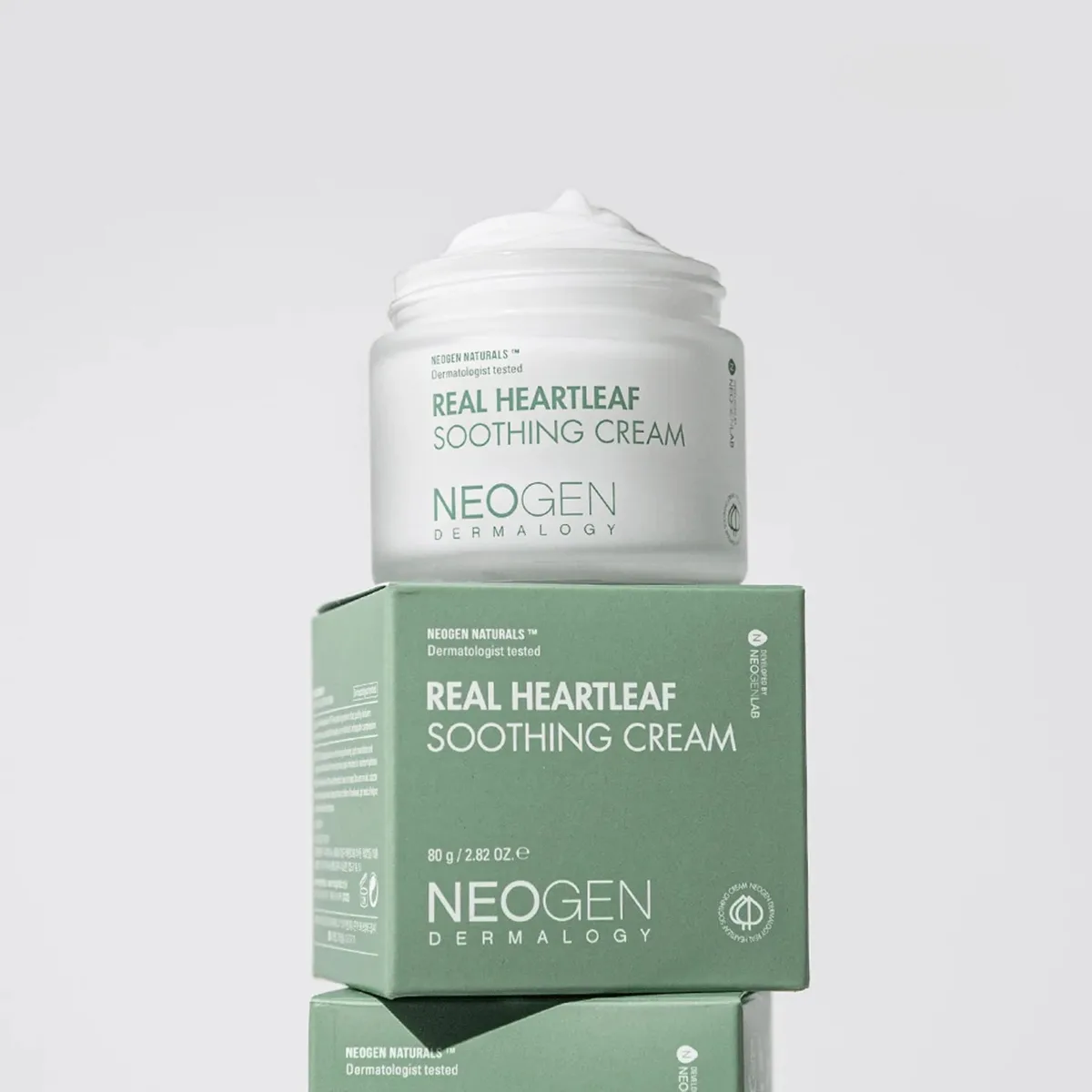
An 80g tub with a screw lid — generous and easy to scoop, though a jar is less hygienic and less travel-friendly than a tube.
Finish
lightweightfast-absorbingnon-greasy
What to Expect on First Use
The gel feels cool and calming on contact, with an immediate hit of comfort on flushed or stressed skin and no tingling; reactive skin usually tolerates it from the first use with no adjustment period.
How Long It Lasts
Roughly three to four months of morning and evening use facial use, given how little you need per application.
It rides the K-beauty pivot from centella toward heartleaf as the soothing ingredient of the moment — houttuynia cordata, long used in Korean herbal tradition, repackaged as a 'cica alternative' for reactive skin, and it became one of Neogen's signature ranges.
About Neogen Established Brand (5–20 years)
Neogen Dermalogy is the skincare line of Korea's Neogenlab, founded in 2000 with in-house R&D and manufacturing. Its Real Heartleaf range became one of the brand's most popular launches, riding the K-beauty wave of houttuynia-cordata 'cica-alternative' soothing skincare with a strong retail and review footprint.
Brand founded: 2000 · Product launched: 2022
Myth vs. Reality
Common Myths
Myth
A lightweight gel-cream can't hydrate enough to be a real moisturizer.
Reality
This one stacks eight molecular weights of hyaluronic acid plus glycerin and panthenol, so it hydrates multiple skin layers despite its light feel — though very dry skin in winter may still want an occlusive on top.
FAQ
Frequently Asked Questions
What does the 75% heartleaf in the Neogen Real Heartleaf Soothing Cream actually do?
Houttuynia cordata replaces most of the usual water base, so the cream is built on a concentrated anti-inflammatory extract that calms redness and irritation. It works alongside the niacinamide, centella and guaiazulene for a layered soothing effect rather than a token amount.
Is the Real Heartleaf cream moisturizing enough for dry skin?
It hydrates well for a light gel-cream thanks to glycerin, panthenol and eight forms of hyaluronic acid, but very dry skin — especially in winter — may want to layer a richer occlusive over it at night. Oily and combination skin can usually wear it alone.
Can this cream help with rosacea-prone or easily flushed skin?
Its three soothing actives — heartleaf, centella and guaiazulene — and fragrance-free formula make it a popular choice for reactive, flush-prone skin. It is not a medical treatment for rosacea, but it can calm the look of visible redness.
Is the Neogen Real Heartleaf cream good for acne-prone skin?
Yes for many people — it is lightweight, non-greasy and contains niacinamide and soothing extracts that suit breakout-prone skin. The one caveat is that the plant oils mean it is not ideal if you are specifically managing fungal acne.
Is this cream safe to use during pregnancy?
Its actives — heartleaf, niacinamide, centella, adenosine and hyaluronic acid — are all pregnancy-friendly staples with no retinoids or strong acids, though a quick check with your doctor is always sensible.
Reviews
What Reviewers Tend to Say
Recurring themes our editors read across retailer reviews of this product — summaries in our words, not quotations, and not a substitute for your own patch test.
The soothing plant on every K-beauty label has real anti-inflammatory pharmacology — and one human trial, in which it was one of four herbs in the same bottle.
Five brands that own the feed, judged on their ingredient lists rather than their view counts — including the one active all five suddenly added at once, and what that tells you.
The internet's favorite hydrator has a counterintuitive dark side — in dry air, a humectant with nothing to seal it can pull water out of your skin instead of into it.
Jun 10, 2026· 5 min
Questions people ask about sensitive skin
Verified answers from our questions library — the nuance a product page cannot carry.
Products, answers, therapy guides, tools and articles in one search. Brand names,
slang and abbreviations all work — accutane finds isotretinoin, bacne finds truncal acne.