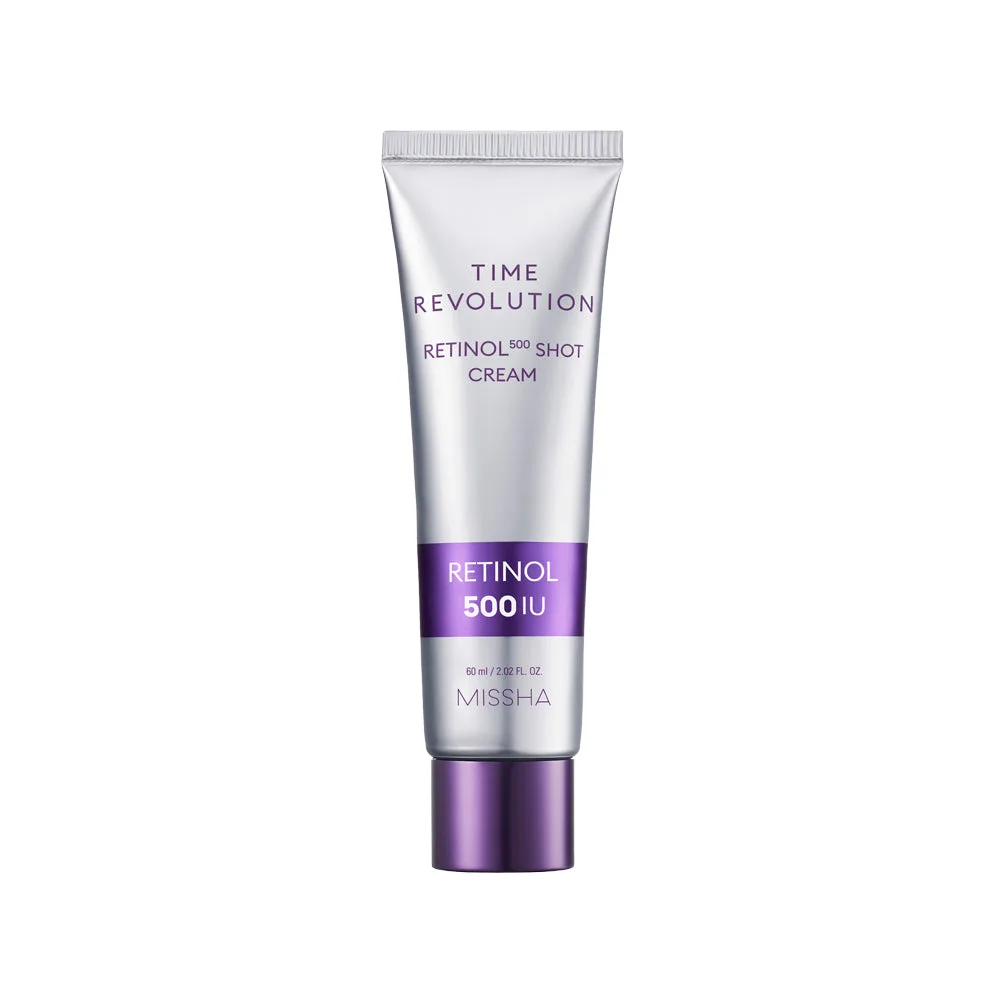
It is the Night Repair bifida-ferment night cream with a retinol shot added, declared in international units, 500 IU, that works out to roughly 0.015 percent and sits thirty-ninth on the list behind six essential oils; the shea-and-ferment base with niacinamide is the honest product, a rich, comfortable night cream for dry skin. The retinol on the tube is a beginner's trace, and the fragrance load makes it a poor first retinoid for the sensitive skin the tube says it was tested on.
Missha Time Revolution Night Repair Retinol 500 Shot Cream Review
Rich Ferment Cream with a Trace of Retinol
retinoidcreamk beautyParaben FreeCruelty Free
A rich, balm-like bifida-ferment night cream with niacinamide, which dry skin will find comfortable and softening, sold as a retinol treatment on the strength of 500 IU, a supplement unit that works out to roughly 0.015 percent and a thirty-ninth-place listing. The retinol will not peel anyone and will not treat anything; the six essential oils and four declared allergens are what reactive skin will notice. A good night cream for dry, resilient skin, and a misleading retinoid.
About two years on the US market with a moderate review base, no published test, and a retinol dose stated in international units rather than a percentage, so this assessment converts the unit from first principles and reads the ingredient order rather than any measurement of the cream. The brand's US listing also reproduces the ingredient list with duplicated entries, which has been cleaned here; the tube itself is the definitive source, and the retinol figure should be treated as a trace until the brand states a percentage.
Verdicts
How well it fits each concern
Verdict by concern tap a concern for the case
Good choicefor DrynessIn your profileYou chose · Shea Butter is a reference standard by mechanism for dryness; this cream carries it.Moderate evidenceStandard tolerabilityNo reviews collected yet
The case for it
Shea Butter with Palmitic & Stearic Acids has trial-supported standing for this concern.
It is plausibly present at a working level, though the concentration is not declared.
The formula carries no trigger this concern is sensitive to, with the cautions noted.
Cautions: fragrance.
What would change this: A declared concentration would move this to a firmer reading of the dose.
Same rule for everyone. “Good choice” is the verdict on 9,564 of 45,024 concern verdicts across the catalog; rule R5 decided 9,072 of them.
As of September 25, 2026, engine 5.1.1.
Supporting rolefor AgingIn your profileYou chose · Retinol is a trial-supported active for aging, but this cream carries it below the studied range — a supporting role at best.Moderate evidenceStandard tolerabilityNo reviews collected yet
The case for it
Retinol has trial-supported standing for this concern.
It is present below the studied range.
The formula carries no trigger this concern is sensitive to, with the cautions noted.
Cautions: a photosensitising active — use sun protection.
What would change this: A concentration inside the studied range would raise this a step.
Same rule for everyone. “Supporting role” is the verdict on 8,197 of 45,024 concern verdicts across the catalog; rule R7 decided 258 of them.
As of September 25, 2026, engine 5.1.1.
R7 — A supported active under-dosed cannot be recommended for the concern; if the category has a supportive job it may still help alongside treatment. · the full register
Carrying active
Retinol
Standing
supported — trials support it
Form
sub threshold (declared 0.015%) — studied range 0.075–0.5%, from the trials on the row; needs leave-on contact; judge it after ~12 weeks
Tolerability
standard — photosensitization
Row checked
against its sources on July 17, 2026 (evidence table ev-2026.09-r228)
Also listed for Dehydration and Dullness — the actives here (Probiotics & Prebiotics, Niacinamide, Retinol, Essential Oils) are in our research queue for those concerns; there is no verdict until their evidence rows are written. That is a gap in our table, not a mark against the product.
A verdict is DermApproved’s assessment of how well a product’s ingredients fit a concern — never a claim about what the product treats. Evidence dots and collected reviews sit beside it and are never blended in.
Rules 0.5.1 · evidence table ev-2026.09-r228 · how we decide
Assessment
Pros & Cons
Pros
✓ Bifida ferment lysate third on the list with real barrier-support data
✓ Niacinamide thirteenth for a modest tone and barrier dividend
✓ Rich shea-and-fatty-acid base that comforts dry skin overnight
✓ No peeling, dryness or purging at this retinol level
✓ Encapsulated retinol shot keeps the trace stable
✓ Ceramide, cholesterol and a phospholipid in the tail
✓ Fair price for a rich night cream
Cons
✗ Retinol declared in IU; roughly 0.015 percent, thirty-ninth on the list
✗ Six essential oils with limonene, citronellol, geraniol and linalool declared
✗ Bergamot and orange oils in a product that requires sun protection
✗ Too heavy for oily, combination-oily and fungal-acne-prone skin
✗ Retinol results absent by reviewers' own accounts
✗ US listing duplicates ingredient entries
Review
Full Review
The tube says Retinol 500 IU, and the unit is the review. International units are how vitamin supplements measure retinol, and one IU is three tenths of a microgram; five hundred of them are about 0.15 milligrams, which spread through a gram of cream is roughly 0.015 percent, and through the whole sixty-millilitre tube would be less than a hundredth of that. Retinol products that publish percentages use 0.1 to 1 percent, and the studies that show retinol smoothing lines and evening tone use those doses over months. Missha chose a unit that makes a trace sound like a shot, and the ingredient list, where retinol sits thirty-ninth behind six essential oils and ten ferments, confirms which it is. The unit is also new to the line's own vocabulary: the companion Retinol Intensive Ampoule launched the same month uses the same IU figure, so the choice is a house style rather than a slip, and it is one worth being suspicious of wherever it appears.
What the tube contains in quantity is a rich night cream, and read as one it is decent. Water, a preservative, then bifida ferment lysate at third, the Night Repair line's signature lysate with small but genuine barrier data, and then shea butter, palmitic and stearic acids, glycerin and a triglyceride, the balm-like base that gives the cream its thick, cushioned feel. A polyolefin, a silicone and emulsifiers follow, then niacinamide at thirteenth, betaine and panthenol, gelling and stabilising agents, and, from twenty-third, the oils: bergamot, geranium, orange, lavender, Roman chamomile and sandalwood. The ten-ferment Extreme Biome complex comes next, then the retinol in its polymer shot, vitamin E, thickeners, rice extract, adenosine, a phospholipid, palm oil, a Bacillus ferment, five vegetable extracts, a yeast ferment, and a tail of ceramide NP, elastin, collagen, alcohol, a hyaluronate, cholesterol and olivates, with limonene, citronellol, geraniol and linalool declared last. The brand's US listing prints several of these entries twice, which is careless rather than sinister, and the list above is the cleaned version.
On dry skin the cream does what its base promises. It spreads like a softened balm, settles to a cushioned, faintly glossy finish, and leaves skin soft and comfortable by morning without a hint of the dryness a retinoid usually brings, because there is no meaningful retinoid to bring it; reviewers who wanted a rich winter night cream are happy, and reviewers who wanted retinol results describe finishing the tube and seeing nothing they could attribute to it. Reviewers who like the cream describe it in the vocabulary of moisturisers, soft, nourished, comfortable, and almost never in the vocabulary of retinoids, which is the most accurate consumer testing the product has had. The niacinamide at thirteenth is the ingredient most likely to deliver a modest evening of tone over months, and the bifida lysate and shea are the comfort; the retinol at this level is, at most, a gentle introduction that a nervous beginner could tolerate, which the brand's dermatologically-tested-for-sensitive-skin line seems designed to say. A dry face in a cold month, layered under it after the ampoule, gets exactly the cushioned, glossy morning that a good shea cream delivers, and there are worse ways to spend twenty-five dollars.
The oils undo that line. Six essential oils in the top thirty of a night cream is a heavy load, and on a product that already asks for daily sunscreen because of its retinol, bergamot and orange peel add a photosensitivity consideration the brand does not address; the four declared allergens are the usual suspects in fragrance patch-test series, and alcohol appears in the tail. Sensitive, rosacea-prone and eczema-prone skin, the very people a 0.015 percent retinol might suit as a starter, are the people most likely to react to the rest of the tube, and a first retinoid that stings from its scent rather than its active is a discouraging place to begin. It is the same pattern as the line's essence cream, a comfortable base carrying a heavy scent, and the same recommendation follows.
On cost the cream is fair for what it is and poor for what it says. Twenty-five dollars for sixty millilitres of a shea-and-ferment night cream with niacinamide is reasonable, and a tube lasts two to three months; twenty-five dollars for a retinol treatment at a fortieth of a working dose is not, and the brand's own line offers the ferment without the retinol pretence in the Night Repair ampoule and cream.
So the recommendation separates the two products in the tube. Dry, normal and resilient skin that wants a rich, comfortable, strongly scented night cream with a real bifida base and niacinamide, and does not mind a trace of retinol along for the ride, will like it and should ignore the shot. Anyone wanting a retinol result should buy a product with a percentage on it; anyone with sensitive or oily skin should skip the tube for the oils and the shea; and nobody should use it while pregnant, however small the dose. The arithmetic is the whole review, and the tube invites it by printing the number.
Formula
Key Ingredients
The hero actives that drive this product's performance.
The retinol on the tube, thirty-ninth on the list and declared in international units rather than a percentage; 500 IU is roughly 0.15 milligrams, which per gram of cream is about 0.015 percent, a tenth or less of the doses that retinol studies use. It is encapsulated in a polymer shot for stability and it is, at this level, a starter's whisper of a retinoid rather than a treatment.
Third on the list, the Night Repair line's signature bifidobacterium lysate with small controlled data for barrier recovery and reduced sensitivity, here doing the hydrating, conditioning work the retinol is credited with and softening what little irritation the retinol could cause.
Thirteenth on the list, after the emulsifiers, and the one ingredient in the tube with a real record for tone, barrier lipids and redness; over weeks it is the plausible source of the brightening and elasticity the brand attributes to the retinol shot.
Fourth, fifth and sixth on the list, the rich, balm-like emollient base that makes this a nourishing night cream for dry skin and the reason it feels like a balm; it is also why oily and fungal-acne-prone skin will find it heavy, and why the cream's comfort outruns its retinoid activity.
Established mechanismfor Dryness · established mechanism
Six essential oils in the top thirty of a retinol night cream, with limonene, citronellol, geraniol and linalool declared, which scent the cream heavily and add sensitisation and, from the bergamot and orange, a photosensitivity consideration to a product that already asks for daily sunscreen; a retinol cream is the last place these belong.
Not yet assessed
Ingredient standings describe the active at treatment-level doses and
vehicles; this product's own condition grades weigh its actual formula.
Used as the closing night step over toner, the Night Repair ampoule and any serum, as a balm-like cream that replaces a separate moisturiser; sunscreen every morning is required. At its retinol level it can be used nightly by most skin, though the essential oils argue for patch testing and for keeping it off nights with acids on reactive faces.
Results Timeline
Soft, nourished, comfortable skin from the first night from the shea base and ferments. A modest evening of tone and texture over eight to twelve weeks from the niacinamide and low-dose retinol; the retinol at this level is a gentle introduction rather than a wrinkle treatment, and firmer skin is the look of a well-moisturised face.
Pairs Well With
Time Revolution Night Repair ampoule underneathSunscreen every morningHydrating tonerA stronger retinoid on alternate nights once tolerated
Missha Time Revolution Night Repair Retinol 500 Shot Cream
Evidence
Science & Expert Perspective
The Science
Retinol is the alcohol form of vitamin A, converted in keratinocytes through retinaldehyde to retinoic acid, and its evidence for photoageing rests on controlled trials at 0.1 to 1 percent over twelve to fifty-two weeks, with 0.25 to 0.5 percent typical of effective over-the-counter products and lower concentrations producing correspondingly smaller effects. The tube declares retinol as 500 IU; one IU of retinol is 0.3 micrograms, so 500 IU is 0.15 milligrams, and the placement of retinol at thirty-ninth on the list is consistent with a concentration in the region of 0.01 to 0.02 percent if the figure is per gram, and far lower if per tube, either of which is below any studied dose. The HDI/trimethylol hexyllactone crosspolymer and polyvinyl alcohol beside it indicate polymer encapsulation for stability. At this level the retinol is unlikely to produce the epidermal thickening, collagen induction or irritation associated with retinoids, which matches the absence of peeling users report; topical retinoids remain contraindicated in pregnancy regardless of dose.
The cream's functional ingredients are elsewhere. Bifida ferment lysate at third position has small controlled studies for improved barrier recovery and reduced sensitivity in leave-on use; niacinamide at thirteenth has randomised evidence at two to five percent for barrier lipid synthesis, hyperpigmentation and erythema, though its placement after the emulsifiers suggests a dose at the lower end. Shea butter, palmitic and stearic acids, caprylic/capric triglyceride, a hydrogenated polyolefin and palm oil form an occlusive, emollient base that reduces transepidermal water loss overnight; ceramide NP, cholesterol and hydrogenated phosphatidylcholine near the end are trace barrier lipids; betaine, panthenol, glycerin and a hyaluronate hydrate. The ten-ferment Extreme Biome complex and the vegetable-extract tail are nominal. Citrus aurantium bergamia fruit oil, Pelargonium graveolens flower oil, Citrus aurantium dulcis peel oil, Lavandula angustifolia oil, Anthemis nobilis flower oil and Santalum album oil supply limonene, citronellol, geraniol and linalool, declared, and bergamot and orange peel oils contain furocoumarins with phototoxic potential unless treated, which the label does not state; alcohol appears low on the list. The fatty base is comedogenic for susceptible skin and a substrate for Malassezia. The brand publishes no test of the cream, and its US ingredient list contains duplicated entries; no independent study exists.
Dermatologist Perspective
The first thing a dermatologist would do with this tube is convert the unit: 500 IU of retinol is a fraction of a milligram, which in a sixty-millilitre cream is a concentration far below anything the retinoid literature has tested, and the thirty-ninth-place listing confirms it. Clinically the cream would be classed as a rich night moisturiser with a bifida ferment and niacinamide, suitable for dry skin, rather than as a retinoid, and patients wanting retinoid effects on lines, texture or pigment would be directed to a product with a stated percentage of 0.25 percent or more, or to retinaldehyde or a prescription. The tolerability picture inverts the marketing: the retinol is too low to irritate, but the six essential oils and four declared allergens are exactly what dermatologists tell sensitive, rosacea-prone and atopic patients to avoid, and the bergamot and orange oils compound the sun-protection advice that any retinol product carries. The heavy shea base rules it out for acne-prone and Malassezia-prone skin, and pregnancy remains a contraindication at any retinol dose. For dry, resilient skin that wants a comfortable scented night cream, it is fine; as a retinol, it is a label.
Guidance
Usage & Recommendations
How to Use
As the final evening step, once toner and the Night Repair ampoule have absorbed, squeeze a pea-sized amount of the balm-like cream onto the fingertips, warm it briefly, and smooth it over the face and neck until it settles into a soft finish; it replaces a separate moisturiser. Use sunscreen every morning, both because of the retinol and because of the bergamot and orange oils. At this retinol level nightly use is tolerable for most skin, but patch test on the jaw for a few days first if essential oils or fragrance have caused trouble, and stop at warmth, redness or breakouts. Keep it off oily, congestion-prone areas, do not use it during pregnancy or breastfeeding, and store the tube capped and out of heat and light to protect the retinol trace.
Value Assessment
At $25.30 for 60 mL, this is reasonable for a rich bifida-ferment night cream with niacinamide and a shea base, and a tube lasts two to three months at a pea-sized amount nightly, which is competitive with mid-range Korean night creams. As a retinol product it is poor value, since the declared 500 IU works out to a fortieth or less of a working dose and reviewers report no retinoid results; a fragrance-free retinol at 0.25 percent or more costs similar money and does the job. The line's Night Repair ampoule and cream offer the same ferment base without the retinol pretence, and there is one size.
Who Should Buy
People with dry or normal, resilient skin who want a rich, comfortable, strongly scented night cream built on a bifida ferment with niacinamide, and who are happy to treat the retinol as a beginner's trace rather than a treatment; fans of the Night Repair line who want its richest cream will find it fits.
Who Should Skip
Buyers wanting a retinol result should buy a product with a stated percentage, since 500 IU is a fortieth of a working dose or less. Sensitive, rosacea-prone and eczema-prone skin should avoid the six essential oils, oily and acne-prone skin the shea base, and pregnant or breastfeeding users any retinol at all.
Ready to try Missha Time Revolution Night Repair Retinol 500 Shot Cream?
A thick, ivory, balm-like cream that softens against the skin into a rich, slightly slippery emulsion, spreads with a little effort, and settles over a few minutes to a soft, cushioned, faintly glossy finish that lasts the night.
Scent
A pronounced spa-like blend of bergamot, orange, lavender and geranium over a soft chamomile-sandalwood base, noticeable on application and for some minutes after.
Packaging
A 60 mL silver soft tube with a purple band and a purple screw cap, printed Retinol 500 Shot Cream and Retinol 500 IU; the tube dispenses cleanly and shows its contents by weight.
Finish
satindewy
What to Expect on First Use
The first night feels like a rich balm rather than a retinoid: comfortable, nourishing, strongly scented, with no tingle and no dryness, and softer skin by morning. There is no purging or flaking at this retinol level; reactive skin may notice warmth or pinkness from the essential oils in the first few uses, and anything resembling a retinol result is a matter of months and of modest scale.
How Long It Lasts
About two to three months at a pea-sized amount nightly.
Missha's Night Repair line grew from a bifida-ferment ampoule through several editions, and in 2024 the brand added retinol to it in a Retinol Intensive Ampoule and this 500 Shot Cream, naming the dose in international units in the manner of vitamin supplements rather than the percentages retinoid products normally use. The cream reached the US store in May 2024, and its listing reproduces the ingredient list with several entries duplicated.
About Missha Established Brand (5–20 years)
Missha, founded in Seoul in 2000 by Able C&C, built the Time Revolution Night Repair line on a bifida-ferment ampoule and added retinol to it in 2024 with this cream and a companion ampoule. The tube states the retinol as 500 IU, an unusual unit that translates to a very low percentage, and the brand publishes no test beyond a dermatologically-tested badge; its US listing reproduces the ingredient list with duplicated entries.
Brand founded: 2000 · Product launched: 2024
Myth vs. Reality
Common Myths
Myth
500 IU is a high dose of retinol.
Reality
International units are a vitamin-supplement measure; 500 IU of retinol is about 0.15 milligrams, which per gram of cream is roughly 0.015 percent, and retinol is thirty-ninth on the list. Over-the-counter retinol studies use 0.1 to 1 percent; this is a starter's trace, which is why reviewers report no peeling and no dramatic results.
Myth
A cream dermatologically tested for sensitive skin is a safe first retinol for reactive faces.
Reality
The retinol is too low to irritate, but the cream carries bergamot, geranium, orange, lavender, chamomile and sandalwood oils with four declared allergens, plus alcohol, which are the ingredients most likely to redden sensitive skin. A first retinoid for reactive skin should be fragrance-free; this one is not.
FAQ
Frequently Asked Questions
How much retinol is in the Missha Time Revolution Night Repair Retinol 500 Shot Cream?
The tube says 500 IU, a vitamin-supplement unit; 500 IU of retinol is about 0.15 milligrams, roughly 0.015 percent per gram of cream, and retinol is thirty-ninth on the ingredient list. That is far below the 0.1 to 1 percent of most over-the-counter retinol products and explains the absence of peeling.
Is the Missha Retinol 500 Shot Cream good for beginners?
Its retinol is low enough that nobody will peel, which suits a nervous beginner, but its six essential oils and four declared fragrance allergens make it a poor first retinoid for sensitive skin. A fragrance-free low-dose retinol is the better starting point; this cream is best treated as a rich night cream with a trace of retinol.
Does the Missha Night Repair Retinol 500 Shot Cream contain fragrance?
No perfume is listed, but bergamot, geranium, orange, lavender, Roman chamomile and sandalwood essential oils sit in the top thirty ingredients with limonene, citronellol, geraniol and linalool declared, so it is a strongly scented cream. Alcohol also appears low on the list.
Can I use the Missha Retinol 500 Shot Cream during pregnancy?
No. It contains retinol, and topical retinoids are avoided in pregnancy and breastfeeding regardless of dose; the bifida-ferment Night Repair ampoule without retinol is the line's alternative.
Is the Missha Retinol 500 Shot Cream suitable for oily or acne-prone skin?
No. It is built on shea butter, palmitic and stearic acids, a triglyceride and palm oil in a balm-like base, which oily, acne-prone and fungal-acne-prone skin will find heavy and congesting. It is a dry-skin night cream.
How do I use the Missha Time Revolution Night Repair Retinol 500 Shot Cream?
At night as the last step, after toner and the Night Repair ampoule, smooth a pea-sized amount over the face and neck and let it settle; use sunscreen every morning. At this retinol level it can be used nightly by most skin, though sensitive faces should patch test for the essential oils first.
Reviews
What Reviewers Tend to Say
Recurring themes our editors read across retailer reviews of this product — summaries in our words, not quotations, and not a substitute for your own patch test.
Common Praise
Many reviewers like the rich, balm-like texture and soft skin by morning
No peeling or dryness, even for retinol beginners
Pleasant spa-like scent for those who enjoy it
Pairs well with the Night Repair ampoule
Common Complaints
Several reviewers see no retinol-type results after a tube
Essential oils are declared by botanical name rather than as fragrance, which is why the most heavily perfumed products in the natural aisle can carry the reassuring word — and why the bottle gets more sensitising the longer you own it.
The fourth most frequent positive patch test in North America is an oxidation product of a molecule that occurs naturally in lavender. Nobody synthesised it into your face cream.
Five brands that own the feed, judged on their ingredient lists rather than their view counts — including the one active all five suddenly added at once, and what that tells you.
Aug 28, 2026· 6 min
Questions people ask about retinoids
Verified answers from our questions library — the nuance a product page cannot carry.
Products, answers, therapy guides, tools and articles in one search. Brand names,
slang and abbreviations all work — accutane finds isotretinoin, bacne finds truncal acne.