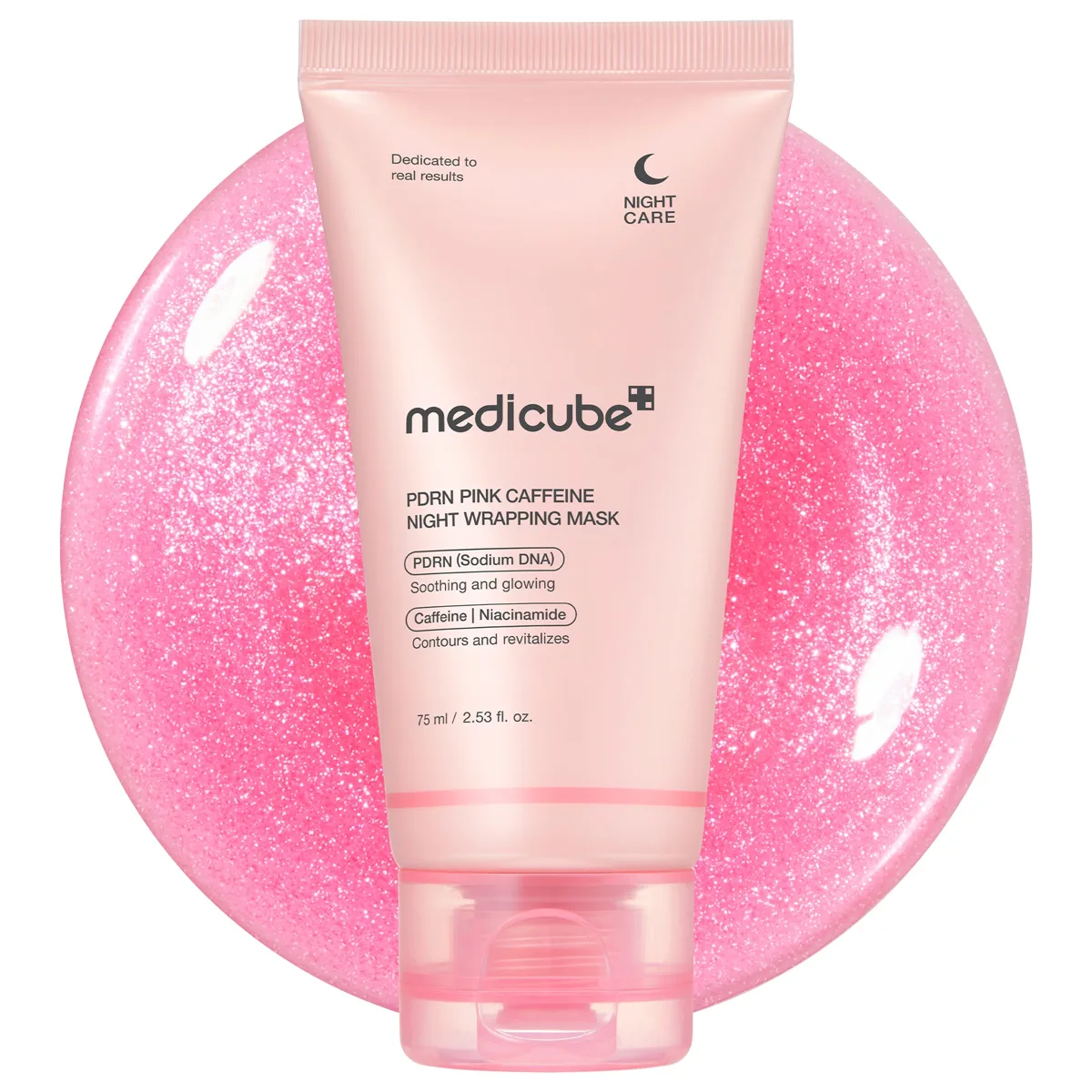
It is a polyvinyl-alcohol peel-off mask reworked for overnight wear, tinted pink and glittered with synthetic mica, sold on PDRN, caffeine, collagen and a twenty-item list of hyaluronates, amino acids and peptides that sit behind the shimmer on the label. Sleeping in a peel-off film is the genuinely unusual idea; the formula under it is water, glycerin, film-former and niacinamide.
A sparkly pink peel-off film you sleep in, which traps glycerin and niacinamide against the face for a plump, tight, glowing morning that lasts until lunch. The PDRN, caffeine, collagen and forty-odd hyaluronates, amino acids and peptides on the tube sit behind the mica and pigment; the polyvinyl alcohol does the work. Fun, briefly effective, awkward to sleep in, and carrying a rose oil that reactive skin should not seal in for eight hours.
Fourteen months of sales and a lively review base make the mask's overnight experience and morning effect well documented, but its efficacy data are three small two-week figures from a single brand-commissioned Korean panel, and no independent test exists. None of the PDRN, caffeine, collagen or peptide claims has been examined at the trace levels present, so the assessment rests on the well-understood behaviour of occlusive peel-off films, the niacinamide evidence and what users consistently report.
Verdicts
How well it fits each concern
Verdict by concern tap a concern for the case
Supporting rolefor DehydrationIn your profileYou chose · Nothing here targets dehydration directly; humectant hydration is the recognised companion to treating it, and this sleeping mask does that without known triggers.Not yet assessedGentleNo reviews collected yet
The case for it
Polyvinyl Alcohol has no evidence row yet for this concern — it is in the research queue.
The formula carries none of the triggers this concern is sensitive to.
What would change this: A researched evidence row for the lead active would replace this with a verdict.
Same rule for everyone. “Supporting role” is the verdict on 8,197 of 45,024 concern verdicts across the catalog; rule R8 decided 4,250 of them.
As of September 25, 2026, engine 5.1.1.
R8 — The category's job (barrier care, humectant hydration, gentle cleansing, photoprotection) is the documented supportive role for this concern. This is the honest verdict for a moisturizer on an acne page. · the full register
Also listed for Dullness — the actives here (Film Formers & Texture Polymers, Niacinamide, PDRN (Polydeoxyribonucleotide) are in our research queue for that concern; there is no verdict until their evidence rows are written. That is a gap in our table, not a mark against the product.
As a maskNot judged: what a mask is for — works within its wear time, benefit outlasts the mask, comes off cleanly — cannot yet be measured from the ingredient list (only intensity without injury can).
A verdict is DermApproved’s assessment of how well a product’s ingredients fit a concern — never a claim about what the product treats. Evidence dots and collected reviews sit beside it and are never blended in.
Rules 0.5.1 · evidence table ev-2026.09-r228 · how we decide
Assessment
Pros & Cons
Pros
✓ Overnight occlusion gives a genuinely plump, smooth, glowing morning
✓ Niacinamide fifth on the list gets eight hours of occluded contact
✓ Film contracts and de-puffs for a temporarily tighter look
✓ Peels off cleanly in one sheet; no rinsing needed
✓ Fun, novel format that reviewers enjoy as a ritual
✓ Oil-free and silicone-free base
✓ Eight to ten uses per tube at a sensible frequency
Cons
✗ PDRN placed behind the synthetic mica and titanium dioxide
✗ Rose essential oil sealed under a film for eight hours
✗ Tight, stiff feel that some cannot sleep in
✗ Film can flake onto bedding or peel unevenly
✗ Effect is hydration and mechanical; gone by afternoon
✗ Forty-item tail of trace hyaluronates, amino acids and peptides
Review
Full Review
You wake up shrink-wrapped. That is the experience this mask is built around, and it is genuinely unusual: a gel painted over the finished routine dries in fifteen minutes to a flexible, faintly glittering film that holds the face taut through the night and peels away in the morning in one translucent sheet, revealing skin that looks plumper, smoother and less puffy than it did the night before. Every one of those effects is real, and every one of them belongs to the film. The polyvinyl alcohol that sits fourth on the list, behind water, glycerin and glycereth-26, is the mechanism; the PDRN, caffeine and the sixty-two-ingredient roll call on the tube are the story told over it.
Read the list and the shape is clear. Water and two humectants, the film-former, niacinamide at fifth, a preservative, two gums, an emulsifier, allantoin, synthetic fluorphlogopite for the sparkle, another preservative, adenosine, the vitamin B12 that makes it pink, and titanium dioxide for opacity. Then, eighteenth, sodium DNA, behind the glitter and the pigment. Then butylene glycol, rose flower oil, and caffeine at twenty-first, after the perfume. What follows is a forty-item tail of ascorbic acid, twelve forms of hyaluronic acid, a full set of amino acids, collagen, elastin, mannitol and eight peptides, the pre-blended complexes that let the label say everything at once. The niacinamide is the only active at a placement that matters, and under an occlusive film for eight hours it gets a better chance than anywhere else in this range, which is probably where the brand's two-week radiance figure of sixteen percent comes from. The rest is decoration under glitter. It is worth saying that the format is not a gimmick in itself; occlusion is one of the oldest tricks in dermatology, and a film that seals a humectant layer on overnight will out-hydrate almost any cream. The question is only what is being sealed in, and here the answer is glycerin, niacinamide, glitter and rose oil.
What the film does is what occlusion does. Sealed under polyvinyl alcohol, the outer skin cannot lose water, the glycerin and glycereth pull moisture in, and by morning the surface is swollen, smooth and light-reflecting; the film also contracts slightly as it dries and holds the skin taut, which is the tightening people feel and the contouring the brand describes. Caffeine, with its modest evidence for temporary vasoconstriction, may add a little to the de-puffing, though the mechanical effect would produce most of it without any caffeine at all. Peel the sheet off and the skin underneath looks excellent for a few hours, the plump recedes as the water leaves, and the brand's own two-week figures for barrier and elasticity, 7.6 and 4.46 percent, are the honest measure of what is left.
The experience divides people cleanly. Reviewers who like it describe the morning reveal, the satisfying one-piece peel, the tighter face, the sparkle in the tube; reviewers who do not describe a stiff, itchy night, a film that flakes onto the pillow or peels in fragments, and a result gone by afternoon. Both are describing the same product. Sleeping in a peel-off mask is a slightly strange thing to ask of a face, and whether the fun of the reveal is worth the night is a matter of temperament as much as skin. A brush makes the difference between the two camps more often than skin type does: a thin, even coat painted on dries into a film that flexes and peels whole, while a thick finger-applied layer stays tacky, cracks, and ends up on the pillow.
The rose oil is the part that turns temperament into a warning. Rosa damascena flower oil at twentieth, ahead of the caffeine, scents the mask pleasantly and puts a known essential-oil sensitiser under an occlusive film for eight hours, which is the exposure pattern that turns a mild allergen into a reaction. Sensitive, rosacea-prone and eczema-prone faces, and anyone with active breakouts or a barrier already stressed by the range's spicule shot, should not seal this in overnight; a fragrance-free version of the same gel would have been a better product and a safer one, and the brand did not make it.
Twenty-four dollars for seventy-five millilitres buys eight to ten full-face applications, or about a month at the two or three nights a week that is sensible, which is on the expensive side for a peel-off mask and cheap if it is thought of as a monthly novelty. Against the rest of the range it is the most ingenious product and the least substantial: a delivery format with almost nothing to deliver but glycerin and niacinamide, which is, to be fair, enough to give a nice morning.
So the recommendation is for a specific person. Resilient, normal-to-combination skin that enjoys a ritual, wants a plump, smooth face for a morning event and can sleep in a film will get exactly that, a few times a month, from a tube that is fun to use. Reactive skin should skip it for the rose oil alone, and nobody should buy it for the PDRN, the caffeine or the forty ingredients at the end of the list.
Formula
Key Ingredients
The hero actives that drive this product's performance.
Fourth on the list and the mechanism of the whole product: the film-former that dries over fifteen minutes into a flexible, skin-hugging sheet that occludes the face overnight and peels off in the morning. Everything the mask does to the skin, the trapped humectants, the tightened feel, the temporary lift, is the polyvinyl alcohol film doing it.
Fifth on the list, behind the film-former, and the only ingredient with a treatment record; under a peel-off film for eight hours it gets an occluded overnight contact that the range's toner and sheet mask cannot give it, which is the plausible basis for the brand's two-week radiance and barrier figures.
The de-puffing active in the name, twenty-first on the list, after the rose oil; caffeine has modest evidence for temporary vasoconstriction and reduced puffiness in leave-on use, and under an occlusive film overnight it may contribute to the tighter, less puffy morning the brand calls contouring, though the film itself does most of that.
The polynucleotide on the tube, eighteenth of sixty-two, behind the synthetic mica that makes the mask sparkle and the titanium dioxide that makes it opaque; at that placement it is a trace humectant under the film, and its injected evidence for firmness does not apply.
Rose essential oil at twentieth, ahead of the caffeine, which gives the mask its scent and is the ingredient most likely to trouble skin sealed under a film for eight hours; it turns a product that could have been fragrance-free into one that sensitive faces need to patch test.
Not yet assessed
Ingredient standings describe the active at treatment-level doses and
vehicles; this product's own condition grades weigh its actual formula.
It is the very last step at night, painted in an even layer over finished skincare with a brush or spatula, avoiding brows, hairline, eyes and lips, and left fifteen minutes to dry before bed; in the morning it peels from the edges or rinses off, and the routine continues. Two or three nights a week is plenty; it should not go over a retinoid or acid night.
Results Timeline
A smoother, plumper, less puffy face on peeling the film off, with a glow that lasts the morning; that is the occlusion and it resets each use. The brand's two-week figures for radiance, barrier and elasticity are small, and beyond the niacinamide's slow work on tone there is nothing cumulative to expect.
Pairs Well With
Hydrating toner and serum underneathLight moisturiser as the layer belowMorning sunscreen
Peel-off masks are built on polyvinyl alcohol, a water-soluble polymer that forms a continuous, flexible film as its solvent evaporates; the film is occlusive, sharply reducing transepidermal water loss, and it contracts modestly on drying, which produces the tightening sensation and a temporary smoothing of fine surface lines. Overnight occlusion of a humectant-rich base of glycerin and glycereth-26 drives water into the stratum corneum and produces the swollen, light-reflecting surface measured as radiance; the effect is well documented for occlusive masks and dressings and is transient, reversing over hours as the corneum equilibrates. The mechanical peel removes the film together with loosely adherent corneocytes, a mild exfoliation that contributes to the smooth feel and, on reactive skin, to post-peel erythema.
Niacinamide at fifth position is the sole ingredient with a treatment record, having randomised evidence at two to five percent for hyperpigmentation, barrier lipid synthesis and sebum; prolonged occluded contact increases its delivery relative to a rinse-off or brief-contact format, and it is the plausible basis for the modest two-week changes the brand reports in radiance and barrier. Caffeine at twenty-first has evidence for transient vasoconstriction and reduction of periorbital puffiness in leave-on formats, though at this placement and beneath a contracting film its contribution is hard to separate from the mechanical effect. Sodium DNA at eighteenth position, behind synthetic fluorphlogopite and titanium dioxide, is a trace; the polynucleotide evidence for firmness and repair concerns injected use, and topically it is a humectant film-former subordinate here to the polyvinyl alcohol. Ascorbic acid at twenty-third in an aqueous gel is unstable and nominal. The extended tail, twelve hyaluronic acid species, a full amino acid panel, collagen extract, hydrolyzed elastin, mannitol and eight peptides including copper tripeptide-1, acetyl hexapeptide-1 and nonapeptide-1, represents pre-blended complexes at fractions of a percent whose surface humectancy is subsumed by the film's occlusion. Rosa damascena flower oil supplies citronellol, geraniol and other fragrance allergens, and occlusion for eight hours materially increases percutaneous exposure to them, which is the principal safety consideration in the formula. Adenosine is a Korean-registered anti-wrinkle functional ingredient with small trials; allantoin soothes. The three panel figures come from a single brand-commissioned test and are unpublished; no independent study of the mask exists.
Dermatologist Perspective
Overnight occlusive masks are a familiar tool in dermatology, where wet wraps and occlusive dressings are used to boost hydration and the penetration of applied medication, and the clinical view of a peel-off film worn to bed follows from that: it will hydrate and temporarily smooth the surface, it will increase the delivery of whatever is under it, and it should therefore only go over ingredients the skin is known to tolerate. That is where most clinicians would pause over this mask, since a rose essential oil sealed under a film for eight hours is precisely the exposure that provokes contact reactions in susceptible patients, and the brand markets the product as calming. The polynucleotide, collagen and peptide claims would be set aside as label copy, the caffeine acknowledged as a minor contributor to morning de-puffing, and the niacinamide credited as the one active that benefits from the format. Standard guidance would be to keep it off retinoid and acid nights, off any inflamed, broken or freshly treated skin, and off rosacea-prone and atopic faces altogether, and to treat the tight, plump morning as the cosmetic effect it is rather than a change in elasticity.
Guidance
Usage & Recommendations
How to Use
At night, finish the usual routine through moisturiser and let it absorb, then use a mask brush or spatula to paint an even, moderately thick layer of the pink gel over the face, keeping clear of the brows, hairline, eyes and lips, and any active breakout or broken skin. Let it dry for about fifteen minutes until it no longer feels wet, then sleep. In the morning, lift the film from the edges and peel it off in one piece, or soften and rinse it with lukewarm water, and continue with cleanser, moisturiser and sunscreen. Use it two or three nights a week at most, never over a retinoid or acid, and never the same night as a spicule product. Patch test on the jaw overnight before the first full-face use, because the rose oil is sealed in; persistent redness, itching or stinging means it is not for your skin.
Value Assessment
At $24 for 75 mL the tube gives eight to ten full-face applications, roughly a month at two or three nights a week, which works out to two to three dollars a use; that is on the expensive side for a peel-off mask, whose base is water, glycerin and polyvinyl alcohol, and reasonable as an occasional overnight treat. The premium buys the pink, the shimmer, the PDRN name and a long list of trace ingredients that the film's occlusion renders moot; what the user actually gets, a plump and smooth morning, is available from far cheaper overnight masks without the rose oil. The two-pack bundles on the brand site bring the price down for anyone who has decided the ritual is worth keeping. There is one size.
Who Should Buy
People with resilient normal, combination or dry skin who enjoy a novel ritual, want a visibly plump, smooth, de-puffed face for a morning event a few times a month, and can sleep comfortably in a tightening film; fans of the PDRN Pink range who want its most unusual product will find it fun.
Who Should Skip
Sensitive, rosacea-prone, eczema-prone or acne-prone skin, and anyone whose barrier is already stressed by exfoliants or spicules, should not seal a rose essential oil under a film overnight. Light sleepers who dislike a tight face, anyone expecting lasting firmness, and anyone buying for the PDRN or caffeine will be disappointed.
Ready to try Medicube PDRN Pink Caffeine Overnight Wrapping Mask?
A thick, pale-pink gel shot through with fine iridescent shimmer that spreads with a brush or spatula, sets in about fifteen minutes to a smooth, flexible, faintly glittering film with a distinct tightening pull, and peels off in the morning as one translucent sheet.
Scent
A soft rose scent from the rose flower oil, noticeable during application and while the film dries, faint by morning.
Packaging
A 75 mL pale-pink soft tube with a translucent pink flip-cap base it stands on, marked Night Care with a moon icon and the PDRN, caffeine and niacinamide callouts; no brush or spatula is included.
Finish
glowydewy
What to Expect on First Use
The first application is a novelty: a sparkly pink gel that tightens as it dries and leaves the face feeling shrink-wrapped, which some people find soothing and others find impossible to sleep in. Peeling it off in the morning is satisfying, the skin underneath looks plump and smooth for a few hours, and mild pinkness from the peel or warmth from the rose oil is the thing to watch for on reactive skin.
How Long It Lasts
About eight to ten uses at a full-face layer, so a month at two or three nights a week.
Medicube added the wrapping mask to the PDRN Pink range in July 2025, taking the peel-off format it had already used in its collagen and kojic acid lines and giving it the range's salmon DNA identity plus caffeine for a contouring claim. The brand explains the pink as the natural colour of the raw materials, which is true of the vitamin B12 in the list, and the sparkle comes from synthetic fluorphlogopite.
About Medicube Established Brand (5–20 years)
Medicube, APR Corp's skincare brand since 2017, sells the PDRN Pink range through Amazon, TikTok Shop and its US store and is one of the biggest K-beauty exporters; its claims come from small brand-commissioned Korean panels, and this mask's listing quotes three of them. The brand's habit of trace-dosing its named actives applies here too, with the polynucleotide placed after the mica and the titanium dioxide.
Brand founded: 2017 · Product launched: 2025
Myth vs. Reality
Common Myths
Myth
Sleeping in the mask delivers PDRN, collagen and peptides into the skin all night.
Reality
The film traps water and humectants against the skin, which is why the face looks plump in the morning. The polynucleotide sits behind the mica and pigment, the collagen and elastin are surface humectants, and the peptides close a sixty-two-ingredient list; occlusion hydrates the outer skin, it does not turn trace ingredients into treatments.
Myth
The tighter, firmer face on waking is elasticity improving.
Reality
A dried polyvinyl-alcohol film contracts slightly and holds the skin taut overnight, and the swelling of the outer skin with trapped water smooths it further; both effects are mechanical and temporary, and the brand's own two-week elasticity figure is under five percent.
FAQ
Frequently Asked Questions
How do I use the Medicube PDRN Pink Caffeine Overnight Wrapping Mask?
Finish the evening routine through moisturiser, then paint an even layer of the mask over the face with a brush or spatula, avoiding brows, hairline, eyes and lips; let it dry for about fifteen minutes and sleep in it. In the morning peel it from the edges or rinse with lukewarm water, then carry on as usual.
Is it safe to sleep in the Medicube wrapping mask?
The film is designed to flex and stay put overnight and most users tolerate it, though it feels tight and some cannot sleep in it. It should not go over broken skin, active breakouts, a retinoid or an acid, and reactive skin should patch test because of the rose oil sealed underneath.
Does the Medicube PDRN wrapping mask really contain PDRN?
Sodium DNA is on the list at eighteenth place, behind the synthetic mica and titanium dioxide, which makes it a trace. The morning plumpness comes from the film trapping glycerin and water against the skin, and the caffeine and niacinamide are the only named actives at a placement that might matter.
Why is the Medicube wrapping mask pink and sparkly?
The pink is mainly vitamin B12, which the brand uses to colour the whole range, and the sparkle is synthetic fluorphlogopite, a lab-made mica. Neither does anything for the skin; the brand says the colour is natural to the raw materials rather than added dye, which is true of the B12.
How often can I use the Medicube PDRN Pink Caffeine Overnight Wrapping Mask?
Two or three nights a week is sensible; the film's occlusion and peel are a mild stress, and the effect does not build with nightly use. Keep it off retinoid and acid nights and off any night after a spicule treatment.
Does the Medicube wrapping mask reduce puffiness or lift the face?
Waking with a tighter, less puffy face is common, from the contracting film, the overnight occlusion and possibly the caffeine; it lasts a few hours. There is no lasting lift, and the brand's own two-week elasticity figure is 4.46 percent.
Reviews
What Reviewers Tend to Say
Recurring themes our editors read across retailer reviews of this product — summaries in our words, not quotations, and not a substitute for your own patch test.
Common Praise
Users consistently describe a plump, smooth, glowy face on peeling it off in the morning
Face feels tighter and less puffy on waking
Peels off in one satisfying sheet
Fun sparkly pink texture
Common Complaints
A common complaint is the tight, stiff feeling while sleeping
Film flakes onto the pillow or peels unevenly
Rose scent bothers sensitive users
Effect gone by afternoon; expensive for a peel-off
Notable Endorsements
Brand panel: radiance +16%, barrier +7.6%, elasticity +4.46% after two weeks
Essential oils are declared by botanical name rather than as fragrance, which is why the most heavily perfumed products in the natural aisle can carry the reassuring word — and why the bottle gets more sensitising the longer you own it.
The fourth most frequent positive patch test in North America is an oxidation product of a molecule that occurs naturally in lavender. Nobody synthesised it into your face cream.
Five brands that own the feed, judged on their ingredient lists rather than their view counts — including the one active all five suddenly added at once, and what that tells you.
Cutting a beard hair takes about a twentieth of a newton. You press with two and stretch your skin by a fifth — which is why almost every shaving problem is a technique problem wearing a hardware costume.
Products, answers, therapy guides, tools and articles in one search. Brand names,
slang and abbreviations all work — accutane finds isotretinoin, bacne finds truncal acne.