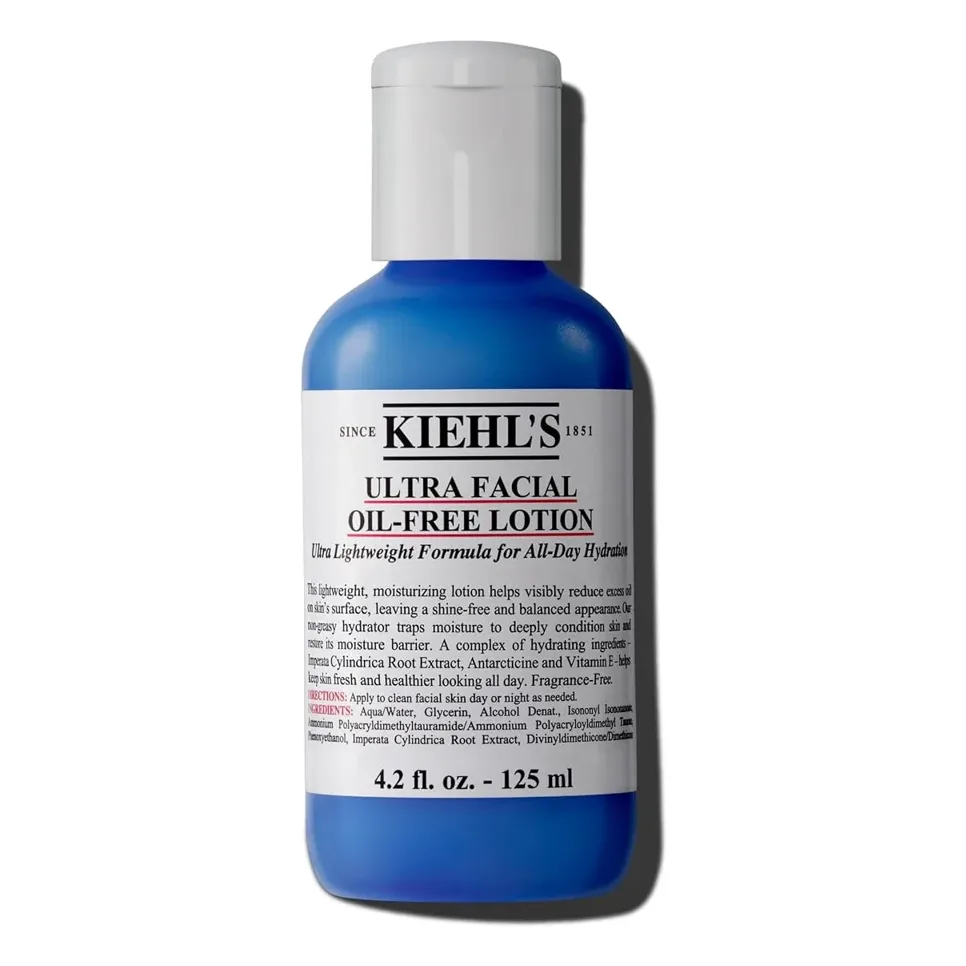
It is an oil-free lotion that replaces oils and waxes with a fluorinated polymer and a silicone elastomer for slip, backs its glycerin with a natural-moisturizing-factor mimic of urea, amino acids and sugars, and adds a sensory trio of alcohol, menthol and a vasodilating niacin ester that makes it feel cool, fast and faintly stimulating. Few oil-free moisturizers combine that much formulation ambition with that many things reactive skin dislikes.
A thin, cool, quick-drying oil-free lotion that hydrates with glycerin and a clever little natural-moisturizing-factor blend, mattifies with polymer films instead of oil, and then adds alcohol, menthol and a flush-inducing niacin ester to feel fresh. Oily, robust skin will like the matte lightness; anyone reactive will feel the sting, and thirty-nine dollars is a lot for a lotion whose best trick is not adding anything.
This lotion has been on sale for around a decade with a couple of hundred reviews across Amazon and Ulta, but Kiehl's has published no study of it, so the assessment rests on its fully disclosed formula and the established behaviour of glycerin, polymer mattifiers, alcohol, menthol and hexyl nicotinate. The split in user ratings between oily-skinned enthusiasts and those reporting film and tightness is consistent with the formula rather than with any controlled measurement of its performance.
Verdicts
How well it fits each concern
Verdict by concern tap a concern for the case
Avoidfor DehydrationIn your profileYou chose · This formula carries drying alcohol — a known trigger for dehydration — so it is not a fit however good its actives are.Moderate evidenceCarries a triggerNo reviews collected yet
The case for it
Glycerin has trial-supported standing for this concern.
It is present at an effective concentration, declared or high in the ingredient list.
The formula carries a known trigger for this concern, which decides the verdict before any efficacy question.
What would change this: Removing the trigger named above would let the actives be judged on their own.
Same rule for everyone. “Avoid” is the verdict on 1,909 of 45,024 concern verdicts across the catalog; rule R1 decided 1,304 of them.
As of September 25, 2026, engine 5.1.1.
R1 — Safety outranks praise (MASTER-PLAN §1.7). A condition-weighted trigger (multiplier ≥ 2 in condition-fit-matrix) decides the verdict before any efficacy question. · the full register
Carrying active
Glycerin
Standing
supported — its mechanism is established
Form
adequate — studied range 20%, from the trials on the row; needs leave-on contact; judge it after ~1 weeks
Tolerability
harsh — drying alcohol
Row checked
against its sources on July 17, 2026 (evidence table ev-2026.09-r228)
The studies behind the evidence row
USP glycerin monograph / Fluhr et al., glycerol and the skin (review) — glycerin is the reference humectant, drawing and holding water in the stratum corneum — reference work
Also listed for Excess Oiliness — the actives here (Glycerin, Alcohol Denat., imperata cylindrica extract, Dimethicone) are in our research queue for that concern; there is no verdict until their evidence rows are written. That is a gap in our table, not a mark against the product.
Does the jobDoes what a moisturizer is for: draws in water, seals moisture in.
A verdict is DermApproved’s assessment of how well a product’s ingredients fit a concern — never a claim about what the product treats. Evidence dots and collected reviews sit beside it and are never blended in.
Rules 0.5.1 · evidence table ev-2026.09-r228 · how we decide
Assessment
Pros & Cons
Pros
✓ Glycerin plus a urea, amino-acid and sugar blend gives a literate natural-moisturizing-factor core
✓ Oil-free polymer films keep shine down for hours without clogging
✓ Cool, quick-drying matte finish that oily skin actually enjoys
✓ Fragrance-free with panthenol and vitamin E to soften the base
✓ Hydrates overnight without heaviness
✓ Generous 4.2 oz bottle lasts about three months
✓ Layers cleanly under mattifying sunscreen and over acne serums
Cons
✗ Denatured alcohol third on the list leaves non-oily skin tight
✗ Menthol and hexyl nicotinate cause tingling and a deliberate flush
✗ Polymer films can feel tacky or sit as a layer all day
✗ Too light for winter or for combination skin in dry climates
✗ Thirty-nine dollars for a humectant-and-polymer lotion
✗ Contains BHT, which some shoppers prefer to avoid
Review
Full Review
Hexyl nicotinate is an unusual thing to find in a moisturizer. It is an ester of niacin, and its job on skin is to dilate the small surface vessels, producing a brief warmth and, on many faces, a faint pink flush a few minutes after application. It turns up in cellulite creams and in a handful of products designed to feel like they are doing something. Its presence near the end of Kiehl's Ultra Facial Oil-Free Lotion, alongside menthol for a cool tingle and denatured alcohol at third on the list for a fast, matte dry-down, tells you what the brief was: a moisturizer for oily skin that feels fresh, cool, quick and faintly stimulating, the sensory opposite of a heavy cream. Judged as that, it is well executed. Judged as skincare for anyone whose face reacts to things, it is a lotion with three built-in reasons to sting.
The hydrating core is respectable. Glycerin sits second, and it does most of the work in a formula that contains no oil and almost nothing occlusive; slip and a matte, film-like finish come instead from a fluorinated polymer and a silicone elastomer, which is how an oil-free lotion keeps shine down for several hours. Further down is the part of the formula worth admiring: urea, glutamic acid, aspartic acid and alanine, plus fructose, glucose and sucrose, a modest mimic of the skin's own natural moisturizing factor. The doses are small, but it is a scientifically literate idea, and it distinguishes the lotion from the plain glycerin water of its sibling toner. The line's story ingredients, Imperata grass root and the Antarctic marine ferment Kiehl's calls glacial glycoprotein, appear as supplier-tested humectants at middling positions; they are not doing much that the glycerin is not already doing. Panthenol and a stable vitamin E add a small soothing and antioxidant counterweight.
On the skin it is exactly what oily-skinned reviewers praise. It spreads thin and cool, tingles for a moment, dries in a minute to a matte finish, and keeps a forehead from shining through a working morning. Overnight it hydrates without any of the heaviness that makes oily skin dread moisturizer. Combination skin caught in the cycle of dehydrating and then over-producing oil tends to settle within a couple of weeks of consistent use, which is the modest, real benefit of hydrating without lipid.
Then there is the other half of the reviews, which are equally accurate. The polymer films that hold shine down are also a film, and on a humid day or over a hyaluronic serum they read as tacky; several reviewers describe a layer they can feel all day. Alcohol at third dries the lotion down fast and, on skin that is not oily, leaves the forehead tight. Menthol and the hexyl nicotinate flush are pleasant on a thick, unbothered face and unpleasant on a reactive one, and over a retinoid or acid that has already irritated the skin they turn a light moisturizer into a stinging one. Rosacea-prone skin, which flushes without help, should not be encouraged to flush by its moisturizer. And in a cold, dry winter, a lotion with no oil and no real occlusive simply does not hold enough water in; the reviewers who say they need something stronger in January are reporting the physics.
None of that is a formulation error. It is a formulation choice, made for a specific customer: a man or woman with genuinely oily, resilient skin, in a warm climate or a warm season, who has never found a moisturizer they did not resent. For that customer the alcohol, the menthol, the flush and the matte film are all features, and the lotion is one of the few prestige moisturizers built entirely around their preferences.
The price is where the argument gets thinner. Thirty-nine dollars for 4.2 ounces is a prestige tag for a glycerin-and-polymer lotion, and while the bottle lasts about three months and the cost per month is tolerable, oil-free gel moisturizers from drugstore and Korean brands deliver similar matte hydration, often without the alcohol, for a fraction of the money. Kiehl's own Oil-Free Gel Cream, which drops the alcohol and the stimulants for a smoother gel, is the better choice for combination skin at the same price. What the lotion offers that those do not is the specific cool-fast-matte sensation, and that is a preference worth paying for only if you already know you have it.
So the flush ingredient gives the game away, and the game is a fair one. Kiehl's built a lotion that feels the way oily skin wants a moisturizer to feel, with a thoughtful hydrating core and a set of sensory additives that make it exhilarating on the right face and irritating on the wrong one. Buy it if your skin is oily and unreactive and you want matte and cool; skip it if your skin flushes, stings, or dries out in winter, because this lotion will do all three on purpose.
Formula
Key Ingredients
The hero actives that drive this product's performance.
Second on the list and the source of nearly all the hydration in a lotion that contains no oil and almost no occlusive; it holds water in the upper skin for hours. Its high level, with the sugars and amino acids further down, is also why the finish can feel faintly tacky on humid days.
Established mechanismfor Dehydration · established mechanism
The desert-grass extract that anchors the entire Ultra Facial line, seventh here and paired further down with the Antarctic Pseudoalteromonas ferment that Kiehl's calls glacial glycoprotein. Both are supplier-tested humectants; in this lotion they are a modest supplement to the glycerin and the reason the label can talk about long-lasting hydration.
A small natural-moisturizing-factor mimic near the end of the list: urea, three amino acids and fructose, glucose and sucrose, the water-binding molecules the skin makes itself. Their doses are low but the idea is sound, and it is the most scientifically literate part of an otherwise workmanlike formula.
Established mechanismfor Dehydration · established mechanism
The sensory trio that makes this lotion feel fast and fresh on oily skin: alcohol third on the list for a quick-drying, matte finish, menthol for a cool tingle, and hexyl nicotinate, a niacin ester that widens surface vessels for a brief warmth and flush. Together they are why it feels active and why reactive skin should think twice.
A fluorinated polymer and a silicone elastomer that give the lotion its oil-free slip and its matte, slightly filmic finish, standing in for the oils and waxes a conventional moisturizer would use. They are the reason some users describe a film on the skin and the reason shine stays down.
Pro-vitamin B5 for a little soothing and barrier support and a stable vitamin E for antioxidant protection, both mid-list. They offset the alcohol and menthol somewhat and give the formula a gentler counterweight to its stimulants.
Established mechanismfor Dehydration · established mechanism
Ingredient standings describe the active at treatment-level doses and
vehicles; this product's own condition grades weigh its actual formula.
Smooth a small amount over the face after serum, morning and night, and let it set for a minute before sunscreen; on dry patches or in winter layer a richer cream over it. Skip it on nights when a retinoid or acid has left the skin stinging, since the alcohol and menthol will amplify that.
Results Timeline
Skin feels cool, hydrated and matte within a minute, and shine stays down for several hours. Combination skin that dehydrates and then over-produces oil tends to settle over a week or two; there is no cumulative treatment effect, and oil production itself does not change.
The lotion's hydration follows well-established humectant science, and its sensory profile follows equally well-established pharmacology, which is what makes it easy to characterise. Glycerin at second position is retained in the stratum corneum and improves hydration and barrier recovery in controlled studies, and the trailing blend of urea, glutamic acid, aspartic acid, alanine, fructose, glucose and sucrose reproduces components of natural moisturizing factor, the mixture of amino acids, sugars and urea that the skin generates from filaggrin breakdown to hold water in corneocytes; at the low levels present here the contribution is supplementary, but urea in particular has independent evidence for hydration and mild keratolysis at higher doses. Imperata cylindrica root extract and Pseudoalteromonas ferment extract are humectants supported by supplier data rather than independent trials. The oil-free finish is achieved with polyperfluoromethylisopropyl ether, a fluorinated polymer with a dry, slippery feel, and a divinyldimethicone/dimethicone copolymer elastomer, both of which form thin, breathable films that reduce the visibility of sebum without occluding the skin heavily; the same films account for the tacky or filmic sensation some users report. The sensory ingredients have clear mechanisms. Denatured alcohol at third position speeds drying and produces a matte, cooling evaporation while contributing to dryness and irritation on non-oily or compromised skin. Menthol activates the TRPM8 cold receptor for a cooling sensation and is a recognised sensory irritant. Hexyl nicotinate is a nicotinic acid ester that penetrates the skin and causes local vasodilation through prostaglandin-mediated pathways, producing transient warmth and erythema within minutes; it is used in pharmacology as a model of cutaneous vasodilation and in cosmetics for a stimulating feel, and it is contraindicated in practice for rosacea and flushing-prone skin. Panthenol and tocopheryl acetate provide modest barrier support and antioxidant activity. BHT is a synthetic antioxidant stabiliser present at a trace level with a long safety record at cosmetic concentrations. The formula contains no sebum-regulating active, so its oil-control claim rests on the absence of added oil and the mattifying films rather than on any change in sebum output.
Dermatologist Perspective
Oil-free, non-comedogenic moisturizers are the standard recommendation for oily and acne-prone skin, and a glycerin-led lotion with polymer mattifiers and a natural-moisturizing-factor blend fits that role for patients with robust, genuinely oily skin who reject heavier textures. The reservations practitioners would raise concern the sensory additives. Denatured alcohol high on the list, menthol and hexyl nicotinate each have a recognised irritant or vasoactive profile, and their combination makes this lotion an unsuitable choice for rosacea, seborrheic dermatitis, eczema, sensitive skin, or anyone using a retinoid, benzoyl peroxide or exfoliating acid that has already compromised the barrier; hexyl nicotinate in particular is a vasodilator that induces flushing, and flushing-prone patients are generally advised to avoid it. For the right patient it is an acceptable daily moisturizer under sunscreen, with the note that it contains no ingredient that reduces sebum and that oil control, if wanted, comes from niacinamide, a topical retinoid or salicylic acid applied beneath it. In cold or dry conditions its lack of occlusive lipids makes it insufficient alone for most skin types other than the very oily.
Guidance
Usage & Recommendations
How to Use
Following cleanser, toner and any serum, twice a day, squeeze out a pea-sized amount and smooth it over the face and neck, using less than you think, since the polymer films build a tacky layer if over-applied. Allow a minute for the alcohol to flash off and the finish to set to matte before applying sunscreen in the morning. Expect a brief cool tingle and, on some faces, a few minutes of warmth or faint flush; if either lingers or stings, the lotion is not suited to your skin. On nights when a retinoid or acid has left the skin irritated, use a bland cream instead. In cold, dry weather layer a richer moisturizer over it or switch to the brand's regular Ultra Facial Cream.
Value Assessment
Thirty-nine dollars for 4.2 fluid ounces is prestige pricing for a glycerin-and-polymer lotion, though the bottle lasts about three months at twice-daily use and the monthly cost is moderate. The formula's genuine assets, an oil-free matte finish and a small natural-moisturizing-factor blend, are available in drugstore and Korean gel moisturizers at a third of the price, frequently without the alcohol and stimulants that narrow this lotion's audience. Within Kiehl's own range the Oil-Free Gel Cream costs the same and suits combination skin better. What the premium buys here is a specific sensory experience, cool, fast and matte, that oily-skinned loyalists value and that no cheaper product replicates exactly; for them the value is fair, and for anyone buying it simply as an oil-free moisturizer it is poor.
Who Should Buy
People with genuinely oily, resilient skin, especially in warm climates or summer, who want a fragrance-free moisturizer that feels cool and fast, dries matte, keeps shine down and never feels heavy, and who enjoy rather than mind a menthol tingle. It suits those who have abandoned every richer moisturizer and layer it under a mattifying sunscreen.
Who Should Skip
Rosacea-prone, sensitive, eczema-prone or flushing-prone skin should avoid the alcohol, menthol and vasodilating niacin ester, as should anyone using a retinoid or acid that leaves the face irritated. Dry and combination skin will find it tight and insufficient in winter, people who dislike a filmic finish will notice the polymer layer, and budget shoppers can find comparable oil-free hydration for far less.
Ready to try Kiehl's Ultra Facial Oil-Free Lotion?
A thin, white, fast-spreading lotion with a cool, slightly slippery glide that sets within a minute to a matte, faintly filmic finish.
Scent
Fragrance-free; a faint alcohol-and-menthol freshness on application that vanishes as it dries.
Packaging
A 4.2 fl oz flip-cap squeeze bottle in the Ultra Facial Oil-Free line's blue and white, generous for a face lotion and easy to over-dose from.
Finish
mattelightweight
What to Expect on First Use
A cool tingle from the menthol and a brief, faint warmth from the hexyl nicotinate on the first application, then a quick-drying matte finish; some users notice a mild flush for a few minutes. Reactive skin may find the combination stings, especially over freshly used actives. There is no adjustment period beyond deciding whether the film-like finish suits you.
Kiehl's built its Oil-Free sub-line in the early 2010s for the combination and oily customers who found the Ultra Facial cream too rich, borrowing the cream's Imperata grass and Antarctic glycoprotein story and adding a mattifying, quick-dry base. The lotion was the lighter of two moisturizers in that line, the gel cream being the other, and it has stayed in the range while the gel cream was reformulated and refilled around it.
About Kiehl's Legacy Brand (20+ years)
Kiehl's, founded as a New York apothecary in 1851 and owned by L'Oréal since 2000, spun its Oil-Free line out of the Ultra Facial franchise in the early 2010s for combination and oily skin, and this lotion has been the line's lighter alternative to the gel cream since. It has no published study; its formula draws on the same Imperata grass and marine glycoprotein story as the rest of the range.
Brand founded: 1851
Myth vs. Reality
Common Myths
Myth
An oil-free lotion that visibly reduces excess oil is controlling sebum.
Reality
This lotion contains no ingredient that reduces oil production. The matte look comes from alcohol drying it down fast and from silicone and fluoropolymer films that keep shine from showing through; it also avoids adding oil of its own. Actual sebum regulation needs niacinamide, retinoids or salicylic acid applied separately.
Myth
The tingle and warmth on application mean the lotion is working.
Reality
The cool tingle is menthol and the brief warmth or flush is hexyl nicotinate, a niacin ester that dilates surface blood vessels. Both are sensory ingredients that signal freshness; neither hydrates or treats anything, and both are reasons this lotion can sting on sensitive or freshly exfoliated skin.
FAQ
Frequently Asked Questions
What is the difference between Kiehl's Ultra Facial Oil-Free Lotion and the Oil-Free Gel Cream?
The lotion is thinner, contains alcohol, menthol and a warming niacin ester for a fast-drying, cool, matte feel, and comes in a 4.2 oz flip-cap bottle. The gel cream is a thicker, alcohol-free gel with a smoother, more cushioned finish in a 1.7 oz jar. Very oily skin usually prefers the lotion; combination skin often prefers the gel cream.
Why does Kiehl's Ultra Facial Oil-Free Lotion feel sticky or leave a film?
Glycerin high on the list plus a silicone elastomer and a fluoropolymer that stand in for oils produce a light, filmic layer that keeps shine down; on humid days or over other humectant products it can read as tacky. Using less, letting it set for a minute, and following with a mattifying sunscreen reduces the sensation.
Does Kiehl's Ultra Facial Oil-Free Lotion contain alcohol?
Yes, denatured alcohol is the third ingredient, which is what gives the lotion its quick-drying, matte finish. It is joined by menthol and hexyl nicotinate, a niacin ester that causes a brief warmth or flush, so the lotion is best suited to oily, non-reactive skin and is not a good choice for rosacea or sensitivity.
Is Kiehl's Ultra Facial Oil-Free Lotion good for acne-prone skin?
It is oil-free, fragrance-free and non-greasy, so it will not add oil or clog pores for most people, and it layers well under salicylic acid or niacinamide serums. It contains no acne-fighting ingredient itself, and the alcohol and menthol can sting over active breakouts or freshly treated skin.
Why does my face feel warm after applying Kiehl's Ultra Facial Oil-Free Lotion?
The formula contains hexyl nicotinate, an ester of niacin that dilates small blood vessels in the skin, producing a short-lived warmth and sometimes a faint flush, alongside menthol for a cooling tingle. It is a sensory effect rather than a benefit, and people who flush easily may prefer to avoid it.
Is Kiehl's Ultra Facial Oil-Free Lotion enough moisturizer for winter?
For oily skin in a mild climate, usually yes. For combination or normal skin in a cold, dry winter, reviewers consistently report needing something richer; the lotion has no oils or occlusives beyond thin polymer films, so a cream layered over it or the brand's regular Ultra Facial Cream is the seasonal alternative.
Reviews
What Reviewers Tend to Say
Recurring themes our editors read across retailer reviews of this product — summaries in our words, not quotations, and not a substitute for your own patch test.
The supplier specification for standard witch hazel water caps the tannin content — the fraction all the research is about — at a level indistinguishable from none. The tightness you feel is the solvent.
Every post that dismantles a home remedy owes the reader a replacement. The honest replacement list is embarrassingly cheap, and one item on it is cheaper still — it is a bath.
The cheapest humectant on the ingredient list is also the best-studied, the most reliable in dry air, and the one your favorite moisturizer is quietly built around.
It's in half your products and headlines none of them. Provitamin B5 has the kind of boring, decades-deep barrier and wound-healing evidence that flashier actives can only envy.
Products, answers, therapy guides, tools and articles in one search. Brand names,
slang and abbreviations all work — accutane finds isotretinoin, bacne finds truncal acne.