

Glycolic vs Lactic Acid: Which AHA Is Actually Right for You
Glycolic gets the hype and the higher numbers. But lactic acid does something glycolic can't — and for a lot of skin, that changes the whole calculation.
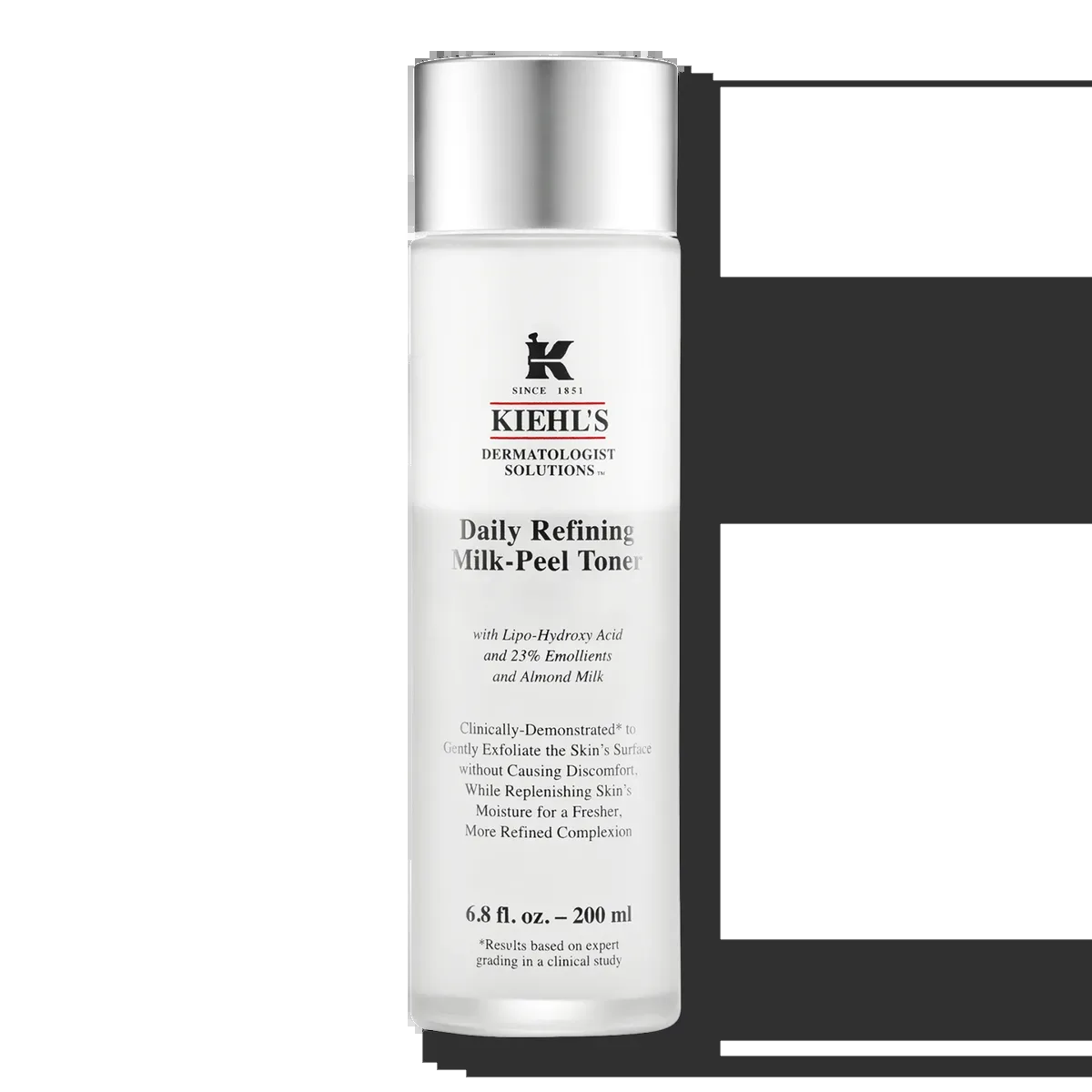
Most exfoliating toners are water-thin and acid-forward, designed to dissolve and strip. This one takes the opposite approach: a milky emulsion with 23% emollients that moisturizes as it exfoliates. The hero acid is not glycolic or salicylic but Lipo-Hydroxy Acid (LHA) — a L'Oréal-patented salicylic acid derivative that works cell-by-cell for controlled, gentle exfoliation. The result is a toner that delivers peel-like refinement without any of the harshness.
A luxuriously gentle exfoliating toner that delivers peel-like glow without any of the harshness. The L'Oréal-patented LHA and 23% emollient base make it one of the few acid toners suitable for dry and normal skin — though the essential oils and price ask a lot.
Roughly five years on market and about 800 reviews, plus brand clinical data from 44-52 subjects, anchor this assessment. LHA itself is heavily researched, but this milky emulsion has a shorter independent track record than Kiehl's heritage staples, so the grade blends ingredient analysis with the available consumer and small-panel evidence.
The case for it
What would change this: A declared concentration would move this to a firmer reading of the dose.
Same rule for everyone. “Good choice” is the verdict on 9,564 of 45,024 concern verdicts across the catalog; rule R5 decided 9,072 of them. Unchanged since September 5, 2026, engine 5.1.1.
Brand or formulator? Disclose a concentration or correct a fact →
The studies behind the evidence row
The case for it
What would change this: A declared concentration would move this to a firmer reading of the dose.
Same rule for everyone. “Not for this” is the verdict on 488 of 45,024 concern verdicts across the catalog; rule R10 decided 488 of them. Unchanged since September 5, 2026, engine 5.1.1.
Brand or formulator? Disclose a concentration or correct a fact →
The studies behind the evidence row
The case for it
Cautions: a photosensitising active — use sun protection.
What would change this: A declared concentration would move this to a firmer reading of the dose.
Same rule for everyone. “Promising” is the verdict on 7,858 of 45,024 concern verdicts across the catalog; rule R9p decided 7,858 of them. Unchanged since September 5, 2026, engine 5.1.1.
Brand or formulator? Disclose a concentration or correct a fact →
The studies behind the evidence row
The case for it
Same rule for everyone. “Good choice” is the verdict on 9,564 of 45,024 concern verdicts across the catalog; rule R5 decided 9,072 of them. Unchanged since September 5, 2026, engine 5.1.1.
Brand or formulator? Disclose a concentration or correct a fact →
The studies behind the evidence row
Also listed for Dullness — the actives here (Squalane, Salicylic Acid, Adenosine, Sweet Almond Oil) are in our research queue for that concern; there is no verdict until their evidence rows are written. That is a gap in our table, not a mark against the product.
Does the jobDoes what a toner is for: not alcohol-driven, adds something real. Not measured from the label: restores skin pH, plays well with what follows.
Where our review and the verdict differ. The review below was written on the formulation and the published trials; the verdicts above apply the stricter standing test in our methodology — an active earns a recommendation only with guideline or regulatory standing for the concern. Where the two disagree, the verdict is DermApproved’s position.
A verdict is DermApproved’s assessment of how well a product’s ingredients fit a concern — never a claim about what the product treats. Evidence dots and collected reviews sit beside it and are never blended in. Rules 0.5.1 · evidence table ev-2026.09-r228 · how we decide
Walk into any dermatologist's office offering cosmetic treatments and you will likely find a milk peel on the menu — a professional-grade lactic acid treatment that delivers dramatic resurfacing with a characteristic milky flush. Kiehl's took that concept, dialed it down to a daily-use format, and replaced the aggressive lactic acid with something far more refined: Lipo-Hydroxy Acid, a L'Oréal-patented salicylic acid derivative that exfoliates your skin one cell at a time. It's a very Kiehl's move — the brand has been translating pharmacy science into approachable products since its 1851 apothecary founding, and since L'Oréal acquired it in 2000, it has had the parent company's patent library to draw on.
The distinction matters. Traditional exfoliating toners — glycolic, lactic, salicylic — dissolve the intercellular cement holding groups of dead cells together, releasing them in sheets. It is effective but inherently aggressive, which is why most acid toners warn against daily use and frequently leave skin tight and flushed. LHA (capryloyl salicylic acid) takes a fundamentally different approach. Its larger, more lipophilic molecular structure targets individual cells at the junction between the stratum corneum and the living epidermis, peeling them off one at a time. The result is exfoliation without inflammation — a distinction that transforms what a toner can do on a daily basis. It also settles the reasonable assumption that LHA is just salicylic acid in a lab coat: the eight extra carbons on the molecule change its penetration speed and precision enough to make daily use viable where ordinary salicylic toners would over-run their welcome.
The formula's other innovation is its delivery vehicle. Where virtually every exfoliating toner on the market is water-thin, this one is a milky emulsion packed with 23 percent emollients. Squalane, safflower oil, and caprylic/capric triglyceride create a cushioned matrix that moisturizes as the LHA exfoliates. Shake the bottle, pour the milky liquid onto a cotton pad, and what you feel is not the astringent bite of an acid toner but the soft glide of a lightweight lotion. It is disorienting at first — you wonder if the product is actually doing anything.
It is. Within the first application, skin looks noticeably more luminous. Not dramatically different, not flushed or peeling, just quietly glowing. By day seven — according to Kiehl's clinical study on 52 women — 96 percent reported moisturized skin, 93 percent reported comfortable skin, and 90 percent reported skin that looked more supple. These are not the numbers of an aggressive resurfacing treatment. They are the numbers of a product that improves skin texture while treating it gently enough that comfort is the primary experience.
The sweet almond extract that gives this toner its milk-peel identity contributes fatty acids and proteins that reinforce the emollient base, while adenosine adds anti-aging benefits through its support of cellular energy metabolism. A touch of milk thistle extract and tocopherol lends antioxidant backup. Lactic acid appears at the end of the INCI list, suggesting it is present at a very low concentration — enough to contribute mild hydrating exfoliation but not enough to qualify as a primary active.
The routine mechanics are simple but worth spelling out: shake first (the emulsion separates by design), sweep on with a cotton pad or press in with palms after evening cleansing, then follow with serum and moisturizer. It's an evening product by nature — skip it on retinoid or peel nights to avoid stacking exfoliants, and treat morning sunscreen as part of the deal, since even gentle exfoliation raises photosensitivity. Anyone pregnant should note that LHA is still a salicylic acid derivative and check with their clinician before making it a nightly habit.
Now for the less flattering truths. At $62 for 6.8 ounces — about three to four months of nightly use — this is an expensive toner by any measure. The LHA is patented and you cannot find it in drugstore alternatives, which gives Kiehl's some pricing leverage. But the emollient base — squalane, safflower oil, triglycerides — is not exotic, and the exfoliating intensity is mild enough that frequent acid users may feel underwhelmed.
The fragrance is the formula's most debatable element. Mandarin peel oil, chamomile flower oil, and cypress oil create a pleasant citrus-herbal scent, but they also introduce limonene and benzyl alcohol as fragrance allergens. For a product in the Dermatologist Solutions line, the essential oil inclusion is an odd choice — especially since the milky format and gentle LHA suggest this toner was designed with reactive skin in mind.
The several hundred reviews on record land at a solid low-fours average, and the sentiment sorts cleanly: converts rave about the instant glow, the un-toner-like milky luxury, and pore refinement over weeks, while the dissatisfied are almost always either acid veterans who wanted more bite or fragrance-averse users who wish the Dermatologist Solutions label had meant fragrance-free.
The ideal user for this product is someone with normal-to-dry skin who wants the benefits of daily exfoliation — smoother texture, refined pores, improved glow — without the tightness, stinging, and peeling that traditional acid toners inflict. It fills a genuine gap in the market. Most exfoliating products assume oily or resilient skin; this one acknowledges that dry skin also wants to glow, it just cannot afford to lose moisture in the process.
For those with oily or acne-prone skin seeking aggressive exfoliation, this toner will feel too gentle and too rich. For truly sensitive skin, the essential oils represent an unnecessary gamble. But for the normal-to-dry sweet spot — skin that wants polish without punishment — this milky formula delivers a quiet, daily refinement that accumulates into genuinely better texture over weeks of use.
The hero actives that drive this product's performance.
| Ingredient | Function | Evidence |
|---|---|---|
| Capryloyl Salicylic Acid (Lipo-Hydroxy Acid / LHA) | A lipophilic derivative of salicylic acid developed by L'Oréal that exfoliates cell-by-cell rather than dissolving entire layers at once. In this milky toner, LHA provides controlled, gentle exfoliation that refines texture without the aggressive peeling of traditional acids — uniquely suited for daily use in a toner format alongside the formula's 23% emollient base. | Established mechanism for Rough Texture · established mechanism |
| Squalane | A lightweight, non-comedogenic emollient that mirrors the skin's own sebum composition. Part of the 23% emollient complex in this formula, squalane ensures the exfoliating toner does not strip or dehydrate — a common complaint with acid toners — by replenishing lipids as the LHA removes surface cells. | Established mechanism for Dryness · established mechanism |
| Sweet Almond Seed Extract (Almond Milk) | The formula's namesake ingredient, sweet almond extract provides emollient fatty acids and proteins that contribute to the milky texture and skin-softening properties. In this exfoliating toner, it adds a cushioning, nourishing quality that makes the acid feel less aggressive on application. | Not yet assessed |
| Adenosine | An anti-aging and anti-inflammatory molecule that supports cell energy metabolism. Included here to provide skin-smoothing and calming benefits that complement the exfoliating action of the LHA, helping to reduce the appearance of fine lines revealed by improved skin texture. | Limited for Aging |
| Lactic Acid | Listed at the end of the INCI, lactic acid provides a secondary, mild AHA exfoliation that works alongside the LHA. While present at a lower concentration, it adds hydrating properties unique among AHAs, pulling moisture into the skin as it gently loosens surface cells. | Established mechanism for Rough Texture · established mechanism |
Ingredient standings describe the active at treatment-level doses and vehicles; this product's own condition grades weigh its actual formula.
Aqua/Water, Hydrogenated Polydecene, Caprylic/Capric Triglyceride, Squalane, Carthamus Tinctorius Seed Oil/Safflower Seed Oil, 1,2-Hexanediol, PEG-6 Caprylic/Capric Glycerides, PEG-40 Glyceryl Cocoate, Phenoxyethanol, Sodium Coceth Sulfate, Capryloyl Salicylic Acid, Tromethamine, Ethylhexylglycerin, Citrus Nobilis Peel Oil/Mandarin Orange Peel Oil, Adenosine, Limonene, Caprylyl Glycol, Anthemis Nobilis Flower Oil, Cupressus Sempervirens Leaf/Nut/Stem Oil, Prunus Amygdalus Dulcis Seed Extract/Sweet Almond Seed Extract, Benzyl Alcohol, Xanthan Gum, Silybum Marianum Extract, Tocopherol, Dehydroacetic Acid, Lactic Acid
toner
PM
Shake the bottle to mix the milky emulsion, then apply to a cotton pad and sweep across the face after cleansing. Can also be poured into hands and patted on. Follow with serum and moisturizer. Best used in the PM routine. On nights using retinol or other acids, skip this toner to avoid over-exfoliation.
Immediate glow and smoother texture after first use. Within 7 days, 96% of clinical study participants reported moisturized skin and 90% reported more supple skin. Ongoing refinement of texture and pore appearance over 4 weeks of consistent use.
Lipo-Hydroxy Acid (capryloyl salicylic acid) is a lipophilic salicylic acid derivative developed by L'Oréal Research that has been the subject of multiple clinical investigations. A key study published in Dermatologic Surgery (Pierard et al., 2003) demonstrated that LHA provides targeted exfoliation at the corneocyte level — literally peeling individual cells from the stratum corneum rather than dissolving groups of cells simultaneously. This cell-by-cell mechanism results in clinical exfoliation without the erythema and barrier disruption associated with traditional hydroxy acids.
The lipophilic character of LHA (it is eight carbons longer than salicylic acid) gives it enhanced affinity for the lipid-rich intercellular matrix of the stratum corneum, allowing it to penetrate slowly and act precisely at the junction between dead and living skin cells. Published research has also documented LHA's ability to stimulate glycosaminoglycan and collagen synthesis in the dermis, conferring anti-aging benefits beyond surface exfoliation.
The 23% emollient complex in this formula — predominantly squalane, safflower oil, and caprylic/capric triglyceride — serves a dual purpose: sensorial (the milky texture) and functional (barrier protection during exfoliation). Squalane, a saturated hydrocarbon that mimics the skin's own squalene, has been shown to improve skin barrier function and reduce transepidermal water loss without comedogenic risk.
Lactic acid, present at the tail end of the INCI list, adds a secondary AHA exfoliation pathway. Even at low concentrations, lactic acid promotes hydration through its ability to increase skin ceramide content — a mechanism distinct from simple humectancy. Adenosine supports ATP-dependent cellular processes and has demonstrated anti-wrinkle efficacy in concentrations as low as 0.04% in clinical studies, making it effective even at the low concentration suggested by its INCI position.
Dermatologists recognize Lipo-Hydroxy Acid as a gentler alternative to traditional hydroxy acids for patients who need exfoliation but cannot tolerate glycolic or salicylic acid toners. Dermatology guidance holds that the cell-by-cell exfoliation mechanism of LHA makes it appropriate for daily use without the barrier disruption associated with higher-concentration acid products. The milky emollient vehicle is viewed favorably, as it addresses a common concern with acid toners — moisture depletion during exfoliation. Dermatologists typically recommend this toner for patients seeking texture improvement and gentle resurfacing, particularly those with dry-to-normal skin who have struggled with traditional exfoliating products. It is often suggested as an introductory exfoliant for patients new to chemical exfoliation.
Shake the bottle to mix the emulsion. Pour a generous amount onto a cotton pad and sweep across the entire face after cleansing at night. Alternatively, dispense into palms and press into skin. Allow a moment to absorb before applying serum and moisturizer. Use nightly as a standalone exfoliating step. On nights using retinol or other exfoliants, skip this toner. Always use sunscreen the following morning, as exfoliation increases photosensitivity.
At $62 for 6.8 oz, this toner is priced at the premium end of the exfoliating toner market. The proprietary LHA technology is genuinely unavailable in lower-priced competitors, which provides some justification for the premium. The emollient-rich formula also means you are getting a toner that doubles as a lightweight skin conditioner, reducing the need for a separate hydrating toner step. At roughly $0.50 per application with nightly use lasting 3-4 months, the per-use cost is reasonable for a prestige product. However, consumers seeking aggressive exfoliation may find better intensity-per-dollar in traditional AHA/BHA toners.
Normal-to-dry skin types who want the benefits of daily chemical exfoliation — smoother texture, refined pores, improved luminosity — without the drying, stripping effects of traditional acid toners. Those new to chemical exfoliation looking for a gentle entry point. Anyone who has tried and failed with harsher acid toners.
Oily or acne-prone skin types seeking aggressive exfoliation — this is too gentle and too emollient. Fragrance-sensitive or allergic skin types — the essential oils are unnecessary irritation risks. Budget shoppers who can find effective AHA/BHA toners at a fraction of the price.
Ready to try Kiehl's Dermatologist Solutions Daily Refining Milk-Peel Toner?
Buy at Amazon ♥Milky, opaque emulsion that feels like a lightweight lotion rather than a traditional watery toner. Shaking the bottle mixes the emollient and water phases into a smooth, creamy liquid that glides across the skin with a soft, cushioned feel.
Citrusy herbal scent from the mandarin peel, chamomile, and cypress essential oils. Pleasant but noticeable — not a fragrance-free formula. Dissipates within 1-2 minutes.
Frosted plastic bottle with a flip-top cap. The opaque bottle protects the light-sensitive ingredients. The flip-top is practical but a pump would allow more precise dosing of the milky formula.
On first use, the milky texture is the immediate surprise — this does not feel like a typical exfoliating toner. There is no stinging or burning, just a soft, emollient glide. Skin looks noticeably more luminous within minutes. The citrus-herbal scent is pleasant. No purging or adjustment period for most users, though those sensitive to LHA may experience mild flaking in the first week.
Around 3-4 months when applied nightly
All Year
This toner represents Kiehl's embrace of L'Oréal's advanced ingredient research, marrying the parent company's patented LHA technology with the brand's approachable, apothecary identity. Inspired by professional milk-peel treatments popular in dermatology offices, it was designed to deliver that post-peel glow as a gentle, daily-use product rather than an aggressive monthly treatment.
Kiehl's was founded in 1851 as a New York City apothecary and has been formulating skincare with pharmaceutical expertise for over 170 years. Acquired by L'Oréal in 2000, the brand maintains its apothecary heritage with dermatologist-recommended formulations backed by clinical testing.
Exfoliating toners always sting and dry out the skin.
This toner contains 23% emollients including squalane, safflower oil, and caprylic/capric triglyceride that actively moisturize while the LHA exfoliates. The milky emulsion format prevents the stripping effect common in water-based acid toners.
Lipo-Hydroxy Acid is the same as regular salicylic acid.
LHA (Capryloyl Salicylic Acid) is a lipophilic derivative of salicylic acid with a larger molecular structure that exfoliates one cell at a time rather than dissolving groups of cells simultaneously. This makes it significantly gentler while still providing effective exfoliation — hence why it can be used daily in a toner format.
LHA is a patented salicylic acid derivative that exfoliates the skin cell-by-cell rather than dissolving entire layers at once like traditional acids. This controlled mechanism makes it gentle enough for daily use while still effectively refining texture, reducing pore appearance, and improving skin luminosity. In this formula, it's cushioned by 23% emollients for added gentleness.
Yes — this toner was specifically designed for daily use. The LHA exfoliates gently enough for nightly application, and the 23% emollient content prevents over-drying. However, on nights when you use other exfoliants (AHA/BHA peels) or retinoids, skip this toner to avoid cumulative irritation.
While gentler than most acid toners, this formula contains essential oils (mandarin, chamomile, cypress) and fragrance allergens that may irritate truly sensitive skin. It is best suited for normal-to-dry skin types looking for gentle exfoliation. Sensitive skin types should patch test and consider starting with every-other-night use.
The milky appearance comes from its emulsion formula — 23% emollients (squalane, safflower oil, triglycerides) are suspended in the water phase, creating an opaque liquid. This is intentional: the emollients replenish moisture and protect the skin barrier while the LHA exfoliates, preventing the dryness and tightness common with traditional acid toners.
Yes, but alternate their use. Apply this toner on nights you skip retinol, and vice versa. Both exfoliate the skin through different mechanisms, and using them simultaneously can lead to over-exfoliation, dryness, and irritation. A typical schedule: Milk-Peel toner Monday/Wednesday/Friday, retinol Tuesday/Thursday.
Recurring themes our editors read across retailer reviews of this product — summaries in our words, not quotations, and not a substitute for your own patch test.
Delivers instant glass skin glow after first use
Milky texture feels luxurious and non-stripping
Skin feels smoother and more refined within days
Gentle enough for daily use unlike many acid toners
Effectively reduces visible pore size over time
Expensive at $62 for a toner
Essential oil scent may bother fragrance-sensitive users
Too gentle for those wanting aggressive exfoliation results
Milky texture takes getting used to vs traditional water-thin toners