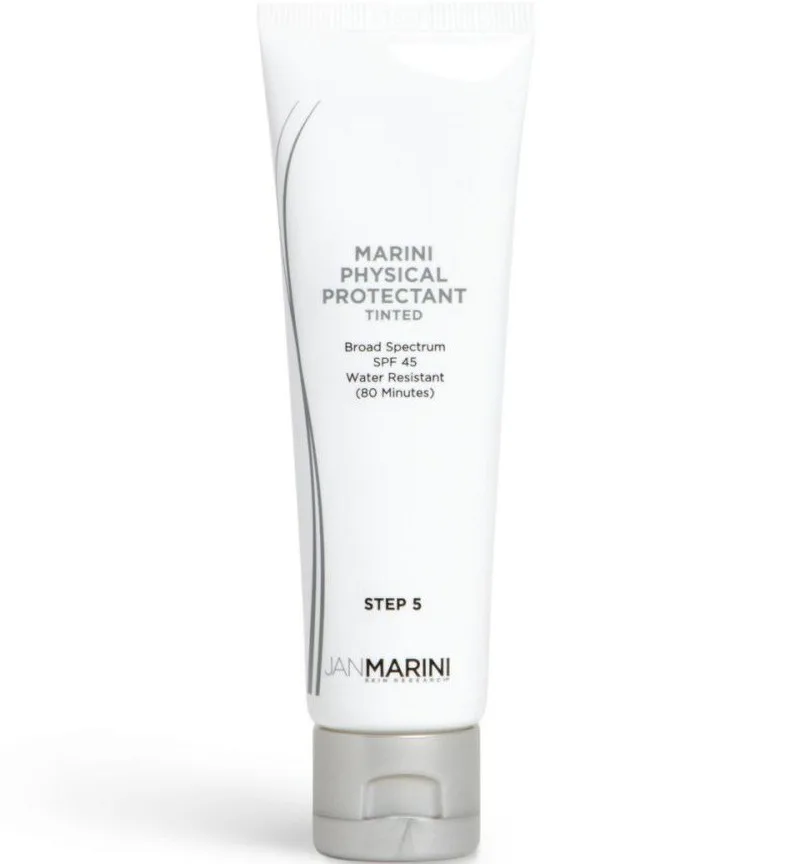
Most mineral sunscreens either skip antioxidant additions or include only token amounts. Jan Marini pairs the 8% zinc + 6% titanium dioxide combination with meaningful green tea, CoQ10, bisabolol, and iron oxide content for a multi-functional photoprotection approach.
Jan Marini Physical Protectant SPF 45 is a clinic-tier mineral sunscreen that does more than block UV — the universal iron oxide tint adds genuine visible-light defense while green tea, CoQ10, and bisabolol round out the antioxidant story. It blends cleanly on fair-to-medium skin, suits sensitive and post-procedure faces, and earns its $50 price for the right buyer.
Full protectionfor Sun DamageIn your profileYou chose · Broad-spectrum SPF 45 with titanium dioxide, zinc oxide: the protection sun damage calls for.Moderate evidenceGentleNo reviews collected yet
The case for it
Zinc Oxide is a first-line active — approved, monograph-listed or named in current guidelines — for this concern.
It is present below the studied range.
The formula carries none of the triggers this concern is sensitive to.
What would change this: A concentration inside the studied range would raise this a step.
Same rule for everyone. “Full protection” is the verdict on 2,288 of 45,024 concern verdicts across the catalog; rule P1 decided 2,232 of them.
Unchanged since September 5, 2026, engine 5.1.1.
P1 — Photoprotection standing is regulatory (M020 / Annex VI filters; 21 CFR 201.327 attaches the early-skin-aging claim to tested broad-spectrum SPF 15+). SPF 30 is the AAD daily-use bar. · the full register
Full protectionfor HyperpigmentationIn your profileYou chose · Broad-spectrum SPF 45 with titanium dioxide, zinc oxide: the protection hyperpigmentation calls for.Not yet assessedGentleNo reviews collected yet
The case for it
Zinc Oxide has no evidence row yet for this concern — it is in the research queue.
The formula carries none of the triggers this concern is sensitive to.
What would change this: A researched evidence row for the lead active would replace this with a verdict.
Same rule for everyone. “Full protection” is the verdict on 2,288 of 45,024 concern verdicts across the catalog; rule P1 decided 2,232 of them.
Unchanged since September 5, 2026, engine 5.1.1.
P1 — Photoprotection standing is regulatory (M020 / Annex VI filters; 21 CFR 201.327 attaches the early-skin-aging claim to tested broad-spectrum SPF 15+). SPF 30 is the AAD daily-use bar. · the full register
Full protectionfor MelasmaIn your profileYou chose · Broad-spectrum SPF 45 with iron oxides for visible light — what melasma needs from a sunscreen.Not yet assessedGentleNo reviews collected yet
The case for it
Zinc Oxide has no evidence row yet for this concern — it is in the research queue.
The formula carries none of the triggers this concern is sensitive to.
What would change this: A researched evidence row for the lead active would replace this with a verdict.
Same rule for everyone. “Full protection” is the verdict on 2,288 of 45,024 concern verdicts across the catalog; rule P2 decided 56 of them.
Unchanged since September 5, 2026, engine 5.1.1.
Full protectionfor AgingIn your profileYou chose · Broad-spectrum SPF 45 with titanium dioxide, zinc oxide: the protection aging calls for.Not yet assessedGentleNo reviews collected yet
The case for it
Zinc Oxide has no evidence row yet for this concern — it is in the research queue.
The formula carries none of the triggers this concern is sensitive to.
What would change this: A researched evidence row for the lead active would replace this with a verdict.
Same rule for everyone. “Full protection” is the verdict on 2,288 of 45,024 concern verdicts across the catalog; rule P1 decided 2,232 of them.
Unchanged since September 5, 2026, engine 5.1.1.
P1 — Photoprotection standing is regulatory (M020 / Annex VI filters; 21 CFR 201.327 attaches the early-skin-aging claim to tested broad-spectrum SPF 15+). SPF 30 is the AAD daily-use bar. · the full register
Supporting rolefor RosaceaIn your profileYou chose · Nothing here targets rosacea directly; photoprotection against a known trigger is the recognised companion to treating it, and this cream does that without known triggers.Not yet assessedGentleNo reviews collected yet
The case for it
Green Tea Extract + Ubiquinone has been researched for this concern and the evidence does not support it.
It is plausibly present at a working level, though the concentration is not declared.
The formula carries none of the triggers this concern is sensitive to.
What would change this: A declared concentration would move this to a firmer reading of the dose.
Same rule for everyone. “Supporting role” is the verdict on 8,197 of 45,024 concern verdicts across the catalog; rule R8 decided 4,250 of them.
Unchanged since September 5, 2026, engine 5.1.1.
R8 — The category's job (barrier care, humectant hydration, gentle cleansing, photoprotection) is the documented supportive role for this concern. This is the honest verdict for a moisturizer on an acne page. · the full register
Carrying active
Green Tea Extract + Ubiquinone
Standing
none
Form
plausible — studied range 2%, from the OTC monograph or label; needs leave-on contact
Good choicefor SensitivityIn your profileYou chose · No fragrance, drying alcohol, declarable allergens or sensitising preservatives in this cream — the profile sensitive skin looks for.Not yet assessedGentleNo reviews collected yet
The case for it
Zinc Oxide has no evidence row yet for this concern — it is in the research queue.
The formula carries none of the triggers this concern is sensitive to.
What would change this: A researched evidence row for the lead active would replace this with a verdict.
Same rule for everyone. “Good choice” is the verdict on 1,938 of 45,024 concern verdicts across the catalog; rule F2 decided 1,938 of them.
Unchanged since September 5, 2026, engine 5.1.1.
Does the jobDoes what a sunscreen is for: UVA coverage, kind to the skin wearing it. Not measured from the label: pleasant enough to actually use.
A verdict is DermApproved’s assessment of how well a product’s ingredients fit a concern — never a claim about what the product treats. Evidence dots and collected reviews sit beside it and are never blended in.
Rules 0.5.1 · evidence table ev-2026.09-r228 · how we decide
Assessment
Pros & Cons
Pros
✓ Pure mineral filters suit sensitive and post-procedure skin
✓ Iron oxide tint adds genuine visible-light protection for melasma
✓ Real antioxidant supporting cast: green tea, CoQ10, bisabolol
✓ Universal tint masks white cast on fair-to-medium tones
✓ Sets to an elegant satin-matte finish under makeup
✓ Fragrance-free and pregnancy-safe formulation
✓ Backed by a legacy clinical brand with 30+ years
✓ Broad-spectrum SPF 45 with strong UVA coverage from zinc
Cons
✗ Single universal tint leaves slight cast on deeper skin tones
✗ Silicone-heavy texture feels artificial to some users
✗ Premium $50 price versus capable drugstore mineral alternatives
✗ Not fungal-acne safe due to fatty-acid-derived emollients
✗ Only one size available, limiting trial flexibility
Review
Full Review
Most mineral sunscreens are built to win one fight: UV radiation. They load up on zinc oxide and titanium dioxide, call it broad-spectrum, and stop there. What that approach quietly ignores is visible light — the part of the spectrum your eyes can actually see, the part that passes straight through window glass, the part that research has increasingly tied to melasma relapses and stubborn post-inflammatory hyperpigmentation. Jan Marini Physical Protectant SPF 45 is interesting precisely because it doesn't ignore that gap. The universal tint that masks the white cast is made of iron oxides, and iron oxides happen to be one of the few cosmetic ingredients with documented ability to attenuate high-energy visible light. So the thing that makes this sunscreen cosmetically wearable is also the thing that makes it functionally more complete. That is a genuinely thoughtful piece of formulating, and it's the reason this product deserves a closer look than its quiet, dermatology-office reputation might suggest.
Jan Marini Skin Research has been around since 1994, founded by a former Murad executive and built deliberately for the dermatology and aesthetician channel rather than the Sephora shelf. That heritage matters here. This is a legacy clinical brand with three decades of office distribution behind it, which is why you'll find this sunscreen handed to patients recovering from lasers, peels, and microneedling rather than marketed on a billboard. The Physical Protectant arrived around 2010 as the brand's clinical-tier mineral option, and it has stayed in the lineup because it does a specific job well: protecting reactive, compromised, or pigmentation-prone skin without the chemical-filter sting that some post-procedure patients can't tolerate.
The active system is a pure mineral pairing — 8% zinc oxide and 6% titanium dioxide. Zinc at that concentration is the workhorse, carrying strong UVA1 and UVA2 coverage alongside UVB, while the titanium dioxide reinforces the UVB end. Together they produce broad-spectrum SPF 45 entirely through physical, non-chemical mechanisms, which is exactly what you want for sensitive skin, rosacea, and the post-procedure window. But the inactive list is where the formula stops being generic. Green tea leaf extract brings polyphenols that have been studied for blunting UV-induced inflammation and oxidative stress. Ubiquinone — CoQ10 — adds a lipid-soluble free-radical scavenger that works in the oily fraction of the formula where many water-based antioxidants can't reach. Bisabolol contributes anti-inflammatory soothing, a sensible inclusion for the irritation-prone skin this product targets. Most mineral sunscreens either skip antioxidants entirely or toss in a token pinch for the label. Jan Marini included a real supporting cast, and that's a meaningful point of difference.
Texture-wise, this is unapologetically a silicone-forward formula. Cyclopentasiloxane, dimethicone, and a stack of silicone elastomers and crosspolymers give it a light, slippery glide that sets down to a satin-matte finish. On the skin it feels modern and elegant, blurs pores slightly, and sits well under makeup — none of the heavy, draggy paste that older mineral sunscreens were notorious for. The trade-off is that silicone-rich textures aren't universally loved; some people find the slip a little artificial, and if you're sensitive to that feel, you'll notice it. It's also worth flagging that this formula is not fungal-acne safe, so anyone managing malassezia-driven breakouts should look elsewhere.
The universal tint is the formula's headline feature and also its most honest limitation. On fair-to-medium skin tones it disappears beautifully, neutralizing the ghostly cast that mineral filters would otherwise leave. On deeper skin tones it's a different story — a single universal shade simply can't match everyone, and users with rich or deep complexions will likely see a slight grey or ashy cast. This isn't a flaw in the formula so much as a limitation of the single-shade approach. If your skin is deep, swatch before you commit, because the tint is designed to blend rather than truly match.
At $50 for 57 grams, this sits firmly in the clinical-premium tier, well above drugstore mineral options. The price isn't outrageous for what you're getting — a pure mineral system, a real antioxidant complex, iron oxide visible-light defense, and the formulation pedigree of a legacy clinical brand — but it's also not cheap, and drugstore mineral sunscreens will protect your skin perfectly well if visible-light defense and antioxidants aren't priorities for you. Where the value genuinely lands is for the melasma, rosacea, and post-procedure crowd. For those users, the iron oxide content and the soothing supporting cast aren't luxury extras — they're functionally relevant, and the price starts to make real sense.
The honest summary: this is a quietly excellent sunscreen with a clear ideal customer and a clear set of people it isn't for. It protects against UV and visible light, it soothes rather than provokes reactive skin, and it wears beautifully on lighter complexions. It also costs more than many people need to spend, comes in only one tint, and won't satisfy anyone hunting for a fungal-acne-safe option or a deep-shade match. If you fall into its target group, it's an easy recommendation. If you don't, there's no shame in spending less.
Formula
Key Ingredients
The hero actives that drive this product's performance.
The antioxidant supporting cast amplifies the photoprotection through complementary mechanisms. Green tea polyphenols provide UV-induced inflammation modulation; CoQ10 offers lipid-soluble free-radical scavenging; bisabolol contributes anti-inflammatory and soothing activity. The combination compounds with the mineral filters to deliver more comprehensive photoprotection than mineral SPF alone.
The universal tint serves dual purposes: cosmetically masking the white cast of mineral filters and providing visible-light (HEV/blue light) protection that uncoated zinc and titanium dioxide can't deliver. Iron oxides are increasingly recognized as important for melasma and post-inflammatory hyperpigmentation prevention through visible-light defense.
Not yet assessed
Ingredient standings describe the active at treatment-level doses and
vehicles; this product's own condition grades weigh its actual formula.
Use as the last step of morning skincare after all serums and moisturizer. Use 2 finger lengths for face. Wait 15 minutes before sun exposure. Reapply every 2 hours during sun exposure.
Results Timeline
Immediate: complete UV and visible-light protection. 1-2 weeks: stable photoprotection. 4-8 weeks: cumulative photoaging-prevention and pigmentation-prevention benefits.
The formulation logic here rests on two well-supported pillars: mineral UV filtering and iron oxide visible-light defense. The zinc oxide and titanium dioxide pairing is uncontroversial — both are long-established broad-spectrum physical filters. What elevates this formula is the iron oxide tint, which is no longer regarded as merely cosmetic. A 2025 review in Photodermatology, Photoimmunology & Photomedicine on tinted sunscreens documented that iron oxide formulations can attenuate high-energy visible light at rates exceeding 93%, with darker tints reaching up to 98% — protection that uncoated zinc and titanium dioxide cannot provide. The clinical relevance was established earlier: a prospective randomized trial published in the Journal of the American Academy of Dermatology (Boukari et al., 2015) found that a sunscreen combining UV and short-wavelength visible-light protection reduced melasma relapse more effectively than UV protection alone. For the melasma and post-inflammatory hyperpigmentation users this product targets, the iron oxide content is functionally important, not decorative. The antioxidant supporting cast has its own evidence base. Green tea polyphenols have been studied in human skin: research published in the Journal of the American Academy of Dermatology demonstrated that topical green tea polyphenols reduce UV-induced erythema and decrease sunburn cell formation, working through inflammation modulation rather than UV filtering. CoQ10 (ubiquinone) contributes lipid-soluble free-radical scavenging that complements water-phase antioxidants, and bisabolol adds anti-inflammatory soothing. The key point is synergy: antioxidants don't replace SPF — they mop up the free radicals that filters inevitably let through, and visible-light defense covers the spectrum that mineral filters miss. This formula stacks all three layers, which is why its photoprotection profile is more comprehensive than mineral SPF alone.
Dermatologists frequently reach for pure mineral sunscreens when treating reactive or compromised skin — rosacea, post-laser and post-peel recovery, and sensitive patients who cannot tolerate chemical filters. Clinicians have long observed that zinc oxide at concentrations around 8% provides reliable UVA coverage, which is the part of the spectrum most associated with photoaging and pigment darkening. For melasma and post-inflammatory hyperpigmentation, dermatologists increasingly emphasize that UV protection alone is insufficient: visible light contributes meaningfully to pigment relapse, and tinted formulations containing iron oxides are commonly recommended specifically because they address that gap. A formulation like this one, pairing a pure mineral filter system with an iron oxide tint, aligns well with current clinical photoprotection guidance for pigmentation-prone patients. Dermatologists also generally regard mineral filters and the supporting botanical and antioxidant ingredients here as appropriate during pregnancy, making this a sensible option for patients seeking a low-irritation, pregnancy-compatible daily sunscreen.
Guidance
Usage & Recommendations
How to Use
Apply as the final step of your morning skincare routine, after all serums and moisturizer have absorbed. Use roughly two finger-lengths of product for the face and neck to reach the labeled SPF 45 — under-applying is the most common reason sunscreens underperform. Smooth it on evenly and allow about 15 minutes before sun exposure so the film sets. The universal tint blends most cleanly on fair-to-medium skin; if your tone is deeper, swatch first and blend thoroughly along the jaw and hairline. Reapply every two hours during continuous sun exposure, and sooner after swimming or heavy sweating. It layers well under makeup once set. For pigmentation concerns, pair it with a morning vitamin C serum underneath for compounded antioxidant defense.
Value Assessment
At $50 for 57 grams, this is priced as a clinical-premium product, noticeably above drugstore mineral sunscreens. The cost is justifiable rather than inflated: you're paying for a pure mineral system, a genuine antioxidant complex, iron oxide visible-light defense, and the formulation pedigree of a legacy brand with three decades of dermatology-office distribution. This isn't celebrity markup — it's a credible clinical formula. That said, value is buyer-dependent. For melasma, rosacea, and post-procedure users, the visible-light protection and soothing actives are functionally relevant and the price earns out. For someone who simply wants UV cover, a less expensive mineral sunscreen will do the job. Only one size is available, so there's no smaller trial option or bulk-value alternative — a minor drawback for first-time buyers.
Who Should Buy
Buy this if you have sensitive, rosacea-prone, or post-procedure skin and want a pure mineral sunscreen that won't sting or provoke reactivity. It's especially worthwhile for anyone managing melasma or post-inflammatory hyperpigmentation, since the iron oxide tint adds visible-light protection that standard mineral SPFs lack. Fair-to-medium skin tones will get the cleanest cosmetic result.
Who Should Skip
Skip it if your skin is deep-toned, since the single universal tint can leave a slight ashy cast and won't truly match you. Pass if you're managing fungal acne, as the formula isn't malassezia-safe. Budget-focused shoppers who only need straightforward UV protection can get equally reliable coverage from a less expensive mineral sunscreen.
Ready to try Jan Marini Physical Protectant SPF 45?
Jan Marini introduced the Physical Protectant SPF 45 as the brand's clinical-tier mineral sunscreen, targeting dermatology-office patients with sensitivity, post-procedure recovery needs, or rosacea/melasma management.
About Jan Marini Legacy Brand (20+ years)
Jan Marini Skin Research was founded in 1994 by Jan Marini, a former Murad executive, with a focus on dermatology-office distribution of clinical anti-aging formulations. The brand has built a 30+ year clinical heritage with strong dermatologist and aesthetician adoption in the US, particularly known for the BioGlycolic AHA line and C-ESTA vitamin C franchise.
Brand founded: 1994 · Product launched: 2010
Myth vs. Reality
Common Myths
Myth
Mineral sunscreens always leave a white cast.
Reality
Modern mineral formulations like this Jan Marini use universal tints (iron oxides) to mask the white cast effectively for fair-to-medium skin tones. Darker tones may still notice slight cast — for those users, products with brown-shade tints or chemical SPF alternatives work better.
Myth
Iron oxides in sunscreen are just for cosmetic tint.
Reality
Iron oxides provide genuine visible-light (HEV/blue light) protection that uncoated zinc and titanium dioxide can't deliver. For melasma and post-inflammatory hyperpigmentation users, the iron oxide content is functionally important, not just cosmetic.
FAQ
Frequently Asked Questions
Will it leave a white cast?
Minimal on fair-to-medium skin tones thanks to the universal iron oxide tint. Darker tones may notice slight cast. The tint is designed to blend rather than match perfectly, so users in deeper skin tones should compare swatches before committing.
Does it really protect against blue light?
Yes, partially. The iron oxide content provides documented visible-light (HEV/blue light) protection that pure mineral filters alone can't deliver. The effect is meaningful for users dealing with melasma or post-inflammatory hyperpigmentation.
Is it safe for post-procedure use?
Yes — the pure mineral filter system is appropriate for post-procedure skin (post-laser, post-peel, post-microneedling) where chemical filter sensitivity is a concern.
Can I use it during pregnancy?
Yes — mineral filters and the supporting ingredient list are pregnancy-safe.
Is it suitable for melasma?
Yes — the iron oxide content adds visible-light protection that's particularly important for melasma management, alongside the UVA/UVB coverage from the mineral filters.
How does it compare to EltaMD UV Physical SPF 41?
Both are tinted mineral sunscreens at similar SPF levels. EltaMD UV Physical is widely recommended by dermatologists and slightly cheaper. Jan Marini Physical Protectant has more elaborate antioxidant supporting cast (CoQ10, green tea, bisabolol). Different products at similar price tiers.
Reviews
What Reviewers Tend to Say
Recurring themes our editors read across retailer reviews of this product — summaries in our words, not quotations, and not a substitute for your own patch test.
Common Praise
Pure mineral protection without chemical filter concerns
Universal tint helps mask mineral white cast
Antioxidant + iron oxide additions for visible-light protection
Suitable for sensitive and post-procedure skin
Pregnancy-safe formulation
Common Complaints
Universal tint doesn't match all skin tones perfectly
Slight white cast on darker skin tones
Silicone-heavy texture not loved by all users
Premium price vs drugstore mineral alternatives
Notable Endorsements
Distributed through US dermatology offices for sensitive and post-procedure patientsRecommended for melasma and rosacea management
Every pigment-fading active runs against a re-pigmenting stimulus, and for melasma part of that stimulus is visible light — which broad-spectrum sunscreen does essentially nothing about unless you can see it on your face.
Products, answers, therapy guides, tools and articles in one search. Brand names,
slang and abbreviations all work — accutane finds isotretinoin, bacne finds truncal acne.