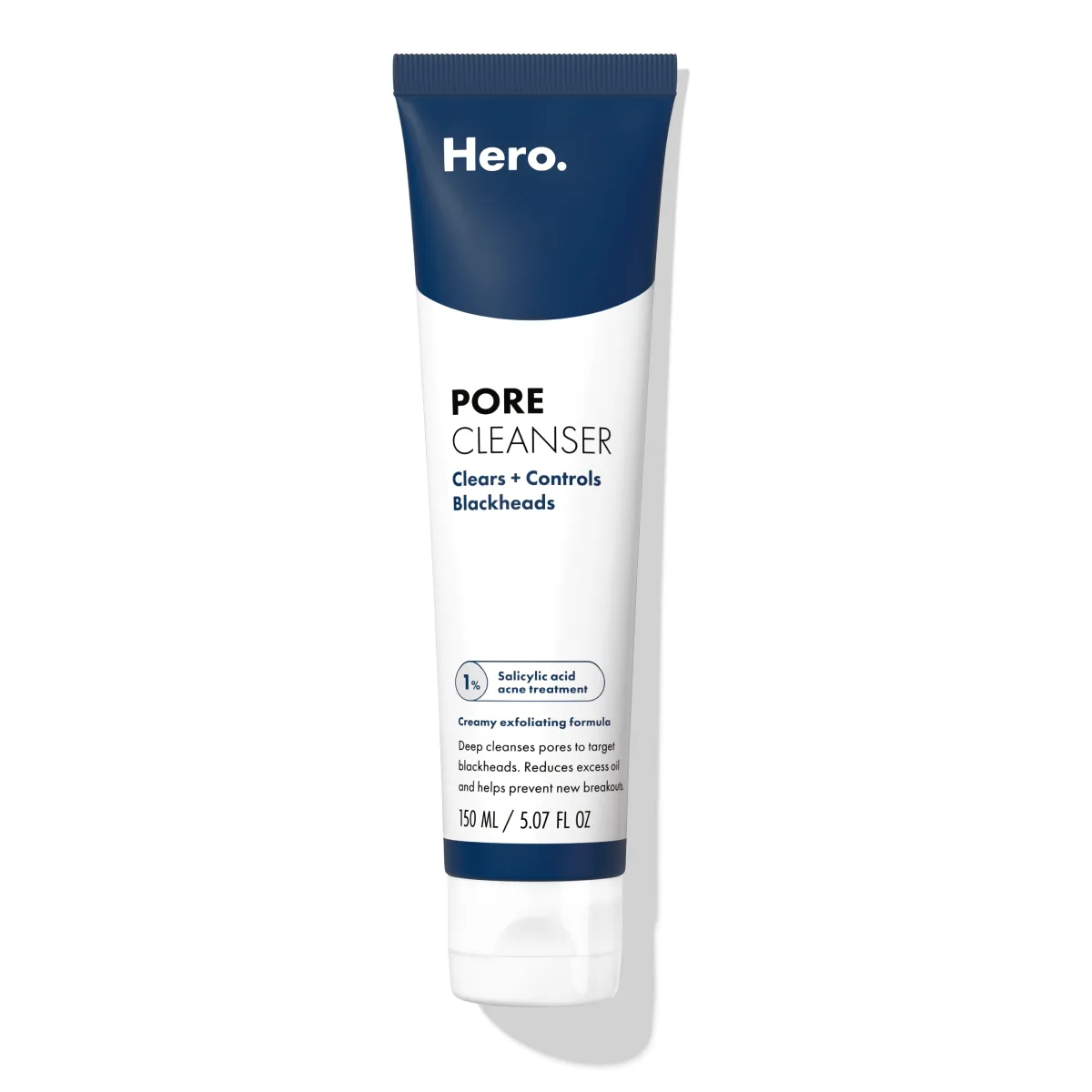
It splits the exfoliation between a half-strength 1% salicylic acid and a physical scrub built from jojoba wax beads, kaolin and diatomaceous earth, so neither route has to be aggressive on its own, and it carries zinc PCA as the oil-control note. In a category where scrub washes tend to be either gritty and acid-free or acid-heavy with token beads, this is a genuinely balanced two-way formula at a drugstore price.
A balanced two-way exfoliating wash, one percent salicylic acid plus soft jojoba beads and clays, that polishes oily, blackhead-prone skin smooth without the scratch of an old-school scrub, for under eleven dollars. It is a few-nights-a-week cleanser rather than a daily one, it is two months old with a thin record, and sensitive or rosacea-prone faces should not go near it.
With two months on the market and roughly 125 ratings at one retailer, this cleanser has no long-term user record, and Hero's 170-person panel measured how skin felt rather than how blackheads changed. The assessment is built from the complete drug-facts label, the established evidence on low-dose salicylic acid washes, and the known behaviour of jojoba wax beads and clays as exfoliants; whether it keeps pores clearer across seasons, and how it performs on darker or more reactive skin, cannot yet be said.
Verdicts
How well it fits each concern
Verdict by concern tap a concern for the case
Good choicefor BlackheadsIn your profileYou chose · Salicylic Acid is an approved or monograph active for blackheads; this rinse-off cream carries it at 1% — short contact still counts for this active, but a leave-on does more.Moderate evidenceStandard tolerabilityNo reviews collected yet
The case for it
Salicylic Acid is a first-line active — approved, monograph-listed or named in current guidelines — for this concern.
It is present at an effective concentration, declared or high in the ingredient list.
The formula carries no trigger this concern is sensitive to, with the cautions noted.
Cautions: fungal-acne triggers.
Same rule for everyone. “Good choice” is the verdict on 9,564 of 45,024 concern verdicts across the catalog; rule R2r decided 408 of them.
As of September 25, 2026, engine 5.1.1.
R2r — Rinse-off exceptions (BPO wash, salicylic acid cleanser) deliver a real but smaller effect than the leave-on form; they cap at 'good choice'. Medicated shampoos for scalp concerns are exempt — the shampoo is the treatment form. Editorial decision 2 Sep 2026, pending advisory review. · the full register
Carrying active
Salicylic Acid
Standing
first line — a regulator recognises it for this use; trials support it · per 21 CFR § 333.350 - Labeling of acne drug products. (US Code of Federal Regulations (Legal Information Institute, Cornell Law School)), opened July 27, 2026
Form
adequate (declared 1%) — studied range 0.5–2%, from the OTC monograph or label; judge it after ~6 weeks
Tolerability
standard — fungal triggers
Row checked
against its sources on July 27, 2026 (evidence table ev-2026.09-r228)
The studies behind the evidence row
OTC monograph, Topical Acne Drug Products — salicylic acid 0.5–2% recognized as an acne treatment active — US Food and Drug Administration
Supporting rolefor Excess OilinessIn your profileYou chose · Rinse-off cream: Salicylic Acid gets seconds of contact, so this supports a routine for excess oiliness rather than treating it.Moderate evidenceStandard tolerabilityNo reviews collected yet
The case for it
Salicylic Acid has early or mechanistic evidence for this concern, not trial-backed standing.
It is in a rinse-off product, so it gets seconds of contact rather than the leave-on exposure the evidence assumes.
The formula carries no trigger this concern is sensitive to, with the cautions noted.
Cautions: fungal-acne triggers.
What would change this: The same active in a leave-on form would be judged on its evidence rather than its contact time.
Same rule for everyone. “Supporting role” is the verdict on 8,197 of 45,024 concern verdicts across the catalog; rule R6 decided 2,017 of them.
As of September 25, 2026, engine 5.1.1.
R6 — Contact time cannot deliver a leave-on claim; the product is judged on its job (cleansing without aggravating). Explicit exceptions (BPO wash, SA cleanser, medicated shampoos) never reach this rule because their rows set rinse_off_ok. · the full register
Carrying active
Salicylic Acid
Standing
plausible — trials support it
Form
contact limited — studied range 30%, from the trials on the row; needs leave-on contact; judge it after ~6 weeks
Tolerability
standard — fungal triggers
Row checked
against its sources on July 17, 2026 (evidence table ev-2026.09-r228)
Supporting rolefor Large PoresIn your profileYou chose · Rinse-off cream: Salicylic Acid gets seconds of contact, so this supports a routine for large pores rather than treating it.Not yet assessedGentleNo reviews collected yet
The case for it
Salicylic Acid has been researched for this concern and the evidence does not support it.
It is in a rinse-off product, so it gets seconds of contact rather than the leave-on exposure the evidence assumes.
The formula carries none of the triggers this concern is sensitive to.
What would change this: The same active in a leave-on form would be judged on its evidence rather than its contact time.
Same rule for everyone. “Supporting role” is the verdict on 8,197 of 45,024 concern verdicts across the catalog; rule R6 decided 2,017 of them.
As of September 25, 2026, engine 5.1.1.
R6 — Contact time cannot deliver a leave-on claim; the product is judged on its job (cleansing without aggravating). Explicit exceptions (BPO wash, SA cleanser, medicated shampoos) never reach this rule because their rows set rinse_off_ok. · the full register
Carrying active
Salicylic Acid
Standing
none
Form
contact limited — studied range 0.5–2%, from the OTC monograph or label; needs leave-on contact; judge it after ~6 weeks
Supporting rolefor Rough TextureIn your profileYou chose · Rinse-off cream: Salicylic Acid gets seconds of contact, so this supports a routine for rough texture rather than treating it.Moderate evidenceGentleNo reviews collected yet
The case for it
Salicylic Acid has trial-supported standing for this concern.
It is in a rinse-off product, so it gets seconds of contact rather than the leave-on exposure the evidence assumes.
The formula carries none of the triggers this concern is sensitive to.
What would change this: The same active in a leave-on form would be judged on its evidence rather than its contact time.
Same rule for everyone. “Supporting role” is the verdict on 8,197 of 45,024 concern verdicts across the catalog; rule R6 decided 2,017 of them.
As of September 25, 2026, engine 5.1.1.
R6 — Contact time cannot deliver a leave-on claim; the product is judged on its job (cleansing without aggravating). Explicit exceptions (BPO wash, SA cleanser, medicated shampoos) never reach this rule because their rows set rinse_off_ok. · the full register
Carrying active
Salicylic Acid
Standing
supported — its mechanism is established
Form
contact limited — studied range 0.5–2%, from the trials on the row; needs leave-on contact; judge it after ~6 weeks
Tolerability
gentle
Row checked
against its sources on July 17, 2026 (evidence table ev-2026.09-r228)
The studies behind the evidence row
International Cosmetic Ingredient Dictionary and Handbook — declared function — Personal Care Products Council
United States Pharmacopeia / National Formulary — excipient monograph — USP-NF
Good choicefor AcneIn your profileYou chose · Salicylic Acid is an approved or monograph active for acne; this rinse-off cream carries it at 1% — short contact still counts for this active, but a leave-on does more.Moderate evidenceStandard tolerabilityNo reviews collected yet
The case for it
Salicylic Acid is a first-line active — approved, monograph-listed or named in current guidelines — for this concern.
It is present at an effective concentration, declared or high in the ingredient list.
The formula carries no trigger this concern is sensitive to, with the cautions noted.
Cautions: fungal-acne triggers.
Same rule for everyone. “Good choice” is the verdict on 9,564 of 45,024 concern verdicts across the catalog; rule R2r decided 408 of them.
As of September 25, 2026, engine 5.1.1.
R2r — Rinse-off exceptions (BPO wash, salicylic acid cleanser) deliver a real but smaller effect than the leave-on form; they cap at 'good choice'. Medicated shampoos for scalp concerns are exempt — the shampoo is the treatment form. Editorial decision 2 Sep 2026, pending advisory review. · the full register
Carrying active
Salicylic Acid
Standing
first line — a regulator recognises it for this use; trials support it · per § 333.310 Acne active ingredients. (U.S. Food and Drug Administration — 21 CFR Part 333 Subpart D (Topical Acne Drug Products), Code of Federal Regulations via GovInfo), opened July 27, 2026
Form
adequate (declared 1%) — studied range 0.5–2%, from the OTC monograph or label; judge it after ~6 weeks
Tolerability
standard — fungal triggers
Row checked
against its sources on July 27, 2026 (evidence table ev-2026.09-r228)
Does the jobDoes what a cleanser is for: surfactant mildness, rinses clean without stripping. Not measured from the label: pH match to skin.
A verdict is DermApproved’s assessment of how well a product’s ingredients fit a concern — never a claim about what the product treats. Evidence dots and collected reviews sit beside it and are never blended in.
Rules 0.5.1 · evidence table ev-2026.09-r228 · how we decide
Assessment
Pros & Cons
Pros
✓ Half-strength 1% salicylic acid balanced against a soft physical scrub
✓ Jojoba wax beads flatten under pressure and rinse away without scratching
✓ Kaolin and zinc PCA leave oily skin matte without tightness
✓ Fragrance-free, alcohol-free and free of plastic microbeads
✓ Cream base with glycerin keeps the scrub from stripping
✓ Under eleven dollars for 150 mL, lasting months at a few nights a week
✓ Nose blackheads lift noticeably within two to three weeks
Cons
✗ Diatomaceous earth grit is too much for sensitive or rosacea-prone skin
✗ Nightly use dries combination cheeks within a couple of weeks
✗ Zinc PCA's oil-control effect is minimal in a rinse-off wash
✗ Two months on the market with only around 125 ratings
✗ Beads clog the flip-cap nozzle and need a firm squeeze
✗ Fine grit feels too mild for anyone wanting a strong scrub
Review
Full Review
The interesting thing about the Pore Cleanser is the number on its drug-facts label. Hero could have put two percent salicylic acid in it, the way the sister Mighty Cleanser does and the way almost every acne wash on the shelf does; instead it settled on one percent and spent the rest of the formula on something to physically polish with. That is the mark of a brand that had already sold a leave-on blackhead product for years, the Pore Release toner, and understood that a customer running both in one routine would end up over-exfoliated if the wash went full strength. The cleanser was launched in July 2026 alongside a Mighty and a Gentle sibling, and it is the one built for the person whose problem is the nose, not the breakout.
The formula is the same low-foam cream base Hero used across all three launches, cocamidopropylamine oxide and cocamidopropyl betaine leading with a potassium cocoate soap behind them, glycerin and propanediol high enough to matter, and a caprylhydroxamic acid preservative system with no parabens, alcohol or fragrance. Into that base go the exfoliants: jojoba esters, the hydrogenated wax spheres that replaced polyethylene microbeads across the industry, kaolin clay for slip and oil absorption, and diatomaceous earth, the fossilised algae silica that is the harder of the two grits. Zinc PCA rides along as the oil-control ingredient, a zinc salt of the skin's own natural moisturising factor. The whole thing reads like a formulator who wanted a scrub that a dermatologist would not wince at, and largely got there.
What each part does is worth separating, because the marketing bundles them as "exfoliates two ways" and that phrase hides some real distinctions. The one percent salicylic acid, oil-soluble and rinsed off within a minute, softens the top of the follicle plug and loosens the oxidised oil that makes a blackhead dark. The jojoba beads then roll over the surface and lift what has been loosened, flattening under finger pressure rather than scratching, and the kaolin and diatomaceous earth add a fine mineral polish that leaves the skin matte. Zinc has genuine laboratory data on inhibiting the enzyme that drives sebum production, but in a wash-off product at an undisclosed concentration the honest reading is a mild astringent after-feel, not a change in how much oil the glands make. Hero's own panel of 170 users, which measured feel rather than counted blackheads, found nine in ten thought their skin was smoother and less oily after washing, and that matches the experience: the effect is immediate on texture and shine, and gradual on the pores themselves.
In use, the cream comes out of the tube faintly chalky and studded with tiny pale beads, lathers modestly, and needs only fingertip pressure; anyone who reaches for a cleansing brush or a washcloth on top of it is asking the diatomaceous earth to do damage. It rinses clean with the beads, leaving skin smooth, cool and matte with a light tingle from the acid around the nose. After two or three weeks of alternate-evening use, blackheads on the nose and chin begin lifting more easily and the skin holds a matte finish longer into the day; pores look tighter by the second month, mostly because their openings are clearer. What the cleanser does not do, and does not claim to, is reach the deeper plug that sits inside the pore, which is why it makes more sense as the companion to a leave-on exfoliant than as the only blackhead step.
The limits are the ones that come with any product carrying an acid and a scrub in one tube. Used every night, it dries combination cheeks within a week or two; three or four evenings a week is the right cadence for most people, with a plain wash in between and a retinoid kept to the off nights. Sensitive, rosacea-prone, eczema-prone or freshly treated skin should stay away entirely, cream base or not, because the mineral grit is exactly what inflamed skin does not need. The beads sometimes clog the flip-cap nozzle and need a firm squeeze. And the record is thin: the product has been on shelves for two months, the hundred-and-twenty-five ratings at Target are enthusiastic but early, and nobody has yet used it through a full oily summer and a dry winter.
The price, ten ninety-nine for 150 millilitres, sits at the bottom of the exfoliating-wash category and well under what clinical brands charge for a salicylic acid scrub with jojoba beads. Used a few nights a week, one tube lasts about four months, which makes it close to free in yearly terms. The value is genuine, and it comes from the formulation rather than the brand name, because Hero's reputation was earned on patches and this is its first attempt at a scrub. The assessment here leans on the complete label and the general literature for its actives, since Hero publishes perception panels rather than efficacy trials.
For oily and combination skin with blackheads, enlarged pores and a rough T-zone, this is the sensible drugstore choice: gentle enough to keep, effective enough to notice, and priced to try without thinking. It belongs a few nights a week in a routine that carries a leave-on salicylic acid or retinoid on the other nights and a decent moisturiser every day. If the problem is inflamed breakouts rather than clogs, the Mighty Cleanser is the better pick; if the skin is dry, reactive or red, none of the scrubs in this category are, and the Gentle Cleanser is where to look.
Formula
Key Ingredients
The hero actives that drive this product's performance.
Half the monograph ceiling, deliberately, because this wash also scrubs: one percent BHA dissolves into the oil at the pore opening and softens the plug while the jojoba beads and clays do the mechanical work, so the two exfoliation routes share the load rather than stacking a full-strength acid on top of grit.
Established mechanismfor Rough Texture · established mechanism
The scrub particles, spherical wax beads that soften and flatten under finger pressure instead of scratching the way crushed shells or plastic microbeads did; in this cream base they roll over the skin, lift loosened flakes and blackhead debris, and melt away at rinse rather than leaving a residue.
The zinc salt of the natural moisturising factor PCA, chosen so the oil-control note and the humectant come from one molecule; zinc has laboratory data on slowing sebum-driving enzymes, though in a rinse-off wash its realistic contribution is a mild astringency and a matte after-feel rather than a change in oil output.
A soft white clay that gives the cream its faintly chalky slip and absorbs surface oil during the minute it sits on the skin, working with diatomaceous earth as the second, gentler abrasive; together they explain why the skin rinses matte without the tightness a sulfate scrub leaves.
Fossilised algae silica, ground fine enough to feel like a whisper of grit rather than sand; it is the harder of the two physical exfoliants here and the one that dictates using light pressure, since silica particles do not soften the way the jojoba beads do.
Not yet assessed
Ingredient standings describe the active at treatment-level doses and
vehicles; this product's own condition grades weigh its actual formula.
Use it as the evening wash three or four times a week, massaging with fingertips only and never a brush or cloth, then follow with a hydrating toner and moisturiser; on those nights leave out any leave-on acid, and keep a retinoid to the nights in between so the skin is never scrubbed and peeled on the same day.
Results Timeline
Skin feels smoother and looks less shiny from the first wash, and nose blackheads start lifting after two to three weeks of alternate-evening use; pores read as tighter and texture noticeably finer at six to eight weeks, while a change in how many blackheads recur takes about three months and depends on a leave-on exfoliant doing the deeper work.
The design logic here is dose-splitting, and it rests on how salicylic acid behaves at different concentrations in a rinse-off. At one percent, salicylic acid still partitions into sebum and softens the keratin plug at the follicle opening during the minute of contact a wash allows, but with a smaller margin of surface irritation than two percent, which is what lets Hero add a physical exfoliant on top without pushing total exfoliation past daily tolerance. The physical half relies on jojoba esters, hydrogenated jojoba wax formed into spheres that deform under pressure; they became the industry's standard replacement when polyethylene microbeads were phased out, and their softness is the reason a scrub can sit in a product meant for acne-prone skin, where jagged particles are known to spread bacteria and inflame lesions. Kaolin and diatomaceous earth are older exfoliants, the first a plate-like clay that absorbs oil and polishes gently, the second a silica that is harder and dictates fingertip-only pressure.
Zinc PCA is the ingredient with the most interesting literature and the least likely real-world impact in this format. Work published in the British Journal of Dermatology in 1988 showed that zinc inhibits 5-alpha-reductase activity in human skin in vitro, with near-complete inhibition at high concentrations and a potentiating effect when combined with azelaic acid and vitamin B6; that enzyme converts testosterone to the dihydrotestosterone that drives sebum output, which is why zinc salts appear in oil-control products. The catch is contact time and dose: the study used millimolar zinc on skin homogenates, and a cleanser rinsed within a minute at an undisclosed zinc PCA level cannot be expected to reproduce it. The realistic effect is mild astringency and a matte after-feel from the PCA salt and the clay, which the brand's feel panel duly recorded. The formulation is honest in that sense, splitting a proven chemical exfoliant, a gentle mechanical one and an oil-absorbing clay into a wash whose main measurable effect is on surface texture and shine, with any change in blackhead recurrence depending on what the leave-on steps in the routine do afterwards.
The clinical view of scrubs in acne-prone skin has softened as the particles have, and a cream wash built on jojoba wax beads with a low-dose salicylic acid is the kind of physical exfoliant many dermatology practices now tolerate for comedonal skin, provided it is used a few times a week with fingertips and never over inflamed lesions. The standing caution is that no scrub treats blackheads at their source; guidance for comedonal acne still centres on a topical retinoid or a leave-on salicylic acid, with a wash like this as the cosmetic polish that keeps texture smooth between them. Rosacea, eczema, seborrhoeic dermatitis and any skin recovering from a procedure or a retinoid start are usually told to avoid mechanical exfoliation altogether, and the diatomaceous earth in this formula puts it squarely in that category. Pregnancy is not a concern at one percent in a rinse-off. The practical advice most clinicians give for a product like this is to alternate it with a bland cleanser, keep pressure light, and stop if the skin looks shiny-tight or red afterwards, since that is over-exfoliation rather than progress.
Guidance
Usage & Recommendations
How to Use
Start with a warm, damp face and a hazelnut of cream on the fingertips. Massage in small circles over the nose, chin, forehead and any rough patches for thirty to sixty seconds, using only the pressure it takes to feel the beads roll, and keep away from the eyes and any inflamed spots. Rinse thoroughly until no grit remains and pat dry. Start with three evenings a week, using a plain cleanser on the other nights, and move to nightly only if oily skin shows no tightness after two weeks. Follow with a hydrating toner and moisturiser, skip leave-on acids on scrub nights, and never combine it with a cleansing brush or washcloth.
Value Assessment
Ten ninety-nine for 150 millilitres is as cheap as a salicylic acid scrub cleanser gets, and formulas with jojoba beads from clinical brands routinely cost double or more. There is one size only; at the sensible cadence of three or four evenings a week a tube lasts about four months, so the yearly outlay is small. Hero is an established brand with a patch legacy rather than a cleanser one, and it publishes user-perception panels instead of trials, so the price buys a well-composed label and a sound exfoliation design rather than a validated result. Judged on what is in the tube, it is very good value; the only thing the low price cannot buy is a longer track record, and at this cost that is an easy gamble.
Who Should Buy
Oily and combination skin with blackheads, visible pores and a rough or shiny T-zone, particularly anyone who wants a physical scrub that will not scratch and a salicylic acid dose gentle enough to alternate with a leave-on exfoliant. It suits people already using Hero's Pore Release toner who want the matching wash for the nights in between.
Who Should Skip
Anyone whose skin is sensitive, rosacea-prone, eczema-prone or barrier-compromised should avoid it; mineral grit and salicylic acid together are more than that skin can take. Anyone with active inflamed or cystic acne should not scrub over lesions, and those hoping for a strong oil-control effect from a wash will find the zinc PCA claim modest in practice.
A soft, faintly chalky white cream studded with tiny pale beads that flatten under the fingers; it produces a low, creamy lather and rinses away with the beads, leaving no film.
Scent
Unscented, with a faint clay-and-soap neutrality that vanishes on rinsing.
Packaging
A 150 mL soft white squeeze tube with a flip cap in Hero's coral-and-white livery; the beads occasionally lodge at the nozzle and need a firmer squeeze to clear.
Finish
mattenon-greasy
What to Expect on First Use
Expect a wash that feels more like a polishing cream than a scrub: the beads are noticeable under the fingertips but never sharp, the lather is modest, and the skin comes out of the sink smooth and matte with a mild cooling tingle from the acid. Some users see a brief cluster of small surface spots around week two as loosened clogs surface; that settles by week four. Any tightness on the cheeks in the first week means it is being used too often.
How Long It Lasts
About four months used three or four evenings a week; nearer two and a half months at daily use.
Hero introduced three cleansers in July 2026 to give its patch-and-treatment customers a first step, and the Pore Cleanser is the one aimed at the problem the brand's Pore Release toner had already staked out: blackheads. Where the toner is a leave-on triple-acid liquid, the cleanser was built as its rinse-off companion, dialling the salicylic acid down to one percent and adding a soft scrub so the two products could be used in the same routine without over-exfoliating.
About Hero Cosmetics Established Brand (5–20 years)
Hero Cosmetics has sold acne patches since 2017 and, since its 2022 acquisition by Church & Dwight, has had an OTC-drug manufacturer behind its monograph products. The brand reports consumer self-assessment panels rather than controlled clinical trials, and this cleanser is assessed on its disclosed drug-facts label and the general evidence for its actives.
Brand founded: 2017 · Product launched: 2026
Myth vs. Reality
Common Myths
Myth
Scrubbing harder makes a physical exfoliating wash clear blackheads faster.
Reality
Blackheads sit inside the pore and no surface scrub reaches them; the jojoba beads and clays here polish away the loosened top of the plug and dead surface cells, and the salicylic acid does the loosening. Pressing harder only grinds the diatomaceous earth into the skin and inflames it.
Myth
The one percent salicylic acid makes this cleanser weaker than the two percent Mighty Cleanser.
Reality
The lower dose is a design choice, not a compromise; with two physical exfoliants in the same formula, a full two percent acid would push the total exfoliation past what daily-use skin tolerates. The Pore Cleanser is the more exfoliating of the two overall, which is why it is best used a few evenings a week rather than twice daily.
FAQ
Frequently Asked Questions
What exfoliates in the Hero Pore Cleanser?
Two things: one percent salicylic acid, which dissolves into pore oil and loosens clogs chemically, and a physical scrub made of soft jojoba wax beads with kaolin clay and fine diatomaceous earth. The beads flatten under pressure and rinse away, so it is far gentler than a shell or plastic-bead scrub.
Can I use the Hero Pore Cleanser every day?
The label allows once or twice daily, but with an acid and a scrub in the same wash, most combination skin does better with three or four evenings a week and a plain cleanser in between. Genuinely oily skin can move to nightly use if no tightness appears on the cheeks.
Does the Pore Cleanser actually remove blackheads?
It lifts the loosened tops of blackheads and keeps pore openings clearer, and users typically see nose blackheads reduce over two to three weeks; the deeper plug is beyond what any wash reaches, so pairing it with a leave-on salicylic acid toner on alternate nights is what changes how many come back.
Is the Hero Pore Cleanser safe for sensitive skin?
Not really. The cream base is mild and there is no fragrance, but salicylic acid plus diatomaceous earth is a combination sensitive, rosacea-prone or barrier-damaged skin usually reacts to; Hero's Gentle Cleanser is the one made for that skin.
Are the beads in Hero's Pore Cleanser plastic microbeads?
No. The scrub particles are jojoba esters, hydrogenated jojoba wax formed into soft spheres that biodegrade and dissolve at rinse, along with kaolin clay and diatomaceous earth, which are minerals; there are no polyethylene microbeads in the formula.
Can I use the Hero Pore Cleanser with Pore Release toner?
Yes, on different nights. Both carry salicylic acid, so use the cleanser on scrub nights with a plain toner afterwards and the leave-on Pore Release on the nights in between; running both in one evening over-exfoliates most skin.
Reviews
What Reviewers Tend to Say
Recurring themes our editors read across retailer reviews of this product — summaries in our words, not quotations, and not a substitute for your own patch test.
Common Praise
Soft scrub beads that do not scratch
Skin feels smooth and matte after rinsing
Nose blackheads lift within a few weeks
Fragrance-free with no sting
Cheapest dual-exfoliating wash on the shelf
Common Complaints
Grit is too fine to feel like a real scrub for some
The whole case for salicylic acid rests on one unglamorous fact of chemistry: it dissolves in oil. Understand that, and you know exactly when it beats a glycolic acid — and when it's overkill.
Those tiny dots on your nose are almost certainly not blackheads — they're normal, functional plumbing you will never 'clear,' and the extraction obsession is quietly wrecking the skin around them.
Adult hormonal acne and teenage acne are different beasts, yet grown women keep drying out deep jawline cysts with teenage products and wondering why it spreads.
May 30, 2026· 5 min
Questions people ask about Acne
Verified answers from our questions library — the nuance a product page cannot carry.
Products, answers, therapy guides, tools and articles in one search. Brand names,
slang and abbreviations all work — accutane finds isotretinoin, bacne finds truncal acne.