





Octocrylene and Homosalate: The Filters America Is Stuck With
The critics are right about the data gap, and they are right that it took two decades to move. What follows from that is not the conclusion most people draw.
The four-filter system (homosalate at 9%, plus octocrylene, octisalate, and avobenzone) delivers higher SPF than the Everyday Active variant while maintaining the same cosmetic elegance. The addition of sodium ascorbyl phosphate (stable vitamin C) and aloe vera juice goes beyond basic UV filtering to address the oxidative stress and skin irritation that come with extended outdoor activity in the sun.
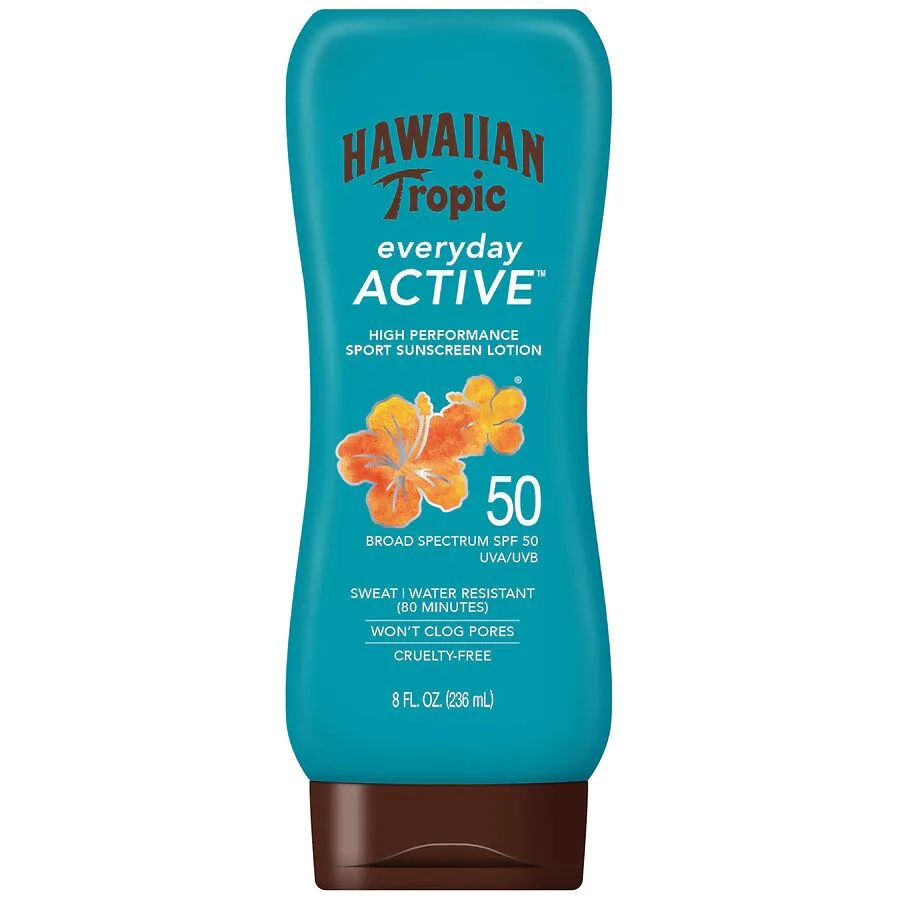
Hawaiian Tropic's most performance-oriented sunscreen delivers SPF 50 protection with 80-minute water resistance while keeping the brand's tropical sensory identity intact. A reliable sport sunscreen at an excellent price point, though the fragrance and older-generation UV filters keep it a step behind the most advanced global formulations.
The case for it
Same rule for everyone. “Full protection” is the verdict on 2,288 of 45,024 concern verdicts across the catalog; rule P1 decided 2,232 of them. Unchanged since September 5, 2026, engine 5.1.1.
Brand or formulator? Disclose a concentration or correct a fact →
The studies behind the evidence row
Does the jobDoes what a sunscreen is for: UVA coverage, holds up in sunlight. Not measured from the label: pleasant enough to actually use.
A verdict is DermApproved’s assessment of how well a product’s ingredients fit a concern — never a claim about what the product treats. Evidence dots and collected reviews sit beside it and are never blended in. Rules 0.5.1 · evidence table ev-2026.09-r228 · how we decide
Sport sunscreens tend to be utilitarian. They smell clinical, feel heavy, and treat application as an obligation rather than an experience. Hawaiian Tropic's Island Sport SPF 50 takes a different approach: it delivers serious sun protection while actively trying to make you enjoy putting it on. Whether this strategy is brilliant marketing or formulation frivolity depends on how much you value the experience of sunscreen application — but the UV protection underneath the tropical scent is genuinely solid.
The filter system uses four chemical actives. Homosalate at 9% — near its FDA-permitted maximum of 15% — carries the heaviest UVB load. Octocrylene at 5% provides additional UVB absorption while serving its critical role as an avobenzone photostabilizer. Octisalate at 4% supplements UVB coverage and enhances the formula's water-resistance characteristics. Avobenzone at 2.7% handles UVA protection. Together, this quartet delivers the SPF 50 broad-spectrum designation, meaning it passed both UVB (SPF) and UVA (critical wavelength) testing requirements.
The key upgrade over the SPF 30 Everyday Active variant is concentration. Higher filter loads mean more UV absorption capacity per unit area, which translates to a more forgiving margin for real-world under-application. Most people apply roughly half the recommended sunscreen amount. An SPF 50 at half-dose still delivers approximately SPF 25 protection — still above the minimum recommended threshold — while an SPF 30 at half-dose drops to about SPF 12. This mathematical buffer is the real advantage of SPF 50, not the marginal difference in laboratory UVB blocking (98% vs 97%).
The formula adds value beyond UV filtering. Sodium ascorbyl phosphate, a stable water-soluble form of vitamin C, provides antioxidant support against the free radicals generated by UV radiation that inevitably penetrates any sunscreen. Aloe vera juice soothes skin that is exposed to sun, wind, and physical activity. Mango seed butter offers emollient moisture and additional antioxidants. Panthenol conditions. The tropical botanical extracts — papaya, passionfruit, plumeria, guava — contribute to the sensory experience and provide trace antioxidant benefits.
On the skin, the lotion spreads with good slip — important for achieving the even, thick film needed for the rated SPF. It absorbs within two to three minutes into a semi-matte finish that is comfortable for active wear. The formula does not feel occlusive or suffocating, which is critical for a product designed to be worn during exercise and water sports. In humid conditions, some users report a light tackiness, but this generally resolves once the formula fully sets. Give it the standard fifteen-minute head start before sun exposure so the film can organize itself, and note one performance detail that active users prize: it stays out of the eyes even during heavy sweating, which is far from guaranteed in the sport category and matters enormously mid-run or mid-set.
The tropical fragrance is the defining sensory characteristic. It is unmistakably Hawaiian Tropic — coconut-forward with floral-fruity notes that evoke beach culture. This is polarizing by design. For those who enjoy it, the scent transforms sunscreen application from a health chore into a mini-ritual. For those who find fragrance irritating, unnecessary, or simply too strong, no amount of UV protection redeems the experience. The fragrance is persistent, remaining noticeable for at least thirty minutes after application.
Water and sweat resistance at 80 minutes meets the FDA maximum claim. In practice, vigorous swimming and toweling will degrade the protective film before the 80-minute mark. Post-swim reapplication is essential. The flip side of a film this durable is the end-of-day removal: the acrylate polymers that hold it through eighty minutes of water do not surrender to a splash of cleanser, so plan on a proper double cleanse at night — an oil or balm first, then a regular wash — especially on the face. The formula's ability to resist sweat makes it genuinely suitable for outdoor exercise, running, hiking, and team sports.
At roughly eleven dollars for eight ounces, the value proposition is excellent for a high-SPF sport sunscreen. The bottle provides approximately eight full-body applications — enough for two to three beach outings if you are reapplying properly. For families, athletes, and anyone who needs to apply sunscreen frequently and generously, the affordable price makes proper usage quantities financially sustainable. The audience boundaries are worth naming plainly. Very sensitive facial skin can find this quartet of chemical filters plus fragrance irritating, and rosacea-prone skin should sit this one out altogether — a fragrance-free mineral formula is the safer beach companion there. Acne-prone faces should also watch how their skin responds to the richer film. For everyone else, including during pregnancy, the formula raises no particular flags, and the vegan, cruelty-free, oxybenzone-free credentials cover the most common objections to a mass-market chemical SPF.
The limitations are the same as any US-market chemical sunscreen: the filter palette is restricted to FDA-approved actives that lag behind the newer-generation filters available in Europe and Asia. Homosalate and octocrylene are effective but have faced increasing scrutiny from both environmental and health-conscious consumers. Hawaiian Tropic deserves credit for removing oxybenzone — the most scrutinized filter — but the broader conversation about chemical sunscreen safety continues to evolve.
As a sport and outdoor activity sunscreen, this delivers what matters: reliable high-SPF protection, water resistance, comfortable wearability, and a price that encourages generous application. The tropical identity is either a bonus or a limitation depending on personal preference. Either way, it works. Three thousand reviews averaging 4.5 stars confirm the shape of the bargain: the praise clusters around dependable protection, the vacation-in-a-bottle scent, and the value of the big bottle, while the complaints are the humidity tack, the scent's intensity for those who didn't want a vacation, and the effort of washing it all off at night — each one the cost of a feature doing its job.
The hero actives that drive this product's performance.
| Ingredient | Function | Evidence |
|---|---|---|
| Avobenzone (2.7%) (2.7%) | The primary UVA filter providing protection against the deeper-penetrating radiation responsible for photoaging and melanoma risk. At 2.7% — higher than in the SPF 30 Everyday Active variant — avobenzone provides enhanced UVA coverage in this higher-SPF formula, stabilized by octocrylene to prevent photodegradation during extended outdoor use. | Regulator-approved for Sun Damage · emerging certainty |
| Homosalate (9%) (9%) | The dominant UVB filter at near-maximum concentration, providing the primary sunburn prevention that drives the SPF 50 rating. At 9%, homosalate absorbs a significant proportion of medium-wave UV radiation, working alongside octisalate to create a robust UVB shield for extended sport and water activities. | Regulator-approved for Sun Damage · limited certainty |
| Octisalate (4%) (4%) | A secondary UVB filter that supplements homosalate's coverage and improves the water resistance of the sunscreen film. Octisalate also enhances the solubility of avobenzone in the formula, contributing to a more uniform UV-protective film across the skin surface during sport activities. | Regulator-approved for Sun Damage · limited certainty |
| Sodium Ascorbyl Phosphate (Vitamin C) | A stable vitamin C derivative that provides antioxidant protection against free radicals generated by UV exposure that penetrates the sunscreen filter layer. In a sport sunscreen designed for extended outdoor use, this antioxidant backstop helps neutralize oxidative damage that even SPF 50 cannot fully prevent. | Limited for Sun Damage |
| Aloe Barbadensis Leaf Juice | Provides soothing and anti-inflammatory benefits for skin exposed to sun, heat, and physical activity. In a sport sunscreen likely worn during outdoor exercise, aloe vera helps counteract the skin stress from combined UV exposure, sweating, and environmental elements. | Not yet assessed |
Ingredient standings describe the active at treatment-level doses and vehicles; this product's own condition grades weigh its actual formula.
Active Ingredients: Homosalate 9%, Octocrylene 5%, Octisalate 4%, Avobenzone 2.7%. Inactive Ingredients: Water/Aqua, Diisopropyl Adipate, Cetearyl Alcohol, Glycerin, Phenoxyethanol, Benzyl Alcohol, Acrylates/C12-22 Alkyl Methacrylate Copolymer, Fragrance/Parfum, C12-15 Alkyl Benzoate, Acrylates/C10-30 Alkyl Acrylate Crosspolymer, Ceteth-10 Phosphate, Dicetyl Phosphate, Coco-Glucoside, Chlorphenesin, Xanthan Gum, Dimethicone, Sodium Hydroxide, Disodium EDTA, Mangifera Indica (Mango) Seed Butter, Tocopheryl Acetate, Carica Papaya (Papaya) Fruit Extract, Mangifera Indica (Mango) Fruit Extract, Passiflora Incarnata Fruit Extract, Plumeria Acutifolia Flower Extract, Psidium Guajava Fruit Extract, Panthenol, Aloe Barbadensis Leaf Juice, Sodium Ascorbyl Phosphate
sunscreen
AM
Apply generously 15 minutes before sun exposure. For sport and water activities, this is designed to be used alone on skin — layering under other products is unnecessary for outdoor activity use. Reapply every 2 hours or immediately after swimming or towel-drying.
Immediate broad-spectrum UV protection. Water and sweat resistance for up to 80 minutes. No long-term skin improvement expected — this is a protective product designed for active outdoor use.
This SPF 50 formula achieves its higher protection rating primarily through increased UV filter concentrations compared to the SPF 30 variant. Homosalate at 9% provides strong UVB absorption centered around 306 nm. The photostabilization of avobenzone by octocrylene follows the same mechanism described for the SPF 30 Everyday Active — octocrylene absorbs excited-state energy from photoactivated avobenzone, preventing molecular degradation and maintaining UVA protection over time.
The practical significance of SPF 50 versus SPF 30 is often misunderstood. Under controlled laboratory conditions using 2 mg/cm² application density, SPF 50 blocks 98% of UVB while SPF 30 blocks 97%. However, real-world application studies consistently show that consumers apply 0.5-1.0 mg/cm² — roughly 25-50% of the tested amount. One trial published in the British Journal of Dermatology (2012) demonstrated that effective SPF decreases exponentially with application density. At half-dose, SPF 50 delivers approximately SPF 25 protection, while SPF 30 delivers approximately SPF 12. This application buffer makes SPF 50 more forgiving of real-world behavior.
Sodium ascorbyl phosphate is a stable, water-soluble derivative of vitamin C that is enzymatically converted to active ascorbic acid in the skin. Work appearing in Skin Pharmacology and Physiology has shown that topical vitamin C provides photoprotective effects by neutralizing reactive oxygen species generated by UV radiation that penetrates sunscreen filters. This antioxidant layer provides a secondary defense mechanism beyond the primary UV filtering.
Working dermatologists recommend SPF 30 as the minimum for daily use and SPF 50+ for extended outdoor activity, making this product well-suited for its intended sport use case. Dermatologists appreciate the broad-spectrum designation and the oxybenzone-free reformulation. The inclusion of antioxidants (vitamin C, vitamin E) aligns with dermatological recommendations to pair sunscreen with antioxidant support for comprehensive photoprotection. However, dermatologists would note that the fragrance is unnecessary from a skin health perspective and adds sensitization risk, particularly in a product applied to sun-heated skin during physical activity. For patients with photodermatoses or skin cancer history, dermatologists would recommend mineral sunscreens or those with newer-generation filters where available.
Apply generously to all exposed skin 15 minutes before outdoor activity. Use approximately one ounce (a full shot glass) for full-body coverage. For face and neck, use a nickel-sized amount. Reapply every 2 hours, or immediately after swimming, sweating heavily, or towel-drying. For water activities, allow the sunscreen to set for 15 minutes on dry skin before entering water. Don't forget commonly missed areas: ears, back of neck, tops of feet, and scalp part line.
At approximately $10.97 for 8 fluid ounces, this is one of the most affordable SPF 50 sport sunscreens on the market at $1.37 per ounce. Compared to performance-oriented sport sunscreens that often run $12-18 for 6 ounces, Hawaiian Tropic's pricing makes proper application quantities financially realistic. A family of four applying one ounce each and reapplying twice during a beach day would use roughly 12 ounces — about $18 worth of this product. For frequent outdoor users, athletes, and families, the price-to-protection ratio is genuinely excellent.
Active outdoor enthusiasts, swimmers, runners, hikers, and beachgoers who need reliable high-SPF protection for extended sun exposure. Ideal for families who need to protect multiple people without premium pricing. Great for anyone who enjoys the tropical sunscreen experience and finds it motivating for consistent application.
Those with fragrance sensitivities, sensitive skin, or rosacea should choose fragrance-free alternatives. Anyone wanting mineral-only sun protection for reef-safety or chemical-avoidance preferences. People who need an elegant facial sunscreen for daily under-makeup wear. Not recommended for infants.
Ready to try Hawaiian Tropic Island Sport Sunscreen Lotion SPF 50?
Buy at Amazon ♥Medium-weight white lotion that spreads easily with good slip and absorbs into a semi-matte finish
Classic Hawaiian Tropic tropical fragrance — pronounced coconut and floral notes
Squeezable plastic bottle (8 fl oz) with flip-top cap. Large format designed for generous full-body application.
Spreads easily with adequate slip for full-body application. Tropical scent is immediately noticeable. Absorbs within 2-3 minutes. Sets to a comfortable, non-sticky finish on most skin. Slight shimmer-free matte appearance once absorbed.
2-4 weeks with regular outdoor activity use; 8 full-body applications per bottle
spring summer
The Island Sport line represents Hawaiian Tropic's answer to the performance sunscreen category dominated by brands like Neutrogena and Coppertone Sport. Rather than abandoning the brand's tropical identity for a purely utilitarian approach, Hawaiian Tropic kept the botanical infusion and signature scent while engineering the formula to withstand water, sweat, and extended UV exposure. The result is a sport sunscreen that smells like a beach vacation rather than a chemistry lab.
Hawaiian Tropic was founded in 1969 by Ron Rice in Daytona Beach, Florida. Now owned by Edgewell Personal Care, the brand has over five decades of sunscreen formulation experience and broad mass-market distribution across the US and internationally.
SPF 50 provides significantly more protection than SPF 30
SPF 50 blocks approximately 98% of UVB rays versus 97% for SPF 30 — a marginal difference. The practical advantage of SPF 50 is that it provides a larger buffer for real-world under-application. Since most people apply only 25-50% of the recommended amount, an SPF 50 product used at half-dose still delivers roughly SPF 25 protection.
Water-resistant sunscreen doesn't need to be reapplied after swimming
Water resistance is rated at 80 minutes under FDA testing conditions. After 80 minutes of water exposure, the protective film is significantly compromised. Reapply immediately after swimming, and every 2 hours regardless of water exposure. Toweling off also removes sunscreen.
No sunscreen is waterproof — the FDA banned that term. This product is water-resistant for up to 80 minutes, the maximum rating allowed. After 80 minutes of swimming or sweating, reapply immediately. On dry land, reapply every 2 hours regardless.
Yes, though the fragrance and heavier sport formula may not suit those who prefer lightweight facial sunscreens. For beach and pool days, it works fine on the face. For daily facial use under makeup, a dedicated face SPF would be more comfortable.
No, this formula is oxybenzone-free. The UV protection comes from four filters: homosalate, octocrylene, octisalate, and avobenzone. This reformulation addresses both reef-safety and personal chemical exposure concerns associated with oxybenzone.
Use approximately one ounce (a full shot glass) for complete body coverage. For face and neck alone, use a nickel-sized amount. Most people under-apply sunscreen by 50-75%, which dramatically reduces the effective SPF. The 8 oz bottle provides about 8 full-body applications.
It is oxybenzone-free, addressing one major reef-toxicity concern. However, it contains octocrylene, homosalate, and octisalate, which some environmental organizations also flag. For maximum reef safety, mineral zinc oxide or titanium dioxide sunscreens are the most cautious choice.
Recurring themes our editors read across retailer reviews of this product — summaries in our words, not quotations, and not a substitute for your own patch test.
Reliable high-SPF protection for beach and outdoor activities
Pleasant tropical scent feels like a vacation
Non-greasy and absorbs well for a sport sunscreen
Excellent value for a large bottle of SPF 50
Does not sting eyes even during heavy sweating
Tropical fragrance can be overpowering for some users
Can leave a slightly sticky film in very humid conditions
Chemical filters may irritate very sensitive facial skin
Needs thorough cleansing to fully remove at end of day
Verified answers from our questions library — the nuance a product page cannot carry.