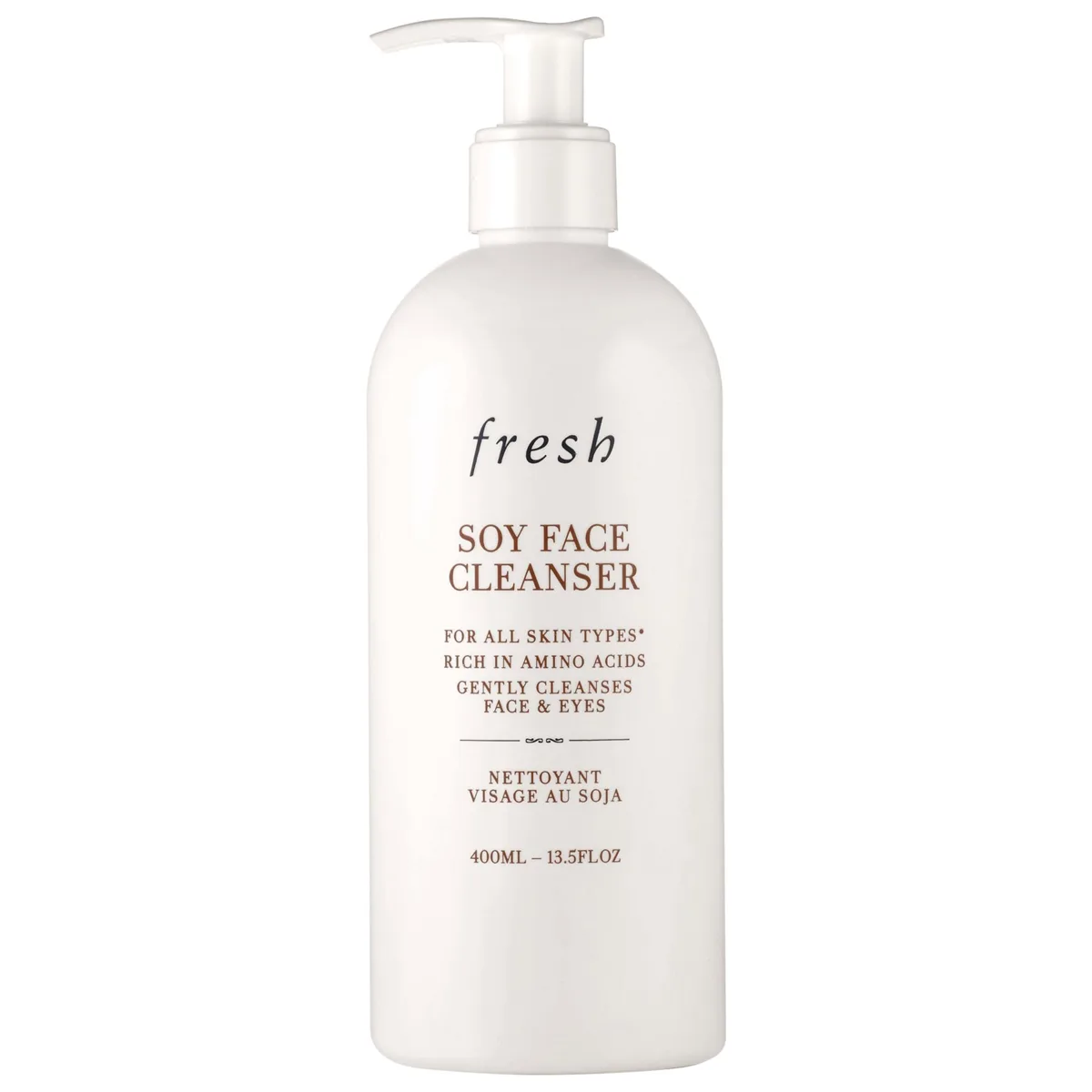
Fresh pioneered the use of soy proteins in skincare when this launched in 1999 — before any other brand had explored soy for skin. The formula approaches cleansing as a hydration step rather than a stripping one: amino acid-rich hydrolyzed soy protein forms a moisture-retaining film while the ultra-gentle coco-glucoside surfactant lifts impurities without disrupting the skin's pH or lipid barrier. It's also ophthalmologist-tested for direct eye contact — a rare distinction for a face wash.
The cleanser that launched a brand and hasn't stopped selling for 25 years. Fresh's Soy Face Wash is about as close to universally good as a cleanser gets — pH-balanced, barrier-respecting, and gentle enough for eyes. The premium price for a wash-off product is its only real weakness.
Good choicefor SensitivityIn your profileYou chose · No fragrance, drying alcohol, declarable allergens or sensitising preservatives in this gel — the profile sensitive skin looks for.Not yet assessedGentleNo reviews collected yet
The case for it
Cucumis Sativus has no evidence row yet for this concern — it is in the research queue.
The formula carries none of the triggers this concern is sensitive to.
What would change this: A researched evidence row for the lead active would replace this with a verdict.
Same rule for everyone. “Good choice” is the verdict on 1,938 of 45,024 concern verdicts across the catalog; rule F2 decided 1,938 of them.
Unchanged since September 5, 2026, engine 5.1.1.
Supporting rolefor DehydrationIn your profileYou chose · Rinse-off gel: Aloe Vera gets seconds of contact, so this supports a routine for dehydration rather than treating it.Moderate evidenceGentleNo reviews collected yet
The case for it
Aloe Barbadensis Leaf Juice has trial-supported standing for this concern.
It is in a rinse-off product, so it gets seconds of contact rather than the leave-on exposure the evidence assumes.
The formula carries none of the triggers this concern is sensitive to.
What would change this: The same active in a leave-on form would be judged on its evidence rather than its contact time.
Same rule for everyone. “Supporting role” is the verdict on 8,197 of 45,024 concern verdicts across the catalog; rule R6 decided 2,017 of them.
Unchanged since September 5, 2026, engine 5.1.1.
R6 — Contact time cannot deliver a leave-on claim; the product is judged on its job (cleansing without aggravating). Explicit exceptions (BPO wash, SA cleanser, medicated shampoos) never reach this rule because their rows set rinse_off_ok. · the full register
Carrying active
Aloe Barbadensis Leaf Juice
Standing
supported — its mechanism is established
Form
contact limited
Tolerability
gentle
Row checked
against its sources on July 17, 2026 (evidence table ev-2026.09-r228)
The studies behind the evidence row
International Cosmetic Ingredient Dictionary and Handbook — declared function — Personal Care Products Council
Cosmetic Ingredient Review — safety assessment and reported function — CIR Expert Panel
Also listed for Dryness, Compromised Skin Barrier and Dullness — the actives here (Cucumber, Borage Seed Oil, Soybean (Glycine Soja) are in our research queue for those concerns; there is no verdict until their evidence rows are written. That is a gap in our table, not a mark against the product.
Excellent at the jobDoes what a cleanser is for, on every measure we can take from the label: pH match to skin, surfactant mildness.
A verdict is DermApproved’s assessment of how well a product’s ingredients fit a concern — never a claim about what the product treats. Evidence dots and collected reviews sit beside it and are never blended in.
Rules 0.5.1 · evidence table ev-2026.09-r228 · how we decide
Assessment
Pros & Cons
Pros
✓ pH-balanced at approximately 5.5 to match the skin's acid mantle — preserves barrier for subsequent actives
✓ Hydrolyzed soy protein creates a moisture-retaining film during cleansing rather than stripping
✓ Borage seed oil provides the richest plant source of GLA for essential fatty acid replenishment
✓ Ophthalmologist-tested for direct eye contact and safe for contact lens wearers
✓ Ultra-gentle coco-glucoside surfactant with no sulfates — 97% reported no moisture stripping in clinical testing
✓ Silicone-free, paraben-free, sulfate-free with a clean preservative system
✓ 25+ years of market validation with 9,000+ Sephora reviews and a 4.5-star average
Cons
✗ Premium pricing of $39 for a wash-off product — 150 mL tube lasts only 2-3 months
✗ Cannot remove heavy or waterproof makeup on its own — needs an oil cleanser as first step
✗ May not feel 'clean enough' for users accustomed to foaming or deep-cleansing formulas
✗ Contains trace Rosa Damascena Flower Oil contributing citronellol and geraniol fragrance allergens
Review
Full Review
In 1999, Lev Glazman and Alina Roytberg had a small problem. Their Boston apothecary, Fresh, was doing well selling artisan soaps, but they wanted to make a skincare product. The couple had noticed something happening in the wellness world: soy was everywhere. Soy milk, soy supplements, soy everything. But nobody had thought to put soy proteins on your face. They did, and the result was a cleanser so successful it sold one tube every 30 to 60 seconds worldwide and caught the attention of LVMH, who acquired the brand the following year.
Twenty-five years later, the Soy Face Cleanser remains Fresh's top seller. That kind of longevity isn't an accident. Products that survive a quarter century of reformulation trends, ingredient fads, and skincare 'revolutions' do so because they solve a fundamental problem well. In this case: how do you clean your face without ruining it in the process?
The answer starts with coco-glucoside, a surfactant derived from coconut sugar. It's one of the gentlest cleansing agents in commercial skincare — no sulfates, no stripping, no disruption to the acid mantle. Fresh pairs it with hydrolyzed soy protein, which is where the formula gets interesting. These broken-down soy peptides act as humectants during the cleansing process, forming a moisture-retaining film on the skin even as the surfactant lifts away dirt and oil. The net effect is that you finish washing your face with more moisture on your skin than you started with. It sounds like marketing, but it's a consistent observation across thousands of reviews: this cleanser leaves skin feeling hydrated rather than tight.
The supporting ingredients are thoughtfully chosen for a wash-off product. Borage seed oil — the richest known plant source of gamma-linolenic acid — replenishes the essential fatty acids that even gentle surfactants can remove. Sunflower seed oil adds linoleic acid for barrier support. Aloe, cucumber extract, and cornflower water provide a triple layer of soothing that calms skin during the brief contact time. Panax ginseng root extract contributes antioxidant activity. And the Rosa Damascena complex (extract, flower water, and flower oil) adds both functional polyphenols and the cleanser's signature light scent.
The pH is matched to the skin's natural acid mantle at approximately 5.5. This matters more than most people realize. A cleanser with a high pH — even a gentle one — temporarily disrupts the acid mantle, weakening the barrier and making skin more susceptible to irritation from subsequent products. By matching the skin's own pH, this cleanser allows you to layer actives (retinol, vitamin C, AHAs) immediately afterward without the barrier compromise that high-pH cleansers create.
On the skin, the gel texture is silky and light, producing a low-lather rinse rather than a dramatic foam. This takes some adjustment if you're used to foaming cleansers — the instinct is to think 'it's not working' because there are no bubbles. It is working. The clinical testing on nearly 200 adults showed 97% reported no moisture stripping. That number is remarkably high for any cleanser at any price point.
The ophthalmologist testing is a genuine differentiator. This cleanser is safe for direct eye contact and for contact lens wearers. If you wear eye makeup daily, you can use this directly on closed eyes without the stinging that most cleansers cause. It won't dissolve waterproof mascara on its own — for that, you need an oil-based first cleanse — but for everyday makeup removal including eye area, it works surprisingly well for a gel cleanser.
The scent is a subtle cucumber-rose note that disappears the moment you rinse. It comes from natural Rosa Damascena Flower Oil, which means trace amounts of Citronellol and Geraniol are present. In a wash-off product with thirty seconds of skin contact, this is a minimal concern for most people, but those with diagnosed fragrance contact allergy should note it.
The value question is the only real point of tension. At $39 for 150 mL, this is expensive for something you rinse down the drain. The jumbo 400 mL size at $78 offers better per-ounce economics and is the smarter buy for committed users. But the honest assessment is this: you can find gentle, pH-balanced, sulfate-free cleansers at the drugstore for $10-15 that will effectively clean your face without stripping it. What you won't find at that price is the specific soy protein hydration effect, the borage oil barrier support, the triple-soothing botanical system, and the refined texture that makes washing your face feel like a genuinely pleasant experience rather than a chore. That experience gap is what you're paying for, and after 25 years and 9,000+ Sephora reviews, the market has clearly decided it's worth it.
This isn't a flashy product. It doesn't promise visible transformation, it doesn't have a trending ingredient, and it won't generate before-and-after content. What it does is the most important thing a cleanser can do: it cleans your skin while leaving the barrier intact. Every product you apply afterward works better because of it. That's the kind of quiet excellence that keeps a product selling one tube a minute for a quarter century.
Formula
Key Ingredients
The hero actives that drive this product's performance.
The signature ingredient — amino acid-rich soy proteins act as humectants, forming a moisture-retaining film on skin during cleansing. Works alongside the gentle coco-glucoside surfactant to ensure the cleansing process adds moisture rather than stripping it, turning a wash-off step into a hydration event.
The richest known plant source of gamma-linolenic acid (GLA), an omega-6 fatty acid that supports barrier repair. In this gel cleanser, it replenishes essential fatty acids that surfactants might otherwise strip away, working alongside sunflower seed oil to maintain the skin's lipid barrier during cleansing.
Provides immediate soothing and anti-inflammatory action during the cleansing process. Works synergistically with cucumber extract and cornflower water to create a triple-soothing system that calms reactive skin while the surfactants lift impurities.
Contains amino acids and organic acids that support the skin's acid mantle, reinforcing the pH-balancing action of this formula. Provides cooling and calming benefits and contributes to the cleanser's signature fresh scent.
Triple presence of damask rose delivers antioxidant polyphenols and mild antimicrobial properties during cleansing. The rosewater and extract provide soothing benefits while the oil contributes the gentle natural fragrance note.
Not yet assessed
Ingredient standings describe the active at treatment-level doses and
vehicles; this product's own condition grades weigh its actual formula.
Use as a standalone AM cleanser or as a second cleanser in a PM double-cleanse routine after an oil-based makeup remover. Ophthalmologist-tested and safe to use around the eyes. Follow with toner, serum, and moisturizer.
Results Timeline
Immediate — skin feels clean, soft, and hydrated after first use with no tightness. Within 1-2 weeks of consistent use, skin feels more balanced and less reactive. Over 4-8 weeks, improvements in overall texture, pore appearance, and reduced redness from a healthier barrier.
Pairs Well With
Hydrating tonersCeramide moisturizersRetinol treatmentsVitamin C serumsAHA/BHA exfoliants
The formulation philosophy behind this cleanser centers on preserving the skin's acid mantle during cleansing — a concept that has gained significant scientific validation since the product launched in 1999. A landmark 2006 study published in the International Journal of Cosmetic Science (Lambers et al.) established that healthy skin surface pH averages approximately 4.7-5.5, and that cleansers with higher pH values temporarily disrupt this barrier, increasing transepidermal water loss and microbial susceptibility.
Coco-glucoside, the primary surfactant, is a non-ionic glucoside surfactant with a critical micelle concentration (CMC) that allows effective cleansing at lower concentrations than anionic surfactants like SLS. Its molecular structure — glucose linked to a fatty alcohol via a glycosidic bond — produces minimal interaction with skin proteins and lipids, resulting in significantly less barrier disruption than sulfate-based alternatives.
Hydrolyzed soy protein contributes amino acids including serine, glutamic acid, and aspartic acid — components of the skin's natural moisturizing factor (NMF). A 2004 study in the Journal of Cosmetic Dermatology documented that soy proteins support skin elasticity and hydration through their ability to form hydrophilic films on the skin surface. The hydrolysis process breaks proteins into peptide fragments small enough to interact with the stratum corneum during the brief cleansing contact time.
Borago officinalis seed oil is the richest known plant source of gamma-linolenic acid (GLA), containing approximately 20-24% GLA by weight. A 2002 study published in the Journal of Dermatological Treatment (Kanehara et al.) demonstrated that topical GLA application improved barrier function in subjects with disrupted skin barriers, reducing transepidermal water loss. In a cleanser context, the borage oil works to replenish fatty acids that even gentle surfactants remove from the intercellular lipid matrix.
The combination of glycerin (a well-established humectant at the third position in the INCI) with the soy protein film creates a dual hydration mechanism during cleansing: glycerin draws moisture to the skin surface while the protein film reduces its evaporation during and after rinsing.
Soy protein and peptides in skin care — Journal of Cosmetic Dermatology (2004)
Effect of borage oil on barrier function in experimentally induced skin disorders — Journal of Dermatological Treatment (2002)
Dermatologist Perspective
Dermatologists widely recommend gentle, pH-balanced cleansers as the foundation of any skincare routine, and this product aligns well with that guidance. Practitioners consistently recognize that over-cleansing with high-pH or sulfate-based cleansers is one of the most common causes of barrier dysfunction, dryness, and irritation. The coco-glucoside surfactant, soy protein film, and matched pH of approximately 5.5 are all dermatologically sound choices. The ophthalmologist testing adds a practical advantage for patients who need to cleanse the periorbital area without irritation. Dermatologists would note that while this is an excellent daily cleanser, it should not be relied upon for removing sunscreen or heavy makeup — a dedicated oil cleanser should precede it in a double-cleansing routine for thorough removal.
Guidance
Usage & Recommendations
How to Use
Wet face with lukewarm water. Squeeze a nickel-sized amount into palms and work into a gentle lather. Massage over the face, including the eye area if desired (ophthalmologist-tested). Rinse thoroughly with lukewarm water. Use morning and evening. In PM routines with heavy makeup or sunscreen, use as a second cleanse after an oil-based makeup remover for thorough removal.
Value Assessment
At $39 for 150 mL, this is undeniably premium for a wash-off product. The jumbo 400 mL size at $78 ($5.78/oz vs. $7.80/oz) is significantly better value and the recommended purchase for regular users. The formulation is genuinely refined — the soy protein hydration film, borage oil barrier support, and pH-matching technology justify some premium over basic gentle cleansers. However, excellent sulfate-free, pH-balanced cleansers exist at the $10-15 range. What you're paying for beyond cleansing efficacy is the specific soy-and-borage hydration mechanism, the botanical soothing complex, and the refined user experience that has earned this product 25 years of loyalty.
Who Should Buy
Anyone looking for a gentle, hydrating daily cleanser that won't compromise their skin barrier. Particularly well-suited for sensitive, dry, and normal skin types, people who wear contact lenses, and those who want a cleanser compatible with active treatments like retinol, vitamin C, and exfoliating acids. An excellent choice for skincare beginners building a foundation routine.
Who Should Skip
Those with very oily skin who prefer a stronger cleansing sensation may find this too gentle. Anyone who needs a single-product makeup remover for heavy or waterproof cosmetics should look for an oil cleanser instead. Budget-conscious shoppers can find adequate gentle cleansers for $10-15, though the formulation refinement here is real. People with soy allergies should note the hydrolyzed soy protein, though allergenicity is significantly reduced through hydrolysis.
Ready to try Fresh Soy pH-Balanced Hydrating Face Wash?
Lightweight, silky gel that produces a gentle, low-foaming, conditioning lather. Not a heavy foam — more of a soft, creamy rinse that glides over the skin.
Scent
Light, fresh cucumber-rose scent from natural cucumber extract and Rosa Damascena ingredients. Noticeable but not overwhelming. Fades immediately upon rinsing.
Packaging
Clear squeeze tube with Fresh branding in simple, functional design. Available in 50 mL, 150 mL, and 400 mL sizes. Practical and hygienic tube format.
Finish
non-greasylightweight
What to Expect on First Use
Immediate comfort on first use — skin feels clean but never stripped or tight. No adjustment period, purging, or irritation for most users. The gentle gel texture and light cucumber scent are the first things users notice. Many describe it as the first cleanser that doesn't leave their skin feeling dry.
How Long It Lasts
2-3 months applied morning and night (150 mL size)
When soy exploded as a superfood in the 1990s, Fresh founders Lev Glazman and Alina Roytberg saw untapped potential for skincare — no beauty brand had explored soy's amino acid-rich proteins for skin. This cleanser launched in 1999 as Fresh's very first skincare product and became the hit that led to LVMH acquiring the brand in 2000. Over 25 years later, it remains their top seller, moving one tube every 30-60 seconds globally.
About Fresh Legacy Brand (20+ years)
Fresh was founded in 1991 in Boston and became an LVMH maison in 2000. The Soy Face Cleanser was their very first skincare product (1999) and remains their top seller over 25 years later, selling one tube every 30-60 seconds globally.
Brand founded: 1991 · Product launched: 1999
Myth vs. Reality
Common Myths
Myth
Soy in skincare disrupts hormones and is unsafe during pregnancy
Reality
The hydrolyzed soy protein in this cleanser is broken down into small peptides and amino acids, structurally different from the soy isoflavones (phytoestrogens) that raise concerns. In a wash-off product with brief skin contact, absorption is negligible. The cleanser is widely considered pregnancy-safe, though those with active melasma should consult their doctor.
Myth
A non-foaming cleanser can't truly clean your skin
Reality
Foam volume has zero correlation with cleansing effectiveness. Coco-glucoside, this formula's plant-derived surfactant, effectively lifts dirt, oil, and light makeup without the harsh stripping of sulfate-based foaming agents. In clinical testing with nearly 200 adults, 97% reported the cleanser did not strip skin of moisture.
Myth
This cleanser can replace a dedicated makeup remover for heavy or waterproof makeup
Reality
While ophthalmologist-tested and effective for light to moderate everyday makeup, this is a gentle gel cleanser, not a makeup-dissolving product. For heavy foundation, waterproof mascara, or long-wear sunscreen, use it as a second cleanse after a dedicated oil-based remover.
FAQ
Frequently Asked Questions
Is Fresh Soy Face Cleanser worth the price?
At $39 for 150 mL, this is premium pricing for a wash-off product. The jumbo 400 mL size at $78 offers better per-ounce value. The soy protein, borage seed oil, and ultra-gentle coco-glucoside surfactant create a genuinely exceptional cleansing experience — it's one of the few cleansers that leaves skin more hydrated after washing. Whether that justifies the premium over drugstore gentle cleansers depends on how much you value the formulation refinement.
Can Fresh Soy Face Cleanser remove makeup?
It effectively removes light to moderate everyday makeup, including eye makeup (it's ophthalmologist-tested for direct eye use). However, it cannot thoroughly remove heavy foundation, waterproof mascara, or long-wear sunscreen on its own. For full makeup removal, use it as a second cleanse after an oil-based makeup remover.
Is Fresh Soy Face Wash safe during pregnancy?
This cleanser is widely considered pregnancy-safe — it contains no retinoids, salicylic acid, or hydroquinone. The hydrolyzed soy protein is broken down into peptides, not the whole isoflavones that raise phytoestrogen concerns. As a wash-off product, absorption is negligible. Those with pregnancy-related melasma should consult their doctor regarding soy products.
Is Fresh Soy Cleanser good for acne-prone skin?
The gentle, non-stripping formula is generally well-tolerated by acne-prone skin, and maintaining the skin's natural pH helps preserve barrier function. However, this cleanser does not contain acne-fighting actives like salicylic acid or benzoyl peroxide. It works best as a gentle cleansing step paired with separate acne treatments in your routine.
What is the pH of Fresh Soy Face Cleanser?
Fresh formulates this cleanser to match the skin's natural pH of approximately 5.5. Clinical testing confirmed it does not disrupt the skin's acid mantle, which is critical for maintaining barrier function and preventing moisture loss during cleansing.
Does Fresh Soy Cleanser have fragrance?
The formula does not contain added synthetic fragrance, but it includes Rosa Damascena Flower Oil which provides a subtle natural scent and contains trace fragrance allergens (citronellol, geraniol). Most users describe the scent as a light, fresh cucumber-rose note that disappears upon rinsing.
Is Fresh Soy Cleanser fungal acne safe?
This cleanser is not considered fungal acne safe due to the presence of sunflower seed oil, borage seed oil, and caprylic/capric triglyceride, which may feed Malassezia yeast. However, as a wash-off product with brief skin contact time, the risk is lower than with leave-on products containing similar ingredients.
Reviews
What Reviewers Tend to Say
Recurring themes our editors read across retailer reviews of this product — summaries in our words, not quotations, and not a substitute for your own patch test.
Common Praise
Incredibly gentle — does not strip or dry out skin even with twice-daily use
Leaves skin feeling soft, hydrated, and comfortable rather than tight
Effectively removes light to everyday makeup including eye makeup
Pleasant, subtle cucumber-rose scent that doesn't linger
Safe for sensitive eyes and contact lens wearers
Works well for virtually every skin type
Common Complaints
Expensive at $39 for a wash-off cleanser that rinses down the drain
May not feel 'clean enough' for those accustomed to foaming cleansers
Cannot thoroughly remove heavy or waterproof makeup on its own
Contains natural fragrance from rose oil that may irritate very sensitive skin
Notable Endorsements
Sephora perennial bestsellerOphthalmologist-testedClinically tested on nearly 200 adults
The burn trials are real and the skeptics who dismiss aloe as folklore are wrong — but the same substance has delayed healing in other wounds, and none of it says anything about what a soothing gel does to intact skin.
The fourth most frequent positive patch test in North America is an oxidation product of a molecule that occurs naturally in lavender. Nobody synthesised it into your face cream.
The cheapest humectant on the ingredient list is also the best-studied, the most reliable in dry air, and the one your favorite moisturizer is quietly built around.
Products, answers, therapy guides, tools and articles in one search. Brand names,
slang and abbreviations all work — accutane finds isotretinoin, bacne finds truncal acne.