Dehydration vs Dryness, Bought Correctly
One is a shortage of oil, the other a shortage of water, and the products that fix them sit on the same shelf doing opposite jobs.
Read the preview
From the DermApproved blog, in Dryness and Dehydration: two problems, one aisle, opposite fixes. Dry skin is short of oil. Dehydrated skin is short of water. Labs measure them with different instruments, and having one tells you nothing about the other — which is why the costliest mistake here is the product that feels most obviously right. For the full breakdown, visit dermapproved.com/blog.
Two different shortages, two different instruments
The confusion is baked into the language. "Dry" is used for a sensation, a skin type, a temporary state and a clinical sign, and in casual use it covers both of the things this article is about. But in a lab they are measured separately, by different devices, and the results don't track each other.
Dryness in the technical sense is a lipid deficit. The stratum corneum's mortar — the intercellular lipid bilayers made of ceramides, cholesterol and free fatty acids — is depleted or disordered. This is largely constitutional: it's a skin type, it tends to run in families, it worsens with age as lipid synthesis declines, and it is the substrate underneath most eczema. It presents as flaking, roughness you can feel with a fingertip, and a matte or chalky look. Crucially, it does not resolve. You manage it.
Dehydration is a water deficit in that same layer, and it is a state rather than a type. It arrives from low humidity, hot water, over-cleansing, wind, air conditioning, a flight, a course of actives that stripped things too far. It presents as tightness, a papery crepe-like texture that shows up most around the eyes and on the cheeks when you smile, dullness, and fine lines that look worse in the morning and better by evening. It resolves, and reasonably quickly, when the cause is addressed.
The measurements make the distinction concrete. Corneometry reads the electrical capacitance of the surface layer, which tracks its water content — that's the dehydration axis. Transepidermal water loss is measured separately, as the rate at which water escapes through the barrier, and it is the closest proxy for how intact the lipid structure is. A person can have normal capacitance and elevated water loss, or the reverse. They are not the same number, and treating them as one is where the shopping goes wrong.
The combination that wastes the most money
Oily and dehydrated at the same time is extremely common, entirely coherent, and the single most misdiagnosed state in skincare — because every instinct points at the wrong shelf.
Here is why it's coherent. Sebum is produced by sebaceous glands under androgen control. Water content in the stratum corneum is a function of natural moisturising factor, barrier integrity and ambient humidity. These are separate systems. A comparative study of oily-skinned and dry-skinned participants measured facial sebum level, pore size and hydration as distinct variables precisely because they don't collapse into a single axis — you can be at the top of the sebum distribution and low on hydration simultaneously.
The experience of it is contradictory in a way that makes people distrust their own reading of their skin. Shiny by midday, tight after cleansing. Visible pores and visible fine crepe. Foundation that separates and clings to flaky patches on an oily face.
The error that follows is predictable. The shine is read as "oily," which sends people toward stronger cleansers, mattifying products, clay masks and acids — every one of which reduces water further while doing nothing about the tightness. Or the tightness is read as "dry," which sends them toward a rich occlusive cream that adds lipids to skin that already has plenty and delivers congestion for the money.
The correct response is to add water and leave the oil alone: humectants, a gentler cleanser, and a light emollient to hold it, with the mattifying instinct resisted entirely. A gel-cream such as Neutrogena Hydro Boost Gel-Cream is built for exactly this — water-phase heavy, light on lipids — and a booster like Vichy Minéral 89 Hyaluronic Acid Booster layered underneath does the humectant job without adding to the shine. Our skin type quiz separates these two axes deliberately rather than forcing you into one of four boxes, and the answers it produces feed the routine finder.
Humectant, emollient, occlusive — what each one is actually for
Three categories, three jobs. Nearly every product in the aisle is a blend of them, and reading a formula for the balance is more useful than reading it for a hero ingredient.
Humectants attract and hold water. Glycerin, hyaluronic acid, urea, panthenol, sodium PGA, propanediol. They are the direct answer to dehydration and they do very little for a lipid deficit. Glycerin is the least glamorous and the most reliable of them — small enough to move into the stratum corneum rather than sitting on it, and present at meaningful levels in almost every good moisturiser precisely because it works. Hyaluronic acid is the marketed one, sits higher in the layer, and works well in a formula that also seals it. Glycerin and hyaluronic acid are complements rather than competitors, which is why they appear together so often.
Emollients fill and smooth. Squalane, fatty alcohols, plant oils, esters, and physiological lipids like ceramides and cholesterol. They address the texture of dryness directly and they are what makes skin feel soft rather than merely damp. The physiological ones do more than smooth — they are replacement mortar.
Occlusives slow evaporation. Petrolatum, dimethicone, lanolin, waxes. They don't hydrate anything themselves; they retain what's already there, and they are what makes a humectant hold instead of evaporating.
The part most people get wrong is that these are sequential rather than alternative. A humectant applied with nothing on top of it in dry air is water sitting on a surface with an exit route — which is the actual explanation for the very common complaint that a hydrating serum made skin feel tighter. It didn't pull water out of the deeper skin in some dramatic way; it simply delivered water to a layer that then lost it, and left the surface feeling worse for the contrast. Apply the humectant to damp skin and put something over it, and the complaint disappears. Our hyaluronic acid ranking for dehydration filters for formulas that already handle this internally.
Barrier lipids work in ratio, and petrolatum is stranger than it looks
Two findings from barrier physiology change how you should read an ingredient list, and neither is intuitive.
The first is that the barrier lipids are a system with proportions, not a shopping list. When researchers applied ceramides, cholesterol or free fatty acids to perturbed skin, applying only one or two of the three actually delayed barrier recovery — worse than nothing. Only mixtures containing all three allowed normal repair, and recovery accelerated further when any one component was increased up to about threefold over an equimolar base. The composition matters more than the presence of a fashionable name on the front of the box.
This is why a well-built barrier cream lists ceramides alongside cholesterol and fatty acids rather than ceramides alone, and it's the strongest argument for buying formulated systems over single-ingredient products in this specific category. CeraVe Moisturizing Cream is the widely available example of a formula built on that principle, and Cetaphil Moisturizing Cream takes a different route to the same end with a glycerin-and-petrolatum backbone. Our ceramide ranking is organised around the same question, and the ceramide ingredient page goes into which forms actually appear in commercial formulas.
The second finding is about petrolatum, and it overturns the textbook description. The standard account is that petrolatum forms an impermeable film on the surface, trapping water — and that this should therefore delay the skin's own repair, because the barrier has no signal that it needs to rebuild. Researchers tested exactly that. Petrolatum accelerated barrier recovery rather than impeding it, and tracer studies found it distributed through the interstices at all levels of the stratum corneum, sitting where the intercellular bilayers sit. It doesn't act as a membrane on top of skin. It moves into the structure.
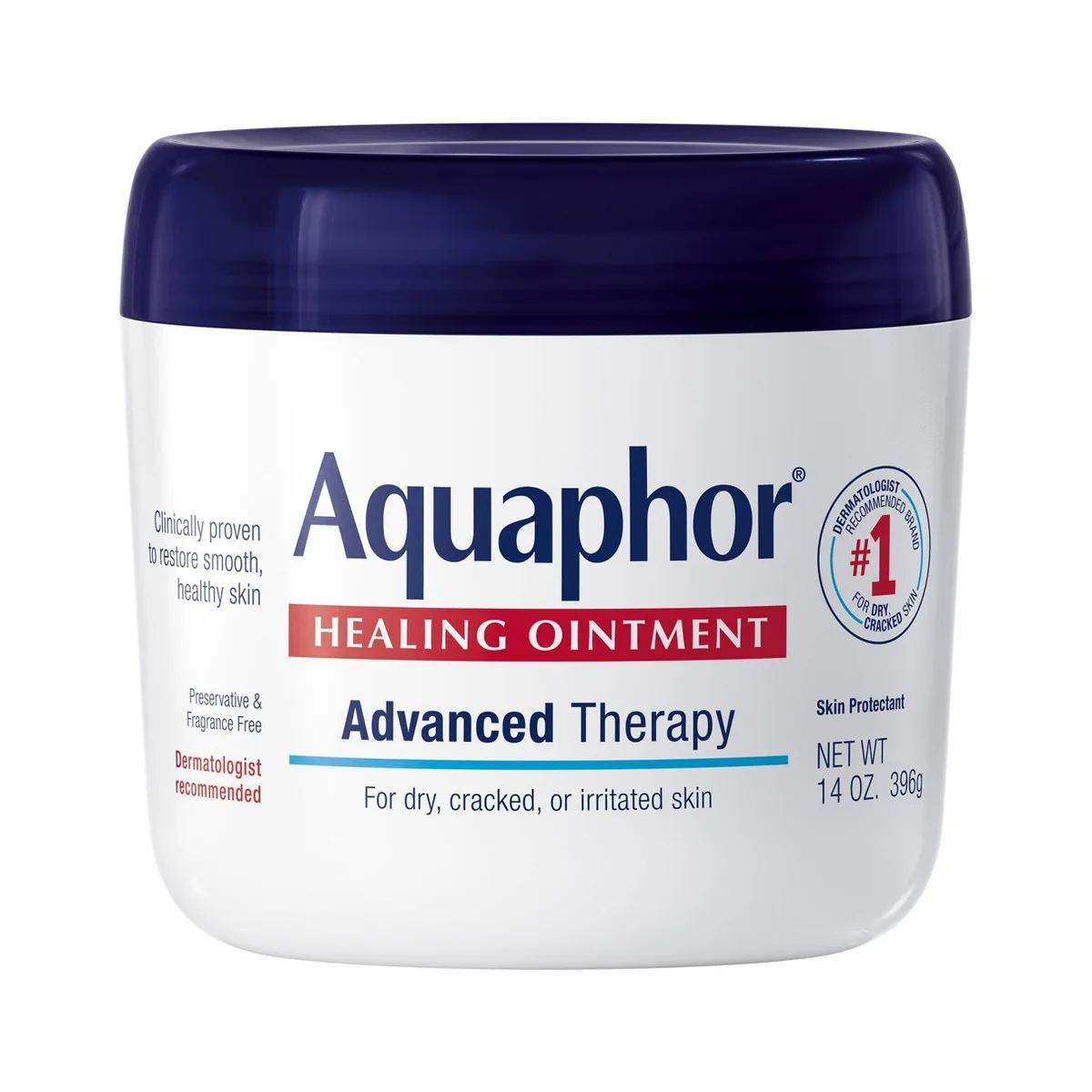
Which makes an ointment like Aquaphor Healing Ointment a more interesting product than its price suggests, and makes "just an occlusive" an inaccurate dismissal. For genuinely lipid-deficient skin, our dry-skin moisturiser ranking and the dry skin routine are built around this ordering rather than around richness for its own sake.
Testing which one you have, without equipment
You don't need a corneometer. Three checks, done honestly, separate the two states reliably enough to shop against.
The first is the cleanse-and-wait test. Wash with a bland cleanser, pat dry, and apply nothing for thirty minutes. Then read what your skin did. Flaking, visible roughness, a chalky matte finish: lipid deficit. Tightness with no flaking, a slightly shiny T-zone reappearing, fine crepe when you smile: water deficit. Both at once is a real answer and the most common one.
The second is the pinch. Gently squeeze skin on the cheek. Dehydrated skin shows fine accordion lines within the pinch that dry skin does not, because the fine-line appearance in dehydration is a water-volume effect rather than a structural one.
The third is the history question, and it's the most diagnostic of the three. Has this been true for years, in every season, since you were young? Lipid deficit — that's a type. Did it start in the last few weeks, after a flight, a heatwave, a new active, a change of climate or a course of something? Water deficit — that's a state, and states have causes worth removing rather than covering.
That last distinction has a practical edge. If it's a state, find the cause before you buy anything: hot showers, over-cleansing, a retinoid ramped too fast, and indoor heating account for most of it, and a product bought to compensate for an ongoing cause is a subscription rather than a fix. For persistent dryness that never resolves regardless of what you do, the question shifts from cosmetic to clinical, and the difference between prescription and shop-bought emollients is worth reading before you spend more.
The two stacks, built
For a lipid deficit, the shape is: gentle non-foaming cleanser, humectant on damp skin, a substantial emollient cream containing a lipid mixture rather than a single lipid, and an occlusive over the top on the worst nights or the worst areas. The order is not decorative — the humectant needs to go on damp and needs something above it, and the occlusive is the last step because nothing penetrates through it. Cleanse less often than feels virtuous, use lukewarm water, and treat body skin as its own project, since the legs and shins are typically worse than the face and are usually ignored until they crack.
For a water deficit, the shape is: identify and remove the cause, gentle cleanser, humectant layer on damp skin, and a light emollient to seal it — with the specific instruction to resist reaching for something richer when it doesn't work immediately, because richer is treating the other problem. Cut the actives back temporarily; a dehydrated barrier is a bad platform for acids and retinoids, and the tolerance comes back once the water does. If your environment is the cause, the environment is the intervention: a humidifier does more for winter dehydration than any serum, which is an unsatisfying thing to be told by a site that reviews serums, and true anyway.
For both at once — the oily-dehydrated case — the stack is the water-deficit one with the emollient kept deliberately light, plus the discipline not to escalate cleansing when the shine returns. The shine is not the problem you are solving.
And across all three, the thing worth internalising is that "moisturiser" is not one product category doing one job. It's three mechanisms in varying proportion, and knowing which mechanism your skin is short of turns a wall of near-identical white jars into a short list. Save your own answers in your skin profile and the recommendations across the site adjust to it, which is more useful than re-deciding this every time you shop.
Products mentioned
Independently reviewed and scored — the real products behind this piece.


- Routine Skincare Routine for Dry Skin The lipid-deficit stack in order
- Ranked list Best Moisturizers for Dry Skin Ranked for lipid deficit rather than richness alone
- Ranked list Best Hyaluronic Acid for Dehydrated Skin Formulas that seal the humectant rather than leaving it exposed
- Ranked list Best Ceramide for Dryness Organised around lipid ratio rather than ceramide presence
- Ingredient Glycerin The least glamorous and most reliable humectant
- Ingredient Hyaluronic Acid Complement to glycerin rather than competitor
- Ingredient Ceramides Which forms actually appear in commercial formulas
- Question Are prescription emollients better than shop-bought ones? When persistent dryness stops being a cosmetic question
References
- Effects of petrolatum on stratum corneum structure and function — Journal of the American Academy of Dermatology, 1992
- Optimization of physiological lipid mixtures for barrier repair — Journal of Investigative Dermatology, 1996
- Petrolatum: Barrier repair and antimicrobial responses underlying this "inert" moisturizer — Journal of Allergy and Clinical Immunology, 2016
- Comparative study into facial sebum level, pore size, and skin hydration between oily-skinned and dry-skinned Thai women — Skin Research and Technology, 2020
- Skin hydration: a review on its molecular mechanisms — Journal of Cosmetic Dermatology, 2007
- The influence of a cream containing 20% glycerin and its vehicle on skin barrier properties — International Journal of Cosmetic Science, 2001
Every cited link is verified to resolve to the paper named. Where a source could not be independently confirmed, it is listed without a link rather than pointing you somewhere wrong.
Frequently asked
How do I tell whether my skin is dry or dehydrated?
Wash with a bland cleanser, apply nothing, and read your skin after thirty minutes. Flaking and a chalky, rough finish means a lipid deficit — dry. Tightness with no flaking, fine crepe when you smile, and a T-zone that reappears means a water deficit — dehydrated. Then ask whether it has been true for years or started in the last few weeks: types persist, states have causes.
Can skin be oily and dehydrated at the same time?
Yes, and it's common. Sebum output and stratum corneum water content are governed by separate systems — one by androgens and sebaceous glands, the other by natural moisturising factor, barrier integrity and humidity. Studies measure them as distinct variables for that reason. The characteristic experience is shiny by midday and tight after cleansing.
Why does my hyaluronic acid serum make my skin feel tighter?
Almost always because nothing is sealing it. A humectant delivers water to the surface layer, and in dry air that water leaves again — the tightness is the contrast afterwards. Apply it to damp skin and put a moisturiser over the top and the effect disappears. It is not a sign the serum is drawing water out of your deeper skin.
Is a ceramide cream better than a plain petrolatum ointment?
They do different jobs and the comparison isn't clean. Ceramides work as part of a ratio — applying one or two of ceramides, cholesterol and free fatty acids actually delayed barrier recovery in testing, while balanced mixtures allowed or accelerated it. Petrolatum, meanwhile, isn't the inert surface film it's described as; it permeates the stratum corneum and accelerated recovery in the same kind of testing. A good routine usually has both.
Will a richer cream fix dehydrated skin?
Usually not, and on oily-dehydrated skin it tends to make things worse by adding congestion without adding water. Dehydration needs humectants plus something light to hold them, and it needs the cause removed — hot water, over-cleansing, an actives routine ramped too fast, dry indoor air. Reaching for something richer is treating the other problem.
Does a humidifier actually help?
For dehydration driven by dry indoor air, yes — meaningfully, and more than most products. Ambient humidity is one of the direct inputs to stratum corneum water content, so raising it addresses the cause rather than compensating for it. It does nothing for a constitutional lipid deficit, which is the other half of why the distinction matters.