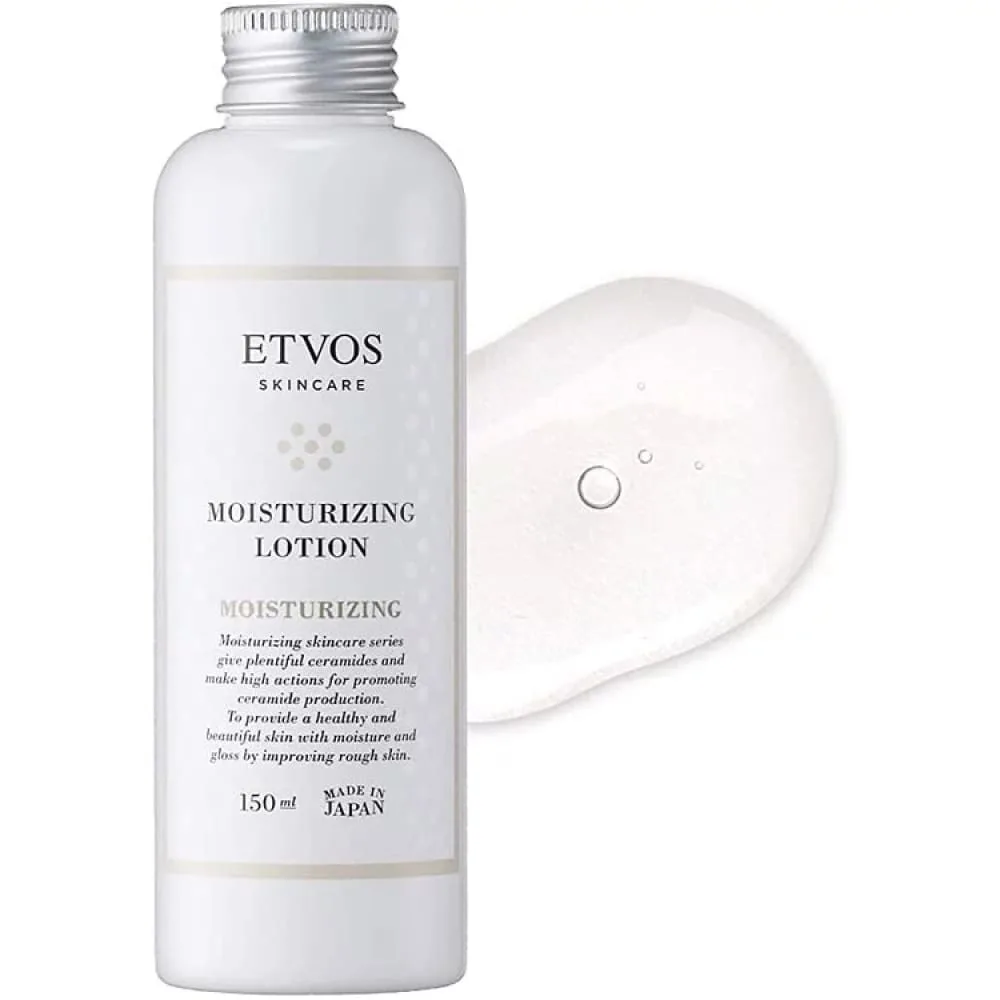
Most ceramide-positioned skincare uses one or two ceramide types. ETVOS Moisturizing Lotion uses all five major human-type ceramides (AG, AP, EOP, NG, NP) — the comprehensive ceramide species combination that mimics the natural stratum corneum lipid matrix. Combined with the five-amino-acid NMF complex (mimicking the skin's natural moisturizing factor), multi-HA chemistry, and proprietary POs-Ca humectant, this is one of the most ingredient-rigorous sensitive-skin toners in the Japanese market.
One of the most rigorously formulated sensitive-skin hydrating toners in the Japanese prestige market — five human-type ceramides plus five-amino-acid NMF complex plus multi-HA chemistry plus POs-Ca proprietary humectant. Genuinely barrier-strengthening chemistry that justifies the prestige pricing for reactive and atopic-dermatitis-prone skin.
Good choicefor DehydrationIn your profileYou chose · Hyaluronic Acid is a reference standard by mechanism for dehydration; this liquid carries it.Moderate evidenceStandard tolerabilityNo reviews collected yet
The case for it
Multi-HA Hydration Stack has trial-supported standing for this concern.
It is plausibly present at a working level, though the concentration is not declared.
The formula carries no trigger this concern is sensitive to, with the cautions noted.
What would change this: A declared concentration would move this to a firmer reading of the dose.
Same rule for everyone. “Good choice” is the verdict on 9,564 of 45,024 concern verdicts across the catalog; rule R5 decided 9,072 of them.
Unchanged since September 5, 2026, engine 5.1.1.
R5 — Trial-supported or guideline-supported active, adequately or plausibly dosed. · the full register
Carrying active
Multi-HA Hydration Stack
Standing
supported — its mechanism is established
Form
plausible — studied range 0.1%, from the trials on the row; needs leave-on contact; judge it after ~1 weeks
Tolerability
standard
Row checked
against its sources on July 17, 2026 (evidence table ev-2026.09-r228)
The studies behind the evidence row
Draelos ZD, Cosmetic Dermatology: Products and Procedures — hyaluronic acid classified as a humectant water-binding agent holding many times its weight in water — reference work
Good choicefor DrynessIn your profileYou chose · Ceramides is a reference standard by mechanism for dryness; this liquid carries it.Moderate evidenceStandard tolerabilityNo reviews collected yet
The case for it
Five Human-Type Ceramide Complex has trial-supported standing for this concern.
It is plausibly present at a working level, though the concentration is not declared.
The formula carries no trigger this concern is sensitive to, with the cautions noted.
Cautions: fragrance.
What would change this: A declared concentration would move this to a firmer reading of the dose.
Same rule for everyone. “Good choice” is the verdict on 9,564 of 45,024 concern verdicts across the catalog; rule R5 decided 9,072 of them.
Unchanged since September 5, 2026, engine 5.1.1.
R5 — Trial-supported or guideline-supported active, adequately or plausibly dosed. · the full register
Carrying active
Five Human-Type Ceramide Complex
Standing
supported — its mechanism is established
Form
plausible
Tolerability
standard — fragrance load
Row checked
against its sources on July 17, 2026 (evidence table ev-2026.09-r228)
The studies behind the evidence row
Elias PM, Feingold KR (eds), Skin Barrier — stratum corneum ceramides are the principal intercellular lamellar lipid; their depletion is the biochemical signature of dry/xerotic skin — reference work
Avoidfor Compromised Skin BarrierIn your profileYou chose · This formula carries fragrance — a known trigger for compromised skin barrier — so it is not a fit however good its actives are.Moderate evidenceCarries a triggerNo reviews collected yet
The case for it
Five Human-Type Ceramide Complex has trial-supported standing for this concern.
It is plausibly present at a working level, though the concentration is not declared.
The formula carries a known trigger for this concern, which decides the verdict before any efficacy question.
What would change this: Removing the trigger named above would let the actives be judged on their own.
Same rule for everyone. “Avoid” is the verdict on 1,909 of 45,024 concern verdicts across the catalog; rule R1 decided 1,304 of them.
Unchanged since September 5, 2026, engine 5.1.1.
R1 — Safety outranks praise (MASTER-PLAN §1.7). A condition-weighted trigger (multiplier ≥ 2 in condition-fit-matrix) decides the verdict before any efficacy question. · the full register
Carrying active
Five Human-Type Ceramide Complex
Standing
supported — its mechanism is established
Form
plausible — studied range 0.5–1%, from the trials on the row; needs leave-on contact; judge it after ~4 weeks
Tolerability
harsh — fragrance load
Row checked
against its sources on July 17, 2026 (evidence table ev-2026.09-r228)
The studies behind the evidence row
Elias PM, Skin Barrier / Coderch et al., ceramides and skin barrier function — ceramides ~50% of SC intercellular lipid mass, essential to the permeability barrier — reference work
Avoidfor SensitivityIn your profileYou chose · This formula carries fragrance — the kind of thing reactive skin flags first.Not yet assessedCarries a triggerNo reviews collected yet
The case for it
Lavandula Angustifolia has no evidence row yet for this concern — it is in the research queue.
The formula carries a known trigger for this concern, which decides the verdict before any efficacy question.
What would change this: Removing the trigger named above would let the actives be judged on their own.
Same rule for everyone. “Avoid” is the verdict on 1,909 of 45,024 concern verdicts across the catalog; rule F1 decided 605 of them.
Unchanged since September 5, 2026, engine 5.1.1.
Avoidfor EczemaIn your profileYou chose · This formula carries fragrance — a known trigger for eczema — so it is not a fit however good its actives are.Moderate evidenceCarries a triggerNo reviews collected yet
The case for it
Five Human-Type Ceramide Complex has early or mechanistic evidence for this concern, not trial-backed standing.
It is plausibly present at a working level, though the concentration is not declared.
The formula carries a known trigger for this concern, which decides the verdict before any efficacy question.
What would change this: Removing the trigger named above would let the actives be judged on their own.
Same rule for everyone. “Avoid” is the verdict on 1,909 of 45,024 concern verdicts across the catalog; rule R1 decided 1,304 of them.
Unchanged since September 5, 2026, engine 5.1.1.
R1 — Safety outranks praise (MASTER-PLAN §1.7). A condition-weighted trigger (multiplier ≥ 2 in condition-fit-matrix) decides the verdict before any efficacy question. · the full register
Carrying active
Five Human-Type Ceramide Complex
Standing
plausible — trials support it
Form
plausible
Tolerability
harsh — fragrance load
Row checked
against its sources on July 17, 2026 (evidence table ev-2026.09-r228)
Emollients and moisturisers for eczema — Cochrane Database of Systematic Reviews — TIER 1, 77 RCTs / 6603 participants, GRADE; CLASS-level, does not name ceramides (2017), opened July 16, 2026
Does the jobDoes what a toner is for: adds something real, not alcohol-driven. Not measured from the label: restores skin pH, plays well with what follows.
A verdict is DermApproved’s assessment of how well a product’s ingredients fit a concern — never a claim about what the product treats. Evidence dots and collected reviews sit beside it and are never blended in.
Rules 0.5.1 · evidence table ev-2026.09-r228 · how we decide
Assessment
Pros & Cons
Pros
✓ Five human-type ceramides (AG + AP + EOP + NG + NP) is genuinely comprehensive
✓ Lavender flower water (not oil) provides calming scent with lower sensitization risk
✓ Additive-light formulation aligns with sensitive-skin best practices
✓ Well-tolerated by reactive, atopic-dermatitis-prone, and compromised barriers
Cons
✗ Lavender flower water rules it out for lavender-allergic users
✗ Per-bottle price above drugstore Japanese sensitive-skin alternatives
✗ Slippery texture takes 60-90 seconds to absorb
✗ 150ml is the only size offered
✗ Not in widespread US distribution; requires Asian-beauty retailers
Review
Full Review
Sensitive-skin skincare in the Japanese prestige market has converged around ceramide chemistry over the past two decades. The biological logic is sound — the stratum corneum lipid matrix depends on ceramides, cholesterol, and free fatty acids in specific ratios to function as the skin's primary barrier, and topical ceramide deposition supports barrier reconstruction in reactive, atopic-dermatitis-prone, and chronically compromised skin. Most ceramide-positioned products in the global market use one or two ceramide types — typically ceramide NP and ceramide AP, the two most commercially available forms. ETVOS's Moisturizing Lotion takes a more comprehensive approach.
The formula contains all five major human-type ceramides — AG, AP, EOP, NG, and NP — at meaningful INCI positions. This is where a reasonable-sounding worry needs correcting: that packing five ceramides into one bottle must dilute each below a useful dose. For the barrier, the opposite is closer to the truth. The natural stratum corneum requires all five species in specific ratios to function properly, so a formula that supplies the whole set is biologically aligned with how the barrier actually rebuilds itself — arguably more useful than a larger dose of a single ceramide working in isolation. The five-ceramide combination is the brand's signature formulation choice and one of the genuinely distinguishing features of ETVOS skincare relative to other sensitive-skin Japanese brands, particularly for skin with documented barrier dysfunction.
The supporting chemistry extends the natural-skin-mimicking approach. A five-amino-acid complex (L-serine, L-threonine, L-proline, L-alanine, L-lysine) is included to mimic the skin's natural moisturizing factor (NMF) — the small-molecule humectants that occur naturally in healthy stratum corneum and provide much of the skin's baseline hydration. Glucosylceramide sits in the formula as a ceramide precursor that the skin converts to active ceramides over time. POs-Ca (phosphoryl oligosaccharide calcium) is the brand's proprietary humectant — a starch- and milk-casein-derived ingredient with documented humectant and skin-conditioning effects in published cosmetic research. Three hyaluronic acid forms provide the multi-HA hydration chassis, and a polyquaternium film-former plus hydrogenated lecithin give the lotion its characteristic slip and help hold moisture at the surface. The combined formula is essentially an attempt to deliver the natural stratum corneum chemistry topically, with each major component represented. One consequence of the glucosylceramide and casein-derived humectant is that the formula isn't vegan, though it is fungal-acne-safe — a rare and welcome combination for congestion-prone reactive skin.
The sensorial chassis is built around what ETVOS calls 'additive-light' formulation — no parabens, no silicones, no synthetic fragrance, no surfactants, no mineral oils, no synthetic colorants. The fragrance character comes from lavender flower water rather than from lavender essential oil, and that distinction dismantles a common myth — that lavender water and lavender oil are the same irritant. The flower water is a hydrosol byproduct of oil distillation and carries far less of the volatile aromatic compounds that drive contact sensitization. The oil at typical cosmetic concentrations is meaningfully riskier; the water is well-tolerated by most sensitive-skin users. It's a deliberate sensitivity-conscious choice, and the lavender water is one of the brand's signature ingredients. For users with documented lavender contact sensitivity, even the water form represents a small risk; for most, it's a subtle calming scent and nothing more.
In use, the experience is satisfyingly understated. The slightly slippery, almost gel-like texture pours easily from the bottle and presses smoothly into skin from palms. The subtle lavender bloom is calming rather than perfumed. The lotion absorbs in 60-90 seconds without leaving residue. Reactive-skin users tend to notice the absence of the typical post-toner tightness or low-grade irritation that other hydrating toners produce. Skin feels noticeably more hydrated and slightly cooler immediately, with cumulative barrier-strengthening improvements building over 4-6 weeks of consistent twice-daily use, layered on damp skin before the matching serum and cream.
Value is reasonable for the formulation depth. At roughly $46 for the 150ml bottle through Asian-beauty retailers, the per-bottle price sits in the upper-mid Japanese sensitive-skin toner tier — above drugstore alternatives but below the most expensive prestige Japanese options. The 150ml bottle stretches 2-3 months at twice-daily use, putting the per-month cost at $15-23 — defensible for the five-ceramide chemistry depth and the ETVOS brand's clinical credibility in the sensitive-skin space. For users with severe reactive skin or atopic-dermatitis-prone barriers, this product earns the prestige pricing; for users with milder sensitivity, drugstore ceramide toners offer better per-dollar value but typically with smaller ceramide profiles.
The ETVOS broader brand context matters for full understanding. The brand was founded in 2007 by Yukie Hibata as one of the first Japanese mineral-makeup brands, and the skincare expansion (Moisture Line launched around 2010) was built around the same additive-light, sensitive-skin philosophy. The brand has built a strong reputation in Japan among dermatology-recommendation lists and atopic-dermatitis-prone customer communities, and its review base runs into the thousands with a consistently high average — reviewers repeatedly credit the five-ceramide complex with genuinely strengthening reactive barriers over weeks, while the recurring reservations are the lavender water for the allergic and the price against drugstore ceramides. The Moisturizing Lotion has anchored the line since its early years and remains one of the brand's bestsellers — a testament to the formulation's continued relevance in the increasingly competitive Japanese sensitive-skin skincare category.
Formula
Key Ingredients
The hero actives that drive this product's performance.
ETVOS's signature five-ceramide chemistry — these are the dominant ceramide species in the natural stratum corneum lipid matrix, and topical deposition of this combination has documented evidence for barrier-strengthening effects in sensitive and atopic-dermatitis-prone skin. The brand's positioning is built around this comprehensive ceramide approach.
Established mechanismfor Dryness · established mechanism
POs-Ca (Phosphoryl Oligosaccharide Calcium)
ETVOS-favored proprietary moisturizing ingredient with documented humectant and skin-barrier-supporting effects — derived from starch and milk casein, with published cosmetic research supporting its skin-conditioning benefits at typical formulation concentrations.
Five amino acids stacked to mimic the skin's natural moisturizing factor (NMF) — the small-molecule humectants that occur naturally in healthy stratum corneum. Particularly relevant in a sensitive-skin formula where supporting endogenous skin chemistry is preferable to introducing foreign actives.
Three molecular-weight HA forms providing comprehensive surface and deeper-penetrating humectant action. Works synergistically with the ceramide and amino acid chemistry to support the formula's broader barrier-and-hydration positioning.
Established mechanismfor Dehydration · established mechanism
ETVOS's signature gentle botanical scent (lavender water rather than lavender oil) — provides a subtle calming fragrance character without the higher concentration of lavender oil that some sensitive-skin users react to. Distinctively ETVOS in sensorial signature.
Not yet assessed
Ingredient standings describe the active at treatment-level doses and
vehicles; this product's own condition grades weigh its actual formula.
Apply after cleansing on damp skin both morning and evening. Use coin-sized portion pressed into face and neck. Follow with ETVOS Moisturizing Serum or another barrier-supporting leave-on, then the brand's Moisturizing Cream or another ceramide-rich moisturizer.
Results Timeline
Immediate hydration and skin-comfort benefits. Cumulative barrier-strengthening improvements typically build over 4-6 weeks of consistent twice-daily use, particularly in chronically reactive or atopic-dermatitis-prone skin.
The five-human-type-ceramide complex is the formula's clinically most interesting chemistry. Ceramides AG, AP, EOP, NG, and NP represent the dominant ceramide species in the natural stratum corneum lipid matrix — together with cholesterol and free fatty acids, they comprise approximately 50% of the stratum corneum's intercellular lipids. The published clinical literature on topical ceramide deposition documents barrier-strengthening effects, with the strongest evidence supporting multi-ceramide combinations that mimic the natural matrix composition rather than single-ceramide formulations.
The specific ceramide species differ in their molecular structure and barrier function role. Ceramide NP (also called Ceramide 3) is the most commercially common in skincare; ceramide AP (Ceramide 6) carries an alpha-hydroxy fatty acid component; ceramide EOP (Ceramide 1) contains a long-chain omega-hydroxy fatty acid; ceramide AG and NG are additional species with documented stratum corneum functions. Together, these five forms cover the major ceramide chemistry the skin's barrier depends on.
The five-amino-acid NMF complex (L-serine, L-threonine, L-proline, L-alanine, L-lysine) mimics the natural moisturizing factor that occurs in healthy stratum corneum. NMF is composed of free amino acids, lactate, urea, and other small-molecule humectants generated by the breakdown of filaggrin during the keratinization process. The published research treats topical NMF-mimetic formulations as credible humectant strategies for skin with reduced endogenous NMF (which includes atopic dermatitis, severe dryness, and certain ichthyosis types). The combined ceramide-plus-NMF approach is biologically sophisticated and aligned with current dermatology understanding of stratum corneum function.
Glucosylceramide is a ceramide precursor that the skin can convert to active ceramides through endogenous enzyme activity. The published research supports its inclusion as supporting chemistry for sustained ceramide delivery, particularly when combined with direct ceramide application (as in this formula).
POs-Ca (phosphoryl oligosaccharide calcium) is a starch- and milk-casein-derived ingredient with documented humectant and skin-conditioning effects in Japanese cosmetic research. ETVOS uses it across the Moisture Line as a brand-signature humectant; the published efficacy data supports its contribution to skin hydration and barrier integrity.
The multi-hyaluronic-acid stack (sodium hyaluronate + hydrolyzed hyaluronic acid + sodium acetylated hyaluronate) provides comprehensive surface and deeper-penetrating humectant action through three molecular-weight forms. The combined humectant load offsets the typical post-toner dryness sensitive skin can experience with simpler hydrating toners.
The lavender flower water (Lavandula angustifolia hydrosol) is the byproduct of lavender essential oil distillation and contains a much smaller concentration of the volatile aromatic compounds that drive contact sensitization than lavender essential oil. The published research treats lavender hydrosol as generally well-tolerated even for sensitive skin, though documented lavender or linalool contact allergy remains a contraindication.
The polyquaternium-51 inclusion is a phosphorylcholine-based cationic polymer that contributes barrier-mimetic film deposition during the rinse, supporting the formula's broader barrier-strengthening positioning.
Dermatologist Perspective
Dermatologists working with atopic dermatitis, severe sensitive skin, and chronically compromised barriers frequently recommend ETVOS as one of the more clinically credible Japanese sensitive-skin brands available. The five-human-type-ceramide complex is taken seriously as biologically aligned chemistry — the comprehensive ceramide approach matches current dermatology understanding of stratum corneum function better than single-ceramide formulations. The amino-acid NMF complex extends the natural-skin-mimicking philosophy. For patients with documented barrier dysfunction, this is among the better Japanese skincare recommendations available. The standard caveats are the lavender flower water for documented lavender-sensitive patients (rare but real) and the prestige pricing relative to drugstore sensitive-skin alternatives. The brand's clinical credibility in Japanese dermatology recommendation circles is well-established.
Guidance
Usage & Recommendations
How to Use
Apply after cleansing on damp skin both morning and evening. Use a coin-sized portion pressed into face and neck from clean palms. Wait 60-90 seconds for absorption before layering the next step. Pair with the ETVOS Moisturizing Serum and Moisturizing Cream for the brand's full barrier-strengthening routine, or with another ceramide-rich moisturizer. Suitable for daily indefinite use; barrier-strengthening contribution accumulates over weeks.
Value Assessment
At roughly $46 for the 150ml bottle through Asian-beauty retailers, the per-bottle price sits in the upper-mid Japanese sensitive-skin toner tier — above Curel ($15-20) and below the most expensive prestige Japanese options. The 150ml bottle stretches 2-3 months at twice-daily face application, putting the per-month cost at $15-23. The argument for the ETVOS premium is the five-ceramide formulation depth and the brand's clinical credibility in the Japanese sensitive-skin space; the argument against is that drugstore ceramide alternatives deliver simpler ceramide chemistry at fraction of the cost. Justified for users with severe reactive skin or atopic-dermatitis-prone barriers; less defensible for users with milder sensitivity who could be served by simpler ceramide formulations.
Who Should Buy
Users with sensitive, dry, atopic-dermatitis-prone, eczema-flared, or chronically compromised-barrier skin who want a comprehensive ceramide-based hydrating toner from a clinically credible Japanese sensitive-skin brand. Best for users committed to a multi-step barrier-strengthening routine.
Who Should Skip
Users with documented lavender contact sensitivity (the lavender flower water is a small but real consideration), users focused on maximum hydration per dollar (Curel and other drugstore Japanese ceramide alternatives offer better value with simpler ceramide profiles), and users seeking active anti-aging or brightening chemistry (this formula is purely hydration-and-barrier-focused).
Lightweight, slightly slippery clear liquid that presses smoothly into skin — visibly different from typical watery toners with a subtle viscosity.
Scent
Subtle calming lavender from the lavender flower water — not heavily perfumed, distinctly ETVOS sensorial signature.
Packaging
White plastic bottle with the brand's distinctive sage-green ETVOS label — clean, clinical-looking, designed for sensitive-skin clinical positioning.
Finish
non-greasylightweightfast-absorbing
What to Expect on First Use
First-use impression is the subtle lavender bloom and the slippery, almost gel-like texture. The lotion absorbs in 60-90 seconds without leaving residue. Skin feels noticeably more hydrated and slightly cooler immediately. Reactive-skin users tend to notice the absence of the typical post-toner tightness or irritation other toners produce.
How Long It Lasts
Roughly 2-3 months applied morning and evening face application for the 150ml bottle.
ETVOS was founded in 2007 by Yukie Hibata as one of the first Japanese mineral-makeup brands, with a strong focus on additive-light formulations for sensitive and reactive skin. The brand expanded into skincare around 2010 with the Moisture Line, built around the five-human-type-ceramide chemistry that became the brand's signature formulation philosophy. The Moisturizing Lotion has anchored the line since its early years and remains one of the brand's bestsellers.
About ETVOS Established Brand (5–20 years)
ETVOS launched in 2007 as one of the first Japanese mineral-makeup brands, expanding into sensitive-skin skincare around 2010 with the Moisture Line ceramide-based formulations. The brand is well-known in Japan for additive-light formulations targeting reactive and atopic-dermatitis-prone skin, anchored in the brand's signature five-human-type-ceramide complex.
Brand founded: 2007 · Product launched: 2014
Myth vs. Reality
Common Myths
Myth
More ceramides in a single product means each is at lower effective concentration.
Reality
The opposite is true for the natural stratum corneum lipid matrix — the skin's barrier requires all five major ceramide species (AG, AP, EOP, NG, NP) in specific ratios to function optimally. Topical formulations that supply all five forms (like this one) can support barrier reconstruction more comprehensively than single-ceramide formulations. The combined approach is biologically aligned with how the natural barrier actually works.
Myth
Lavender water is the same as lavender essential oil — both irritate sensitive skin.
Reality
Lavender flower water (hydrosol) is a byproduct of lavender essential oil distillation and contains a much smaller concentration of the volatile aromatic compounds that drive contact sensitization. For most users including most sensitive-skin users, lavender flower water is well-tolerated. Lavender essential oil at typical cosmetic concentrations carries meaningfully more sensitization risk. The ETVOS formula uses the water, not the oil — a deliberate sensitivity-conscious choice.
FAQ
Frequently Asked Questions
What does the five-ceramide complex in ETVOS Moisturizing Lotion actually do?
Ceramides AG, AP, EOP, NG, and NP are the dominant ceramide species in the natural stratum corneum lipid matrix. The skin's barrier requires these specific ceramide forms in particular ratios to function optimally. Topical deposition of all five forms supports barrier reconstruction more comprehensively than single-ceramide formulations, which is why this product is recommended for atopic-dermatitis-prone and chronically reactive skin.
Is ETVOS Moisturizing Lotion safe for atopic dermatitis or eczema?
Yes — the five-ceramide chemistry, multi-HA hydration, amino-acid NMF complex, and POs-Ca proprietary humectant are all aligned with what dermatology guidelines recommend for atopic-dermatitis skincare. Many Japanese dermatologists specifically recommend ETVOS for patients with eczema or chronic reactive skin. The lavender flower water is the only ingredient consideration for users with documented lavender sensitivity.
How is ETVOS Moisturizing Lotion different from Curel?
Both are Japanese sensitive-skin brands with ceramide chemistry, but ETVOS focuses on the five-human-type-ceramide combination plus amino-acid NMF chemistry, while Curel uses a smaller ceramide profile plus pseudo-ceramide chemistry. Curel is more accessible (drugstore distribution, lower price); ETVOS is more ingredient-rigorous (prestige formulation, higher price). For severe reactive skin, ETVOS's comprehensive five-ceramide approach is often the better fit; for milder sensitive skin, Curel offers better value.
Can ETVOS Moisturizing Lotion be used during pregnancy?
Yes — the formula contains no retinoids, salicylates, or pregnancy-restricted ingredients. The five-ceramide chemistry, amino-acid complex, POs-Ca humectant, and multi-HA hydration are all considered pregnancy-safe at cosmetic concentrations. The lavender flower water is the only ingredient worth a conversation with your prenatal-care provider if you have known sensitivities.
How does the POs-Ca ingredient work?
POs-Ca (phosphoryl oligosaccharide calcium) is a starch- and milk-casein-derived ingredient with documented humectant and skin-conditioning effects. The published cosmetic research treats it as a credible supporting humectant that contributes to barrier integrity through both surface moisture-binding and skin-conditioning chemistry. ETVOS uses it across the Moisture Line as a brand-signature humectant.
How long until visible results from ETVOS Moisturizing Lotion?
Immediate hydration and skin-comfort benefits. Cumulative barrier-strengthening improvements (reduced reactive flushing, improved barrier resilience, less chronic dryness) typically build over 4-6 weeks of consistent twice-daily use. Best results when used as part of the full ETVOS Moisture Line routine (lotion + serum + cream).
Reviews
What Reviewers Tend to Say
Recurring themes our editors read across retailer reviews of this product — summaries in our words, not quotations, and not a substitute for your own patch test.
Common Praise
Five-ceramide complex genuinely strengthens reactive barriers over weeks of use
Lavender flower water is calming rather than perfumed
Pairs naturally with the broader ETVOS Moisture Line routine
Lightweight texture absorbs cleanly
Well-tolerated on compromised barriers
Common Complaints
Lavender flower water rules it out for lavender-allergic users
Per-bottle price hard to justify versus drugstore ceramide alternatives
Slippery texture takes time to absorb
150ml is the only size offered
Notable Endorsements
Recommended by Japanese dermatologists for atopic-dermatitis-prone and reactive skinLong-standing @cosme sensitive-skin toner rankingsFeatured in Japanese ceramide-skincare editorial coverage
Western sensitive skincare works by subtraction — remove the fragrance, remove the alcohol, shorten the list. Japan's answer adds a designed molecule back in, and one of the two bets has a trial literature.
The internet's favorite hydrator has a counterintuitive dark side — in dry air, a humectant with nothing to seal it can pull water out of your skin instead of into it.
A wrecked barrier is the most common self-inflicted skin condition and the one with the clearest fix — the difficulty is that the routine which caused it feels productive and the one that repairs it feels like giving up.
Products, answers, therapy guides, tools and articles in one search. Brand names,
slang and abbreviations all work — accutane finds isotretinoin, bacne finds truncal acne.