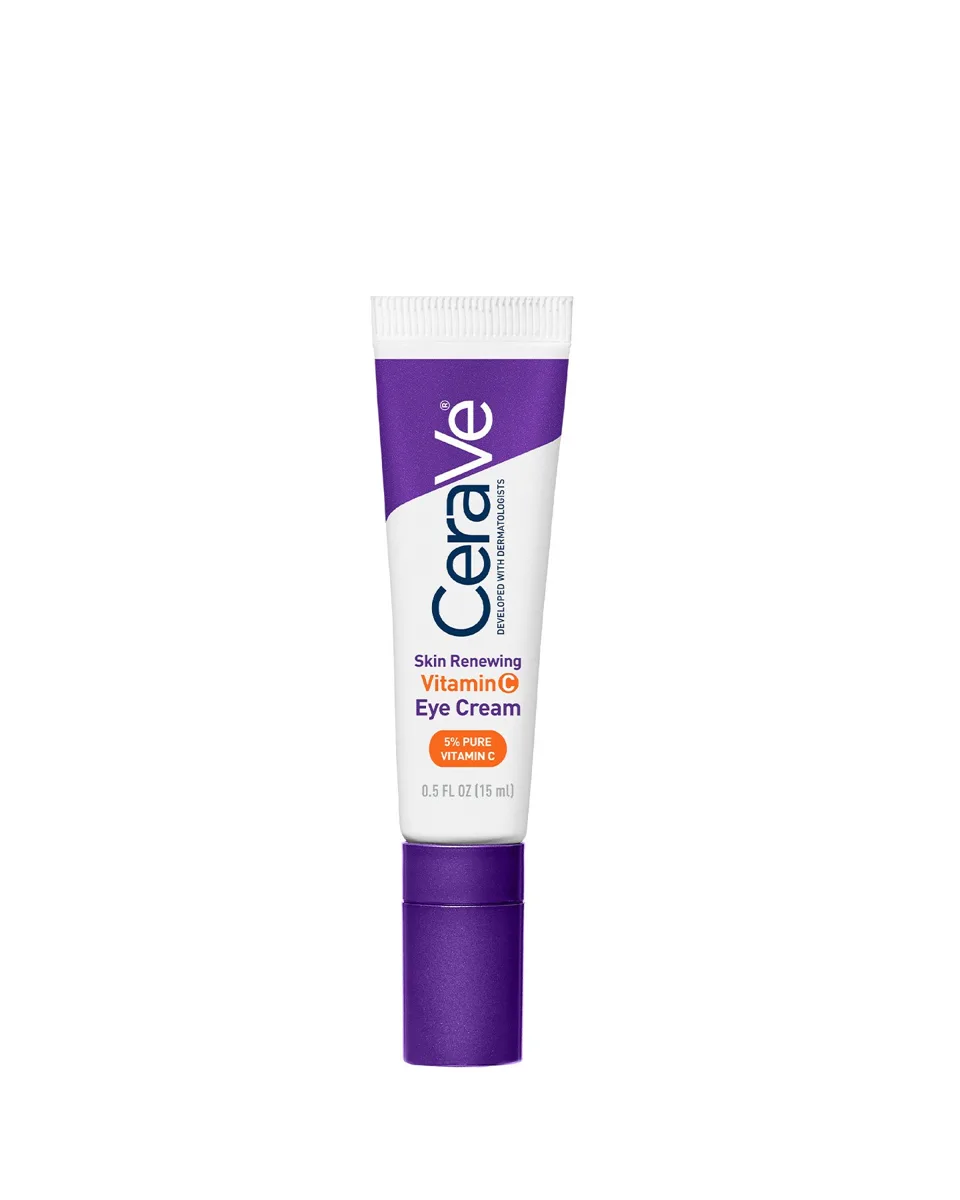
Most drugstore eye creams either offer ceramide-based hydration or include vitamin C — this is one of the few that combines 5% pure ascorbic acid with CeraVe's triple-ceramide barrier technology in a formula specifically optimized for the periorbital area. The addition of caffeine and dipotassium glycyrrhizate creates a three-pathway approach to dark circles (pigment, vascular, inflammatory) that's unusual at this price point.
A genuinely thoughtful eye cream that attacks dark circles from three angles — pigment, vasculature, and inflammation — while keeping the periorbital barrier intact with CeraVe's ceramide technology. At $25 for a formula that's ophthalmologist-tested and pregnancy-safe, it's one of the smartest drugstore entries in the brightening eye cream category.
Note: This cream launched in August 2024 and our assessment is based on approximately 18 months of market data. Scoring relies on ingredient analysis, CeraVe's formulation track record, and a growing but moderate user review base. Expect this assessment to evolve as longer-term user data accumulates.
Verdicts
How well it fits each concern
Verdict by concern tap a concern for the case
Supporting rolefor Dark CirclesIn your profileYou chose · Caffeine has early evidence for dark circles, and hydration of the periorbital area is the recognised companion to treating it — a reasonable supporting choice, short of a recommendation.Moderate evidenceGentleNo reviews collected yet
The case for it
Caffeine has early or mechanistic evidence for this concern, not trial-backed standing.
It is plausibly present at a working level, though the concentration is not declared.
The formula carries none of the triggers this concern is sensitive to.
What would change this: A declared concentration would move this to a firmer reading of the dose.
Same rule for everyone. “Supporting role” is the verdict on 8,197 of 45,024 concern verdicts across the catalog; rule R8a decided 1,489 of them.
Unchanged since September 5, 2026, engine 5.1.1.
R8a — A plausible-tier active in a category with a supportive job: the sentence names the active instead of saying nothing targets the concern (the AmLactin / CeraVe SA case for keratosis pilaris, where no guideline and single trials leave the keratolytics at early evidence). · the full register
Carrying active
Caffeine
Standing
plausible — trials support it
Form
plausible — studied range 1–3%, from the OTC monograph or label; needs leave-on contact
Tolerability
gentle
Row checked
against its sources on July 17, 2026 (evidence table ev-2026.09-r228)
Promisingfor AgingIn your profileYou chose · Vitamin C has trial-level evidence for aging but no guideline or regulatory standing yet — promising, short of a recommendation; the other actives here are not yet assessed for it.Moderate evidenceGentleNo reviews collected yet
The case for it
Ascorbic Acid has trial-level evidence for this concern but no guideline or regulatory standing yet.
It is present at an effective concentration, declared or high in the ingredient list.
The formula carries none of the triggers this concern is sensitive to.
What would change this: Guideline or regulatory standing for the active on this concern would move this from a promising bet to a recommendation.
Same rule for everyone. “Promising” is the verdict on 7,858 of 45,024 concern verdicts across the catalog; rule R9p decided 7,858 of them.
Unchanged since September 5, 2026, engine 5.1.1.
R9p — 0.5.0: 'Unproven' beside three filled dots read as one question answered twice with opposite words (7,018 rows). The chip measures standing, the dots measure trial volume; where the row carries at least one RCT or a tier-2 source (moderate dots) and the active is present at a working level, the honest word is Promising. Unproven is reserved for plausible-standing rows with limited or weak evidence, or an under-dosed form. Same rank as Unproven — a bet either way; the dots order them. · the full register
Carrying active
Ascorbic Acid
Standing
plausible — trials support it
Form
adequate (declared 5%) — studied range 5%, from the trials on the row; needs leave-on contact; judge it after ~12 weeks
Tolerability
gentle
Row checked
against its sources on July 17, 2026 (evidence table ev-2026.09-r228)
Promisingfor DullnessIn your profileYou chose · Hyaluronic Acid has trial-level evidence for dullness but no guideline or regulatory standing yet — promising, short of a recommendation; the other actives here are not yet assessed for it.Moderate evidenceGentleNo reviews collected yet
The case for it
Sodium Hyaluronate has trial-level evidence for this concern but no guideline or regulatory standing yet.
It is present at an effective concentration, declared or high in the ingredient list.
The formula carries none of the triggers this concern is sensitive to.
What would change this: Guideline or regulatory standing for the active on this concern would move this from a promising bet to a recommendation.
Same rule for everyone. “Promising” is the verdict on 7,858 of 45,024 concern verdicts across the catalog; rule R9p decided 7,858 of them.
Unchanged since September 5, 2026, engine 5.1.1.
R9p — 0.5.0: 'Unproven' beside three filled dots read as one question answered twice with opposite words (7,018 rows). The chip measures standing, the dots measure trial volume; where the row carries at least one RCT or a tier-2 source (moderate dots) and the active is present at a working level, the honest word is Promising. Unproven is reserved for plausible-standing rows with limited or weak evidence, or an under-dosed form. Same rank as Unproven — a bet either way; the dots order them. · the full register
Carrying active
Sodium Hyaluronate
Standing
plausible — trials support it
Form
adequate
Tolerability
gentle
Row checked
against its sources on July 17, 2026 (evidence table ev-2026.09-r228)
Good choicefor DrynessIn your profileYou chose · Ceramides is a reference standard by mechanism for dryness; this cream carries it.Moderate evidenceGentleNo reviews collected yet
The case for it
Ceramide NP, Ceramide AP, Ceramide EOP has trial-supported standing for this concern.
It is plausibly present at a working level, though the concentration is not declared.
The formula carries none of the triggers this concern is sensitive to.
What would change this: A declared concentration would move this to a firmer reading of the dose.
Same rule for everyone. “Good choice” is the verdict on 9,564 of 45,024 concern verdicts across the catalog; rule R5 decided 9,072 of them.
Unchanged since September 5, 2026, engine 5.1.1.
R5 — Trial-supported or guideline-supported active, adequately or plausibly dosed. · the full register
Carrying active
Ceramide NP, Ceramide AP, Ceramide EOP
Standing
supported — its mechanism is established
Form
plausible
Tolerability
gentle
Row checked
against its sources on July 17, 2026 (evidence table ev-2026.09-r228)
The studies behind the evidence row
Elias PM, Feingold KR (eds), Skin Barrier — stratum corneum ceramides are the principal intercellular lamellar lipid; their depletion is the biochemical signature of dry/xerotic skin — reference work
Does the jobDoes what a eye cream is for: safe for eye skin, targets a real eye concern. Not measured from the label: hydrates without heaviness, stays where it's put.
Where our review and the verdict differ. The review below was written on the formulation and the published trials; the verdicts above apply the stricter standing test in our methodology — an active earns a recommendation only with guideline or regulatory standing for the concern. Where the two disagree, the verdict is DermApproved’s position.
A verdict is DermApproved’s assessment of how well a product’s ingredients fit a concern — never a claim about what the product treats. Evidence dots and collected reviews sit beside it and are never blended in.
Rules 0.5.1 · evidence table ev-2026.09-r228 · how we decide
Assessment
Pros & Cons
Pros
✓ 5% pure ascorbic acid is well-calibrated for the thin periorbital skin — effective without irritation
✓ Triple-pathway approach targets pigment, vascular, and inflammatory causes of dark circles simultaneously
✓ Ophthalmologist-tested and safe for contact lens wearers with sensitive eyes
✓ CeraVe's triple-ceramide complex maintains barrier integrity in the most fragile facial skin
✓ Pregnancy-safe formula fills a real gap for expecting mothers who can't use retinol eye creams
✓ Smooth texture absorbs quickly and sits well under concealer without creasing
✓ Caffeine provides visible depuffing within minutes of application for immediate morning results
Cons
✗ Evidence for topical vitamin C on dark circles specifically is thinner than for general facial brightening
✗ Results require 4-8 weeks of consistent use before visible dark circle improvement
✗ Tube packaging exposes vitamin C to air each time it's opened, potentially reducing stability over time
✗ 0.5 oz tube feels small relative to the $25 price point despite lasting 3-4 months
✗ Limited long-term user data given its August 2024 launch
Review
Full Review
For years, CeraVe was the brand you reached for when your skin needed fixing — a stripped-down, dermatologist-approved safety net that prioritized barrier health above all else. The Skin Renewing Vitamin C Eye Cream, launched in August 2024, signals something interesting: CeraVe is no longer content to just repair. It wants to brighten, too.
The question is whether a brand built on the quiet virtues of ceramides and clinical restraint can deliver an effective vitamin C treatment for one of skincare's most stubborn complaints: dark under-eye circles. After examining the formulation and the science behind it, the answer is a qualified but genuine yes.
The foundation of this eye cream is 5% pure ascorbic acid — L-ascorbic acid, the most biologically active and well-studied form of vitamin C. That concentration is a deliberate choice. Most facial vitamin C serums run 10-20%, but the periorbital skin is roughly 40% thinner than the rest of the face, with fewer oil glands and a more fragile barrier. Five percent strikes the balance between being potent enough to inhibit tyrosinase — the enzyme that drives melanin production behind pigmented dark circles — while being gentle enough that ophthalmologist testing clears it for daily use on sensitive eyes.
But CeraVe didn't just put vitamin C in an eye cream and call it done. The formula takes a multi-pathway approach that reflects a genuinely thoughtful understanding of why dark circles happen. Caffeine handles the vascular dimension, constricting the dilated blood vessels that create that blue-purple shadowing visible through thin periorbital skin. Dipotassium glycyrrhizate, derived from licorice root, adds anti-inflammatory action that calms the micro-inflammation contributing to both pigmentation and vascular discoloration. Three distinct mechanisms addressing three distinct causes of the same visible problem — it's the kind of formulation logic that earns respect.
Underneath the active ingredients, CeraVe's signature ceramide architecture does what it has always done, but in a context where it matters more than usual. The under-eye area's compromised barrier function means it loses moisture faster and is more vulnerable to irritation from actives. Ceramide NP, AP, and EOP, paired with cholesterol and phytosphingosine, create a lipid environment that keeps the skin hydrated enough to avoid the crepey, dehydrated look that makes dark circles appear deeper. Sodium hyaluronate adds another hydration layer, plumping the thin skin to reduce the shadow effect from hollow under-eye areas.
Panthenol — vitamin B5 — is a smart inclusion that often gets overlooked in ingredient-list analysis. In the periorbital context, its anti-inflammatory and wound-healing properties help the delicate skin recover from daily environmental assault while keeping the area calm enough to tolerate the ascorbic acid without protest.
The texture lands in a comfortable middle ground: richer than a gel eye cream, lighter than the heavy creams that tend to migrate into your eyes by midday. It absorbs within about 30 seconds of gentle patting and sits well under concealer and makeup without creasing or pilling. The faint citrus note from the ascorbic acid disappears almost instantly on application.
Results, honestly, require patience. The immediate payoff is hydration — the under-eye area looks plumper and slightly brighter from day one, though this is more about light reflection from hydrated skin than actual pigment change. Caffeine's depuffing effect kicks in within about 15-20 minutes, which makes this a worthwhile morning-routine inclusion even before the vitamin C has had time to work its longer-term magic. Real dark-circle brightening from the ascorbic acid typically becomes noticeable around week four and continues building through weeks eight to twelve.
The honest limitation here is that topical vitamin C's evidence base for dark circles specifically is less robust than its evidence base for general facial brightening and photoaging. A 2009 study in Skin Research and Technology showed that topical sodium ascorbate improved dark circles, but the literature on the topic remains relatively thin compared to, say, vitamin C for hyperpigmentation on the face. CeraVe's inclusion of caffeine and licorice derivatives is partly a pragmatic hedge — attacking the problem through multiple mechanisms because no single topical ingredient reliably eliminates dark circles on its own.
The tube lasts a reasonable three to four months with twice-daily use on both eyes, which makes the $24.99 price point quite fair. This isn't a luxury eye cream pretending to be clinical. It's a clinical eye cream from a clinical brand, priced accordingly.
As a relatively recent addition to CeraVe's lineup — less than two years on the market — this product doesn't yet have the decades-deep review base that some of the brand's flagship moisturizers and cleansers enjoy. But CeraVe's track record of formulation integrity, combined with the ophthalmologist testing and the sensible ingredient choices on display here, earns it a confident recommendation for anyone willing to be patient with the results timeline.
This eye cream won't make genetically deep-set dark circles vanish. What it will do is meaningfully address the modifiable factors — pigmentation, puffiness, dehydration, and micro-inflammation — with a formula that's safe enough to use every day, twice a day, without worrying about irritation. For a brand that built its reputation on making skin care boring in the best possible way, that's a compelling pitch.
Formula
Key Ingredients
The hero actives that drive this product's performance.
Pure L-ascorbic acid at 5% — the most bioactive form of vitamin C — chosen specifically for the delicate periorbital area where higher concentrations could cause stinging. At this level, it inhibits tyrosinase to address melanin-driven dark circles while providing antioxidant protection against the oxidative stress that accelerates under-eye aging, working alongside the caffeine in this formula for a dual-pathway approach to brightening.
Targets the vascular component of dark circles by constricting blood vessels in the thin periorbital skin, reducing the blue-purple discoloration caused by visible capillaries. In this formula, caffeine complements the vitamin C's pigment-reducing action — vitamin C addresses brown melanin circles while caffeine tackles the bluish vascular kind, covering both major causes of under-eye darkness.
CeraVe's signature triple-ceramide complex is particularly valuable in an eye cream context because the periorbital skin is thinner and more prone to barrier disruption. These ceramides work with cholesterol and phytosphingosine to reinforce the lipid matrix that keeps this fragile skin hydrated and resilient, preventing the crepey, dehydrated look that makes dark circles appear worse.
Established mechanismfor Dryness · established mechanism
The sodium salt of hyaluronic acid with better skin penetration than the parent molecule, delivering deep hydration to plump the thin under-eye skin. This temporary volumizing effect reduces the shadow cast by hollowed under-eye areas, providing an immediate visible improvement while the vitamin C works on longer-term pigment correction.
Provides soothing anti-inflammatory action that makes this eye cream tolerable for even reactive periorbital skin. Panthenol also supports the skin's natural repair processes, complementing the ceramides' barrier-building function and helping the delicate eye area recover from environmental stressors.
A licorice-derived anti-inflammatory and skin-brightening agent that adds a third pathway to this formula's dark-circle strategy. While vitamin C inhibits melanin production and caffeine constricts vessels, dipotassium glycyrrhizate calms the inflammation that can worsen both types of discoloration.
Not yet assessed
Ingredient standings describe the active at treatment-level doses and
vehicles; this product's own condition grades weigh its actual formula.
Apply to the orbital bone area using your ring finger in gentle patting motions. Use before serum and moisturizer in your routine. Can be used morning and evening. In the AM, apply before sunscreen.
Results Timeline
Immediate hydration and subtle plumping effect from the first application. Caffeine-driven depuffing visible within 15-20 minutes of application. Brightening and dark circle improvement begins around 4 weeks with consistent twice-daily use. Full benefits for pigmentation-related dark circles at 8-12 weeks.
Pairs Well With
retinol serums (on face, not eye area)broad-spectrum SPFhydrating toners
L-ascorbic acid is the most extensively studied form of topical vitamin C, with decades of research supporting its role as a collagen-synthesis cofactor and tyrosinase inhibitor. At the 5% concentration used in this formula, it sits below the 10-20% range commonly used for facial photoaging but within the range shown to deliver measurable antioxidant and brightening effects on the more delicate periorbital skin.
A pivotal 2009 study by Ohshima et al., published in Skin Research and Technology, directly examined topical vitamin C's effect on dark under-eye circles. Using image analysis and echograms on 14 subjects over 6 months, the researchers found that topical sodium ascorbate significantly reduced erythema-index measurements on treated sides compared to vehicle-treated sides, with a trend toward increased dermal thickness. While this study used a different vitamin C salt, the mechanism — tyrosinase inhibition and antioxidant protection — applies to the ascorbic acid in this formula.
A 2023 systematic review by Al-Niaimi and Chiang, published in the Journal of Cosmetic Dermatology, confirmed vitamin C's efficacy in melasma and photoaging, noting that topical ascorbic acid at various concentrations improved hyperpigmentation scores across multiple randomized controlled trials. The melanin-inhibiting mechanism is particularly relevant to the pigmentary component of dark circles.
Caffeine's vasoconstrictive properties have been documented in dermatological literature as effective for reducing periorbital puffiness and the appearance of dark circles caused by visible blood vessels. A 2020 review in the Journal of Cosmetics, Dermatological Sciences and Applications confirmed caffeine's ability to improve microcirculation and reduce edema in the periorbital area.
The ceramide foundation of this formula aligns with the well-established research on lipid-based barrier repair. Kono et al.'s 2021 qualitative review in The Journal of Dermatology confirmed that ceramide-containing formulations improve barrier function and water retention — benefits that are amplified in the thin periorbital skin where transepidermal water loss is naturally higher.
Many dermatologists and ophthalmologists have noted that 5% ascorbic acid represents a well-tolerated concentration for the periorbital area, which is significantly thinner and more reactive than facial skin. Dermatologists frequently recommend this product for patients seeking a non-prescription approach to dark circles, particularly those who cannot use retinol-based eye creams due to pregnancy or sensitivity. The combination of vitamin C with caffeine is recognized by clinicians as addressing the two most common treatable causes of dark circles — hyperpigmentation and vascular prominence. Dermatologists advise pairing this with daily broad-spectrum sunscreen, as UV exposure both degrades vitamin C and worsens the pigmentation contributing to dark circles.
Guidance
Usage & Recommendations
How to Use
Dispense a small amount onto your ring finger. Apply dots of product around the orbital bone — both under the eye and along the brow bone. Gently pat (don't rub) with upward motions until fully absorbed. Use morning and evening after cleansing but before applying facial serums and moisturizer. In the morning, follow your full routine with broad-spectrum SPF 30 or higher. Can be worn alone or under concealer and makeup.
Value Assessment
At $24.99 for 0.5 oz, this eye cream offers a competitive price-to-ingredient ratio for a formula featuring pure ascorbic acid, caffeine, triple ceramides, and hyaluronic acid. The tube lasts approximately three to four months with twice-daily use, putting the monthly cost around $6-8 — well below most vitamin C eye creams, which typically run $35-60 for similar sizes. CeraVe's legacy as a dermatologist-developed brand means the pricing reflects formulation research rather than marketing overhead. The only value concern is relative: $25 for 0.5 oz is more per-ounce than CeraVe's larger moisturizers, but that's standard for targeted eye treatments with active ingredients.
Who Should Buy
Anyone dealing with dark circles from pigmentation, puffiness, or dehydration who wants an affordable, ophthalmologist-tested treatment. Pregnant or breastfeeding individuals who need a retinol-free eye cream with genuine active ingredients. CeraVe loyalists expanding their routine into targeted treatments.
Who Should Skip
Those expecting dramatic dark circle elimination from a topical product — no eye cream can override deep structural or genetic dark circles. Anyone with known sensitivity to ascorbic acid in the eye area. People looking for an anti-wrinkle eye cream should consider CeraVe's peptide-based Skin Renewing Eye Cream instead.
Ready to try CeraVe Skin Renewing Vitamin C Eye Cream?
Rich but fast-absorbing cream with a smooth, non-greasy feel. Heavier than a gel eye cream but lighter than a traditional rich eye cream. Blends easily into the orbital area without tugging.
Scent
Fragrance-free with a very faint citrus note from the ascorbic acid that dissipates immediately upon application
Packaging
Squeeze tube with a small opening for controlled dispensing. The opaque tube helps protect the vitamin C from light degradation, though a pump or airless container would offer even better stability.
Finish
satinnon-greasyfast-absorbing
What to Expect on First Use
Most users report no stinging or irritation on first use — the 5% ascorbic acid concentration is well-calibrated for the delicate eye area. Immediate hydration is noticeable, and the cream sits well under makeup without creasing. Some users notice a subtle brightening effect within the first week, though this is likely from the hydration and light reflection rather than pigment change.
How Long It Lasts
3-4 months applied morning and evening to both eyes
CeraVe launched this eye cream in August 2024 as part of a portfolio expansion that brought their clinical-grade ceramide technology to targeted treatment categories. The vitamin C eye cream was designed to fill a gap in their lineup between the original Skin Renewing Eye Cream (peptide-focused, for wrinkles) and the demand for a brightening-focused eye treatment that maintained CeraVe's barrier-first philosophy.
About CeraVe Legacy Brand (20+ years)
CeraVe was developed with dermatologists in 2005 and has been recommended in clinical settings for nearly two decades. Its formulations are backed by peer-reviewed research and the brand holds National Eczema Association seals of acceptance.
Brand founded: 2005 · Product launched: 2024
Myth vs. Reality
Common Myths
Myth
Vitamin C is too harsh for the eye area and will cause irritation
Reality
The concentration and form matter enormously. This formula uses 5% ascorbic acid — well below the 10-20% concentrations found in facial vitamin C serums — specifically calibrated for the thinner periorbital skin. The buffered pH and surrounding emollient base further reduce irritation potential. It's ophthalmologist-tested for safety.
Myth
Eye creams can't actually reduce dark circles — they're genetic
Reality
Dark circles have multiple causes, and genetics is only one. Pigmentation-related circles can respond to tyrosinase inhibitors like vitamin C, vascular circles can improve with caffeine's vasoconstrictive effect, and dehydration-related shadows improve with proper hydration. An eye cream won't override genetics entirely, but it can meaningfully improve the modifiable factors.
FAQ
Frequently Asked Questions
Does CeraVe Vitamin C Eye Cream actually work for dark circles?
The 5% ascorbic acid targets melanin-driven dark circles by inhibiting the enzyme that produces pigment, while caffeine addresses vascular dark circles by constricting blood vessels. Results vary by cause — pigmentation-related circles show the most improvement, typically visible after 4-8 weeks of consistent twice-daily use. Genetic or structural dark circles won't fully resolve with any topical product.
Can I use CeraVe Vitamin C Eye Cream with retinol?
Yes — this eye cream pairs well with retinol used on the rest of your face. Apply this cream to the orbital bone area first, then apply your retinol serum to the face, avoiding the eye area. The ceramides in this eye cream can actually help buffer the delicate eye skin from any retinol that migrates during sleep.
Is CeraVe Vitamin C Eye Cream safe for sensitive eyes?
Yes — this formula is ophthalmologist-tested and safe for contact lens wearers. The 5% ascorbic acid concentration is specifically chosen for the delicate periorbital area, and the ceramide-rich base provides additional barrier protection. Most users with sensitive eyes report no stinging or irritation.
How long does CeraVe Vitamin C Eye Cream take to show results?
Hydration and subtle plumping are immediate. Caffeine-driven depuffing occurs within 15-20 minutes. Visible brightening of dark circles typically begins around week 4, with more significant pigment improvement at 8-12 weeks. Consistent twice-daily application is key to seeing meaningful results.
Should I use CeraVe Vitamin C Eye Cream morning or night?
Both. The formula is designed for twice-daily use. In the morning, it provides antioxidant protection against UV-generated free radicals and immediate depuffing. At night, the vitamin C works on pigment correction while you sleep. For maximum benefit, apply at both times.
Is CeraVe Vitamin C Eye Cream safe during pregnancy?
Yes — unlike retinol, topical vitamin C is considered safe during pregnancy and breastfeeding. The 5% ascorbic acid concentration and the other ingredients in this formula are pregnancy-compatible, making it a good option for addressing dark circles during and after pregnancy when retinol-based eye creams must be avoided.
What's the difference between CeraVe Skin Renewing Eye Cream and the Vitamin C Eye Cream?
The original Skin Renewing Eye Cream focuses on wrinkles and fine lines using peptides and ceramides. The Vitamin C Eye Cream targets dark circles and brightness using 5% ascorbic acid plus caffeine. Choose the original for crow's feet and wrinkles, or the vitamin C version for dark circles and dullness around the eyes.
Reviews
What Reviewers Tend to Say
Recurring themes our editors read across retailer reviews of this product — summaries in our words, not quotations, and not a substitute for your own patch test.
Common Praise
Gentle enough for sensitive eye area
Noticeable brightening after a few weeks
Non-irritating even for contact lens wearers
Good texture that doesn't migrate into eyes
Common Complaints
Results take time to become visible
Packaging could be more hygienic
Small tube for the price
Some users see minimal dark circle improvement
Notable Endorsements
Developed with dermatologistsOphthalmologist testedSafe for contact lens wearers
We scored eight of the most commonly recommended brands across every core step. Almost all of them have exactly one category they are quietly weak at — and it turns out to be the same one, in the step with the best evidence behind it.
Western sensitive skincare works by subtraction — remove the fragrance, remove the alcohol, shorten the list. Japan's answer adds a designed molecule back in, and one of the two bets has a trial literature.
Licorice root is skincare's rare two-in-one: a pigment inhibitor and an anti-inflammatory in the same molecule — which is exactly why reactive skin should know it.
Products, answers, therapy guides, tools and articles in one search. Brand names,
slang and abbreviations all work — accutane finds isotretinoin, bacne finds truncal acne.