Most mineral sprays cut their zinc with titanium dioxide or chemical filters to stay sprayable; this one hits SPF 50 on 24% zinc oxide as the only active. That single-filter purity, paired with a genuinely fragrance-free Sensitive base, makes it a rare all-mineral aerosol that reactive and rosacea-prone skin can actually tolerate.
An all-zinc mineral sunscreen in a genuinely sprayable, fragrance-free format that reactive skin can tolerate. It dries clearer than its 24% zinc load implies and holds up in water, but like every spray it demands you actually rub it in to hit SPF 50. A convenient, sensitive-skin-friendly choice for bodies more than faces.
Full protectionfor Sun DamageIn your profileYou chose · Broad-spectrum SPF 50 with zinc oxide: the protection sun damage calls for.Moderate evidenceGentleNo reviews collected yet
The case for it
Zinc Oxide 24% is a first-line active — approved, monograph-listed or named in current guidelines — for this concern.
It is present at an effective concentration, declared or high in the ingredient list.
The formula carries none of the triggers this concern is sensitive to.
Same rule for everyone. “Full protection” is the verdict on 2,288 of 45,024 concern verdicts across the catalog; rule P1 decided 2,232 of them.
Unchanged since September 5, 2026, engine 5.1.1.
P1 — Photoprotection standing is regulatory (M020 / Annex VI filters; 21 CFR 201.327 attaches the early-skin-aging claim to tested broad-spectrum SPF 15+). SPF 30 is the AAD daily-use bar. · the full register
Good choicefor SensitivityIn your profileYou chose · No fragrance, drying alcohol, declarable allergens or sensitising preservatives in this spray — the profile sensitive skin looks for.Not yet assessedGentleNo reviews collected yet
The case for it
Zinc Oxide 24% has no evidence row yet for this concern — it is in the research queue.
The formula carries none of the triggers this concern is sensitive to.
What would change this: A researched evidence row for the lead active would replace this with a verdict.
Same rule for everyone. “Good choice” is the verdict on 1,938 of 45,024 concern verdicts across the catalog; rule F2 decided 1,938 of them.
Unchanged since September 5, 2026, engine 5.1.1.
Full protectionfor AgingIn your profileYou chose · Broad-spectrum SPF 50 with zinc oxide: the protection aging calls for.Not yet assessedGentleNo reviews collected yet
The case for it
Zinc Oxide 24% has no evidence row yet for this concern — it is in the research queue.
The formula carries none of the triggers this concern is sensitive to.
What would change this: A researched evidence row for the lead active would replace this with a verdict.
Same rule for everyone. “Full protection” is the verdict on 2,288 of 45,024 concern verdicts across the catalog; rule P1 decided 2,232 of them.
Unchanged since September 5, 2026, engine 5.1.1.
P1 — Photoprotection standing is regulatory (M020 / Annex VI filters; 21 CFR 201.327 attaches the early-skin-aging claim to tested broad-spectrum SPF 15+). SPF 30 is the AAD daily-use bar. · the full register
Does the jobDoes what a sunscreen is for: UVA coverage, kind to the skin wearing it. Not measured from the label: pleasant enough to actually use.
A verdict is DermApproved’s assessment of how well a product’s ingredients fit a concern — never a claim about what the product treats. Evidence dots and collected reviews sit beside it and are never blended in.
Rules 0.5.1 · evidence table ev-2026.09-r228 · how we decide
Assessment
Pros & Cons
Pros
✓ All-mineral SPF 50 from a single 24% zinc oxide filter
✓ Genuinely fragrance-free and non-stinging on reactive skin
✓ Dries clearer than its high zinc load would suggest
✓ Convenient mist reaches backs, shoulders and hard spots
✓ Holds 80-minute water and sweat resistance well
✓ Short, transparent ingredient list with no chemical filters
✓ Carries the Skin Cancer Foundation Seal of Recommendation
Cons
✗ Mist lands patchy unless you rub it in fully
✗ Aerosol burns through product faster than a lotion
✗ Slightly tacky mineral finish in humid weather
✗ Isopropyl myristate makes it less ideal for acne-prone faces
✗ Inhalation caution means it is awkward for facial use
Review
Full Review
There is a small chemistry problem hiding inside every mineral spray sunscreen, and Blue Lizard's Sensitive Spray is a good place to watch it play out. Zinc oxide is a dense, gritty mineral powder. Aerosols want to fling a fine, even mist. Those two facts do not naturally get along, which is why most spray sunscreens quietly hand the job over to chemical filters that dissolve cleanly into the propellant. Blue Lizard refused that shortcut and built this whole thing on 24% zinc oxide as the only active, then had to solve the dispersion puzzle with a scaffolding of silicone elastomers, polyhydroxystearic acid, and volatile carriers that keep the mineral suspended right up until it hits your skin. Understanding that is the key to using it well, because the formula is genuinely good and the most common way people get burned with it has nothing to do with the formula at all.
Start with what it is. This is the adult-facing version of Blue Lizard's Sensitive line, the one without any added fragrance and without chemical filters, designed for the kind of skin that flares at the first whiff of avobenzone or a perfume top note. The Australian-pharmacist heritage matters here less as a marketing story and more as a clue to the brand's priorities: it has spent over twenty years optimizing for high, reliable UV defense on skin that cannot afford to react. The spray takes that same all-mineral Sensitive philosophy and pours it into the format people actually reach for at the beach, where wrangling a lotion onto a sandy, sweaty back is nobody's idea of fun.
The ingredient list is refreshingly short and free of anything alarming. Behind the 24% zinc you get aloe leaf juice and glycerin doing humectant duty, propanediol and pentylene glycol smoothing the feel, and a quietly clever set of dispersants. Butyloctyl salicylate is worth a mention: despite the salicylate name it is not a chemical UV filter or a BHA, but a film-forming emollient that boosts SPF efficiency and helps the zinc spread. Synthetic beeswax and sorbitan olivate firm up the water-resistant film, which is how the brand earns its 80-minute water-resistance claim. The one flag for the truly acne-prone is isopropyl myristate, a slip agent that sits on the higher end of the comedogenic scale, so this is a better pick for bodies than for blemish-prone facial skin.
In use, the spray lands cool and visibly wet, and this is the exact moment that decides whether it works. The mist drifts, the way every aerosol mist drifts, and if you walk away without touching it you will get a patchy, streaky layer that protects unevenly. Smooth it across the skin with your palms and the wet sheen melts into a light, faintly tacky film within a minute or two. For an all-zinc product the cast is impressively restrained. It is not invisible the way a chemical spray is, but it sheers down to a soft, near-neutral finish that most skin tones can wear without looking ghosted, which is a real achievement at this filter load. On the face, the move is to spray into your hands and press it on rather than blast it directly, both for control and to keep the mist out of your eyes and lungs.
That inhalation point is the honest caveat for any spray sunscreen, not a knock specific to this one. You should never spray it near the face in still air or apply it indoors, and the FDA continues to flag aerosol application as a reason these formats can never quite match a lotion for guaranteed coverage. The trade is convenience for a margin of uncertainty, and you accept it knowingly. The other practical limit is yield: an aerosol simply burns through product faster than a tube, so a single can does not last nearly as long as the same dollar value in lotion. For a daily-driver face sunscreen that math is poor, but for a grab-and-go beach and field-day can it is perfectly reasonable.
Performance where it counts is strong. The water and sweat resistance genuinely holds, the fragrance-free base lives up to its name with no sting on reactive or rosacea-prone skin, and the finish does not turn greasy the way some mineral bodies do. It earns its sensitive-skin badge honestly. Value sits in the fair-but-not-thrilling zone: you are paying a small premium over the brand's own lotion for the spray convenience and the faster burn rate, which is a reasonable tax if the format is what gets you to actually reapply. And reapplication, not the formula, is where sunscreen succeeds or fails.
The final read is straightforward. If you want an all-mineral, truly fragrance-free sunscreen for backs, shoulders, arms, legs, and the chaos of getting it onto kids or yourself between ocean dips, this is a smart, well-built option that reactive skin tolerates. Just treat the can as a delivery device, not a magic shield: spray generously, rub it in every time, reapply on schedule, and respect that a spray rewards diligence. Do that and the 24% zinc does exactly what it promises.
Formula
Key Ingredients
The hero actives that drive this product's performance.
The sole UV filter here, and at 24% it is doing all the heavy lifting alone rather than splitting duty with titanium dioxide the way the brand's lotions do. That single-filter, high-load approach is what lets the spray dry down clear and lean on broad UVA-UVB coverage from one mineral, while the surrounding polyhydroxystearic acid and silicone dispersants keep the dense zinc evenly suspended in the aerosol mist.
Regulator-approvedfor Sun Damage · limited certainty
Listed high in the inactives to counter the slightly drying, film-forming nature of a 24% zinc spray. It contributes light soothing and humectancy that suits the reactive skin this Sensitive line targets, softening the otherwise spec-heavy mineral base.
The main humectant offsetting the matte, mineral-forward feel of the spray. Working alongside aloe and propanediol, it pulls a little water into the upper skin so a high zinc load does not read as chalky or tight after the volatile spray carriers flash off.
Not yet assessed
Ingredient standings describe the active at treatment-level doses and
vehicles; this product's own condition grades weigh its actual formula.
Hold the can close, spray generously over each area, then smooth it in with your hands so the mineral film lands evenly instead of in a fine drift. On the face, spray into your palms first rather than directly, and let moisturizer fully absorb before applying.
Results Timeline
Protection is immediate on application since this is a physical mineral filter. Reapply every two hours outdoors and after 80 minutes of swimming or sweating to maintain the labeled SPF 50.
Pairs Well With
Lightweight humectant moisturizerNiacinamide serumAntioxidant vitamin C serum in the AM
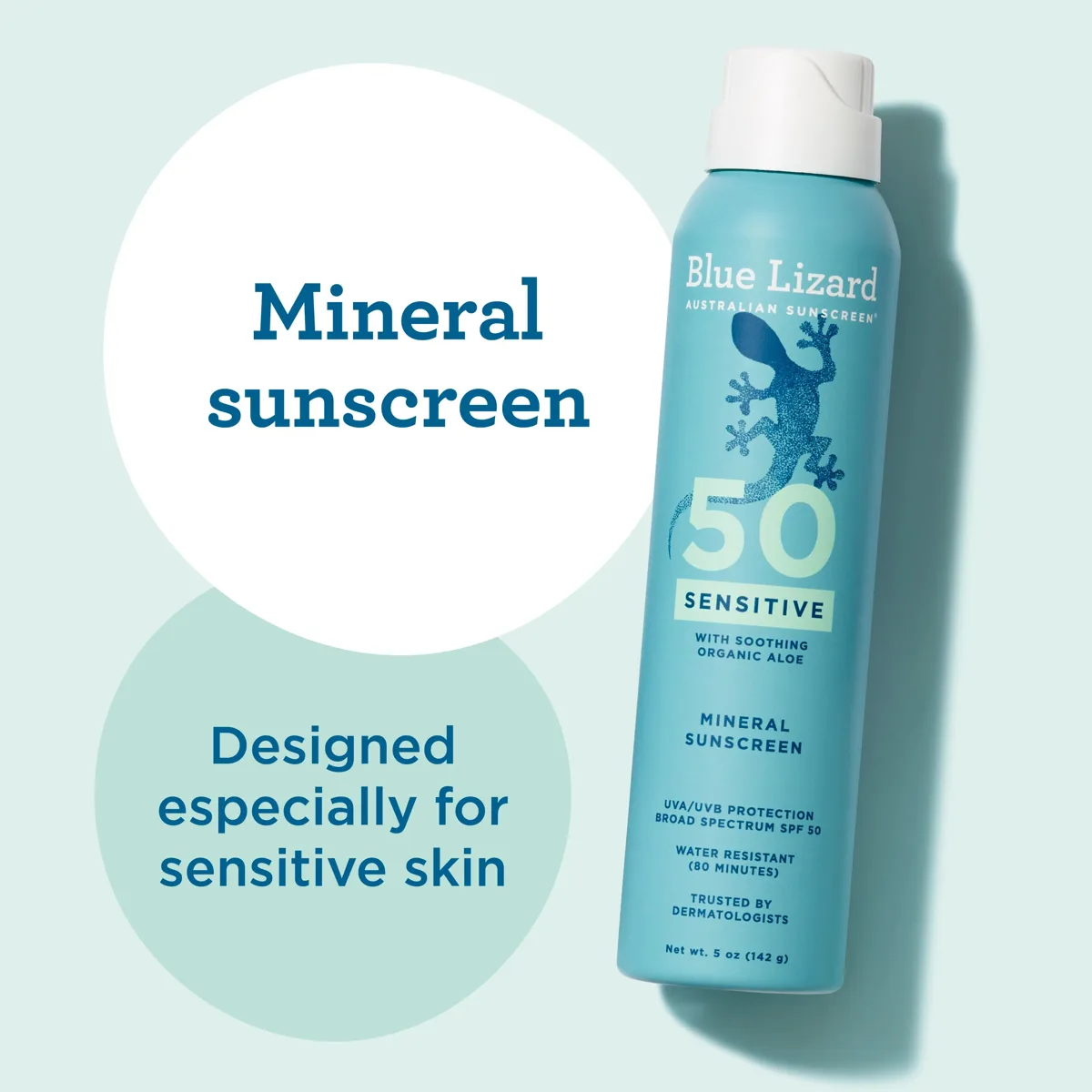
Blue Lizard Sensitive Mineral Sunscreen Spray SPF 50
Sample PM Routine
Cleanser to remove sunscreen
Treatment serum
Moisturizer
Evidence
Science & Expert Perspective
The Science
The protective claim rests on a single filter, and zinc oxide is the most thoroughly characterized broad-spectrum mineral filter in the FDA monograph, recognized as safe and effective and uniquely able to cover the full UVA1 range that many chemical filters miss. At 24% it is dosed near the practical ceiling for a sprayable formula, which is what allows SPF 50 from one active without titanium dioxide. The more interesting science in this specific formula is the dispersion system rather than the filter itself. Dense zinc particles tend to clump and settle, and clumped filter is uneven filter, so the formula relies on polyhydroxystearic acid, a well-established mineral-dispersant surfactant, to coat the particles and keep them individually suspended in the silicone-and-emollient carrier. Even, individual particle distribution is precisely what determines real-world SPF, because gaps in the film let UV through regardless of the number on the label. Butyloctyl salicylate further raises the formula's SPF efficiency as a film-former and spreading aid, a documented way to push a given filter load to a higher measured SPF. The water-resistance claim, validated to the FDA's 80-minute standard, comes from the synthetic beeswax and silicone film that resists wash-off. The unavoidable limitation, well-documented in regulatory reviews of aerosol sunscreens, is that spray delivery produces less reliable coverage than lotion because of drift and under-application, which is why the rub-in step is not optional but essential to realizing the tested SPF.
Dermatologist Perspective
Mineral, fragrance-free sunscreens like this all-zinc formula are commonly suggested for patients with sensitive, rosacea-prone, or chemical-filter-reactive skin, since zinc oxide rarely triggers contact irritation and offers reliable broad-spectrum coverage. In clinical guidance, spray formats are typically framed as a convenience tool rather than a primary face sunscreen: the consistent recommendation is to spray a generous amount and then rub it in evenly, because patchy aerosol application is a frequent cause of unexpected sunburn. Dermatology educators also routinely caution against spraying near the face or in enclosed spaces to avoid inhalation. For reactive skin that struggles with stinging chemical sunscreens, an all-mineral spray is often presented as a practical way to keep body sun protection consistent, with the standard reminder that any sunscreen only works at the labeled SPF when reapplied every two hours of sun exposure.
Guidance
Usage & Recommendations
How to Use
Shake the can, then hold it a few inches from clean, moisturized skin and spray each area until it glistens evenly. Immediately smooth the product in with your hands so the mineral film lands uniformly rather than in a drift pattern, paying attention to edges and the backs of arms and legs. For the face, spray into your palms first and press it on; never spray directly at your face. Apply outdoors or in a ventilated space to avoid inhaling the mist, and wait a couple of minutes before dressing. Reapply at least every two hours of sun exposure, and after 80 minutes of swimming, toweling, or heavy sweating.
Value Assessment
At around $19 for a 5 oz can, this sits a few dollars above the brand's own Sensitive lotion, and the spray format inherently uses up product faster, so the cost-per-protected-application is noticeably higher than a tube. You are paying for convenience, not for a more advanced formula, and that is a fair trade only if the spray is genuinely what gets you to apply and reapply. For a dedicated beach, sport, or kid-wrangling can the premium is reasonable. As an everyday face sunscreen the value is weak, since a lotion delivers the same zinc protection more economically and more reliably. Buy it for the format, not as a money-saver.
Who Should Buy
Buy this if you have sensitive, rosacea-prone, or chemical-filter-reactive skin and want an all-mineral, fragrance-free sunscreen for the body that is easy to apply at the beach or on the field. It is also a good pick for parents who need to cover squirming kids quickly and anyone who reaches for a lotion less often than they should.
Who Should Skip
Pass if your main need is a daily facial sunscreen, where a lotion gives more reliable coverage and better value. Acne-prone faces may want to avoid the isopropyl myristate, and anyone uneasy about aerosol inhalation or who wants a fully invisible chemical-filter finish will be happier with a different format.
Ready to try Blue Lizard Sensitive Mineral Sunscreen Spray SPF 50?
A fine pressurized mist that lands wet, then settles into a light, slightly tacky mineral film once the carriers evaporate.
Scent
No added fragrance; a faint neutral mineral-and-aloe note is all that registers.
Packaging
Pressurized continuous-spray aluminum can with a lock-cap actuator.
Finish
naturalnon-greasy
What to Expect on First Use
First spray feels cool and damp, and the instinct to skip rubbing it in is the main pitfall. Smooth it across the skin and the wet sheen turns into an even, barely-there layer within a minute or two with no sting on reactive skin.
How Long It Lasts
About 5-8 full-body applications per can, so roughly one to two weeks of daily beach use or a few weeks of casual exposure.
The continuous-spray format arrived as Blue Lizard extended its long-running Sensitive line into the convenience formats parents and athletes kept asking for. The challenge was keeping the all-zinc promise in an aerosol, since dense mineral particles resist even dispersion, which is why the formula leans on silicone and polyhydroxystearic acid dispersants.
About Blue Lizard Legacy Brand (20+ years)
Blue Lizard was created by Australian pharmacists in 1998 to address one of the highest UV and skin-cancer burdens on earth, and it has carried pediatrician and dermatologist recommendations plus Skin Cancer Foundation recognition for over two decades. This continuous-spray version is a newer delivery format built on the brand's long-standing all-mineral Sensitive base.
Brand founded: 1998 · Product launched: 2019
Myth vs. Reality
Common Myths
Myth
A mineral spray protects you the second it leaves the can, no rubbing needed.
Reality
The SPF 50 rating assumes an even, thorough layer. With any spray, the mist drifts and lands patchy, so smoothing it in by hand is what actually delivers the labeled protection.
Myth
Higher zinc percentage means a worse white cast.
Reality
Cast comes from particle size and dispersion, not just concentration. This formula's 24% zinc is micronized and dispersed well enough that it sheers out far clearer than the number suggests.
FAQ
Frequently Asked Questions
Does the Blue Lizard Sensitive spray leave a white cast?
For an all-zinc formula it sheers down impressively. The 24% zinc oxide is micronized and well dispersed, so once you rub it in it settles into a soft, near-neutral finish rather than the heavy white film a high zinc number might suggest.
Do I still need to rub in this mineral sunscreen spray?
Yes, always. The SPF 50 rating assumes an even layer, but aerosol mist drifts and lands patchy. Smoothing it across the skin with your hands after spraying is what actually delivers the labeled protection.
Is the Blue Lizard Sensitive Mineral Spray reef friendly?
It uses only zinc oxide as its UV filter, with no oxybenzone or octinoxate, the two ingredients most often restricted in reef-protection laws. That makes it a reasonable choice where those chemical filters are banned, though no sunscreen is truly impact-free.
Can I use this Blue Lizard spray on my face?
You can, but spray it into your palms and press it on rather than aiming at your face, to avoid inhaling the mist. Note that the isopropyl myristate in the base is mildly comedogenic, so acne-prone facial skin may prefer the brand's face-specific lotions.
How is the spray different from Blue Lizard's Sensitive lotion?
The spray relies on a single 24% zinc oxide filter, while the Sensitive lotion pairs zinc oxide with titanium dioxide. The spray trades some application reliability for convenience and uses up product faster, but both share the same fragrance-free, all-mineral approach.
Is this sunscreen spray safe to use during pregnancy?
Yes. It contains only zinc oxide as its active filter, with no chemical sunscreens, retinoids, or other ingredients typically flagged during pregnancy. Spraying it outdoors or in a ventilated area is a sensible precaution for anyone.
Reviews
What Reviewers Tend to Say
Recurring themes our editors read across retailer reviews of this product — summaries in our words, not quotations, and not a substitute for your own patch test.
Common Praise
Truly fragrance-free and non-stinging
Dries clear with little white cast for an all-zinc formula
Convenient for backs, shoulders and hard-to-reach spots
Holds up well in water and sweat
Common Complaints
Spray can feel uneven without rubbing in
Aerosol runs out faster than a lotion
Slightly tacky finish in humidity
Easy to under-apply with any spray
Notable Endorsements
Skin Cancer Foundation Seal of RecommendationDermatologist-recommended brand
Repigmentation arrives as freckle-like islands around hair follicles rather than as a receding edge — which makes it nearly impossible to judge by eye, and makes the six-month verdict most people deliver on their own treatment badly premature.
IPL is a filtered flashlamp, a true vascular laser is one wavelength aimed at haemoglobin, and the choice between them turns on a distinction almost no consult makes: whether your redness is vessels or a state.
Products, answers, therapy guides, tools and articles in one search. Brand names,
slang and abbreviations all work — accutane finds isotretinoin, bacne finds truncal acne.