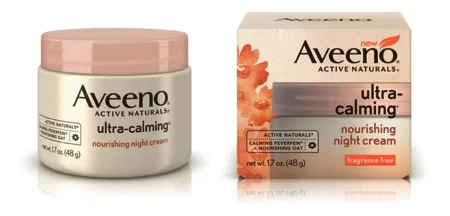
Few drugstore night creams build their identity around feverfew, a botanical specifically chosen for the look of redness, paired with Aveeno's oat. The oil-free, fragrance-free formula also makes it an unusually light 'nourishing' cream that reactive and even oily-sensitive skin can tolerate overnight.
A genuinely distinctive sensitive-skin night cream built around feverfew, the anti-redness botanical, plus Aveeno's calming oat in a light, oil-free, fragrance-free base. It soothes reactive skin overnight without grease. The frustrating part is that Aveeno has discontinued it, so finding it at a fair price is now the real challenge.
Note that Aveeno has discontinued this night cream, so what remains is third-party retailer and reseller stock at prices that fluctuate rather than a freshly produced item. This assessment draws on the substantial review history the cream accumulated over its long shelf life and on the established evidence behind oat and parthenolide-reduced feverfew, while acknowledging that current availability, pricing, and any fresh data will keep shifting as supplies run down.
Verdicts
How well it fits each concern
Verdict by concern tap a concern for the case
Good choicefor SensitivityIn your profileYou chose · No fragrance, drying alcohol, declarable allergens or sensitising preservatives in this cream — the profile sensitive skin looks for.Not yet assessedGentleNo reviews collected yet
The case for it
Oat Kernel Flour has no evidence row yet for this concern — it is in the research queue.
The formula carries none of the triggers this concern is sensitive to.
What would change this: A researched evidence row for the lead active would replace this with a verdict.
Same rule for everyone. “Good choice” is the verdict on 1,938 of 45,024 concern verdicts across the catalog; rule F2 decided 1,938 of them.
Unchanged since September 5, 2026, engine 5.1.1.
Good choicefor DrynessIn your profileYou chose · Ceramides is a reference standard by mechanism for dryness; this cream carries it.Moderate evidenceGentleNo reviews collected yet
The case for it
Ceramide NP has trial-supported standing for this concern.
It is plausibly present at a working level, though the concentration is not declared.
The formula carries none of the triggers this concern is sensitive to.
What would change this: A declared concentration would move this to a firmer reading of the dose.
Same rule for everyone. “Good choice” is the verdict on 9,564 of 45,024 concern verdicts across the catalog; rule R5 decided 9,072 of them.
Unchanged since September 5, 2026, engine 5.1.1.
R5 — Trial-supported or guideline-supported active, adequately or plausibly dosed. · the full register
Carrying active
Ceramide NP
Standing
supported — its mechanism is established
Form
plausible
Tolerability
gentle
Row checked
against its sources on July 17, 2026 (evidence table ev-2026.09-r228)
The studies behind the evidence row
Elias PM, Feingold KR (eds), Skin Barrier — stratum corneum ceramides are the principal intercellular lamellar lipid; their depletion is the biochemical signature of dry/xerotic skin — reference work
Supporting rolefor RosaceaIn your profileYou chose · Nothing here targets rosacea directly; barrier repair and gentle hydration is the recognised companion to treating it, and this cream does that without known triggers.Not yet assessedGentleNo reviews collected yet
The case for it
Panthenol has been researched for this concern and the evidence does not support it.
It is plausibly present at a working level, though the concentration is not declared.
The formula carries none of the triggers this concern is sensitive to.
What would change this: A declared concentration would move this to a firmer reading of the dose.
Same rule for everyone. “Supporting role” is the verdict on 8,197 of 45,024 concern verdicts across the catalog; rule R8 decided 4,250 of them.
Unchanged since September 5, 2026, engine 5.1.1.
R8 — The category's job (barrier care, humectant hydration, gentle cleansing, photoprotection) is the documented supportive role for this concern. This is the honest verdict for a moisturizer on an acne page. · the full register
Carrying active
Panthenol
Standing
none
Form
plausible — studied range 1–5%, from the OTC monograph or label; needs leave-on contact
Good choicefor DehydrationIn your profileYou chose · Panthenol (Vitamin B5) is a reference standard by mechanism for dehydration; this cream carries it.Moderate evidenceGentleNo reviews collected yet
The case for it
Panthenol has trial-supported standing for this concern.
It is plausibly present at a working level, though the concentration is not declared.
The formula carries none of the triggers this concern is sensitive to.
What would change this: A declared concentration would move this to a firmer reading of the dose.
Same rule for everyone. “Good choice” is the verdict on 9,564 of 45,024 concern verdicts across the catalog; rule R5 decided 9,072 of them.
Unchanged since September 5, 2026, engine 5.1.1.
R5 — Trial-supported or guideline-supported active, adequately or plausibly dosed. · the full register
Carrying active
Panthenol
Standing
supported — its mechanism is established
Form
plausible — studied range 2.5%, from the trials on the row; needs leave-on contact
Tolerability
gentle
Row checked
against its sources on July 17, 2026 (evidence table ev-2026.09-r228)
The studies behind the evidence row
Cosmetic Ingredient Review assessment of panthenol / dexpanthenol — humectant and moisturizer that raises stratum-corneum water content — reference work
Good choicefor Compromised Skin BarrierIn your profileYou chose · Ceramides is a reference standard by mechanism for compromised skin barrier; this cream carries it.Moderate evidenceGentleNo reviews collected yet
The case for it
Ceramide NP has trial-supported standing for this concern.
It is plausibly present at a working level, though the concentration is not declared.
The formula carries none of the triggers this concern is sensitive to.
What would change this: A declared concentration would move this to a firmer reading of the dose.
Same rule for everyone. “Good choice” is the verdict on 9,564 of 45,024 concern verdicts across the catalog; rule R5 decided 9,072 of them.
Unchanged since September 5, 2026, engine 5.1.1.
R5 — Trial-supported or guideline-supported active, adequately or plausibly dosed. · the full register
Carrying active
Ceramide NP
Standing
supported — its mechanism is established
Form
plausible — studied range 0.5–1%, from the trials on the row; needs leave-on contact; judge it after ~4 weeks
Tolerability
gentle
Row checked
against its sources on July 17, 2026 (evidence table ev-2026.09-r228)
The studies behind the evidence row
Elias PM, Skin Barrier / Coderch et al., ceramides and skin barrier function — ceramides ~50% of SC intercellular lipid mass, essential to the permeability barrier — reference work
Does the jobDoes what a moisturizer is for: draws in water, softens and smooths.
A verdict is DermApproved’s assessment of how well a product’s ingredients fit a concern — never a claim about what the product treats. Evidence dots and collected reviews sit beside it and are never blended in.
Rules 0.5.1 · evidence table ev-2026.09-r228 · how we decide
Assessment
Pros & Cons
Pros
✓ Distinctive feverfew active targets the look of redness
✓ Calming oat broadens the soothing effect overnight
✓ Oil-free and fragrance-free, light on reactive skin
✓ Absorbs cleanly without grease despite being a night cream
✓ Suits even oily-but-sensitive skin types
✓ Long track record of loyal redness-prone users
Cons
✗ Discontinued by Aveeno, so stock is dwindling
✗ Reseller pricing is inconsistent and often inflated
✗ Feverfew can sensitize Asteraceae-allergic users
✗ Lighter than expected for a 'nourishing' night cream
✗ Jar packaging is less hygienic for sensitive skin
Review
Full Review
Most night creams sell themselves on richness, the promise of waking up swaddled in something thick and expensive. This one took a different bet entirely, staking its identity on a single unfussy botanical: feverfew. That alone makes it worth understanding, because feverfew is not a marketing flourish but a deliberate, slightly unusual choice for a drugstore moisturizer. Feverfew is a daisy-family plant with a long history in herbal medicine, and in skincare it shows up specifically as an anti-redness agent. The catch is that raw feverfew contains parthenolide, a compound that can sensitize skin, which is exactly the opposite of what you want in a calming product. The clever move Aveeno made was using a parthenolide-reduced feverfew, keeping the soothing, anti-inflammatory benefits while stripping out most of the irritant. Build a sensitive-skin line around that, add the brand's signature oat, and you get the Ultra-Calming franchise this cream belonged to.
The formula reflects that calming-first philosophy from top to bottom. Water and glycerin establish the hydration base, oat kernel flour brings the familiar beta-glucan and avenanthramide soothing, and the feverfew juice sits lower in the list as the targeted anti-redness active. A single ceramide, ceramide NP, appears right at the end to nod toward barrier support, and panthenol adds humectant comfort. The whole thing is built oil-free, which is the genuinely interesting structural decision. A night cream you would expect to lean rich and emollient instead uses silicones and lightweight conditioning agents to deliver a soft, comfortable feel without any actual oils. That makes it a 'nourishing' cream that even oily-but-sensitive skin can wear overnight, a combination that is rarer than it sounds. It is a quiet reminder that the word nourishing on a label describes intent rather than texture, and that what reactive skin usually needs at night is not more weight but fewer reasons to flare.
On the skin, the experience surprises people, sometimes pleasantly and sometimes not. It spreads thin and absorbs fast, closer to a rich lotion than a thick overnight balm, with no fragrance and no tingle. If you were expecting to slather on something dense and luxurious, the lightness can read as underwhelming at first. But that is the point: it is designed to calm and hydrate without weighing reactive skin down, and by the next morning the payoff shows up as skin that simply looks and feels more settled. Aveeno cited clinical data showing visibly reduced redness within a week, and while company data always warrants a grain of salt, the mechanism is plausible and the long base of loyal user reviews backs up the redness-calming reputation. For chronically reactive or rosacea-prone skin, the comfort tends to build over a few weeks of nightly use.
The honest limitations split into two categories. The first is inherent to the hero ingredient: feverfew, even in its parthenolide-reduced form, belongs to the Asteraceae family, and people allergic to that family (think ragweed, chamomile, marigold) can react to it. This is not a reason to avoid the cream broadly, but it is a real reason to patch test on the inner arm before trusting it on your face, and it is why the most cautious sensitive-skin users sometimes steer clear of feverfew products entirely. The second limitation is circumstantial but significant: Aveeno has discontinued this cream. The formula was well liked and was not pulled for any safety reason, but the practical consequence is that you are now buying from remaining retailer and reseller stock at prices that bounce around unpredictably. A jar that once sat around eighteen or nineteen dollars might now be listed for considerably more, and there is no manufacturer price to anchor against.
That discontinuation is what complicates the value question, because the cream itself is reasonably priced when found near its old shelf cost. As a light, oil-free, fragrance-free night cream with a distinctive soothing active, it offered fair drugstore value in its day. The problem is purely availability: if the only listings you can find carry a steep markup, the value collapses and a currently produced calming cream becomes the smarter buy. There is no shame in brand loyalty, but there is no sense in overpaying for a discontinued jar when comparable soothing options remain in production.
The recommendation, then, comes with an asterisk. If you have sensitive, redness-prone, or rosacea-prone skin, tolerate feverfew, and can find this cream at something close to its original price, it is a lovely, low-drama nighttime option that does its calming job without grease or scent. If you have a known daisy-family allergy, skip it on principle. And if the only versions available are marked up to collector prices, let it go gracefully; it was a good cream, but it is not so irreplaceable that it is worth paying a premium for the privilege of using up the last of the stock. Patch test, buy sensibly, and enjoy it while it lasts.
Formula
Key Ingredients
The hero actives that drive this product's performance.
Aveeno's signature anti-redness botanical, here in a parthenolide-reduced form chosen to soothe without the sensitizing risk raw feverfew carries. In this night cream it teams with the oat to target the look of redness and reactivity overnight while you aren't applying anything else.
Supplies the calming beta-glucans and avenanthramides that anchor Aveeno's sensitive-skin claims. Paired with feverfew in this formula, it broadens the soothing effect and helps hydrate dry, reactive skin through the night.
A barrier lipid included to help shore up a compromised, sensitive-skin barrier overnight. It is dosed at the very end of the list, so it is a supportive accent to the oat and feverfew rather than the cream's headline repair active.
Established mechanismfor Dryness · established mechanism
A humectant and skin-conditioning agent that improves overnight hydration and smoothness. In this oil-free formula it helps compensate for the absence of richer emollients, keeping the cream comfortable on dry sensitive skin.
Established mechanismfor Dehydration · established mechanism
Ingredient standings describe the active at treatment-level doses and
vehicles; this product's own condition grades weigh its actual formula.
An evening-only step. Apply after any PM serum or treatment as the final layer; if you use a retinoid, it can sit on top as a soothing buffer for reactive skin.
Results Timeline
Skin feels more comfortable and hydrated by the next morning. Aveeno cites visibly reduced redness within a week; barrier comfort for chronically reactive skin builds over about 3-4 weeks.
Pairs Well With
Gentle PM cleanserHydrating or soothing serumsRetinoid (as a buffer)
Two soothing ingredients define this cream, and they sit at different points on the evidence curve. Colloidal oat, here as oat kernel flour, is the well-established pillar: its beta-glucans form a hydrating film and its avenanthramides are polyphenols with documented anti-inflammatory and antihistaminic activity, an evidence base strong enough that colloidal oatmeal holds FDA skin-protectant status. Feverfew, the cream's signature, sits in the promising-but-younger category. Extracts of Tanacetum parthenium contain parthenolide and other sesquiterpene lactones with anti-inflammatory and antioxidant activity, and laboratory and early clinical work suggests parthenolide-depleted feverfew can reduce markers of skin irritation and the appearance of redness while avoiding the contact-sensitizing risk of the raw extract. The crucial formulation detail is precisely that parthenolide reduction: parthenolide is both the most studied bioactive and the chief sensitizer, so a depleted extract is a deliberate trade that favors tolerability. The oil-free base is the other notable design choice; rather than relying on occlusive oils, it uses silicones such as dimethicone and phenyl trimethicone alongside humectants like glycerin and panthenol to deliver overnight comfort, which is what lets even oily-sensitive skin wear it. A lone ceramide NP appears at the end of the list as a barrier nod rather than a meaningfully dosed repair active. The overall logic, pairing a robust soothing ingredient with a targeted anti-redness botanical in a low-irritation base, is coherent; the main honest caveat is that feverfew's clinical evidence, while encouraging, is thinner than oat's, and concentrations here are undisclosed.
Dermatologist Perspective
Feverfew and colloidal oat both appear in clinical conversations about calming sensitive and redness-prone skin, and a parthenolide-reduced feverfew is the form generally regarded as appropriate for topical use because it lowers the contact-allergy risk of the raw plant. In practice, soothing botanicals like these are often suggested as supportive care for mild redness and reactivity, frequently alongside gentle, fragrance-free routines and sun protection. Clinicians typically caution that anyone with a known Asteraceae or Compositae allergy should approach feverfew products carefully and patch test, since cross-reactivity is possible. For conditions such as rosacea, the broad clinical view is that gentle moisturizers can complement but not replace targeted prescription therapy, and persistent redness warrants proper evaluation rather than reliance on a cosmetic cream alone.
Guidance
Usage & Recommendations
How to Use
Use it at night only, as the last step of your evening routine. After cleansing and any serum or treatment, smooth a thin layer over the face and neck; the oil-free texture absorbs quickly, so you won't need to wait long before getting into bed. If you use a retinoid, this cream can sit on top as a soothing buffer for reactive skin. Because of the feverfew, patch test on the inner arm for a couple of nights first, especially if you have any daisy-family allergies. Keep the jar clean by scooping with a fingertip or spatula.
Value Assessment
Value here is entirely hostage to availability. As a light, oil-free, fragrance-free night cream with a genuinely distinctive feverfew-and-oat soothing angle, it offered fair drugstore value when it sat around eighteen to nineteen dollars on shelves. But Aveeno has discontinued it, so there is no current list price, only third-party and reseller stock at prices that swing from reasonable to opportunistic. Found near its old cost, it is a worthwhile, gentle pick; marked up steeply, it stops making sense, and a currently produced calming moisturizer becomes the better spend. Treat the price you are quoted, not the formula, as the deciding factor.
Who Should Buy
Buy it if you have sensitive, redness-prone, or rosacea-prone skin, tolerate feverfew, and want a light, oil-free, fragrance-free night cream you can find at a fair price. It is especially appealing for oily-but-sensitive skin that struggles with the heaviness of typical night creams.
Who Should Skip
Anyone with a known Asteraceae or Compositae (ragweed, chamomile, marigold) allergy should skip it given the feverfew. Pass too if you want a genuinely rich overnight balm, or if the only listings you can find are heavily marked up because of the discontinuation.
Ready to try Aveeno Ultra-Calming Nourishing Night Cream?
A surprisingly light, oil-free cream that spreads thin and absorbs cleanly, closer to a rich lotion than a heavy overnight balm.
Scent
Fragrance-free, with only a faint neutral base note and no perfume or botanical scent added.
Packaging
Screw-top jar, which is convenient but invites fingers into a product aimed at sensitive skin.
Finish
non-greasysatin
What to Expect on First Use
It goes on light and sinks in fast with no tingle or scent, which can feel underwhelming if you expect a thick night balm. Skin reads calmer and more comfortable by morning; reactive users should patch test first because the feverfew can occasionally provoke an Asteraceae-family sensitivity.
It was a long-running fixture of Aveeno's Ultra-Calming line, the brand's redness-and-sensitivity franchise built around a parthenolide-reduced feverfew extract. Aveeno has since discontinued it, so the loyal following it built over the years now hunts for remaining stock.
About Aveeno Legacy Brand (20+ years)
Aveeno was founded in 1945 with the Mayo Clinic and has been dermatologist-recommended for over 80 years. It pioneered colloidal oat skincare, and colloidal oatmeal earned FDA skin-protectant status in 2003 with input from the brand's research.
Brand founded: 1945 · Product launched: 2015
Myth vs. Reality
Common Myths
Myth
Feverfew in skincare is the same plant that triggers allergies in tea.
Reality
It is the same botanical, but skincare uses a parthenolide-reduced form designed to keep the soothing benefits while lowering the sensitizing compound. Still, people allergic to the Asteraceae family should patch test.
Myth
A night cream has to be thick and greasy to work.
Reality
Overnight benefit comes from the actives and from giving skin uninterrupted hours to recover, not from heaviness. This oil-free cream proves a light texture can still calm and hydrate sensitive skin through the night.
FAQ
Frequently Asked Questions
What does feverfew do in the Aveeno Ultra-Calming Night Cream?
Feverfew is the cream's anti-redness botanical, used in a parthenolide-reduced form so it soothes the look of redness and reactivity without the sensitizing risk of the raw plant. It works alongside the calming oat to settle sensitive skin overnight.
Is the Aveeno Ultra-Calming Night Cream still available?
Aveeno has discontinued this product, so what remains is third-party retailer and reseller stock. You can still find it in some places, but availability is shrinking and prices vary widely.
Can people with allergies use a feverfew night cream?
Feverfew belongs to the Asteraceae (daisy) family, so anyone allergic to ragweed, chamomile, or marigold should be cautious and patch test first. The parthenolide-reduced form lowers, but does not eliminate, the chance of a reaction.
Why is this night cream so lightweight?
It is built oil-free, using silicones and humectants like glycerin and panthenol instead of heavy oils for overnight comfort. That keeps it light enough for sensitive and even oily-prone skin to wear through the night.
Is the Aveeno Ultra-Calming Night Cream safe in pregnancy?
It contains no retinoids or salicylic acid; the main consideration is the feverfew botanical. It is generally regarded as low-risk topically, but as with any botanical product, confirm with your own provider if you are pregnant.
Does this cream actually reduce redness?
Aveeno cited clinical data showing visibly reduced redness within a week, and the feverfew-and-oat mechanism is plausible, with a long base of loyal redness-prone users. It calms the appearance of redness rather than treating an underlying condition like rosacea.
Reviews
What Reviewers Tend to Say
Recurring themes our editors read across retailer reviews of this product — summaries in our words, not quotations, and not a substitute for your own patch test.
Common Praise
Calms redness overnight
Lightweight despite being a night cream
No fragrance or breakouts
Comfortable on reactive, sensitive skin
Common Complaints
Now discontinued and hard to find
Pricing inconsistent from resellers
Feverfew can sensitize some users
Lighter than expected for a 'nourishing' cream
Notable Endorsements
Long-standing favorite among rosacea and redness-prone usersFragrance-free, oil-free formula trusted for sensitive skin
Western sensitive skincare works by subtraction — remove the fragrance, remove the alcohol, shorten the list. Japan's answer adds a designed molecule back in, and one of the two bets has a trial literature.
A wrecked barrier is the most common self-inflicted skin condition and the one with the clearest fix — the difficulty is that the routine which caused it feels productive and the one that repairs it feels like giving up.
'Barrier damage' has become the internet's all-purpose diagnosis. It's also a real, specific condition with a specific and slightly boring cure: mostly, stop doing things.
Products, answers, therapy guides, tools and articles in one search. Brand names,
slang and abbreviations all work — accutane finds isotretinoin, bacne finds truncal acne.