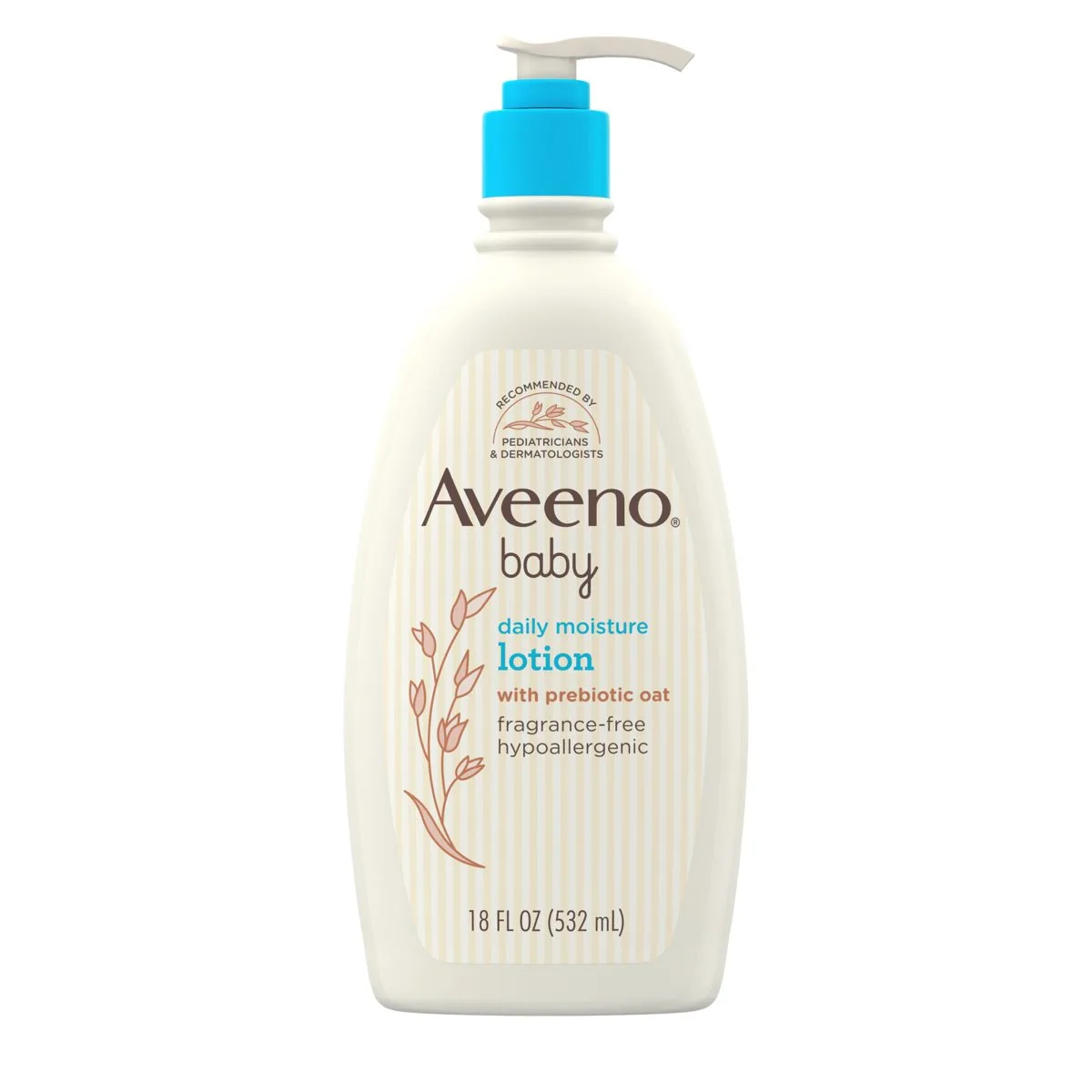
Eleven ingredients, no fragrance, and the three that matter in the right places: glycerin second, petrolatum fourth, oat flour eighth, with allantoin as a finishing touch and a cationic emulsifier that makes a petrolatum lotion absorb like a light cream. It is the fragrance-free version of the base Aveeno uses across its adult lotions, which is exactly why it works on babies.
body carelotiondermatologist recommendedParaben FreeNot Cruelty Free
Eleven ingredients, no fragrance, and the three that matter exactly where they should be: glycerin, petrolatum and oat flour in a cationic base that makes a petrolatum lotion absorb like a light cream. It is the bottle pediatricians name for dry and mildly eczematous infant skin, it costs thirteen dollars for a pump that lasts months, and fifteen thousand reviews agree with the pediatricians. Flares still need an ointment on top.
Strong choicefor DrynessIn your profileYou chose · Petrolatum is an approved or monograph active for dryness; this lotion carries it high in the ingredient list.Moderate evidenceGentleNo reviews collected yet
The case for it
Petrolatum is a first-line active — approved, monograph-listed or named in current guidelines — for this concern.
It is present at an effective concentration, declared or high in the ingredient list.
The formula carries none of the triggers this concern is sensitive to.
Same rule for everyone. “Strong choice” is the verdict on 1,459 of 45,024 concern verdicts across the catalog; rule R2 decided 892 of them.
As of September 25, 2026, engine 5.1.1.
Supporting rolefor SensitivityIn your profileYou chose · Mostly gentle: declarable allergens — usable for sensitive skin with a patch test.Not yet assessedStandard tolerabilityNo reviews collected yet
The case for it
Glycerin has no evidence row yet for this concern — it is in the research queue.
The formula carries no trigger this concern is sensitive to, with the cautions noted.
Cautions: a declarable fragrance allergen.
What would change this: A researched evidence row for the lead active would replace this with a verdict.
Same rule for everyone. “Supporting role” is the verdict on 8,197 of 45,024 concern verdicts across the catalog; rule F3 decided 183 of them.
As of September 25, 2026, engine 5.1.1.
Strong choicefor EczemaIn your profileYou chose · Petrolatum is an approved or monograph active for eczema; this lotion carries it high in the ingredient list.Moderate evidenceStandard tolerabilityNo reviews collected yet
The case for it
Petrolatum is a first-line active — approved, monograph-listed or named in current guidelines — for this concern.
It is present at an effective concentration, declared or high in the ingredient list.
The formula carries no trigger this concern is sensitive to, with the cautions noted.
Cautions: a declarable fragrance allergen.
Same rule for everyone. “Strong choice” is the verdict on 1,459 of 45,024 concern verdicts across the catalog; rule R2 decided 892 of them.
As of September 25, 2026, engine 5.1.1.
R2 — A regulator- or guideline-recognised first-line active, declared at an effective strength, in a form the claim supports. · the full register
Carrying active
Petrolatum
Standing
first line — a regulator recognises it for this use; its mechanism is established; trials support it · per 21 CFR § 347.50 - Labeling of skin protectant drug products. (US Code of Federal Regulations (Legal Information Institute, Cornell Law School)), opened July 27, 2026
Form
adequate — studied range up to 100%, from the OTC monograph or label; needs leave-on contact; judge it after ~1 weeks
Tolerability
standard — allergen count
Row checked
against its sources on July 27, 2026 (evidence table ev-2026.09-r228)
Also listed for Winter Skin — the actives here (Glycerin, Petrolatum, Colloidal Oatmeal, Allantoin) are in our research queue for that concern; there is no verdict until their evidence rows are written. That is a gap in our table, not a mark against the product.
As a body productNot judged: what a body product is for — real substance, not just slip, realistic to use daily — cannot yet be measured from the ingredient list (only fragrance load can).
A verdict is DermApproved’s assessment of how well a product’s ingredients fit a concern — never a claim about what the product treats. Evidence dots and collected reviews sit beside it and are never blended in.
Rules 0.5.1 · evidence table ev-2026.09-r228 · how we decide
Assessment
Pros & Cons
Pros
✓ Glycerin second and petrolatum fourth, the humectant-plus-occlusive structure infant skin needs
✓ Genuinely fragrance-free with no masking scent
✓ Cationic base makes a petrolatum lotion absorb without a greasy film
✓ Oat flour in a leave-on where its soothing fraction stays on the skin
✓ National Eczema Association seal and around 15,000 reviews with few reactions
✓ Thirteen dollars for a pump that lasts three to five months, with a refill size
Cons
✗ Too light on its own for active eczema flares, which need an ointment on top
✗ Benzyl alcohol preservative is a declared, if rare, allergen
✗ Isopropyl palmitate is a mildly comedogenic ester, a consideration for adult users
✗ Pump on the 18 oz bottle sticks and clogs over the months it takes to empty
✗ Reformulations leave long-time users disputing the texture
Review
Full Review
The most honest version of a formula is usually the one sold to babies. Aveeno uses essentially this lotion base across its adult range, dressed up with fragrances and claims about stress relief or radiance, and the baby bottle is what is left when all of that is removed: eleven ingredients, no scent, no story, and a National Eczema Association seal where the marketing would go. Reviewing it is a chance to judge the base on its merits, which turn out to be considerable.
Read the list and the structure is textbook. Glycerin is second, the humectant that draws water into the outer skin. Petrolatum is fourth, the occlusive that keeps it there and the ingredient with the longest and strongest record of any for protecting infant skin. Between them sits distearyldimonium chloride, a cationic emulsifier that is the quiet reason the lotion works the way it does: it spreads the petrolatum in a thin, even film, which is why a formula with this much occlusive in its top four goes on light, turns briefly slippery, and is absorbed by the time the nappy is done up rather than sitting on the skin like an ointment. Isopropyl palmitate, cetyl alcohol and dimethicone fill out the emollient side. Oat kernel flour is eighth, the skin-protectant grade that Aveeno built its name on, and in a leave-on it actually stays where its avenanthramides and beta-glucan can do something. Allantoin closes the list, a small soothing addition that the adult versions of the base do not carry and that suits the chafed folds a baby lotion is asked to cover. Benzyl alcohol is the only preservative.
That last point deserves a sentence, because benzyl alcohol is a declared fragrance allergen and a parent reading labels will find it on the list of things to watch. In practice it is one of the rarer sensitizers in the patch-test literature, it is used here as a preservative rather than a scent, and the alternative preservatives it replaced, parabens and phenoxyethanol, were the ones parents actually objected to. The formula has been revised more than once to arrive at this system, and the long-running complaint in the reviews that the lotion 'used to be thicker' is the sound of those revisions, not a change to the glycerin, petrolatum and oat that do the work.
On performance, roughly 15,000 reviews pooled between Walmart and the brand site say what a formula like this should deliver. Post-bath tightness gone. Flaky shins and dry cheeks smoothed within days. Skin still comfortable the next morning. No reaction, which for a product applied to newborns twice a day is the finding that matters most, and the reason the fragrance-free claim on the front is worth more here than on any adult bottle. The complaints are about scope and hardware: the lotion is too light on its own for a real eczema flare, where a thicker ointment on the patches is the standard pairing, and the pump on the 18-ounce bottle sticks and clogs over the months it takes to empty. Neither is a formula problem, and both are worth knowing before the bottle arrives: keep an ointment beside it, and unscrew the pump and rinse the tube when it starts to stick.
What the lotion cannot do is worth stating plainly, because the baby aisle implies otherwise. Routine emollient use from birth does not prevent eczema; the BEEP trial and a 2022 Cochrane review both found no protective effect and some increase in skin infections with daily emollients in high-risk infants. This lotion keeps dry skin comfortable and helps manage mild eczema between flares, which is a real and useful job. It is not a vaccine, and no lotion is.
Adults should know that it works for them too. It is the fragrance-free version of the base in the brand's Daily Moisturizing range, and a grown-up with sensitive or eczema-prone skin who buys the baby bottle gets the same moisturizer without the lavender and without the price of the 'sensitive' adult lines. The cationic base absorbs as well on an adult forearm as on an infant one, and the powdery-dry finish suits people who dislike lotion under clothes.
At around thirteen dollars for 18 ounces, with a 33-ounce refill cheaper per ounce and small sizes for the changing bag, a bottle lasts three to five months of twice-daily use on one baby, and the cost per week is close to nothing. Aveeno has been in the pediatric aisle since 1945 and this lotion is where the trust it has earned is best deserved: a correctly built, fragrance-free, minimally preserved moisturizer with the oat placed where it can act, sold at a pharmacy price. Buy it for any baby with dry or mildly eczematous skin, use it on damp skin after every bath, and keep an ointment beside it for the flares it was never meant to handle alone.
Formula
Key Ingredients
The hero actives that drive this product's performance.
Finely milled oat flour is the skin-protectant grade that FDA's monograph recognises at 1 percent and above, sitting eighth here in a leave-on lotion where its beta-glucan and avenanthramides actually stay on the skin; it is the ingredient that turns a well-built petrolatum lotion into the product pediatricians name for itchy, dry infant skin.
Second on an eleven-ingredient list, glycerin is the humectant half of the lotion's structure, drawing water into the outer skin so that the petrolatum a few lines down has something to hold; on a baby's thin, fast-drying skin the pairing is what makes the 24-hour claim believable.
Established mechanismfor Dryness · established mechanism
Fourth on the list, petrolatum is the occlusive that seals the glycerin's water in and the ingredient with the strongest record of any for protecting infant skin; the cationic distearyldimonium chloride base spreads it thinly, so a lotion with this much petrolatum absorbs without the greasy film a baby ointment leaves.
Regulator-approvedfor Dryness · established mechanism
The last ingredient and the one that distinguishes this from the brand's adult lotion base: a small dose of allantoin adds a skin-protectant, soothing note that suits the chafed folds and nappy-area edges a baby lotion is asked to cover.
Not yet assessed
Ingredient standings describe the active at treatment-level doses and
vehicles; this product's own condition grades weigh its actual formula.
Smooth it over the whole body within a few minutes of the bath while the skin is still damp, and again in the morning on cheeks, hands and any dry patches; on active eczema, a thicker ointment on the patches with this lotion everywhere else is the usual pairing, and the lotion goes on before any barrier cream in the nappy area.
Results Timeline
Skin feels soft and the post-bath tightness is gone from the first application; flaky shins, dry cheeks and rough elbows smooth out over three to five days of twice-daily use, and the lotion's real strength, keeping the skin comfortable through the next day, is obvious within the first week.
The lotion's evidence is unusually solid for a baby product because each of its three working ingredients has its own literature. A 2016 review in the Indian Journal of Dermatology on moisturizer design describes the humectant-plus-occlusive pairing as the foundation of an effective leave-on, with glycerin the reference humectant and petrolatum the occlusive that reduces transepidermal water loss more than any other single ingredient, and it notes that petrolatum's safety record in infants is among the longest in dermatology. The oat is the ingredient specific to this brand: a 2015 review in the Journal of Drugs in Dermatology summarised colloidal oatmeal's anti-inflammatory and anti-itch activity, attributed to its avenanthramides, and a 2008 study in Archives of Dermatological Research showed those polyphenols inhibit NF-kB signalling and reduce histamine-induced itch in human subjects; both were supported by the brand's parent company, which is worth weighing, though they agree with independent work. Colloidal oatmeal is also recognised by FDA's skin protectant monograph at 1 percent or more, which is a regulatory statement about its standing as an active, not a claim that it works better than other emollients. On infants, a 2019 review in Current Opinion in Pediatrics on infant skin care summarises the guidance this lotion fits: the newborn barrier is thinner and more permeable, emollients should be applied to damp skin after brief, infrequent baths, and fragrance-free products are preferred. The limits are equally well documented. The BEEP randomised trial, reported in full in Health Technology Assessment in 2024, found that daily emollient application from birth in high-risk infants did not prevent eczema and was associated with more skin infections, and a 2022 Cochrane review of skin care interventions in infants reached the same conclusion across trials, so the lotion should be understood as comfort and maintenance rather than prevention. Benzyl alcohol is a declared allergen with a low sensitization rate in patch-test series, and isopropyl palmitate rates as mildly comedogenic in the classic assays, a consideration mainly for adult users on facial skin rather than for infants.
This is one of a small number of baby moisturizers that pediatricians and pediatric dermatologists name by default, and the reasoning is consistent across clinics: it is fragrance-free, it pairs a humectant with petrolatum, it carries colloidal oatmeal at a leave-on dose, and it is cheap enough to be applied generously twice a day, which matters more than any single ingredient. The guidance attached to it is about technique, namely apply within minutes of the bath to damp skin, use it over the whole body rather than only on dry patches, and keep bathing brief and infrequent. For infants with established eczema, clinicians treat it as the everyday emollient between flares and add a thicker ointment on active patches, with any prescribed topical applied first. Parents are routinely reminded that no emollient prevents eczema, whatever the aisle implies, and that the lotion's job is comfort and barrier support. Benzyl alcohol is rarely raised as a concern except in the uncommon infant with a documented sensitivity to it.
Guidance
Usage & Recommendations
How to Use
Within a few minutes of lifting the baby out of the bath, while the skin is still slightly damp, pump a coin-sized amount into your palm and smooth it over the whole body in long strokes, working quickly because the lotion turns slippery for a moment and then absorbs. Use a little more on shins, cheeks, elbows and any dry patches, and a small amount on the face if it is dry, avoiding the eyes. Repeat in the morning on cheeks, hands and anywhere that chaps. On eczema patches, apply any prescribed treatment first, then the lotion around the patch, then a thicker ointment on top of the patch itself. In the nappy area it goes on before, not instead of, a zinc barrier cream. If the pump sticks, unscrew it and run warm water through the tube.
Value Assessment
Around thirteen dollars for 18 ounces from a first-party retailer is close to the floor for a fragrance-free moisturizer with glycerin, petrolatum and oat in its top eight, and the 33-ounce refill brings the per-ounce cost lower still for households that use a lot; the 8 and 12 oz sizes are convenient but cost more per ounce. Twice-daily full-body use on one baby empties the 18-ounce pump in three to five months, so the weekly cost is trivial. What the money buys is the reference infant lotion from a legacy pediatric brand, with a National Eczema Association seal and a conservative preservative system; what it does not buy is a flare-strength ointment, which is a separate and equally cheap purchase. For adults with sensitive skin it is also one of the best-value fragrance-free body lotions on the shelf, since it is the same base the brand sells in its adult lines at a similar price with fragrance added.
Who Should Buy
Parents of babies and toddlers with dry, sensitive or mildly eczematous skin who want the fragrance-free lotion their pediatrician is likely to name, households that want a big pump or refill for twice-daily use, and adults with sensitive or eczema-prone skin looking for the same base without the fragrance of the adult lines.
Who Should Skip
A baby in an active eczema flare needs a thicker petrolatum ointment on the patches rather than this lotion alone, though it still suits the surrounding skin. The rare infant with a documented benzyl alcohol sensitivity needs a differently preserved product, and adults using it on acne-prone facial skin should be aware of the isopropyl palmitate.
Ready to try Aveeno Baby Daily Moisture Body Lotion?
A medium-weight white lotion that turns briefly slippery from the cationic base, then absorbs to a soft, dry, faintly powdery finish with no film.
Scent
None; the faint waxy note of the base is all there is, and it disappears on the skin.
Packaging
Tall white 18 fl oz pump bottle with a blue pump and cap, the Aveeno Baby oat-stalk label, a 'fragrance-free, hypoallergenic' line and the National Eczema Association seal; also sold in 8, 12 and 33 oz sizes.
Finish
non-greasysatinfast-absorbing
What to Expect on First Use
The first application feels lighter than parents expect from a lotion with petrolatum in its top four: it spreads easily over a wriggling baby, goes slightly slippery, and is absorbed by the time the nappy is on. Skin is soft the next morning. Over the first week dry cheeks and flaky shins clear, and the only thing left to judge is whether a particular baby's eczema patches need something thicker on top.
How Long It Lasts
Three to five months of twice-daily full-body use on one baby from the 18 oz pump.
Aveeno built its baby range in the 2000s around this lotion and the matching wash, and the lotion became the bottle pediatricians named when parents asked what to use on dry or mildly eczematous infant skin. It has been reformulated to remove parabens and phenoxyethanol, and the long-running debate in reviews about whether it 'used to be thicker' tracks those revisions rather than any change to the core glycerin, petrolatum and oat structure.
About Aveeno Legacy Brand (20+ years)
Aveeno began with the Musher brothers' colloidal oatmeal bath in 1945, and its oat is an FDA-monograph skin protectant backed by peer-reviewed research from the brand's parent company. Now under Kenvue, it is among the brands pediatricians most often recommend for infant skin, and this lotion, with National Eczema Association acceptance, is one of the most-reviewed baby moisturizers sold in the United States.
Brand founded: 1945
Myth vs. Reality
Common Myths
Myth
Daily lotion from birth will stop a baby developing eczema.
Reality
The large BEEP trial and a 2022 Cochrane review both found that routine emollient use in infancy does not prevent eczema; a good lotion keeps dry skin comfortable and helps manage mild eczema, but it is not prevention.
Myth
Petrolatum in a baby lotion is a concern.
Reality
Cosmetic-grade petrolatum is highly refined, has one of the longest safety records of any skincare ingredient, and is the single most effective occlusive for infant skin; its position here is a strength, not a compromise.
FAQ
Frequently Asked Questions
Is the Aveeno Baby Daily Moisture Lotion fragrance-free?
Yes, genuinely; there is no fragrance on the eleven-ingredient list and no masking scent. It is the fragrance-free counterpart to the brand's scented adult lotions, built on the same base.
Can I use Aveeno Baby lotion on a newborn?
It is labelled for use from birth and its ingredients are the ones pediatric guidance favours for infant skin: glycerin, petrolatum and oat, with no fragrance. Apply it to damp skin after the bath and use it sparingly in the first weeks.
Is Aveeno Baby lotion good for baby eczema?
For dry skin and mild eczema, yes, and it carries the National Eczema Association seal. During flares it is usually too light on its own, and a thicker petrolatum ointment on the patches, with this lotion elsewhere, is the standard pairing; any prescribed treatment goes on first.
Does Aveeno Baby lotion contain parabens or phenoxyethanol?
Neither. It is preserved with benzyl alcohol, which is a declared allergen but a rare one, and it has no parabens, phenoxyethanol, formaldehyde releasers or isothiazolinones.
Can adults use Aveeno Baby lotion?
Yes. It is the fragrance-free version of the base Aveeno uses in its adult Daily Moisturizing lotions, and many adults with sensitive or eczema-prone skin buy it for exactly that reason.
What sizes does the Aveeno Baby lotion come in?
The 18 fl oz pump is the standard, with 8 and 12 oz sizes for travel and a 33 oz refill that is the cheapest per ounce.
Reviews
What Reviewers Tend to Say
Recurring themes our editors read across retailer reviews of this product — summaries in our words, not quotations, and not a substitute for your own patch test.
Occupational hand dermatitis is one of the most common work-related diseases on earth, it follows a script, and the cheapest fix works only if you start it before the skin splits.
Every post that dismantles a home remedy owes the reader a replacement. The honest replacement list is embarrassingly cheap, and one item on it is cheaper still — it is a bath.
The blanket dismissal of DIY masks is lazy, because these four grade completely differently once you look at what is actually in them and at what dose.
Products, answers, therapy guides, tools and articles in one search. Brand names,
slang and abbreviations all work — accutane finds isotretinoin, bacne finds truncal acne.