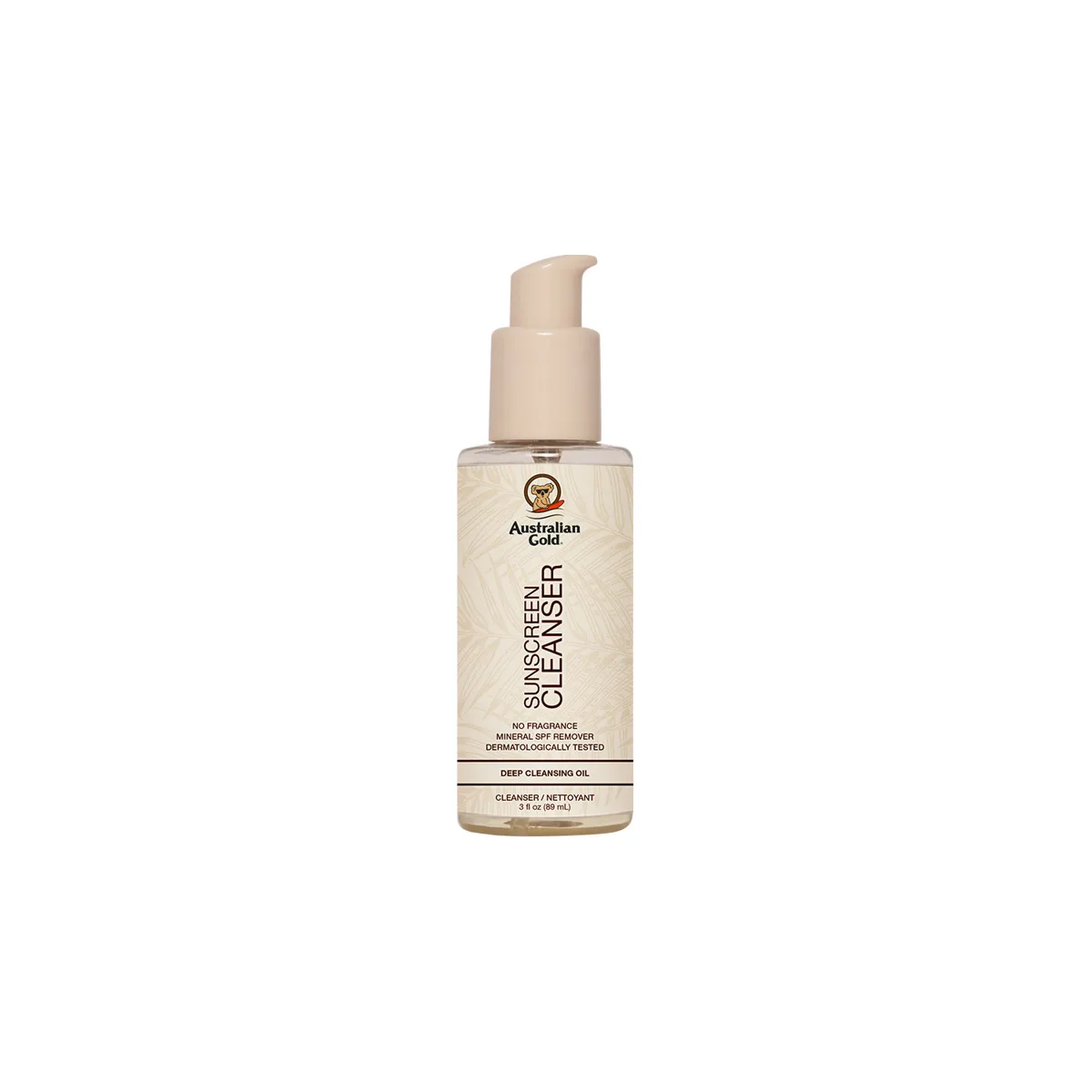
Australian Gold positions this oil cleanser specifically for sunscreen removal — combines sunflower seed oil (primary chassis) with squalane (skin-mimetic), olive oil, and tea tree oil for effective SPF breakdown plus antibacterial support. Distinctive within the brand's sun-care platform extension into cleansing.
Australian Gold's Sunscreen Cleanser is the brand's oil cleanser specifically positioned for SPF removal — combines sunflower seed oil, squalane, olive oil, and tea tree oil at $18.99 for 3oz. Effective SPF breakdown chemistry with antibacterial support. Plant oils and tea tree limit fungal-acne and sensitive-skin use.
Released 2023 with growing distribution; approximately 240 reviews accumulated.
Verdicts
How well it fits each concern
Verdict by concern tap a concern for the case
Supporting rolefor Sun DamageIn your profileYou chose · Rinse-off oil: Vitamin E gets seconds of contact, so this supports a routine for sun damage rather than treating it.Limited evidenceGentleNo reviews collected yet
The case for it
Tocopheryl Acetate has early or mechanistic evidence for this concern, not trial-backed standing.
It is in a rinse-off product, so it gets seconds of contact rather than the leave-on exposure the evidence assumes.
The formula carries none of the triggers this concern is sensitive to.
What would change this: The same active in a leave-on form would be judged on its evidence rather than its contact time.
Same rule for everyone. “Supporting role” is the verdict on 8,197 of 45,024 concern verdicts across the catalog; rule R6 decided 2,017 of them.
Unchanged since September 5, 2026, engine 5.1.1.
R6 — Contact time cannot deliver a leave-on claim; the product is judged on its job (cleansing without aggravating). Explicit exceptions (BPO wash, SA cleanser, medicated shampoos) never reach this rule because their rows set rinse_off_ok. · the full register
Carrying active
Tocopheryl Acetate
Standing
plausible — trials support it
Form
contact limited
Tolerability
gentle
Row checked
against its sources on July 17, 2026 (evidence table ev-2026.09-r228)
Also listed for Compromised Skin Barrier — the actives here (Emulsifiers, Squalane, Vitamin E, Olive Oil) are in our research queue for that concern; there is no verdict until their evidence rows are written. That is a gap in our table, not a mark against the product.
As a cleanserNot judged: what a cleanser is for — surfactant mildness, pH match to skin, rinses clean without stripping — cannot yet be measured from the ingredient list (only puts something back can).
A verdict is DermApproved’s assessment of how well a product’s ingredients fit a concern — never a claim about what the product treats. Evidence dots and collected reviews sit beside it and are never blended in.
Rules 0.5.1 · evidence table ev-2026.09-r228 · how we decide
Assessment
Pros & Cons
Pros
✓ Specifically positioned for sunscreen removal — addresses real need for SPF wearers
✓ Sunflower seed oil primary chassis effective for SPF breakdown
✓ Squalane addition is skin-mimetic without comedogenic concerns
✓ Tea tree oil provides antibacterial benefit for after-sun skin
✓ Emulsifier enables clean rinse-off without oily residue
✓ Vitamin E antioxidant defense
✓ Both vegan and cruelty-free
✓ Accessible drugstore pricing
Cons
✗ Olive and sunflower oil limit fungal-acne use
✗ Tea tree oil allergen consideration
✗ Smaller 3oz format depletes faster than larger Western alternatives
✗ Pricing slightly above J-beauty cleansing oils with comparable function
Review
Full Review
It makes a certain poetic sense that the brand whose name is synonymous with sun would eventually decide to help you wash the sunscreen off. Australian Gold spent its history on SPF, and in 2023 it released its very first cleanser — an oil cleanser pitched explicitly at the problem its core products create, which is that water-resistant, filter-heavy sunscreen doesn't come off with soap and water alone. The question worth asking is whether a sunscreen cleanser is a meaningful category or just a marketing frame on a perfectly ordinary cleansing oil, and the honest answer lands somewhere reassuringly in the middle: the positioning is mostly framing, but the framing happens to point at a real and underappreciated need.
Daily sunscreen wearers genuinely do benefit from oil cleansing as a first step, because the silicones and chemical filters that make modern sunscreens water-resistant are designed to cling, and surfactant cleansers alone tend to smear them around rather than lift them off. An oil-based first cleanse dissolves that film properly, which is the whole rationale behind the double-cleanse routine. The formula here is refreshingly short — eight ingredients, no padding. Sunflower seed oil leads as the primary cleansing chassis, a well-established, relatively well-tolerated oil whose linoleic acid content gives it a mild barrier-friendly bonus while it dissolves SPF and makeup. Ethylhexyl palmitate adds a lightweight emollient ester to broaden that solvent action against stubborn residue. The quiet workhorse is PEG-20 glyceryl triisostearate, the emulsifier that lets the whole thing convert from oil to milk when water hits it — the single feature that separates a clean-rinsing cleansing oil from a greasy mess left behind on the skin, and it's well-chosen here. Squalane contributes skin-mimetic emollience that's famously well-tolerated even by acne-prone skin without comedogenic worry, while olive fruit oil rounds out the plant-oil chemistry. Tocopheryl acetate supplies a touch of antioxidant defense, and tea tree oil — at a modest concentration — brings a well-established antibacterial benefit that's genuinely useful for after-sun skin that may be a little barrier-compromised. Phenoxyethanol handles preservation, and that's the whole story.
In practice it behaves exactly as an oil cleanser should: a pure oil applied to dry skin, massaged in to break down sunscreen and grime, then emulsified with water into a milk that rinses clean without leaving a film to battle. It's the ideal first step of a double cleanse, with a second water-based wash to follow and finish the job. There's a light, natural tea tree scent rather than added parfum, and the formula is fragrance-free in that sense, which counts in its favor for anyone wary of fragranced cleansers. SPF and makeup removal is immediate; any skin-clarity benefit from the antibacterial angle is the slow, consistent-use kind rather than an overnight effect.
The limitations are worth stating without spin. Olive and sunflower oils both carry fungal-acne flags, so anyone managing Malassezia should skip it despite the tea tree's presence. Tea tree oil itself, while gentle for most, is a documented allergen for a minority and a reason some shoppers actively avoid it — if that's you, this isn't your cleanser, full stop. The 3oz format is on the small side and will deplete faster than the larger bottles common in Western and J-beauty cleansing oils, which nudges the real-world cost up. And the pricing sits a touch above some comparable cleansing oils with the same basic function.
On value, $18.99 for 3oz works out to about $6.33 an ounce — reasonable drugstore territory, neither a steal nor a splurge. There are cheaper per-ounce options and roughly comparable cleansing oils, so Australian Gold sits squarely mid-pack rather than leading on price. With a legacy brand behind it and a medium data-confidence rating reflecting a couple of years on the market and a few hundred reviews, it's a known, dependable quantity rather than an unknown experiment, and the vegan and cruelty-free formulation is a genuine plus.
The natural buyer is a daily sunscreen wearer who wants an oil cleanser framed and built specifically for SPF removal, and existing Australian Gold fans completing their routine with the brand. Normal, combination, oily, and dry skin all get along with it. The wrong buyer is anyone fungal-acne-prone, anyone tea-tree-allergic or tea-tree-averse, and anyone who'd rather have a richer cleansing balm or a larger, cheaper bottle. Stripped of its clever positioning, this is a competent, no-nonsense cleansing oil that does the one job it advertises well — and for a lot of sunscreen-faithful routines, that's precisely enough. The most useful way to think about it is that the sunscreen-cleanser label isn't a gimmick so much as a reminder: if you wear SPF every day the way you're supposed to, you genuinely need something that dissolves it cleanly, and an oil cleanser is the right tool whether or not it carries a sun-themed name. Australian Gold simply built one and pointed it at the obvious use case its own customers face. Judged on that honest, modest brief, it succeeds — a tidy little formula that does exactly what it promises, asks no more of your skin than necessary, and quietly fills a real gap in a lot of routines that already revolve around protection.
Formula
Key Ingredients
The hero actives that drive this product's performance.
Modest concentration provides antibacterial benefit — meaningful for after-sun cleansing where skin may be barrier-compromised. Note: tea tree oil is documented allergen for some users.
Apply to dry skin, massage to break down sunscreen and makeup, emulsify with water to milk, rinse thoroughly. Follow with second cleanse (gel or foam cleanser) for double-cleanse routine — essential after sunscreen day.
Results Timeline
Immediate sunscreen and makeup removal; cumulative skin clarity over consistent use.
Oil cleansing is increasingly recognized as essential first step for daily sunscreen wearers. Plant oil chemistry effectively breaks down water-resistant sunscreen formulations that soap and water alone cannot remove. The emulsifier (PEG-20 glyceryl triisostearate) enables the oil-to-milk conversion that's critical for clean rinse-off. Squalane provides skin-mimetic emollience with established skin-tolerated profile. Tea tree oil has documented antibacterial effects useful for after-sun skin support.
References
Oil cleansing in modern skincare routines — Journal of Cosmetic Dermatology (2019)
Dermatologist Perspective
Double-cleansing with oil cleanser as first step is commonly recommended in dermatology for patients wearing daily sunscreen, makeup, or both. The Australian Gold formulation provides reasonable drugstore-accessible option specifically marketed for this purpose.
Guidance
Usage & Recommendations
How to Use
Apply to dry skin in PM. Massage gently to break down sunscreen and makeup. Add water to emulsify into milky consistency. Rinse thoroughly. Follow with water-based cleanser (foam or gel) for complete double-cleanse routine.
Value Assessment
At $18.99 for 3oz ($6.33 per ounce), the cleanser offers reasonable drugstore value.
Who Should Buy
Daily sunscreen wearers seeking specific SPF-removal oil cleanser. Australian Gold brand users. Vegan oil cleanser seekers. Those wanting antibacterial benefit from tea tree addition.
Who Should Skip
Fungal-acne-prone users. Tea tree allergic individuals. Those preferring richer cleansing balm format or J-beauty alternatives at better per-ounce value.
Pure oil cleanser that breaks down sunscreen effectively when massaged into dry skin. Emulsifies to milky consistency when water added. Rinses cleanly without oily residue.
Released 2023 as Australian Gold's first cleanser product — addresses the practical need for effective sunscreen removal that follows from the brand's heritage SPF positioning.
About Australian Gold Legacy Brand (20+ years)
Australian Gold's Sunscreen Cleanser is the brand's oil cleanser specifically positioned for SPF and makeup removal — combines sunflower seed oil, squalane, olive oil, and tea tree oil emollient chemistry for effective sunscreen breakdown.
Brand founded: 1985 · Product launched: 2023
Myth vs. Reality
Common Myths
Myth
Regular cleanser is sufficient to remove sunscreen.
Reality
Modern water-resistant sunscreens with silicone and chemical filter chemistry require oil-based cleansing for thorough removal. Soap and water alone often leaves residue that contributes to clogged pores and skin congestion. Oil cleanser as first step of double cleanse is the dermatologist-recommended approach for sunscreen wearers.
FAQ
Frequently Asked Questions
Why use a specific sunscreen cleanser?
Modern water-resistant sunscreens require oil-based cleansing for thorough removal. Soap and water alone often leaves residue that contributes to congestion and breakouts. Oil cleanser specifically positioned for sunscreen breakdown is increasingly recommended for daily SPF wearers.
Is the Sunscreen Cleanser considered pregnancy-friendly?
Yes — no retinoids, salicylic acid, or other pregnancy-contraindicated actives. Tea tree oil at cosmetic concentrations is generally considered pregnancy-safe.
Is this fungal-acne safe?
No — olive oil and sunflower oil carry fungal-acne concerns. For Malassezia folliculitis-prone users, choose squalane-only oil cleansers.
Do I still need to double cleanse?
Yes — oil cleanse first to break down sunscreen, then water-based cleanse to remove the emulsified residue and oil layer.
Why tea tree oil?
Tea tree provides antibacterial benefit useful for after-sun skin that may be barrier-compromised. Note: tea tree is documented allergen for some users — patch test if sensitive.
Will the 3oz bottle last?
Approximately 1-2 months at daily use as first-cleanse oil.
Reviews
What Reviewers Tend to Say
Recurring themes our editors read across retailer reviews of this product — summaries in our words, not quotations, and not a substitute for your own patch test.
Common Praise
Specifically positioned for sunscreen removal
Effective oil-to-milk emulsification
Squalane addition is skin-mimetic and well-tolerated
Tea tree oil provides antibacterial benefit
Accessible drugstore pricing
Common Complaints
Tea tree oil allergen consideration
Olive and sunflower oil limit fungal-acne use
Small 3oz format depletes quickly
Some users prefer fragrance-free oil cleansers without tea tree
The famous 15/1/0.5 trio isn't marketing folklore — it traces to a specific Duke experiment. But 'the studied combination' and 'any serum with all three names on the label' are not the same thing.
The one home formulation with a genuinely coherent case, taken apart on its own terms: the pH window, the oxidation clock, and what a browning serum has actually become.
Products, answers, therapy guides, tools and articles in one search. Brand names,
slang and abbreviations all work — accutane finds isotretinoin, bacne finds truncal acne.