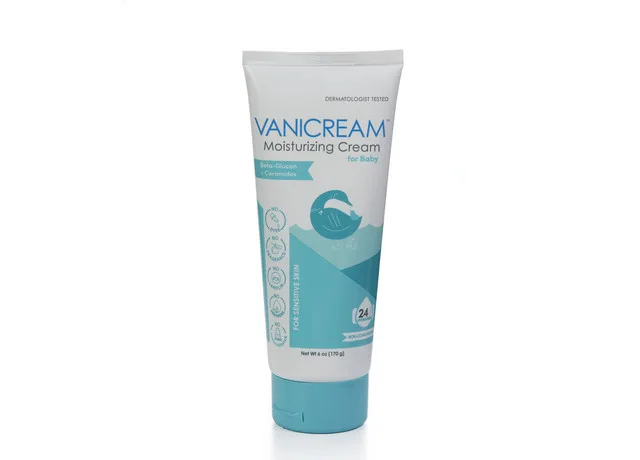
It takes Vanicream's signature short, allergen-conscious ingredient deck and quietly upgrades it with skin-identical ceramides and soothing beta-glucan rather than the botanical oils and fragrances most baby creams lean on. The result is a baby moisturizer that reads more like a barrier-repair cream than a nursery novelty.
body carecreampharmacy brandParaben FreeFungal Acne SafeCruelty Free
A baby moisturizer that behaves like a grown-up barrier cream: short ingredient list, no fragrance, ceramides and beta-glucan over a petrolatum-glycerin base. It quietly hydrates reactive infant skin without the botanicals that tend to trigger flare-ups, and at around ten dollars it is hard to fault.
Because this cream launched in 2024, the score draws more on Vanicream's long allergen-conscious formulating record and the predictable behavior of petrolatum, glycerin, and ceramides than on years of accumulated user data. Its few hundred early reviews are encouraging, but long-term performance across a wide range of infant skin is still being established.
Verdicts
How well it fits each concern
Verdict by concern tap a concern for the case
Strong choicefor DrynessIn your profileYou chose · Petrolatum is an approved or monograph active for dryness; this cream carries it high in the ingredient list.Moderate evidenceGentleNo reviews collected yet
The case for it
Petrolatum is a first-line active — approved, monograph-listed or named in current guidelines — for this concern.
It is present at an effective concentration, declared or high in the ingredient list.
The formula carries none of the triggers this concern is sensitive to.
Same rule for everyone. “Strong choice” is the verdict on 1,459 of 45,024 concern verdicts across the catalog; rule R2 decided 892 of them.
Unchanged since September 5, 2026, engine 5.1.1.
Strong choicefor EczemaIn your profileYou chose · Petrolatum is an approved or monograph active for eczema; this cream carries it high in the ingredient list.Moderate evidenceGentleNo reviews collected yet
The case for it
Petrolatum is a first-line active — approved, monograph-listed or named in current guidelines — for this concern.
It is present at an effective concentration, declared or high in the ingredient list.
The formula carries none of the triggers this concern is sensitive to.
Same rule for everyone. “Strong choice” is the verdict on 1,459 of 45,024 concern verdicts across the catalog; rule R2 decided 892 of them.
Unchanged since September 5, 2026, engine 5.1.1.
R2 — A regulator- or guideline-recognised first-line active, declared at an effective strength, in a form the claim supports. · the full register
Carrying active
Petrolatum
Standing
first line — a regulator recognises it for this use; its mechanism is established; trials support it · per 21 CFR § 347.50 - Labeling of skin protectant drug products. (US Code of Federal Regulations (Legal Information Institute, Cornell Law School)), opened July 27, 2026
Form
adequate — studied range up to 100%, from the OTC monograph or label; needs leave-on contact; judge it after ~1 weeks
Tolerability
gentle
Row checked
against its sources on July 27, 2026 (evidence table ev-2026.09-r228)
Good choicefor Compromised Skin BarrierIn your profileYou chose · Petrolatum is a reference standard by mechanism for compromised skin barrier; this cream carries it high in the ingredient list.Moderate evidenceGentleNo reviews collected yet
The case for it
Petrolatum has trial-supported standing for this concern.
It is present at an effective concentration, declared or high in the ingredient list.
The formula carries none of the triggers this concern is sensitive to.
Same rule for everyone. “Good choice” is the verdict on 9,564 of 45,024 concern verdicts across the catalog; rule R5 decided 9,072 of them.
Unchanged since September 5, 2026, engine 5.1.1.
Good choicefor SensitivityIn your profileYou chose · No fragrance, drying alcohol, declarable allergens or sensitising preservatives in this cream — the profile sensitive skin looks for.Not yet assessedGentleNo reviews collected yet
The case for it
Glycerin has no evidence row yet for this concern — it is in the research queue.
The formula carries none of the triggers this concern is sensitive to.
What would change this: A researched evidence row for the lead active would replace this with a verdict.
Same rule for everyone. “Good choice” is the verdict on 1,938 of 45,024 concern verdicts across the catalog; rule F2 decided 1,938 of them.
Unchanged since September 5, 2026, engine 5.1.1.
Good choicefor DehydrationIn your profileYou chose · Glycerin is a reference standard by mechanism for dehydration; this cream carries it high in the ingredient list.Moderate evidenceGentleNo reviews collected yet
The case for it
Glycerin has trial-supported standing for this concern.
It is present at an effective concentration, declared or high in the ingredient list.
The formula carries none of the triggers this concern is sensitive to.
Same rule for everyone. “Good choice” is the verdict on 9,564 of 45,024 concern verdicts across the catalog; rule R5 decided 9,072 of them.
Unchanged since September 5, 2026, engine 5.1.1.
R5 — Trial-supported or guideline-supported active, adequately or plausibly dosed. · the full register
Carrying active
Glycerin
Standing
supported — its mechanism is established
Form
adequate — studied range 20%, from the trials on the row; needs leave-on contact; judge it after ~1 weeks
Tolerability
gentle
Row checked
against its sources on July 17, 2026 (evidence table ev-2026.09-r228)
The studies behind the evidence row
USP glycerin monograph / Fluhr et al., glycerol and the skin (review) — glycerin is the reference humectant, drawing and holding water in the stratum corneum — reference work
As a body productNot judged: what a body product is for — real substance, not just slip, realistic to use daily — cannot yet be measured from the ingredient list (only fragrance load can).
A verdict is DermApproved’s assessment of how well a product’s ingredients fit a concern — never a claim about what the product treats. Evidence dots and collected reviews sit beside it and are never blended in.
Rules 0.5.1 · evidence table ev-2026.09-r228 · how we decide
Assessment
Pros & Cons
Pros
✓ Short, allergen-conscious ingredient list with nothing extraneous
✓ Real skin-identical ceramides plus soothing beta-glucan
✓ Petrolatum-glycerin base seals in moisture effectively
✓ Completely fragrance-free with no sting or warming
✓ Absorbs without a greasy, lint-grabbing residue
✓ Works for the whole family, not just babies
✓ Excellent value at around ten dollars
Cons
✗ Small 6 oz tube empties fast with full-body baby use
✗ Higher per-ounce cost than the adult tubs
✗ Plain, clinical feel with no pleasant scent or ritual
✗ Petrolatum richness can be much for oily adult skin
Review
Full Review
There is a particular kind of parent who reads ingredient lists at two in the morning, and Vanicream has been quietly serving that person for fifty years. So when the brand that built its reputation on subtraction — taking out dyes, fragrances, lanolin, parabens, formaldehyde releasers, botanical extracts, essentially everything dermatology patients tend to react to — decides to make a cream for babies, it is worth paying attention. Infant skin is thinner, more permeable, and more reactive than adult skin, which means it is exactly the audience where Vanicream's whole philosophy should pay off most. This cream is that philosophy applied to the nursery, and for the most part it lands.
The formula is refreshingly legible. Water and glycerin lead, then petrolatum, then a tidy run of stabilizers and emulsifiers before you hit the genuinely interesting part: two skin-identical ceramides (NP and AP), beta-glucan, and a clean preservative pairing of polyepsilon-lysine and 1,2-hexanediol. That is essentially the whole story. There is no fragrance, no essential oil, no plant extract playing dress-up as a hero ingredient. For skin that has not yet decided what it is allergic to, that restraint is not a marketing gimmick; it is the actual feature.
Mechanically, the cream runs a humectant-plus-occlusive play. Glycerin, sitting second on the list, draws water into the upper layers of the skin. Petrolatum, the single most effective occlusive substance we have, seals that water in by slowing transepidermal water loss to a crawl. The ceramides reinforce the lipid scaffolding of a barrier that, in a baby, is still under construction, and beta-glucan adds a soothing, water-holding film on top. None of these ingredients is exotic. The point is that they are the right ones, in sensible order, with nothing bolted on to justify a higher price.
In use, it is almost aggressively unremarkable, which is the highest compliment you can pay a sensitive-skin product. The texture is a true cream — heavier than a lotion, lighter than an ointment — that goes on white, spreads easily, and melts down within a minute or two to leave skin soft rather than greasy. There is no sting, no tingle, no warming sensation, nothing that would make a baby squirm. It absorbs well enough to use on hands and face without leaving a slick that grabs onto lint and crumbs. Honestly, plenty of adults with eczema or rosacea would be perfectly happy using this as their daily face cream and never knowing it came from the baby aisle.
Where it earns its keep is on compromised skin. Diaper-area dryness, eczema patches behind the knees and elbows, those rough wind-chapped cheeks that show up the first cold week of winter — this is the cream's natural habitat. The combination of a strong occlusive and real ceramides means it does more than sit on the surface looking moisturized; it actually supports the barrier doing the repair. For families managing pediatric eczema, that is meaningful, and it pairs cleanly with a prescribed hydrocortisone (medication first, this on top to seal it) without any ingredient conflicts to worry about.
It is not flawless, and the flaws are mostly about expectations. People who want a baby product to feel like an experience — a soft scent, a silky slip, a luxurious ritual — will find this almost clinical. That is by design, but it can feel anticlimactic next to the perfumed, pastel-packaged competition. The 6 oz tube is also small relative to Vanicream's giant adult tubs, and on a per-ounce basis you are paying a premium for the baby branding even though the core idea is the same as the brand's other moisturizers. If you are slathering it on a baby head to toe twice a day, that tube empties faster than you would like. And while petrolatum is fantastic, it does mean the cream skews rich; for an adult with genuinely oily skin it may be more than the face needs.
The value question is easy to answer. Around ten dollars for a fragrance-free, ceramide-containing, allergen-conscious cream from a brand with this much dermatological goodwill is a fair deal bordering on a steal. You are not paying for hype here — there is no celebrity, no viral moment, no clinical-sounding claims that outrun the evidence. You are paying for a competent formula and a track record of not irritating people, which for a baby product is precisely what you should be paying for.
The honest caveat is data. This is a 2024 launch, so it has a few hundred reviews rather than the tens of thousands behind Vanicream's older creams, and it has not yet logged years of real-world use across millions of babies. The ingredient list inspires confidence and the brand's history is reassuring, but it is still a newer product, and the score reflects that mix of strong fundamentals and a shorter paper trail. If you want a baby moisturizer that does its job without drama, omits the usual irritant suspects, and does not cost a fortune, this is an easy one to reach for — and a quietly excellent option for sensitive adult skin too.
Formula
Key Ingredients
The hero actives that drive this product's performance.
Sits high in this short ingredient list as the occlusive backbone, forming a breathable seal over delicate baby skin so the glycerin and ceramides underneath are not lost to evaporation. In a formula this stripped-down, it does most of the heavy lifting against dryness.
Regulator-approvedfor Dryness · established mechanism
The second ingredient and the humectant half of the formula's strategy, pulling water into the upper skin layers that the petrolatum then locks down. Pairing a strong humectant with a strong occlusive is what gives this lightweight cream staying power on a baby's frequently-washed skin.
Established mechanismfor Dryness · established mechanism
Two skin-identical ceramides added to a base that already moisturizes well, helping reinforce the immature, more permeable barrier of infant skin. They complement the petrolatum seal rather than replace it, supporting the lipid matrix from within.
Established mechanismfor Dryness · established mechanism
A soothing, film-forming polysaccharide that holds water and calms reactive skin — a sensible addition here given the cream is aimed at the easily-irritated skin of babies and eczema-prone children.
Not yet assessed
Ingredient standings describe the active at treatment-level doses and
vehicles; this product's own condition grades weigh its actual formula.
On a baby, smooth a thin layer onto clean, slightly damp skin after bath time to trap surface moisture. For adults borrowing it, it layers cleanly under sunscreen or over a hydrating serum without pilling.
Results Timeline
Immediate softening and comfort on application. Visibly less flaky, more resilient skin within several days of consistent twice-daily use. Meaningful improvement in chronic dry or eczema-prone patches over 2-4 weeks.
Pairs Well With
Gentle fragrance-free cleansersHydrocortisone for eczema flares (apply medication first)Plain occlusive ointment for very dry patches
The case for this cream rests less on any single novel active than on a well-chosen pairing of barrier-supporting ingredients. Petrolatum is the most studied occlusive in dermatology, reducing transepidermal water loss by upward of 98 percent and serving as the comparison standard against which other occlusives are measured. Glycerin is an equally well-documented humectant that not only attracts water but has been shown to support normal skin barrier function and corneocyte maturation. The genuinely modern touch is the inclusion of ceramides NP and AP. Infant skin has a thinner stratum corneum and a still-developing lipid barrier, and topical ceramides that mimic the skin's own intercellular lipids have a strong evidence base for improving hydration and barrier integrity in dry and eczema-prone skin, including in pediatric atopic dermatitis where ceramide-containing moisturizers are commonly recommended as part of maintenance care. Beta-glucan, derived from yeast or oats, is a film-forming polysaccharide with promising data for soothing and water retention, though its evidence base is thinner than the others. What makes the formula sensible is not a proprietary breakthrough but the decision to combine a proven occlusive, a proven humectant, and barrier-identical lipids while deliberately excluding fragrance and botanical extracts — the ingredient categories most frequently implicated in pediatric contact reactions. For a developing barrier, that subtraction is as evidence-aligned as the additions.
Dermatologist Perspective
Pediatric dermatologists generally favor exactly this kind of formula for infant and eczema-prone skin: fragrance-free, dye-free, and free of botanical extracts, with a base built on petrolatum and glycerin. Standard clinical guidance for childhood atopic dermatitis emphasizes liberal, frequent moisturizer use as the foundation of care, and ceramide-containing creams are routinely suggested to help restore a compromised barrier. The absence of fragrance and essential oils is specifically valued, since these are among the more common causes of contact reactions in children. In practice, a cream like this is often recommended to be applied within a few minutes of bathing to lock in moisture, and to be layered over any prescribed topical medication rather than mixed with it. It is the unglamorous, low-risk approach clinicians tend to trust for reactive skin.
Guidance
Usage & Recommendations
How to Use
Apply to clean skin, ideally within a few minutes of a lukewarm bath while skin is still slightly damp, to trap surface moisture. Smooth a thin, even layer over the face and body, focusing on dry or rough patches, and reapply after hand-washing or whenever skin feels tight. For eczema-prone areas, layer it over any prescribed topical medication rather than mixing them, applying the medication first and this cream on top to seal it in. It is gentle enough for twice-daily use and suitable for all ages, so caregivers can use the same tube on their own hands and face.
Value Assessment
At roughly ten dollars for the 6 oz tube, this is priced like a mainstream baby lotion while delivering a formula closer to a barrier-repair cream. The per-ounce cost runs higher than Vanicream's large adult tubs, so families going through it quickly may find the bigger 16 oz baby size or even the adult cream more economical for full-body use. But you are not paying a hype tax here — there is no celebrity founder or viral surcharge baked in, just a competent fragrance-free formula from a brand with deep dermatological credibility. For the combination of ceramides, a clean preservative system, and an allergen-conscious base, the price is fair and arguably underpriced relative to prestige baby brands offering less.
Who Should Buy
Parents of babies or young children with dry, sensitive, or eczema-prone skin who want a fragrance-free moisturizer that skips botanicals and common irritants. It is equally well suited to adults with reactive, eczema-prone, or rosacea-prone skin looking for a simple, affordable barrier cream that happens to live in the baby aisle.
Who Should Skip
Those hoping for a sensorially rich, lightly-scented baby ritual will find this almost too plain. Anyone with oily adult skin may want something lighter for the face, and families moisturizing a baby head-to-toe daily should consider the larger 16 oz size for better value rather than the small tube.
Ready to try Vanicream Moisturizing Cream for Baby?
A medium-weight white cream that is thicker than a lotion but melts down quickly, leaving skin soft rather than slick.
Scent
Genuinely odorless — no added fragrance and no masking scent, which is the point for reactive baby skin.
Packaging
Squeeze tube with a flip cap, easy to handle one-handed mid-diaper-change.
Finish
non-greasynatural
What to Expect on First Use
No tingle, no adjustment period, no learning curve — it goes on, sinks in, and that is the whole experience. First-time users coming from richer baby balms may be surprised how unobtrusive it feels.
How Long It Lasts
About 6-8 weeks of daily full-body baby use from the 6 oz tube; longer if used for spot-treating dry patches.
Vanicream built its name in the 1970s by stripping out the chemicals that dermatology patients reacted to. This baby line extends that philosophy to infants, whose thinner, more permeable skin is even more prone to irritation — filling the gap between heavily-fragranced mass-market baby lotions and bare petrolatum ointment.
About Vanicream Legacy Brand (20+ years)
Vanicream is made by Pharmaceutical Specialties, a family-run Minnesota company founded in 1974 that built its reputation among dermatologists and allergists by formulating without the most common contact allergens. Its products are routinely recommended for sensitive and reactive skin and several carry the National Eczema Association Seal of Acceptance.
Brand founded: 1975 · Product launched: 2024
Myth vs. Reality
Common Myths
Myth
Baby moisturizers need oils and botanical extracts to be nourishing.
Reality
Botanicals and essential oils are among the more common triggers for infant skin reactions. This formula deliberately omits them and relies on petrolatum, glycerin, and ceramides — ingredients with stronger evidence for protecting a developing barrier.
Myth
A fragrance-free cream means it has nothing in it.
Reality
Fragrance-free refers only to the absence of scent compounds. This cream still carries two ceramides and beta-glucan working alongside its occlusive and humectant base.
FAQ
Frequently Asked Questions
Can adults use Vanicream Moisturizing Cream for Baby?
Yes. The formula is labeled for all ages, and its fragrance-free, ceramide-containing base makes it a perfectly good daily moisturizer for adults with sensitive, eczema-prone, or rosacea-prone skin. Many adults use it on the face and hands without issue.
Is Vanicream baby cream good for eczema?
It is well suited to eczema-prone skin. The petrolatum-glycerin base plus skin-identical ceramides supports barrier repair, and the deliberate absence of fragrance and botanicals reduces the risk of triggering a flare. It layers cleanly over a prescribed topical medication.
Does the Vanicream baby cream contain fragrance or essential oils?
No. It is completely fragrance-free and contains no essential oils or botanical extracts, which are among the more common causes of skin reactions in babies. The cream is genuinely odorless.
How is this different from the regular Vanicream Moisturizing Cream?
The baby version uses a similarly allergen-conscious approach but adds beta-glucan and skin-identical ceramides over a glycerin-petrolatum base, and comes in a smaller squeeze tube. Both are fragrance-free, but the baby formula is geared toward the thinner, more reactive skin of infants.
When should I apply Vanicream baby cream for the best results?
Apply it within a few minutes of bath time while the skin is still slightly damp, which traps surface moisture under the occlusive base. Reapply to dry or rough patches as needed throughout the day.
What size does Vanicream Moisturizing Cream for Baby come in?
It is most commonly sold in a 6 oz squeeze tube, and a larger 16 oz size is also available for families who go through it quickly. The larger size offers better per-ounce value for full-body daily use.
Reviews
What Reviewers Tend to Say
Recurring themes our editors read across retailer reviews of this product — summaries in our words, not quotations, and not a substitute for your own patch test.
Common Praise
Gentle enough for eczema-prone babies
No fragrance or sting
Absorbs without feeling greasy
Works for the whole family
Common Complaints
Smaller tube than the adult sizes
Plain, clinical feel some expect more from a baby product
Pricier per ounce than the big adult tubs
Notable Endorsements
Frequently suggested by pediatric and dermatology offices for sensitive infant skin
Occupational hand dermatitis is one of the most common work-related diseases on earth, it follows a script, and the cheapest fix works only if you start it before the skin splits.
Every post that dismantles a home remedy owes the reader a replacement. The honest replacement list is embarrassingly cheap, and one item on it is cheaper still — it is a bath.
Western sensitive skincare works by subtraction — remove the fragrance, remove the alcohol, shorten the list. Japan's answer adds a designed molecule back in, and one of the two bets has a trial literature.
Products, answers, therapy guides, tools and articles in one search. Brand names,
slang and abbreviations all work — accutane finds isotretinoin, bacne finds truncal acne.