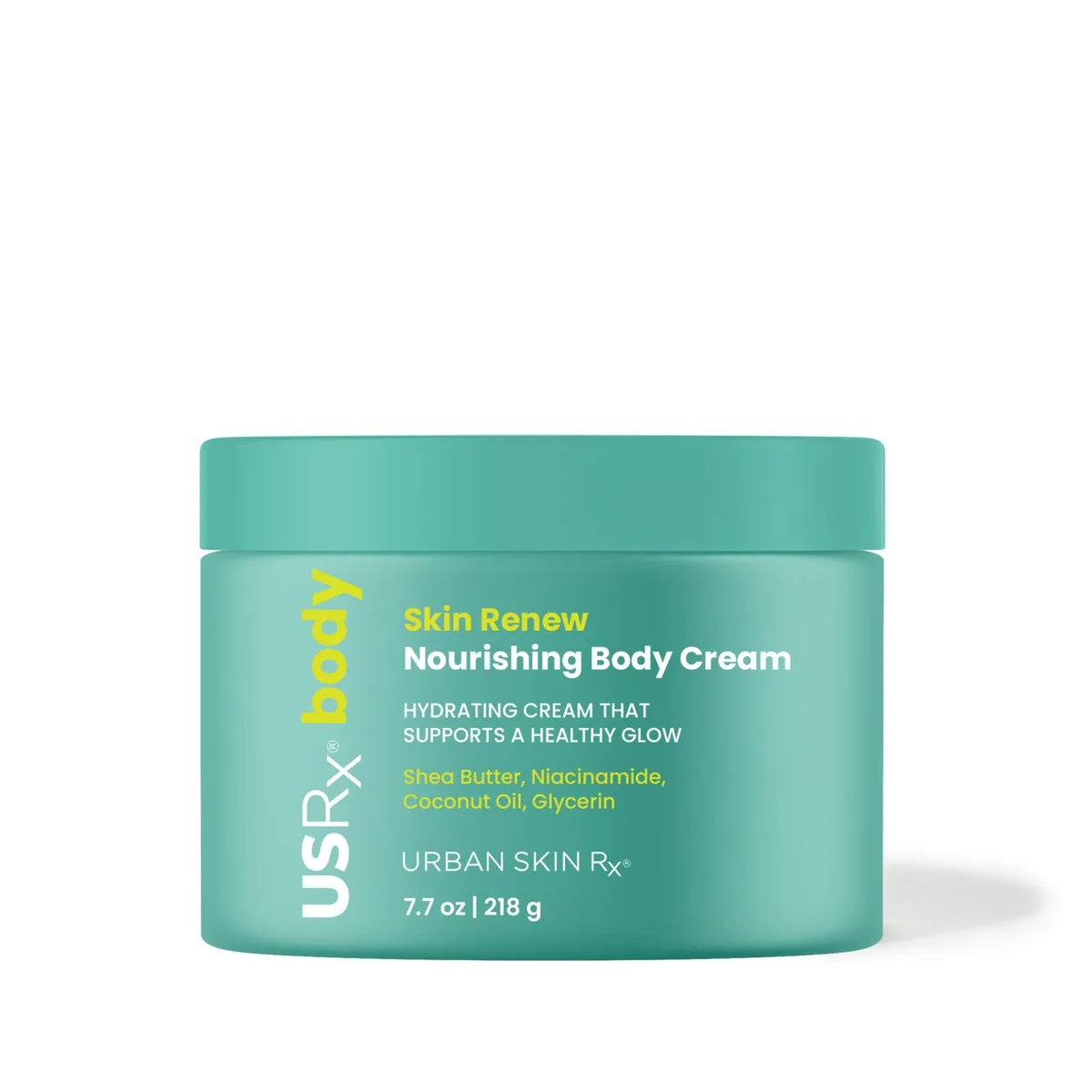
It is a body-butter-dense cream that behaves like a lotion, with a coconut triglyceride and sunflower oil ahead of the shea so it melts and absorbs rather than sitting, and it is the moisturising step the brand designed to follow its glycolic body wash. The even-tone story is a trace of niacinamide behind the xanthan gum; the value is a good emollient at a fair price with a scent people enjoy.
Urban Skin Rx Skin Renew Nourishing Body Cream Review
Citrus Body Butter, Lightly
body carecreamclinicalParaben FreeCruelty FreeVegan
A dense, melting body cream that absorbs like a lotion, built on a coconut triglyceride, sunflower oil and shea, with a fresh tangerine-grapefruit scent and a trace of niacinamide behind the thickener. It hydrates ordinary dry skin well for $18 and is the natural partner to the brand's glycolic body wash; the even-tone language is unearned, the citrus oils sit above the only active, and reactive skin should look elsewhere.
This cream launched in late 2025 and carries about ten reviews on the brand's site with no retail record yet, and Urban Skin Rx publishes no testing of it. The assessment rests on the ingredient list and the well-studied behaviour of its emollients rather than on any real-world data about the product.
Verdicts
How well it fits each concern
Verdict by concern tap a concern for the case
Good choicefor DrynessIn your profileYou chose · Glycerin is a reference standard by mechanism for dryness; this cream carries it high in the ingredient list.Moderate evidenceStandard tolerabilityNo reviews collected yet
The case for it
Propanediol and Glycerin has trial-supported standing for this concern.
It is present at an effective concentration, declared or high in the ingredient list.
The formula carries no trigger this concern is sensitive to, with the cautions noted.
Cautions: fragrance.
Same rule for everyone. “Good choice” is the verdict on 9,564 of 45,024 concern verdicts across the catalog; rule R5 decided 9,072 of them.
As of September 25, 2026, engine 5.1.1.
Good choicefor DehydrationIn your profileYou chose · Glycerin is a reference standard by mechanism for dehydration; this cream carries it high in the ingredient list.Moderate evidenceStandard tolerabilityNo reviews collected yet
The case for it
Propanediol and Glycerin has trial-supported standing for this concern.
It is present at an effective concentration, declared or high in the ingredient list.
The formula carries no trigger this concern is sensitive to, with the cautions noted.
Same rule for everyone. “Good choice” is the verdict on 9,564 of 45,024 concern verdicts across the catalog; rule R5 decided 9,072 of them.
As of September 25, 2026, engine 5.1.1.
R5 — Trial-supported or guideline-supported active, adequately or plausibly dosed. · the full register
Carrying active
Propanediol and Glycerin
Standing
supported — its mechanism is established
Form
adequate — studied range 20%, from the trials on the row; needs leave-on contact; judge it after ~1 weeks
Tolerability
standard
Row checked
against its sources on July 17, 2026 (evidence table ev-2026.09-r228)
The studies behind the evidence row
USP glycerin monograph / Fluhr et al., glycerol and the skin (review) — glycerin is the reference humectant, drawing and holding water in the stratum corneum — reference work
Also listed for Rough Texture — the actives here (Sunflower Oil, Glycerin, Niacinamide, Essential Oils) are in our research queue for that concern; there is no verdict until their evidence rows are written. That is a gap in our table, not a mark against the product.
As a body productNot judged: what a body product is for — real substance, not just slip, realistic to use daily — cannot yet be measured from the ingredient list (only fragrance load can).
A verdict is DermApproved’s assessment of how well a product’s ingredients fit a concern — never a claim about what the product treats. Evidence dots and collected reviews sit beside it and are never blended in.
Rules 0.5.1 · evidence table ev-2026.09-r228 · how we decide
Assessment
Pros & Cons
Pros
✓ Coconut triglyceride and sunflower oil ahead of the shea, so a dense cream melts and absorbs fast
✓ Shea and coconut oil leave dry shins and elbows soft through the day
✓ Velvety, non-greasy finish with no film on clothes or sheets
✓ The natural partner to the brand's glycolic body wash
✓ Vegan, silicone-free and mineral-oil-free
✓ Fresh tangerine-grapefruit scent that most people enjoy
✓ $18 for 7.7 oz, between drugstore and natural-brand prices
Cons
✗ Niacinamide is the twenty-first ingredient, so the even-tone claim is unearned
✗ Tangerine and grapefruit peel oils sit above the active; not for reactive skin
✗ Glycerin only twelfth, so very dry winter skin needs a humectant underneath
✗ Coconut oil and shea make it wrong for breakout-prone backs and chests
✗ Wide jar is unhygienic for a cream this dense
✗ Launched late 2025 with almost no real-world feedback
Review
Full Review
Urban Skin Rx puts niacinamide on the description of this cream the way it puts it on everything, and the ingredient list places it twenty-first, after the xanthan gum that thickens the formula and the potassium hydroxide that sets its pH. That is a trace, and a trace of niacinamide does not even skin tone, so the honest thing to do with the brand's even-tone language is set it aside and judge the cream as what it is: a rich, well-made, citrus-scented emollient at a fair price. On those terms it is easy to like.
The formula is a conventional body cream in the good sense. Water, then caprylic/capric triglyceride, a light coconut-derived emollient, then sunflower seed oil, linoleic-rich and among the better-evidenced plant oils for barrier support; cetearyl alcohol for structure, propanediol as a humectant, shea butter sixth, an emulsifier, and coconut oil eighth. Glycerin sits twelfth, aloe and coconut water follow, and then the two citrus peel oils, tangerine and grapefruit, at fifteenth and sixteenth. After that come thickeners, the pH adjuster, the niacinamide, a chamomile extract and preservatives. Twenty-five ingredients, no silicones, no mineral oil, vegan, and an order of ingredients that explains the texture exactly: dense in the jar because of the shea and fatty alcohols, quick to melt because the triglyceride and sunflower oil are ahead of them.
That texture is the product's real argument. A scoop the size of a walnut turns to cream as it spreads, covers a leg easily, and is absorbed within a couple of minutes to a soft, velvety finish with no film on the sheets; rough shins and elbows feel different the next morning and stay comfortable through the day with daily use. It is rich enough to be the only body step for most skin, which is presumably the point, since the brand launched it alongside a 5 percent glycolic body wash and the cream is the lipid that replaces what the acid removes. Used that way, wash then cream on damp skin, the pair does a reasonable job on the rough, dull body skin the line targets.
What the cream does less well is hydrate in the strict sense. Glycerin at twelfth is lower than in the best dry-skin creams, where it usually sits second or third, and propanediol is the only humectant ahead of the lipids; the result is a cream that seals and softens more than it draws water in, which is fine for ordinary dry skin and not quite enough for very dry skin in winter, where a humectant-heavy lotion underneath or an oil over it closes the gap. Aloe and coconut water contribute more to the story than to the hydration.
The citrus is the decision to weigh. Tangerine and grapefruit peel oils give the cream a bright, fresh, natural smell that fills a bathroom and softens within an hour, and most people will find it a pleasure. They are also essential oils rich in limonene, which oxidises into a recognised sensitiser, placed above the only active in a product from a brand that knows its audience's skin darkens where it is irritated. The brand calls them antioxidant-rich; on skin they are fragrance. For resilient skin they are harmless. For sensitive, eczema-prone or fragrance-reactive skin they are a reason to choose an unscented cream, and expressed citrus oils on limbs that will see strong sun argue for evening use. Coconut oil and shea round out a lipid profile that breakout-prone backs and chests should avoid.
The product is a few months old, launched in late 2025 with a handful of reviews, so its real-world record is thin. What makes it reviewable is that its ingredients are entirely conventional and thoroughly understood; there is nothing novel in the jar to wait for data on. The jar itself is the one packaging complaint, a wide screw-top that fingers go into, and a pump or tube would have been more hygienic for a cream this dense. A clean spatula solves it, and keeping the jar out of the shower keeps water out of the preservative system, which is a mild one and deserves the help.
At $18 for 7.7 ounces the price is fair. It sits between drugstore body butters and the pricier natural brands, a jar lasts about two months of daily full-body use, and the shea-and-sunflower base compares well with either. What the money does not buy is meaningful niacinamide, a fragrance-free option or a humectant-rich formula for the driest skin.
The recommendation is warm and specific. For normal, combination or moderately dry body skin that likes a rich cream that absorbs fast and smells of citrus, and especially for anyone using the brand's glycolic wash and needing the moisturiser that goes with it, this is a good, fairly priced choice. Ignore the even-tone promise, keep it off breakout-prone areas and off reactive skin, and if your skin is very dry, add a humectant underneath. The cream is better than its label, which is a compliment to the cream and a note to the label.
Formula
Key Ingredients
The hero actives that drive this product's performance.
Second and third, the lipid backbone: a light coconut-derived triglyceride for slip and fast absorption, and linoleic-rich sunflower for barrier support. Their high placement is why the cream feels richer than a lotion and still sinks in without grease.
Sixth, the cushioning butter that gives the cream its melting, body-butter texture and lays down the occlusive layer that keeps dry skin comfortable through the day. With coconut oil two places later, it is the 'nourishing' in the name.
Established mechanismfor Dryness · established mechanism
Propanediol fifth and glycerin twelfth, the humectants that draw water into the surface so the lipids have something to seal in; glycerin sits lower than in the best dry-skin creams, which is why the hydration is good rather than exceptional.
Established mechanismfor Dryness · established mechanism
Twenty-first, behind the thickener and the pH adjuster, so the even-tone ingredient the brand names on the label is present at a trace. It supports the barrier a little; it will not change body discolouration at this dose.
Fifteenth and sixteenth, the citrus scent that the brand calls antioxidant-rich; they are essential oils rich in limonene, present above the niacinamide, and they are the ingredients most likely to bother reactive skin and the reason for evening use on sun-exposed limbs.
Not yet assessed
Ingredient standings describe the active at treatment-level doses and
vehicles; this product's own condition grades weigh its actual formula.
Smooth over damp skin after a shower, working extra into knees, elbows and shins; it is rich enough to be the only body step for most skin and pairs naturally after the brand's AHA body wash. Keep it off breakout-prone areas of the back and chest, and use it in the evening on limbs that will see strong sun.
Results Timeline
Immediate: a melting, cushioned feel and soft, non-greasy skin with a citrus scent. Short-term (1-2 weeks): dry, rough patches on shins and elbows smooth out with daily use. Long-term: maintained comfort; the trace of niacinamide will not visibly change tone, and the brand's glow claim is hydration.
Pairs Well With
Even Tone AHA body washSuper C body oil on discoloured areasbody SPF on exposed skin
The formula is a conventional oil-in-water body cream whose performance follows from its emollient order. Caprylic/capric triglyceride, second in the list, is a medium-chain coconut-derived emollient with a light feel and good spreading, and sunflower seed oil, third, is roughly two-thirds linoleic acid, the essential fatty acid required for ceramide synthesis, with controlled evidence for improving barrier function on dry skin; their placement ahead of the structural fatty alcohol and the shea butter is why the cream absorbs quickly despite its density. Shea butter at sixth contributes stearic- and oleic-rich triglycerides and unsaponifiables shown in controlled studies to improve hydration and reduce transepidermal water loss, and coconut oil at eighth adds lauric acid and occlusion; both are comedogenic in classic assays, which is relevant to acne-prone trunk skin. Cetearyl alcohol, glyceryl stearate SE, stearic acid and cetearyl glucoside form the emulsion, and xanthan gum thickens.
Humectancy is modest. Propanediol at fifth is a plant-derived glycol with humectant and preservative-boosting properties, and glycerin, the best-evidenced topical humectant, appears at twelfth and again lower in the list, a placement below that of dedicated dry-skin creams; aloe leaf juice and coconut liquid endosperm contribute polysaccharides and electrolytes with minor humectant effect. Niacinamide at the twenty-first position is present at a level far below the 2 to 5 percent used in controlled studies of barrier lipid synthesis and hyperpigmentation, so no measurable tone or barrier effect should be attributed to it. Chamomilla recutita extract has mild anti-inflammatory evidence as bisabolol and apigenin, at a trace here.
The tolerance consideration is the citrus. Citrus reticulata (tangerine) and Citrus paradisi (grapefruit) peel oils are predominantly d-limonene, whose oxidation products are among the most frequent fragrance sensitisers in patch-test series; expressed grapefruit peel oil also carries a low phototoxic potential from trace furanocoumarins, supporting evening application on sun-exposed limbs. The brand's description of these oils as antioxidant-rich has no meaningful basis for topical benefit. Preservation is phenoxyethanol with ethylhexylglycerin and a sorbate-benzoate pair, a low-irritation system. Urban Skin Rx publishes no product-specific testing.
Dermatologist Perspective
For ordinary dry body skin, dermatologists recommend a cream rather than a lotion, applied to damp skin daily, with emollient lipids and ideally a humectant high in the list, and this formula meets most of that brief: sunflower oil and shea are sound choices, the texture encourages daily use, and the coconut triglyceride keeps it from feeling occlusive. Clinicians would make three notes. The niacinamide is a trace and the product should not be chosen for any tone or barrier effect from it; the two citrus peel oils are avoidable sensitisers in a product marketed to skin prone to post-inflammatory hyperpigmentation, so patients with atopic dermatitis, contact allergy or reactive skin would be steered to an unscented emollient; and the coconut oil and shea argue against use on acne-prone areas of the back and chest. For a patient with resilient skin using an AHA body wash, a rich cream like this afterwards is exactly the right pairing, with sunscreen by day.
Guidance
Usage & Recommendations
How to Use
After a shower, pat the skin until it is damp and scoop out a walnut-sized amount with clean fingers, warming it briefly in the palm until it begins to melt. Smooth it over the body with long strokes, giving extra to knees, elbows, shins and heels, and let it absorb for a couple of minutes before dressing. Use it daily, morning or evening, as the moisturising step after the brand's glycolic body wash or any cleanser; on very dry skin apply a humectant lotion first or a few drops of oil over it. Keep it off breakout-prone areas of the back and chest, prefer evening use on limbs that will see strong sun because of the citrus oils, and patch test on the inner arm first if fragranced products have caused reactions. Close the jar tightly and keep it out of the shower.
Value Assessment
Eighteen dollars for 7.7 ounces places this between drugstore body butters and the natural-brand jars it resembles in formula, and a jar lasts about two months of daily full-body use, roughly $2 a week. The money buys a well-ordered shea-and-sunflower emollient that melts and absorbs faster than most creams this dense, a vegan formula and a pleasant scent; it does not buy a working dose of niacinamide, a humectant-rich formula for the driest skin, a fragrance-free option or a hygienic pump. Fair value for a good body cream, and no value at all as the even-tone product its description implies.
Who Should Buy
People with normal, combination or moderately dry body skin who want a rich cream that melts in fast, smells fresh and citrusy, and pairs with an exfoliating body wash, at a price between drugstore and natural brands. It suits anyone building a routine around Urban Skin Rx's body line who needs its moisturising step.
Who Should Skip
Sensitive, eczema-prone or fragrance-reactive skin, given two citrus peel oils above the only active, and breakout-prone backs and chests, given the coconut oil and shea. Anyone buying it for niacinamide or even tone should know the dose is a trace, and very dry winter skin will want a humectant-heavier cream.
Ready to try Urban Skin Rx Skin Renew Nourishing Body Cream?
A rich, off-white to pale yellow cream with a body-butter density that melts on contact and absorbs within a couple of minutes to a soft, non-greasy finish
Scent
Bright, natural tangerine and grapefruit, fresh rather than sweet, strong on application and softening within an hour
Packaging
A 7.7 oz white plastic jar with a screw lid
Finish
velvetynon-greasy
What to Expect on First Use
The first application is the cream at its best: a dense scoop that melts as it spreads, sinks in within a couple of minutes, and leaves dry skin soft with a citrus smell that fills the room. Rough shins and elbows feel different by the next morning. Sensitive skin may notice a faint warmth from the citrus oils in the first uses, which is the cue to try a plainer cream; there is otherwise nothing to adjust to.
How Long It Lasts
About 2 months with daily full-body use, longer on dry zones only
Urban Skin Rx built its face range on hyperpigmentation in skin of color and in late 2025 launched a small body line, a glycolic wash, a mist and this cream, sharing the tangerine-grapefruit scent and a trace of the brand's niacinamide to carry its even-tone identity below the chin. The cream is the hydration step, positioned for the dry, rough, dull body skin the brand's clients ask about and priced to sit beside drugstore body butters.
About Urban Skin Rx Established Brand (5–20 years)
Urban Skin Rx, founded in 2010 by master esthetician Rachel Roff around hyperpigmentation in skin of color, launched this body cream in late 2025 as part of a new body line. The brand publishes no clinical trials, and the cream's formula is a conventional emollient with a trace of niacinamide.
Brand founded: 2010 · Product launched: 2025
Myth vs. Reality
Common Myths
Myth
The niacinamide in this body cream evens skin tone
Reality
Niacinamide is the twenty-first ingredient, behind the xanthan gum and potassium hydroxide, which puts it at a trace far below the 2 to 5 percent used in pigment studies. It may support the barrier a little; it will not change discolouration, and the glow the brand promises is hydration.
Myth
Citrus oils in a body cream are antioxidants that brighten
Reality
Tangerine and grapefruit peel oils are fragrance, mostly limonene, with negligible antioxidant effect on skin and a real sensitisation potential once oxidised. They make the cream smell wonderful and they are the reason reactive skin should patch test.
FAQ
Frequently Asked Questions
Is the Urban Skin Rx Skin Renew Body Cream good for very dry skin?
Good rather than exceptional. Shea, sunflower and a coconut triglyceride sit high in the list and the cream melts in richly, but glycerin is only twelfth, so on very dry winter skin a humectant-heavier cream or a layer of oil over it does more. For ordinary dry and rough skin it works well.
Does the Skin Renew body cream brighten or even skin tone?
No. Niacinamide is the twenty-first ingredient, a trace, and the citrus oils are fragrance rather than actives. Skin looks brighter because it is hydrated and smooth; for body discolouration the brand's Super C oil, with a vitamin C ester and bearberry, is the product with a real dose.
Is the Urban Skin Rx body cream safe for sensitive skin?
It contains tangerine and grapefruit peel oils above the niacinamide, and limonene-rich citrus oils are recognised sensitisers once oxidised. Ordinary skin will be fine; sensitive, eczema-prone or fragrance-reactive skin should patch test on the inner arm or choose an unscented cream.
Can I use the Skin Renew Body Cream with the Even Tone AHA Body Wash?
Yes, that is how the brand intends it: the glycolic wash exfoliates and the cream replaces the lipid the acid removes. Apply it to damp skin straight after the shower, and wear SPF on exposed skin by day because the wash raises sun sensitivity.
Is the Urban Skin Rx body cream greasy or heavy?
It is dense in the jar and light on the skin: a coconut triglyceride and sunflower oil sit ahead of the shea, so it melts and absorbs within a couple of minutes without a film. Oily skin can use it on dry zones; breakout-prone backs and chests should skip it because of the coconut oil.
Is the Skin Renew Nourishing Body Cream vegan?
Yes. The formula is entirely plant- and mineral-derived, with no honey, beeswax, lanolin or other animal ingredients, and Urban Skin Rx is cruelty-free.
Reviews
What Reviewers Tend to Say
Recurring themes our editors read across retailer reviews of this product — summaries in our words, not quotations, and not a substitute for your own patch test.
Common Praise
rich but absorbs fast
fresh tangerine smell
softens dry shins overnight
affordable
nice after the AHA wash
Common Complaints
too new to judge
scent strong
niacinamide is barely there
jar is unhygienic
no visible brightening
Notable Endorsements
Part of Urban Skin Rx's 2025 body lineEsthetician-developed for skin of color
Essential oils are declared by botanical name rather than as fragrance, which is why the most heavily perfumed products in the natural aisle can carry the reassuring word — and why the bottle gets more sensitising the longer you own it.
The fourth most frequent positive patch test in North America is an oxidation product of a molecule that occurs naturally in lavender. Nobody synthesised it into your face cream.
Five brands that own the feed, judged on their ingredient lists rather than their view counts — including the one active all five suddenly added at once, and what that tells you.
Products, answers, therapy guides, tools and articles in one search. Brand names,
slang and abbreviations all work — accutane finds isotretinoin, bacne finds truncal acne.