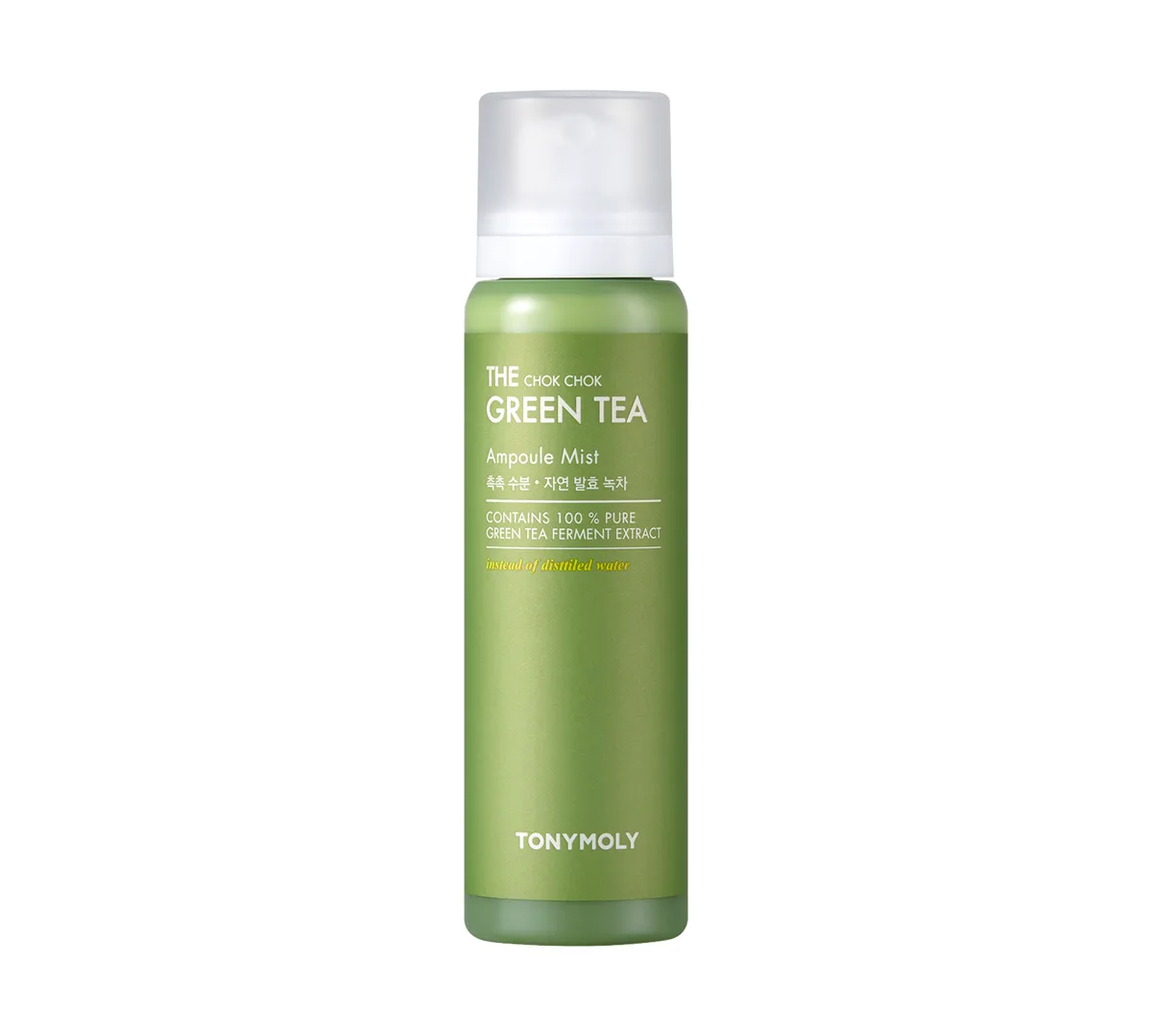
It is a true bi-phase spray, with triethylhexanoin, hydrogenated polyolefin, camellia seed oil and squalane forming a visible oil layer over a water phase carrying green tea, centella and allantoin, so one shake and a spray deliver both a hydrating and an emollient layer at once. Most mists offer one or the other; this one behaves closer to a sprayable serum, which is exactly what the name promises.
TONYMOLY The Chok Chok Green Tea Serum Mist Review
Dry-Skin Serum Mist
tonermistk beautyParaben FreeNot Cruelty Free
A real bi-phase serum mist that leaves dry skin soft for hours, with green tea placed high enough to count and a proper soothing cluster of centella, allantoin and licorice. It is too rich for oily faces, too fragranced for reactive ones, and it must be shaken like a salad dressing, but for a dry, tolerant complexion it is one of the better-value sprayable hydrators around.
Although this mist has been on TONYMOLY's US store since 2020, the feedback that can be counted amounts to a few dozen Amazon ratings, and its Ulta listing has expired, so no confident picture of long-term satisfaction exists. The score reflects the bi-phase formulation, the placement of its green tea and soothing ingredients and the brand's history with the Chok Chok range, and remains provisional until a larger review base forms.
Verdicts
How well it fits each concern
Verdict by concern tap a concern for the case
Good choicefor DrynessIn your profileYou chose · Squalane is a reference standard by mechanism for dryness; this mist carries it.Moderate evidenceStandard tolerabilityNo reviews collected yet
The case for it
Squalane has trial-supported standing for this concern.
It is plausibly present at a working level, though the concentration is not declared.
The formula carries no trigger this concern is sensitive to, with the cautions noted.
Cautions: fragrance.
What would change this: A declared concentration would move this to a firmer reading of the dose.
Same rule for everyone. “Good choice” is the verdict on 9,564 of 45,024 concern verdicts across the catalog; rule R5 decided 9,072 of them.
As of September 25, 2026, engine 5.1.1.
Supporting rolefor DehydrationIn your profileYou chose · Nothing here targets dehydration directly; humectant hydration is the recognised companion to treating it, and this mist does that without known triggers.Not yet assessedStandard tolerabilityNo reviews collected yet
The case for it
Camellia Sinensis Leaf Extract has no evidence row yet for this concern — it is in the research queue.
The formula carries no trigger this concern is sensitive to, with the cautions noted.
What would change this: A researched evidence row for the lead active would replace this with a verdict.
Same rule for everyone. “Supporting role” is the verdict on 8,197 of 45,024 concern verdicts across the catalog; rule R8 decided 4,250 of them.
As of September 25, 2026, engine 5.1.1.
R8 — The category's job (barrier care, humectant hydration, gentle cleansing, photoprotection) is the documented supportive role for this concern. This is the honest verdict for a moisturizer on an acne page. · the full register
Also listed for Dullness and Winter Skin — the actives here (Green Tea Extract, Squalane, Centella Asiatica) are in our research queue for those concerns; there is no verdict until their evidence rows are written. That is a gap in our table, not a mark against the product.
Does the jobDoes what a toner is for: adds something real, not alcohol-driven. Not measured from the label: restores skin pH, plays well with what follows.
A verdict is DermApproved’s assessment of how well a product’s ingredients fit a concern — never a claim about what the product treats. Evidence dots and collected reviews sit beside it and are never blended in.
Rules 0.5.1 · evidence table ev-2026.09-r228 · how we decide
Assessment
Pros & Cons
Pros
✓ Genuine bi-phase formula with a real oil layer that keeps skin soft for hours
✓ Green tea extract placed eleventh, well above its position in the range's micro mist
✓ Soothing cluster of centella, allantoin, chamomile and licorice calms post-cleanse tightness
✓ Works as a one-step toner and essence for dry skin
✓ No drying alcohol and a mild preservative system
✓ Large 150ml bottle that lasts around three months
Cons
✗ Rosewood and citrus peel oils give a stronger fragrance than the rest of the line
✗ Rich ester-and-oil phase feels slick on oily and combination skin
✗ Must be shaken vigorously before every use or it sprays unevenly
✗ Continuous aerosol valve makes it easy to over-apply and waste product
✗ Dulls and shifts matte makeup, so it is bare-skin only
✗ Ceramide NP is a trace inclusion rather than a functional barrier dose
Review
Full Review
The first thing to do with this can is read the ingredient list, because the opaque aluminium hides the most important thing about what is inside: an oil phase that separates from the green tea water on standing, and that layer is the whole argument for the product. Most face mists are a water phase with a few humectants and a scent, and they evaporate off the skin taking a little of your own moisture with them. The Chok Chok Green Tea Serum Mist is built differently: triethylhexanoin and hydrogenated polyolefin sit second and third on the ingredient list, camellia seed oil and squalane follow in the teens, and together they form a genuine oil phase that floats on the green tea water beneath. Shake it hard, spray, and both layers land together. The water flashes off within a minute; the oil stays, and skin that was tight after cleansing simply stops being tight. That is what the brand's dual-layer moisture claim means, and for once the claim describes the chemistry accurately.
TONYMOLY sold this in the US as the Ampoule Mist when it arrived in 2020, and quietly renamed it the Serum Mist later; the formula is the same and the can still carries the old name. Either name is fair. It behaves less like a toner and more like a sprayable light serum, and it earns the comparison on the water side as well as the oil side. Camellia sinensis leaf extract, the range's sun-fermented green tea, is eleventh in the list, which is high for a botanical in a mist and a long way from the token placement it gets in the range's lighter micro mist. Below it come purslane, glycerin, allantoin, centella asiatica, chamomile and dipotassium glycyrrhizate, a soothing cluster that would not look out of place in a calming serum. Whether the fermentation makes the tea a superior antioxidant is an open question that the brand answers with folklore rather than data, but green tea extract at this level is a respectable inclusion either way.
Using it is a slightly different ritual from other mists. The valve is a continuous aerosol-style spray, so a light press keeps going and it is easy to put on more than you need; the application is wetter than a micro mist and you feel it land. Pressed in with the palms, the finish is a soft, dewy satin that stays put, and dry skin in particular tends to describe this as the most comfortable step in the routine, the moment the face stops feeling like paper. The scent is the one place the formula goes slightly overboard. Rosewood oil sits at twenty-first, followed by orange, mandarin and bergamot peel oils, and the result is a warm floral-citrus fragrance that is stronger than the rest of the Chok Chok line and hangs around for ten minutes or so. Plenty of people will enjoy it. People with rosacea, eczema or a history of reacting to essential oils should not be spraying it on their faces every day, and I would rather say that plainly than let the green tea branding imply a gentleness the fragrance load does not support.
Who it suits is fairly clear once you understand the oil layer. Dry and normal skin, especially in a cold or air-conditioned environment, gets a hydrating and emollient step in one spray and can go straight to moisturiser. Combination skin can use it at night. Oily and acne-prone skin will find the esters, the phenyl trimethicone and the oils slick and unnecessary, and will be far happier with the range's micro mist, which solves the evaporation problem with a much lighter hand. It also does not belong over makeup: the oil phase dulls a matte foundation and can make it slide, so this is a bare-skin product, morning and evening, not a handbag refresher.
On the question of what it does beyond feeling nice, honesty requires modesty. The oil film reduces water loss for a few hours and the soothing extracts take the edge off post-cleanse tightness; used daily, dry skin looks calmer and less flaky within a couple of weeks, which is a real if unglamorous result. The ceramide NP near the bottom of the list is a barrier gesture rather than a barrier repair, and the green tea's antioxidant benefit is preventive and invisible. Nobody should buy this expecting brightening, firming or any change in fine lines, whatever the rosewood oil is credited with on the label.
The review record is thinner than the product's six years on the US market would suggest, a few dozen Amazon ratings averaging just over four stars, and the Ulta listing has gone. The comments that exist cluster predictably: dry skin loves the softness and the size, combination skin finds it oily, everyone mentions the shaking. That thinness is why the score here leans on the formula rather than the crowd, and why it may shift as more feedback accumulates.
At nineteen dollars for 150ml, it is priced sensibly for what is essentially a light sprayable serum with a decent green tea dose and a real emollient phase, and a bottle lasts about three months of twice-daily use. If your skin is dry, you tolerate fragrance, and you like the idea of a toner and an essence in one shake-and-spray, this is a quietly good product that outperforms its modest reputation. If your skin is oily or reactive, the lighter micro mist in the same range is the better buy, and this one will sit in the cabinet, quietly separating inside its can.
Formula
Key Ingredients
The hero actives that drive this product's performance.
Eleventh in the list and the first botanical to appear, the sun-fermented green tea here is positioned high enough to matter as an antioxidant contributor, unlike its token role in the range's lighter micro mist; it also sets the faint tea note under the citrus oils.
Part of the substantial oil phase that makes this a two-phase serum mist rather than a toner spray: with triethylhexanoin, hydrogenated polyolefin and camellia seed oil it forms the emollient layer that sits on skin after the water flashes off, which is what the brand means by dual-layer moisture.
Established mechanismfor Dryness · established mechanism
Sits just below squalane with allantoin, chamomile and licorice-derived dipotassium glycyrrhizate to give the mist a genuine soothing cluster; it is the reason the spray calms a tight, freshly cleansed face rather than only wetting it.
The oleic-rich oil pressed from tea seeds, listed fourteenth, adds slip and a soft, lasting finish to the emollient layer and keeps the green tea theme honest by contributing lipids as well as leaf antioxidants.
Near the end of the list alongside sunflower unsaponifiables and black currant seed oil, the ceramide is a trace barrier gesture; the oil phase does the real work of reducing water loss, and the ceramide mostly supports the label claim.
Established mechanismfor Dryness · established mechanism
Rosewood plus orange, mandarin and bergamot peel oils lower down give the mist its warm floral-citrus scent; the brand credits rosewood with firming, but its practical contribution is fragrance and a linalool load that sensitised skin can react to.
Not yet assessed
Ingredient standings describe the active at treatment-level doses and
vehicles; this product's own condition grades weigh its actual formula.
Shake hard to combine the two phases, mist onto clean skin and press in as a toner-and-essence step, then go straight to moisturiser; it is heavy enough that oily skin can skip serum, and too emollient to spray over a matte foundation without dulling it.
Results Timeline
Skin feels softer and less tight immediately and stays comfortable for several hours thanks to the oil layer; with daily use dry skin looks calmer and more even within two to three weeks, though the antioxidant benefit of the green tea is preventive rather than visible.
The formulation logic here is a bi-phase emulsion-free spray, a format that deserves more attention than it gets. Rather than emulsifying oil into water with surfactants, which would require a thicker, creamier product that cannot be atomised, the formula keeps a distinct oil phase of triethylhexanoin, hydrogenated poly(C6-14 olefin), camellia seed oil, squalane and cetyl ethylhexanoate floating on the aqueous phase, with a small amount of polyglyceryl-10 myristate and hydrogenated phosphatidylcholine to help the two disperse briefly when shaken. On the skin the water phase evaporates and the lipids remain as a thin occlusive-emollient film. Squalane and the ester oils are well characterised as reducing transepidermal water loss, and camellia seed oil, dominated by oleic acid, provides slip and a lasting soft finish. This is why the product measurably outperforms single-phase water mists on skin comfort, and also why it is too rich for oily skin: the lipid load that benefits a dry face is simply excess on one that produces plenty of its own.
The aqueous phase carries the botanicals. Green tea polyphenols, principally epigallocatechin gallate, have a substantial evidence base for antioxidant and photoprotective activity in vitro and in human studies of topical application, including reductions in UV-induced erythema and oxidative markers, though the concentrations in those studies are standardised and typically higher than a cosmetic extract at eleventh position can deliver. The brand's claim that sun-fermented green tea is a superior antioxidant to fresh tea is not supported by any published comparison; fermentation alters the catechin-to-theaflavin balance rather than simply increasing potency. Centella asiatica, allantoin, chamomile and dipotassium glycyrrhizate are each supported for anti-irritant effects at cosmetic levels, and their combination is the most defensible functional cluster in the formula. Ceramide NP appears too low in the list to contribute meaningful barrier lipids on its own; the barrier benefit here comes from the oil film, not the ceramide.
The fragrance components are the formulation's most significant clinical consideration. Rosewood oil is rich in linalool, and the orange, mandarin and bergamot peel oils contribute limonene and, in bergamot's case, the furocoumarin bergapten. Oxidised linalool and limonene are well-documented contact allergens, and a leave-on spray applied daily to the face is the exposure pattern most associated with sensitisation. Bergapten's phototoxicity is concentration-dependent and unlikely to matter at cosmetic dilution under sunscreen, but it is a reason to keep this as a routine step rather than a sun-exposure refresher.
Dermatologist Perspective
Skin specialists assessing a bi-phase mist tend to give it more credit than a plain water spray, because the oil layer addresses the evaporative drying that clinicians routinely warn patients about with misting habits. For dry, mature or winter-stressed skin the emollient film and the soothing extracts are seen as a sensible, low-risk comfort step, best pressed in and followed by a moisturiser. The reservations are the ones clinicians raise about most fragranced Korean mists: rosewood and citrus peel oils are frequent culprits in facial contact dermatitis, and patients with rosacea, eczema, perioral dermatitis or a barrier compromised by retinoid or acne treatment are generally advised to avoid essential-oil sprays entirely. The rich ester-and-silicone content also earns a caution for acne-prone patients, for whom a lighter, oil-free hydrating mist is the usual recommendation. The green tea and ceramide claims are regarded as cosmetic support rather than treatment, and the product is best understood clinically as a comfortable emollient toner for dry, tolerant skin.
Guidance
Usage & Recommendations
How to Use
Shake the can hard for several seconds to recombine the oil and water phases, since the opaque aluminium will not show you when they have separated, then, with eyes closed, spray two or three passes over clean, dry skin from about eight inches away. Wait a moment for the water to settle and press the residue in with your palms rather than letting it evaporate, then apply serum if you use one and moisturiser. Use morning and evening as the toner step; in the morning finish with sunscreen, since the mist carries citrus oils. Do not spray over makeup, as the oil layer dulls and shifts foundation. Oily skin can limit it to evenings or to dry patches. Shake again before every use, keep the cap on to protect the valve, and patch test on the jaw if you have reacted to essential oils before.
Value Assessment
Nineteen dollars for 150ml works out well for what is, functionally, a light serum in a spray bottle: a genuine oil phase with squalane and camellia seed oil, green tea high in the list and a soothing cluster of centella, allantoin and chamomile. A bottle covers roughly three months of twice-daily use, which is inexpensive for a leave-on step that replaces both toner and essence for dry skin. There is a single size and no refill. TONYMOLY's long mass-market history means the formula is not a gamble, though it comes without clinical validation and the sun-fermented green tea story is marketing rather than measured superiority. For dry, fragrance-tolerant skin the price reflects genuine formulation value; for oily skin it would be money spent on a product that sits unused, and the cheaper micro mist in the same range is the better buy.
Who Should Buy
Dry and normal skin that finds ordinary mists leave it tighter, and anyone who wants a toner and essence in one spray for a winter or air-conditioned routine. It suits people who tolerate fragrance and like a dewy, cushioned finish under moisturiser.
Who Should Skip
Oily, acne-prone and fungal-acne-prone skin, which will find the ester-and-oil phase slick and pore-clogging. Sensitive, rosacea-prone and eczema-prone skin should avoid the rosewood and citrus oils, and anyone wanting a mist to refresh over makeup needs a lighter, oil-free spray.
Ready to try TONYMOLY The Chok Chok Green Tea Serum Mist?
A milky two-phase liquid in which an oil layer separates from the green tea water on standing; once shaken it sprays as a continuous, slightly heavier dewy veil that leaves a soft, faintly cushioned film rather than drying away.
Scent
A warm floral-citrus fragrance from rosewood and orange peel oils over a green tea base, more present than the rest of the range and lingering for ten minutes or so.
Packaging
An opaque olive-green 150ml aluminium can with a white cap and a continuous-spray aerosol-style valve, still printed with the original Ampoule Mist name; because the can is opaque you cannot see the two phases separate, so shaking before each use is on trust.
Finish
dewysatin
What to Expect on First Use
After a good shake, the first press of the continuous valve lays down more than a typical mist and skin feels immediately softer and calmer as the water evaporates and the oil layer settles. The floral-citrus scent is noticeable for a few minutes. Oily skin may find the finish slick on day one; dry skin usually finds it the most comfortable step in the routine.
How Long It Lasts
About three months with two or three sprays twice a day from the 150ml bottle.
The Chok Chok range was TONYMOLY's play on the fermented green tea trend of the mid-2010s, built around a Korean tea the brand describes as sun-fermented for a full year. The serum mist, originally sold as the Ampoule Mist, was added to the US line in 2020 as the range's heaviest spray, giving dry-skinned fans a leave-on step between the cleansing water and the water cream.
About TONYMOLY Established Brand (5–20 years)
Founded in Seoul in 2006, TONYMOLY is one of Korea's larger mass-market beauty companies and has sold in the US through Ulta and Amazon for a decade. The Chok Chok line is built on a proprietary sun-fermented green tea extract; the brand publishes no clinical data on it, so the range's credibility rests on ingredient choices and retail track record.
Brand founded: 2006 · Product launched: 2020
Myth vs. Reality
Common Myths
Myth
A serum mist can replace a moisturiser.
Reality
The oil layer in this spray does reduce water loss more than a plain mist, but it is a thin, uneven film with no structured barrier lipids beyond a trace of ceramide NP. For dry skin it is a comfortable prep step, not a substitute for a cream on top.
Myth
Fermented green tea is a stronger antioxidant than regular green tea.
Reality
Fermentation changes the catechin profile and can improve some extraction yields, but there is no published evidence that TONYMOLY's sun-fermented extract outperforms standard green tea extract on skin. The green tea here is a reasonable antioxidant inclusion, not a proven upgrade.
FAQ
Frequently Asked Questions
Is the Chok Chok Green Tea Serum Mist the same product as the Green Tea Ampoule Mist?
Yes. TONYMOLY sold it as the Ampoule Mist when it launched in the US in 2020 and later renamed it the Serum Mist; the can still carries the original name, and the 150ml size and the bi-phase formula are unchanged.
Why does the Serum Mist separate in the bottle?
It is a two-phase formula with a real oil layer of triethylhexanoin, camellia seed oil and squalane floating on the green tea water phase. The opaque can hides the separation, so shake it hard for a few seconds before every spray, or you will get mostly water first and mostly oil at the end.
Can I use the Chok Chok Serum Mist on oily or acne-prone skin?
It is on the rich side for oily skin, with several esters and oils and a silicone in the top ten, and it is fragranced. Combination skin can get away with it as a night-time step; genuinely oily or breakout-prone skin is better served by the range's lighter micro mist.
Does the Green Tea Serum Mist work over makeup?
Not well. The oil layer dulls powder and matte foundations and can make them slide. Use it on bare skin as a toner-essence step and reserve a lighter water mist for daytime touch-ups.
Is the Chok Chok Serum Mist safe to use while pregnant?
Its ingredients are conventional emollients, botanical extracts and essential oils with no retinoids or high-dose actives, so it is generally considered fine in pregnancy. Anyone who becomes newly sensitive to fragrance during pregnancy may want to patch test the rosewood and citrus oils first.
How much green tea is actually in the Serum Mist?
Camellia sinensis leaf extract is eleventh on the list and the seed oil is fourteenth, which is meaningfully higher than in the range's micro mist. The exact percentage is not disclosed, so treat it as a real antioxidant supporting ingredient rather than a quantified active.
Reviews
What Reviewers Tend to Say
Recurring themes our editors read across retailer reviews of this product — summaries in our words, not quotations, and not a substitute for your own patch test.
Essential oils are declared by botanical name rather than as fragrance, which is why the most heavily perfumed products in the natural aisle can carry the reassuring word — and why the bottle gets more sensitising the longer you own it.
Cutting a beard hair takes about a twentieth of a newton. You press with two and stretch your skin by a fifth — which is why almost every shaving problem is a technique problem wearing a hardware costume.
The burn trials are real and the skeptics who dismiss aloe as folklore are wrong — but the same substance has delayed healing in other wounds, and none of it says anything about what a soothing gel does to intact skin.
Your immune cells already make it to kill microbes. Now it's in a spray bottle for breakouts and redness, and the real evidence is quietly stronger than the 'miracle mist' marketing that's outrunning it.
Products, answers, therapy guides, tools and articles in one search. Brand names,
slang and abbreviations all work — accutane finds isotretinoin, bacne finds truncal acne.