PHAs are the gentlest class of hydroxy acids — their larger molecular size means they exfoliate the outermost surface layer without penetrating deep enough to cause the irritation, stinging, and peeling associated with AHAs and BHAs. This toner pairs that ultra-gentle exfoliation with niacinamide and aloe vera, creating what's essentially an exfoliant for people who can't tolerate exfoliants.
The toner for people who thought they couldn't use acids. At 3% gluconolactone, this is exfoliation with training wheels — gentle, hydrating, and almost impossibly hard to irritate your skin with. Ideal for sensitive types; too subtle for the impatient.
Roughly five years on the market with a moderate 800-review pool, this gluconolactone toner sits on firmer footing than a fresh launch. PHA exfoliation is well-documented, so the score weighs that established chemistry against a still-modest body of consumer feedback.
Verdicts
How well it fits each concern
Verdict by concern tap a concern for the case
Promisingfor DullnessIn your profileYou chose · Glycerin has trial-level evidence for dullness but no guideline or regulatory standing yet — promising, short of a recommendation; the other actives here are not yet assessed for it.Moderate evidenceGentle100 reviews collected
The case for it
Glycerin has trial-level evidence for this concern but no guideline or regulatory standing yet.
It is present at an effective concentration, declared or high in the ingredient list.
The formula carries none of the triggers this concern is sensitive to.
What would change this: Guideline or regulatory standing for the active on this concern would move this from a promising bet to a recommendation.
Same rule for everyone. “Promising” is the verdict on 7,858 of 45,024 concern verdicts across the catalog; rule R9p decided 7,858 of them.
Unchanged since September 5, 2026, engine 5.1.1.
R9p — 0.5.0: 'Unproven' beside three filled dots read as one question answered twice with opposite words (7,018 rows). The chip measures standing, the dots measure trial volume; where the row carries at least one RCT or a tier-2 source (moderate dots) and the active is present at a working level, the honest word is Promising. Unproven is reserved for plausible-standing rows with limited or weak evidence, or an under-dosed form. Same rank as Unproven — a bet either way; the dots order them. · the full register
Carrying active
Glycerin
Standing
plausible — trials support it
Form
adequate — studied range 2–20%, from the trials on the row; needs leave-on contact; judge it after ~1 weeks
Tolerability
gentle
Row checked
against its sources on July 17, 2026 (evidence table ev-2026.09-r228)
The studies behind the evidence row
Harry's Cosmeticology / Baran & Maibach Textbook of Cosmetic Dermatology — humectant, emollient and occlusive classification — standard reference text
Good choicefor SensitivityIn your profileYou chose · No fragrance, drying alcohol, declarable allergens or sensitising preservatives in this liquid — the profile sensitive skin looks for.Not yet assessedGentle100 reviews collected
The case for it
Gluconolactone has no evidence row yet for this concern — it is in the research queue.
The formula carries none of the triggers this concern is sensitive to.
What would change this: A researched evidence row for the lead active would replace this with a verdict.
Same rule for everyone. “Good choice” is the verdict on 1,938 of 45,024 concern verdicts across the catalog; rule F2 decided 1,938 of them.
Unchanged since September 5, 2026, engine 5.1.1.
Good choicefor DehydrationIn your profileYou chose · Glycerin is a reference standard by mechanism for dehydration; this liquid carries it high in the ingredient list.Moderate evidenceGentle100 reviews collected
The case for it
Glycerin has trial-supported standing for this concern.
It is present at an effective concentration, declared or high in the ingredient list.
The formula carries none of the triggers this concern is sensitive to.
Same rule for everyone. “Good choice” is the verdict on 9,564 of 45,024 concern verdicts across the catalog; rule R5 decided 9,072 of them.
Unchanged since September 5, 2026, engine 5.1.1.
R5 — Trial-supported or guideline-supported active, adequately or plausibly dosed. · the full register
Carrying active
Glycerin
Standing
supported — its mechanism is established
Form
adequate — studied range 20%, from the trials on the row; needs leave-on contact; judge it after ~1 weeks
Tolerability
gentle
Row checked
against its sources on July 17, 2026 (evidence table ev-2026.09-r228)
The studies behind the evidence row
USP glycerin monograph / Fluhr et al., glycerol and the skin (review) — glycerin is the reference humectant, drawing and holding water in the stratum corneum — reference work
Also listed for Rough Texture — the actives here (Gluconolactone, Niacinamide, Glycerin, Aloe Vera) are in our research queue for that concern; there is no verdict until their evidence rows are written. That is a gap in our table, not a mark against the product.
Does the jobDoes what a toner is for: not alcohol-driven, adds something real. Not measured from the label: restores skin pH, plays well with what follows.
A verdict is DermApproved’s assessment of how well a product’s ingredients fit a concern — never a claim about what the product treats. Evidence dots and collected reviews sit beside it and are never blended in.
Rules 0.5.1 · evidence table ev-2026.09-r228 · how we decide
Assessment
Pros & Cons
Pros
✓ Gentlest chemical exfoliant available — suitable even for highly sensitive skin
✓ Gluconolactone functions as both exfoliant and humectant simultaneously
✓ Completely fragrance-free, alcohol-free, and silicone-free with 16 ingredients
✓ Can be safely layered with retinol and other actives due to minimal irritation risk
✓ Budget-friendly at $15 for 100ml — one of the most affordable PHA toners
✓ Pregnancy-safe exfoliation option when BHA is contraindicated
Cons
✗ 3% PHA provides very subtle results that take weeks to notice
✗ Too gentle for those accustomed to or needing stronger acid exfoliation
✗ 3% niacinamide is below the clinically optimal 5% concentration
✗ The watery texture and absence of sensation may feel ineffective to some users
✗ Not suitable as a standalone solution for significant texture or pigmentation concerns
Review
Full Review
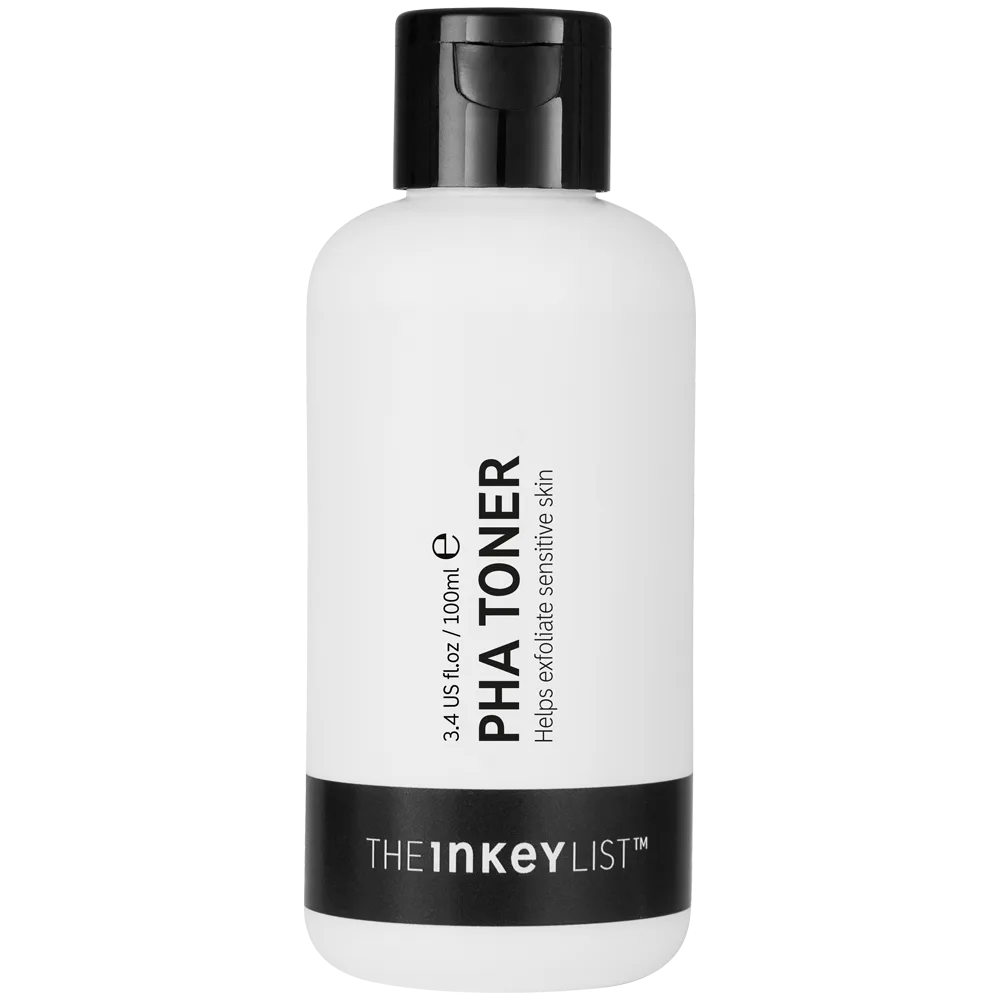
In the hierarchy of skincare acids, AHAs get the spotlight — glycolic acid, lactic acid, the ones that deliver visible results and dramatic before-and-afters. BHAs get the acne crowd. And PHAs? PHAs sit in the corner, largely ignored by an industry that rewards intensity over gentleness. The INKEY List's PHA Toner is a quiet argument that gentleness has its own value, and that the people who need exfoliation the most — those with sensitive, reactive skin — are often the ones who can't access it. The product fits its maker's whole thesis: The INKEY List launched in 2018 on ingredient transparency at aggressively accessible prices, and this 2020 release was among the first budget PHA toners to reach a mainstream audience — an acid class that had been living in dermatological literature and $35 niche products finally showing up at drugstore money.
Gluconolactone, the PHA in this formula at 3%, is structurally different from AHAs in one crucial way: its molecule is significantly larger. This isn't a minor technical detail — it fundamentally changes how the acid interacts with skin. Where glycolic acid's small molecules dive deep into the epidermis (causing the tingling, redness, and peeling that acid users know well), gluconolactone stays on the outermost surface layer, loosening dead cells without the penetration depth that triggers irritation. It's the difference between sandblasting and gentle dusting.
The formula around the gluconolactone is thoughtfully minimal. Niacinamide at 3% adds tone-evening and oil-controlling benefits — below the clinical gold standard of 5%, but still functional, especially in a product that's designed to layer into a multi-step routine. Aloe vera and glycerin provide soothing hydration. The total ingredient count is 16, with no fragrance, no alcohol, no silicone, and nothing that a dermatologist would flag as a potential sensitizer. The compatibility sheet reads as broadly as the marketing implies: fungal-acne safe, vegan, cruelty-free, and considered pregnancy-safe — a genuinely rare combination for anything in the exfoliant aisle. It even pairs with a buffered retinol routine, providing mild surface turnover on the nights the retinoid rests. And gentle or not, exfoliation is exfoliation: keep the morning SPF habit intact.
In use, this toner is an exercise in subtlety. It feels like water — literally just water on your skin. No tingle, no warmth, no visible foam or film. It absorbs in seconds and leaves behind a slightly dewy, hydrated feel. For anyone accustomed to AHA toners that make their skin flush and feel "worked," this experience can feel anticlimactic. Where's the proof it's doing something?
The proof comes slowly. Over weeks, not days, the skin surface gradually becomes smoother. Dullness lifts incrementally. The complexion looks slightly more even, slightly more luminous. These aren't the dramatic results of a glycolic peel — they're the quiet, cumulative improvements that come from consistent, gentle exfoliation that never overwhelms the skin's repair capacity. For sensitive skin types who've been burned (sometimes literally) by aggressive acids, this gentle arc of improvement is exactly what's needed.
Gluconolactone has an additional property that AHAs lack: it functions as a humectant. While glycolic acid can leave skin feeling dry and tight, gluconolactone actually draws moisture to the skin surface during the exfoliation process. Combined with the glycerin and aloe vera in this formula, the result is a toner that exfoliates while actively hydrating — a combination that's nearly impossible with conventional AHAs.
The limitation is straightforward: if you want visible, rapid exfoliation results, 3% gluconolactone won't satisfy. This toner won't erase hyperpigmentation, dramatically shrink pores, or transform textured skin in two weeks. It's designed for maintenance-level exfoliation and for people whose skin can't tolerate anything stronger. If you're a seasoned acid user looking for your next step up, this is a step sideways — gentler, not stronger.
At $15 for 100ml, the pricing is reasonable for what amounts to one of the most accessible PHA toners on the market. PHAs in general are underrepresented in affordable skincare — most PHA products sit in the $25-$40 range — so The INKEY List's entry point makes this acid class accessible to a much wider audience. The eight hundred or so reviews averaging 4.1 tell the story of a product whose greatest strength reads as a weakness to the wrong buyer — sensitive-skinned users celebrating zero irritation and a slow-building glow, while acid veterans grumble that nothing dramatic happens. Both are describing the same formula working as designed. A nightly-use bottle stretches four to five months from its unassuming flip-cap squeeze bottle, which makes the per-month cost almost negligible.
The PHA Toner fits beautifully into two scenarios. First: as a daily exfoliant for sensitive skin that can't tolerate AHAs or BHAs. Used morning and evening, it provides the gentlest possible chemical exfoliation, slowly improving texture without ever crossing the irritation threshold. Second: as an alternating toner in a multi-acid routine — use the PHA on rest days between stronger AHA or BHA sessions, maintaining gentle exfoliation while the skin recovers from more intensive treatments.
This isn't a glamorous product. It won't trend on social media or produce satisfying peel-off videos. But for the significant population of sensitive-skinned people who've been excluded from the exfoliation conversation, the PHA Toner opens a door that was previously closed — gently, of course.
Formula
Key Ingredients
The hero actives that drive this product's performance.
A polyhydroxy acid with a larger molecular size than AHAs, which means it exfoliates the skin surface without penetrating as deeply — resulting in gentler exfoliation with less irritation. In this formula, it works alongside niacinamide to smooth texture and improve radiance while also functioning as a humectant, drawing moisture to the skin during the exfoliation process.
At 3%, niacinamide supports the gentle exfoliation by helping even skin tone, reducing redness, and controlling shine. While below the optimal 5% concentration, it provides meaningful barrier support and pore-refining benefits that complement the PHA's surface exfoliation.
Provides soothing and anti-inflammatory support that reinforces the gentle positioning of this toner. Aloe vera helps calm any mild irritation from the PHA while adding hydration to the freshly exfoliated skin.
A powerful humectant that ensures the exfoliation doesn't compromise hydration. Glycerin works in tandem with gluconolactone's own humectant properties to keep the skin moisturized throughout the exfoliation process.
Established mechanismfor Dehydration · established mechanism
Ingredient standings describe the active at treatment-level doses and
vehicles; this product's own condition grades weigh its actual formula.
Apply after cleansing on dry or slightly damp skin. Sweep across the face with a cotton pad or pat directly with hands. Follow with serum and moisturizer. Can be used morning and evening for sensitive skin types, or as an every-other-day exfoliant to alternate with AHA/BHA products.
Results Timeline
Immediate hydrating sensation and a slightly smoother feel. Within 2-3 weeks, more even texture and reduced dullness. Full brightening and tone-evening benefits at 6-8 weeks of consistent use.
Gluconolactone belongs to the polyhydroxy acid (PHA) family, which was developed as a gentler alternative to alpha hydroxy acids. The key structural difference is molecular size — gluconolactone's larger molecular weight (178 g/mol vs glycolic acid's 76 g/mol) limits its penetration to the outermost epidermal layers. A comparative study published in Dermatologic Surgery (Edison et al., 2004) demonstrated that gluconolactone provided comparable improvements in photoaged skin (fine wrinkles, roughness, and pigmentation) to glycolic acid, while producing significantly less stinging, burning, and irritation.
Gluconolactone also possesses unique humectant properties — its multiple hydroxyl groups allow it to bind water, actively hydrating the skin during exfoliation. This dual function distinguishes PHAs from AHAs and makes them particularly suitable for sensitive or dehydrated skin where traditional exfoliation can worsen moisture loss.
The 3% niacinamide provides anti-inflammatory and barrier-supporting benefits that complement the PHA's exfoliation. While studies most commonly validate niacinamide at 4-5% concentrations, research published in the British Journal of Dermatology demonstrated measurable benefits — including sebum reduction — beginning at lower concentrations when formulated in appropriate delivery vehicles.
Dermatologist Perspective
Dermatologists increasingly recognize PHAs as a valuable option for patients who cannot tolerate AHA or BHA exfoliants. Working dermatologists frequently recommend gluconolactone-based products for patients with rosacea, eczema, or post-procedure sensitivity who still need gentle exfoliation. The INKEY List PHA Toner's fragrance-free, minimal formula aligns well with dermatological recommendations for sensitive skin. Dermatologists would note that while 3% gluconolactone is conservative, it provides a safe starting point that can be used daily without risk of over-exfoliation — a common issue with AHA-based toners.
Guidance
Usage & Recommendations
How to Use
After cleansing, apply a small amount to a cotton pad and sweep across the face, or pour a few drops into your palms and pat directly onto the skin. Allow 30-60 seconds to absorb before applying the next step in your routine. Can be used morning and evening. Start with once daily and increase frequency as tolerated. Follow with serum, moisturizer, and SPF in the morning.
Value Assessment
At $15 for 100ml, this toner is competitively priced within the PHA category, where products typically range from $25-$40. The formula is honest about what it delivers — gentle exfoliation with hydrating and soothing support — and doesn't pretend to be more aggressive than it is. For sensitive skin types who've spent money on products they couldn't tolerate, the reliability and gentleness of this toner represents genuine value.
Who Should Buy
Sensitive skin types who want to exfoliate but can't tolerate AHAs or BHAs. Skincare beginners looking for a gentle introduction to chemical exfoliation. Anyone using retinol who wants a compatible, non-irritating exfoliating toner. Pregnant individuals seeking a pregnancy-safe exfoliation option.
Who Should Skip
Experienced acid users who need stronger exfoliation for stubborn texture or hyperpigmentation. Those looking for rapid, visible results — this toner works slowly and subtly. Oily skin types with significant acne would benefit more from a BHA product.
Watery, clear liquid with the consistency of regular water — extremely lightweight and thin
Scent
None — completely fragrance-free
Packaging
Clear plastic squeeze bottle with flip-cap, showing the transparent liquid inside. Simple INKEY List branding.
Finish
lightweightfast-absorbingdewy
What to Expect on First Use
First application feels like water — no tingling, no stinging, no sensation at all for most users. Those accustomed to AHA or BHA toners may feel this is doing nothing, but the gentle action is the entire point. No purging, no adjustment period expected.
The INKEY List developed this toner to fill a gap for people who wanted the texture-smoothing benefits of chemical exfoliation but couldn't tolerate AHAs or BHAs. PHAs had been known in dermatological circles but were underrepresented in affordable skincare, making this one of the first budget PHA toners to reach a mainstream audience.
About The INKEY List Established Brand (5–20 years)
The INKEY List launched in 2018 with a focus on ingredient transparency and accessible pricing. The PHA Toner reflects the brand's philosophy of offering targeted, well-formulated products at budget-friendly prices.
Brand founded: 2018 · Product launched: 2020
Myth vs. Reality
Common Myths
Myth
If a toner doesn't sting or tingle, it's not exfoliating
Reality
Gluconolactone (PHA) has a larger molecular structure than glycolic or salicylic acid, so it works on the skin surface without the penetration depth that causes tingling. The exfoliation is happening — it's just doing so gently enough that you don't feel it.
Myth
PHAs are too weak to be effective
Reality
Clinical studies show that gluconolactone provides comparable exfoliation results to glycolic acid over time, with significantly less irritation. The results take longer to appear but are achieved without the sensitivity and peeling that stronger acids cause.
FAQ
Frequently Asked Questions
Is The INKEY List PHA Toner good for sensitive skin?
Yes — this is one of the gentlest exfoliating toners available. Gluconolactone (PHA) has a larger molecular size than AHAs and BHAs, so it exfoliates the surface layer without the deep penetration that causes stinging and irritation. The fragrance-free, aloe-infused formula is specifically designed for sensitive skin types.
What's the difference between PHA, AHA, and BHA?
AHAs (like glycolic acid) exfoliate the skin surface and work at deeper levels, providing stronger but more irritating results. BHAs (like salicylic acid) are oil-soluble and penetrate into pores, targeting acne and blackheads. PHAs (like the gluconolactone in this toner) have the largest molecules, so they exfoliate only the outermost layer — gentler results with far less irritation.
Can I use The INKEY List PHA Toner with retinol?
Yes — PHAs are gentle enough to use alongside retinol in most routines. Apply the PHA toner first, allow it to absorb, then apply your retinol. The PHA's mild exfoliation can help retinol work more effectively while its humectant properties add hydration that buffers retinol dryness.
How often should I use The INKEY List PHA Toner?
Most skin types can use this toner daily, including morning and evening, due to its gentle nature. Start with once daily and increase to twice daily if your skin tolerates it well. Even sensitive skin types typically handle daily use within the first week.
Is The INKEY List PHA Toner pregnancy-safe?
Gluconolactone (PHA) is generally considered safe during pregnancy. It doesn't carry the same concerns as salicylic acid (BHA), and its gentle surface-level exfoliation is not associated with the systemic absorption risks of stronger acids. Always consult your healthcare provider for specific guidance.
Reviews
What Reviewers Tend to Say
Recurring themes our editors read across retailer reviews of this product — summaries in our words, not quotations, and not a substitute for your own patch test.
Common Praise
Perfect for sensitive skin — no irritation
Leaves skin glowy and smooth
Great gentle introduction to acid exfoliation
Absorbs quickly with no residue
Common Complaints
Too gentle for those wanting visible exfoliation results
Some feel initial tightness when first using
3% niacinamide is below optimal concentration
Results are subtle and take several weeks to notice
The burn trials are real and the skeptics who dismiss aloe as folklore are wrong — but the same substance has delayed healing in other wounds, and none of it says anything about what a soothing gel does to intact skin.
Polyhydroxy acids get filed under 'beginner exfoliant,' as if gentle meant weak. The truth is stranger: their bulk is exactly why they work for the skin everything else sets on fire.
More products claim to fix dullness than any other concern, which is a strong hint the word means nothing — it is at least four separate mechanisms, and the one nobody sells for is the blood.
Glow isn't a vibe or a filter. It's light bouncing off smooth, hydrated, evenly-toned skin, which means you can reverse-engineer it into a checklist instead of chasing it with a highlighter.
Mar 18, 2026· 6 min
Questions people ask about sensitive skin
Verified answers from our questions library — the nuance a product page cannot carry.
Products, answers, therapy guides, tools and articles in one search. Brand names,
slang and abbreviations all work — accutane finds isotretinoin, bacne finds truncal acne.