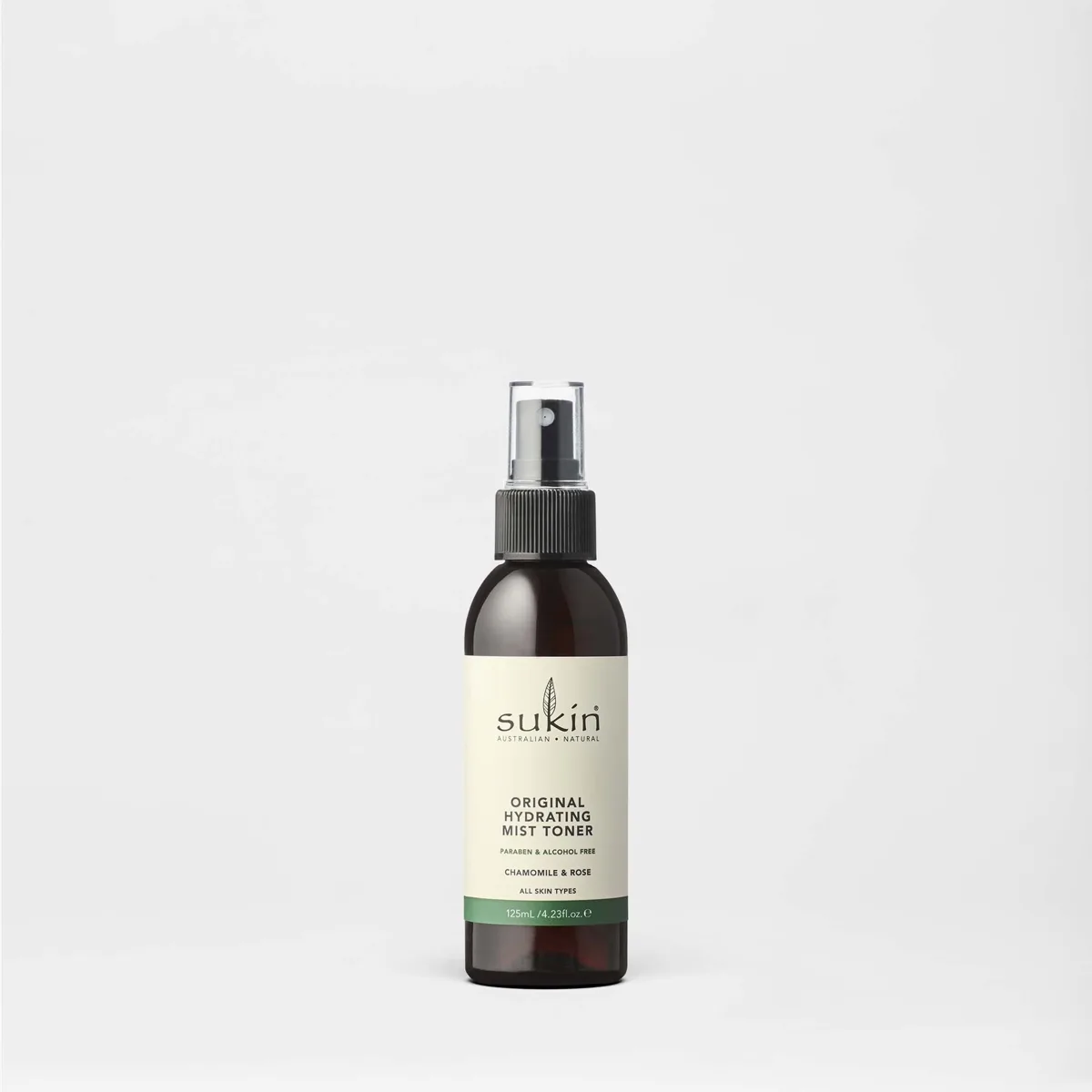
Where most hydrating mists pile on extracts for a longer ingredient list, this one stays deliberately spare: rose water as the base, glycerin for hydration, chamomile to soothe, and little else. That minimalism is the point — it makes the mist genuinely low-risk for reactive skin and keeps the price near drugstore territory.
A genuinely gentle, genuinely cheap rose-water mist that nails exactly one job: a cooling, lightly hydrating refresh for tired or heat-flushed skin. Don't expect it to moisturize on its own or transform your tone — but as a no-risk toning spritz from a brand that keeps its formulas honest and short, it more than earns its few dollars.
Good choicefor DehydrationIn your profileYou chose · Glycerin is a reference standard by mechanism for dehydration; this mist carries it.Moderate evidenceGentleNo reviews collected yet
The case for it
Glycerin has trial-supported standing for this concern.
It is plausibly present at a working level, though the concentration is not declared.
The formula carries none of the triggers this concern is sensitive to.
What would change this: A declared concentration would move this to a firmer reading of the dose.
Same rule for everyone. “Good choice” is the verdict on 9,564 of 45,024 concern verdicts across the catalog; rule R5 decided 9,072 of them.
Unchanged since September 5, 2026, engine 5.1.1.
R5 — Trial-supported or guideline-supported active, adequately or plausibly dosed. · the full register
Carrying active
Glycerin
Standing
supported — its mechanism is established
Form
plausible — studied range 20%, from the trials on the row; needs leave-on contact; judge it after ~1 weeks
Tolerability
gentle
Row checked
against its sources on July 17, 2026 (evidence table ev-2026.09-r228)
The studies behind the evidence row
USP glycerin monograph / Fluhr et al., glycerol and the skin (review) — glycerin is the reference humectant, drawing and holding water in the stratum corneum — reference work
Promisingfor DullnessIn your profileYou chose · Glycerin has trial-level evidence for dullness but no guideline or regulatory standing yet — promising, short of a recommendation; the other actives here are not yet assessed for it.Moderate evidenceGentleNo reviews collected yet
The case for it
Glycerin has trial-level evidence for this concern but no guideline or regulatory standing yet.
It is plausibly present at a working level, though the concentration is not declared.
The formula carries none of the triggers this concern is sensitive to.
What would change this: A declared concentration would move this to a firmer reading of the dose.
Same rule for everyone. “Promising” is the verdict on 7,858 of 45,024 concern verdicts across the catalog; rule R9p decided 7,858 of them.
Unchanged since September 5, 2026, engine 5.1.1.
R9p — 0.5.0: 'Unproven' beside three filled dots read as one question answered twice with opposite words (7,018 rows). The chip measures standing, the dots measure trial volume; where the row carries at least one RCT or a tier-2 source (moderate dots) and the active is present at a working level, the honest word is Promising. Unproven is reserved for plausible-standing rows with limited or weak evidence, or an under-dosed form. Same rank as Unproven — a bet either way; the dots order them. · the full register
Carrying active
Glycerin
Standing
plausible — trials support it
Form
plausible — studied range 2–20%, from the trials on the row; needs leave-on contact; judge it after ~1 weeks
Tolerability
gentle
Row checked
against its sources on July 17, 2026 (evidence table ev-2026.09-r228)
The studies behind the evidence row
Harry's Cosmeticology / Baran & Maibach Textbook of Cosmetic Dermatology — humectant, emollient and occlusive classification — standard reference text
Good choicefor SensitivityIn your profileYou chose · No fragrance, drying alcohol, declarable allergens or sensitising preservatives in this mist — the profile sensitive skin looks for.Not yet assessedGentleNo reviews collected yet
The case for it
Rosa Damascena Flower Water has no evidence row yet for this concern — it is in the research queue.
The formula carries none of the triggers this concern is sensitive to.
What would change this: A researched evidence row for the lead active would replace this with a verdict.
Same rule for everyone. “Good choice” is the verdict on 1,938 of 45,024 concern verdicts across the catalog; rule F2 decided 1,938 of them.
Unchanged since September 5, 2026, engine 5.1.1.
Does the jobDoes what a toner is for: not alcohol-driven, adds something real. Not measured from the label: restores skin pH, plays well with what follows.
A verdict is DermApproved’s assessment of how well a product’s ingredients fit a concern — never a claim about what the product treats. Evidence dots and collected reviews sit beside it and are never blended in.
Rules 0.5.1 · evidence table ev-2026.09-r228 · how we decide
Assessment
Pros & Cons
Pros
✓ Extremely short, transparent six-ingredient formula with nowhere for irritants to hide
✓ Genuinely gentle — alcohol-free, no added fragrance oils, non-comedogenic
✓ Cooling, refreshing mist that revives tired or heat-flushed skin
✓ Works well as a midday refresh sprayed over makeup
✓ Vegan, cruelty-free, and made with carbon-neutral manufacturing
✓ Very inexpensive for a 125 mL bottle that lasts months
✓ Oil-free and fungal-acne safe, suiting oily and reactive skin alike
Cons
✗ Provides only light, short-lived hydration without a moisturizer on top
✗ Natural rose water scent can bother rose-sensitive users
✗ Spray nozzle sputters unevenly on some bottles
✗ No actives, so it won't change tone, texture, or pores
✗ Glycerin alone can leave skin tight in very dry air
Review
Full Review
Six ingredients. That is the entire formula, and it is the most interesting thing about this little spray bottle. In a category where most hydrating mists read like a botanical garden's inventory — fifteen extracts, three humectants, a peptide or two for marketing weight — Sukin's Signature Hydrating Mist Toner shows up with rose water, glycerin, chamomile, a preservative, and a pinch of citric acid to keep the pH friendly. There is nowhere for a bad ingredient to hide, and that turns out to be the whole point.
Start with what it is. Rosa damascena flower water makes up the bulk of the bottle, standing in for plain water and bringing a soft, faintly floral aromatic quality and a mild freshening feel. Glycerin is the only real moisturizer in the mix, a humectant that draws a thin film of water onto the skin's surface. Chamomile extract rounds it out with bisabolol and flavonoids that take the edge off transient redness. Phenoxyethanol preserves it; citric acid nudges the pH into a comfortable range. That is the formula, start to finish, and Sukin doesn't pretend otherwise.
It's worth asking what the rose water is actually doing, since it's the ingredient the product name leans on. Distilled rose water is essentially the aromatic byproduct of steam-processing rose petals — mostly water, with trace plant compounds that give it a mild astringent character and its soft scent. It isn't a treatment active, and it won't fade a spot or shrink a pore. What it contributes is sensory: the cooling, faintly floral spritz that makes the mist feel like a small ritual rather than a step you tolerate. That's a real and underrated benefit — a product you enjoy using is a product you'll actually reach for — but it's honest to file it under experience rather than efficacy.
The texture is exactly what you would expect: a thin, watery mist that disperses, lands cool, and absorbs within seconds, leaving the faintest dewy softness and no residue. On a hot afternoon or after a long flight, that cooling hit is the product's best trick. Spritz it on flushed, tired skin and there is a small but real moment of relief. It also works nicely as a prep step — dampen the face, then apply a water-based serum, and the serum spreads more evenly. Plenty of people keep a bottle on the desk purely as a midday reset, and for that it is close to ideal: fine enough to land as a veil rather than droplets, oil-free enough not to disturb makeup.
The limitations matter here, and the biggest one is baked into how mists are sold. This will not moisturize your skin in any lasting way on its own. Glycerin without an occlusive on top is a humectant left exposed — it pulls water to the surface, and in dry air that water can simply evaporate, occasionally leaving skin feeling no better or even slightly tighter than before. The fix is trivial: follow with a moisturizer. But if you are buying this expecting all-day hydration from a spray, you will be disappointed, and that disappointment is on the marketing of the entire mist category, not on this particular bottle. It's worth retiring a second myth while we're here — that a rose-water toner 'balances' the skin's pH. Healthy skin re-establishes its own acid mantle within about an hour of cleansing, and a brief spritz doesn't meaningfully change it. What this mist does is hydrate lightly and feel nice; the pH story is folklore.
The other caveat is the rose water itself. 'Fragrance-free' in the no-added-parfum sense is true, but rose flower water carries naturally aromatic compounds, and a small number of genuinely rose-reactive people will notice. The spray nozzle is the only build-quality gripe — on some units it sputters rather than mists evenly.
Where it shines is breadth and gentleness, and the short ingredient list is exactly why. There is nothing in here to clog a pore, nothing to feed malassezia (it's genuinely fungal-acne safe), no alcohol to dry you out, no added fragrance oils, no animal-derived anything. Every ingredient you don't include is an ingredient that can't react with you, which is the underrated virtue of a deliberately spare formula: it makes the mist an easy yes for oily and combination skin that wants a weightless step, for sensitive skin that reacts to busier toners, and for anyone who just likes the ritual of a cool spritz. It is vegan, cruelty-free, and made under Sukin's carbon-neutral manufacturing — credentials the brand has built its identity on since 2007, and which here come without the price premium that 'clean' positioning usually invites.
That price is really the closer. This sits in drugstore territory at around thirteen dollars, and a 125 mL bottle lasts a couple of months of regular misting. You are not paying for actives, because there essentially aren't any beyond glycerin — you are paying for a well-made, genuinely inoffensive freshening mist from a brand that didn't pad the formula to justify a markup. Its roughly 2,400 reviews averaging 4.3 land exactly where the formula predicts: praised as cooling, gentle, and cheap, dinged only for light, short-lived hydration and the occasional uneven nozzle.
Judged as a hydrating serum-in-a-spray, it underdelivers. Judged as what it actually is — a cheap, soothing, low-risk toning refresh — it is a quietly sensible little product. Buy it for the cool spritz and the gentleness, follow it with a moisturizer, and you will get exactly what it promises and nothing it doesn't.
Formula
Key Ingredients
The hero actives that drive this product's performance.
Forms the bulk of this mist in place of plain water, carrying mild astringent and aromatic plant compounds that give the spray its faintly floral character and the cooling, freshening sensation the product is built around. It is the reason this reads as a toning mist rather than a simple hydrating spritz.
The lone humectant doing the actual hydrating work here — it pulls a thin layer of water onto the skin surface and is why a spray this lightweight still leaves a faint dewy softness rather than evaporating to nothing. Its low position in such a short list means this is gentle surface hydration, not deep moisture.
Established mechanismfor Dehydration · established mechanism
Added for its bisabolol and flavonoid content, which calm transient redness and reactivity — a sensible pairing with the rose water to keep the mist soothing on tired or heat-flushed skin rather than just refreshing.
Not yet assessed
Ingredient standings describe the active at treatment-level doses and
vehicles; this product's own condition grades weigh its actual formula.
Spritz onto clean skin before serums to leave the surface slightly damp, which helps water-based serums spread; it can also be misted over makeup midday for a quick refresh. Follow with a moisturizer to seal in the thin layer of hydration, since the mist itself contains no occlusives.
Results Timeline
The cooling, freshening effect is immediate. A softer, less tight feeling after cleansing shows within the first few days. Because the formula is minimal, expect comfort and light hydration rather than any cumulative change to tone or texture over weeks.
Pairs Well With
Hyaluronic acid serumLightweight gel moisturizerNiacinamide serum
There is little to oversell here, and that honesty is the formula's strength. Glycerin is among the most thoroughly studied humectants in dermatology: it binds water through hydrogen bonding and has been shown to improve stratum corneum hydration and support barrier recovery even at low concentrations. In a mist, though, its benefit is inherently transient — a humectant deposits water at the surface, and without an occlusive layer to slow evaporation, that water is vulnerable in low-humidity environments. This is well-documented humectant behavior, and it is precisely why this mist is best understood as a prep-and-refresh step rather than a moisturizing treatment. Chamomilla recutita extract contributes bisabolol and chamomile flavonoids such as apigenin, compounds with measured anti-inflammatory activity in topical studies; in a brief-contact spray the soothing effect is real but mild, consistent with the low concentration and short dwell time. Rosa damascena flower water has a long traditional-use history and some preliminary evidence for antioxidant and mild anti-inflammatory phenolics, but robust clinical data on floral waters specifically is thin — its role here is as much sensory as functional. The takeaway is that this formula's evidence base is modest by design: it relies on a couple of well-understood, gentle ingredients doing exactly what they reliably do, which is appropriate for a low-cost everyday mist and far preferable to a long list of underdosed actives making outsized claims.
Dermatologist Perspective
Dermatologists generally regard facial mists like this one as a comfort step rather than a treatment, and tend to set expectations accordingly. The common clinical point is that a glycerin-based mist hydrates only superficially and benefits from a moisturizer layered on top to prevent transepidermal water loss — a frequent piece of guidance for patients who mist throughout the day and wonder why their skin still feels dry. For sensitive and reactive skin, the short, fragrance-oil-free ingredient list is often viewed favorably, since fewer botanicals means fewer potential triggers, though clinicians note that even natural rose water is a possible sensitizer for a small subset of patients. Overall it is the kind of low-risk, low-claim product dermatologists rarely object to, provided users understand it supplements a routine rather than replacing a proper moisturizer.
Guidance
Usage & Recommendations
How to Use
Hold the bottle 15-20 cm from clean, dry or freshly cleansed skin and mist evenly, eyes closed, until the face feels lightly damp. You can either press the residue in gently with your palms or move straight to your next step while the skin is still moist, which helps water-based serums spread. Always follow with a moisturizer to seal the hydration in. Throughout the day, mist over bare skin or makeup whenever you want a cooling refresh. There is no need to wipe with a cotton pad — this is a leave-on mist, not a cleansing toner.
Value Assessment
At drugstore pricing for a 125 mL bottle, this is easy to recommend on value alone — a couple of months of regular misting for the cost of a sandwich. You are not paying for actives, because there essentially are none beyond glycerin, and that is reflected honestly in the price; Sukin hasn't padded the formula to justify a markup, which is more than can be said for many 'clean beauty' mists charging three times as much for a similar rose-water-and-glycerin base. As an established brand with a long track record rather than a buzzy newcomer, Sukin isn't asking you to pay a hype premium. The fair way to frame it: this is inexpensive because it is simple, and it is worth buying precisely because the price matches what is in the bottle.
Who Should Buy
Anyone wanting an inexpensive, no-drama freshening spritz — oily and combination skin that likes a weightless toning step, sensitive skin that reacts to busier toners, and people who simply enjoy a cooling mid-afternoon mist. It is a sensible pick for those who value short, transparent formulas and vegan, cruelty-free credentials without a premium price.
Who Should Skip
Those expecting genuine, lasting hydration from a single product should look to a proper serum or moisturizer instead, since this only refreshes. Anyone specifically reactive to rose water will want to avoid it, and bargain-hunters seeking active ingredients — niacinamide, acids, antioxidants at meaningful levels — won't find them in this deliberately minimal mist.
Ready to try Sukin Signature Hydrating Mist Toner?
A thin, watery spray that disperses in a light mist and absorbs almost instantly, leaving only a faint dewy film and no residue.
Scent
A soft, natural rose note from the flower water — subtle and clean rather than perfumey, with no added fragrance or essential oils.
Packaging
A 125 mL recyclable plastic bottle with a fine-mist pump spray. Practical and travel-friendly, though the nozzle quality can vary between units.
Finish
lightweightdewyfast-absorbing
What to Expect on First Use
Cool and refreshing from the first spritz, with no sting or tightness. There is no adjustment period or purging to expect — what you feel on day one is what the product does throughout.
How Long It Lasts
Roughly 2-4 months with once- or morning and night misting, depending on how generously you spray.
The mist sits in Sukin's core Signature line, the affordable everyday range that made the Australian brand a pharmacy staple from its 2007 launch. It exists to be the easy, inexpensive toning step in Sukin's philosophy of plant-based, no-frills routines.
About Sukin Established Brand (5–20 years)
Sukin launched in Australia in 2007 and built its reputation on affordable, carbon-neutral, vegan formulations sold through pharmacies and natural-goods retailers. It is one of Australia's best-selling natural skincare lines, though its credibility rests on plant-based formulating philosophy and broad consumer trust rather than published clinical trials of individual products.
Brand founded: 2007 · Product launched: 2007
Myth vs. Reality
Common Myths
Myth
A hydrating mist will keep skin moisturized through the day on its own.
Reality
This formula is mostly rose water and a little glycerin with no occlusive to trap moisture, so misting without sealing it under a cream can actually leave skin feeling drier as the water evaporates. Use it as a prep or refresh step, not a standalone moisturizer.
Myth
Rose water toners 'balance' the skin's pH.
Reality
This mist's job is light hydration and a soothing sensory hit, not pH correction. Healthy skin re-establishes its own acid mantle within an hour of cleansing, and a brief spritz of rose water does not meaningfully alter it.
FAQ
Frequently Asked Questions
Does Sukin's Hydrating Mist Toner contain alcohol?
No — it is alcohol-free, which is why it can be misted on reactive or dry skin without the drying, stinging effect that astringent alcohol-based toners cause. The toning sensation comes from rose water and chamomile, not alcohol.
Is the Sukin Hydrating Mist Toner actually fragrance-free?
There is no added fragrance or essential oil, but the rose flower water that forms the base carries a natural, light floral scent. If you are sensitive to rose specifically, that aroma is present, though it is far milder than a perfumed toner.
Can I spray Sukin Hydrating Mist Toner over makeup?
Yes — its fine watery mist and lack of oils make it a handy midday refresh that revives makeup without disturbing it. Hold the bottle at arm's length so it lands as a fine, even veil rather than droplets.
Will the Sukin mist hydrate my skin by itself?
Only lightly and briefly. With just glycerin doing the work and no occlusive to seal it, the mist is best used to dampen skin before a serum or to refresh during the day, then followed with a moisturizer to lock the moisture in.
Is Sukin Signature Hydrating Mist Toner suitable for oily and acne-prone skin?
Yes — it is oil-free, non-comedogenic, and contains nothing in the way of pore-clogging emollients, so it suits oily and breakout-prone skin looking for a weightless toning step. The short, simple formula is also fungal-acne safe.
Is this toner vegan and cruelty-free?
Yes — Sukin is a certified vegan and cruelty-free brand, and this mist contains no animal-derived ingredients. It is also made with carbon-neutral manufacturing, in line with the brand's sustainability positioning.
Reviews
What Reviewers Tend to Say
Recurring themes our editors read across retailer reviews of this product — summaries in our words, not quotations, and not a substitute for your own patch test.
Common Praise
Refreshing and cooling on hot days
Genuinely fragrance-light and gentle
Inexpensive for the bottle size
Pleasant subtle rose scent
Handy for setting or reviving makeup
Common Complaints
Hydration is light and short-lived
Fine, uneven spray nozzle on some bottles
Rose water scent not for everyone
Does little on its own without follow-up moisturizer
Notable Endorsements
Vegan and cruelty-free (certified)Carbon-neutral manufacturing
Chamomile's active fraction inhibits the same inflammatory pathways a steroid does, at a fraction of the strength — and the version that works best is grubbed out of Brazilian cerrado, while the synthetic substitute is half inactive by construction.
The cheapest humectant on the ingredient list is also the best-studied, the most reliable in dry air, and the one your favorite moisturizer is quietly built around.
IPL is a filtered flashlamp, a true vascular laser is one wavelength aimed at haemoglobin, and the choice between them turns on a distinction almost no consult makes: whether your redness is vessels or a state.
The supplier specification for standard witch hazel water caps the tannin content — the fraction all the research is about — at a level indistinguishable from none. The tightness you feel is the solvent.
Aug 28, 2026· 9 min
Questions people ask about sensitive skin
Verified answers from our questions library — the nuance a product page cannot carry.
Products, answers, therapy guides, tools and articles in one search. Brand names,
slang and abbreviations all work — accutane finds isotretinoin, bacne finds truncal acne.