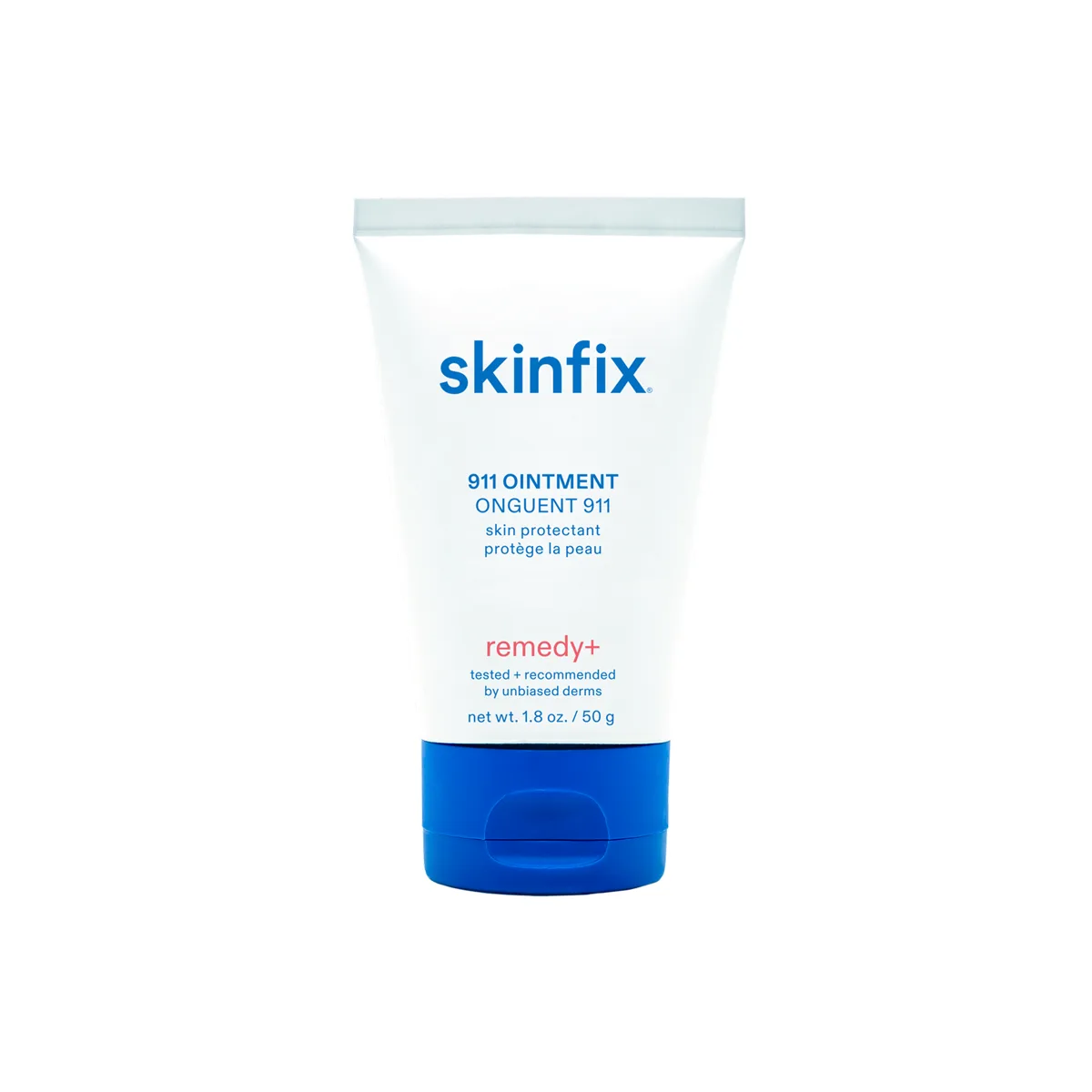
It is 55 percent petrolatum rather than the near-100 percent of a jelly, with the balance in sunflower, coconut, jojoba and rosehip oils, shea and cupuaçu butters and beeswax, plus a monograph dose of allantoin and a little bisabolol and aloe. The result spreads and absorbs more like a balm while keeping most of petrolatum's occlusion, in a fragrance-free formula that has held up for years.
A petrolatum ointment made pleasant: 55 percent petroleum jelly loosened with sunflower, coconut and jojoba oils, shea, cupuaçu and beeswax, with a monograph dose of allantoin and no fragrance or preservative. It heals chapped lips, cracked heels and chafed skin as well as the drugstore jelly it improves on, spreads better, and costs about fifteen times as much per ounce. Good product, luxury price, small tube.
Strong choicefor DrynessIn your profileYou chose · Petrolatum is an approved or monograph active for dryness; this ointment carries it at 55%.Moderate evidenceGentleNo reviews collected yet
The case for it
Petrolatum is a first-line active — approved, monograph-listed or named in current guidelines — for this concern.
It is present at an effective concentration, declared or high in the ingredient list.
The formula carries none of the triggers this concern is sensitive to.
Same rule for everyone. “Strong choice” is the verdict on 1,459 of 45,024 concern verdicts across the catalog; rule R2 decided 892 of them.
As of September 25, 2026, engine 5.1.1.
Good choicefor Compromised Skin BarrierIn your profileYou chose · Petrolatum is a reference standard by mechanism for compromised skin barrier; this ointment carries it at 55%.Moderate evidenceGentleNo reviews collected yet
The case for it
Petrolatum has trial-supported standing for this concern.
It is present at an effective concentration, declared or high in the ingredient list.
The formula carries none of the triggers this concern is sensitive to.
Same rule for everyone. “Good choice” is the verdict on 9,564 of 45,024 concern verdicts across the catalog; rule R5 decided 9,072 of them.
As of September 25, 2026, engine 5.1.1.
Strong choicefor EczemaIn your profileYou chose · Petrolatum is an approved or monograph active for eczema; this ointment carries it at 55%.Moderate evidenceGentleNo reviews collected yet
The case for it
Petrolatum is a first-line active — approved, monograph-listed or named in current guidelines — for this concern.
It is present at an effective concentration, declared or high in the ingredient list.
The formula carries none of the triggers this concern is sensitive to.
Same rule for everyone. “Strong choice” is the verdict on 1,459 of 45,024 concern verdicts across the catalog; rule R2 decided 892 of them.
As of September 25, 2026, engine 5.1.1.
R2 — A regulator- or guideline-recognised first-line active, declared at an effective strength, in a form the claim supports. · the full register
Carrying active
Petrolatum
Standing
first line — a regulator recognises it for this use; its mechanism is established; trials support it · per 21 CFR § 347.50 - Labeling of skin protectant drug products. (US Code of Federal Regulations (Legal Information Institute, Cornell Law School)), opened July 27, 2026
Form
adequate (declared 55%) — studied range up to 100%, from the OTC monograph or label; needs leave-on contact; judge it after ~1 weeks
Tolerability
gentle
Row checked
against its sources on July 27, 2026 (evidence table ev-2026.09-r228)
Good choicefor Post-ProcedureIn your profileYou chose · Petrolatum is a reference standard by mechanism for post procedure; this ointment carries it at 55%.Moderate evidenceGentleNo reviews collected yet
The case for it
Petrolatum has trial-supported standing for this concern.
It is present at an effective concentration, declared or high in the ingredient list.
The formula carries none of the triggers this concern is sensitive to.
Same rule for everyone. “Good choice” is the verdict on 9,564 of 45,024 concern verdicts across the catalog; rule R5 decided 9,072 of them.
As of September 25, 2026, engine 5.1.1.
Also listed for Winter Skin — the actives here (Petrolatum, Allantoin, Sunflower Oil, Beeswax) are in our research queue for that concern; there is no verdict until their evidence rows are written. That is a gap in our table, not a mark against the product.
A verdict is DermApproved’s assessment of how well a product’s ingredients fit a concern — never a claim about what the product treats. Evidence dots and collected reviews sit beside it and are never blended in.
Rules 0.5.1 · evidence table ev-2026.09-r228 · how we decide
Assessment
Pros & Cons
Pros
✓ 55 percent petrolatum, the most effective occlusive in dermatology, with a registered allantoin active
✓ Sunflower, jojoba and rosehip oils and cupuaçu and shea butters make it spread and feel like a balm
✓ Fragrance-free, preservative-free, essential-oil-free and lanolin-free
✓ Relief on contact for chapped lips, cuticles, heels and chafed skin, visibly better by morning
✓ Safe over the eye area and as an overnight face seal on dry skin
✓ Bisabolol and aloe add genuine soothing to raw or irritated patches
✓ Years on the market with a large, consistently positive owner record
Cons
✗ $28 for 1.8 ounces, roughly fifteen times the price of petroleum jelly
✗ Still shiny and tacky on the face, as any petrolatum film is
✗ Coconut oil, shea and beeswax are the ingredients breakout-prone faces should weigh
✗ Beeswax and shea give it a waxy drag that resists spreading in a cold room
✗ Small tube disappears quickly if used for full-face slugging
✗ Treats dryness and cracking only; no effect on the inflammation of eczema or dermatitis
Review
Full Review
Petrolatum is the most effective moisturiser in dermatology and one of the cheapest substances in the pharmacy, which makes it a hard product to charge for. It reduces water loss through the skin by more than 98 percent, it does not clog pores, it almost never causes a reaction, and it costs a few dollars a pound in a plastic tub. Everything sold above that price is an argument about what it is worth to make petrolatum easier to spread, nicer to touch and better to look at, and Skinfix's 911 Ointment is one of the more honest versions of that argument. It keeps petrolatum as more than half the formula, dilutes it with oils and butters that spread and feel like a balm, adds a registered skin-protectant active, leaves out everything that could irritate, and puts it in a 1.8-ounce tube for $28. Whether that is a good deal depends entirely on how much the niceness matters to you, and the rest of this review is about what the niceness consists of.
It consists of a well-chosen lipid blend. After petrolatum comes sunflower seed oil, a linoleic-rich oil with genuine clinical evidence for supporting the skin barrier rather than merely sitting on it, then beeswax for structure, shea and cupuaçu butters for cushion, and coconut, rosehip and jojoba oils for slip and a little nutrition. The petrolatum still does the sealing; the oils and butters make it spread thinly without dragging, set to a glossy film that feels less like a coating, and leave the skin softer in the morning than plain jelly does, which is the difference between an occlusive you tolerate and one you reach for. Bisabolol and aloe add a soothing note that raw, chafed skin appreciates, and tocopherol keeps the oils from going rancid in a preservative-free formula. Allantoin at 0.5 percent is the labelled active, the monograph skin protectant that lets the tube say it relieves chapped, chafed and cracked skin, and it softens keratin and calms at a dose that is exactly what the regulation requires and no more.
What is not in the tube is as important as what is. No fragrance, no essential oils, no preservatives, no silicones, no lanolin. On lips that react to flavoured balms, on the raw skin around a healing scrape, on cracked winter heels, on cuticles torn by cold and hand-washing, and on the eye area at bedtime, there is nothing here to sting, and the roughly 130 reviewers on Skinfix's site and the thousands at Sephora describe the same experience: relief on contact, visibly better by morning, and no breakouts for most faces that slug with it. The two ingredients worth a thought on breakout-prone skin are the coconut oil and the beeswax, not the petrolatum, which is among the least comedogenic occlusives there is; acne-prone users should keep the ointment to lips and patches.
In practice the tube is a utility. A pea for the lips, a smear for the cuticles, a thin layer over moisturiser on the face on a dry winter night, a thicker one on heels under socks. It shines, because petrolatum shines, and it is tacky for an hour, because that is what an occlusive film feels like, and there is no getting around either. It also travels better than a tub: the tube fits a coat pocket, the ointment does not leak in heat the way a squeeze tube can, and it doubles as a hand and knuckle rescue on a cold day, which is where most owners end up using it most. Used with the restraint it rewards, the tube lasts three to six months. Used as a nightly full-face and body slug it lasts weeks, and at that point the arithmetic turns against it hard.
The arithmetic is the review's only real complaint. Twenty-eight dollars for 1.8 ounces is about $15.50 an ounce; petroleum jelly is about a dollar an ounce, and the mass-market healing ointments that also blend petrolatum with lanolin, glycerin and panthenol sit around two or three dollars an ounce. Skinfix's version is fragrance-free like the best of those, better-feeling than most, free of lanolin for the people who react to it, and comes from a barrier-focused brand with a dozen years of clinically tested products behind it; that is worth something. It is not worth ten times, and the tube is small enough that the price feels like a subscription to niceness rather than a purchase of protection.
So the recommendation splits along the usual line. If you want the best-feeling petrolatum ointment you can buy, fragrance-free and lanolin-free, from a brand whose barrier products you already trust, and you will use it sparingly on the places that need it, this is a lovely tube and it earns its loyalists. If you want the protection without the niceness, the drugstore jelly does the same sealing for the price of a coffee, and if you slug your whole face every night, buy the tub and save the tube for your bag.
Formula
Key Ingredients
The hero actives that drive this product's performance.
More than half the jar, the most effective occlusive in dermatology and the reason the ointment heals cracked heels and chapped lips; Skinfix cuts the usual 90-plus percent with plant oils and butters so it spreads more easily and feels less like a jar of jelly, at some cost to raw occlusion.
Regulator-approvedfor Dryness · established mechanism
The labelled OTC skin-protectant active at the monograph's 0.5 percent, which is what lets the ointment legally claim to relieve chafed, chapped and cracked skin; it softens keratin and soothes, and it is the drug half of a product that is mostly petrolatum doing the work.
The first inactive after petrolatum, a linoleic-rich oil with clinical evidence for supporting the skin barrier, chosen here to loosen the petrolatum into a spreadable ointment while adding a lipid the skin can use.
Thickens the plant-oil fraction so the ointment holds its shape in a warm jar and stays put on a heel or a cuticle, and makes the product non-vegan, which Skinfix's plant-forward positioning does not flag.
With shea, the butters that give the ointment its rich cushion and a little emollience beyond occlusion; cupuaçu is an Amazonian cousin of cocoa butter with unusually high water-binding capacity for a lipid, which suits an ointment meant for very dry skin.
The chamomile-derived anti-irritant that with aloe gives the ointment its soothing note on raw, chafed or freshly irritated skin, a small but well-evidenced addition to a formula that is otherwise about sealing.
Not yet assessed
Ingredient standings describe the active at treatment-level doses and
vehicles; this product's own condition grades weigh its actual formula.
Press a thin layer over moisturiser as the last step at night, on lips, cuticles, heels or any chapped patch, and over the whole face only if the skin is dry rather than breakout-prone; a little goes further than the jar suggests and it should never go under sunscreen.
Results Timeline
Chapped lips, cuticles and chafed skin feel relieved on contact and look better by morning, which is the petrolatum sealing water in overnight. Cracked heels and persistently dry patches take a week or two of nightly use. It does not treat the cause of eczema or dermatitis, only the dryness and cracking, so flares need their own treatment.
Pairs Well With
A humectant serum or moisturiser underneath, so the ointment has water to seal inA retinoid, as the buffering top layer on irritated nights
THIS PRODUCT on lips, cuticles, heels and dry patches
Evidence
Science & Expert Perspective
The Science
The ointment's effect is occlusion, and petrolatum is the reference standard for it. A semi-solid mixture of hydrocarbons, petrolatum forms a continuous, water-impermeable film on the skin that reduces transepidermal water loss by around 98 percent, more than any other commonly used ingredient, and unlike most occlusives it also penetrates into the upper stratum corneum, where it fills gaps between corneocytes and accelerates barrier recovery after damage. It is biologically inert, non-sensitising and, despite decades of consumer belief to the contrary, non-comedogenic in controlled testing, which is why it is the standard post-procedure and eczema occlusive in dermatology. Skinfix uses it at 55 percent, which retains most of that occlusive effect while allowing the remaining 45 percent of the formula to change how the ointment spreads and feels.
That remainder is chosen with some care. Sunflower seed oil, the first inactive after petrolatum, is around 60 to 70 percent linoleic acid and has been shown in clinical work on neonatal and adult skin to preserve or improve barrier function, in contrast to oleic-dominant oils such as olive that can disrupt it; its presence adds a lipid the skin can incorporate rather than merely a solvent. Shea and cupuaçu butters contribute stearic and oleic triglycerides and unsaponifiables that soften the film, with cupuaçu notable among plant butters for high water-absorption capacity; beeswax structures the oil phase so the ointment holds its body in the tube; coconut, rosehip and jojoba oils add spreadability, and tocopherol protects the oils from oxidation in the absence of a preservative. Bisabolol, the chamomile sesquiterpene, and aloe leaf extract have documented anti-irritant activity at low concentrations.
Allantoin at 0.5 percent is the labelled active under the FDA skin-protectant monograph, which recognises it at 0.5 to 2 percent for the temporary protection and relief of chapped, chafed or cracked skin and lips; it is a mild keratolytic and soothing agent whose effect is modest beside the petrolatum's but whose presence is what permits the drug claim. The formula contains no anti-inflammatory and does not act on the immune process of eczema or dermatitis, and its benefit in those conditions is the occlusion and protection it provides over a treatment. Skinfix publishes no trial of the finished ointment, and none is needed for a product whose mechanism is this well established.
Dermatologist Perspective
Petrolatum ointments are the workhorse occlusive of dermatology, recommended after procedures, over eczema treatments, on cracked hands and heels and, increasingly, as an overnight seal on dry facial skin, and clinicians are generally happy to see patients use a fragrance-free, preservative-free version like this one. The advice that accompanies it is standard: apply over a moisturiser or damp skin so there is water to seal in, use a thin layer, keep it off actively weeping or infected skin without a clinician's say-so, and remember that it protects and hydrates but does not treat inflammation, so an eczema or dermatitis flare still needs its anti-inflammatory beneath it. Beeswax is a recognised though uncommon contact allergen, and coconut oil and shea are the components an acne-prone patient would be told to weigh before slugging the whole face. The price would draw a wry note, since plain petrolatum does the sealing for a fraction of the cost; the value dermatologists would concede is the improved spreadability and the absence of lanolin, which some patients react to in the mass-market alternatives.
Guidance
Usage & Recommendations
How to Use
At night, after cleansing and applying a moisturiser or hydrating serum so the skin has water to hold, squeeze a pea-sized amount from the tube and warm it between the fingertips until it softens, then press a thin film over lips, cuticles, heels or any chapped, chafed or cracked patch; over the whole face and eye area it works as a bedtime seal on dry skin, using no more than a thin layer. On heels and hands a thicker coat under socks or gloves speeds things up. It should always be the last step and never go under sunscreen or makeup. Keep it off actively weeping or infected skin unless a clinician has said otherwise, and use it over rather than instead of any eczema treatment. Keep the cap snapped shut; it needs no refrigeration and lasts a year after opening.
Value Assessment
At $28 for 1.8 ounces, this ointment costs about $15.50 an ounce against roughly a dollar for petroleum jelly and two to three dollars for the mass-market petrolatum-lanolin healing ointments, and its formula justifies a premium over those for the fragrance-free, lanolin-free, preservative-free build and the plant-oil blend that makes it spread and feel like a balm, but not a premium of five to fifteen times. Used sparingly on lips, cuticles, heels and dry patches the tube lasts three to six months, which brings the cost to something tolerable for a utility product; used as a nightly full-face slug it lasts weeks and becomes one of the most expensive ways to apply petrolatum. Skinfix's clinical-brand record and the ointment's long run of satisfied owners are real, and the value is fair for someone who wants the niceness and poor for anyone who only wants the protection.
Who Should Buy
People with dry, sensitive or eczema-prone skin who want a fragrance-free, lanolin-free petrolatum ointment that spreads and feels better than the drugstore jelly, for lips, cuticles, heels, chafed skin and the occasional overnight face seal, and who will use it sparingly enough that a 1.8-ounce tube lasts a season.
Who Should Skip
Anyone who slugs the whole face or body nightly and would empty the tube in weeks, for whom a tub of plain petrolatum does the same sealing; acne-prone faces wary of coconut oil, shea and beeswax; vegans, because of the beeswax; and anyone expecting a healing ointment to treat the inflammation of eczema rather than seal over its treatment.
A dense, translucent amber ointment that softens under a fingertip, spreads more easily than petroleum jelly thanks to the plant oils and sets to a glossy, tacky occlusive film that lasts through the night.
Scent
Unscented; a faint natural note from the beeswax and oils on opening, undetectable on the skin.
Packaging
A 1.8 oz / 50 g white squeeze tube with a cobalt-blue flip cap in Skinfix's Remedy+ livery, easy to slip into a bag and cleaner to dose than a tub.
Finish
glowynourishing
What to Expect on First Use
The first use on chapped lips or a cracked heel is immediate relief and a glossy seal; on the face it feels like a lighter petroleum jelly that still shines. There is nothing to react to and nothing to adjust to, and the only surprise is how little is needed.
How Long It Lasts
Three to six months of nightly use on lips, cuticles and dry patches, a few weeks if slathered over the whole face and body every night.
Skinfix grew out of a family healing balm recipe dating to 1870, and the 911 Ointment is that idea in modern OTC form: a skin-protectant ointment for the chafed, cracked and chapped places a moisturiser cannot fix, launched in the brand's early years and registered with allantoin as its active. It has become the brand's utility product, the tube people keep by the bed and in the bag.
About Skinfix Established Brand (5–20 years)
Skinfix was founded in 2014 by Amy Gordinier around a heritage healing balm and has since built a clinically tested, dermatologist-partnered barrier range with several National Eczema Association acceptances. The 911 Ointment is one of its oldest products, an OTC skin protectant with a drug facts panel that fixes its allantoin dose; the brand's broader claims for it rest on its own testing.
Brand founded: 2014 · Product launched: 2018
Myth vs. Reality
Common Myths
Myth
Petrolatum suffocates the skin or clogs pores.
Reality
Petrolatum is one of the least comedogenic occlusives in dermatology and does not block the skin from breathing; it slows water loss while the skin repairs beneath it, which is why it is the standard wound and eczema occlusive. The coconut oil, shea and beeswax in this ointment are more relevant to breakout-prone skin than the petrolatum is.
Myth
The healing in the name means the ointment treats eczema or dermatitis.
Reality
It is an OTC skin protectant that relieves dryness, chapping and cracking and shields the skin while it heals; it contains no anti-inflammatory and does not treat the immune process behind eczema. On a flare it is the occlusive over a treatment, not the treatment.
FAQ
Frequently Asked Questions
What is the difference between Skinfix 911 Ointment and petroleum jelly?
Petroleum jelly is essentially all petrolatum; the 911 Ointment is 55 percent petrolatum with sunflower, coconut, jojoba and rosehip oils, shea and cupuaçu butters, beeswax, a 0.5 percent allantoin active and a little bisabolol and aloe. It spreads more easily and feels less like a jelly, at some cost to raw occlusion and a large cost in price.
Can I use Skinfix 911 Ointment on my face overnight?
Yes, and Skinfix suggests it as a bedtime seal over moisturiser for dry skin, including the eye area. It is fragrance-free and petrolatum itself is non-comedogenic, but the coconut oil, shea and beeswax make it a less obvious choice for acne-prone faces, which should keep it to lips and dry patches.
Is Skinfix 911 Ointment safe for eczema?
It is a fragrance-free, preservative-free occlusive that many people with eczema use over their treatment to seal in moisture, and it contains no common triggers beyond beeswax. It does not treat the inflammation of a flare, so it goes over a prescribed or OTC anti-inflammatory rather than in place of one.
Is Skinfix 911 Ointment vegan?
No. Beeswax is one of its inactive ingredients and part of what gives it body. Everything else is petrolatum, plant oils and butters, and the brand does not test on animals.
How much Skinfix 911 Ointment should I use?
Very little. A pea covers both lips or a set of cuticles, and a thin film pressed over moisturiser is enough for the whole face; more just adds shine. Used that way the 1.8-ounce tube lasts months, which is the only way its price makes sense.
Can Skinfix 911 Ointment be used on babies or in pregnancy?
Its ingredients, petrolatum, plant oils, beeswax and 0.5 percent allantoin, are all standard in products used on infants and during pregnancy, and there is no fragrance, preservative or active of concern. For a baby's rash or broken skin, a clinician should still be the one to say what to use.
Reviews
What Reviewers Tend to Say
Recurring themes our editors read across retailer reviews of this product — summaries in our words, not quotations, and not a substitute for your own patch test.
Common Praise
Heals cracked heels and cuticles within days
Works as an overnight face seal without breaking skin out
Less greasy and easier to spread than petroleum jelly
Occupational hand dermatitis is one of the most common work-related diseases on earth, it follows a script, and the cheapest fix works only if you start it before the skin splits.
Every post that dismantles a home remedy owes the reader a replacement. The honest replacement list is embarrassingly cheap, and one item on it is cheaper still — it is a bath.
The viral overnight Vaseline trick is genuinely great for some skin and a breakout machine for others — and the deciding factor is entirely what's underneath.
Products, answers, therapy guides, tools and articles in one search. Brand names,
slang and abbreviations all work — accutane finds isotretinoin, bacne finds truncal acne.