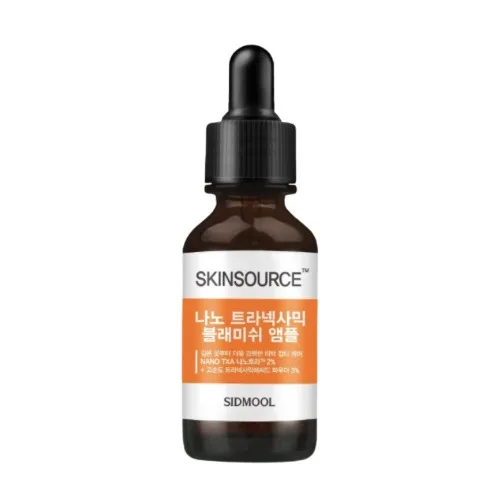
It puts a trial-dose 3 percent tranexamic acid and 5 percent niacinamide into a twelve-ingredient, water-based, fragrance-free ampoule and prints both numbers on the label, at a price a third of what Western tranexamic serums charge. Two-thirds of the acid is liposome-encapsulated, a sensible answer to the molecule's poor skin penetration that few budget formulas attempt.
Three percent tranexamic acid and five percent niacinamide, both printed on the label, in a twelve-ingredient fragrance-free water base for about sixteen dollars. That is the study dose of a serious pigment active at a fraction of the usual price, and the formula is as gentle as it is plain. It is brand new and import-only, so patience is required on both fronts.
With a 2026 launch and no US distribution, this ampoule's user record is a few dozen cross-border reviews, so the experience notes lean on Sidmool's declared concentrations and the published literature on 3 percent tranexamic acid and 5 percent niacinamide rather than on feedback about this bottle. The liposomal delivery claim has not been tested independently.
Verdicts
How well it fits each concern
Verdict by concern tap a concern for the case
Not for thisfor Acne ScarringIn your profileYou chose · The actives here have been researched for acne scarring and the evidence does not support the claim.Not yet assessedGentleNo reviews collected yet
The case for it
Niacinamide 5% has been researched for this concern and the evidence does not support it.
It is present at an effective concentration, declared or high in the ingredient list.
The formula carries none of the triggers this concern is sensitive to.
Same rule for everyone. “Not for this” is the verdict on 488 of 45,024 concern verdicts across the catalog; rule R10 decided 488 of them.
As of September 25, 2026, engine 5.1.1.
Promisingfor Dark SpotsIn your profileYou chose · Niacinamide has trial-level evidence for dark spots but no guideline or regulatory standing yet — promising, short of a recommendation; the other actives here are not yet assessed for it.Moderate evidenceGentleNo reviews collected yet
The case for it
Niacinamide 5% has trial-level evidence for this concern but no guideline or regulatory standing yet.
It is present at an effective concentration, declared or high in the ingredient list.
The formula carries none of the triggers this concern is sensitive to.
What would change this: Guideline or regulatory standing for the active on this concern would move this from a promising bet to a recommendation.
Same rule for everyone. “Promising” is the verdict on 7,858 of 45,024 concern verdicts across the catalog; rule R9p decided 7,858 of them.
As of September 25, 2026, engine 5.1.1.
R9p — 0.5.0: 'Unproven' beside three filled dots read as one question answered twice with opposite words (7,018 rows). The chip measures standing, the dots measure trial volume; where the row carries at least one RCT or a tier-2 source (moderate dots) and the active is present at a working level, the honest word is Promising. Unproven is reserved for plausible-standing rows with limited or weak evidence, or an under-dosed form. Same rank as Unproven — a bet either way; the dots order them. · the full register
Carrying active
Niacinamide 5%
Standing
plausible — trials support it
Form
adequate (declared 5%)
Tolerability
gentle
Row checked
against its sources on July 17, 2026 (evidence table ev-2026.09-r228)
Good choicefor HyperpigmentationIn your profileYou chose · Niacinamide is a trial-supported active for hyperpigmentation; this ampoule carries it at 5%.Moderate evidenceGentleNo reviews collected yet
The case for it
Niacinamide 5% has trial-supported standing for this concern.
It is present at an effective concentration, declared or high in the ingredient list.
The formula carries none of the triggers this concern is sensitive to.
Same rule for everyone. “Good choice” is the verdict on 9,564 of 45,024 concern verdicts across the catalog; rule R5 decided 9,072 of them.
As of September 25, 2026, engine 5.1.1.
Good choicefor MelasmaIn your profileYou chose · Tranexamic Acid is a trial-supported active for melasma; this ampoule carries it at 3%.Strong evidenceGentleNo reviews collected yet
The case for it
Tranexamic Acid has trial-supported standing for this concern.
It is present at an effective concentration, declared or high in the ingredient list.
The formula carries none of the triggers this concern is sensitive to.
Same rule for everyone. “Good choice” is the verdict on 9,564 of 45,024 concern verdicts across the catalog; rule R5 decided 9,072 of them.
As of September 25, 2026, engine 5.1.1.
Also listed for Dullness — the actives here (Niacinamide, Tranexamic Acid, Panthenol (Vitamin B5) are in our research queue for that concern; there is no verdict until their evidence rows are written. That is a gap in our table, not a mark against the product.
Where our review and the verdict differ. The review below was written on the formulation and the published trials; the verdicts above apply the stricter standing test in our methodology — an active earns a recommendation only with guideline or regulatory standing for the concern. Where the two disagree, the verdict is DermApproved’s position.
A verdict is DermApproved’s assessment of how well a product’s ingredients fit a concern — never a claim about what the product treats. Evidence dots and collected reviews sit beside it and are never blended in.
Rules 0.5.1 · evidence table ev-2026.09-r228 · how we decide
Assessment
Pros & Cons
Pros
✓ 3% tranexamic acid, the dose used in most topical melasma trials, declared on the label
✓ 5% niacinamide blocks melanin transfer, attacking pigment from a second angle
✓ Twelve-ingredient, fragrance-free, alcohol-free, oil-free water base
✓ Two-thirds of the acid is liposome-encapsulated to aid penetration
✓ Panthenol, pantolactone and beta-glucan calm inflamed post-acne marks
✓ Fungal-acne-friendly by ingredient list
✓ About a third of the price of Western tranexamic serums
Cons
✗ Import-only with slow shipping and a Korean-language label
✗ Launched in 2026, so real-world feedback is scarce
✗ Small 30 ml bottle for twice-daily full-face use
✗ No hydration or lipids of its own; needs a moisturizer over it
✗ Liposome delivery claim is untested by the brand
✗ 5% niacinamide can flush very reactive skin in the first days
Review
Full Review
Tranexamic acid was a haemophilia drug before it was a skincare ingredient, and the reason it ended up in a sixteen-dollar Korean ampoule is a story about how pigment science trickles down. The molecule is a synthetic lysine analogue that stops blood clots dissolving, and it has been given to surgical and heavy-bleeding patients for decades. In 1979 a Japanese dermatologist noticed that a patient taking it for something else saw her melasma fade, and thirty years of investigation followed: oral tablets, injections, then topical creams, mostly at 3 percent, mostly for melasma, mostly in East Asia. By the early 2020s it had escaped the clinic. Prestige brands put it in fifty- and ninety-dollar serums with 'discoloration' in the name. Sidmool, a Korean independent with a habit of printing its doses, has now put the same 3 percent into a plain amber dropper bottle and asked sixteen dollars for it. The Skin Source Nano Tranexamic Blemish Ampoule is what happens when a proven active finishes its trickle down.
The ingredient list is twelve items long and reads like a formulator's answer to the question 'what is the least you need'. Water, then niacinamide at a declared 5 percent, then tranexamic acid at a declared 30,100 parts per million, which is 3.01 percent and is split, according to the label, into 2 percent carried in nano-liposomes and 1 percent as high-purity powder. Then a preservative, panthenol, glycerin, sodium hyaluronate, acerola and blueberry extracts, hydrogenated lecithin to build the liposomes, pantolactone and beta-glucan. No fragrance, no alcohol, no oil, no silicone, no exfoliating acid. It is water with two actives at study concentrations and a handful of soothers, and the fact that the two concentrations are on the front of the bottle, in a category where most brands hide the dose behind the word 'complex', is the most Sidmool thing about it.
The pairing is well chosen. Tranexamic acid works upstream of pigment production: UV and inflammation make keratinocytes release plasmin and other signals that tell melanocytes to make more melanin and to reach out to more cells, and tranexamic acid blunts that conversation. Niacinamide works downstream, blocking the transfer of finished melanin packets into the surrounding skin cells. Hit both steps and you have a rational two-pronged approach to the flat red and brown marks that acne leaves behind, which is precisely the 'blemish' in the product's name; Sidmool's customer base skews young and its marks are post-inflammatory rather than hormonal. The liposome fraction is the one technical claim, and it is a sensible one. Tranexamic acid is small but water-soluble and does not cross the lipid barrier easily, which is part of why topical results lag oral ones; wrapping most of the dose in phospholipid vesicles is the standard formulator's answer. Whether Sidmool's liposomes deliver more than the free acid is not something the brand has tested, and no one should assume it.
In use, it is almost nothing, which is what a pigment serum should be. The fluid is water-thin with a faint slip, disappears in under thirty seconds and layers under anything. There is no sting, no warmth and no fragrance. A few reactive users report a brief flush in the first days from the 5 percent niacinamide, an effect that fades with once-daily introduction. Then nothing happens for weeks, because that is how pigment works. The first sign, around week four to six, is that fresh red marks stop lingering the way they used to. Brown marks take two to three months, mild melasma longer, and everything stalls without daily sunscreen, which is not a caveat but the whole premise.
The evidence deserves plain framing. Topical tranexamic acid at 2 to 5 percent has a respectable trial record for melasma, often matching hydroquinone in small studies, and a 2024 network meta-analysis found that topical, intradermal and microneedled tranexamic acid all beat placebo from week eight, while oral tranexamic acid plus topical care worked fastest and best. That is honest support for what this ampoule is doing and an honest ceiling on it: a 3 percent serum is a maintenance and mild-case tool, not a replacement for a dermatologist's melasma plan. For post-acne marks specifically, the trial data is thinner and the case rests on mechanism plus the far better-documented niacinamide.
The limitations are practical rather than formulaic. The product is months old, so English-language feedback is a few dozen reviews and the durability of the liposomes over a bottle's life is untested. It is import-only, which means one to three weeks of shipping, a Korean-only label and a price that swings between sixteen and twenty-nine dollars depending on the retailer's discount that week. Thirty millilitres used twice daily on the whole face lasts six to eight weeks, so the dropper bottle is small for the job. And the formula's plainness is a double edge: there is no hydration, no lipid and no occlusive here, so it needs a real moisturizer over it.
Sidmool has twenty-five years of Korean word-of-mouth and zero clinical trials, and this ampoule is a fair example of what that produces: an honest, minimal, well-dosed formula that borrows its evidence from the literature on its actives rather than generating any of its own. Western brands charge four to six times as much for the same concentrations wrapped in more ingredients and more copy. If you have the patience to import and the discipline to wear sunscreen, this is one of the most cost-effective ways to put trial-dose tranexamic acid and niacinamide on a face that keeps its acne marks too long.
Formula
Key Ingredients
The hero actives that drive this product's performance.
Declared at 30,100 ppm, just over 3 percent, split on the label into a 2 percent nano-liposomal fraction and 1 percent high-purity powder. Tranexamic acid interrupts the signalling between UV-stressed keratinocytes and melanocytes, and 3 percent is the concentration most topical melasma studies have used, so this is a working dose rather than a nod.
Second in the list at a declared 5 percent, the upper end of what studies use for pigmentation, where it blocks the transfer of melanin packets into skin cells. Paired with tranexamic acid it attacks post-blemish marks from two directions, and its barrier support makes the acid easier for reactive skin to tolerate.
The phospholipid Sidmool uses to build the 'nano' liposomes that carry two-thirds of the tranexamic acid, a water-soluble molecule that otherwise penetrates skin poorly. Encapsulation is the formula's main technical claim and the reason for the name.
Provitamin B5 and its lactone, placed fifth and eleventh, soothing the low-grade inflammation that keeps post-acne marks red and helping the barrier while two actives work. They are what make this an ampoule for blemish-prone skin rather than a bare brightening acid.
A natural vitamin C source added after the actives for antioxidant support and a mild brightening assist; at its position it complements rather than competes with the tranexamic acid and niacinamide. The blueberry extract beside it plays the same supporting antioxidant role.
Not yet assessed
Ingredient standings describe the active at treatment-level doses and
vehicles; this product's own condition grades weigh its actual formula.
Apply to dry skin after toner and before moisturizer, morning and night; it is water-thin and layers under anything. It combines happily with retinoids and azelaic acid on the same night and needs a strict daily sunscreen habit, since pigmentation work without SPF is wasted.
Results Timeline
There is nothing to feel on application beyond light hydration. Fresh red post-acne marks begin to fade within four to six weeks, brown marks and mild melasma take eight to twelve weeks of twice-daily use to show a visible difference, and improvement plateaus rather than continuing indefinitely; stopping lets pigment return over months.
Pairs Well With
Retinoids at nightAzelaic acidBroad-spectrum SPF 50 every morningA ceramide moisturizer
Tranexamic acid is a synthetic lysine derivative that inhibits plasminogen activation, and its effect on pigmentation follows from that: ultraviolet exposure and inflammation cause keratinocytes to release plasminogen activator, and the resulting plasmin drives arachidonic acid and prostaglandin release along with fibroblast growth factor signalling that stimulates melanocyte activity and dendricity. Blocking plasmin interrupts that keratinocyte-to-melanocyte conversation, which is why the molecule reduces the recurrent, inflammation-fed pigmentation of melasma and post-inflammatory marks rather than bleaching existing pigment directly. Topical studies have used concentrations of 2 to 5 percent, most often 3 percent, which matches the 30,100 ppm Sidmool declares. A 2024 systematic review and network meta-analysis in the Journal of Cosmetic Dermatology (https://pubmed.ncbi.nlm.nih.gov/38059683/) compared administration routes across randomized trials and found that topical tranexamic acid, like intradermal and microneedled delivery, produced statistically significant reductions in the Melasma Area and Severity Index versus placebo from week eight onward, while oral tranexamic acid combined with routine topical agents achieved the largest and fastest improvements; over the long run, the authors concluded, the route mattered less than the drug. That places a 3 percent serum on solid but modest ground: effective, slow, and outperformed by prescription-supervised oral therapy.
Niacinamide at 5 percent contributes a complementary mechanism with a substantial evidence base of its own, inhibiting the transfer of melanosomes from melanocytes to keratinocytes and improving the appearance of hyperpigmented spots over 8 to 12 weeks in controlled studies, while also supporting barrier lipid synthesis that helps skin tolerate daily use. The formula's liposomal fraction addresses a genuine delivery problem, since tranexamic acid is hydrophilic and penetrates the stratum corneum poorly, and phospholipid encapsulation is a recognised strategy for improving cutaneous delivery of water-soluble actives; Sidmool has not published penetration or efficacy data for its specific vesicles, so the claim should be read as formulation rationale rather than demonstrated advantage. Panthenol, pantolactone and beta-glucan provide anti-inflammatory and humectant support relevant to post-inflammatory marks, and the acerola and blueberry extracts add minor antioxidant activity. No clinical study of this ampoule exists.
Topical tranexamic acid has earned a place in dermatological pigment management over the past decade, particularly for melasma and for post-inflammatory hyperpigmentation in darker skin, where it offers a non-hydroquinone option with a good safety record; concentrations around 3 percent are what clinicians most often see in the studies and in the compounded or commercial products they recommend. A serum that combines that dose with 5 percent niacinamide in a minimal, fragrance-free base is a reasonable adjunct, and its declared concentrations make it easier to evaluate than most. The realistic counsel is that topical tranexamic acid works slowly, over two to three months, that it maintains rather than cures, and that it cannot substitute for the oral therapy or combination regimens a dermatologist would use for moderate to severe melasma. Sunscreen is non-negotiable, since the pigment pathway it blocks is triggered by UV. Practitioners would also note that its safety in pregnancy is not established and that hormonal melasma in pregnancy is usually managed conservatively. For young patients with lingering post-acne marks and no active acne, this is a sensible, low-risk product to pair with a retinoid.
Guidance
Usage & Recommendations
How to Use
Cleanse and apply any toner, then let the skin dry. Draw up four to five drops with the dropper and pat them over the whole face, or two to three drops onto areas with marks, avoiding the eye area. It absorbs in under thirty seconds; follow with a moisturizer, since the ampoule provides little hydration of its own. Use morning and night. For the first week apply once daily to check for any niacinamide flush, then move to twice daily. It layers under retinoids and azelaic acid at night, and if you use a low-pH vitamin C serum, apply that first and wait a few minutes or move it to the opposite time of day. Wear broad-spectrum SPF 50 every morning without exception. Expect the first changes at four to six weeks and judge the result at three months. Store the amber bottle away from heat and finish within six months.
Value Assessment
At roughly sixteen dollars for 30 millilitres on a typical Beauty Box Korea discount, or up to twenty-nine at list, this ampoule delivers the study concentration of tranexamic acid and a full 5 percent niacinamide for a third or less of what Western brands charge for comparable serums, which commonly sit at forty to ninety dollars. The formula is minimal, so you are paying almost entirely for the actives and the liposomal work, not for texture or packaging. International shipping adds five to fifteen dollars and one to three weeks, and the bottle lasts six to eight weeks at twice-daily full-face use, so the monthly cost lands around ten dollars including postage. There is no larger size. For anyone treating post-acne marks or mild melasma on a budget, the value is exceptional; the trade is patience, both for delivery and for results.
Who Should Buy
People with lingering red or brown post-acne marks, mild melasma or general uneven tone who want a trial-dose tranexamic acid and niacinamide serum without the prestige markup, especially oily, combination and fungal-acne-prone skin that needs a water-based, oil-free formula. It suits anyone already using a retinoid who wants a compatible daytime pigment step, and K-beauty shoppers comfortable ordering from Korea.
Who Should Skip
Anyone with moderate to severe melasma, who needs a dermatologist-led plan rather than a cosmetic serum, and anyone unwilling to wait two to three months and wear sunscreen daily for results. Pregnant users should check with a provider given the lack of safety data, and shoppers who will not import from Korea have no domestic source.
Ready to try Sidmool Skin Source Nano Tranexamic Blemish Ampoule?
A clear, water-thin fluid with the faintest slip from the liposomes; it spreads like a toner, absorbs in under thirty seconds and leaves skin slightly hydrated with no film.
Scent
Fragrance-free; a faint, clean, mildly fruity note from the acerola extract that vanishes immediately.
Packaging
A 30 ml amber glass dropper bottle with a black rubber-bulb pipette and an orange Skin Source label; the dark glass protects the actives, the dropper meters neatly, and it is compact enough to travel.
Finish
invisiblefast-absorbinglightweight
What to Expect on First Use
First use is uneventful in the way a pigment serum should be: no tingle, no warmth, no smell, just a watery layer that disappears. A few people with very reactive skin notice a brief flush from the 5 percent niacinamide in the first days. Nothing visible happens for several weeks; the first sign is usually that new red marks stop lingering.
How Long It Lasts
About six to eight weeks at four to five drops twice daily on the full face; three months or more if used only on spots.
Skin Source is Sidmool's line of stripped-down 'one active, one job' ampoules, the successor to the DIY-community ethos the brand grew from in 2000. The Nano Tranexamic Blemish Ampoule launched in 2026 as tranexamic acid moved from a dermatologist's melasma tool into a mainstream K-beauty ingredient, and Sidmool's answer was to publish the dose, split it between free and liposomal forms, and aim it at the acne-mark market its younger customers dominate.
About Sidmool Established Brand (5–20 years)
Sidmool has been a small Korean independent since 2000, born from a DIY skincare community and known for single-active ampoules with the concentration printed on the label. It has no published clinical studies; trust rests on ingredient transparency and a long domestic reputation rather than dermatological validation.
Brand founded: 2000 · Product launched: 2026
Myth vs. Reality
Common Myths
Myth
Tranexamic acid is an exfoliating acid like glycolic or salicylic.
Reality
Despite the name it is not an exfoliant and does not lower skin pH meaningfully; it is a lysine derivative that blocks plasmin-driven signalling between skin cells and pigment cells. It does not sting, peel or increase sun sensitivity the way hydroxy acids do.
Myth
Mixing 5% niacinamide with tranexamic acid will irritate skin or cancel the effect.
Reality
The two are routinely combined in melasma studies and work on different steps of pigmentation, niacinamide blocking melanin transfer and tranexamic acid reducing melanocyte stimulation. The old niacinamide-flushing worry applies to a minority of users and to very acidic pairings, not to this formula.
Myth
A topical tranexamic serum works as well as the oral tablets dermatologists prescribe for melasma.
Reality
Meta-analyses show oral tranexamic acid combined with topical care outperforms topical alone, especially in the first weeks, though topical routes catch up in the long run. A serum like this is a maintenance and mild-case tool, not a substitute for a dermatologist's melasma plan.
FAQ
Frequently Asked Questions
How much tranexamic acid is in the Sidmool Nano Tranexamic Blemish Ampoule?
Sidmool declares 30,100 ppm, roughly 3 percent, made up of 2 percent tranexamic acid in nano-liposomes plus 1 percent high-purity powder, alongside 5 percent niacinamide. Three percent is the concentration used in most published topical tranexamic acid melasma studies.
Does the Sidmool tranexamic ampoule work on acne marks?
It is designed for them. Tranexamic acid calms the inflammation-driven pigment signalling behind red and brown post-acne marks and niacinamide blocks melanin transfer, so fresh red marks usually fade within four to six weeks and brown marks over two to three months with daily sunscreen. It does not treat active acne or indented scars.
Can I use Sidmool Nano Tranexamic Blemish Ampoule with retinol or vitamin C?
Yes to both. Tranexamic acid and niacinamide are not exfoliants and pair well with retinoids at night; with vitamin C, apply a low-pH ascorbic serum first, wait a few minutes, then this ampoule, or use vitamin C in the morning and this at night if you notice any flushing.
Is the Sidmool tranexamic ampoule safe for sensitive skin?
Its twelve-ingredient list has no fragrance, alcohol, essential oils or exfoliating acids, and panthenol and beta-glucan are included to soothe, so most sensitive skin tolerates it. The 5 percent niacinamide can cause a brief flush in a small minority; introducing it once daily for a week settles that.
Is the Sidmool tranexamic acid ampoule fungal acne safe?
Yes by ingredient list: it is water-based with no oils, esters, fatty alcohols or polysorbates, and the small amount of hydrogenated lecithin used for the liposomes is generally considered acceptable. It is one of the safer brightening serums for Malassezia-prone skin.
Where can I buy the Sidmool Skin Source Nano Tranexamic ampoule in the US?
It is not stocked by US retailers; it ships from Korean cross-border shops such as Beauty Box Korea at around sixteen to twenty-nine dollars depending on discounts, plus shipping. Expect one to three weeks for delivery and a Korean-language label.
Reviews
What Reviewers Tend to Say
Recurring themes our editors read across retailer reviews of this product — summaries in our words, not quotations, and not a substitute for your own patch test.
Common Praise
Fades red post-acne marks faster than niacinamide alone
Water-thin and fragrance-free, no sting even on fresh blemishes
Layers under everything without pilling
Excellent price for the declared doses
Common Complaints
Import-only with slow shipping
Results on older brown marks are slow
Small 30 ml dropper bottle for twice-daily use
Too new to have much feedback
Notable Endorsements
Concentrations declared on the label: 3% tranexamic acid and 5% niacinamideSidmool Skin Source line's reputation for single-active ampoules in Korea
It was invented to stop bleeding during surgery. In 2026 it's in dozens of brightening serums — and the evidence is better than most trend ingredients can claim.
Japan runs a third regulatory tier between cosmetic and pharmaceutical, and once you can see it, the entire J-beauty aisle stops looking modest and starts looking legally precise.
Most heritage claims are unfalsifiable. This one sits on a public regulatory register — which makes it the rare case where you can check what 150 years of institutional research actually bought.
It's the benchmark every other brightener is measured against — and the one you can no longer grab off a US drugstore shelf. Here's the clear-eyed version.
May 26, 2026· 5 min
Questions people ask about Acne Scarring
Verified answers from our questions library — the nuance a product page cannot carry.
Products, answers, therapy guides, tools and articles in one search. Brand names,
slang and abbreviations all work — accutane finds isotretinoin, bacne finds truncal acne.