

Castor Oil Grows Nothing. What It Actually Does Is Stranger and More Useful.
No trial has ever shown it produces a single new lash — and the one adverse event with its own case literature is weirder than anything on the bottle.

It's the canonical execution of the Japanese emulsion step at the franchise's signature price — fermented single-cultivar soymilk and isoflavones in a squalane-sealed milk that assumes you're layering it over a watery lotion, a routine architecture Western moisturizers simply aren't built around.
The canonical Japanese milk-step in its cheapest competent form: fermented soymilk and isoflavones in a squalane-sealed emulsion that turns a watery toner into lasting suppleness for about seventeen imported dollars. Alcohol in third place and a paraben keep reactive skin away, and it underwhelms used alone — but inside the routine it was built for, it's quietly excellent.
This NC-generation formula has shelved since 2022 with a deep Japanese-language review record but only shallow importer listings stateside, and the $16.99 figure reflects one verified US reseller against a far lower domestic price. The assessment leans on the franchise's twenty-year track record and the well-documented chemistry of glycerin-squalane emulsions rather than on Western user volume.
The case for it
Same rule for everyone. “Good choice” is the verdict on 9,564 of 45,024 concern verdicts across the catalog; rule R5 decided 9,072 of them. Unchanged since September 5, 2026, engine 5.1.1.
Brand or formulator? Disclose a concentration or correct a fact →
The studies behind the evidence row
The case for it
What would change this: A researched evidence row for the lead active would replace this with a verdict.
Same rule for everyone. “Supporting role” is the verdict on 8,197 of 45,024 concern verdicts across the catalog; rule R8 decided 4,250 of them. Unchanged since September 5, 2026, engine 5.1.1.
Brand or formulator? Disclose a concentration or correct a fact →
Also listed for Dullness — the actives here (Squalane, Soybean (Glycine Soja) are in our research queue for that concern; there is no verdict until their evidence rows are written. That is a gap in our table, not a mark against the product.
Does the jobDoes what a moisturizer is for: draws in water, softens and smooths.
A verdict is DermApproved’s assessment of how well a product’s ingredients fit a concern — never a claim about what the product treats. Evidence dots and collected reviews sit beside it and are never blended in. Rules 0.5.1 · evidence table ev-2026.09-r228 · how we decide
There's a whole step in the Japanese skincare routine that English never bothered to translate properly. 乳液 — nyūeki, literally 'milk liquid' — gets rendered as 'emulsion' on export packaging, a word that means nothing to most Western shoppers and so gets shelved, mentally, as 'thin moisturizer.' That misfiling explains a thousand confused reviews. In the Japanese architecture, moisturizing is split into two specialized layers: a lotion (what the West calls toner) floods the skin with water, and the emulsion follows as a light milk whose only job is sealing that water in with the minimum necessary lipid. Cream, if it appears at all, is a third act for dry skin and winter. The West collapsed all three jobs into one heavy jar and called it progress; Japan kept the layers separate and optimized each. Sana's Nameraka Honpo Soy Milk Moisture Emulsion NC is among the cheapest fully competent executions of that philosophy you can buy — which makes it both a fine product and a useful education.
The formula reads like a textbook the brand has been refining since 2005. Water and glycerin form the humectant base; squalane, fourth on the list, is the sealing lipid — skin-identical, weightless, non-greasy, the exact right choice for a milk that promises suppleness without surface evidence. The emulsifiers are the gentle amino-acid kind, beeswax adds a whisper of structural occlusion, and arginine handles pH while moonlighting as a humectant. Then the franchise signature: fermented soymilk from Fukuyutaka soybeans grown in Kyushu — a single-cultivar supply chain that remains the most charming flex in Japanese drugstore skincare — plus high-purity isoflavones, soy protein, and seed extract. In the cleansers this soy garnish is mostly identity; here, in a leave-on with hours of contact, the isoflavones' modest evidence base for skin conditioning and elasticity support actually gets room to operate. Nothing in the bottle is exotic, everything is purposeful, and the whole assembly costs less than a fancy coffee order.
In use, the product teaches the category's virtues quickly. Over lotion-damp skin, a pump and a half presses in within seconds and leaves the finish Japanese reviewers call mochi-hada — rice-cake skin, soft and bouncy with no layer you can feel. Western moisturizer instincts misread this as 'not doing anything'; the doing reveals itself at hour six, when skin that would normally tighten simply hasn't. Used alone on bare skin — the standard Western misuse — it genuinely does underwhelm, because it's sealing water that was never deposited. The bottle assumes a routine, and rewards anyone who supplies one.
The honest demerits are concentrated in two ingredients. Ethanol sits third — higher than in most of the line — keeping the milk light and flash-dry but announcing itself with a fleeting solvent coolness on application and a hard pass from barrier-compromised, rosacea-prone, and alcohol-averse users. And methylparaben, while among the best-studied and least objectionable preservatives in the toxicology literature, remains a dealbreaker for a slice of shoppers the brand has clearly decided to let go. Add the soy-everywhere composition (a true allergy concern, not a wellness one) and beeswax (ruling out vegans and strict fungal-acne lists), and the audience narrows from 'everyone' to 'most people' — still a wide electorate for a product this cheap. A note for the routine-curious: the emulsion step also changes how sunscreen behaves. Because the finish is supple but dry to the touch, chemical sunscreens spread over it without the pilling that creams provoke, and the layer underneath keeps SPF from settling into dry patches by mid-morning — a small daily dividend the category rarely gets credit for.
The value calculation barely needs performing. Seventeen dollars imported — under seven in a Tokyo drugstore — for 150ml that stretches three to four months of twice-daily use puts the per-application cost in coffee-change territory, and the franchise's two decades of best-seller rankings testify that the formula survives daily-driver scrutiny at national scale. Within the line, it slots between the watery lotions and the 50g cream, and the classic economy move is exactly that stack: lotion, this emulsion, cream at night in winter — a complete three-layer Japanese routine for less than one Western prestige moisturizer.
The recommendation writes itself along routine lines rather than skin types. If you already run — or want to learn — the layered Japanese architecture, this is the milk-step to start with: cheap enough to experiment, good enough to keep, and instructive enough to explain the whole philosophy through use. Normal, combination, and moderately dry skin will find the finish addictive; oily skin gets a legitimate one-and-done moisturizer over toner. If your skin is reactive to alcohol, genuinely dry in the way that needs ceramides and occlusion, or you want one jar to do everything — the collapsed Western format exists for you, and this bottle will only frustrate. It was never trying to be a moisturizer. It's the half of one Japan decided deserved its own name.
The hero actives that drive this product's performance.
| Ingredient | Function | Evidence |
|---|---|---|
| Fermented Soymilk Liquid | The line's fermented Fukuyutaka-soybean signature sits at the heart of this emulsion's plumping claim — fermentation shrinks the soy conditioning molecules so the milk-thin lotion leaves skin supple rather than coated. | Not yet assessed |
| Soy Isoflavones | In a leave-on step the line's high-purity isoflavones finally get a fair contact window — the phytoestrogen conditioning that the franchise's cleansers can only gesture at has hours to work here. | Not yet assessed |
| Squalane | Fourth in the formula and doing the emollient heavy lifting — the skin-identical lipid that lets a beeswax-light lotion seal the watery layers beneath without any oily afterfeel. | Established mechanism for Dryness · established mechanism |
| Arginine | The amino acid pulls double duty as humectant and pH adjuster, keeping the carbomer gel network neutral while feeding the skin's own moisturizing-factor pool. | Not yet assessed |
Ingredient standings describe the active at treatment-level doses and vehicles; this product's own condition grades weigh its actual formula.
Water, Glycerin, Alcohol, Squalane, Soy Isoflavones, Fermented Soymilk Liquid, Butylene Glycol, Arginine, Carbomer, Cyclodextrin, Stearic Acid, Glyceryl Stearate, Sodium Stearoyl Glutamate, Cetyl Alcohol, Soy Protein, Glycine Max (Soybean) Seed Extract, Sodium Polyacrylate, Beeswax, Methylparaben
moisturizer
AM & PM
Use it the Japanese way: after your hydrating lotion (toner), pump a 10-yen-coin amount into palms and press across the face while skin is still damp — it seals the watery layers rather than replacing them. Oily skin can stop here; dry skin tops it with the line's cream at night.
Immediate softness and a supple, non-sticky finish from the first use; the cumulative payoff — steadier hydration, fewer flaky patches, that 'mochi skin' bounce the line is named for — settles in across two to three weeks of twice-daily use. This is maintenance moisturizing, not corrective treatment.
The emulsion category embodies a principle moisturizer science has validated repeatedly: humectants need occlusion to perform. Glycerin — here in its customary second position — raises stratum corneum water content within minutes, but in low-humidity conditions unsealed humectants equilibrate with the air and can draw water outward; pairing them with even a light lipid film measurably improves retention, which is precisely the lotion-then-emulsion logic of the Japanese routine. Squalane is an evidence-rich choice for that film: structurally analogous to the squalene in human sebum, it spreads thin, resists oxidation, and reduces transepidermal water loss without the comedogenic baggage of heavier occlusives. The amino-acid emulsifier system (sodium stearoyl glutamate) reflects the Japanese industry's documented preference for low-irritation interfaces, and arginine's dual role — neutralizing the carbomer network while contributing to the skin's natural moisturizing factor pool — is standard but intelligent formulation. The soy story warrants calibrated respect: topical isoflavones, particularly genistein, have small controlled studies showing improvements in elasticity and photoaging markers in mature skin, plausibly via estrogen-receptor-mediated collagen support, and fermented soy derivatives offer better skin penetration of those aglycone forms — a fair mechanistic rationale, at cosmetic doses, for the line's claims, well short of pharmacological certainty. The two scrutiny magnets resolve differently: third-position ethanol is a genuine tolerability tradeoff, documented as both a penetration-and-evaporation aid and an irritant on compromised barriers, while methylparaben at regulated concentrations carries one of the most extensively reviewed safety files in preservation — consumer aversion to it is cultural, not toxicological.
When patients describe tight, flaky skin despite 'moisturizing constantly,' clinicians often discover a single heavy cream applied to bone-dry skin — and the corrective advice, applying moisture in layers onto damp skin, is essentially the Japanese routine this product belongs to. Dermatologists broadly endorse the humectant-then-seal sequence; whether it arrives as toner-plus-emulsion or as a single well-built lotion is treated as preference rather than physiology. For this specific formula, clinical counsel would sort by barrier status: resilient skin tolerates third-position alcohol without consequence, while eczema, rosacea, and retinoid-initiation patients are routinely steered to alcohol-free alternatives, since ethanol on impaired barriers measurably worsens irritation and water loss. The paraben provokes no clinical concern — regulatory reviews have repeatedly affirmed methylparaben's safety margin — and soy allergy, though uncommon as a contact issue, is the one genuine exclusion criterion practitioners would flag in a formula this soy-dense.
Apply within a minute of your hydrating lotion, while skin still carries surface dampness: a pump to a pump and a half warmed between palms, then pressed — not rubbed — across face and neck in two or three unhurried passes. Morning use takes sunscreen directly on top once it settles, about thirty seconds. At night, dry and mature skin should seal it with the line's cream; oily and combination skin can end the routine here. It also works as a gentle buffer layer under retinoids for resilient skin. Skip it on freshly exfoliated or barrier-stressed days if alcohol bothers you, shake nothing — the emulsion pours ready — and expect the pump to outlast a season.
At $16.99 imported — and roughly ¥990 domestically, a gap that says everything about J-beauty logistics — this emulsion costs about fourteen cents per application across a three-to-four-month bottle. There is no meaningful Western competition at the price point because the West barely manufactures the category; the closest analogues are K-beauty emulsions at half again the cost or Japanese competitors within a dollar or two. The smarter value frame is the full stack: this bottle plus the line's lotion and cream assembles a complete three-layer routine for under forty imported dollars, undercutting single prestige moisturizers while delivering a more evidence-coherent architecture. The only value risk is misuse — bought alone and applied to dry skin, it will disappoint at any price.
Anyone building or curious about the layered Japanese routine — this is the canonical, lowest-risk milk-step to learn with. Normal, combination, and moderately dry skin chasing the mochi finish, oily skin wanting a one-step moisturizer over toner, and budget routines that refuse to feel like compromises are all squarely served.
Alcohol-reactive, rosacea-prone, and barrier-compromised skin — the third-position ethanol is disqualifying, not incidental. Soy-allergic users face a formula built on the allergen, vegans hit beeswax, paraben-avoiders know their answer, and anyone unwilling to run a lotion underneath should buy a conventional moisturizer instead of half of one.
Ready to try Sana Nameraka Honpo Soy Milk Moisture Emulsion NC?
Buy at Amazon ♥A pourable, milk-thin white emulsion that spreads with watery slip, then settles into a supple, powder-soft finish — moisture you feel as bounce rather than as a layer.
Unfragranced; a brief whiff of alcohol and faint soy on application that vanishes within seconds.
The line's stout 150ml pump bottle in cream-and-blue — unglamorous, mercifully practical, and built for one-handed bathroom use.
First use teaches the category: applied to lotion-damp skin it disappears in two presses and leaves a finish drier than a cream but softer than a gel — if you've never used a Japanese emulsion, the absence of 'moisturizer feel' is the point, not a defect. Reactive skin may notice the alcohol's fleeting coolness.
Three to four months at a pump-and-a-half twice daily.
All Year
The 乳液 (nyūeki, 'milk liquid') step is the half of the Japanese routine that never crossed the Pacific — a light sealing milk between toner and cream — and Nameraka Honpo's version has anchored the line since 2005; the NC renewal kept the formula's bones and the grandmother-approved price while refining the fermentation-derived conditioning that made it a perennial ranking fixture.
The Nameraka Honpo emulsion has been a fixture of Japanese drugstore routines since the soy-milk line debuted in 2005 under Sana, Tokiwa Pharmaceutical's 1976-founded brand; the NC formula is its early-2020s renewal, still built around fermented soymilk from a single Kyushu soybean cultivar and still priced for daily, whole-family use.
An emulsion is just a watered-down moisturizer for people who can't handle cream.
It's a different architecture, not a diluted one: Japanese routines split hydration (lotion) from sealing (emulsion) so each layer can be optimized — the emulsion's job is locking the lotion's water in with minimal lipid. Skipping the lotion and using this alone is the actual misuse, and the source of most 'it's not moisturizing enough' complaints.
The soy in this bottle will affect hormones through your skin.
Topical isoflavones at cosmetic doses condition the skin surface and show modest photoaging benefits in small studies — systemic hormonal effects from a leave-on lotion are not among the documented outcomes. The phytoestrogen chemistry stays put; enjoy the softness without the endocrine anxiety.
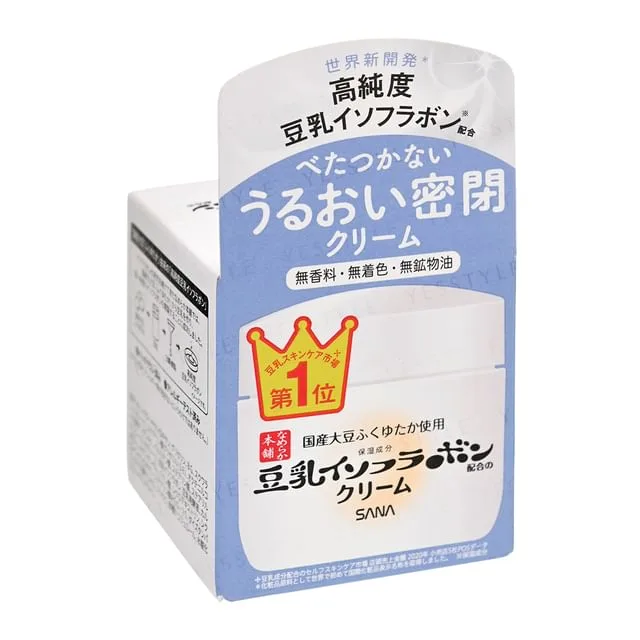
Weight and role: the emulsion is a milk-thin sealing layer for day use or oilier skin, while the 50g cream is the line's richer night-time occlusive. Classic Japanese routines use both — emulsion always, cream layered on top when skin runs dry.
It's designed on that assumption — the emulsion's light lipid load seals water it expects to find already on the skin. Used on bare skin it underwhelms; pressed over a hydrating lotion it produces exactly the supple finish the reviews rave about.
Often, yes — the squalane-led, mineral-oil-free formula is light, and many oily users make it their only moisturizing step. The beeswax and soy lecithin-adjacent components keep it off strict fungal-acne lists, and anyone reactive to alcohol should note its third-place position.
Because the ethanol is real — it's third on the ingredient list, there to keep the milk light and fast-absorbing, and its scent flashes off within seconds. No perfume is added; what you smell is the solvent leaving, not a fragrance.
It's practically engineered for shared bathroom shelves — unfragranced, fast-absorbing, cheap enough that nobody polices pump counts. Teens and low-effort minimalists can use it straight after cleansing, accepting that it performs best over a basic toner.
NC is the line's renewal-generation code: refined fermented-soymilk conditioning and updated texture work, same role and price tier. Old stock marked NA still circulates through importers, so check the suffix if formula vintage matters to you.
Recurring themes our editors read across retailer reviews of this product — summaries in our words, not quotations, and not a substitute for your own patch test.
melts in without stickiness
leaves the mochi-soft finish the line is famous for
one bottle lasts a season
alcohol scent noticeable on application
not rich enough alone for winter-dry skin
paraben purists pass on principle