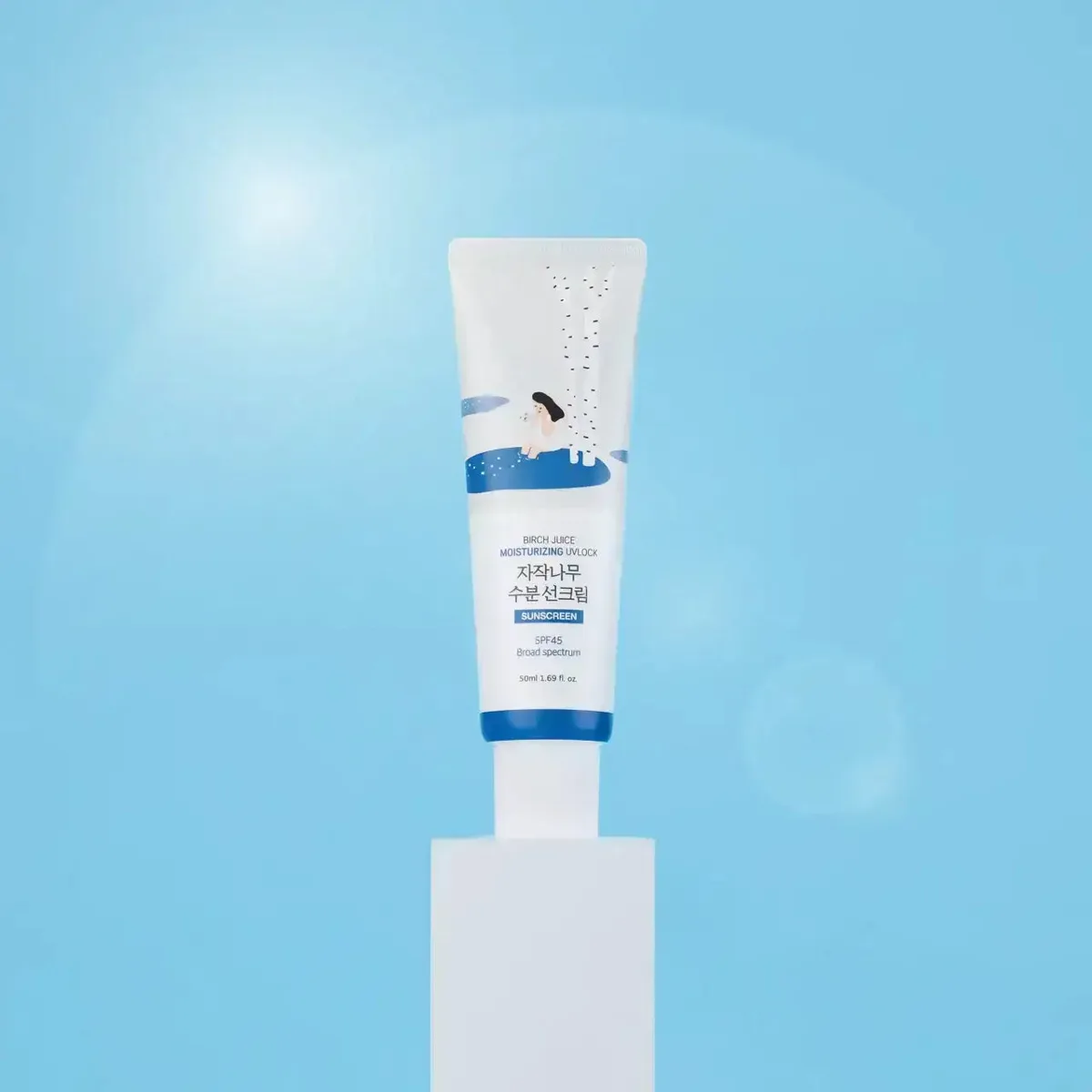
It is the US-compliant rebuild of the Birch Juice sunscreen that made Round Lab famous, keeping the moisturiser-like, cast-free, dewy finish and the niacinamide-birch-glucoside skincare layer while swapping the Korean version's modern filters for avobenzone, homosalate and octisalate with an unusually thorough three-part photostabiliser. It is the rare K-beauty sunscreen that reaches US shelves as a real OTC drug product with declared percentages rather than a grey-market import.
The US rebuild of Korea's bestselling sunscreen, and a good one: avobenzone, homosalate and octisalate with an unusually thorough three-part photostabiliser, the same moisturiser-like, cast-free, dewy finish and the niacinamide-birch-glucoside skincare layer that made the original a phenomenon, sold as a real FDA-compliant drug product at a fair $25. Its limits are the American filter list, avobenzone alone on UVA, homosalate near its ceiling and no water resistance, plus two essential oils the sensitive-skin pitch did not need; for daily, under-makeup, no-cast wear it remains one of the best-liked sunscreens on the US shelf, and honestly so.
Full protectionfor Sun DamageIn your profileYou chose · Broad-spectrum SPF 45 with avobenzone: the protection sun damage calls for.Moderate evidenceGentleNo reviews collected yet
The case for it
Avobenzone 2.7% is a first-line active — approved, monograph-listed or named in current guidelines — for this concern.
It is present at an effective concentration, declared or high in the ingredient list.
The formula carries none of the triggers this concern is sensitive to.
Same rule for everyone. “Full protection” is the verdict on 2,288 of 45,024 concern verdicts across the catalog; rule P1 decided 2,232 of them.
As of September 25, 2026, engine 5.1.1.
P1 — Photoprotection standing is regulatory (M020 / Annex VI filters; 21 CFR 201.327 attaches the early-skin-aging claim to tested broad-spectrum SPF 15+). SPF 30 is the AAD daily-use bar. · the full register
Carrying active
Avobenzone 2.7%
Standing
first line — a regulator recognises it for this use; trials support it · per 21 CFR § 352.10 Sunscreen active ingredients (US FDA — 21 CFR Part 352 (Sunscreen Drug Products for Over-the-Counter Human Use), via Cornell Legal Information Institute; part heading marked [STAYED INDEFINITELY], effective date stayed at 66 FR 67485), opened September 1, 2026
Form
adequate (declared 2.7%) — studied range up to 3%, from the OTC monograph or label; needs leave-on contact
Tolerability
gentle
Row checked
against its sources on September 1, 2026 (evidence table ev-2026.09-r228)
21 CFR § 352.10 Sunscreen active ingredients — US FDA — 21 CFR Part 352 (Sunscreen Drug Products for Over-the-Counter Human Use), via Cornell Legal Information Institute; part heading marked [STAYED INDEFINITELY], effective date stayed at 66 FR 67485, opened September 1, 2026
Also listed for Dehydration and Dryness — the actives here (Avobenzone, Homosalate, Niacinamide, Butyloctyl Salicylate) are in our research queue for those concerns; there is no verdict until their evidence rows are written. That is a gap in our table, not a mark against the product.
Does the jobDoes what a sunscreen is for: UVA coverage, kind to the skin wearing it. Not measured from the label: pleasant enough to actually use.
A verdict is DermApproved’s assessment of how well a product’s ingredients fit a concern — never a claim about what the product treats. Evidence dots and collected reviews sit beside it and are never blended in.
Rules 0.5.1 · evidence table ev-2026.09-r228 · how we decide
Assessment
Pros & Cons
Pros
✓ FDA-compliant US rebuild with declared filter percentages, not a grey-market import
✓ Three-part avobenzone photostabiliser keeps broad-spectrum protection through the day
✓ Moisturiser-like, dewy, cast-free finish on every skin tone
✓ Niacinamide, birch sap, glyceryl glucoside and hyaluronates hydrate enough to skip moisturiser
✓ Sits under makeup without pilling
✓ Large, consistent four-year review record across US retailers
✓ Fair price for the texture and the stabiliser package
Cons
✗ Avobenzone alone on UVA; moderate for long days in strong sun
✗ Homosalate at 13.5 percent sits inside the US-versus-EU regulatory argument
✗ No water-resistance claim; reapply after sweat or swimming
✗ Chamomile and pine essential oils in a sensitive-skin sunscreen
✗ Dewy finish turns shiny on oily skin by afternoon
✗ Not the Korean formula, which some buyers expect
Review
Full Review
Round Lab's Birch Juice Moisturizing Sunscreen is Korea's bestselling SPF, twenty million tubes and counting, and like nearly every Korean sunscreen it cannot legally be sold in the United States, because its filters, the modern European actives that make Asian sunscreens so elegant, are not on the FDA's list. Most K-beauty brands solve this by letting the grey market do the importing. Round Lab did something rarer: in 2022 it reformulated the sunscreen with American filters, ran the FDA-method tests, printed a drug label with percentages, and sold it at Sephora and Target as UVLock SPF 45 Broad Spectrum. The rebuild is where this review lives, because the question is not whether the Korean original is good, which is settled, but whether a version built from the FDA's short, old filter list can keep what people loved, and how much of the original's protection it had to give up to do it.
Mostly, it can. The actives are avobenzone at 2.7 percent, homosalate at 13.5 and octisalate at 4.5, the standard American chemical trio, with avobenzone carrying all of the UVA and the two salicylates supplying the UVB and dissolving the avobenzone. Avobenzone breaks down in light, and the formula's answer is the most thorough stabilising package seen on a K-beauty US launch: butyloctyl salicylate, diethylhexyl 2,6-naphthalate and benzotriazolyl dodecyl p-cresol, three ingredients whose only job is to keep the avobenzone working through a day, which is what allows the broad-spectrum label to mean something at four in the afternoon. Homosalate at 13.5 percent sits near the US ceiling and inside the regulatory argument every American chemical sunscreen inherits, the EU having capped it lower over endocrine-activity data, and that argument belongs to the filter list, not to this brand. What the rebuild does not have is the Korean version's UVA depth; avobenzone at under 3 percent is adequate for daily wear and moderate for a day in strong sun, and there is no water-resistance claim, so this is a commuting, desk and city sunscreen rather than a beach one. That is a limit worth stating plainly, because the brand's Korean reputation can lead a buyer to expect more UVA than any US chemical formula can deliver.
The part people loved, the feel, survives intact. The inactive list is the Birch line's skincare base: niacinamide ninth, the Inje birch sap, glycerin, glyceryl glucoside, two hyaluronates, allantoin, sweet wormwood and purslane extracts, a cauliflower-mushroom extract, and calcium aluminium borosilicate flakes for a faint pearly sheen. On the face it is a light, milky lotion that absorbs in a minute, leaves no cast on any tone, sets to a soft dewy glow and sits under foundation without pilling; normal and combination skin can skip a separate moisturiser, which is the whole reputation, and dry skin wants only a light cream beneath. The record is large and consistent: over five hundred reviews on the brand's US site and more than two thousand on Amazon, plus a Vogue, Allure and NBC Select circuit, and the praise is the same everywhere, moisturiser feel, no cast, no pilling, while the complaints are the glow turning to shine on oily skin, the faint scent, and the discovery that it is not the Korean formula, which the packaging could say more clearly than it does.
The scent is the formulation's one avoidable fault. Anthemis nobilis flower oil and Pinus sylvestris leaf oil sit low in the inactive list, giving a faint chamomile-pine note that fades in minutes and putting natural fragrance allergens into a sunscreen the brand sells for sensitive skin; most faces will never notice, chemical filters are a bigger irritant for reactive eyes, and it did not need to be there. Reactive, rosacea-prone or eczema-prone skin would do better with the brand's mineral sun cushion, which is fragrance-free, or a mineral sunscreen from elsewhere.
On price, $25 for 50 millilitres, six to eight weeks at the correct quarter-teaspoon, is fair: below the prestige tier, above the drugstore, and buying a genuinely elegant texture, a proper stabiliser package, a skincare base and an FDA drug label rather than a customs gamble. The Korean original costs about the same imported and cannot be verified as a US product; this can, and for a product that is technically a drug, that verification is worth something.
So the recommendation is warm with a footnote. For dry, normal, combination or moderately sensitive skin that wants a daily sunscreen it will actually wear, cast-free and moisturising under makeup, this is one of the best-liked and best-built chemical sunscreens on the American shelf, and a credit to a brand that did the rebuild properly. For long outdoor days, reapply every two hours or bring a higher-UVA product; for very oily skin, expect shine by afternoon; and for truly reactive skin, the essential oils and the chemical filters point to the mineral cushion instead.
Formula
Key Ingredients
The hero actives that drive this product's performance.
The sole UVA filter, below the 3 percent US maximum, carrying all the long-wave protection in a formula that had to swap the Korean version's modern filters for FDA-approved ones; it is inherently photounstable, and the butyloctyl salicylate, diethylhexyl 2,6-naphthalate and benzotriazolyl dodecyl p-cresol around it are there to keep it working through the day.
Regulator-approvedfor Sun Damage · emerging certainty
Two salicylate UVB filters, homosalate near its 15 percent US ceiling, that deliver the SPF 45 and act as the oil phase dissolving the avobenzone; homosalate at this level is also the ingredient behind the sunscreen's regulatory question mark, since the EU has capped it lower on endocrine-activity grounds.
Regulator-approvedfor Sun Damage · limited certainty
Three ingredients whose job is to stop the avobenzone breaking down in light, an unusually thorough stabilising package for a US chemical sunscreen and the reason the reformulation can honestly claim broad spectrum through a full day rather than for the first hour.
The skincare layer that earned the original its moisturiser-like reputation: niacinamide ninth in the inactive list, the line's Inje birch sap, glyceryl glucoside, two hyaluronates, glycerin and allantoin, which together make the lotion feel like a hydrating cream and give the brand its 'skincare sunscreen' pitch.
Two essential oils in the second half of the list that give the lotion its faint herbal scent and put natural fragrance allergens into a sunscreen sold for sensitive skin; low in the list, unlikely to bother most faces, and the one formulation choice the reformulation should have dropped.
Not yet assessed
Ingredient standings describe the active at treatment-level doses and
vehicles; this product's own condition grades weigh its actual formula.
Apply as the last skincare step every morning, about a quarter-teaspoon for the face and neck, over a moisturiser that has absorbed or, on normal skin, in place of one; it sits under makeup without pilling once it has set for a minute. Because avobenzone carries all the UVA, use the full amount and reapply after two hours outdoors; it is not labelled water-resistant.
Results Timeline
Immediate: broad-spectrum SPF 45 from application with a dewy, moisturiser-like finish and no white cast. Ongoing: daily use prevents new sun damage and the darkening of marks; the niacinamide contributes a slow, modest evening of tone over weeks. It treats nothing existing.
Pairs Well With
a light moisturizer underneath on dry skinmakeup over itthe brand's sun cushion for reapplication over makeup
The sunscreen's protection comes from three FDA-monograph organic filters. Avobenzone (butyl methoxydibenzoylmethane) at 2.7 percent absorbs across UVA1 and UVA2 and is the only long-wave filter, so UVA performance depends entirely on its photostability; avobenzone degrades rapidly under UV unless stabilised, and the formula addresses this with three agents, butyloctyl salicylate, which has published data reducing avobenzone photodegradation, diethylhexyl 2,6-naphthalate, a triplet-state quencher developed specifically to stabilise avobenzone, and benzotriazolyl dodecyl p-cresol, a UV absorber and stabiliser, a combination more comprehensive than most US chemical sunscreens employ. Homosalate at 13.5 percent and octisalate at 4.5 percent are salicylate UVB absorbers that also constitute the oil phase dissolving the avobenzone; homosalate's US maximum is 15 percent, while the EU Scientific Committee on Consumer Safety reduced its permitted concentration on the basis of in vitro endocrine-activity data, an ongoing regulatory divergence that applies to the filter class rather than to this product. SPF 45 at the labelled 2 mg/cm² transmits about 2.2 percent of erythemal UVB; the broad-spectrum designation requires passing the FDA critical-wavelength test. No water-resistance claim is made, so the labelled protection assumes dry conditions.
The inactive phase carries the skincare rationale. Niacinamide has randomised evidence at 2 to 5 percent for reducing erythema, sebum and post-inflammatory hyperpigmentation and for improving barrier function; its ninth position in the inactive list suggests a concentration in or near that range. Betula platyphylla japonica juice contributes sugars, amino acids and minerals with modest hydration data; glycerin, propanediol, glyceryl glucoside, which has small clinical data for aquaporin-3 upregulation, sodium hyaluronate and hyaluronic acid provide humectancy; allantoin, Artemisia annua, Portulaca oleracea and Sparassis crispa extracts add soothing and antioxidant support with in vitro evidence; tocopherol and ascorbic acid are antioxidants that modestly quench UV-generated radicals. Caprylyl methicone, polymethylsilsesquioxane and glyceryl polymethacrylate give slip and a soft-focus finish, calcium aluminium borosilicate flakes coated with triethoxycaprylylsilane provide a subtle sheen, and acrylate polymers with tromethamine form the emulsion. Anthemis nobilis (Roman chamomile) flower oil and Pinus sylvestris (Scots pine) leaf oil are essential oils containing terpene fragrance allergens; chamomile is a documented contact sensitiser in Asteraceae-allergic individuals. Preservation uses 1,2-hexanediol, pentylene glycol, methylpropanediol and ethylhexylglycerin. The chemical filters carry the category's usual tolerance issues, ocular stinging and occasional avobenzone contact allergy. The brand's UVA and wear testing beyond the required FDA methods is unpublished, and no independent study of the product exists.
Dermatologist Perspective
For daily photoprotection, dermatologists prioritise a broad-spectrum sunscreen of SPF 30 or higher that the patient will wear every day at the correct dose, and they recognise that elegant, cast-free chemical lotions are what most patients actually adhere to; a US-compliant formulation with a properly stabilised avobenzone and a hydrating base fits that priority, and clinicians would regard it as a sound choice for daily urban wear on most skin types, noting that it should be applied at a quarter-teaspoon for the face, reapplied every two hours outdoors and not relied on for swimming or heavy sweating, since it carries no water-resistance claim. They would explain the difference between this and the Korean original honestly: the US filter list offers less UVA depth than the modern European filters, which is a limitation of American regulation rather than of this brand, and the brand's choice to reformulate legally is preferable to the grey-market imports many patients use unknowingly. For sensitive, rosacea-prone or atopic patients, clinicians would note the chamomile and pine oils and the potential for chemical-filter eye stinging, and would suggest a fragrance-free mineral option; the homosalate concentration would be described as within US limits and part of a broader regulatory debate that current evidence does not resolve.
Guidance
Usage & Recommendations
How to Use
Every morning, as the last step of skincare and before makeup, squeeze out about a quarter-teaspoon, roughly two full finger-lengths, and spread it evenly over the face, ears and neck, over a moisturiser that has absorbed or, on normal to oily skin, in place of one. Allow a minute to set before foundation; it will not pill once dry. Apply fifteen minutes before going outside and reapply at least every two hours during sun exposure and immediately after swimming or sweating, since it is not water-resistant; the brand's sun cushion is a convenient way to reapply over makeup. Use it on children over six months with a doctor's advice as the label directs, keep it out of the eyes, and rinse with water if it migrates in. Store below 30 °C and replace an opened tube after a year.
Value Assessment
Twenty-five dollars for 50 ml is about $15 an ounce, and used at the correct quarter-teaspoon every morning the tube lasts six to eight weeks; that is below prestige sunscreen pricing and above the drugstore, and it buys a texture most drugstore chemical sunscreens cannot match, a three-part avobenzone stabiliser most do not include, a niacinamide-birch-glucoside base that can replace a morning moisturiser, and an FDA drug label with declared percentages rather than an import of uncertain provenance. It does not buy the Korean version's UVA filters, water resistance or a fragrance-free formula. Against imported Korean sunscreens at similar prices it trades UVA depth for legality and verifiability; against American chemical sunscreens at the same price it is simply nicer to wear. Good value for daily wear.
Who Should Buy
Dry, normal, combination or moderately sensitive skin that wants a daily, cast-free, moisturiser-like chemical sunscreen for commuting, desk and city days, that sits under makeup, and that is a verifiable FDA-compliant product rather than an import. It suits fans of the Korean Birch Juice sunscreen who want a legal US version, deeper skin tones tired of white cast, and anyone who skips sunscreen because sunscreen feels like sunscreen.
Who Should Skip
Beach, sport and long-outdoor-day users need a water-resistant sunscreen with stronger UVA coverage, and very oily skin will find the dewy finish shiny by afternoon. Reactive, rosacea-prone or eczema-prone faces and sensitive eyes should note the chamomile and pine oils and the chemical filters and choose a fragrance-free mineral option, and buyers expecting the Korean formula's filters will not find them.
A light, milky lotion with a faint pearly sheen from borosilicate glass flakes, spreading easily and absorbing within a minute to a dewy, hydrated, cast-free finish that feels like a moisturiser
Scent
A faint herbal note of chamomile and pine from the essential oils, noticeable on application and gone within minutes
Packaging
A 50 ml white squeeze tube with a screw cap and the line's birch illustration
Finish
dewylightweightinvisible
What to Expect on First Use
The first morning explains the fan base: the lotion goes on like a hydrating cream, leaves no cast on any tone, sets to a soft dewy glow and sits under foundation without pilling. Dry and normal skin can skip a separate moisturiser. Oily skin may read the glow as shine by afternoon. A faint herbal scent fades quickly, and most eyes tolerate it, though chemical filters can sting on a sweaty day.
How Long It Lasts
About 6-8 weeks at a quarter-teaspoon for the face every morning
Round Lab's Birch Juice Moisturizing Sunscreen became Korea's bestselling SPF and a global K-beauty phenomenon, but its filters are not approved in the United States; rather than sell it grey-market, the brand reformulated it in 2022 with FDA-permitted actives as UVLock SPF 45 Broad Spectrum, keeping the texture and the birch-sap skincare base. It has since been picked up by Sephora, Target and Amazon and featured by Vogue, Allure and NBC Select as one of the best sunscreens tested.
About ROUND LAB Established Brand (5–20 years)
ROUND LAB, founded in South Korea in 2017, made its name with the Birch Juice sunscreen, Korea's bestselling SPF for several years with over twenty million units sold, and sells in the US through its own site, Sephora, Amazon and Target. UVLock SPF 45 is the FDA-compliant US reformulation of that sunscreen, launched in 2022 with US-approved filters, and carries an OTC drug label with declared percentages; the brand's own tests are unpublished.
Brand founded: 2017 · Product launched: 2022
Myth vs. Reality
Common Myths
Myth
The US UVLock SPF 45 is the same sunscreen as the Korean Birch Juice SPF 50+
Reality
The texture and skincare base are the same idea, but the filters are entirely different: the Korean version uses modern European filters such as Uvinul A Plus and Tinosorb S, which the FDA has not approved, while the US version uses avobenzone, homosalate and octisalate with photostabilisers. The US product is a real FDA-compliant OTC drug with declared percentages; it is not an import.
Myth
SPF 45 is meaningfully weaker than SPF 50+
Reality
SPF 45 blocks about 97.8 percent of UVB at the labelled dose and SPF 50 about 98 percent; the difference is trivial next to the difference between applying a quarter-teaspoon and applying a thin swipe. The more relevant gap is UVA, where the Korean filters outperform avobenzone, which is why the US version stabilises its avobenzone so carefully.
FAQ
Frequently Asked Questions
What is the difference between Round Lab's US UVLock SPF 45 and the Korean Birch Juice SPF 50+?
The filters. The Korean version uses modern European UV filters the FDA has not approved; the US UVLock uses avobenzone 2.7 percent, homosalate 13.5 percent and octisalate 4.5 percent with three photostabilisers, and is a real FDA-compliant OTC drug product. The moisturiser-like texture, cast-free finish and niacinamide-birch-glucoside skincare base are carried over, and most users find the feel nearly identical.
Is the Round Lab UVLock SPF 45 sunscreen broad spectrum?
Yes, it is labelled broad spectrum under the FDA critical-wavelength test, with avobenzone as its sole UVA filter, photostabilised by butyloctyl salicylate, diethylhexyl 2,6-naphthalate and benzotriazolyl dodecyl p-cresol. That is adequate daily UVA protection; for long days in strong sun a higher-SPF product with a stronger UVA profile, or diligent two-hourly reapplication, is the better plan.
Does the Round Lab UVLock sunscreen leave a white cast?
No. It has no mineral filters, so it dries clear and dewy on every skin tone, with a faint pearly sheen from glass flakes rather than any chalkiness; reviewers with deeper complexions single this out. The trade is a glow that very oily skin may read as shine by afternoon.
Is the Round Lab UVLock sunscreen fragrance-free and safe for sensitive skin?
It has no added perfume but does contain chamomile flower oil and pine leaf oil, two essential oils low in the list that give a faint herbal scent, and its chemical filters can sting sensitive eyes. Most sensitive skin tolerates it well, but reactive, rosacea-prone or eczema-prone faces may prefer the brand's mineral sun cushion or a fragrance-free mineral sunscreen.
Can I skip moisturiser with the Round Lab UVLock sunscreen?
On normal, combination and oily skin, yes: the birch sap, glycerin, glyceryl glucoside, hyaluronates and niacinamide make it hydrating enough to be the morning moisturiser, which is its whole reputation. Dry skin will still want a light cream underneath, especially in winter.
Is the Round Lab UVLock sunscreen water-resistant?
No; the US label carries no water-resistance claim, so it should be reapplied after swimming or heavy sweating and every two hours outdoors. It is a daily-wear sunscreen for commuting, desk and city days rather than a beach or sports sunscreen.
Reviews
What Reviewers Tend to Say
Recurring themes our editors read across retailer reviews of this product — summaries in our words, not quotations, and not a substitute for your own patch test.
Common Praise
feels like a moisturiser, not a sunscreen
no white cast on any skin tone
no pilling under makeup
hydrating enough to skip moisturiser
does not sting the eyes for most
Common Complaints
dewy finish turns shiny on oily skin
not the same formula as the Korean original
faint herbal scent
SPF 45 rather than 50+
small 50 ml tube
Notable Endorsements
Korea's bestselling sunscreen line, 20M+ units sold (brand claim)Featured by Vogue, Allure and NBC SelectSold at Sephora, Amazon and Target
Essential oils are declared by botanical name rather than as fragrance, which is why the most heavily perfumed products in the natural aisle can carry the reassuring word — and why the bottle gets more sensitising the longer you own it.
The fourth most frequent positive patch test in North America is an oxidation product of a molecule that occurs naturally in lavender. Nobody synthesised it into your face cream.
Five brands that own the feed, judged on their ingredient lists rather than their view counts — including the one active all five suddenly added at once, and what that tells you.
IPL is a filtered flashlamp, a true vascular laser is one wavelength aimed at haemoglobin, and the choice between them turns on a distinction almost no consult makes: whether your redness is vessels or a state.
Sep 2, 2026· 9 min
Questions people ask about sunscreen
Verified answers from our questions library — the nuance a product page cannot carry.
Products, answers, therapy guides, tools and articles in one search. Brand names,
slang and abbreviations all work — accutane finds isotretinoin, bacne finds truncal acne.