


Octocrylene and Homosalate: The Filters America Is Stuck With
The critics are right about the data gap, and they are right that it took two decades to move. What follows from that is not the conclusion most people draw.
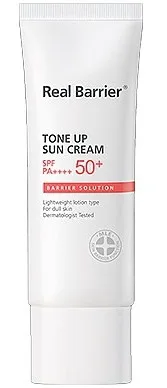
It folds a one-and-done tone-up makeup base into a hybrid SPF50+ sunscreen built on Real Barrier's ceramide MLE platform, adding niacinamide so the brightening is partly active rather than purely optical. The trade-off that sets it apart is a single light-leaning tint and a botanical scent.
A hybrid tone-up sunscreen that genuinely works as a one-step brightening makeup base, pairing real SPF50+/PA++++ protection with niacinamide and Real Barrier's ceramide platform. It shines on light-to-medium skin but flattens on deeper tones, and the botanical oil blend keeps it off the sensitive-skin shortlist.
Judgment here draws more on the published INCI and the predictable behavior of its filters and pigments than on a large review pool, since the couple hundred ratings across Amazon, Stylevana and Jolse are decent but limited. As a tinted, fragranced hybrid, both shade match and skin tolerance vary by individual well beyond the average rating, so treat the tone-up suitability and irritation notes as the cautious estimates they are.
The case for it
Same rule for everyone. “Full protection” is the verdict on 2,288 of 45,024 concern verdicts across the catalog; rule P1 decided 2,232 of them. Unchanged since September 5, 2026, engine 5.1.1.
Brand or formulator? Disclose a concentration or correct a fact →
The studies behind the evidence row
The case for it
What would change this: A declared concentration would move this to a firmer reading of the dose.
Same rule for everyone. “Full protection” is the verdict on 2,288 of 45,024 concern verdicts across the catalog; rule P1 decided 2,232 of them. Unchanged since September 5, 2026, engine 5.1.1.
Brand or formulator? Disclose a concentration or correct a fact →
The studies behind the evidence row
The case for it
Cautions: known irritants.
What would change this: A declared concentration would move this to a firmer reading of the dose.
Same rule for everyone. “Full protection” is the verdict on 2,288 of 45,024 concern verdicts across the catalog; rule P1 decided 2,232 of them. Unchanged since September 5, 2026, engine 5.1.1.
Brand or formulator? Disclose a concentration or correct a fact →
The studies behind the evidence row
Also listed for Dullness — the actives here (Zinc Oxide, Homosalate, Titanium Dioxide, Niacinamide) are in our research queue for that concern; there is no verdict until their evidence rows are written. That is a gap in our table, not a mark against the product.
Does the jobDoes what a sunscreen is for: UVA coverage, kind to the skin wearing it. Not measured from the label: pleasant enough to actually use.
A verdict is DermApproved’s assessment of how well a product’s ingredients fit a concern — never a claim about what the product treats. Evidence dots and collected reviews sit beside it and are never blended in. Rules 0.5.1 · evidence table ev-2026.09-r228 · how we decide
If you have spent any time in Korean skincare, you have met the tone-up sunscreen: a tinted SPF that promises to brighten your complexion the instant you smooth it on, leaving a luminous, slightly airbrushed finish. To a lot of Western shoppers the category reads with suspicion, sounding uncomfortably close to skin-whitening, or like makeup wearing the costume of sun protection. So the fair question for Real Barrier's Tone Up Sun Cream is a blunt one: is this real sunscreen with a cosmetic bonus, or cosmetic brightening with a sunscreen label stapled on? The answer, encouragingly, is the former, with some real caveats about who it flatters.
The protection is legitimate. This is a hybrid formula, leading with zinc oxide and titanium dioxide for mineral broad-spectrum coverage and then layering homosalate and ethylhexyl salicylate over the top as organic UVB boosters. That combination is what lets the cream reach SPF50+/PA++++ while staying lighter and less chalky than an all-mineral tone-up would. The tint itself comes from a sensible pigment complex: titanium dioxide and mica do the brightening and blurring, while a touch of iron oxide adds warmth to counteract the bluish cast that plain titanium leaves behind. The result on the skin is an immediate evening of tone, a softening of redness and dullness, and the kind of soft-focus glow that makes the cream double convincingly as a light makeup base. Many people wear it alone or under minimal makeup and skip foundation entirely.
What keeps it from being mere paint is the supporting formula, which is unmistakably Real Barrier. Niacinamide sits relatively high on the list, so the brightening claim is not purely optical: over weeks of daily use it lends an actual active working toward a more even tone, rather than relying solely on pigments that wash off at night. Beneath that, the brand's MLE ceramide base and madecassoside from centella give the cream a barrier-supporting, soothing foundation that pigment-heavy sunscreens usually lack. So while the headline is cosmetic, the substructure is skincare, and that is a meaningfully better proposition than a tinted SPF that stops at the surface.
Now The main drawbacks, because there are two that matter. The first is shade. This is built around a single, light-leaning tint, and like most tone-up products it is calibrated for light-to-medium skin. On those tones it brightens cleanly and looks natural; on deeper skin it can read grey or ashy, the classic failure mode of a one-shade brightening product. Blending thinly helps, but no amount of technique fully solves a tint that was not designed for your depth, and deeper-skinned shoppers should go in with realistic expectations or skip it altogether. The second limitation is the one that runs through this entire Real Barrier sun line: the formula contains patchouli, juniper, mugwort and mint oils, giving it a woody-herbal scent and a tolerance profile that is friendlier to robust skin than to reactive skin. Mugwort especially is a known sensitizer for some, and combined with the pigment load and chemical filters, this is not the sunscreen I would point a rosacea-prone or fragrance-allergic person toward.
In daily use, the texture is creamy and lightly pigmented, spreading to a smooth, semi-matte, blurred finish. There is a faint cast on application that settles within a minute or two into the brightened look the product is named for. It behaves well under powder if you want more hold, and it wears like a hybrid of skincare and base makeup, which is exactly the point. As with the rest of the line, the 40ml tube is modest, and if you are using it as both your sunscreen and your makeup base every day, with the reapplication good protection demands, you will reach the bottom faster than the price tag suggests.
On value, it lands in fair territory. Around twenty dollars for 40ml is reasonable for a product doing double duty as SPF and a brightening base, and the niacinamide and ceramide content justify a slight premium over a bare tinted sunscreen. But the small size and the single-shade limitation cap its universal appeal, so the value depends heavily on whether the tint actually suits you. If it does, you are effectively buying two products in one tube; if it does not, no amount of skincare pedigree underneath will rescue the finish.
Who should buy it? Light-to-medium-skinned users who want a one-step brightening makeup base with genuine SPF50+ protection and do not react to botanical oils. They get an instant glow, real filters, and an active-backed brightening angle. Who should skip it? Deeper skin tones the single tint will not flatter, anyone with fragrance-reactive or rosacea-prone skin, and purists who want their sunscreen and their makeup to stay separate jobs. For the right complexion and the right skin type, though, this is a smartly built two-in-one that earns its tone-up name.
The hero actives that drive this product's performance.
| Ingredient | Function | Evidence |
|---|---|---|
| Zinc Oxide | The lead filter, second on the list, providing broad-spectrum mineral protection and contributing to the tone-up effect by adding a soft, light-reflecting veil. In this hybrid cream it does the heavy UVA-UVB lifting while the chemical filters boost the SPF efficiency. | Regulator-approved for Sun Damage · limited certainty |
| Homosalate & Ethylhexyl Salicylate | Two organic UVB filters layered over the minerals to push the formula to SPF50+ while keeping the texture lighter and less chalky than a pure mineral tone-up would be. They are what let this cream double as a smooth makeup base rather than a heavy whitening paste. | Regulator-approved for Sun Damage · limited certainty |
| Tone-Up Pigment Complex (Titanium Dioxide, Mica, Iron Oxides) | Titanium dioxide and mica brighten and blur while iron oxides add a faint warm tint, together neutralizing the bluish-white cast that plain titanium would leave. This is the engine behind the instant tone-up glow and the reason the cream evens out redness and dullness on contact. | Regulator-approved for Sun Damage · limited certainty |
| Niacinamide | Placed relatively high, it gives the brightening claim an actual active rather than just optical pigments, gradually supporting a more even tone with daily use. It also reinforces the ceramide-barrier base the brand is known for. | Emerging for Hyperpigmentation |
| Madecassoside | The standardized centella triterpene calms the skin beneath the tone-up layer and softens the slight dryness pigment-heavy sunscreens can cause. It keeps the brightening formula from feeling purely cosmetic by adding a soothing benefit. | Not yet assessed |
Ingredient standings describe the active at treatment-level doses and vehicles; this product's own condition grades weigh its actual formula.
Water/Aqua, Zinc Oxide, Cyclopentasiloxane, Homosalate, Ethylhexyl Salicylate, Titanium Dioxide, Dipropylene Glycol, Propylheptyl Caprylate, Polyglyceryl-4 Diisostearate/Polyhydroxystearate/Sebacate, Glycerin, Niacinamide, Aloe Barbadensis Leaf Extract, Brassica Oleracea Italica (Broccoli) Extract, Pogostemon Cablin Oil, Juniperus Virginiana Oil, Artemisia Vulgaris Oil, Mentha Arvensis Leaf Oil, Disteardimonium Hectorite, Magnesium Sulfate, Silica, Polyglyceryl-3 Polydimethylsiloxyethyl Dimethicone, 1,2-Hexanediol, Vinyl Dimethicone/Methicone Silsesquioxane Crosspolymer, Triethoxycaprylylsilane, Stearic Acid, Aluminum Hydroxide, Glyceryl Caprylate, Dimethicone/Vinyl Dimethicone Crosspolymer, Caprylyl Glycol, Dicaprylyl Carbonate, Mica, Ethylhexylglycerin, Adenosine, Tocopherol, 7-Dehydrocholesterol, Madecassoside, Myristoyl/Palmitoyl Oxostearamide/Arachamide MEA, Ascorbyl Glucoside, Panthenol, Propanediol, Iron Oxides (Ci 77491), Iron Oxides (Ci 77492)
sunscreen
AM
Use as the final skincare and makeup-base step over moisturizer. It can stand in for a light foundation; layer powder on top if you want more hold.
Instant brightening and tone evening on application; cumulative niacinamide tone benefits over 4-8 weeks; ongoing photoprotection with daily use.
Two mechanisms run in parallel here: photoprotection and optical brightening, and both are well understood. The UV defense is a hybrid system. Zinc oxide and titanium dioxide provide photostable mineral filtering across UVA and UVB, while homosalate and ethylhexyl salicylate are organic salicylate filters that absorb UVB efficiently and let the formula hit SPF50+ without an unworkably thick mineral load. The PA++++ rating reflects strong UVA persistence, the wavelengths most tied to photoaging and pigmentation. The tone-up effect is straightforward color science: titanium dioxide and mica are high-refractive-index particles that scatter visible light to brighten and soft-focus the skin, and the small amount of iron oxide shifts the tint warmer to neutralize the blue-white flashback that titanium alone produces. The more skincare-relevant element is niacinamide, whose evidence for modestly improving uneven tone and supporting barrier lipid synthesis is among the better established in cosmetic dermatology, meaning the brightening here is partly cumulative and active rather than wholly cosmetic. Madecassoside contributes a documented anti-inflammatory action. The countervailing note is the botanical oils, patchouli, juniper, mugwort and Mentha arvensis, which carry fragrance compounds and, in mugwort's case, recognized contact-allergen potential; their soothing claims are far weaker in evidence than their capacity to irritate sensitized skin. The protective and brightening science is solid; the essential-oil inclusion is the formula's least defensible choice.
Tinted sunscreens hold a useful place in clinical guidance, since the iron oxides that create the tint also help shield against visible light, a factor relevant to melasma and other pigmentary conditions that respond poorly to UV-only protection. A hybrid formula that combines mineral and organic filters with niacinamide fits the pattern often suggested for patients seeking both photoprotection and gradual tone improvement. The practical limitation dermatologists tend to raise with single-shade tone-up products is exactly the one seen here: a tint calibrated for lighter skin can appear ashy on deeper complexions, where a wider tinted-sunscreen range is preferable. The other standard caution concerns the botanical oils; for patients with eczema, rosacea or fragrance allergy, a fragrance-free sunscreen is generally the safer recommendation. Adequate application amount remains essential, as the visible-light and UV benefits both depend on a sufficiently thick, even layer.
Smooth it on as the final step of your morning routine over moisturizer, blending an even layer across the face and feathering it at the jaw and hairline to avoid a visible edge. Use enough for real protection rather than a sheer swipe, then set with a light powder if you want more longevity or a more matte look. It can be worn alone as a brightening base or under minimal makeup. Reapply over the day during sun exposure, ideally with a powder or stick SPF to avoid disturbing the tint. Daytime use only, and patch test first if your skin reacts to fragrance.
At about twenty dollars for 40ml, the Tone Up Sun Cream is reasonably priced for a product that genuinely replaces both a sunscreen and a light makeup base, and the niacinamide and ceramide content support a modest premium over a plain tinted SPF. The value math hinges on fit: if the single light-leaning tint flatters your skin, you are effectively getting two steps in one tube, which is good economy. If the tint reads ashy on you, the skincare pedigree underneath cannot redeem the finish, and the money is better spent elsewhere. The small tube and the heavy daily use a makeup base invites also mean frequent repurchasing, so factor ongoing cost into the decision rather than the sticker price alone.
It earns a spot if you have light-to-medium skin and want a single step that brightens, blurs and protects at SPF50+, and your skin tolerates botanical oils. It is ideal for anyone who likes a tinted, glowy base and would happily skip separate foundation.
Skip it if you have deeper skin the one-shade tint will leave ashy, or if your skin reacts to fragrance, mugwort or essential oils. Those who prefer an untinted sunscreen, or want their SPF and makeup as separate, more flexible steps, should also look elsewhere.
Ready to try Real Barrier Tone Up Sun Cream SPF50+?
Buy at Amazon ♥A creamy, lightly pigmented sunscreen that spreads to a smooth, semi-matte blurred finish with a soft brightening veil.
A woody-herbal note from patchouli, juniper and mint oils, noticeable at first and softening as it sets.
Squeeze tube that protects the formula and suits travel; the 40ml size depletes quickly with daily makeup-base use.
Applies with a faint white-to-neutral cast that settles into a brightened, blurred finish within a minute or two. The single tone suits light-to-medium skin best; deeper tones may find it ashy. The herbal scent is the most prominent first impression.
About 4-6 weeks as a daily face sunscreen and makeup base with reapplication.
All Year
Real Barrier built the Tone Up Sun Cream for the Korean makeup-base trend, where a tinted, brightening sunscreen replaces both SPF and light foundation, while keeping its signature ceramide-barrier and centella soothing system underneath the pigments.
Real Barrier is Neopharm's dermo-cosmetic line, built on the patented MLE lamellar-lipid technology shared with the clinic-sold Atopalm brand. The Tone Up Sun Cream applies that barrier focus to a brightening, makeup-base hybrid sunscreen.
A tone-up sunscreen is just whitening makeup with no real protection.
This one reaches SPF50+/PA++++ from genuine zinc, titanium and organic filters; the pigments add the cosmetic glow on top of, not instead of, real broad-spectrum protection.
Yes, that is its main appeal. The pigment and silica blur pores and even tone, so many people wear it alone or under minimal makeup as a one-step brightening base with SPF50+ protection.
It is built around a single light-leaning tint, so it brightens light-to-medium skin cleanly but can read slightly grey or ashy on deeper tones. Blending well and using a thin layer helps minimize any cast.
It is a hybrid. Zinc oxide and titanium dioxide provide mineral protection while homosalate and ethylhexyl salicylate boost UVB coverage, which keeps the texture lighter than a pure mineral tone-up.
It has no added perfume but does contain patchouli, juniper, mugwort and mint oils, which give it a herbal scent and can bother fragrance-sensitive skin despite the soothing base.
The ceramide and centella base is soothing, but the botanical oils and the pigment-plus-chemical-filter load make it less ideal for reactive skin than a plain fragrance-free sunscreen. Patch test first.
Recurring themes our editors read across retailer reviews of this product — summaries in our words, not quotations, and not a substitute for your own patch test.
Brightening base evens tone instantly
Doubles as light makeup
Blurs redness and dullness
Tone-up can look slightly grey or ashy
Herbal essential-oil scent
Limited shade flexibility
Verified answers from our questions library — the nuance a product page cannot carry.