




Hyaluronic Acid Can Actually Dehydrate Your Skin (Here's When)
The internet's favorite hydrator has a counterintuitive dark side — in dry air, a humectant with nothing to seal it can pull water out of your skin instead of into it.
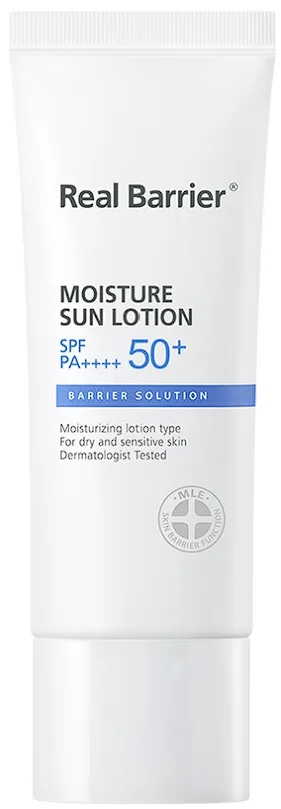
It runs an all-modern European filter system, Tinosorb M plus two triazones and Uvinul A Plus, on a genuine Real Barrier moisturizing base of ceramide and a deep hyaluronic-acid stack. Most moisturizing sunscreens compromise on filters or on hydration, this one refuses to skimp on either.
A daily moisturizing sunscreen that genuinely earns both halves of that label: a fully modern Tinosorb-and-triazone filter system reaches SPF50+/PA++++ with no white cast, riding on a real Real Barrier base of ceramide and a deep hyaluronic stack. The one catch is added lavender oil, which makes it a poor fit for the truly fragrance-reactive.
This evaluation leans on the fully published INCI and the well-characterized European filter set more than on long-term review depth, since the few hundred ratings across Amazon, Olive Young and Stylevana are positive but moderate. Because the formula contains lavender oil, individual tolerance varies more than the aggregate rating implies, so treat the irritation score as conservative and patch test if your skin is reactive.
The case for it
Cautions: fragrance.
What would change this: A declared concentration would move this to a firmer reading of the dose.
Same rule for everyone. “Good choice” is the verdict on 9,564 of 45,024 concern verdicts across the catalog; rule R5 decided 9,072 of them. Unchanged since September 5, 2026, engine 5.1.1.
Brand or formulator? Disclose a concentration or correct a fact →
The studies behind the evidence row
The case for it
What would change this: A declared concentration would move this to a firmer reading of the dose.
Same rule for everyone. “Good choice” is the verdict on 9,564 of 45,024 concern verdicts across the catalog; rule R5 decided 9,072 of them. Unchanged since September 5, 2026, engine 5.1.1.
Brand or formulator? Disclose a concentration or correct a fact →
The studies behind the evidence row
The case for it
What would change this: A declared concentration would move this to a firmer reading of the dose.
Same rule for everyone. “Full protection” is the verdict on 2,288 of 45,024 concern verdicts across the catalog; rule P1 decided 2,232 of them. Unchanged since September 5, 2026, engine 5.1.1.
Brand or formulator? Disclose a concentration or correct a fact →
The studies behind the evidence row
The case for it
What would change this: A declared concentration would move this to a firmer reading of the dose.
Same rule for everyone. “Full protection” is the verdict on 2,288 of 45,024 concern verdicts across the catalog; rule P1 decided 2,232 of them. Unchanged since September 5, 2026, engine 5.1.1.
Brand or formulator? Disclose a concentration or correct a fact →
The studies behind the evidence row
The case for it
What would change this: Removing the trigger named above would let the actives be judged on their own.
Same rule for everyone. “Avoid” is the verdict on 1,909 of 45,024 concern verdicts across the catalog; rule R1 decided 1,304 of them. Unchanged since September 5, 2026, engine 5.1.1.
Brand or formulator? Disclose a concentration or correct a fact →
The studies behind the evidence row
Does the jobDoes what a sunscreen is for: UVA coverage, holds up in sunlight. Not measured from the label: pleasant enough to actually use.
A verdict is DermApproved’s assessment of how well a product’s ingredients fit a concern — never a claim about what the product treats. Evidence dots and collected reviews sit beside it and are never blended in. Rules 0.5.1 · evidence table ev-2026.09-r228 · how we decide
Most people who under-apply sunscreen are not lazy; they are uncomfortable. They have tried sunscreen after sunscreen that left their face feeling tight, looking chalky, or pilling into little gray flecks under makeup, and somewhere along the way they quietly decided that daily SPF was a chore to endure rather than a step they actually wanted. Real Barrier's Moisture Sun Lotion is built squarely for that person. Its entire design philosophy is to make protection feel like a moisturizer, so you reach for it because you like how it feels rather than because you know you should.
The trick is in what Real Barrier put underneath the filters. This is a brand born from Neopharm, the Korean lab behind the patented MLE lamellar-lipid technology that also supplies the clinic-sold Atopalm line, and that barrier-repair heritage is all over the ingredient list. Look past the UV filters and you find ceramide NP arranged on a lamellar lipid structure, a genuinely deep hyaluronic acid complex spanning everything from cross-polymer down to hydrolyzed fragments, plus niacinamide, panthenol, ectoin and madecassoside. That is not the supporting cast of a typical sunscreen; that is the ingredient list of a decent barrier moisturizer that happens to also block UV. The payoff is a finish that stays dewy and plump instead of tight, which is exactly what converts a reluctant SPF-skipper into a daily user.
The protection itself is no afterthought. The filter system is entirely modern and European in character: Tinosorb M as the photostable, broad-spectrum backbone, ethylhexyl triazone and diethylhexyl butamido triazone covering UVB with high efficiency, and Uvinul A Plus handling the long-UVA wavelengths most responsible for photoaging and stubborn pigmentation. This is the kind of filter lineup formulators reach for when they want high SPF and PA++++ without the instability, the stinging, or the heavy white cast that older filters bring. Because these filters are efficient, the formula can stay light, and because they are organic rather than mineral, the lotion sinks in clear across every skin tone. There is no ghostly flashback, no chalk, no need to rub for a full minute to make it disappear.
In use, the texture reads as a thin, milky lotion that spreads with very little effort and melts into a soft, dewy finish in a couple of minutes. It layers cleanly under makeup as long as you give it that brief set time, and it does not fight with the rest of a routine. On dry and normal skin this finish is close to ideal. On oily skin the dewiness can tip slightly toward shine by midday, so very oil-prone users may prefer to set it with a light powder or choose a more matte formula for high-sebum days. None of this is a dealbreaker; it is just the honest trade-off of a sunscreen that prioritizes hydration over a velvet matte finish.
The real limitation, and the reason this cannot be a blanket recommendation, is fragrance. Real Barrier included lavender oil, which carries the fragrance allergens linalool and limonene along with it, both of which sit on the ingredient list. For most people the soft herbal-floral scent is pleasant and fades as the lotion sets. But for genuinely fragrance-reactive skin, or for anyone with rosacea or a compromised barrier that flares at the slightest provocation, an essential oil in a leave-on product worn every single day is a meaningful risk. It is a slightly puzzling choice in a formula otherwise so clearly engineered for barrier health, and it is the single thing keeping this from being an easy pick for sensitive skin. If your skin tolerates fragrance without complaint, you can largely ignore this paragraph; if it does not, this is your cue to look elsewhere.
Value is reasonable rather than remarkable, and the sticking point is size. At around eighteen dollars the formula is fairly priced for what it contains, but it comes in a 40ml tube, and if you use it as a proper face sunscreen with the reapplication that real protection requires, you will move through it faster than you would like. Treated as a single morning step it stretches to a month or more; treated as the reapply-every-few-hours product sunscreen is supposed to be, it is a frequent repurchase. Buying it for the right reasons means accepting that the per-use cost is higher than the sticker suggests.
Who should buy it? Anyone with dry, normal or combination skin who has been skipping or skimping on sunscreen because every formula feels drying or leaves a cast. The ceramide-and-hyaluronic base solves the comfort problem that keeps people from wearing SPF daily, and the filter system is genuinely up to date. Who should skip it? The fragrance-reactive, the rosacea-prone, and anyone whose skin treats lavender oil as an irritant rather than a luxury. For everyone else, this is a moisturizing sunscreen that does both jobs honestly, and the kind you might actually look forward to putting on.
The hero actives that drive this product's performance.
| Ingredient | Function | Evidence |
|---|---|---|
| Methylene Bis-Benzotriazolyl Tetramethylbutylphenol (Tinosorb M) | A modern broad-spectrum organic filter that also physically scatters UV, anchoring the photostable backbone of this lotion. Alongside the triazones it lets the formula reach SPF50+/PA++++ without the older, less stable filters that tend to sting sensitive skin or pill under makeup. | Not yet assessed |
| Ethylhexyl Triazone (Uvinul T 150) | One of the most efficient UVB absorbers available, used here to hit high SPF at low concentration so the texture can stay light. It pairs with the UVA filters to give the balanced protection the PA++++ rating reflects. | Regulator-approved for Sun Damage · limited certainty |
| Diethylamino Hydroxybenzoyl Hexyl Benzoate (Uvinul A Plus) | A dedicated long-UVA absorber that covers the wavelengths most responsible for photoaging and pigmentation. In this moisture-focused lotion it is what makes the protection genuinely broad-spectrum rather than UVB-heavy. | Regulator-approved for Sun Damage · limited certainty |
| Ceramide NP | True to the Real Barrier name, the lotion carries Neopharm's signature ceramide on a lamellar lipid structure, so the sunscreen doubles as a barrier-supporting moisturizer rather than a drying film. This is the feature that sets it apart from filter-only suncare. | Established mechanism for Dryness · established mechanism |
| Multi-Weight Hyaluronic Acid Complex | An unusually deep stack of hyaluronic acid forms, from cross-polymer to hydrolyzed fragments, layered to hold water at several depths. It is why a chemical sunscreen this protective still wears like a hydrating lotion and leaves skin plump rather than tight. | Established mechanism for Dehydration · established mechanism |
| Niacinamide | Sitting high on the list, it supports the ceramide-and-lipid barrier work and helps even tone over time, a logical companion to daily UV defense. It also lends the formula a mild brightening angle without relying on actives that could irritate under sun exposure. | Established mechanism for Compromised Skin Barrier · established mechanism |
Ingredient standings describe the active at treatment-level doses and vehicles; this product's own condition grades weigh its actual formula.
Water, Dibutyl Adipate, Propanediol, Diethylamino Hydroxybenzoyl Hexyl Benzoate, Polymethylsilsesquioxane, Ethylhexyl Triazone, Niacinamide, Methylene Bis-Benzotriazolyl Tetramethylbutylphenol, Coco-Caprylate/Caprate, Caprylyl Methicone, Diethylhexyl Butamido Triazone, Glycerin, Butylene Glycol, 1,2-Hexanediol, Brassica Oleracea Italica (Broccoli) Extract, Lavandula Angustifolia (Lavender) Oil, Hydrogenated Lecithin, Sodium Hyaluronate, Pentylene Glycol, Behenyl Alcohol, Poly C10-30 Alkyl Acrylate, Polyglyceryl-3 Methylglucose Distearate, Decyl Glucoside, Tromethamine, Carbomer, Acrylates/C10-30 Alkyl Acrylate Crosspolymer, Sodium Stearoyl Glutamate, Polyacrylate Crosspolymer-6, Ethylhexylglycerin, Adenosine, Xanthan Gum, T-Butyl Alcohol, Tocopherol, Ectoin, Panthenol, Caprylic/Capric Triglyceride, 7-Dehydrocholesterol, Madecassoside, Myristoyl/Palmitoyl Oxostearamide/Arachamide MEA, Ascorbyl Glucoside, Glycine Soja (Soybean) Sterols, Linoleic Acid, Phospholipids, Cetearyl Alcohol, Glyceryl Stearate SE, Cholesterol, Dimethylsilanol Hyaluronate, Hydrolyzed Sodium Hyaluronate, Hydrolyzed Hyaluronic Acid, Ceramide NP, Potassium Hyaluronate, Hyaluronic Acid, Sodium Hyaluronate Crosspolymer, Hydroxypropyltrimonium Hyaluronate, Sodium Hyaluronate Dimethylsilanol, Sodium Acetylated Hyaluronate, Linalool, Limonene
sunscreen
AM
The last step of your morning routine, applied generously over moisturizer. Give it two to three minutes to set before makeup.
Immediate broad-spectrum protection on application; hydration and comfort felt from day one; cumulative photoprotection benefits to tone and aging build over months of daily use.
The protection story here is about filter selection, and this lotion makes uniformly modern choices. Tinosorb M (methylene bis-benzotriazolyl tetramethylbutylphenol) is a hybrid organic-particulate filter that both absorbs and scatters UV and is prized for photostability, meaning it does not degrade quickly under the sun the way some older filters do. It is paired with ethylhexyl triazone and diethylhexyl butamido triazone, two of the most efficient UVB absorbers in cosmetic use, which allow a high SPF to be reached at relatively low filter load so the texture can stay light. Long-UVA coverage, the wavelengths most implicated in photoaging and pigmentation, comes from diethylamino hydroxybenzoyl hexyl benzoate, marketed as Uvinul A Plus. Together this combination is what underpins the SPF50+ and PA++++ ratings, with the PA++++ specifically signaling strong UVA persistence. None of these filters is approved in the United States by the FDA's older monograph, which is why this category of sunscreen is associated with Korea and the EU, but their safety and efficacy are well documented in the regulatory frameworks that do permit them. The more product-specific point is the base: niacinamide's role in supporting stratum corneum lipid synthesis, ceramide NP as a barrier lipid, and ectoin as an osmolyte that helps cells resist environmental stress are all reasonable companions to daily photoprotection, since UV exposure itself stresses the barrier the formula is simultaneously reinforcing. The lavender oil is the one ingredient with no protective or barrier rationale; it is a sensory addition, and its linalool and limonene content is the formula's only meaningful caution.
Daily broad-spectrum sunscreen is the most evidence-backed anti-aging and skin-cancer-prevention step available, and dermatologists generally emphasize that the best sunscreen is the one a person will actually wear every day. A high-SPF, high-UVA formula on a hydrating ceramide base addresses a common reason people abandon sunscreen, namely that drier formulas feel uncomfortable, and so tends to improve real-world adherence. The modern filter system here provides the broad-spectrum coverage clinical guidance calls for, including the strong UVA protection reflected in the PA++++ rating. The standard caution from a clinical standpoint concerns the added fragrance: leave-on products containing lavender oil and its associated allergens are frequently flagged for patients with eczema, rosacea or a history of contact dermatitis, for whom a fragrance-free sunscreen is usually the safer recommendation. Reapplication every couple of hours during sustained sun exposure remains necessary regardless of how high the SPF rating reads.
Apply as the final step of your morning routine, after moisturizer, using a generous amount, about two finger-lengths for the face and neck, since under-application sharply cuts the real protection. Spread it evenly and give it two to three minutes to set before makeup so it does not pill. Reapply every two hours during prolonged sun exposure, after swimming, or after heavy sweating. It is a daytime-only product; there is no need to use it at night. If your skin is fragrance-sensitive, patch test on the inner arm before committing to daily facial use.
Around eighteen dollars buys a sunscreen with a genuinely current filter system and a moisturizer-grade base, which is fair value on paper. The practical catch is the 40ml tube: used as a true face sunscreen with the reapplication real protection requires, it empties in roughly a month, pushing the effective cost above what the sticker implies. No larger size meaningfully offsets this, so the value verdict depends on how you use it. As a single daily morning step it is reasonably economical for the formulation quality; as a frequently reapplied product it becomes a recurring purchase. You are paying a small premium for the hydration and the modern filters, and for dry skin that finally tolerates daily SPF, that premium is easy to justify.
Reach for this if you have dry, normal or combination skin and keep skipping sunscreen because formulas feel drying or leave a cast. The ceramide-and-hyaluronic base makes daily SPF genuinely comfortable, and the modern filters protect without chalk or flashback.
Steer clear if your skin reacts to fragrance, or if you have rosacea or a compromised barrier, because the lavender oil and its linalool and limonene are a daily-wear risk. Very oily skin chasing a matte finish, and anyone wanting a large-format value tube, will also do better elsewhere.
Ready to try Real Barrier Moisture Sun Lotion SPF50+?
Buy at Amazon ♥A thin, milky lotion that spreads easily and melts into a dewy, hydrated finish without the heavy slip of a cream sunscreen.
A soft herbal-floral note from lavender oil; noticeable on application and fading as it sets.
Squeeze tube that keeps the filters protected from light and air; practical for travel but only 40ml, so reapplication eats through it.
Goes on without white cast and settles to a comfortable dewy finish in a couple of minutes. Fragrance-sensitive skin may register the lavender; otherwise there is no sting or tightness.
Roughly 4-6 weeks if used as a proper face sunscreen with daily reapplication; longer if it is only a morning single-application step.
All Year
Real Barrier extended its barrier-repair philosophy into suncare by treating the sunscreen as a moisturizer that happens to protect, loading it with the same ceramide and hyaluronic systems found in its creams rather than building a bare-bones UV filter base.
Real Barrier is Neopharm's dermo-cosmetic line, built on the patented MLE lamellar-lipid technology that also powers the clinic-sold Atopalm brand. Its sunscreens fold the same ceramide-and-barrier focus into modern European UV filters.
A hydrating sunscreen cannot offer serious protection.
This one reaches SPF50+/PA++++ using efficient modern filters, then layers hydration on top, proving moisturizing and high protection are not mutually exclusive.
No. It uses organic European filters rather than mineral ones, so it sinks in clear with a dewy finish and works across skin tones.
Very much so. Its base is loaded with ceramide NP and a multi-weight hyaluronic acid complex, so it hydrates as it protects and avoids the tight, drying feel of many chemical sunscreens.
It contains lavender oil, which brings linalool and limonene with it. The scent is pleasant for most people, but if your skin is reactive to fragrance you may prefer a fragrance-free option.
Yes. The thin lotion sets to a smooth, dewy base in a couple of minutes; just let it settle before applying foundation to avoid pilling.
It skips oxybenzone and octinoxate in favor of newer filters often marketed as reef-conscious, and contains no retinoids, so it is generally considered pregnancy-friendly. Confirm with your own doctor if unsure.
Recurring themes our editors read across retailer reviews of this product — summaries in our words, not quotations, and not a substitute for your own patch test.
No white cast
Genuinely hydrating finish
Lightweight under makeup
Lavender scent bothers fragrance-sensitive users
Small 40ml tube
Slight dewy shine on oily skin
Verified answers from our questions library — the nuance a product page cannot carry.