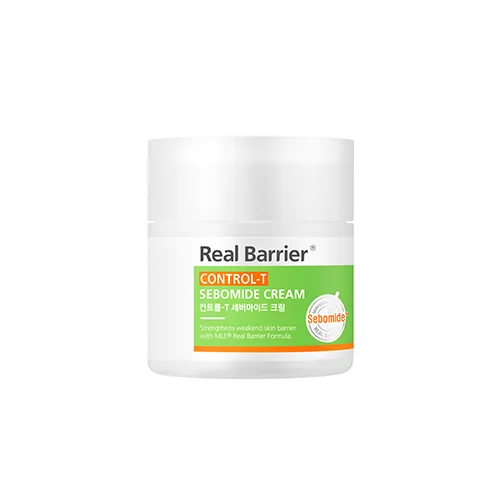
Oil-control moisturizers typically use astringent ingredients that strip the skin and trigger more sebum production — a counterproductive cycle. Real Barrier did the opposite, pairing genuine sebum regulation from niacinamide, zinc PCA, and silica with their proprietary MLE ceramide barrier-repair delivery system. The result is an oil-control cream that actively strengthens the barrier rather than compromising it, which is genuinely rare in the category.
One of the best oil-control moisturizers in the K-beauty category — Aestura's MLE ceramide technology meets genuine sebum regulation, all in a fragrance-free gel-cream that respects compromised barriers. If you have oily or combination skin that also struggles with sensitivity, this cream was built for you.
Promisingfor Excess OilinessIn your profileYou chose · Niacinamide has trial-level evidence for excess oiliness but no guideline or regulatory standing yet — promising, short of a recommendation; the other actives here are not yet assessed for it.Moderate evidenceStandard tolerabilityNo reviews collected yet
The case for it
Niacinamide has trial-level evidence for this concern but no guideline or regulatory standing yet.
It is plausibly present at a working level, though the concentration is not declared.
The formula carries no trigger this concern is sensitive to, with the cautions noted.
Cautions: fungal-acne triggers.
What would change this: A declared concentration would move this to a firmer reading of the dose.
Same rule for everyone. “Promising” is the verdict on 7,858 of 45,024 concern verdicts across the catalog; rule R9p decided 7,858 of them.
Unchanged since September 5, 2026, engine 5.1.1.
R9p — 0.5.0: 'Unproven' beside three filled dots read as one question answered twice with opposite words (7,018 rows). The chip measures standing, the dots measure trial volume; where the row carries at least one RCT or a tier-2 source (moderate dots) and the active is present at a working level, the honest word is Promising. Unproven is reserved for plausible-standing rows with limited or weak evidence, or an under-dosed form. Same rank as Unproven — a bet either way; the dots order them. · the full register
Carrying active
Niacinamide
Standing
plausible — trials support it
Form
plausible — studied range 2%, from the trials on the row; needs leave-on contact; judge it after ~8 weeks
Tolerability
standard — fungal triggers
Row checked
against its sources on July 17, 2026 (evidence table ev-2026.09-r228)
Promisingfor Large PoresIn your profileYou chose · Niacinamide has trial-level evidence for large pores but no guideline or regulatory standing yet — promising, short of a recommendation; the other actives here are not yet assessed for it.Moderate evidenceGentleNo reviews collected yet
The case for it
Niacinamide has trial-level evidence for this concern but no guideline or regulatory standing yet.
It is plausibly present at a working level, though the concentration is not declared.
The formula carries none of the triggers this concern is sensitive to.
What would change this: A declared concentration would move this to a firmer reading of the dose.
Same rule for everyone. “Promising” is the verdict on 7,858 of 45,024 concern verdicts across the catalog; rule R9p decided 7,858 of them.
Unchanged since September 5, 2026, engine 5.1.1.
R9p — 0.5.0: 'Unproven' beside three filled dots read as one question answered twice with opposite words (7,018 rows). The chip measures standing, the dots measure trial volume; where the row carries at least one RCT or a tier-2 source (moderate dots) and the active is present at a working level, the honest word is Promising. Unproven is reserved for plausible-standing rows with limited or weak evidence, or an under-dosed form. Same rank as Unproven — a bet either way; the dots order them. · the full register
Carrying active
Niacinamide
Standing
plausible — trials support it
Form
plausible — studied range 4%, from the trials on the row; needs leave-on contact; judge it after ~8 weeks
Tolerability
gentle
Row checked
against its sources on July 17, 2026 (evidence table ev-2026.09-r228)
Supporting rolefor AcneIn your profileYou chose · Niacinamide has early evidence for acne, and barrier care alongside acne treatment is the recognised companion to treating it — a reasonable supporting choice, short of a recommendation.Moderate evidenceStandard tolerabilityNo reviews collected yet
The case for it
Niacinamide has early or mechanistic evidence for this concern, not trial-backed standing.
It is plausibly present at a working level, though the concentration is not declared.
The formula carries no trigger this concern is sensitive to, with the cautions noted.
Cautions: fungal-acne triggers.
What would change this: A declared concentration would move this to a firmer reading of the dose.
Same rule for everyone. “Supporting role” is the verdict on 8,197 of 45,024 concern verdicts across the catalog; rule R8a decided 1,489 of them.
Unchanged since September 5, 2026, engine 5.1.1.
R8a — A plausible-tier active in a category with a supportive job: the sentence names the active instead of saying nothing targets the concern (the AmLactin / CeraVe SA case for keratosis pilaris, where no guideline and single trials leave the keratolytics at early evidence). · the full register
Carrying active
Niacinamide
Standing
plausible — trials support it
Form
plausible — studied range 4–5%, from the OTC monograph or label; needs leave-on contact; judge it after ~8 weeks
Tolerability
standard — fungal triggers
Row checked
against its sources on July 17, 2026 (evidence table ev-2026.09-r228)
Good choicefor SensitivityIn your profileYou chose · No fragrance, drying alcohol, declarable allergens or sensitising preservatives in this gel cream — the profile sensitive skin looks for.Not yet assessedGentleNo reviews collected yet
The case for it
Centella Asiatica Complex has been researched for this concern and the evidence does not support it.
It is plausibly present at a working level, though the concentration is not declared.
The formula carries none of the triggers this concern is sensitive to.
What would change this: A declared concentration would move this to a firmer reading of the dose.
Same rule for everyone. “Good choice” is the verdict on 1,938 of 45,024 concern verdicts across the catalog; rule F2 decided 1,938 of them.
Unchanged since September 5, 2026, engine 5.1.1.
Good choicefor Compromised Skin BarrierIn your profileYou chose · Niacinamide is a reference standard by mechanism for compromised skin barrier; this gel cream carries it high in the ingredient list.Moderate evidenceGentleNo reviews collected yet
The case for it
Niacinamide has trial-supported standing for this concern.
It is present at an effective concentration, declared or high in the ingredient list.
The formula carries none of the triggers this concern is sensitive to.
Same rule for everyone. “Good choice” is the verdict on 9,564 of 45,024 concern verdicts across the catalog; rule R5 decided 9,072 of them.
Unchanged since September 5, 2026, engine 5.1.1.
Does the jobDoes what a moisturizer is for: supplies barrier lipids, draws in water.
Where our review and the verdict differ. The review below was written on the formulation and the published trials; the verdicts above apply the stricter standing test in our methodology — an active earns a recommendation only with guideline or regulatory standing for the concern. Where the two disagree, the verdict is DermApproved’s position.
A verdict is DermApproved’s assessment of how well a product’s ingredients fit a concern — never a claim about what the product treats. Evidence dots and collected reviews sit beside it and are never blended in.
Rules 0.5.1 · evidence table ev-2026.09-r228 · how we decide
Assessment
Pros & Cons
Pros
✓ MLE ceramide delivery system mimics natural skin architecture
✓ Genuine oil control from niacinamide, zinc PCA, and silica
✓ Completely fragrance-free — rare in the K-beauty oil-control category
✓ Full centella fraction complex delivers concentrated soothing
✓ Semi-matte finish layers cleanly under sunscreen and makeup
✓ Lightweight enough for humid climates without losing barrier support
✓ Backed by Amorepacific's clinical research infrastructure
Cons
✗ Too lightweight for dry skin
✗ Semi-matte finish looks flat on normal skin
✗ Price higher than generic K-beauty moisturizers
✗ 50ml tube on the small side for twice-daily use
✗ Not strictly fungal-acne safe
Review
Full Review
Most oil-control moisturizers on the market are built around a fundamental misunderstanding of how oily skin works. The typical formulation approach goes something like this: take a standard cream base, add astringent ingredients like witch hazel or high-percentage alcohol, pile in mattifying powders, and label the whole thing for oily skin. What this approach ignores is that stripping the skin is one of the most reliable ways to make oil production worse — the sebaceous glands detect dehydration and respond by producing more oil, creating a feedback loop where the more you dry your skin, the oilier it gets by the afternoon. And because all that stripping damages the barrier in the process, oily skin on these regimens ends up in a paradoxical state of being shiny and dry at the same time, with the added bonus of reactive redness and increased breakouts.
Real Barrier Control-T was built to break that cycle, and it does so by applying a very specific piece of research to a category that usually ignores it. Real Barrier is a subsidiary brand of Aestura, itself a subsidiary of Amorepacific — Korea's largest cosmetics company — and the brand's identity is built around a proprietary technology called Multi-Lamellar Emulsion, or MLE. The short version is that MLE is a way of structuring ceramides, cholesterol, and fatty acids into layered lipid formations that mimic the natural architecture of the stratum corneum. Rather than dumping ceramides loose into a cream base, Aestura arranges them in the same way they appear in actual human skin, which in theory allows smaller amounts to deliver stronger barrier repair. The research backing MLE came originally out of atopic dermatitis studies — the brand started by developing creams for eczema patients who needed serious barrier work at low irritation risk.
Applying that framework to an oil-control moisturizer is where Control-T gets interesting. Instead of fighting oily skin with astringents, the cream uses niacinamide at a meaningful percentage (high enough to sit near the top of the ingredient list) paired with zinc PCA to regulate sebum through the pathways that actually work. Silica microspheres handle the physical mattification, absorbing surface oil throughout the day without drying the underlying skin. And the MLE ceramide complex runs in the background, giving the skin the barrier support it needs to tolerate the oil-control work without spiraling into dehydration.
The soothing layer deserves its own attention. Where most formulas use one or two centella-derived ingredients, Control-T includes the full centella fraction package: madecassoside, asiaticoside, asiatic acid, and madecassic acid, plus the whole plant extract. These four compounds are the isolated active constituents that drive centella's anti-inflammatory and wound-healing reputation, and their combined inclusion represents one of the most concentrated soothing stacks in the oil-control category. If you have oily skin that also reacts badly to BHAs, retinoids, or over-cleansing, this cream is doing real work to reduce the inflammatory load while still delivering the sebum control you came for.
The texture experience matches the formulation philosophy. Control-T is a lightweight gel-cream that spreads easily and absorbs within thirty seconds into a semi-matte finish with no tacky residue. On application it feels cool rather than rich, and under sunscreen it provides a stable, grip-free base that doesn't pile or turn greasy through the morning. For oily skin in humid climates, it's the kind of moisturizer that actually feels usable in summer — you don't have to compromise between barrier support and wearable weight.
The fragrance-free formulation is worth flagging because it's unusually rare in the K-beauty category, which tends to treat scent as part of the user experience. Real Barrier as a whole runs fragrance-free across its line because its customers include eczema and atopic dermatitis patients who cannot tolerate added perfume. For buyers with fragrance sensitivity, rosacea, or combination oily-reactive skin, this makes Control-T one of the very few K-beauty oil-control options that doesn't add a potential irritant on top of the oil work.
Where Control-T shows its limits is in skin type breadth. This is, unambiguously, a cream for oily and combination skin, and trying to use it on dry skin will be a disappointing experience. The semi-matte finish will look flat on normal skin that doesn't need shine control, and the weight is too light to handle serious dryness. Real Barrier sells richer MLE creams for those skin types — Aqua Soothing Gel Cream for normal-to-combination, Extreme Cream for dry — and the brand's consistency across formulations means stepping between them based on season or skin state is straightforward.
The price, at around $25 for 50ml, is meaningfully higher than generic K-beauty moisturizers but meaningfully lower than Western ceramide creams with less thoughtful formulations. What you're paying for is MLE delivery technology, fragrance-free formulation discipline, and the research infrastructure of Amorepacific's derm-focused subsidiary. For oily and combination skin that has struggled to find a moisturizer that handles both sebum control and barrier repair without making one worse to fix the other, Control-T is one of the clearest recommendations in the category. It is doing something specific and difficult, and it is doing it genuinely well.
Formula
Key Ingredients
The hero actives that drive this product's performance.
Aestura's proprietary Multi-Lamellar Emulsion delivery system, which arranges ceramide, cholesterol, and fatty acids into multi-layered structures that mimic the natural architecture of the stratum corneum — this is why a Real Barrier cream delivers stronger barrier repair at lower ceramide percentages than conventional formulas.
Established mechanismfor Compromised Skin Barrier · established mechanism
Sits high in the ingredient list and does double duty here — regulating sebum production for the 'Control-T' oil-control positioning while also supporting the skin's own ceramide synthesis, reinforcing the topical MLE complex from the inside.
Established mechanismfor Compromised Skin Barrier · established mechanism
The ingredient responsible for this cream's signature semi-matte finish — silica microspheres absorb surface oil throughout the day, giving oily and combination skin the shine control that most ceramide moisturizers fail to deliver.
A complete centella fraction package — all four isolated actives rather than just the whole plant extract, delivering concentrated anti-inflammatory and wound-healing support tailored for irritation-prone oily skin.
Contributes to the sebum-regulating story and adds mild antibacterial action — commonly paired with niacinamide in oil-control formulas for its complementary effect on excess sebum production.
Limitedfor Excess Oiliness
Ingredient standings describe the active at treatment-level doses and
vehicles; this product's own condition grades weigh its actual formula.
Apply after water-based serums and treatments as your moisturizer step. Works beautifully under sunscreen because of the semi-matte finish. At night, skip any additional occlusive — this cream is designed to finish the routine without needing a layer on top.
Results Timeline
Immediate oil control and comfort from the first application. Barrier recovery signs in oily skin — less reactive flushing, fewer breakouts from over-drying — usually appear within 2-3 weeks. Full shine reduction benefits build over 4-6 weeks of consistent use.
The foundation of Real Barrier's approach is the Multi-Lamellar Emulsion technology developed by Aestura's parent company, Amorepacific, originally for atopic dermatitis research. Published work on MLE technology, including a 2006 paper in the International Journal of Cosmetic Science, demonstrated that arranging ceramides, cholesterol, and fatty acids into layered structures mimicking the native stratum corneum lipid lamellae could deliver stronger barrier restoration than conventional cream bases using the same ingredients. This is the underlying reason Real Barrier creams can often deliver meaningful barrier repair at lower ceramide percentages than competing products — the delivery matters as much as the concentration. The sebum-regulating case for niacinamide rests on a 2006 study published in the British Journal of Dermatology by Draelos and colleagues, which demonstrated that 2% topical niacinamide significantly reduced sebum excretion rates in Japanese and Caucasian subjects. Zinc PCA's role in sebum regulation has been supported by several smaller studies, including work demonstrating its 5-alpha-reductase inhibition which reduces the conversion of testosterone to the more sebogenic dihydrotestosterone. The centella asiatica fraction complex — madecassoside, asiaticoside, asiatic acid, and madecassic acid — is backed by a body of research including a 2014 review in Phytotherapy Research cataloguing anti-inflammatory and collagen-supporting mechanisms. Together, this is one of the more research-aligned oil-control moisturizer formulations in the K-beauty category.
Dermatologists often struggle to recommend moisturizers for oily, acne-prone, sensitive skin because the category is dominated by either over-rich creams or over-drying gels. Dermatology practitioners tend to recommend niacinamide-containing oil-control moisturizers with barrier-supporting lipids over astringent formulations, noting that the cycle of over-drying and rebound oiliness is a frequent reason patients fail their routines. Real Barrier's MLE approach is the kind of formulation dermatologists who follow K-beauty developments tend to flag as genuinely research-based rather than marketing-driven. For patients with sensitive oily skin — a common combination that is poorly served by most oil-control products — this cream is commonly cited as a reasonable option.
Guidance
Usage & Recommendations
How to Use
Apply a pea-sized amount to clean, slightly damp skin morning and night after hydrating serums. Pat or smooth gently into face and neck, focusing on the T-zone where oil control is needed most. In the morning, follow with sunscreen once the cream has absorbed. At night, this is designed to be your final moisturizer step — no additional occlusive layer needed. Store at normal room temperature and avoid leaving the tube in direct sunlight for extended periods.
Value Assessment
At $25 for 50ml, Control-T is priced above basic K-beauty moisturizers but below Western ceramide creams with less sophisticated delivery systems. The value argument is strongest for oily and combination skin that has failed other oil-control products or struggles with sensitivity — in those cases, the MLE ceramide system and fragrance-free formulation justify the premium. For straightforward oily skin with no sensitivity concerns, a basic niacinamide moisturizer at half the price may be adequate, but you would lose the barrier-repair sophistication that makes this cream distinctive. No larger size is offered, which is the main structural limitation.
Who Should Buy
Oily and combination skin users — especially those with sensitivity, acne, or compromised barriers from aggressive actives. Also an excellent pick for K-beauty enthusiasts who want MLE ceramide technology in an oil-friendly format, and for fragrance-sensitive users who need a rare unscented K-beauty moisturizer.
Who Should Skip
Dry skin, normal skin looking for a dewy finish, or anyone with severe fungal acne concerns who needs a strictly fungal-acne-safe routine. It is similarly a skip if you're shopping at the lowest K-beauty price tier — the MLE technology premium doesn't make sense on that budget.
Lightweight gel-cream that feels cool on application and spreads easily. Absorbs quickly into a semi-matte finish with no residue.
Scent
Essentially scentless — no added fragrance and only faint botanical notes from the plant extracts.
Packaging
White opaque plastic tube with pump-style cap. Hygienic, travel-friendly, and protects the actives from air exposure.
Finish
mattenon-greasylightweight
What to Expect on First Use
Skin feels immediately cooled and matte on first application with no tightness. Over the first week, expect noticeably reduced shine by midday. The barrier-repair benefits of the MLE ceramides — fewer reactive breakouts, calmer redness — typically appear in weeks two and three with consistent twice-daily use.
How Long It Lasts
Approximately 2-3 months applied morning and night to face.
Real Barrier is made by Aestura, a subsidiary of Amorepacific (one of Korea's largest cosmetics companies), founded in 2017 as a spin-off dedicated to barrier-focused skincare using MLE technology originally developed for atopic dermatitis research. Control-T launched in 2020 as the brand's answer to the oily-skin market, applying the same MLE framework to a lightweight gel-cream format rather than the rich creams Real Barrier was already known for.
About Real Barrier Established Brand (5–20 years)
Real Barrier is made by Aestura, a subsidiary of Korean pharmaceutical giant Amorepacific, and was developed using the company's proprietary MLE (Multi-Lamellar Emulsion) technology originally created for atopic dermatitis skincare. The brand's credibility comes from Amorepacific's decades of research infrastructure rather than indie K-beauty marketing.
Brand founded: 2015 · Product launched: 2020
Myth vs. Reality
Common Myths
Myth
Oily skin doesn't need ceramides.
Reality
Oily skin frequently has compromised barrier function, often made worse by harsh cleansers, acids, and benzoyl peroxide treatments. Ceramide replacement helps oily skin tolerate active ingredients, reduces reactive redness, and breaks the over-drying cycle that drives more sebum production.
Myth
Matte finish moisturizers are drying.
Reality
The matte finish in this cream comes from silica microspheres absorbing surface oil, not from drying agents stripping water from skin. The underlying MLE ceramide system still delivers substantial barrier hydration beneath the oil-control layer.
FAQ
Frequently Asked Questions
Does this moisturize enough for dry skin?
No — this is specifically an oil-control formulation for oily and combination skin. Dry skin will find it too lightweight and the semi-matte finish unflattering. Look at Real Barrier's Extreme or Aqua Soothing creams instead, which use the same MLE ceramide system in richer bases.
How does this compare to Real Barrier's Aqua Soothing Gel Cream?
Aqua Soothing is focused on hydration and soothing for normal-to-combination skin, while Control-T adds genuine oil-control ingredients (silica, zinc PCA, higher niacinamide) for oily skin. If you have oily skin that also struggles with sensitivity or over-drying from actives, Control-T is the more targeted pick.
Will this replace a separate BHA or acne treatment?
No — this is a moisturizer and barrier repair product, not an acne treatment. It complements a BHA routine by giving your skin the ceramide support it needs to tolerate the BHA without going into overdrive. Use them together, not interchangeably.
Can Control-T Moisturizer be used while pregnant or breastfeeding?
Yes — there are no retinoids, salicylic acid at meaningful concentrations, or other pregnancy-restricted actives. The niacinamide, ceramides, centella, and zinc PCA are all considered pregnancy-safe. It's a strong pick for pregnant users dealing with hormonal oiliness.
Why is this more expensive than other K-beauty moisturizers?
You're paying for Aestura's MLE (Multi-Lamellar Emulsion) delivery technology, which is their proprietary method of structuring ceramides into lipid layers that mimic natural skin architecture. The price reflects meaningful formulation research, not just brand markup.
Can I use this year-round or only in summer?
Most oily users can use it year-round, though in very dry winter conditions you may want to layer a hydrating serum underneath or switch to a richer Real Barrier cream temporarily. It's strongest in humid and warm conditions where other ceramide creams feel too heavy.
Does this cause fungal acne?
This cream contains some ingredients that may not be ideal for fungal-acne-sensitive users, so it's not fully fungal-acne safe. If you've identified fungal acne as a specific concern, look for a stricter formulation — though most users with bacterial or hormonal acne tolerate this cream very well.
Reviews
What Reviewers Tend to Say
Recurring themes our editors read across retailer reviews of this product — summaries in our words, not quotations, and not a substitute for your own patch test.
Topically, the molecule the argument tells you to avoid is one the stratum corneum is structurally built from — and in acne-prone skin the documented finding is a shortage of it.
Five brands that own the feed, judged on their ingredient lists rather than their view counts — including the one active all five suddenly added at once, and what that tells you.
Western sensitive skincare works by subtraction — remove the fragrance, remove the alcohol, shorten the list. Japan's answer adds a designed molecule back in, and one of the two bets has a trial literature.
A wrecked barrier is the most common self-inflicted skin condition and the one with the clearest fix — the difficulty is that the routine which caused it feels productive and the one that repairs it feels like giving up.
Aug 5, 2026· 8 min
Questions people ask about Acne
Verified answers from our questions library — the nuance a product page cannot carry.
Products, answers, therapy guides, tools and articles in one search. Brand names,
slang and abbreviations all work — accutane finds isotretinoin, bacne finds truncal acne.