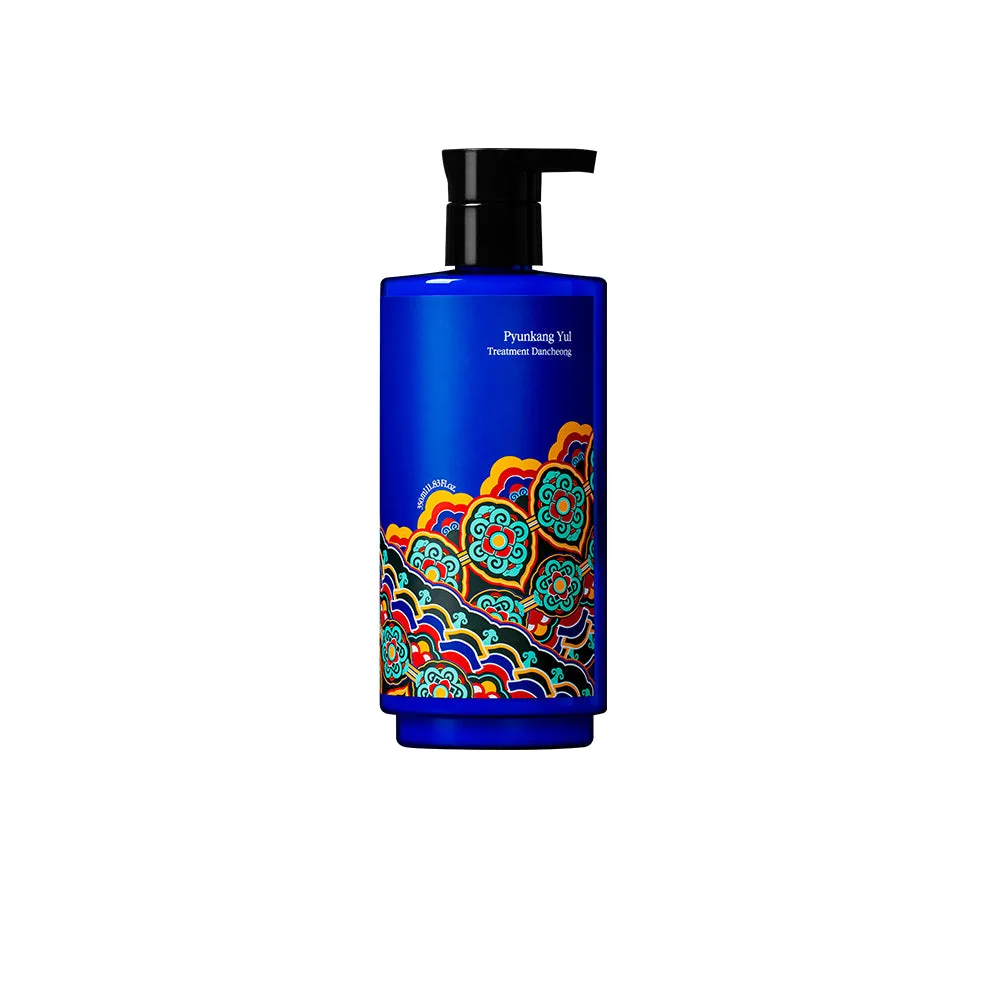
It is the conditioner Pyunkang Yul never made before: a full-strength behentrimonium-and-dimethicone cream built for shine and slip rather than for scalp comfort, wrapped in the line's dancheong artwork and scented with five essential oils. The brand's other treatment is designed to go on the scalp; this one is designed to stay off it and make the lengths look expensive.
A conventional, well-executed shine conditioner — behentrimonium chloride, cetearyl alcohol and a generous dimethicone dose — dressed in temple-pattern artwork, essential oils and a roster of botanicals that do nothing in a rinse-off. It detangles beautifully and leaves dry lengths glossy, it is too heavy for fine hair and too fragranced for the brand's core audience, and at twenty-four dollars the formula does not justify the premium over the many conditioners built the same way.
No US retailer stocks this treatment yet and no independent review base exists for it; it arrived on Pyunkang Yul's international store in November 2025 after a 2024 Korean launch. Everything here is drawn from the full published ingredient list and from how conditioners built on behentrimonium chloride and dimethicone are known to perform, not from tracked user experience with this bottle.
Verdicts
How well it fits each concern
Verdict by concern tap a concern for the case
Strong choicefor DrynessIn your profileYou chose · Dimethicone is an approved or monograph active for dryness; this cream carries it high in the ingredient list.Moderate evidenceStandard tolerabilityNo reviews collected yet
The case for it
Dimethicone is a first-line active — approved, monograph-listed or named in current guidelines — for this concern.
It is present at an effective concentration, declared or high in the ingredient list.
The formula carries no trigger this concern is sensitive to, with the cautions noted.
Cautions: fragrance.
Same rule for everyone. “Strong choice” is the verdict on 1,459 of 45,024 concern verdicts across the catalog; rule R2 decided 892 of them.
As of September 25, 2026, engine 5.1.1.
A verdict is DermApproved’s assessment of how well a product’s ingredients fit a concern — never a claim about what the product treats. Evidence dots and collected reviews sit beside it and are never blended in.
Rules 0.5.1 · evidence table ev-2026.09-r228 · how we decide
Assessment
Pros & Cons
Pros
✓ Behentrimonium and cetearyl alcohol base gives excellent slip and detangling
✓ High dimethicone dose delivers real, immediate shine on dry or damaged lengths
✓ Cationic guar adds a mask-like richness without needing a long dwell time
✓ Essential-oil scent is pleasant, natural-smelling and matches the shampoo
✓ Pump bottle dispenses a thick cream cleanly; a small dose goes far
✓ Complete ingredient list published on the brand's own store
✓ Works after any shampoo, not only the Dancheong wash
Cons
✗ Too heavy for fine hair and builds up with every-wash use
✗ Not suitable for scalp application, unlike the brand's other treatment
✗ Four declared fragrance allergens rule it out for reactive skin at the hairline
✗ Resurrection plant and seven hyaluronates do nothing in a rinse-off
✗ Twenty-four dollars for a mainstream quat-and-silicone architecture
✗ Single 350ml size with no larger or refill format
Review
Full Review
Read the ingredient list of Pyunkang Yul's Treatment Dancheong from the bottom and it tells a story: seven forms of hyaluronic acid, sweet flag root, a resurrection plant that revives in the desert from a single drop of water, green tea, centella, sea buckthorn, skullcap, honeysuckle. Read it from the top and it tells a different one: water, cetearyl alcohol, behentrimonium chloride, dipropylene glycol, dimethicone. The second reading is the one that describes what happens to your hair, and it describes a good, ordinary conditioner. The first reading is the one on the box.
That is not a criticism of the formula so much as an orientation. Behentrimonium chloride and cetearyl alcohol are the pairing behind most of the conditioners that have ever made hair feel expensive: the fatty alcohol builds the lamellar cream, the long-chain quaternary ammonium compound carries a positive charge that binds hard to the negatively charged, damaged regions of the cuticle, and the two together flatten the scales and give the slip that lets a comb through wet hair without a fight. Dimethicone, placed fifth, then lays a smooth, light-reflecting film over the flattened surface — that is the 'luminous shine' in the copy, and dimethicone delivers it more reliably than any botanical could. A cationic guar gum, guar hydroxypropyltrimonium chloride, thickens the cream and adds a second layer of deposition, which is why the treatment feels almost mask-like in the shower and leaves a faint coated softness once hair is dry. This is a textbook architecture, and Pyunkang Yul has executed it competently.
It is also a different architecture from the brand's other rinse-off treatment, and the difference is worth spelling out because the two are easy to confuse on a shelf. The Low pH Scalp Treatment uses a mild ester quat and invites you to massage it into the scalp. Treatment Dancheong uses the heavy quat and a much larger silicone dose, and the sensible advice is the opposite: keep it from the ears down. Applied at the roots on fine or oily hair it will flatten volume within a wash and build up over a couple of weeks; applied on the scalp of someone with eczema or seborrhoeic dermatitis it will leave a film that does that skin no favours. On dry, coarse, wavy or colour-damaged lengths, though, it is exactly the right tool, and hair dries smoother, shinier and more sealed-looking at the ends from the first use. There is nothing to wait for. The effect is as strong on day one as it will ever be, because it is a coating, not a repair.
The scent is the same five-oil accord as the Dancheong shampoo — sweet orange, lavender, bergamot, geranium, rosemary — and in the conditioner it is, if anything, more present, because limonene is listed sixth, ahead of the essential oils themselves, and because a conditioner sits on the hair for several minutes rather than sixty seconds. It smells good: bright citrus over a clean herbal-floral base, the kind of scent that reads as spa rather than perfume counter and lingers softly into the next day. But the label's declaration of limonene, linalool, citronellol and geraniol is not decoration. Those are the allergen fractions of the oils, the molecules that produce most fragrance contact allergy, and they are present here in a product that spends longer on the skin at the hairline and neck than the shampoo does. For a healthy, non-reactive scalp this is a non-issue. For the people who found Pyunkang Yul precisely because its products smell of nothing, it is the reason this range is not for them, and the brand — to its credit — still sells the unscented alternatives alongside it.
Which brings the reading back to the bottom of the list. The resurrection plant, Anastatica hierochuntica, is a beautiful piece of storytelling: a desert tumbleweed that curls into a dry ball and unfurls when wetted, invoked here as a symbol of hydration. It is a symbol. The unfurling is a mechanical property of the dead plant's tissue, not a transferable moisturising action, and the extract sits in the last third of a formula that is rinsed down the drain after three minutes. The seven hyaluronates that follow it are the same story in a different vocabulary. Hyaluronic acid in any molecular weight is a water-soluble humectant, and hair fibre is not living tissue that can be hydrated from within; conditioning works by coating and smoothing the cuticle, which is what the quat and silicone at the top of the list are doing while the hyaluronates rinse away. One of the seven, hydroxypropyltrimonium hyaluronate, is cationic and can deposit lightly, which is a small and honest exception. The rest is a number to print.
None of this makes the product bad. It makes it a good mainstream conditioner with a long decorative list, and the fair question is whether that is worth twenty-four dollars for 350ml. It comes in one size, in a cobalt pump bottle wrapped in a band of dancheong artwork that is genuinely lovely and makes a matched pair with the shampoo. The pump dispenses a thick cream cleanly, two pumps cover shoulder-length hair, and the bottle lasts a couple of months at three washes a week. But the formula that does the work — fatty alcohol, behentrimonium, dimethicone, cationic guar — is the formula inside a great many conditioners that cost half as much, and what the premium buys is the essential-oil scent, the bottle and the story. Those are real pleasures, and there is no shame in paying for them. They are just not formulation depth.
The range is too new to have accumulated the kind of user record that would let anyone say how it wears over months of use; it arrived on the brand's international store in November 2025 and has no US retailer presence yet. On the published formula alone, Treatment Dancheong is a reliable, shine-forward conditioner for dry and damaged lengths, best kept off the scalp, best skipped by anyone with fragrance sensitivity, and best bought by someone who wants their conditioner to smell like a Korean bathhouse and look like a temple beam. Read from the top, it will do exactly what it says. Read from the bottom, take the poetry as poetry.
Formula
Key Ingredients
The hero actives that drive this product's performance.
Ingredient
Function
Evidence
Behentrimonium Chloride
Third in the list, right behind the cetearyl alcohol it pairs with, which makes this a classic high-substantivity conditioner rather than the mild ester-quat build of the brand's Low pH Scalp Treatment. The long C22 chain gives it strong affinity for damaged cuticle and the best detangling in the category, and it is also the reason this one should stay on the lengths and off the scalp.
Fifth in the formula — a substantial dose for a rinse-off — and the source of the 'luminous shine' the copy promises. It lays a smooth, light-reflecting film over the cuticle that the quat has already flattened, seals split ends optically, and cuts drying time; on fine hair, it is also the ingredient that will eventually feel like build-up.
Regulator-approvedfor Dryness · established mechanism
A cationic guar gum that thickens the cream and adds a second layer of positively charged deposition alongside the behentrimonium — the combination is what gives the treatment its noticeably slippery, mask-like feel in the shower and its soft, coated finish once hair is dry.
The same five-oil accord as the Dancheong shampoo, with limonene listed sixth — ahead of the fragrance oils themselves — which signals a generous dose. Limonene, linalool, citronellol and geraniol are declared as the allergen fractions, and on a conditioner that people leave on for several minutes, contact time with those molecules is longer than in the wash.
The desert plant the marketing story rests on, sitting in the last third of the formula among honeysuckle, skullcap, sea buckthorn, centella, green tea and sweet flag. Its lore of reviving with a drop of water makes it a natural mascot for a hydration claim; in a rinse-off conditioner it is a trace botanical with no measured effect on hair fibre.
Seven hyaluronate species close the list, which is impressive to print and immaterial in practice: hyaluronates are water-soluble humectants that rinse out with the cream. The hydroxypropyltrimonium hyaluronate variant is at least cationic and can deposit lightly on hair, but the softness users feel comes from the quat and silicone above it.
Not yet assessed
Ingredient standings describe the active at treatment-level doses and
vehicles; this product's own condition grades weigh its actual formula.
Keep this on the mid-lengths and ends — the behentrimonium and dimethicone are exactly what dry lengths want and exactly what an oily or sensitive scalp does not. It sits naturally after the Dancheong shampoo, sharing its scent, but works just as well after an unscented wash for anyone who wants the fragrance at half strength.
Results Timeline
Detangling and slip are immediate, and hair dries visibly smoother and shinier from the first use — that is the quat and silicone working, not a cumulative effect. Over a few weeks the finish stays consistent; on fine hair the more likely change is a gradual heaviness from dimethicone build-up, which a clarifying wash resets.
Pairs Well With
Shampoo Dancheong or any thorough-cleansing shampooan occasional clarifying wash to clear silicone build-upa heat protectant on blow-dried hair
THIS PRODUCT — mid-lengths and ends, two to three minutes, rinse
Heat protectant and style
Sample PM Routine
Shampoo Dancheong or an unscented wash
THIS PRODUCT on lengths only, comb through, rinse
Clarifying shampoo every few weeks if hair feels weighed down
Evidence
Science & Expert Perspective
The Science
The performance of this treatment is explained almost entirely by cationic deposition and silicone film formation, both of which are among the best-characterised mechanisms in hair cosmetic science. Hair that has been bleached, heat-styled or simply weathered carries an excess of negatively charged sites where the cuticle's protective lipid layer has been lost. Behentrimonium chloride, a C22 quaternary ammonium surfactant, is drawn to those sites electrostatically, and its long hydrophobic tail then orients outward to restore a lubricating surface; combined with cetearyl alcohol it forms a lamellar gel network that spreads that deposit evenly and gives the cream its body. This is why detangling improves immediately and why the effect is strongest on the most damaged hair.
Dimethicone works by a different route. It does not bind electrostatically but spreads as a low-surface-tension film across the cuticle, filling in the roughness between lifted scales, reducing friction and increasing specular reflection — the optical basis of 'shine'. It also reduces drying time by lowering the water-holding of the surface. The trade-off, documented across the literature on silicone conditioners, is accumulation on hair that is washed with mild surfactants, which is why an occasional clarifying wash is standard advice. Guar hydroxypropyltrimonium chloride is a cationic polysaccharide that thickens the formula and contributes additional charge-driven deposition; polymer-quat pairings of this kind are the mainstream approach to giving a conditioner a heavier, mask-like sensory profile.
The essential-oil fragrance is relevant scientifically for its allergen content. Limonene, linalool, citronellol and geraniol are natural constituents of citrus, lavender and geranium oils and are among the fragrance substances that must be declared on cosmetic labels above threshold concentrations because of their documented sensitising potential; oxidised limonene and linalool in particular are frequent positive reactions in dermatology patch-test series. Their presence in a leave-for-minutes conditioner means longer contact at the hairline than in a shampoo.
For the botanical extracts and the hyaluronate complex, there are no controlled studies of hair-fibre or scalp outcomes in a rinse-off vehicle, and the physical chemistry argues against an effect: hyaluronic acid is fully water-soluble and is removed with the cream on rinsing, and hair keratin, being non-living, cannot be hydrated from within in the way skin can.
Dermatologist Perspective
Hair and scalp specialists would classify this as a standard cosmetic conditioner and would have two practical notes for anyone with a skin condition. First, the essential-oil fragrance: the declared allergens are the ones most often implicated in fragrance contact dermatitis, and a conditioner touches the hairline, ears and neck for several minutes, so someone with a history of fragrance allergy or with eczema in those areas should choose an unscented product — the brand makes several. Second, the placement: behentrimonium chloride and a substantial dimethicone level are appropriate for the lengths but are commonly advised against on the scalp of patients with seborrhoeic dermatitis, folliculitis or an oily, acne-prone hairline, where residue can aggravate matters. Neither point is unusual for the category; the clinical view is simply that this is a lengths-only product for people without reactive skin, and that its hydration claims describe a coating, not a treatment.
Guidance
Usage & Recommendations
How to Use
After shampooing, squeeze the water from the hair so the cream is not diluted, then dispense two pumps and apply from the ears down, concentrating on mid-lengths and ends and avoiding the scalp. Comb through with fingers or a wide-tooth comb — the slip will be immediate — and leave for two to three minutes while finishing the shower. Rinse thoroughly with lukewarm water until the coated feel gives way to a soft one; residue left at this stage is what shows up later as heaviness. Fine hair does well with a single pump and use every second wash, alternated with a lighter conditioner. A clarifying shampoo every few weeks clears the dimethicone film if hair starts to lose volume.
Value Assessment
At about twenty-four dollars for 350ml on the brand's international store, Treatment Dancheong costs more than Pyunkang Yul's 500ml Low pH Scalp Treatment and considerably more than the drugstore conditioners that share its behentrimonium-cetearyl-dimethicone core. There is only one size, so no per-millilitre saving is available. What the price buys is the five-oil essential fragrance, the guar-thickened texture and a genuinely beautiful bottle; what it does not buy is any formulation advantage from the resurrection plant, the botanical roster or the seven hyaluronates, which are inert in a rinse-off. Pyunkang Yul is an established brand with a strong sensitive-skin record, but that record was built on unscented minimalism, and this is a scented, decorated mainstream conditioner priced as a premium one. Fair for the experience; not a formula-per-dollar buy.
Who Should Buy
People with dry, coarse, wavy or colour-treated hair who want serious slip, a glossy finish and sealed-looking ends from a rinse-off conditioner, and who enjoy a natural citrus-herbal scent. It also suits anyone building a matched Dancheong set with the shampoo for the shelf and the shared fragrance.
Who Should Skip
Fine or oily hair that flattens under heavy conditioners, anyone who wants a treatment they can massage into the scalp, and anyone with fragrance allergy, eczema at the hairline or a general preference for unscented products — which is most of the audience that found Pyunkang Yul in the first place. Strict silicone-avoiders should also pass.
A thick, glossy white cream that turns markedly slippery on wet hair — mask-like slip from the cationic guar, and it needs a thorough rinse
Scent
The Dancheong accord: sweet orange and bergamot up front, lavender and geranium behind, a rosemary edge, softened on the lengths and persisting into the next day
Packaging
The same cobalt-blue 350ml pump bottle as the shampoo, banded with dancheong temple-pattern artwork; the pump dispenses a thick cream cleanly and the pair look deliberate on a shelf
Finish
glowyvelvety
What to Expect on First Use
Wet hair combs through almost immediately after application, and the cream leaves a faint coated feel until rinsed well. Dry hair is glossier and smoother from the first use, with ends that look sealed; the effect is at full strength on day one and does not build, though fine hair may notice heaviness within a couple of weeks of every-wash use.
How Long It Lasts
About eight to ten weeks at three uses a week on shoulder-length hair with a two-pump dose confined to the lengths; long, thick hair will finish the 350ml in six
The Dancheong range launched in 2024 as Pyunkang Yul's heritage-themed hair and body collection, named for the painted patterns that protected Korean temple timbers from weather and insects. The treatment was designed as the shampoo's partner, sharing its essential-oil accord and its botanical roster, and reached the brand's international store in November 2025.
About Pyunkang Yul Established Brand (5–20 years)
Pyunkang Yul grew out of a Seoul Korean-medicine hospital and earned its following with restrained, fragrance-free formulas for reactive skin; it publishes complete ingredient lists but not clinical data on its own products. Dancheong, its 2024 fragranced hair-and-body line, trades on the brand's heritage imagery more than on the minimalism that built its name.
Brand founded: 2013 · Product launched: 2024
Myth vs. Reality
Common Myths
Myth
The resurrection plant extract rehydrates dry hair the way it revives itself.
Reality
Anastatica hierochuntica's ability to unfurl when wetted is a property of the dead plant's structure, not a transferable hydration mechanism. In this conditioner it is a trace extract; the softness and shine come from behentrimonium chloride and dimethicone, which are listed near the top.
Myth
A conditioner with seven kinds of hyaluronic acid moisturises more deeply.
Reality
Hyaluronates are water-soluble and rinse away with the cream, whatever their molecular weight. Hair fibre is not living tissue that can be hydrated from within; conditioning works by coating and smoothing the cuticle, which is what the quat and silicone here do.
FAQ
Frequently Asked Questions
Is Pyunkang Yul Treatment Dancheong a conditioner or a hair mask?
Functionally a rich rinse-off conditioner. It is built on cetearyl alcohol, behentrimonium chloride and dimethicone — the standard architecture of a conditioning cream — thickened with cationic guar so it feels mask-like in the shower. Two to three minutes on the lengths is all it needs.
Can I put Treatment Dancheong on my scalp like the Low pH Scalp Treatment?
Better not to. Unlike the brand's scalp-friendly treatment, this one uses behentrimonium chloride and a hefty dose of dimethicone, both of which leave a film that can weigh down roots and irritate an oily or reactive scalp. Keep it to mid-lengths and ends.
Does the Dancheong treatment contain silicone?
Yes — dimethicone is the fifth ingredient, which is a substantial level for a rinse-off. It is what gives the shine and the smooth, sealed-looking ends, and it is also why fine hair may need an occasional clarifying wash when using it regularly.
Is Treatment Dancheong fragrance-free?
No. It is scented with orange, lavender, bergamot, geranium and rosemary essential oils, and the label declares limonene, linalool, citronellol and geraniol — the allergen fractions of those oils. It is the brand's fragranced line, not its sensitive-skin one.
Do I need to use the Dancheong shampoo with this treatment?
Only for the matching scent. The treatment works after any shampoo, and using it after one of Pyunkang Yul's unscented washes is a sensible way to get the fragrance at lower intensity while keeping the shine and slip.
Is Pyunkang Yul Treatment Dancheong good for fine hair?
It can be, applied sparingly and only from the ears down. The behentrimonium and dimethicone are heavy for fine strands, and every-wash use tends to build up within a few weeks; alternating it with a lighter conditioner or clarifying periodically keeps volume intact.
Reviews
What Reviewers Tend to Say
Recurring themes our editors read across retailer reviews of this product — summaries in our words, not quotations, and not a substitute for your own patch test.
Common Praise
Excellent slip and detangling on long or coarse hair
Visible shine and a smooth finish after blow-drying
Scent matches the shampoo and lingers pleasantly
A little goes a long way on the lengths
Common Complaints
Heavy on fine hair and builds up over time
Strongly fragranced for a Pyunkang Yul product
Pricier than conditioners with the same core formula
The fourth most frequent positive patch test in North America is an oxidation product of a molecule that occurs naturally in lavender. Nobody synthesised it into your face cream.
Essential oils are declared by botanical name rather than as fragrance, which is why the most heavily perfumed products in the natural aisle can carry the reassuring word — and why the bottle gets more sensitising the longer you own it.
The internet's favorite hydrator has a counterintuitive dark side — in dry air, a humectant with nothing to seal it can pull water out of your skin instead of into it.
Products, answers, therapy guides, tools and articles in one search. Brand names,
slang and abbreviations all work — accutane finds isotretinoin, bacne finds truncal acne.