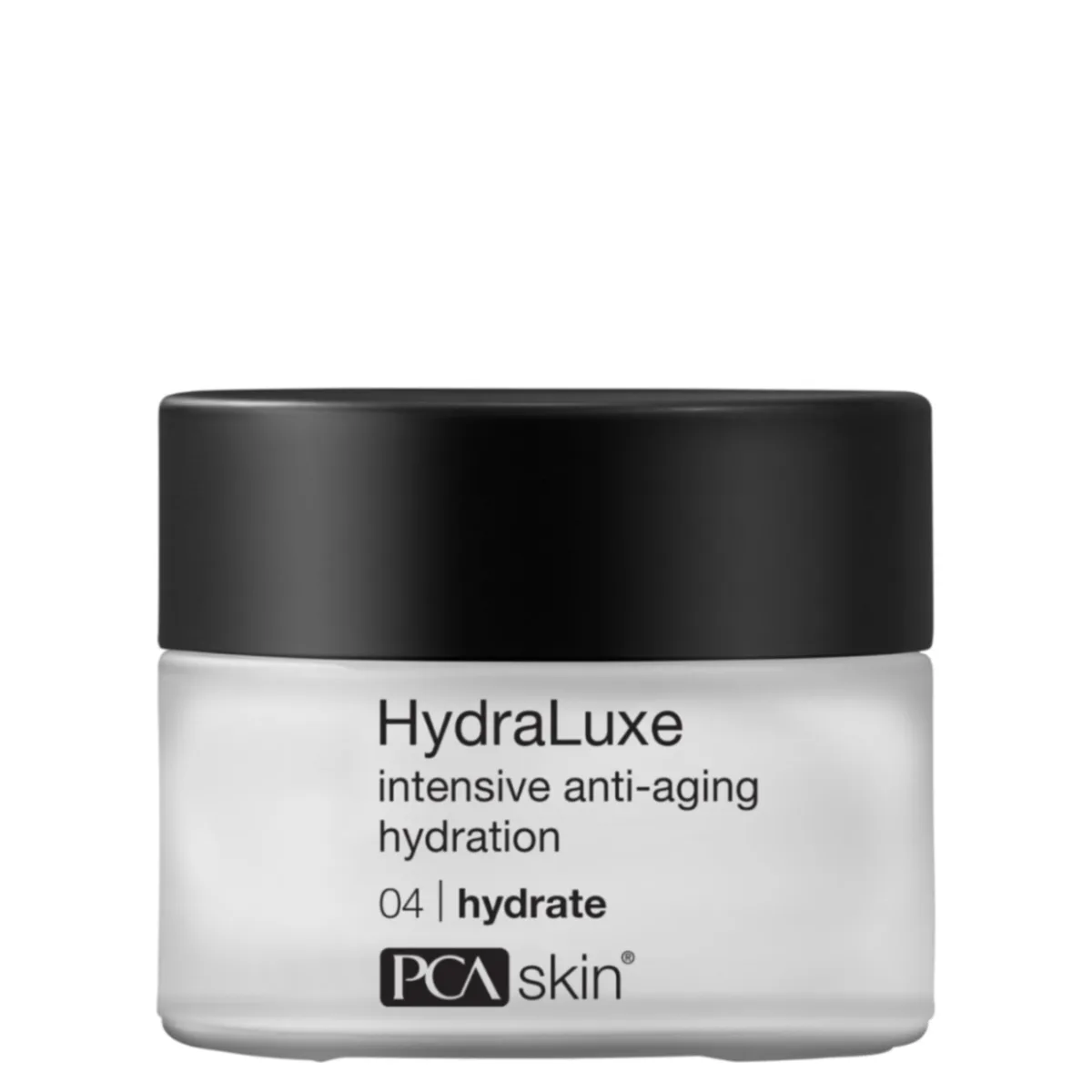
Niacinamide second on the list of a rich, shea-and-squalane cream is genuinely unusual, and the lamellar phospholipid emulsion PCA brands as IQ Adaptive Hydration is a real formulation technique that lets a heavy cream absorb rather than sit. The snow algae, peony and chicory extracts that headline the marketing are trace additions; the substance is in the first fifteen ingredients.
A genuinely well-engineered rich cream, with niacinamide in second position, real barrier lipids and a lamellar emulsion that lets a heavy formula absorb cleanly, sold at a price the trace botanicals on the label cannot justify. Dry, mature skin will love how it feels and will get a legitimate niacinamide benefit over months; nobody will get the firming and volume the jar promises, and the added fragrance is an odd choice from a clinical brand.
About 300 retailer reviews over nine years give a reliable read on how HydraLuxe feels and hydrates, and the niacinamide in its second position rests on decades of independent research; the branded hydration complex and the snow algae, peony and chicory extracts that carry the marketing have only supplier data, and PCA has published no trial of the cream itself. The firming and volume claims are therefore assessed from the ingredient list rather than from any measured result.
Verdicts
How well it fits each concern
Verdict by concern tap a concern for the case
Good choicefor DrynessIn your profileYou chose · Shea Butter is a reference standard by mechanism for dryness; this cream carries it.Moderate evidenceStandard tolerabilityNo reviews collected yet
The case for it
Shea Butter and Squalane has trial-supported standing for this concern.
It is plausibly present at a working level, though the concentration is not declared.
The formula carries no trigger this concern is sensitive to, with the cautions noted.
Cautions: fragrance.
What would change this: A declared concentration would move this to a firmer reading of the dose.
Same rule for everyone. “Good choice” is the verdict on 9,564 of 45,024 concern verdicts across the catalog; rule R5 decided 9,072 of them.
As of September 25, 2026, engine 5.1.1.
Supporting rolefor AgingIn your profileYou chose · Niacinamide has early evidence for aging, and hydration and barrier support is the recognised companion to treating it — a reasonable supporting choice, short of a recommendation.Moderate evidenceStandard tolerabilityNo reviews collected yet
The case for it
Niacinamide has early or mechanistic evidence for this concern, not trial-backed standing.
It is plausibly present at a working level, though the concentration is not declared.
The formula carries no trigger this concern is sensitive to, with the cautions noted.
What would change this: A declared concentration would move this to a firmer reading of the dose.
Same rule for everyone. “Supporting role” is the verdict on 8,197 of 45,024 concern verdicts across the catalog; rule R8a decided 1,489 of them.
As of September 25, 2026, engine 5.1.1.
R8a — A plausible-tier active in a category with a supportive job: the sentence names the active instead of saying nothing targets the concern (the AmLactin / CeraVe SA case for keratosis pilaris, where no guideline and single trials leave the keratolytics at early evidence). · the full register
Carrying active
Niacinamide
Standing
plausible — trials support it
Form
plausible — studied range 4–5%, from the trials on the row; needs leave-on contact; judge it after ~8 weeks
Tolerability
standard
Row checked
against its sources on July 17, 2026 (evidence table ev-2026.09-r228)
Supporting rolefor DehydrationIn your profileYou chose · Nothing here targets dehydration directly; humectant hydration is the recognised companion to treating it, and this cream does that without known triggers.Not yet assessedStandard tolerabilityNo reviews collected yet
The case for it
Niacinamide has no evidence row yet for this concern — it is in the research queue.
The formula carries no trigger this concern is sensitive to, with the cautions noted.
What would change this: A researched evidence row for the lead active would replace this with a verdict.
Same rule for everyone. “Supporting role” is the verdict on 8,197 of 45,024 concern verdicts across the catalog; rule R8 decided 4,250 of them.
As of September 25, 2026, engine 5.1.1.
R8 — The category's job (barrier care, humectant hydration, gentle cleansing, photoprotection) is the documented supportive role for this concern. This is the honest verdict for a moisturizer on an acne page. · the full register
Supporting rolefor Winter SkinIn your profileYou chose · Nothing here targets winter skin directly; occlusive hydration is the recognised companion to treating it, and this cream does that without known triggers.Not yet assessedStandard tolerabilityNo reviews collected yet
The case for it
Niacinamide has no evidence row yet for this concern — it is in the research queue.
The formula carries no trigger this concern is sensitive to, with the cautions noted.
What would change this: A researched evidence row for the lead active would replace this with a verdict.
Same rule for everyone. “Supporting role” is the verdict on 8,197 of 45,024 concern verdicts across the catalog; rule R8 decided 4,250 of them.
As of September 25, 2026, engine 5.1.1.
R8 — The category's job (barrier care, humectant hydration, gentle cleansing, photoprotection) is the documented supportive role for this concern. This is the honest verdict for a moisturizer on an acne page. · the full register
Avoidfor Compromised Skin BarrierIn your profileYou chose · This formula carries fragrance — a known trigger for compromised skin barrier — so it is not a fit however good its actives are.Moderate evidenceCarries a triggerNo reviews collected yet
The case for it
Niacinamide has trial-supported standing for this concern.
It is present at an effective concentration, declared or high in the ingredient list.
The formula carries a known trigger for this concern, which decides the verdict before any efficacy question.
What would change this: Removing the trigger named above would let the actives be judged on their own.
Same rule for everyone. “Avoid” is the verdict on 1,909 of 45,024 concern verdicts across the catalog; rule R1 decided 1,304 of them.
As of September 25, 2026, engine 5.1.1.
R1 — Safety outranks praise (MASTER-PLAN §1.7). A condition-weighted trigger (multiplier ≥ 2 in condition-fit-matrix) decides the verdict before any efficacy question. · the full register
Carrying active
Niacinamide
Standing
supported — its mechanism is established
Form
adequate — studied range 2%, from the trials on the row; needs leave-on contact; judge it after ~8 weeks
Tolerability
harsh — fragrance load
Row checked
against its sources on July 17, 2026 (evidence table ev-2026.09-r228)
Does the jobDoes what a moisturizer is for: draws in water, softens and smooths.
A verdict is DermApproved’s assessment of how well a product’s ingredients fit a concern — never a claim about what the product treats. Evidence dots and collected reviews sit beside it and are never blended in.
Rules 0.5.1 · evidence table ev-2026.09-r228 · how we decide
Assessment
Pros & Cons
Pros
✓ Niacinamide second on the list gives real, evidence-backed support for barrier, tone and fine lines
✓ Shea, squalane, triglyceride and silicone system holds moisture through a dry night
✓ Lamellar phospholipid emulsion lets a rich cream absorb without a greasy film
✓ Immediately plumps and cushions dry, tight or post-peel skin
✓ Softens dry lines and creases over a few months of use, per reviewers
✓ Nickel-sized dose stretches the jar to three or four months
✓ Buffers a retinoid well on nights when the skin needs comfort
Cons
✗ A hundred and sixty-one dollars for 1.8 ounces is luxury pricing for a niacinamide cream
✗ Snow algae, peony and chicory extracts are trace ingredients with supplier-only evidence
✗ Contains added fragrance, unexpected in a clinical brand and a risk for reactive skin
✗ Too rich for oily, acne-prone or humid-climate skin
✗ Firming and volume claims are not supported by anything in the formula
✗ Jar packaging exposes the cream to air and fingers with every use
Review
Full Review
PCA Skin's product page for HydraLuxe names four key ingredients: an adaptive hydration complex, snow algae, chicory leaf extract and peony extract. It does not mention niacinamide. Turn the jar over and niacinamide is the second ingredient, directly after water, in a position that suggests a dose in the several-percent range that clinical studies have used for barrier repair, blotchiness and fine lines. The four ingredients the marketing names sit fifteenth, thirty-first, thirty-second and thirty-eighth respectively. This is the whole story of HydraLuxe in one comparison: it is a very good niacinamide cream dressed as a luxury botanical one, and it is priced for the costume rather than the substance.
Start with the substance, because it is real. After the niacinamide come caprylic triglyceride, an ester, dimethicone and fatty alcohols, then glycerin, pentylene glycol, shea butter and squalane. That is a serious emollient system: a mix of light triglyceride, silicone slip, occlusive butter and a skin-identical hydrocarbon that between them keep water in the stratum corneum through a dry night. Hydrogenated lecithin, fifteenth, is the phospholipid at the centre of what PCA calls IQ Adaptive Hydration. Strip away the name and it is a lamellar emulsion, a formulation technique in which the emulsifier organises the cream's water and oils into layered bilayers resembling the skin's own barrier structure, so that a heavy cream integrates into the surface rather than sitting on it. It is not unique to PCA, but it is well done here, and it is why a cream this rich sinks in within a minute or two and leaves a supple satin surface rather than a film. Tocopherol, betaine and acetyl glucosamine further down add antioxidant and humectant support, and a trace of retinyl palmitate gives the anti-aging claim a whisper of vitamin A.
In use the cream is a pleasure. It is dense and ivory in the jar, yields under a fingertip, and a nickel-sized amount covers the face with cushion to spare. Dry skin looks plumper by morning from the first night, the tight, papery feeling of winter eases within days, and skin recovering from one of PCA's own peels, which is clearly the client this was designed around, finds it soothing. Reviewers across Amazon and Dermstore, about three hundred of them over nine years, describe softened dry lines and creases after a few months of use, which is precisely what a well-hydrated stratum corneum plus a real niacinamide dose should produce over eight to twelve weeks. There is no tingling and no adjustment period.
Now the costume. Snow algae, the alpine extract PCA leads with, is third from the end of a forty-ingredient list, and its supporting data come from the supplier's laboratory work on longevity-associated proteins in cultured cells and small panels. Peony root and chicory leaf are thirty-first and thirty-second, below the fragrance and both preservatives, and their claims of restoring volume and strengthening skin structure have no independent clinical support at any dose, let alone at these positions. The jar's promise of improved skin fullness and plumping is, in practice, the plumping that any good hydration produces; the firming is not there. And then there is the fragrance itself, sitting mid-list in a cream from a brand whose reputation rests on clinical restraint. The scent is light and fades in minutes, but its presence is a puzzling choice for a product aimed at dry, mature, often sensitive skin, and rosacea-prone reviewers who assumed a clinical jar meant unscented have been caught out by it.
The richness is also a real limit. Shea butter, isostearyl isostearate and a cluster of waxy esters make this a cold-weather cream for dry and normal skin, and oily or acne-prone users report congestion within a couple of weeks. It is fine over a retinoid as a buffer, fine under sunscreen in winter, and too much for a humid summer on combination skin. The frosted glass jar is handsome, and a jar is defensible for a cream this thick, but it means a clean fingertip every time and a formula exposed to air with each use.
The price is where the review has to be plain. A hundred and sixty-one dollars for 1.8 ounces is roughly ninety dollars an ounce, which puts HydraLuxe alongside department-store luxury creams whose cachet is the point. The niacinamide, the lipids and the lamellar emulsion are all excellent, and all of them are available in creams costing a third as much from brands with equally good chemists. What the extra money buys is PCA Skin's thirty-five years of professional history, a formula built to sit comfortably on post-peel skin, and the branded botanicals that give the jar its story. The cost per application, at a nickel-sized dose lasting three to four months, is about a dollar a day, which softens the blow without changing the arithmetic.
The recommendation follows from all of this. If your skin is dry or mature, you are already a PCA Skin client, and you want the richest, most comfortable cream the brand makes with a genuine niacinamide benefit built in, HydraLuxe will not disappoint you, and it will earn its place in your winter routine. If you are shopping on formula, the same ingredients that do the work here can be had for far less, and if you are buying for the snow algae and the peony, you are buying the label. It is a good cream. It is not a hundred-and-sixty-dollar idea.
Formula
Key Ingredients
The hero actives that drive this product's performance.
Second on the list, directly after water, which in a rich cream is a striking placement and suggests a dose in the several-percent range even though PCA does not state one. It is the one ingredient in HydraLuxe with a serious evidence base for barrier lipids, blotchiness and fine lines, and it is quietly doing more of the anti-aging work than any of the branded complexes the marketing names.
Established mechanismfor Compromised Skin Barrier · established mechanism
Ninth and eleventh, the two skin-compatible lipids that give the cream its richness: shea for a cushioning, slightly occlusive body and squalane for slip and barrier compatibility. With the triglyceride and ester emollients above them, they are what make HydraLuxe feel like a winter cream rather than a lotion, and they carry most of the moisture-retention benefit.
Established mechanismfor Dryness · established mechanism
The phospholipid at the heart of the complex PCA calls IQ Adaptive Hydration, fifteenth on the list: it forms bilayer structures that mimic skin's own lipid arrangement and help the water phase and oils sit in the stratum corneum rather than on top of it. The adaptive language is marketing, but the lamellar-lipid idea behind it is a real formulation technique.
The headline botanical, an extract of an alpine algae marketed for longevity pathways, sitting third from the end of a forty-ingredient list. Its supplier data on collagen and barrier markers are in vitro and small-panel; at this position it is a trace ingredient whose job is to distinguish the cream on a shelf rather than to change the skin.
The two extracts PCA credits with volume and structure, listed thirty-first and thirty-second. Chicory leaf carries supplier claims for supporting dermal proteins and peony for plumping; both are far down the list and neither has independent clinical support, so they contribute a story more than a measurable effect.
Not yet assessed
Ingredient standings describe the active at treatment-level doses and
vehicles; this product's own condition grades weigh its actual formula.
Goes on after any serum or corrective treatment and before sunscreen in the morning; it is rich enough to be the final step at night, and on retinoid nights it makes a good buffer applied over the treatment once that has absorbed.
Results Timeline
Skin feels cushioned and looks plumper from the first application, and the tight, papery feeling of dry winter skin eases within days. Improvements in blotchiness and fine-line softness attributable to the niacinamide take eight to twelve weeks; the firming and volume claims should not be expected to show at all in any measurable way.
The evidence for HydraLuxe lives almost entirely in its second ingredient, and it is strong. Bissett, Oblong and Berge's split-face trial in Dermatologic Surgery in 2005 applied 5% niacinamide to one side of the face and vehicle to the other in fifty women with photodamage for twelve weeks and documented significant reductions in fine lines, hyperpigmented spots, red blotchiness and sallowness, with improved elasticity; earlier work from the same group showed that topical niacinamide increases the skin's synthesis of ceramides, free fatty acids and cholesterol and reduces transepidermal water loss, which is the barrier mechanism behind the hydration benefits a rich cream is built to deliver. A 2024 review in Drug Delivery and Translational Research of niacinamide's dermal delivery and clinical evidence confirms that most of the clinical signal falls between 2% and 5% and that the ingredient is exceptionally well tolerated, which fits a formula intended for dry, sensitive, post-procedure skin. PCA does not disclose the percentage, but a listing directly after water in an emulsion of this richness is consistent with a dose in that range. The emulsion itself has a rational basis: hydrogenated lecithin, the phospholipid PCA brands as IQ Adaptive Hydration, is used to build lamellar-phase creams in which emulsifier bilayers mimic the ordered lipid structure of the stratum corneum, an approach shown in formulation studies to improve skin compatibility and moisture retention relative to conventional oil-in-water systems; the claim that the formula adapts to different environments has no specific support. Shea butter, squalane and caprylic/capric triglyceride are well-characterised emollients with documented reductions in water loss, and acetyl glucosamine, betaine and tocopherol contribute humectant and antioxidant support with modest evidence. The headline botanicals are a different matter. Coenochloris signiensis, the snow algae, is supported by supplier in vitro work on Klotho and AMPK expression in cultured cells and small uncontrolled panels; Paeonia albiflora root and Cichorium intybus leaf extracts have supplier claims for volume and dermal protein support and no independent clinical trials; all three sit in the last quarter of the list at concentrations unlikely to reproduce even the supplier results. Retinyl palmitate near the end of the list is the least active retinoid ester and, at trace level, contributes little beyond a label claim. The honest scientific reading is that HydraLuxe is a well-built niacinamide barrier cream whose measurable benefits come from ingredients the marketing does not emphasise.
Rich niacinamide creams occupy a comfortable place in clinical recommendations for dry, mature and post-procedure skin, and a formula that pairs a high-placed niacinamide with shea, squalane and a lamellar emulsion is the kind of moisturizer a practice carrying PCA Skin would reasonably offer patients recovering from peels or tolerating a retinoid. The reservations a clinician would raise are specific. The added fragrance is unnecessary in a product for reactive skin and would prompt a patch-test recommendation for rosacea or eczema-prone patients. The trace retinyl palmitate is generally regarded as low risk but is enough for cautious practitioners to suggest an alternative during pregnancy. The firming and volume claims would be set aside, since nothing in the formula acts on dermal structure, and the snow algae and peony extracts would be described as marketing rather than medicine. For oily or acne-prone patients the cream is too occlusive and a lighter niacinamide moisturizer would be preferred. Within those limits it is a sound, comfortable cream whose real value is barrier support and a niacinamide dose, not the botanicals on the front of the jar.
Guidance
Usage & Recommendations
How to Use
Use it as the final step of the evening routine and the last step before sunscreen in the morning. After cleansing and applying any corrective serum or retinoid, wait a minute for that to absorb, then take a nickel-sized amount from the jar with a clean fingertip, warm it between the fingers and press it over the face and neck, smoothing outward rather than rubbing. Allow a minute or two for the lamellar emulsion to settle before layering sunscreen. Dry skin can use it twice daily year-round; normal and combination skin may prefer it at night only or reserved for cold months. Skin that is oily or breakout-prone should use it sparingly on dry areas. Patch test behind the ear if fragrance has caused reactions before, and close the jar tightly after each use.
Value Assessment
A hundred and sixty-one dollars for 1.8 ounces works out to about ninety dollars an ounce, which is luxury-counter pricing, and the formula does not carry a luxury-only ingredient to explain it: niacinamide, shea, squalane and a lamellar emulsion are all found in excellent creams at a third of the price, and the botanicals that distinguish HydraLuxe on paper are trace additions. The dose is small and the jar lasts three to four months, so the daily cost is roughly a dollar, which many buyers will accept for a cream this pleasant. PCA Skin's professional pedigree and the formula's suitability for post-peel skin justify some premium, but the honest assessment is that this is a good cream sold at a great cream's price. Only one size is offered, so there is no larger jar to improve the arithmetic.
Who Should Buy
People with dry, mature or dehydrated skin who want a rich, comfortable cream with a genuine niacinamide benefit and who value PCA Skin's clinic pedigree, particularly those recovering from peels or buffering a retinoid through winter. It suits anyone who already uses the brand's corrective serums and wants the most cushioning moisturizer the line offers.
Who Should Skip
Oily, combination-in-summer and acne-prone skin will find it too heavy and should choose a lighter niacinamide moisturizer. Fragrance-reactive, rosacea-prone or very sensitive skin should be cautious given the added scent, pregnant users may prefer a cream without retinyl palmitate, and anyone shopping on formula rather than brand can find the same working ingredients for far less.
Ready to try PCA Skin HydraLuxe Intensive Hydration?
A dense, ivory cream that yields under the fingertip and spreads into a soft, cushiony layer, sinking in over a minute or two to leave a supple, faintly satin surface with no grease.
Scent
A light, clean, faintly floral fragrance that is noticeable on application and fades within a few minutes; it is added fragrance, not the smell of the botanicals.
Packaging
A frosted glass 1.8 oz jar with a black screw lid, labelled HydraLuxe intensive anti-aging hydration; no spatula is included.
Finish
satindewy
What to Expect on First Use
The first few days bring an immediate sense of cushioning and a plumper look by morning, with no tingling or purging; the fragrance registers briefly at application. Skin that is oily or acne-prone can feel congested by the second week, which is the cue to move it to night-only use or to drier areas.
How Long It Lasts
Three to four months at a nickel-sized amount twice daily; closer to five months used at night only.
PCA Skin introduced HydraLuxe around 2017 as the top tier of its moisturizer range, aimed at dry, mature clients who wanted a richer cream than the brand's clinical lotions and who were already spending on in-clinic peels. It adopted supplier-branded actives from the prestige market, notably an alpine snow algae extract, and has kept the formula largely stable while the brand dropped the words Intensive Hydration from the jar in a later relabel.
About PCA Skin Established Brand (5–20 years)
PCA Skin has formulated professional skincare since 1990, starting with chemical peels developed with dermatologists and building a clinic-sold daily line made by in-house chemists. HydraLuxe, launched around 2017, is the brand's most expensive moisturizer; it leans on supplier-branded hydration and botanical complexes, and PCA has published no clinical study on the finished cream to support its firming and volume claims.
Brand founded: 1990 · Product launched: 2017
Myth vs. Reality
Common Myths
Myth
The snow algae and peony extracts are what make this cream anti-aging.
Reality
They sit in the last quarter of a forty-ingredient list, below the fragrance and the preservatives, and their support is supplier laboratory work. The anti-aging credentials in this jar belong to the niacinamide in second position, which has independent trials behind it, and to the barrier lipids that keep skin hydrated enough to look smoother.
Myth
A cream this expensive from a clinical brand must be fragrance-free.
Reality
It is not. Fragrance sits mid-list, and while the scent is light and fades quickly, it is an added perfume of the kind most dermatology-adjacent brands leave out. Sensitive or rosacea-prone skin should patch test rather than assume the clinical label means unscented.
FAQ
Frequently Asked Questions
Is PCA Skin HydraLuxe worth 161 dollars?
As a rich, well-made cream with niacinamide high in the list and a sophisticated lamellar emulsion, it is a good moisturizer; as a formula, nothing in it justifies luxury pricing, because the headline botanicals are trace additions and the core ingredients are available in creams at a third of the price. It is worth it to someone already invested in PCA's clinic ecosystem who wants their richest option; it is not a value buy.
Does PCA Skin HydraLuxe contain fragrance?
Yes. Fragrance appears in the middle of the ingredient list, giving the cream a light, clean scent that fades within minutes. That is unusual for a clinical brand and worth knowing for anyone with sensitive, rosacea-prone or fragrance-reactive skin, who should patch test first.
What is IQ Adaptive Hydration in PCA HydraLuxe?
It is PCA's name for a hydrogenated-lecithin-based emulsion system that forms lipid bilayers resembling the skin's own barrier structure, helping the cream's water and oils integrate into the stratum corneum rather than sit on the surface. The lamellar technique is real and well used across the industry; the claim that the formula adapts to different environments is marketing.
Can I use PCA Skin HydraLuxe if I have oily or acne-prone skin?
It is not the right cream for that skin. Shea butter, several heavy esters and a rich emulsion make it a winter or dry-skin moisturizer, and reviewers with oily skin report congestion within a couple of weeks. PCA's lighter moisturizers suit oily skin far better.
How does PCA HydraLuxe compare with PCA Collagen Hydrator?
Both are rich creams for dry skin, but HydraLuxe is the more expensive, more anti-aging-positioned formula with niacinamide second in the list and the snow algae and peony extracts, while Collagen Hydrator is a simpler, shea-based cream at a lower price. Dry skin that wants pure moisture does fine with the cheaper one; HydraLuxe adds a niacinamide dose and a lighter finish.
Is PCA Skin HydraLuxe safe to use during pregnancy?
The formula contains a small amount of retinyl palmitate, a mild vitamin A ester, near the end of the list. Most clinicians consider trace retinyl palmitate in a moisturizer low-risk, but since topical retinoids are generally avoided in pregnancy, anyone pregnant or trying to conceive should check with their doctor or choose a retinoid-free cream.
Reviews
What Reviewers Tend to Say
Recurring themes our editors read across retailer reviews of this product — summaries in our words, not quotations, and not a substitute for your own patch test.
Picking one skin state and selling through hospital dermatology departments is a genuinely smart strategy. Whether the house botanical earns its billing is a separate question, and the answer is not the one either side wants.
Natural formulators swap shea, cocoa, mango and murumuru as though they were interchangeable. One carries roughly ten times the non-fat material of the others, and one is functionally a wax.
Five brands that own the feed, judged on their ingredient lists rather than their view counts — including the one active all five suddenly added at once, and what that tells you.
Products, answers, therapy guides, tools and articles in one search. Brand names,
slang and abbreviations all work — accutane finds isotretinoin, bacne finds truncal acne.