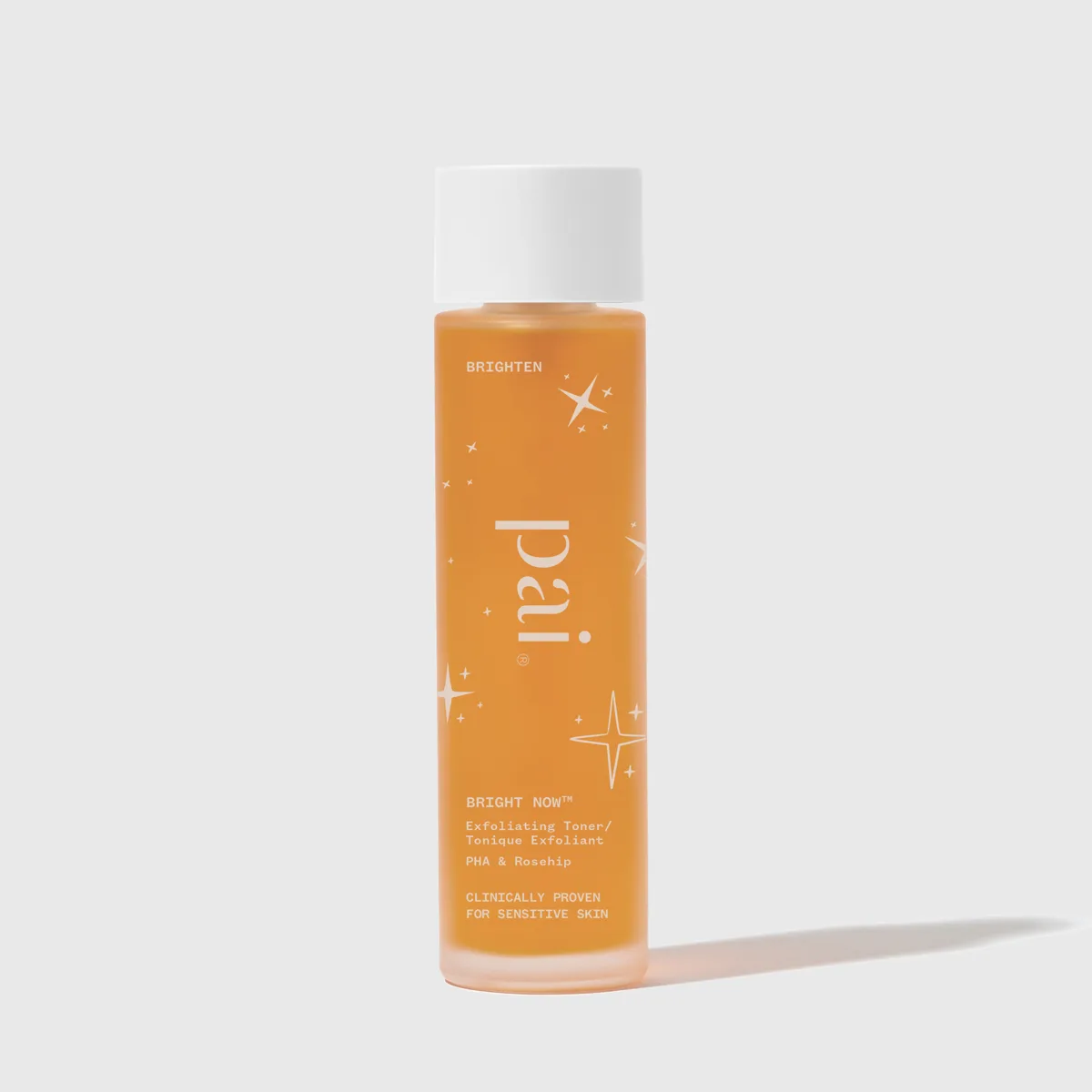
Combines two PHA acids (gluconolactone + lactobionic acid) for gentle multi-mechanism exfoliation, plus brand-signature rosehip extract for natural antioxidant support, plus niacinamide, plus comprehensive sensitive-skin soothing cast (centella, aloe, allantoin, panthenol). Suits sensitive and rosacea-prone skin where typical AHA toners would over-irritate.
Pai Skincare's Bright Now PHA & Rosehip Exfoliating Toner combines gluconolactone and lactobionic acid PHAs with rosehip extract, niacinamide, and comprehensive sensitive-skin soothing cast. Genuinely gentle exfoliating toner at 42 dollars for 150ml — the right product for sensitive skin that AHA toners over-irritate.
Released in 2023 with roughly 320 reviews, this toner has a moderate track record within Pai's sensitive-skin community. PHA exfoliation via gluconolactone and lactobionic acid is well-supported by peer-reviewed work, while the rosehip antioxidant claim sits at a more promising tier, so the score blends both alongside the brand's record since 2007.
Verdicts
How well it fits each concern
Verdict by concern tap a concern for the case
Promisingfor DullnessIn your profileYou chose · Hyaluronic Acid has trial-level evidence for dullness but no guideline or regulatory standing yet — promising, short of a recommendation; the other actives here are not yet assessed for it.Moderate evidenceGentleNo reviews collected yet
The case for it
Sodium Hyaluronate has trial-level evidence for this concern but no guideline or regulatory standing yet.
It is plausibly present at a working level, though the concentration is not declared.
The formula carries none of the triggers this concern is sensitive to.
What would change this: A declared concentration would move this to a firmer reading of the dose.
Same rule for everyone. “Promising” is the verdict on 7,858 of 45,024 concern verdicts across the catalog; rule R9p decided 7,858 of them.
Unchanged since September 5, 2026, engine 5.1.1.
R9p — 0.5.0: 'Unproven' beside three filled dots read as one question answered twice with opposite words (7,018 rows). The chip measures standing, the dots measure trial volume; where the row carries at least one RCT or a tier-2 source (moderate dots) and the active is present at a working level, the honest word is Promising. Unproven is reserved for plausible-standing rows with limited or weak evidence, or an under-dosed form. Same rank as Unproven — a bet either way; the dots order them. · the full register
Carrying active
Sodium Hyaluronate
Standing
plausible — trials support it
Form
plausible
Tolerability
gentle
Row checked
against its sources on July 17, 2026 (evidence table ev-2026.09-r228)
Good choicefor HyperpigmentationIn your profileYou chose · Niacinamide is a trial-supported active for hyperpigmentation; this liquid carries it, though the concentration is not declared.Moderate evidenceGentleNo reviews collected yet
The case for it
Niacinamide has trial-supported standing for this concern.
It is plausibly present at a working level, though the concentration is not declared.
The formula carries none of the triggers this concern is sensitive to.
What would change this: A declared concentration would move this to a firmer reading of the dose.
Same rule for everyone. “Good choice” is the verdict on 9,564 of 45,024 concern verdicts across the catalog; rule R5 decided 9,072 of them.
Unchanged since September 5, 2026, engine 5.1.1.
Good choicefor SensitivityIn your profileYou chose · No fragrance, drying alcohol, declarable allergens or sensitising preservatives in this liquid — the profile sensitive skin looks for.Not yet assessedGentleNo reviews collected yet
The case for it
Centella Asiatica + Aloe + Allantoin + Panthenol Soothing Complex has been researched for this concern and the evidence does not support it.
It is plausibly present at a working level, though the concentration is not declared.
The formula carries none of the triggers this concern is sensitive to.
What would change this: A declared concentration would move this to a firmer reading of the dose.
Same rule for everyone. “Good choice” is the verdict on 1,938 of 45,024 concern verdicts across the catalog; rule F2 decided 1,938 of them.
Unchanged since September 5, 2026, engine 5.1.1.
Also listed for Rough Texture — the actives here (Rosehip Oil, Niacinamide, Hyaluronic Acid, Centella Asiatica) are in our research queue for that concern; there is no verdict until their evidence rows are written. That is a gap in our table, not a mark against the product.
Does the jobDoes what a toner is for: not alcohol-driven, adds something real. Not measured from the label: restores skin pH, plays well with what follows.
A verdict is DermApproved’s assessment of how well a product’s ingredients fit a concern — never a claim about what the product treats. Evidence dots and collected reviews sit beside it and are never blended in.
Rules 0.5.1 · evidence table ev-2026.09-r228 · how we decide
There's a persistent misconception that PHAs are just AHAs with the volume turned down — same chemistry, gentler dose. The truth is more interesting than that. Polyhydroxy acids are physically larger molecules: gluconolactone weighs in at roughly two and a half times the molecular weight of glycolic acid, and lactobionic acid is bigger still. That size difference changes how they behave, slowing their penetration so they exfoliate without the deep stratum-corneum disruption that AHAs cause. The practical translation is markedly less irritation, a smaller bump in UV sensitivity, and real tolerability for skin types that simply fail AHA trials. PHAs aren't slow AHAs; they're a different exfoliation tier, and that distinction is the whole reason this toner exists.
Pai Skincare built its entire identity around exactly this kind of skin. Founded in 2007 by Sarah Brown in the UK, the brand has spent its life formulating for sensitive and reactive complexions — the rosacea, eczema, perioral dermatitis, and chronic-reactivity crowd who quietly fail most of what's on the shelf. The Bright Now PHA & Rosehip Toner, launched in 2023, brings that sensitive-skin philosophy into the gentle-exfoliation category. Gluconolactone sits at the second position in the INCI and lactobionic acid at the third, which signals meaningful inclusion of both PHAs rather than a token splash. Using two together gives slightly broader exfoliating coverage than a single-PHA product while keeping the overall experience firmly on the gentle side of the gentleness-versus-aggression trade-off — which is precisely where this brand wants to be.
The rosehip is the signature flourish. Rosa canina fruit extract brings natural vitamin C, beta-carotene, tocopherols, and a characteristic fatty acid profile, and at position five in the INCI it's present at a meaningful level rather than as window dressing — promising antioxidant and surface-conditioning support that complements the exfoliation. From there the active framework continues with niacinamide at position six for tone evenness and barrier support, both well-documented, plus the comprehensive soothing cast that Pai reliably builds into its formulas: centella asiatica triterpenes, aloe barbadensis polysaccharides, allantoin, and panthenol, all working to buffer any reactivity from the acids. Sodium hyaluronate adds surface hydration that offsets the mild dryness any exfoliating step can bring. It's a deck assembled to exfoliate and reassure in the same motion.
Using it is conspicuously uneventful in the best way. The toner is a lightweight, watery liquid with just a touch of viscosity, fragrance-free, and crucially there's no tingling or stinging — PHAs work without the surface-acid sensation AHAs produce, which is reassuring for anyone who's flinched at a glycolic toner before. Sweep it over clean skin with a cotton pad or bare hands, morning or evening. Subtle smoothness and brightness show up over two to four weeks, with cumulative tone evenness developing across eight to twelve weeks. Most people tolerate daily use; the genuinely sensitive should start every other day and build frequency as their skin signals it's comfortable. Worth noting that even gentle PHAs raise UV sensitivity somewhat, so daily SPF remains non-negotiable.
Its limitations are mostly about pace and price rather than quality. Visible results arrive more slowly than an AHA equivalent would deliver them — that's the inherent cost of the gentler mechanism, not a formulation flaw, but it's real if you're impatient. At $42 for 150ml, this is moderate clean-beauty pricing, and bare-bones PHA toners exist for a fraction of the cost if all you want is the acid without the rosehip and the soothing supporting cast. There's also limited big-retailer presence in the US, so it can take some hunting to find. The premium here is paying for the certified-organic farming heritage, the brand's deep sensitive-skin expertise, and the genuinely comprehensive supporting formula — fair value if you need that, less compelling if you don't.
Slotting it into a routine is straightforward, and the gentleness gives you latitude that AHA toners don't. It goes on after cleansing and before serums and moisturizer, and because PHAs are so mild it can comfortably share a routine with other actives that would clash with a stronger acid — niacinamide pairs naturally, and even a retinoid on alternate nights is usually manageable here where an aggressive glycolic toner might tip the balance into irritation. That tolerance is the quiet superpower of the PHA approach: it lets reactive skin add a brightening, smoothing step without forcing a trade-off elsewhere in the routine. The medium data confidence reflects a still-modest review base for a 2023 launch, so the assessment leans partly on the well-established PHA science and Pai's long sensitive-skin track record rather than a deep well of long-term feedback — but the early reviews that exist consistently flag the gentleness and the lack of stinging as the standout.
For sensitive, rosacea-prone, or AHA-intolerant skin looking for gentle exfoliation that won't trigger a flare, this is a thoughtful, well-built purchase, and it's fragrance-free, vegan, cruelty-free, and pregnancy-safe to boot. The brand heritage genuinely matters here: people who've struck out on multiple acid products elsewhere tend to find Pai's formulations tolerable where others weren't, and that track record is worth something the ingredient list alone can't convey. The flip side is equally clear — if your skin already does well on AHAs and you want faster, more dramatic resurfacing, a stronger glycolic or lactic toner will get you there quicker and likely cheaper. This is a precision tool for a specific, underserved kind of skin, and on those terms it's quietly excellent.
Formula
Key Ingredients
The hero actives that drive this product's performance.
Polyhydroxy acid (PHA) framework — gluconolactone and lactobionic acid are larger-molecular-weight cousins of AHAs that exfoliate more gently due to slower skin penetration. Suited to sensitive skin where AHAs would over-irritate. Position 2 and 3 INCI suggest meaningful concentration.
Brand-signature Pai active — rosehip provides natural vitamin C, beta-carotene, and tocopherol antioxidant content alongside fatty acid profile. Position 5 in INCI suggests meaningful inclusion.
Centella triterpenes plus aloe polysaccharides plus allantoin plus panthenol — comprehensive sensitive-skin soothing supporting cast that buffers PHA exfoliation reactivity.
Surface hydration support that addresses the typical dryness from exfoliating products. PHAs are gentler than AHAs but still benefit from hydration cushioning.
Plausible mechanismfor Dullness
Ingredient standings describe the active at treatment-level doses and
vehicles; this product's own condition grades weigh its actual formula.
Apply to clean skin morning or evening with cotton pad or hands. PHAs are gentler than AHAs but still increase UV sensitivity moderately — daily AM SPF recommended. Can be used daily by most users; sensitive skin should start every-other-day.
Results Timeline
Subtle smoothness and brightness over 2-4 weeks; cumulative tone evenness over 8-12 weeks.
Pai Skincare Bright Now PHA & Rosehip Exfoliating Toner
Serum
Eye cream
Moisturizer
Sunscreen
Sample PM Routine
Cleansing
Pai Skincare Bright Now PHA & Rosehip Exfoliating Toner
Treatment serum
Eye cream
Moisturizer
Evidence
Science & Expert Perspective
The Science
The PHA framework has solid dermatology evidence. Gluconolactone and lactobionic acid are polyhydroxy acids with larger molecular weight than AHAs (glycolic, lactic) — published research has documented gentler exfoliation through slower skin penetration. A 2014 review in the International Journal of Dermatology established PHAs as appropriate first-line exfoliation chemistry for sensitive skin types where AHAs are over-aggressive. The PHA mechanism produces less stratum corneum disruption and significantly lower transepidermal water loss compared to AHA exfoliation. Lactobionic acid additionally has documented humectant properties and modest antioxidant activity. Rosehip (Rosa canina) fruit extract has published research on natural vitamin C content, beta-carotene, tocopherol, and characteristic fatty acid profile — antioxidant and surface-conditioning support. Niacinamide at meaningful concentration provides barrier function and tone evenness through documented mechanisms. The soothing supporting cast (centella triterpenes, aloe polysaccharides, allantoin, panthenol) provides anti-inflammatory and barrier-support documented in skincare literature.
References
Polyhydroxy acids in sensitive skin exfoliation — clinical evaluation — International Journal of Dermatology (2014)
Dermatologist Perspective
PHA-based exfoliation chemistry is increasingly recommended by dermatologists as first-line approach for sensitive, rosacea-prone, and barrier-compromised patients where AHA chemistry would be over-aggressive. The Pai Bright Now PHA Toner fits this clinical positioning well — dual PHA framework plus comprehensive soothing cast plus brand heritage in sensitive-skin formulation. Patient selection: sensitive, rosacea, eczema-prone, post-procedure recovery, AHA-intolerant. Patients with tolerant skin who do well on AHAs may prefer faster-acting alternatives.
Guidance
Usage & Recommendations
How to Use
Apply to clean skin with cotton pad or hands morning or evening (or both, after tolerance is established). Most users tolerate daily use; sensitive skin should start every-other-day. Mandatory daily AM SPF 30 or higher — PHAs increase UV sensitivity moderately, less than AHAs but still meaningfully. Pair with the matching Pai sensitive-skin moisturizer or any compatible moisturizer of choice.
Value Assessment
At 42 dollars for 150ml, per-ml cost is 0.28 dollars — moderate clean-beauty pricing. The Inkey List PHA Toner at substantially lower price covers basic PHA mechanism. Naturium Mandelic Topical Acid at moderate price covers different gentle-exfoliation chemistry. The Pai premium reflects sensitive-skin brand expertise and certified-organic farming heritage. Reasonable for the Pai customer with sensitive-skin priorities; expensive vs basic PHA alternatives.
Who Should Buy
Sensitive, rosacea-prone, or AHA-intolerant skin types seeking gentle exfoliation. Patients who have failed AHA toner trials due to irritation. Sensitive-skin focused routines that value the Pai brand heritage. Post-procedure recovery requiring gentle exfoliation alternatives. Pregnancy-safe acid routine builders.
Who Should Skip
Tolerant skin types who do well on AHAs — faster results from AHA equivalents. Strict budget — The Inkey List PHA at lower price covers basic mechanism. Patients seeking treatment-grade exfoliation intensity — PHAs are by design gentler than treatment-grade AHA/BHA products.
Ready to try Pai Skincare Bright Now PHA & Rosehip Exfoliating Toner?
Toner applies smoothly without tingling or stinging — PHAs work much more gently than AHAs. Subtle smoothness and brightness develop over 2-4 weeks. Cumulative tone evenness over 8-12 weeks of consistent use.
Pai Skincare was founded in 2007 by Sarah Brown in the UK, built around clean-beauty positioning specifically for sensitive and reactive skin. The brand has emphasized minimal-ingredient formulations and certified-organic actives since launch. The Bright Now PHA & Rosehip Toner launched in 2023 as the brand's entry into gentle exfoliation — using PHA chemistry that suits Pai's sensitive-skin patient base where typical AHA toners would be too aggressive.
About Pai Skincare Established Brand (5–20 years)
Pai Skincare was founded in 2007 by Sarah Brown in the UK, built around clean-beauty positioning for sensitive and reactive skin. The brand emphasizes minimal-ingredient formulations and certified-organic actives. The Bright Now Toner brings the brand's sensitive-skin philosophy into the gentle-exfoliation category via PHA chemistry.
Brand founded: 2007 · Product launched: 2023
Myth vs. Reality
Common Myths
Myth
PHAs work the same as AHAs, just at slower speed.
Reality
PHAs (gluconolactone, lactobionic acid) are larger molecules than AHAs (glycolic, lactic) — they penetrate skin more slowly through a different mechanism, providing exfoliation without the deep stratum corneum disruption that AHAs cause. The benefit is significantly less irritation and lower UV sensitivity increase. The trade-off is slower visible results. PHAs are not 'slow AHAs' — they're a different exfoliation tier suited to sensitive skin where AHAs would over-react.
FAQ
Frequently Asked Questions
What is the difference between PHA and AHA?
PHAs (gluconolactone, lactobionic acid) are larger molecules than AHAs (glycolic, lactic) — they exfoliate more gently with significantly less irritation and lower UV sensitivity increase. Suited to sensitive skin where typical AHA toners would over-react. The trade-off is slower visible results.
Can I use this Pai toner daily?
Yes for most skin types — PHAs tolerate daily use well. Sensitive skin should start every-other-day to assess tolerance, then increase to daily as skin adapts.
Is this Pai toner pregnancy-safe?
Yes — PHAs (gluconolactone, lactobionic acid) have no pregnancy contraindications and the broader Pai formulation is pregnancy-safe at cosmetic concentrations.
Will this Pai toner cause sun sensitivity?
Moderate — PHAs increase UV sensitivity less than AHAs but still warrant daily AM SPF use. Mandatory broad-spectrum SPF 30 or higher when using any exfoliating acid.
Can I use this Pai toner with retinol?
Yes, but on different routine times — PHA toner in the AM, retinol in the PM. Combining in the same application can compound irritation potential.
Reviews
What Reviewers Tend to Say
Recurring themes our editors read across retailer reviews of this product — summaries in our words, not quotations, and not a substitute for your own patch test.
Common Praise
PHAs deliver gentle exfoliation without typical AHA irritation
Polyhydroxy acids get filed under 'beginner exfoliant,' as if gentle meant weak. The truth is stranger: their bulk is exactly why they work for the skin everything else sets on fire.
Nearly every trial that made this ingredient famous ran at 2–5%. The double-digit numbers on the shelf are answering a question the biology never asked.
The K-beauty buzzword slaps a green leaf on half the shelf — but centella is one of the rare botanicals with genuine wound-healing data. The trick is knowing which molecule is doing the job.
Feb 27, 2026· 6 min
Questions people ask about Hyperpigmentation
Verified answers from our questions library — the nuance a product page cannot carry.
Products, answers, therapy guides, tools and articles in one search. Brand names,
slang and abbreviations all work — accutane finds isotretinoin, bacne finds truncal acne.