Menopause Changes the Skin You Are Treating, Not Just How It Looks
The collagen number is real. It is also the wrong thing to fix first — because the substrate your routine was built on has quietly been replaced.
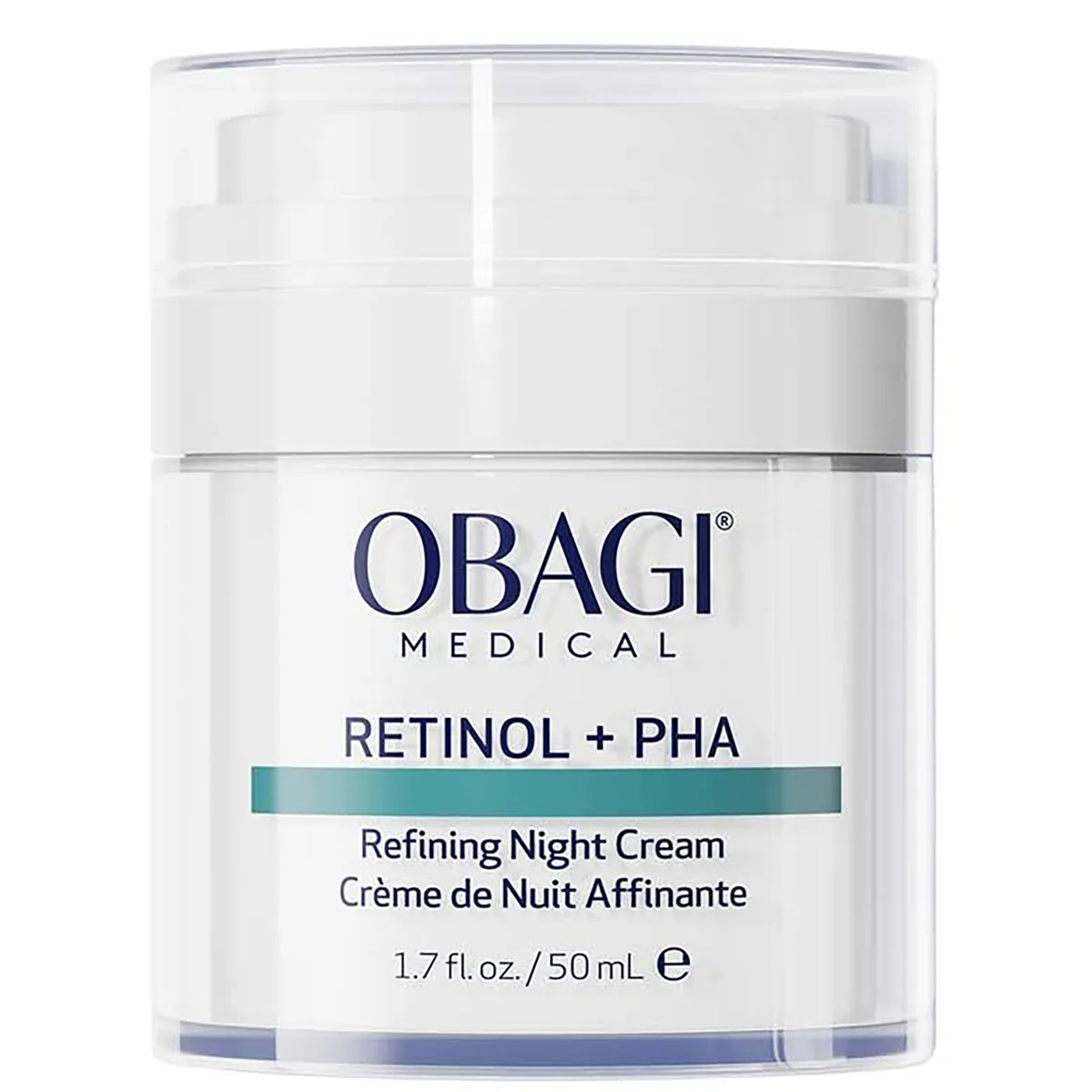
Most retinol creams ask you to tolerate the flaking; this one pairs the retinol with gluconolactone, a polyhydroxy acid third in the list, so the dead surface cells the retinoid loosens are cleared and hydrated in the same step. Obagi delivers the retinol in a slow-release entrapment and wraps both actives in eight named hydrators, which is a physician brand's answer to the drop-out problem rather than another strength tier.
A thoughtful retinol night cream that solves the flaking problem by building the cleanup in: slow-release retinol beside a well-dosed polyhydroxy acid, wrapped in enough hydrators to be the last step of the night. It is gentle for what it is and Obagi's eight-week test is at least a test. The retinol percentage is a secret and $135 is a lot for a night cream, but for first-time or sensitive retinol users it is a well-reasoned way in.
Launched in 2025, this cream has only a few dozen reviews and thin retailer feedback, so the assessment rests on Obagi's eight-week clinical test, whose instrumental smoothness and tone figures are brand data on file rather than published, and on the independent literature for retinol and gluconolactone. The retinol concentration is not disclosed, which limits how precisely the product can be compared with others.
The case for it
What would change this: A declared concentration would move this to a firmer reading of the dose.
Same rule for everyone. “Good choice” is the verdict on 9,564 of 45,024 concern verdicts across the catalog; rule R5 decided 9,072 of them. As of September 25, 2026, engine 5.1.1.
Brand or formulator? Disclose a concentration or correct a fact →
The studies behind the evidence row
The case for it
What would change this: Guideline or regulatory standing for the active on this concern would move this from a promising bet to a recommendation.
Same rule for everyone. “Promising” is the verdict on 7,858 of 45,024 concern verdicts across the catalog; rule R9p decided 7,858 of them. As of September 25, 2026, engine 5.1.1.
Brand or formulator? Disclose a concentration or correct a fact →
The studies behind the evidence row
The case for it
Cautions: fungal-acne triggers.
What would change this: A declared concentration would move this to a firmer reading of the dose.
Same rule for everyone. “Promising” is the verdict on 7,858 of 45,024 concern verdicts across the catalog; rule R9p decided 7,858 of them. As of September 25, 2026, engine 5.1.1.
Brand or formulator? Disclose a concentration or correct a fact →
The studies behind the evidence row
The case for it
What would change this: A declared concentration would move this to a firmer reading of the dose.
Same rule for everyone. “Promising” is the verdict on 7,858 of 45,024 concern verdicts across the catalog; rule R9p decided 7,858 of them. As of September 25, 2026, engine 5.1.1.
Brand or formulator? Disclose a concentration or correct a fact →
The studies behind the evidence row
Also listed for Rough Texture — the actives here (Gluconolactone, Hyaluronic Acid, Retinol, Vitamin E) are in our research queue for that concern; there is no verdict until their evidence rows are written. That is a gap in our table, not a mark against the product.
Where our review and the verdict differ. The review below was written on the formulation and the published trials; the verdicts above apply the stricter standing test in our methodology — an active earns a recommendation only with guideline or regulatory standing for the concern. Where the two disagree, the verdict is DermApproved’s position.
A verdict is DermApproved’s assessment of how well a product’s ingredients fit a concern — never a claim about what the product treats. Evidence dots and collected reviews sit beside it and are never blended in. Rules 0.5.1 · evidence table ev-2026.09-r228 · how we decide
Retinol has the best evidence of any over-the-counter anti-aging ingredient and one of the worst retention rates. People start it, flake for three weeks, and stop. Obagi, whose Obagi360 Retinol 1.0 is exactly the kind of product that causes that cycle, launched the Retinol + PHA Refining Night Cream in 2025 as an answer to the drop-out rather than another rung on the strength ladder, and the ingredient list reads like a checklist of everything a formulator would add to keep someone using a retinoid past week three.
The first thing to notice is the order. Gluconolactone, a polyhydroxy acid, is third in the list, ahead of the glycerin and every emollient; retinol is thirteenth, behind the shea butter extract and the hydrogenated lecithin that most likely carries it. That is a PHA cream with a retinol in it, not the other way round, and the arrangement is deliberate. Polyhydroxy acids are the large, slow, water-binding cousins of glycolic acid, and the published work on them found they could be combined with retinoic acid without the irritation a classical AHA would add. Here the gluconolactone does two jobs at once: it clears the loosened surface cells that would otherwise show as retinol flaking, and it hydrates while doing it. The retinol, at an undisclosed percentage, is delivered in what Obagi calls an entrapment system that releases it gradually through the night, which flattens the irritation curve of a free retinol at the same dose.
Around those two is the hydration cast Obagi counts as eight: caprylic/capric triglyceride second, sunflower seed oil sixth, glycerin, shea butter extract, sodium hyaluronate directly after the retinol, jojoba esters, tocopherol and squalane. It is a proper emollient cream, fragrance-free and alcohol-free, with cetearyl and cetyl alcohols for body and a little dimethicone for slip. The finish is a soft matte-satin cushion that most skin will happily wear as its only night product, and that is the design brief: one step, no separate moisturizer, no reason to skip it.
In use it behaves like a good moisturizer that turns out to be doing more. The first week is smooth and uneventful, the PHA softening texture immediately. In the second and third weeks some users see fine flaking on the cheeks or around the nose as the retinol takes hold, and the gluconolactone smooths most of it away before it becomes the sheet-peeling that sends people back to the drawer. By four weeks the surface is noticeably refined, and Obagi's own eight-week clinical test, run across 2024 and 2025, reported that nine in ten participants saw visible smoothing and fewer blemishes at that point, with most seeing more even tone and softer fine lines at eight weeks, and instrumental improvements of 29% in smoothness and 10% in tone evenness. Those are brand figures, on file rather than published, but they are an actual clinical test with instrumental endpoints, which is more than most retinol creams bring, and they align with what retinol and PHAs are independently known to do on those timescales.
What the cream will not tell you is how much retinol you are getting, and that is the honest reservation. The evidence for retinol's effect on fine lines and collagen comes from studies at defined concentrations, and an undisclosed dose in an entrapment system leaves the buyer trusting the four-week results rather than the label. Obagi's Retinol 1.0 exists for people who want a stated strength; this cream is for people who would rather have results they can tolerate than a number they can quote. Very oily skin will also find the sunflower-and-shea base heavier than it wants, cetyl esters and shea carry a mild congestion risk, and the price is the standing Obagi objection: $135 for 1.7 oz is prestige night cream money, though a hazelnut-sized dose stretches the bottle to two or three months, around $45 to $65 a month.
There is also a quieter argument for the combination that the marketing does not make. Retinol and gluconolactone address the same two complaints, dull texture and clogged, uneven skin, by different routes, the retinoid from below by normalising how cells mature and the PHA from above by clearing what has already died, and in a single cream the two reinforce each other on the four-to-eight-week horizon Obagi's test used. That is why the blemish figure in the test is worth noticing: it is the kind of result a retinoid alone produces slowly and a PHA alone produces superficially, and together they produce it faster, which for the adult with congestion and early lines is the actual point of buying one product instead of two.
For whom, then? First-time retinol users who have heard the horror stories, sensitive or dry skin that has quit a retinoid before, and anyone who wants one evening product that treats and moisturizes without a ritual of layers. For that audience it is one of the more carefully engineered entry points on the market. For experienced retinoid users with resilient skin, the undisclosed dose and the rich base are two reasons to keep using whatever stronger, cheaper product they already tolerate.
The hero actives that drive this product's performance.
| Ingredient | Function | Evidence |
|---|---|---|
| Retinol (entrapped, slow-release) | Thirteenth in the list at an undisclosed percentage, delivered in what Obagi describes as an entrapment system that releases it gradually through the night; the hydrogenated lecithin two places above it is the likely carrier. The slow release is the point: it lets a night cream carry a working retinol dose for a sensitive-leaning audience without the sting of a free retinol at the same level. | Emerging for Aging |
| Gluconolactone | Third in the list, ahead of the glycerin, which makes the polyhydroxy acid the more generously dosed of the two actives. It exfoliates gently while binding water, so it clears the flaky surface a retinol produces and hydrates at the same time, which is the rationale for putting the two in one cream. | Not yet assessed |
| Sodium Hyaluronate | Directly after the retinol, hyaluronic acid is the first of Obagi's eight named hydrators, drawing water into the epidermis to offset the dryness a retinoid causes in its first weeks. | Plausible mechanism for Dullness |
| Squalane | Skin-identical squalane in the back half of the list, with linoleic-rich sunflower oil sixth doing the barrier feeding, forms the lipid cushion that lets a retinol cream feel like a moisturizer even while the retinoid is working. | Not yet assessed |
| Tocopherol | Vitamin E in its active form, placed mid-list to protect the retinol from oxidation in the tube and to add antioxidant support to skin that a retinoid has made temporarily more reactive. | Limited for Aging |
Ingredient standings describe the active at treatment-level doses and vehicles; this product's own condition grades weigh its actual formula.
Aqua (Water), Caprylic/Capric Triglyceride, Gluconolactone, Glycerin, Cetearyl Alcohol, Helianthus Annuus (Sunflower) Seed Oil, Cetyl Alcohol, Cetyl Esters, Sodium Hydroxide, Dimethicone, Hydrogenated Lecithin, Butyrospermum Parkii (Shea) Butter Extract, Retinol, Sodium Hyaluronate, Cetearyl Glucoside, Jojoba Esters, Tocopherol, Hydroxyethyl Acrylate/Sodium Acryloyldimethyl Taurate Copolymer, Polysorbate 20, Ethylhexylglycerin, Squalane, Carbomer, Allyl Methacrylates Crosspolymer, Xanthan Gum, Phenoxyethanol, Tetrasodium Glutamate Diacetate, Polysorbate 60, Sorbitan Isostearate, Citric Acid
treatment
PM
Apply a pea-to-hazelnut amount to the face in the evening as the last step; the cream is emollient enough to stand alone, though very dry skin can add a plain moisturizer over it. Keep other retinoids, glycolic or salicylic acid and benzoyl peroxide off the same night, and wear SPF every morning.
Smoother-feeling skin within the first week from the PHA, and possibly some light flaking in weeks two and three as the retinol takes hold. Obagi's clinical test reported visible smoothness and fewer blemishes at four weeks and more even tone and softer fine lines at eight; the collagen-level changes retinol is known for continue over six months.
The cream stacks two actives with independent evidence and a rationale for combining them. Retinol's clinical case rests on controlled work such as the 2007 study in the Archives of Dermatology, a randomised, double-blind, vehicle-controlled comparison in 36 elderly subjects in which 0.4% retinol lotion applied up to three times a week for 24 weeks significantly reduced fine wrinkling scores against vehicle, with biopsies showing increased glycosaminoglycan expression and procollagen I immunostaining, the authors attributing the wrinkle effacement to greater matrix synthesis and water retention. Retinol must be converted in skin to retinaldehyde and then retinoic acid, which makes it gentler and slower than tretinoin; entrapment or encapsulation systems, which this product uses, further slow its release and are a well-established formulation strategy for reducing retinoid dermatitis without changing the mechanism. Obagi does not disclose the concentration, so the product's position relative to the trial doses is unknown.
Gluconolactone is a polyhydroxy acid, a class characterised in a 2004 review as delivering the exfoliating, smoothing and anti-aging effects of alpha-hydroxy acids without their sensory irritation, with added humectant and barrier-enhancing properties and antioxidant chelation, compatibility with rosacea and atopic skin, and good tolerability in combination with retinoic acid. Its third-place position here implies a working dose. The mechanistic logic of the pairing is that the retinoid accelerates keratinocyte turnover while the PHA gently detaches the resulting surface cells and binds water, so the visible flaking that drives retinoid abandonment is reduced. The supporting cast addresses barrier stress: sunflower seed oil supplies linoleic acid, squalane and jojoba esters provide skin-compatible emollience, shea butter extract and caprylic/capric triglyceride occlude, sodium hyaluronate and glycerin hydrate, and tocopherol protects the retinol from oxidation and adds antioxidant capacity. Obagi's 2024 to 2025 eight-week clinical test, reporting 29% instrumental improvement in smoothness, 10% in tone evenness and majority participant-perceived gains in smoothness, blemishes, tone and fine lines, is brand data on file; its instrumental endpoints make it more informative than a perception panel, but it has not been peer reviewed.
Retinoid non-adherence is one of the most common frustrations in cosmetic dermatology, and formulations that pair an encapsulated retinol with a polyhydroxy acid and a heavy hydration base are a recognised strategy for keeping patients on vitamin A through the adjustment period; the PHA literature specifically supports combining gluconolactone with retinoids for tolerability. Clinicians would regard this cream as a reasonable starting retinoid for sensitive, dry or first-time patients and as a step down for those who have abandoned tretinoin or a 1% retinol, with the usual counsel to begin on alternate nights, use sunscreen daily and avoid stacking acids or other retinoids. The main clinical reservation is the undisclosed retinol concentration, which makes it hard to position against other products or to know when a patient has outgrown it; a practitioner would generally want to see a stated percentage before recommending it as a long-term anti-aging retinoid rather than an entry product. The emollient base suits dry and normal skin and would be steered away from acne-prone or seborrhoeic patients, who do better with a retinoid gel. It is not for use in pregnancy.
Use in the evening as the final step. Cleanse and let the skin dry fully, then apply a pea-to-hazelnut amount to the face, spreading evenly and avoiding the eye contour and lips; it can be feathered onto the neck if the skin there is not already reactive. No moisturizer is needed over it for most skin, though a plain barrier cream on top helps very dry faces in the first weeks. Begin every other night for two weeks and move to nightly once there is no persistent flaking or redness; if the second and third weeks bring fine flakes, stay the course rather than adding a scrub, since the PHA in the formula will clear them. Do not use it on the same night as glycolic or salicylic acid, benzoyl peroxide or another retinoid. Wear broad-spectrum sunscreen every morning. Stop during pregnancy or breastfeeding and before any resurfacing procedure, and keep the pump bottle capped and away from heat and light.
One hundred and thirty-five dollars for 1.7 oz puts this at the prestige end of retinol night creams, and the buyer is asked to pay it without knowing the retinol percentage, which is a real gap when cheaper products state theirs. What the money buys is a physician brand's combination of slow-release retinol and a well-dosed PHA in a genuinely complete night cream, fragrance-free, with an eight-week clinical test behind it and a base rich enough to replace a separate moisturizer, which offsets some of the cost. A hazelnut-sized amount nightly stretches the bottle to two or three months, so the running cost lands around $45 to $65 a month, and an alternate-night start extends it further. There is only one size. For a sensitive or first-time retinol user who values tolerability and a one-step routine, the price is defensible; for an experienced user, a stated-strength retinol and a separate PHA cost less and offer more control.
First-time retinol users, and sensitive, dry or normal skin that has quit a retinoid before because of flaking, who want a single evening product that treats and moisturizes at once. Obagi patients stepping down from the Retinol 1.0 or looking for a gentler vitamin A alongside a SuzanObagiMD routine are the natural audience, as is anyone who wants texture, tone and blemishes addressed together.
Experienced retinoid users who want a stated strength will be frustrated by the undisclosed dose, and very oily or acne-prone skin will find the sunflower-and-shea base heavy. Pregnant and breastfeeding users must avoid retinol, rosacea-prone or barrier-compromised skin should approach any retinoid-plus-acid product carefully, and budget shoppers can pair a stated-percentage retinol with a separate PHA for far less.
Ready to try Obagi Retinol + PHA Refining Night Cream?
Buy at Amazon ♥A medium-rich, opaque white cream that spreads smoothly, absorbs over a minute or two and leaves a soft, cushioned, matte-satin finish
Unscented; a faint neutral cream smell
A 1.7 oz airless pump bottle in Obagi's white-and-blue clinical livery
The first nights feel like a good moisturizer rather than a treatment: no sting, no tightness, a soft cushioned finish. Around the second week some users notice fine flaking on the cheeks or around the nose as the retinol takes effect, and the PHA smooths most of it away; by week four the surface is visibly more refined. Very oily skin notices the richness before it notices anything else.
About two to three months at a hazelnut-sized amount nightly; longer on an alternate-night start
fall winter
Obagi's retinol history runs through the Obagi360 Retinol 0.5 and 1.0, straightforward free-retinol creams that many patients found too drying, and the SuzanObagiMD line's use of polyhydroxy acids for sensitive skin. The Retinol + PHA Refining Night Cream, launched in 2025, brings those two threads together as the brand's first combination product, aimed at the patient who wants retinol results without a retinol face.
Obagi has been a physician-dispensed skincare brand since dermatologist Zein Obagi founded it in 1988, with nearly four decades of retinoid experience through its Nu-Derm and Retinol lines. This 2025 night cream is new, and its smoothness and tone figures come from an eight-week brand clinical test rather than a published trial; the retinol and polyhydroxy acid it combines each have independent literature.
Using an acid and a retinol together always over-exfoliates the skin.
That is true of glycolic or salicylic acid, which penetrate quickly and add to retinoid irritation. Polyhydroxy acids are larger, slower and humectant, and the published work on them found combinations with retinoic acid well tolerated. Pairing gluconolactone with a slow-release retinol is a considered exception, not a reckless stack.
A retinol cream that does not flake is not strong enough to work.
Flaking is a side effect, not a measure of efficacy. Encapsulated or slow-release retinol reaches the same receptors with a gentler delivery curve, and the PHA in this formula removes the loosened cells that would otherwise show as flakes; the retinol is still working underneath, on the same weeks-to-months timetable.
Obagi does not disclose it. Retinol sits thirteenth in the ingredient list, behind the emollients and gluconolactone, in a slow-release entrapment system. The brand's eight-week test reported visible smoothing at four weeks and softer fine lines at eight, which is consistent with a moderate, encapsulated dose rather than the 1.0% of the Obagi360 Retinol.
Most skin can after a short ramp. Start every other night for the first two weeks, since the retinol and gluconolactone together can bring mild flaking, and move to nightly once the skin is settled. Sensitive or rosacea-prone users may prefer to stay on alternate nights.
Usually not. The cream carries sunflower oil, shea butter extract, squalane, jojoba esters and hyaluronic acid, and Obagi built it to be the last step. Very dry skin in winter can layer a plain barrier cream on top, especially in the first few weeks.
No. It contains retinol, a vitamin A derivative, and topical retinoids are conventionally avoided in pregnancy and breastfeeding. Switch to a retinoid-free option such as azelaic acid or a plain PHA product on medical advice.
The Retinol 1.0 is a stronger, free-retinol cream that many find drying. The Retinol + PHA uses an undisclosed slow-release retinol dose paired with a polyhydroxy acid and a heavier hydration cast, so it is gentler and doubles as a night cream. It is the better choice for first-time or sensitive retinol users; the 1.0 for experienced skin wanting maximum strength.
Yes, on a morning-and-night split: vitamin C under sunscreen in the morning, this cream at night. Keep glycolic, salicylic and other retinoids off the nights you use it.
Recurring themes our editors read across retailer reviews of this product — summaries in our words, not quotations, and not a substitute for your own patch test.
Smoother, brighter skin within a month without the usual retinol peeling
Rich enough to skip a separate night cream
No fragrance or sting
Blemishes and texture improve together
Expensive for a night cream
Retinol strength not stated
Too rich for very oily skin
Mild flaking in the first weeks