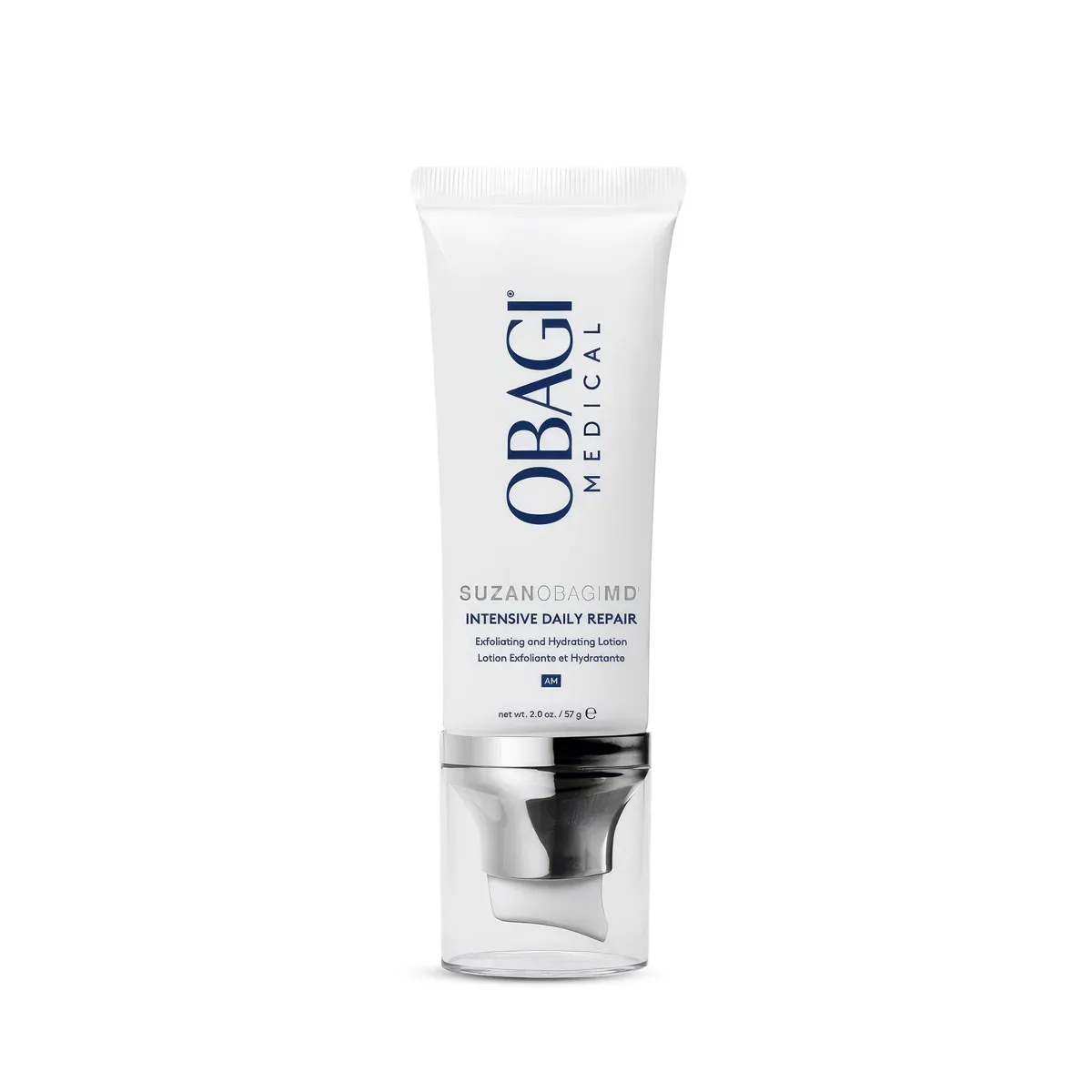
It is a physician-brand exfoliant built on the two gentlest acids in the class, gluconolactone and lactobionic acid, in the top four of the list, wrapped in shea, panthenol, allantoin, bisabolol and chamomile so that rosacea-prone and post-procedure skin can exfoliate daily. Most acid lotions choose strength; this one chooses tolerability, and it is candid about it.
The exfoliant Obagi made for people who cannot use Obagi: two polyhydroxy acids high in the list, a serious soothing cast and a shea-rich base that lets sensitive, dry and rosacea-prone skin resurface daily without a sting. It is too heavy for oily faces, its results are gentle by design, and $90 for 2 oz is a physician-brand markup on cheap acids, but for its intended skin it is well judged.
Eight years on the market and a few hundred retailer reviews support the comfort and tolerability observations, but Obagi quotes no efficacy figures for this lotion and its own site carries only a handful of mixed ratings, so the assessment leans on the published literature for polyhydroxy acids rather than on data about this product. Much of that PHA research was sponsored by the acids' manufacturer.
Verdicts
How well it fits each concern
Verdict by concern tap a concern for the case
Unprovenfor AgingIn your profileYou chose · Vitamin C has early or mechanistic evidence for aging — a reasonable bet, not a recommendation; the other actives here are not yet assessed for it.Moderate evidenceGentleNo reviews collected yet
The case for it
Tetrahexyldecyl Ascorbate has early or mechanistic evidence for this concern, not trial-backed standing.
It is present below the studied range.
The formula carries none of the triggers this concern is sensitive to.
What would change this: A concentration inside the studied range would raise this a step.
Same rule for everyone. “Unproven” is the verdict on 1,111 of 45,024 concern verdicts across the catalog; rule R9 decided 1,111 of them.
As of September 25, 2026, engine 5.1.1.
R9 — Plausible-tier actives alone do not earn a recommendation, and 'not for this' would overstate the case against them. 'Unproven' with the evidence dots lets the reader judge the bet (added 0.2.0 after the first shadow run put a 10% niacinamide serum at 'not for this' for hyperpigmentation). 0.5.0: the closing clause reads the other heroes — "nothing else here addresses it" only when every other active has a researched 'none' row; "not yet assessed" when that is the truth. Rows whose dots read moderate or better now reach R9p first. · the full register
Carrying active
Tetrahexyldecyl Ascorbate
Standing
plausible — trials support it
Form
sub threshold — studied range 5%, from the trials on the row; needs leave-on contact; judge it after ~12 weeks
Tolerability
gentle
Row checked
against its sources on July 17, 2026 (evidence table ev-2026.09-r228)
Good choicefor DrynessIn your profileYou chose · Shea Butter is a reference standard by mechanism for dryness; this lotion carries it high in the ingredient list.Moderate evidenceGentleNo reviews collected yet
The case for it
Butyrospermum Parkii has trial-supported standing for this concern.
It is present at an effective concentration, declared or high in the ingredient list.
The formula carries none of the triggers this concern is sensitive to.
Same rule for everyone. “Good choice” is the verdict on 9,564 of 45,024 concern verdicts across the catalog; rule R5 decided 9,072 of them.
As of September 25, 2026, engine 5.1.1.
Also listed for Rough Texture, Dullness and Large Pores — the actives here (Gluconolactone, Lactobionic Acid, Shea Butter, Allantoin) are in our research queue for those concerns; there is no verdict until their evidence rows are written. That is a gap in our table, not a mark against the product.
Where our review and the verdict differ. The review below was written on the formulation and the published trials; the verdicts above apply the stricter standing test in our methodology — an active earns a recommendation only with guideline or regulatory standing for the concern. Where the two disagree, the verdict is DermApproved’s position.
A verdict is DermApproved’s assessment of how well a product’s ingredients fit a concern — never a claim about what the product treats. Evidence dots and collected reviews sit beside it and are never blended in.
Rules 0.5.1 · evidence table ev-2026.09-r228 · how we decide
Assessment
Pros & Cons
Pros
✓ Gluconolactone and lactobionic acid third and fourth in the list, a real PHA dose
✓ No sting, and PHAs are documented as compatible with rosacea and atopic skin
✓ Panthenol, allantoin, bisabolol and chamomile form a serious soothing cast
✓ Rich enough to replace a morning moisturizer on dry or normal skin
✓ Fragrance-free and alcohol-free, with antioxidant support from vitamins C and E
✓ Pairs well under sunscreen with a night-time retinoid or Nu-Derm regimen
✓ Airless pump keeps the antioxidants and acids stable
Cons
✗ Shea, ethylhexyl palmitate and alkyl benzoate make it too heavy for oily or acne-prone skin
✗ $90 for 2 oz is a physician-brand premium on inexpensive acids
✗ Results are gentle and gradual, easy to mistake for nothing happening
✗ Pump dispenses more than a face needs
✗ Peptides sit at the very end of the list and add little
✗ Obagi quotes no efficacy data for this product and its own site reviews are thin
Review
Full Review
Obagi's reputation was built on the Nu-Derm system, a supervised regimen of tretinoin and hydroquinone that makes skin peel, flush and, eventually, transform, and that a large share of patients abandon within weeks because they cannot stand it. The SuzanObagiMD line, launched in 2018 with dermatologist Suzan Obagi, exists for those patients, and Intensive Daily Repair is its exfoliant: a lotion designed to resurface skin that flinches at glycolic acid, let alone retinoic. Read that way, its every formulation choice makes sense, including the ones that limit it.
The acids come first. Gluconolactone is third in the list and lactobionic acid fourth, ahead of every emollient, which makes this a genuinely PHA-driven product rather than a moisturizer with a whisper of acid. Polyhydroxy acids are the large, slow cousins of the alpha-hydroxies: their extra hydroxyl groups make them bulky, so they penetrate gradually instead of flooding the epidermis, and they bind water, chelate metals and scavenge radicals along the way. The clinical literature on them, largely from the same NeoStrata group that gave the world glycolic acid, found they deliver AHA-like smoothing and anti-aging effects without the sensory irritation, are compatible with rosacea and atopic skin, can be used after procedures and combine well with retinoic acid and hydroquinone. That is a description of exactly the patient this lotion was made for.
Around the acids is a base that is generous to the point of excess. Caprylic/capric triglyceride second, glyceryl stearate and glycerin, then shea butter eighth, an alkyl benzoate, ethylhexyl palmitate, cetyl alcohol and dimethicone. It is a proper cream-lotion, rich enough to stand in for a morning moisturizer on dry skin, and it is the reason oily and congestion-prone users report heaviness and the occasional breakout: three of those emollients have comedogenic reputations, and the shea is not subtle. The soothing cast follows: panthenol, allantoin, bisabolol, green tea and chamomile extracts, tocopheryl acetate, an oil-soluble vitamin C ester near the end, a little hyaluronic acid, and two myristoyl pentapeptides as the final entries, present at a level that makes them a label credit rather than a mechanism. Mica and titanium dioxide give the finish a faint luminosity.
In use it is quiet. Two or three pumps spread easily, sink in over a minute and leave a satin, lightly glowing surface with no tingle at all, which sensitive users who have braced for an acid find almost disconcerting. Skin feels hydrated immediately, because PHAs are humectants, and by the second or third week the surface is smoother and clearer in the way a gentle exfoliant produces: less roughness, a little more brightness, pores that look slightly tidier. That is the honest ceiling. It does not deliver the visible turnover of a 10% glycolic or the remodelling of a retinoid, and Obagi, to its credit, does not claim it does; the brand quotes no efficacy percentages for this product at all, which is rare for the company and slightly telling.
Two details in the list deserve a second look. The first is that the product is entirely fragrance-free and alcohol-free, which for an acid lotion from a clinical brand is not automatic and matters enormously to the audience it serves; the chamomile extract is the only botanical a reactive person might need to think about. The second is the optical finish: mica and titanium dioxide give the skin a soft, healthy-looking luminosity that sunscreen covers but that, on a bare face in the morning, reads as the kind of glow people credit to the acids. It is harmless and a little flattering, and it is worth knowing which part is the light and which part is the skin.
The complaints in eight years of reviews are consistent and fair. The lotion is heavy on oily skin. The results are subtle. The pump throws out more than a face needs. And $90 for 2 oz is a lot for gluconolactone, lactobionic acid and shea butter, materials that cost little; the premium is for the physician-brand channel, the SuzanObagiMD name and a formula that has been thought through for tolerability rather than for drama. At two to three pumps a day the bottle lasts six to eight weeks, so the monthly cost runs $45 to $60, which is prestige-serum territory for a daily lotion.
Where it earns its place is in a specific routine: the patient on tretinoin or Nu-Derm at night whose skin cannot take a second active, or the rosacea-prone person who has never been able to exfoliate at all, using this in the morning under sunscreen and getting a gradual, comfortable improvement in texture without the flare that every other acid has caused. For that person, the lotion is close to ideal and the price is a fair trade for not having to give up. For someone with resilient, oily or acne-prone skin, or anyone who wants an exfoliant to feel like it is working, a lighter, cheaper glycolic or salicylic product will do more; this one was never meant for them, and it says so in every ingredient.
Formula
Key Ingredients
The hero actives that drive this product's performance.
Third in the list, ahead of every emollient, which makes this a genuinely PHA-led lotion rather than a moisturizer with a sprinkle of acid. Gluconolactone's large ring structure keeps it on the surface, exfoliating slowly and holding water as it goes, so a sensitive face can use it daily where glycolic would sting.
Fourth in the list, the second polyhydroxy acid, larger still than gluconolactone and even gentler; it adds antioxidant chelation to the exfoliating and humectant work, and together the pair is the closest thing to a daily acid that rosacea-prone skin can tolerate.
Eighth in the list, the occlusive that lets a PHA product double as the day's moisturizer, cushioning the exfoliation so skin feels supplied rather than scrubbed; it is also the reason oily and congestion-prone skin finds the lotion heavy.
Established mechanismfor Dryness · established mechanism
The oil-soluble vitamin C ester near the end of the list, joining tocopheryl acetate and green tea in an antioxidant garnish that supports the PHAs' own free-radical scavenging; its position makes it a supporting note rather than a brightening dose.
The soothing pair mid-list that, with panthenol and chamomile extract, is the SuzanObagiMD signature: enough anti-irritant support that a lotion built on two acids can be sold to the sensitive-skin patients the line was created for.
Not yet assessed
Ingredient standings describe the active at treatment-level doses and
vehicles; this product's own condition grades weigh its actual formula.
Obagi positions it as a morning step: two to three pumps after cleansing and any serum, feathered onto the jawline and neck, then sunscreen straight over it. It can replace a morning moisturizer on dry skin; at night it sits under, not with, a retinoid, so alternate or keep it to daytime.
Results Timeline
Softer, more hydrated skin from the first application, since PHAs are humectants as well as exfoliants. Smoother texture and a clearer surface show at two to four weeks; the pore and fine-line improvements Obagi describes are eight-to-twelve-week outcomes and gentler than a glycolic product would produce.
The formulation logic rests on the pharmacology of polyhydroxy acids, and the foundational review of that class comes from the group that developed them. A 2004 supplement in Cutis described PHAs such as gluconolactone and lactobionic acid as a new generation of alpha-hydroxy acids that provide the same exfoliation, smoothing and anti-aging benefits without the sensory irritation that limits classical AHAs; the larger PHA molecules penetrate more slowly, and their multiple hydroxyl groups give them humectant, moisturizing and barrier-enhancing properties that AHAs lack, along with antioxidant activity through metal chelation. The authors reported that PHAs are compatible with clinically sensitive skin including rosacea and atopic dermatitis, can be used after cosmetic procedures, were well tolerated in combination with retinoic acid in adult facial acne, produced significant smoothing and plumping when combined with pro-vitamin A, and were compatible across African American, Caucasian and Hispanic and Asian skin. Much of that work was sponsored by the manufacturer of the acids, which is the appropriate caveat, but the tolerability findings have held up in two decades of clinical use and are the reason PHAs are the standard recommendation when a sensitive or retinoid-treated patient needs an exfoliant.
This lotion places gluconolactone third and lactobionic acid fourth, an order consistent with a working PHA concentration, and buffers them with sodium hydroxide. The emollient base of caprylic/capric triglyceride, glyceryl stearate, shea butter, C12-15 alkyl benzoate, ethylhexyl palmitate, cetyl alcohol and dimethicone supplies occlusion and slip that offsets any barrier disruption from daily exfoliation, at the cost of comedogenic potential on oily skin. Panthenol, allantoin and bisabolol have documented anti-irritant and barrier-supporting effects; chamomile and green tea extracts add polyphenol antioxidants alongside tocopheryl acetate and tetrahexyldecyl ascorbate, a stable lipophilic vitamin C ester whose position near the end of the list implies a supporting dose. Sodium hyaluronate contributes surface hydration. Myristoyl pentapeptide-11 and myristoyl pentapeptide-8 are the final two ingredients and, at that position, are unlikely to reach the concentrations used in their supplier studies. Mica and titanium dioxide are optical. Obagi publishes no clinical or consumer data specific to this product, so its benefits are inferred from the PHA literature rather than demonstrated in this formula.
Polyhydroxy acids occupy a well-defined niche in clinical practice: they are what dermatologists reach for when a patient needs exfoliation but cannot tolerate glycolic or salicylic acid, whether because of rosacea, atopic tendencies, recent procedures or, very commonly, an ongoing retinoid regimen that has used up the skin's tolerance. A gluconolactone-and-lactobionic lotion with panthenol, allantoin and bisabolol is a textbook version of that recommendation, and its origin in a dermatologist-developed line for sensitive Nu-Derm patients is consistent with how it is typically used, as a morning step under sunscreen opposite a night-time retinoid. The reservations are about fit rather than safety: the shea-and-ester base makes it a poor choice for acne-prone or seborrhoeic patients, who would be steered to a lighter PHA format, and the chamomile is worth noting for anyone with a daisy-family allergy. Expectations are also set realistically, since PHAs improve texture and hydration gradually and do not substitute for a retinoid on lines or pigment. For the sensitive, dry or retinoid-treated patient it is an easy recommendation, with the price the only real hesitation.
Guidance
Usage & Recommendations
How to Use
Use once a day, in the morning, on clean, dry skin. After any serum, dispense two pumps, three if you are covering the neck, and massage into the face, then feather the lotion down over the jawline and onto the neck; a little goes further than the pump suggests. Let it settle for a minute and apply broad-spectrum sunscreen over it, which is non-negotiable with any daily exfoliant. On dry or normal skin it can be the morning moisturizer; on combination skin, skip a separate cream and keep it thin over the T-zone. Do not combine it with a glycolic or salicylic product in the same routine, and keep retinoids or Nu-Derm for the evening. If skin is freshly lasered, peeled or irritated, wait until it has calmed. Patch test if you are allergic to chamomile or related plants.
Value Assessment
Ninety dollars for 2 oz puts this at the top of the exfoliating-lotion market, and its materials, two polyhydroxy acids, shea butter, glycerin, esters and a soothing cast, are not expensive; PHA lotions with similar acid placement exist at a third of the price. The premium buys a physician-dispensed brand, a formula tuned specifically for tolerability alongside tretinoin, an airless pump and the SuzanObagiMD name. At two to three pumps once daily the bottle lasts six to eight weeks, so the running cost is $45 to $60 a month, which is steep for what is functionally a daily lotion; using two pumps and keeping it to the face stretches it toward three months. There is only one size. For a Nu-Derm or tretinoin patient whose skin has rejected every other exfoliant, the price is a fair trade for finally having one that works; for anyone else, the same acids are available for much less.
Who Should Buy
People with sensitive, dry, rosacea-prone or retinoid-treated skin who have never been able to tolerate a daily exfoliant and want one that also moisturizes, especially patients on tretinoin or Nu-Derm looking for a gentle morning step under sunscreen. Anyone who prefers subtle, steady texture improvement to dramatic peeling will find it well matched.
Who Should Skip
Oily, acne-prone or fungal-acne-prone skin will find the shea-and-ester base heavy and may congest. Anyone wanting visible exfoliation or a treatment for pigment and lines should use a glycolic product or a retinoid instead, and budget shoppers can get the same two acids for far less.
A medium-weight, faintly luminous lotion with a soft shea richness that spreads easily, sinks in over a minute and leaves a satin, lightly dewy finish from the mica and titanium dioxide
Scent
Unscented; a faint neutral cream smell with no added fragrance
Packaging
A 2 oz airless pump bottle in SuzanObagiMD's clean white livery
Finish
satindewy
What to Expect on First Use
The first application is undramatic, which is the point: a soft lotion, no sting, a faint glow from the light-reflecting minerals, and skin that feels supplied rather than exfoliated. Sensitive users who brace for an acid tingle find none. The only early adjustment is for oily skin, which notices the shea within a day or two.
How Long It Lasts
About six to eight weeks at two to three pumps once daily on face and neck; longer if kept to the face
Obagi launched the SuzanObagiMD line in 2018, developed with dermatologist Suzan Obagi at the University of Pittsburgh, as a gentler counterpart to the brand's prescription-strength Nu-Derm system for patients who could not tolerate it. Intensive Daily Repair was the line's exfoliating step, built on the polyhydroxy acid work that showed PHAs could deliver AHA-like benefits without the sting, and it has since been folded into Obagi's simplified catalogue under the same name.
About Obagi Legacy Brand (20+ years)
Obagi has been a physician-dispensed brand since dermatologist Zein Obagi founded it in 1988, and the SuzanObagiMD sub-line, developed with dermatologist Suzan Obagi, launched in 2018 for sensitive skin. Its polyhydroxy acid approach draws on a published clinical literature; Obagi quotes no efficacy figures for this lotion, and its own site carries only a handful of mixed reviews.
Brand founded: 1988 · Product launched: 2018
Myth vs. Reality
Common Myths
Myth
Polyhydroxy acids are just weaker glycolic acid.
Reality
They are larger molecules that penetrate more slowly, which is why they do not sting, but they also bind water, chelate metals and act as antioxidants, none of which glycolic acid does. They exfoliate more gently and more slowly, and they moisturize while they do it, which is a different trade rather than a diluted one.
Myth
A product with 'repair' in the name rebuilds the skin.
Reality
The name refers to daily maintenance of texture and hydration. The acids resurface, the emollients and humectants support the barrier, and the antioxidants offer some defence; nothing here remodels collagen or reverses damage, and the peptides at the end of the list are present at levels that do not change that.
FAQ
Frequently Asked Questions
Is Obagi Intensive Daily Repair a moisturizer or an exfoliant?
Both, deliberately. Gluconolactone and lactobionic acid sit third and fourth in the list for gentle daily exfoliation, and shea butter, glycerin and esters make it rich enough to replace a morning moisturizer on dry or normal skin. Oily skin may want to treat it as a treatment step and skip a separate cream.
Can I use Obagi Intensive Daily Repair if I have rosacea?
It is one of the few exfoliants built for that. Polyhydroxy acids have been shown to be compatible with rosacea and atopic skin, and the formula adds panthenol, allantoin, bisabolol and chamomile as anti-irritants. Patch test first, and note the chamomile if you react to plants in the daisy family.
Can Obagi Intensive Daily Repair be used with tretinoin or Nu-Derm?
Yes, and that pairing is one reason it exists. Use the PHA lotion in the morning under sunscreen and the retinoid at night; the published PHA work found the combination with retinoic acid well tolerated. Do not stack it with a glycolic or salicylic product in the same routine.
Is Obagi Intensive Daily Repair good for oily or acne-prone skin?
Not really. The acids are fine, but shea butter, ethylhexyl palmitate and C12-15 alkyl benzoate in the top ten make the base rich, and congestion-prone users often find it heavy. A lighter PHA gel or toner suits oily skin better.
Why does Obagi Intensive Daily Repair look slightly shimmery?
Mica and titanium dioxide are in the list, giving the lotion a faint light-reflecting glow on the skin. It is cosmetic, reads as a healthy satin finish rather than glitter, and disappears under sunscreen.
Is Obagi Intensive Daily Repair safe during pregnancy?
Polyhydroxy acids are generally considered among the safest exfoliants in pregnancy, and the formula has no retinoids, hydroquinone or salicylic acid. Confirm with your obstetrician, and be aware that pregnancy skin can be more reactive.
Reviews
What Reviewers Tend to Say
Recurring themes our editors read across retailer reviews of this product — summaries in our words, not quotations, and not a substitute for your own patch test.
Common Praise
Smooths texture without the sting of glycolic acid
Doubles as a morning moisturizer on dry skin
Skin looks clearer and brighter within a month
No fragrance, no irritation on rosacea-prone skin
Common Complaints
Too heavy and greasy for oily or acne-prone skin
Expensive for the size
Pump dispenses too much
Results are subtle compared with stronger acids
Notable Endorsements
Developed with dermatologist Suzan Obagi for sensitive and post-procedure patientsDispensed by dermatology practices as a gentle daily exfoliant alongside tretinoin regimens
Polyhydroxy acids get filed under 'beginner exfoliant,' as if gentle meant weak. The truth is stranger: their bulk is exactly why they work for the skin everything else sets on fire.
Natural formulators swap shea, cocoa, mango and murumuru as though they were interchangeable. One carries roughly ten times the non-fat material of the others, and one is functionally a wax.
Glow isn't a vibe or a filter. It's light bouncing off smooth, hydrated, evenly-toned skin, which means you can reverse-engineer it into a checklist instead of chasing it with a highlighter.
Mar 18, 2026· 6 min
Questions people ask about exfoliation
Verified answers from our questions library — the nuance a product page cannot carry.
Products, answers, therapy guides, tools and articles in one search. Brand names,
slang and abbreviations all work — accutane finds isotretinoin, bacne finds truncal acne.