You Don't Look Tired. You Have Three Separate Things Happening Under Your Eyes.
Blood, pigment and shadow produce almost identical darkness in a bathroom mirror — and only one of them is a skincare problem.
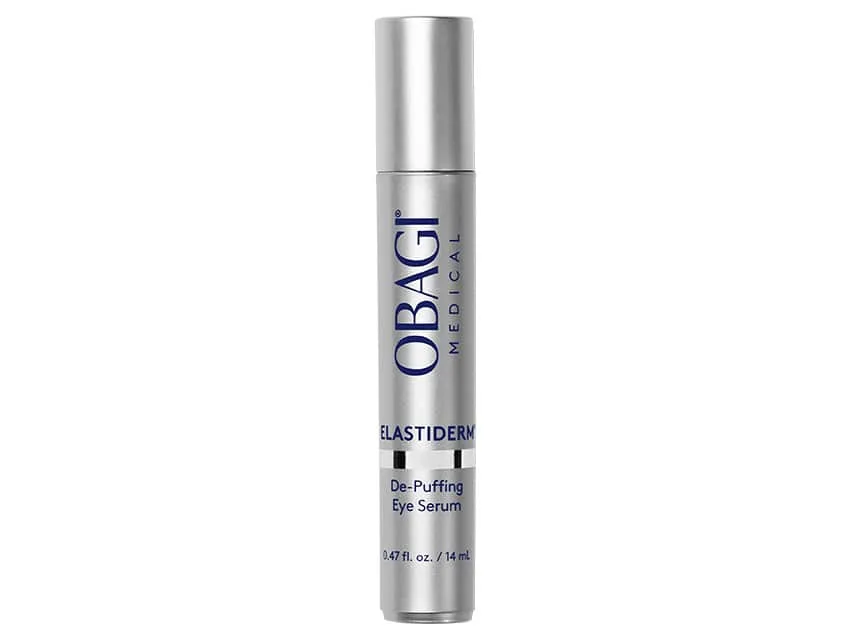
Thirteen ingredients, no oil, no silicone, no fragrance, no film-former: it is caffeine and Obagi's biopsy-studied copper-zinc malonate in a glycol-water base, delivered by a steel rollerball. Most de-puffing serums pad the formula with humectants and botanicals; this one does one fast thing and one slow thing and leaves hydration to whatever you put on next.
A cold steel rollerball loaded with caffeine and Obagi's copper-zinc complex, and almost nothing else: it de-puffs on the spot, irritates no one and adds no hydration or brightening. For morning puffiness on tolerant or reactive eyes alike it is reliable; at $130 for 14 ml it is paying clinical-brand money for one fast trick and one slow, unproven-in-this-bottle promise.
More than a decade of physician-channel sales and several hundred reviews support the de-puffing, comfort and tolerability observations, but Obagi publishes no consumer or instrumental figures for this serum, and its elasticity claim borrows a 2009 biopsy study of the copper-zinc malonate complex in a facial cream rather than resting on trials of the serum itself. The concentration of the complex in this vehicle is not disclosed.
The case for it
What would change this: A declared concentration would move this to a firmer reading of the dose.
Same rule for everyone. “Supporting role” is the verdict on 8,197 of 45,024 concern verdicts across the catalog; rule R8a decided 1,489 of them. As of September 25, 2026, engine 5.1.1.
Brand or formulator? Disclose a concentration or correct a fact →
The studies behind the evidence row
Also listed for Aging — the actives here (Propanediol, Caffeine, Arginine, bi mineral contour complex) are in our research queue for that concern; there is no verdict until their evidence rows are written. That is a gap in our table, not a mark against the product.
Does the jobDoes what a eye cream is for: safe for eye skin, targets a real eye concern. Not measured from the label: hydrates without heaviness, stays where it's put.
A verdict is DermApproved’s assessment of how well a product’s ingredients fit a concern — never a claim about what the product treats. Evidence dots and collected reviews sit beside it and are never blended in. Rules 0.5.1 · evidence table ev-2026.09-r228 · how we decide
Thirteen ingredients. Water, two glycols, caffeine, a preservative, a thickener, a surfactant, malonic acid, arginine, a preservative booster, two mineral salts and a pH adjuster. Obagi's De-Puffing Eye Serum is about as austere as a cosmetic gets, and the austerity is the point: it does one fast thing, de-puff with caffeine and cold, and one slow thing, feed the under-eye a copper-zinc malonate complex with biopsy evidence for elastin, and it declines to do anything else. No oil, no silicone, no hyaluronic acid, no botanicals, no fragrance. Whether that reads as clinical discipline or as $130 for not much depends on what you were hoping an eye serum would do.
The product has been around since 2012 as the ELASTIderm Eye Serum, built as the morning partner to Obagi's ELASTIderm Eye Cream, and the 2025 renaming by function changed nothing but the label. It has accumulated several hundred reviews in that time, which say the same thing in the same order: the rollerball is cold and lovely, the puffiness goes down, nothing happens to dark circles, the tube is small.
The fast job is done well. Caffeine is fourth in the list, behind only water and the two glycols that carry it, which is a real dose in a formula this thin. It constricts the superficial vessels under the eye and helps move the fluid that pools there overnight, and the steel rollerball does the same mechanically, especially straight from the fridge. Roll once under each eye and by the time the liquid has dried, a minute later, the morning bags are visibly flatter. It lasts most of the day. The formula dries to absolutely nothing, so concealer goes over it without a thought, and its lack of anything reactive makes it one of the few eye products that people with eczema-prone lids and easily stung eyes can use without incident.
The slow job is more speculative. Malonic acid with zinc carbonate and copper carbonate hydroxide is the Bi-Mineral Contour Complex that Obagi has patented, and the evidence for it is a 2009 biopsy study of a copper-zinc malonate cream on photoaged facial skin, which found increased new elastin synthesis and regenerating elastic fibres after six weeks. That is a real result and it belongs to a cream, on the face, at a stated 0.1%. The serum uses the same complex in a glycol-water base under the eye, and Obagi publishes no consumer or instrumental figures for it. Users who stay with it for a few months sometimes describe the under-eye looking smoother and springing back a little better, which is what the mechanism would predict, and it is also what a few months of a consistent eye routine tends to produce regardless. The claim is plausible; it is not proven in this bottle.
What the serum will not do is anything about dark circles beyond the vascular kind, and it is worth being blunt because the two problems get sold together so often. There is no niacinamide, arbutin, vitamin C or retinoid here. Pigmented circles stay exactly as they were. Bluish circles look lighter for a few hours because the vessels are narrower. Hollows are hollows.
The formula's austerity has a cost beyond the mechanisms it omits. There is no emollient of any kind, so dry or mature under-eyes will feel the absence and need a cream over the top, which for most users means the ELASTIderm eye cream Obagi bundles it with and another $130. The rollerball, delightful when it works, is a mechanical part that sometimes stops rolling or dispenses unevenly near the end. And the price per millilitre is steep for two glycols and caffeine, however well judged: the 14 ml tube lasts three to four months at one pass per eye twice a day, which softens the arithmetic to around $35 to $45 a month but does not change what the money buys.
There is also a practical case for the format that the ingredient list does not show. A rollerball serum is the only under-eye product many people will use consistently in the morning, because it takes ten seconds, needs no fingers and cannot be over-applied; the discipline of a tiny, quick, cold step is what makes a caffeine product work at all, since caffeine's effect is measured in hours and has to be repeated daily. That is the argument for the tube over a tub of gel, and it is a real one for anyone who has bought de-puffing creams and left them in the drawer.
It is easiest to recommend to two kinds of person. The first has reactive eyes and has given up on eye products because everything stings, and wants something that will de-puff in the morning without a reaction; this is close to the safest option on the market. The second is already using the ELASTIderm eye cream and wants the morning counterpart Obagi designed for it. For everyone else, a fragrance-free caffeine eye gel with a bit of hyaluronic acid does the puffiness job, hydrates on the way, and costs a fraction; the copper-zinc complex is the only argument for paying more, and it is an argument for patience rather than a promise.
The hero actives that drive this product's performance.
| Ingredient | Function | Evidence |
|---|---|---|
| Caffeine | Fourth in a thirteen-ingredient list, directly after the two glycols, which puts caffeine at a genuinely working level in this water-thin serum. It is the de-puffing engine, constricting the fine vessels under the eye and moving fluid along, and the cold rollerball is there to give it a mechanical push. | Limited for Dark Circles |
| Bi-Mineral Contour Complex (Malonic Acid, Zinc Carbonate, Copper Carbonate Hydroxide) | Obagi's patented copper-zinc malonate, the same complex as in the ELASTIderm creams, here carried in a glycol-water base with nothing to slow its contact with the thin under-eye skin. Its published biopsy evidence is for elastin synthesis in facial skin; in this serum it is the slow, elasticity-oriented half of a formula whose fast half is caffeine. | Not yet assessed |
| Arginine | An amino acid placed just after the malonic acid, doing double duty as a pH partner for the acid and as a mild humectant, the only real hydration in a formula that otherwise leaves moisturizing to whatever follows it. | Not yet assessed |
| Dipropylene Glycol + Methylpropanediol | The two glycols second and third in the list are the vehicle: solvents that keep the caffeine and mineral salts dissolved, spread instantly from the rollerball and dry down to nothing, which is why the serum can go under makeup in a minute. | Not yet assessed |
Aqua (Water), Dipropylene Glycol, Methylpropanediol, Caffeine, Phenoxyethanol, Hydroxyethylcellulose, Laureth-9, Malonic Acid, Arginine, Ethylhexylglycerin, Zinc Carbonate, Copper Carbonate Hydroxide, Sodium Hydroxide
treatment
AM & PM
Roll on after cleansing, morning and night, along the orbital bone and outer corner, before any eye cream or face serum. It is water-thin with no emollient at all, so dry under-eyes need a cream over it; kept in the fridge, the rollerball works harder in the morning.
Puffiness looks reduced within minutes from the caffeine and the cold roller, and again each morning it is used. The mineral complex's elasticity work, if it shows, is a two-to-three-month change in how the under-eye springs back. Do not expect pigmented dark circles to lighten; nothing here targets pigment.
The serum combines a well-understood fast mechanism with a slower one whose evidence is borrowed. Caffeine's cosmetic pharmacology is documented: it penetrates skin readily, it is a phosphodiesterase inhibitor, it stimulates cutaneous microcirculation and it produces vasoconstriction of superficial vessels, which together account for its reputation against periorbital oedema and vascular shadowing. In this formula caffeine is the fourth ingredient in a thirteen-item list carried by dipropylene glycol and methylpropanediol, solvents that dissolve it fully and evaporate quickly, so contact with the thin under-eye skin is immediate and unimpeded by emollients. The steel rollerball adds thermal vasoconstriction and mechanical lymphatic displacement, the same principle as a cold compress. The de-puffing effect is therefore real, rapid and reversible, lasting hours rather than days.
The slow mechanism is the Bi-Mineral Contour Complex: malonic acid with zinc carbonate and copper carbonate hydroxide, a copper-zinc malonate. Its supporting evidence is a 2009 study in Experimental Dermatology in which 21 women with photoaged facial skin applied a 0.1% copper-zinc malonate cream twice daily for six weeks; biopsies showed regenerating elastic fibres on histology, a significant increase in newly synthesised tropoelastin by immunofluorescence, and increased desmosine, an elastin-specific cross-link, with the authors proposing that the bi-metal compound enhances elastin biosynthesis and that this may explain wrinkle effacement seen in clinical trials of the cream. The proposed pathway is cofactor support for lysyl oxidase, the copper-dependent enzyme that cross-links elastin. That study concerns a cream on facial skin; the serum delivers the same salts in a glycol-water vehicle under the eye at an unstated concentration, and no trial of the serum itself has been published, so the elasticity benefit should be regarded as mechanistically plausible rather than demonstrated. Arginine contributes buffering and mild humectancy, hydroxyethylcellulose thickens, laureth-9 is a solubiliser and phenoxyethanol with ethylhexylglycerin preserves. The formula contains no ingredient with evidence against pigmentary dark circles.
For periorbital puffiness, the clinical advice is usually to address contributors first, sleep position, salt, allergies and alcohol, and then to accept that topical products offer temporary relief through caffeine and cold, which is exactly what this serum provides in a clean, fragrance-free vehicle that practitioners are comfortable suggesting for reactive or eczema-prone eyelids. Its lack of emollient is a feature for oily or milia-prone patients and a gap for dry, mature ones, who are typically told to layer an eye cream over it. On the elasticity claim, dermatologists familiar with the ELASTIderm literature would note that the biopsy evidence for the copper-zinc malonate complex comes from a facial cream and has not been replicated for this serum, and would position the product as a de-puffer with a possible long-term bonus rather than as an anti-aging treatment; a retinoid remains the evidence-based choice for periorbital lines in patients who can tolerate one. Patients with dark circles are counselled that the cause determines the treatment and that this serum addresses only the vascular component, briefly. As a safe morning product for puffiness it fits standard advice; the price is the main reason it is not recommended more widely.
Roll it on twice a day, on clean, dry skin and before any eye cream or face product. Shake the tube gently, then roll the steel ball along the orbital bone under each eye from the inner corner outward and up toward the outer corner, one or two passes per eye; the ball dispenses a thin film of liquid as it moves. Pat any excess in with the ring finger and let it dry for about a minute, after which concealer or an eye cream can go on. Keep the serum on the bone rather than the lash line. For stronger morning de-puffing, store the tube in the refrigerator. Dry or mature under-eyes should follow with an emollient eye cream, since the serum contains none. Wipe the rollerball after use and cap it, and if the ball stops turning, warm the tip briefly in the hand and roll it on the back of the hand to free it.
One hundred and thirty dollars for 14 ml is a high price per millilitre, and the ingredients, two glycols, caffeine, a thickener, a surfactant, an amino acid and two mineral salts, cost very little; what the money buys is Obagi's physician-brand provenance, the patented complex with its biopsy study, a well-made steel rollerball and a formula that can be trusted on the most reactive eyes. Because the roller dispenses sparingly, a tube lasts three to four months at twice-daily use, bringing the monthly cost to roughly $35 to $45, which is more palatable than the sticker suggests. There is only one size, and it is often bundled with the ELASTIderm eye cream. Against fragrance-free caffeine eye gels at a quarter of the price, it is expensive for the de-puffing alone; against other physician-brand eye serums, it is priced in line and simpler than most. For reactive eyes or committed ELASTIderm users the value is acceptable; for anyone shopping on ingredients per dollar, it is not.
People whose main under-eye complaint is morning puffiness and who want a fast, cooling, fragrance-free fix that disappears under makeup, especially those with reactive, eczema-prone or easily stung eyes who have struggled with other eye products. Existing ELASTIderm eye cream users wanting the morning counterpart Obagi designed for it are the other natural audience.
Anyone with dry, mature under-eyes who wants hydration will find nothing here and should look for a cream or a serum with humectants. People targeting pigmented dark circles need niacinamide, arbutin or vitamin C at working doses, hollows need a different conversation altogether, and budget shoppers can get the caffeine and the cold from a fragrance-free gel for far less.
A water-thin, clear liquid dispensed by a steel rollerball that glides cool over the skin and dries down to nothing within a minute
None; unfragranced and odourless
A slim 14 ml tube with a metal rollerball applicator and a cap, in ELASTIderm's white-and-blue livery
The first roll is the whole experience: a cold metal ball gliding under the eye, a thin liquid that vanishes as it dries, and puffiness that looks noticeably less by the time the coffee is made. There is no tingle, no residue and nothing to adjust to; dry skin will notice the absence of any cushion and want a cream after it.
About three to four months at one pass under each eye twice daily; the rollerball dispenses sparingly
All Year
Obagi added the ELASTIderm Eye Serum around 2012 as the morning companion to its ELASTIderm Eye Cream, pairing the cream's copper-zinc malonate complex with caffeine and a cooling rollerball for the puffiness the cream did not address. In Obagi's 2025 renaming by function it became the De-Puffing Eye Serum, unchanged in formula, still sold beside the cream and often bundled with it.
Founded in 1988 by dermatologist Zein Obagi, Obagi has been a physician-dispensed brand for nearly forty years and its ELASTIderm eye products have sat in dermatology offices for most of that time. The copper-zinc malonate complex in this serum has a peer-reviewed biopsy study behind it; the serum itself carries no published trial and its de-puffing claim rests on caffeine's general literature.
A de-puffing eye serum will fade dark circles too.
This one contains nothing that acts on pigment. Caffeine can make vascular, bluish circles look lighter for a few hours by constricting the vessels, but pigmented circles and shadow from hollows are untouched. The formula is honest about being for puffiness and fine lines.
The cold rollerball is a gimmick.
Cold is the oldest de-puffing tool there is: it constricts superficial vessels and helps shift the fluid that pools under the eye overnight. Combined with caffeine, which does the same thing chemically, the roller is doing real, if temporary, work, and chilling the tube makes it do more.
Yes. Obagi renamed it by function in its 2025 relaunch. The formula, the 14 ml rollerball tube, the caffeine-and-mineral-complex pairing and the $130 price are unchanged from the ELASTIderm Eye Serum sold since 2012.
After cleansing, roll the steel ball gently along the orbital bone under each eye and out toward the temple, one or two passes, then smooth any liquid in with a fingertip. Use morning and night; keeping the tube in the fridge makes the morning de-puffing stronger. Follow with an eye cream if your under-eye is dry.
They are designed as a pair. Roll the serum on first, let it dry for a minute, then apply the cream over it. The serum brings the caffeine and the cold; the cream brings the emollients and a higher concentration of the shared mineral complex.
Barely. Its base is two glycols with a little arginine, and it contains no oil, butter, silicone or hyaluronic acid. It is a treatment liquid, not a moisturizer, and dry or mature under-eyes should layer a cream over it.
Only the vascular kind, and only for a few hours, because caffeine constricts the vessels that show through thin skin. It has no brightening or pigment-inhibiting ingredient, so pigmented circles and hollows will look the same.
It is among the least likely eye products to react: no fragrance, alcohol, retinoid, acid or essential oil. The only ingredients occasionally implicated in sensitivity are phenoxyethanol and laureth-9, both at low levels. Keep it off the lash line and it is unlikely to sting.
Recurring themes our editors read across retailer reviews of this product — summaries in our words, not quotations, and not a substitute for your own patch test.
Rollerball is cooling and visibly de-puffs in the morning
Absorbs instantly and sits under concealer
No sting or irritation, even on sensitive eyes
Under-eye skin looks smoother after a couple of months
Expensive for such a small bottle
Does nothing for dark circles
Rollerball can stop rolling or dispense unevenly
No hydration, so dry under-eyes need a cream on top