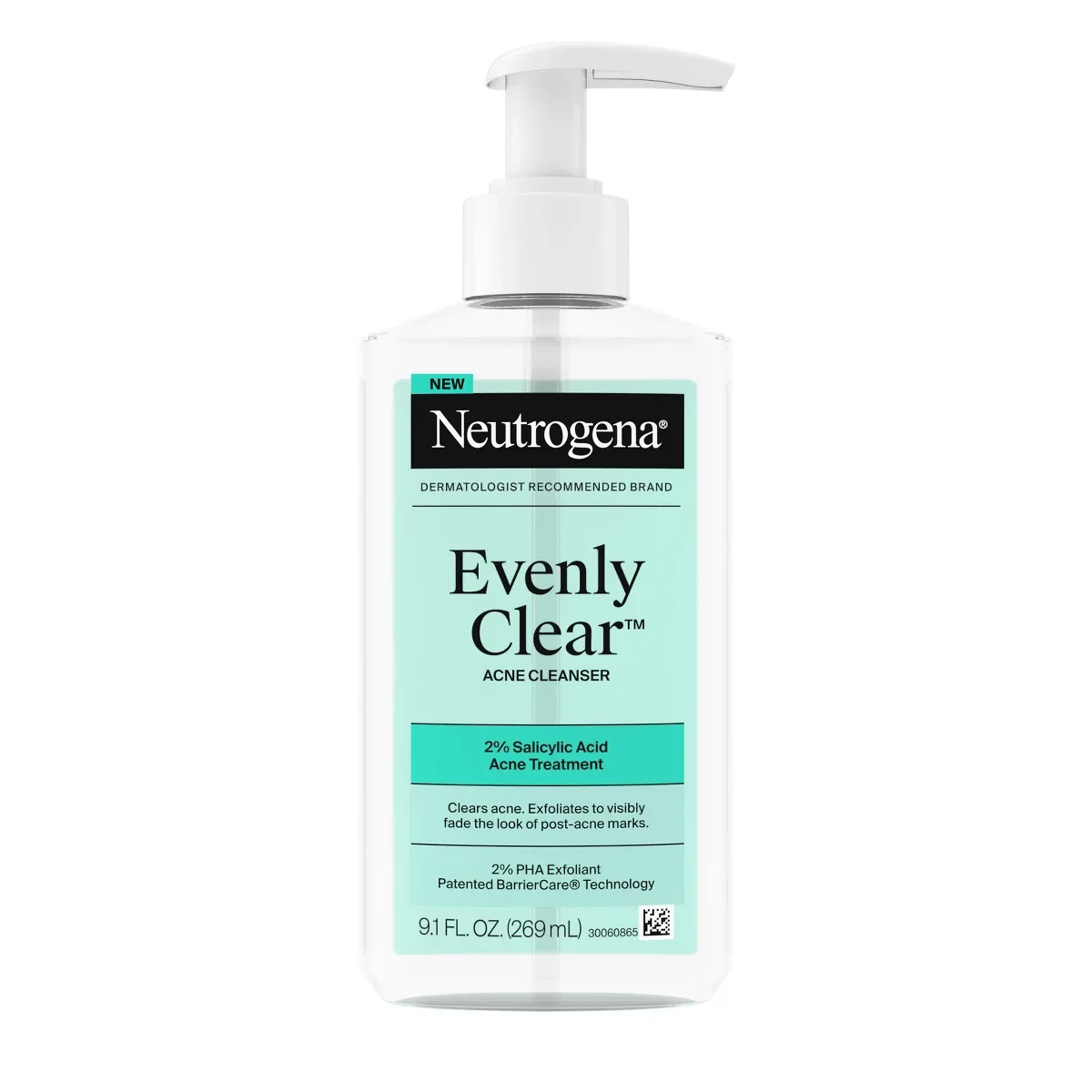
It is a two-percent salicylic acid acne wash rebuilt for the ingredient-literate: sulfate-free, fragrance-free, with a declared two percent gluconolactone PHA for gentle surface exfoliation and glycerin and panthenol to offset the acid, in a line designed and tested with post-acne marks on skin of colour in mind. Same monograph active as the drugstore classics, considerably kinder base.
Neutrogena's 2025 rethink of the drugstore acne wash: the same two percent salicylic acid as the classics, on a sulfate-free taurate-sultaine base with a declared two percent PHA, glycerin, panthenol and no fragrance, so oily skin gets cleaned without being stripped. One of the better acne cleansers on a drugstore shelf at fifteen dollars; a rinse-off still cannot fade marks, and combination skin will want it once a day.
The cleanser has been on the market since January 2025 with a large first-year review base and a DailyMed label fixing its active, but Neutrogena's oil-removal and mark-related claims come from in-house panels that are not published, so the assessment leans on the well-established salicylic acid and PHA literature, the surfactant chemistry and the retailer feedback rather than on independent trials. The cleansing and tolerability judgements are confident; the line's mark-fading positioning is evaluated as a routine claim, not a cleanser claim.
Verdicts
How well it fits each concern
Verdict by concern tap a concern for the case
Good choicefor AcneIn your profileYou chose · Salicylic Acid is an approved or monograph active for acne; this rinse-off foam carries it at 2% — short contact still counts for this active, but a leave-on does more.Moderate evidenceStandard tolerabilityNo reviews collected yet
The case for it
Salicylic Acid 2% is a first-line active — approved, monograph-listed or named in current guidelines — for this concern.
It is present at an effective concentration, declared or high in the ingredient list.
The formula carries no trigger this concern is sensitive to, with the cautions noted.
Cautions: known irritants.
Same rule for everyone. “Good choice” is the verdict on 9,564 of 45,024 concern verdicts across the catalog; rule R2r decided 408 of them.
As of September 25, 2026, engine 5.1.1.
R2r — Rinse-off exceptions (BPO wash, salicylic acid cleanser) deliver a real but smaller effect than the leave-on form; they cap at 'good choice'. Medicated shampoos for scalp concerns are exempt — the shampoo is the treatment form. Editorial decision 2 Sep 2026, pending advisory review. · the full register
Carrying active
Salicylic Acid 2%
Standing
first line — a regulator recognises it for this use; trials support it · per § 333.310 Acne active ingredients. (U.S. Food and Drug Administration — 21 CFR Part 333 Subpart D (Topical Acne Drug Products), Code of Federal Regulations via GovInfo), opened July 27, 2026
Form
adequate (declared 2%) — studied range 0.5–2%, from the OTC monograph or label; judge it after ~6 weeks
Tolerability
standard — irritant load
Row checked
against its sources on July 27, 2026 (evidence table ev-2026.09-r228)
Good choicefor BlackheadsIn your profileYou chose · Salicylic Acid is an approved or monograph active for blackheads; this rinse-off foam carries it at 2% — short contact still counts for this active, but a leave-on does more.Moderate evidenceGentleNo reviews collected yet
The case for it
Salicylic Acid 2% is a first-line active — approved, monograph-listed or named in current guidelines — for this concern.
It is present at an effective concentration, declared or high in the ingredient list.
The formula carries none of the triggers this concern is sensitive to.
Same rule for everyone. “Good choice” is the verdict on 9,564 of 45,024 concern verdicts across the catalog; rule R2r decided 408 of them.
As of September 25, 2026, engine 5.1.1.
R2r — Rinse-off exceptions (BPO wash, salicylic acid cleanser) deliver a real but smaller effect than the leave-on form; they cap at 'good choice'. Medicated shampoos for scalp concerns are exempt — the shampoo is the treatment form. Editorial decision 2 Sep 2026, pending advisory review. · the full register
Carrying active
Salicylic Acid 2%
Standing
first line — a regulator recognises it for this use; trials support it · per 21 CFR § 333.350 - Labeling of acne drug products. (US Code of Federal Regulations (Legal Information Institute, Cornell Law School)), opened July 27, 2026
Form
adequate (declared 2%) — studied range 0.5–2%, from the OTC monograph or label; judge it after ~6 weeks
Tolerability
gentle
Row checked
against its sources on July 27, 2026 (evidence table ev-2026.09-r228)
The studies behind the evidence row
OTC monograph, Topical Acne Drug Products — salicylic acid 0.5–2% recognized as an acne treatment active — US Food and Drug Administration
Supporting rolefor Excess OilinessIn your profileYou chose · Rinse-off foam: Salicylic Acid gets seconds of contact, so this supports a routine for excess oiliness rather than treating it.Moderate evidenceGentleNo reviews collected yet
The case for it
Salicylic Acid 2% has early or mechanistic evidence for this concern, not trial-backed standing.
It is in a rinse-off product, so it gets seconds of contact rather than the leave-on exposure the evidence assumes.
The formula carries none of the triggers this concern is sensitive to.
What would change this: The same active in a leave-on form would be judged on its evidence rather than its contact time.
Same rule for everyone. “Supporting role” is the verdict on 8,197 of 45,024 concern verdicts across the catalog; rule R6 decided 2,017 of them.
As of September 25, 2026, engine 5.1.1.
R6 — Contact time cannot deliver a leave-on claim; the product is judged on its job (cleansing without aggravating). Explicit exceptions (BPO wash, SA cleanser, medicated shampoos) never reach this rule because their rows set rinse_off_ok. · the full register
Carrying active
Salicylic Acid 2%
Standing
plausible — trials support it
Form
contact limited — studied range 30%, from the trials on the row; needs leave-on contact; judge it after ~6 weeks
Tolerability
gentle
Row checked
against its sources on July 17, 2026 (evidence table ev-2026.09-r228)
Also listed for Acne Scarring — the actives here (Salicylic Acid, Cleansing Surfactants, Glycerin, Gluconolactone) are in our research queue for that concern; there is no verdict until their evidence rows are written. That is a gap in our table, not a mark against the product.
Does the jobDoes what a cleanser is for: surfactant mildness, rinses clean without stripping. Not measured from the label: pH match to skin.
A verdict is DermApproved’s assessment of how well a product’s ingredients fit a concern — never a claim about what the product treats. Evidence dots and collected reviews sit beside it and are never blended in.
Rules 0.5.1 · evidence table ev-2026.09-r228 · how we decide
Assessment
Pros & Cons
Pros
✓ Two percent salicylic acid, the monograph maximum, on a DailyMed-listed Drug Facts panel
✓ Sulfate-free taurate-sultaine base cleans oil without stripping
✓ Declared two percent gluconolactone PHA for gentle surface exfoliation
✓ Glycerin, panthenol and starch derivative cushion the acid
✓ Fragrance-free, dye-free, oil-free and vegan
✓ Fifteen dollars for a 9.1-ounce pump, three to four months of use
✓ Over a thousand retailer reviews at 4.6 stars within its first year
Cons
✗ A rinse-off cannot fade existing dark marks, whatever the line promises
✗ Drying on combination cheeks at twice daily; once a day is the realistic rhythm
✗ Benzalkonium chloride and cocamidopropyl derivatives are known sensitisers
✗ Light, airy foam disappoints people who equate lather with cleaning
✗ Not for dry, sensitive, rosacea-prone or eczema-prone skin
Review
Full Review
For about thirty years the American drugstore acne wash has been a fixed thing: two percent salicylic acid, a sulfate surfactant that foams like a bar of soap, a fragrance, and a squeaky, tight finish that generations of teenagers learned to read as clean. Neutrogena wrote most of that template with its Oil-Free Acne Wash, and its Evenly Clear cleanser, launched in January 2025, is the same company quietly rewriting it. The active is unchanged, two percent salicylic acid on a Drug Facts panel, registered on DailyMed as an OTC monograph drug. Everything around it is different, and the difference is the review.
The base is sulfate-free. Cocamidopropyl hydroxysultaine and sodium methyl cocoyl taurate lead the inactives, an amphoteric-and-taurate pair that has become the standard for dermatologist-developed acne washes because it cleans oil thoroughly, Neutrogena's panel measured up to 85 percent of surface oil removed in a wash, without the barrier disruption of sodium laureth sulfate. Glycerin sits fourth and panthenol mid-list, with a potato-starch derivative the brand calls BarrierCare, to cushion the acid; there is no fragrance, no dye, no oil, no silicone. Then, fifth, the second acid: gluconolactone, a polyhydroxy acid Neutrogena declares at two percent, the gentlest exfoliating acid in common use, a big humectant molecule that penetrates slowly and smooths the surface without the sting or the inflammatory flush of a glycolic. That choice is the tell about who the line is for. Evenly Clear was built around post-acne marks on skin of colour, where inflammation is the enemy because it is what darkens a mark, and a PHA is the exfoliant you pick when you want turnover without irritation.
In use the wash is what the rest of the aisle should have been years ago. A pump of clear gel works into a soft, airy foam, a faint cooling tingle from menthyl lactate signals the ritual, and the rinse leaves oily skin fresh, matte and comfortable rather than squeaky. Shine is down by the afternoon; fewer new blackheads and whiteheads follow within three or four weeks of twice-daily use as the salicylic acid does its brief, repeated work at the pore openings. The more than a thousand Target reviews at 4.6 stars are almost all about the same thing: it works like the old wash without the tightness. Combination skin does notice the acid on the cheeks after a few days and settles at once a day, which is the honest rhythm for most people who are not oily all over, and dry or sensitive skin should not be using a two percent salicylic wash at all.
It helps to see where the cleanser sits in the line, because Evenly Clear is a routine rather than a product. Neutrogena built it as a five-step set: this wash, a salicylic gel moisturiser, a benzoyl peroxide cleansing mask, a PHA leave-on exfoliant and an adapalene 0.1 percent retinoid, and each carries its own Drug Facts panel where it needs one. The wash is the step that every user takes twice a day, which is why the brand spent its effort making it tolerable; the mask and the retinoid are the ones that carry the acne-clearing load, and the exfoliant and sunscreen the mark-fading one. Read that way, the cleanser's modest job, remove oil, loosen pores, do no harm, is exactly the right job for it, and it does it better than the bottle it replaced.
One practical note on the foam. The taurate-sultaine system produces a lighter, airier lather than a sulfate wash, and people raised on dense drugstore foam sometimes read that as weak and use twice as much. A single pump is enough for a full face; the cleaning is being done by the surfactants and the acid, not by the volume of bubbles, and the lighter foam is the trade for the absence of tightness afterward.
The limits are the format's. A wash-off is on the face for under a minute, so the salicylic acid and the PHA loosen pores and remove oil and do not change pigment; Evenly Clear's promise to fade the look of marks belongs to the routine, where fewer new breakouts mean fewer new marks and the leave-on PHA exfoliant, the adapalene gel and daily sunscreen do the actual fading. Buyers who expect the cleanser to erase existing dark spots are the source of its few disappointed reviews. The Drug Facts warning to use one acne medication at a time is about stacking dryness rather than danger, and the practical answer is to introduce the wash first and a benzoyl peroxide or adapalene a week or two later, dropping to once daily if the skin objects.
The small quibbles are ingredients that a very reactive face might notice: menthyl lactate is mild but it is a cooling agent, benzalkonium chloride is a quaternary preservative with a known sensitisation rate, cocamidopropyl derivatives are a recognised patch-test allergen, and chamomile extract is there for the label. None of them troubles most oily skin. All of them are reasons the 'gentle' on the front applies to the surfactant base rather than to the whole formula for the truly sensitive.
At fifteen dollars for a 9.1-ounce pump, three to four months of twice-daily washing, it is priced like the drugstore classic it replaces and undercuts every dermatologist-brand salicylic wash with the same base by half or more. For oily and combination acne-prone skin, and particularly for people with deeper skin tones who have found older acne washes left them irritated and marked, it is the cleanser to reach for first.
Formula
Key Ingredients
The hero actives that drive this product's performance.
The OTC acne active at the monograph ceiling, declared on a Drug Facts panel; in a rinse-off it gets thirty to sixty seconds of contact, enough for the oil-soluble acid to begin loosening keratin in follicle openings and to lower surface oil, and not enough to do what a leave-on does. It is the reason the wash is a drug, and the reason concurrent acne treatments should be introduced one at a time.
The polyhydroxy acid Neutrogena declares at two percent, fifth on the inactive list, a large, slow-penetrating, humectant exfoliant that smooths surface texture without the sting of glycolic; in this wash it is there to keep the mark-fading promise on skin of colour honest by exfoliating gently rather than provoking the inflammation that darkens marks.
A sulfate-free amphoteric-and-taurate surfactant pair leading the inactives, mild enough to earn the 'gentle' on the front and foamy enough to remove the up-to-85-percent of surface oil Neutrogena measured; the taurate is what most modern non-stripping acne washes rely on, and it is the reason this cleanser does not leave the tightness the brand's older Oil-Free Acne Wash does.
Neutrogena's BarrierCare Technology, on the label, is a humectant pair and a starch derivative that cushion the surfactant system; glycerin fourth and panthenol mid-list reduce post-wash dryness, which on a two-percent salicylic wash is the difference between skin that tolerates twice-daily use and skin that flakes.
A mild, menthol-derived cooling agent that gives the foam a faint, fresh chill without menthol's sting or smell, the sensory cue that makes an acne wash feel as though it is working; it is harmless on most skin and the first thing a reactive user will notice.
Not yet assessed
Ingredient standings describe the active at treatment-level doses and
vehicles; this product's own condition grades weigh its actual formula.
Wash twice a day as the Drug Facts direct, then moisturise; the salicylic acid rinses off, so a leave-on treatment still does the heavy lifting. The label's warning to use only one acne medication at a time is about stacking irritation, so pair it with a benzoyl peroxide or adapalene by introducing one, then the other a week or two later, and drop to once daily if the skin gets tight.
Results Timeline
Oil and shine drop from the first wash, which is what Neutrogena's 85-percent-oil-removal figure measures. Fewer new blackheads and whiteheads take three to four weeks of twice-daily use, and any fading of post-acne marks is a matter of eight to twelve weeks, mostly from preventing new inflammation and wearing sunscreen; a wash-off cannot fade existing marks on its own.
Pairs Well With
Neutrogena Evenly Clear Acne Gel Face MoisturizerNeutrogena Evenly Clear Facial Retinoid (adapalene) at nightA non-comedogenic sunscreen for mark fading
Other salicylic acid washes in the same routineIntroducing benzoyl peroxide or adapalene at the same time rather than staggeredLeave-on AHA/BHA exfoliants on the same day for sensitive skin
Neutrogena Evenly Clear Gentle Acne Foaming Face Cleanser
Neutrogena Evenly Clear Acne Gel Face Moisturizer
Sunscreen
Sample PM Routine
Neutrogena Evenly Clear Gentle Acne Foaming Face Cleanser
Adapalene or benzoyl peroxide (staggered introduction)
Moisturiser
Evidence
Science & Expert Perspective
The Science
The cleanser pairs the best-evidenced OTC acne active with a modern surfactant system, and the science of each is clear. Salicylic acid at two percent is the upper limit of the FDA acne monograph, and as a lipophilic beta-hydroxy acid it dissolves in sebum and loosens corneocyte cohesion in the follicular infundibulum, the mechanism behind its comedolytic effect; the caveat for any wash is contact time, since thirty to sixty seconds delivers a fraction of the keratolysis a leave-on provides, and trials of salicylic acid cleansers show real but modest reductions in comedones and surface oil compared with vehicle, consistent with Neutrogena's oil-removal figure and with the gradual improvement users report. Gluconolactone, a polyhydroxy acid, is a larger molecule than glycolic or lactic acid with slower penetration, humectant activity and antioxidant capacity, and comparative studies have shown it exfoliates with substantially less stinging and erythema, which matters in a line aimed at post-inflammatory hyperpigmentation in skin of colour, where irritation-driven inflammation is itself a cause of marks; its declared two percent in a rinse-off contributes a mild surface smoothing rather than the resurfacing of a leave-on.
The surfactant chemistry explains the tolerability. Cocamidopropyl hydroxysultaine is an amphoteric surfactant and sodium methyl cocoyl taurate a mild anionic, and their combination forms mixed micelles with far lower protein binding and barrier disruption than the sodium laureth sulfate base of legacy acne washes; PEG-120 methyl glucose dioleate thickens without adding irritancy. Glycerin at fourth and panthenol reduce post-wash transepidermal water loss, and sodium hydrolyzed potato starch dodecenylsuccinate is a starch-derived polymer that deposits lightly to reduce the feeling of dryness, the basis of the BarrierCare label. Menthyl lactate is a menthol ester that activates cold receptors with milder irritancy and less odour than menthol, cocamidopropyl PG-dimonium chloride phosphate is a mild conditioning agent, and benzalkonium chloride preserves the formula; benzalkonium and cocamidopropyl derivatives are both documented contact allergens at low frequency, and chamomile is an Asteraceae sensitiser. The Drug Facts warning about concurrent acne medications reflects additive dryness and irritation with benzoyl peroxide, retinoids or other salicylates, not a pharmacological interaction. The evidence supports the cleanser as an effective, unusually mild two percent salicylic acid wash for oily and combination acne-prone skin and does not support any direct effect on existing hyperpigmentation.
Dermatologist Perspective
A two percent salicylic acid cleanser on a sulfate-free base is close to what dermatology now recommends as the wash step for oily, comedonal, acne-prone skin, and this one is a welcome update to a drugstore category that had lagged; clinicians who counsel patients on acne routines tend to prefer exactly this pairing of a mild surfactant system with the monograph maximum of salicylic acid, with the leave-on work assigned to adapalene or benzoyl peroxide and the wash kept to once or twice daily depending on dryness. The line's emphasis on post-inflammatory hyperpigmentation in skin of colour is regarded as sound in principle, since minimising irritation is central to preventing marks, and the choice of a polyhydroxy acid over glycolic is consistent with that; clinicians would nonetheless remind patients that a cleanser does not treat existing marks and that sunscreen and a retinoid do. The Drug Facts caution about combining acne medications is interpreted in practice as advice to stagger introductions rather than a prohibition. Patients with dry, atopic, rosacea-prone or barrier-compromised skin are directed to a non-acid cleanser, and those with known sensitivity to benzalkonium chloride or cocamidopropyl compounds should check the list. Pregnancy poses no concern with a rinse-off salicylic acid at this level.
Guidance
Usage & Recommendations
How to Use
Twice a day, wet the face with lukewarm water, pump the clear gel into wet hands and work it into a soft foam, then massage gently over the face for thirty to sixty seconds, avoiding the eye area, and rinse thoroughly; if any foam gets into the eyes, flush with water. Pat dry and follow with a moisturiser, and with sunscreen in the morning, which matters for anyone hoping to fade marks. Introduce it on its own for a week or two before adding benzoyl peroxide or adapalene, and if the skin becomes tight or flaky, drop to once daily, ideally in the evening. Combination skin often settles at once a day; dry and sensitive skin should use a non-acid cleanser instead. Keep the pump closed and use within twelve months of opening.
Value Assessment
Fifteen dollars for a 9.1-ounce pump is the price the drugstore acne wash has always been, and at two pumps twice daily the bottle lasts three to four months, so the cost per wash is trivial; what has changed is what the money buys. The same two percent salicylic acid now comes on a sulfate-free taurate-sultaine base with a declared PHA, humectants and no fragrance, a combination that dermatologist-developed brands sell for thirty to forty dollars in smaller bottles, and Neutrogena's scale makes it the cheapest route to that formulation. Against the brand's own Oil-Free Acne Wash it costs a dollar or two more and is markedly kinder; against a plain gentle cleanser it is the same price with an acne active added. Excellent value for oily and combination acne-prone skin, and the trial-size tube makes testing tolerance cheap.
Who Should Buy
Oily and combination acne-prone skin, teenagers and adults alike, that wants a two percent salicylic acid wash without the sulfate strip and fragrance of the drugstore classics, and particularly people with deeper skin tones who have found older acne washes irritating and mark-provoking. Anyone building an Evenly Clear or adapalene routine gets the right first step.
Who Should Skip
Dry, sensitive, rosacea-prone, eczema-prone or barrier-compromised skin should use a non-acid gentle cleanser, and anyone expecting a face wash to fade existing dark marks needs a leave-on treatment and sunscreen instead. People with known reactions to benzalkonium chloride, cocamidopropyl compounds or chamomile should read the list first.
Ready to try Neutrogena Evenly Clear Gentle Acne Foaming Face Cleanser with Salicylic Acid and PHAs?
A clear gel that pumps out and works into a soft, airy, low-density foam on wet skin, with a faint cooling tingle, rinsing clean to a fresh, non-tight finish.
Scent
Fragrance-free; a faint clean, slightly minty-cool note from the menthyl lactate while lathering.
Packaging
A 9.1-ounce clear pump bottle in the Evenly Clear blue-and-white livery, hygienic and easy to dose; smaller 2-ounce and 0.5-ounce tubes exist for travel and trial.
Finish
mattenon-greasy
What to Expect on First Use
The first wash is a pleasant surprise for anyone raised on the brand's older acne washes: a soft foam, a light cool tingle, a clean rinse and skin that feels fresh rather than squeaky. Oily skin sees less shine by the afternoon; combination skin may notice dryness on the cheeks after a few days of twice-daily use and settles at once a day. There is no purging from a wash-off, and the eyes tolerate stray foam better than most acne cleansers.
How Long It Lasts
About three to four months at two pumps twice daily.
FDA OTC monograph acne drugSulfate-freeFragrance-freeDye-freeNon-comedogenic
Background
The Story Behind This Product
Neutrogena launched Evenly Clear in January 2025 as its first acne line built around post-inflammatory marks and skin of colour, pairing this cleanser with a gel moisturiser, a benzoyl peroxide mask, a PHA exfoliant and an adapalene retinoid; the cleanser replaced the harsher sulfate base of the brand's legacy acne washes with a taurate-sultaine system and a PHA, following the direction dermatologist-developed acne care had taken over the previous decade.
About Neutrogena Legacy Brand (20+ years)
Neutrogena, now under Kenvue, has sold dermatologist-marketed acne washes for decades and registers them as FDA OTC monograph drugs with labelled actives on DailyMed, which fixes the salicylic acid dose here at two percent. Evenly Clear is its 2025 acne line built for skin of colour and post-acne marks, with in-house clinical panels that are disclosed in claims but not published.
Brand founded: 1930 · Product launched: 2025
Myth vs. Reality
Common Myths
Myth
A salicylic acid face wash fades dark acne marks.
Reality
The acid and the PHA rinse away in under a minute, which is enough to loosen pore openings and remove oil and not enough to change pigment in the skin. Evenly Clear's mark-fading story belongs to the whole routine: fewer new breakouts means fewer new marks, the PHA exfoliant and adapalene do the leave-on work, and sunscreen does the rest. The wash is the gentle first step, not the fader.
Myth
Two acids in an acne wash makes it harsh.
Reality
Salicylic acid at two percent is the standard monograph dose, and gluconolactone is the gentlest exfoliating acid in common use, a large molecule that penetrates slowly and holds water; the pair on a sulfate-free base with glycerin and panthenol is milder than the brand's older single-acid, sulfate-based washes. The dryness some users report is the salicylic acid, and once-daily use is the fix.
FAQ
Frequently Asked Questions
What is in the Neutrogena Evenly Clear Gentle Acne Foaming Face Cleanser?
Two percent salicylic acid as the FDA-listed acne active, a declared two percent gluconolactone PHA, a sulfate-free surfactant pair of cocamidopropyl hydroxysultaine and sodium methyl cocoyl taurate, glycerin and panthenol for barrier comfort, a potato-starch derivative Neutrogena calls BarrierCare, a menthyl lactate cooling agent and a chamomile extract. It is fragrance-free, dye-free, oil-free and vegan.
How is the Evenly Clear cleanser different from Neutrogena's Oil-Free Acne Wash?
Same two percent salicylic acid active, very different base. The Oil-Free Acne Wash uses a sulfate-based surfactant system and a fragrance; Evenly Clear is sulfate-free and fragrance-free, adds a two percent PHA and humectants, and was designed with post-acne marks on skin of colour in mind. It cleans oily skin as well and leaves it noticeably less tight.
Does the Neutrogena Evenly Clear cleanser fade dark spots and acne marks?
Not on its own. A wash-off is on the skin for under a minute and cannot change pigment; its contribution to mark fading is preventing new breakouts and exfoliating gently without the irritation that darkens marks on deeper skin tones. The leave-on steps in the Evenly Clear line, the PHA exfoliant and adapalene, plus daily sunscreen, are what fade existing marks over months.
Can I use the Evenly Clear cleanser with benzoyl peroxide or adapalene?
Yes, and the line is built for it, but the Drug Facts warning about using one topical acne medication at a time is about irritation, not safety: introduce the cleanser first, add benzoyl peroxide or adapalene a week or two later, and if the skin gets tight or flaky drop the wash to once a day. Most people settle on the wash morning and evening with adapalene at night.
Is the Neutrogena Evenly Clear cleanser too drying for combination skin?
Twice a day, it can be; two percent salicylic acid removes oil efficiently and combination cheeks notice within a few days. Glycerin, panthenol and the sulfate-free base soften it considerably compared with older acne washes, and once-daily use with a moisturiser afterward suits most combination skin. Dry and sensitive skin should choose a non-acid cleanser.
How do you use the Neutrogena Evenly Clear Acne Cleanser?
Wet the face, pump the gel into wet hands, work it into a lather and massage gently over the face for thirty to sixty seconds, then rinse thoroughly, twice a day as the label directs. Avoid the eyes and flush with water if it gets in. Follow with a moisturiser, and sunscreen in the morning.
Reviews
What Reviewers Tend to Say
Recurring themes our editors read across retailer reviews of this product — summaries in our words, not quotations, and not a substitute for your own patch test.
Common Praise
Cleans oily skin without the tight, stripped feel of older acne washes
The whole case for salicylic acid rests on one unglamorous fact of chemistry: it dissolves in oil. Understand that, and you know exactly when it beats a glycolic acid — and when it's overkill.
Adult hormonal acne and teenage acne are different beasts, yet grown women keep drying out deep jawline cysts with teenage products and wondering why it spreads.
Products, answers, therapy guides, tools and articles in one search. Brand names,
slang and abbreviations all work — accutane finds isotretinoin, bacne finds truncal acne.