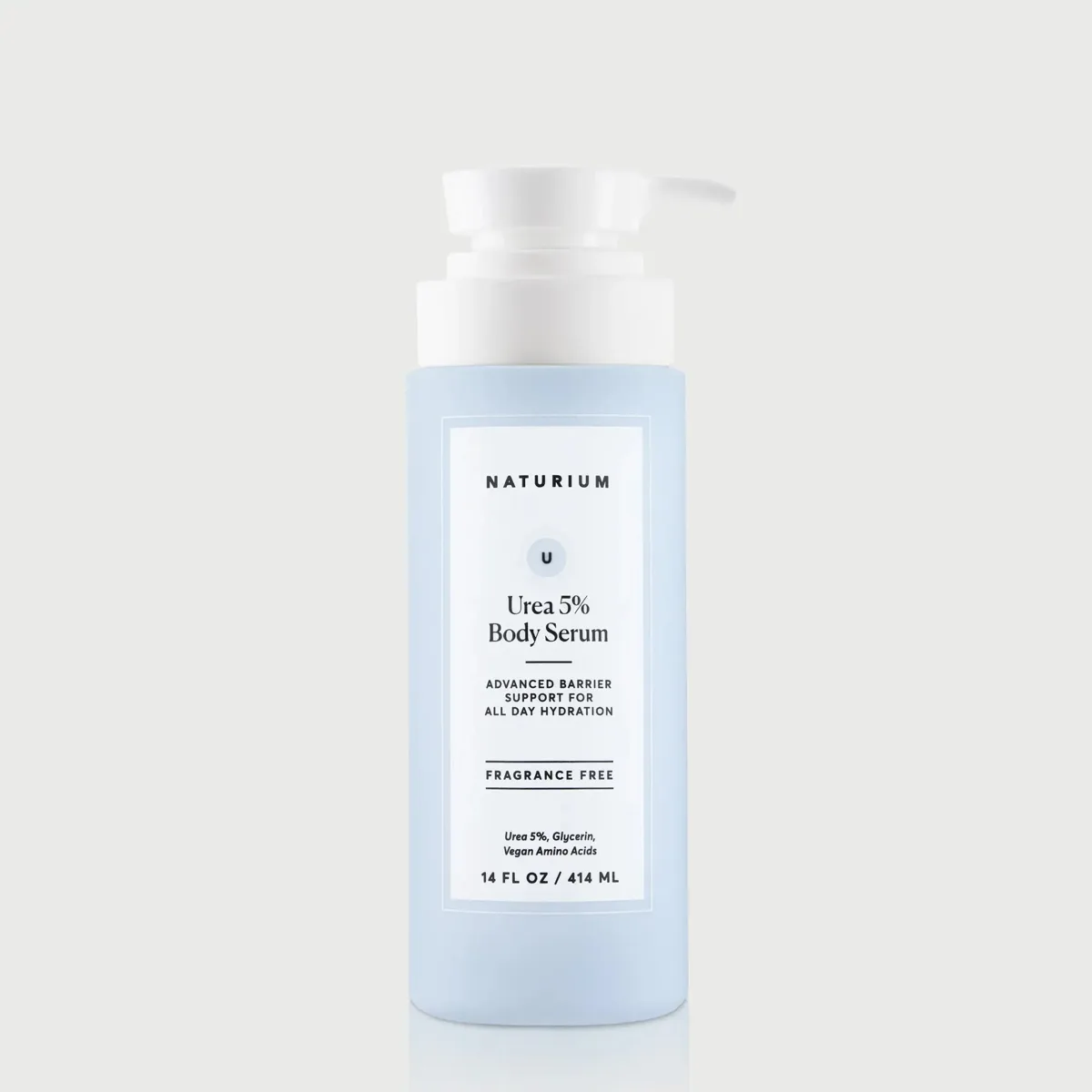
Most urea body products are heavy creams at 10 percent and above aimed at cracked heels; this one puts a hydrating 5 percent urea into a milky, fast-absorbing serum alongside the rest of the skin's own natural moisturising factor — glycerin, PCA, hyaluronate and free amino acids — so it works as an everyday whole-body hydrator rather than a targeted keratolytic, fragrance-free and cheap enough to use lavishly from a 14-ounce pump.
A smart, unglamorous body hydrator: 5 percent urea with glycerin, PCA, hyaluronate and free amino acids — the skin's own moisturising factor, replaced wholesale — in a thin, fragrance-free milk that vanishes in a minute and costs $23 for 14 ounces. It makes ashy shins and rough elbows look better within a week and hydrates deeply over a month. It is not a KP smoother at this dose, the 'firming' is marketing, and very dry skin needs a cream over it; but as the daily base layer for a whole body, it is one of the better-value things in the aisle.
Nearly two years on the shelf and around a hundred and twenty Target reviews at 4.1 stars make this a moderately documented product whose active — urea at a declared 5 percent — has decades of clinical evidence behind it; the middling rating and the complaints about thinness and the pump are weighed here as real signals about the format rather than the chemistry. No product-specific study exists beyond the brand's dermatologist-tested claim, the review base is small for a mass-market body product, and the astaxanthin and amino-acid claims are read as cosmetic rather than tested.
Verdicts
How well it fits each concern
Verdict by concern tap a concern for the case
Good choicefor DrynessIn your profileYou chose · Glycerin is a reference standard by mechanism for dryness; this lotion carries it high in the ingredient list.Moderate evidenceGentleNo reviews collected yet
The case for it
Glycerin + Magnesium PCA + Sodium Hyaluronate has trial-supported standing for this concern.
It is present at an effective concentration, declared or high in the ingredient list.
The formula carries none of the triggers this concern is sensitive to.
Same rule for everyone. “Good choice” is the verdict on 9,564 of 45,024 concern verdicts across the catalog; rule R5 decided 9,072 of them.
As of September 25, 2026, engine 5.1.1.
Good choicefor DehydrationIn your profileYou chose · Glycerin is a reference standard by mechanism for dehydration; this lotion carries it high in the ingredient list.Moderate evidenceGentleNo reviews collected yet
The case for it
Glycerin + Magnesium PCA + Sodium Hyaluronate has trial-supported standing for this concern.
It is present at an effective concentration, declared or high in the ingredient list.
The formula carries none of the triggers this concern is sensitive to.
Same rule for everyone. “Good choice” is the verdict on 9,564 of 45,024 concern verdicts across the catalog; rule R5 decided 9,072 of them.
As of September 25, 2026, engine 5.1.1.
R5 — Trial-supported or guideline-supported active, adequately or plausibly dosed. · the full register
Carrying active
Glycerin + Magnesium PCA + Sodium Hyaluronate
Standing
supported — its mechanism is established
Form
adequate — studied range 20%, from the trials on the row; needs leave-on contact; judge it after ~1 weeks
Tolerability
gentle
Row checked
against its sources on July 17, 2026 (evidence table ev-2026.09-r228)
The studies behind the evidence row
USP glycerin monograph / Fluhr et al., glycerol and the skin (review) — glycerin is the reference humectant, drawing and holding water in the stratum corneum — reference work
Supporting rolefor Rough TextureIn your profileYou chose · Urea is a reference standard by mechanism for rough texture, but this lotion carries it below the studied range — a supporting role at best.Moderate evidenceGentleNo reviews collected yet
The case for it
Urea 5% has trial-supported standing for this concern.
It is present below the studied range.
The formula carries none of the triggers this concern is sensitive to.
What would change this: A concentration inside the studied range would raise this a step.
Same rule for everyone. “Supporting role” is the verdict on 8,197 of 45,024 concern verdicts across the catalog; rule R7 decided 258 of them.
As of September 25, 2026, engine 5.1.1.
R7 — A supported active under-dosed cannot be recommended for the concern; if the category has a supportive job it may still help alongside treatment. · the full register
Carrying active
Urea 5%
Standing
supported — its mechanism is established
Form
sub threshold (declared 5%) — studied range 10%, from the trials on the row; needs leave-on contact; judge it after ~2 weeks
Tolerability
gentle
Row checked
against its sources on July 17, 2026 (evidence table ev-2026.09-r228)
The studies behind the evidence row
International Cosmetic Ingredient Dictionary and Handbook — declared function — Personal Care Products Council
United States Pharmacopeia / National Formulary — excipient monograph — USP-NF
Supporting rolefor Keratosis PilarisIn your profileYou chose · Nothing here targets keratosis pilaris directly; emollient hydration is the recognised companion to treating it, and this lotion does that without known triggers.Limited evidenceGentleNo reviews collected yet
The case for it
Urea 5% has early or mechanistic evidence for this concern, not trial-backed standing.
It is present below the studied range.
The formula carries none of the triggers this concern is sensitive to.
What would change this: A concentration inside the studied range would raise this a step.
Same rule for everyone. “Supporting role” is the verdict on 8,197 of 45,024 concern verdicts across the catalog; rule R8 decided 4,250 of them.
As of September 25, 2026, engine 5.1.1.
R8 — The category's job (barrier care, humectant hydration, gentle cleansing, photoprotection) is the documented supportive role for this concern. This is the honest verdict for a moisturizer on an acne page. · the full register
Carrying active
Urea 5%
Standing
plausible — trials support it
Form
sub threshold (declared 5%) — studied range 10–20%, from the OTC monograph or label; judge it after ~2 weeks
Tolerability
gentle
Row checked
against its sources on July 17, 2026 (evidence table ev-2026.09-r228)
Also listed for Winter Skin and Compromised Skin Barrier — the actives here (Glycerin, Meadowfoam Seed Oil, Urea, Astaxanthin) are in our research queue for those concerns; there is no verdict until their evidence rows are written. That is a gap in our table, not a mark against the product.
As a body productNot judged: what a body product is for — real substance, not just slip, realistic to use daily — cannot yet be measured from the ingredient list (only fragrance load can).
A verdict is DermApproved’s assessment of how well a product’s ingredients fit a concern — never a claim about what the product treats. Evidence dots and collected reviews sit beside it and are never blended in.
Rules 0.5.1 · evidence table ev-2026.09-r228 · how we decide
Assessment
Pros & Cons
Pros
✓ Declared 5% urea with glycerin, PCA, hyaluronate and amino acids — a full NMF set
✓ Fragrance-free, essential-oil-free and gentle enough for sensitive body skin
✓ Thin milk absorbs in a minute with no film or tack
✓ Visible improvement in ashy, rough limbs within a week
✓ Hydration builds over weeks as urea raises the skin's own NMF
✓ Layers under retinol or acid body lotions as a buffer
✓ $23 for 14 oz — generous enough to use all over
Cons
✗ 5% is a hydrating dose, not a KP-smoothing one
✗ Too light alone for very dry, flaky or winter skin
✗ Stings on nicks, fissures and open eczema
✗ 'Firmness' and astaxanthin claims are decoration
✗ Runny texture and an uneven pump draw complaints
✗ Small, middling review base at Target
Review
Full Review
The outer skin keeps itself hydrated with a cocktail it manufactures in place: the natural moisturising factor, a mixture of free amino acids, pyrrolidone carboxylic acid, lactate, sugars, salts and — about seven percent of the total — urea. Dry, ashy, winter-cracked skin is, at the molecular level, skin that has lost that cocktail, and the cheapest effective body care replaces it. Read Naturium's Urea 5% Body Serum with that in mind and the ingredient list turns out to be less a urea product than a moisturising-factor product: glycerin second, urea fourth at a declared 5 percent, then magnesium PCA, a blend of collagen-derived amino acids and sodium hyaluronate, all suspended in a light meadowfoam-oil milk. The name sells the urea; the formula sells the mixture.
Naturium, seven years old and two years into e.l.f. Beauty's ownership, built its body line at Target on single-active washes and lotions — glycolic, salicylic, retinol — and urea, a staple of European pharmacy body care and a cult ingredient in the keratosis pilaris and eczema communities, was the missing one. The brand launched this in December 2024 as a 'body serum', and the format is the first thing to understand. It is a thin, peach-tinted milk — the tint comes from a Haematococcus microalgal extract, the astaxanthin source, which is there as an antioxidant garnish — that runs a little in the palm, spreads over a whole leg from one pump, and is gone in a minute with no film, no tack and no scent. That thinness is a design choice: the serum is meant to sit under the brand's retinol and acid body lotions as a hydrating base, or under a cream in winter, and to be pleasant enough to use on a whole body every day.
The dose is the second thing. Five percent urea is the humectant range — enough to pull water into the stratum corneum and, used daily, to raise the skin's own urea and moisturising-factor levels, which is why the hydration it gives builds over weeks rather than flashing off — and it is below the 10 percent where urea starts to soften and loosen keratin, and far below the 20 to 40 percent of prescription heel creams. On rough, ashy, scaly skin that shows within a week: shins and elbows stop looking grey, forearms feel smooth, and the tight, itchy feeling of a dry evening eases. It also behaves well under other things: applied first on damp skin it makes the brand's retinol and glycolic body lotions noticeably easier to tolerate, and it sits under a body sunscreen without pilling. On keratosis pilaris the bumps soften a little over a month but do not go; that job belongs to the brand's glycolic lotion or a higher urea, and this is the layer that makes those tolerable. The amino acids, the PCA and the hyaluronate are honest supporting humectants, and the 'improves the appearance of firmness' on the bottle is what better-hydrated skin looks like, not anything structural.
The limits are those of a light hydrator. Very dry, flaky or eczema-prone skin, especially in winter, will find the serum a first layer rather than a moisturiser and want a cream or oil over it; used alone on that skin it under-delivers, and the middling four-stars-and-change at Target reads like people who expected a body lotion and got a milk. Urea stings on broken skin, so shaving nicks, fissured knuckles and open eczema patches want it kept away until healed. The texture runs if the pump is pressed over a sink rather than a palm, and the pump itself draws complaints as the bottle empties. And the astaxanthin and the amino acids are decoration on a formula that would work identically without them.
Twenty-three dollars for 14 ounces — often several dollars less at Target — is where the product earns its keep. Per ounce it is cheaper than most face-brand body serums, cheaper than the imported pharmacy urea creams it is imitating, and generous enough to use on a whole body without rationing; two to three months of daily arms-and-legs use, six to eight weeks all over. The e.l.f. manufacturing scale shows in the price, and for a fragrance-free, vegan, dermatologist-tested formula with a declared active dose that is good value by any measure. What it does not buy is a cream's occlusion or a keratolytic's smoothing, and buyers who need either should read the 5 percent on the front as the honest description it is.
For anyone with ordinary dry-to-normal body skin who wants one fragrance-free thing to put on after the shower that works, disappears and does not cost much, this is an easy recommendation, and for KP-prone or retinol-using skin it is the base layer the other products were missing. Use it on damp skin, add a cream on top when winter demands, and keep it off anything that is cracked. It is the skin's own moisturising factor in a pump bottle, and that turns out to be most of what body skin ever needed.
Formula
Key Ingredients
The hero actives that drive this product's performance.
Fourth on the list at a declared 5 percent — the humectant dose, below the 10 percent where urea starts to soften keratin and well below the 20-40 percent of prescription keratolytics — so this serum draws water into the stratum corneum and raises its own natural-moisturising-factor level without the sting or peel a higher urea brings; on rough, scaly or KP-prone limbs it hydrates deeply and smooths only gently.
Established mechanismfor Dehydration · established mechanism
Glycerin second on the list with a PCA salt and hyaluronate lower down — the rest of the natural moisturising factor that urea belongs to, so the serum replaces the skin's own humectant mix rather than a single component, which is why the hydration reads as 'all day' rather than as a surface film that flashes off.
Established mechanismfor Dryness · established mechanism
The light lipid phase that turns a humectant water into a milky serum — a fast-absorbing triglyceride and an oxidation-stable meadowfoam oil in a lecithin emulsion — enough to slow the water urea has pulled in from leaving again, and thin enough that the serum disappears in a minute on a whole leg.
A blend of the free amino acids found in collagen — glycine, proline, hydroxyproline and the rest, plant-fermented rather than animal-derived — which the label credits with 'firmness'; in practice they are small humectant molecules that join urea and PCA in the moisturising-factor story, and the firmness claim is the marketing gloss on better hydration.
The microalgal source of astaxanthin, a carotenoid antioxidant, sitting seventh and tinting the serum faintly — with in vitro and small oral-supplement data for photoprotection, it is a supporting antioxidant here rather than a working active, and the reason the serum is a shade of peach rather than white.
Not yet assessed
Ingredient standings describe the active at treatment-level doses and
vehicles; this product's own condition grades weigh its actual formula.
A body-only step, best on skin still damp from the shower so the urea and glycerin have water to hold: pump it over arms, legs and torso, massage until it disappears, and either stop there on normal skin or follow with a richer body cream or oil on dry, scaly or winter skin. It layers under the brand's retinol or glycolic body lotions as a buffering base and can be alternated with the Glycolic Acid Body Lotion on KP-prone areas. Keep it off cracked or fissured skin, where even 5 percent urea stings, and off the face, which has its own products.
Results Timeline
Immediate: skin feels soft, plumped and comfortable within a minute, without any tacky or greasy trace. Short term (1-2 weeks of daily use): visibly less ashiness and flaking on shins, elbows and forearms, and rough patches that feel smoother to the touch. Full benefits (4-6 weeks): a steadier, better-hydrated barrier with less day-to-day tightness — the natural-moisturising-factor effect of daily urea — and gentle smoothing of KP bumps, short of what a 10 percent urea or an acid lotion achieves.
Pairs Well With
a richer body cream or oil over it on dry skinNaturium's Glycolic Acid Body Lotion, alternated on KPthe Calmer Ceramide or Booster Hyaluronic body wash before ita retinol body lotion, with this as the buffer underneath
Urea's evidence base is among the deepest in body care. It is a native component of the stratum corneum's natural moisturising factor, and topical urea at 5 to 10 percent has randomised, vehicle-controlled data for increasing stratum corneum hydration, reducing transepidermal water loss and — with daily use over weeks — upregulating the skin's own expression of aquaporin-3, filaggrin-processing enzymes and antimicrobial peptides, which is why its hydrating effect persists after application stops. The dose-response is well described: below about 10 percent urea acts as a humectant and mild keratin conditioner; at 10 percent and above it becomes progressively keratolytic, softening and loosening hyperkeratotic scale, which is the mechanism of the 20 to 40 percent creams used for heel fissures and ichthyosis. At 5 percent, then, this serum is a hydrator with a mild smoothing effect, and its keratosis pilaris benefit is limited to reducing the dryness that accentuates follicular plugs; the clinical KP literature favours 10 percent urea, lactic or salicylic acid for the plugs themselves.
The rest of the humectant set mirrors the moisturising factor: glycerin, magnesium PCA (the skin's own pyrrolidone carboxylate, present as a magnesium salt), free amino acids derived from collagen hydrolysis, and sodium hyaluronate. Replacing several NMF components together has some support over single-humectant products in hydration studies, and glycerin's own record for barrier support is extensive. The free amino acids act as small humectants; there is no mechanism by which topical amino acids assemble into dermal collagen, so the 'firmness' claim is cosmetic — a plumping of the hydrated stratum corneum. The lipid phase is caprylic/capric triglyceride and meadowfoam seed oil in a lecithin and sodium stearoyl glutamate emulsion, a light occlusive layer sufficient to slow water loss on normal skin and insufficient for the occlusion an atopic or ichthyotic barrier needs. Haematococcus pluvialis extract supplies astaxanthin, a carotenoid with in vitro antioxidant activity and small oral-supplement trials for photoprotection; topical evidence at cosmetic doses is minimal and its role here is antioxidant support and colour. Rosemary leaf extract is an antioxidant preservative aid. The formula is fragrance-free, and urea's only common adverse effect — transient stinging on fissured or inflamed skin — is dose-related and mild at 5 percent.
Dermatologist Perspective
Urea is one of the few body-care ingredients dermatologists recommend by name, and the 5 percent dose in this serum sits in the range clinicians use for everyday maintenance of dry skin, xerosis in older patients and the background hydration of keratosis pilaris and mild eczema — enough to restore moisturising-factor levels, low enough to avoid the stinging and irritation that limit 10 percent-plus products on sensitive or inflamed skin. The full NMF-style humectant set and the absence of fragrance make it an easy recommendation for reactive body skin. The advice that accompanies it in practice is about expectations and layering. Patients with keratosis pilaris are told that 5 percent urea will not clear the plugs and that a keratolytic — 10 percent urea, lactic acid, glycolic acid or salicylic acid — does that job, with this serum as the tolerability base beneath it. Patients with atopic or very dry skin are told the light emulsion is not an occlusive and needs a cream or ointment over it, particularly in winter, and that urea should be kept off fissured or excoriated skin until it has closed. Pregnant patients can use it freely. The astaxanthin and amino-acid 'firmness' claims would be read as cosmetic and left aside; the urea is the reason to recommend it.
Guidance
Usage & Recommendations
How to Use
After a shower, on skin patted to damp rather than dry, pump a generous amount into the palm — one press covers a leg — and massage over arms, legs, torso and anywhere rough or ashy until it disappears, which takes about a minute. Once a day is enough for maintenance; twice a day, or a cream layered over it, for dry, flaky or winter skin. On nights that include a retinol or acid body lotion, apply this first as the buffer and the active over it once absorbed, or alternate nights on KP-prone or reactive areas. Keep it off shaving nicks, cracked heels, fissured knuckles and open eczema until they have healed, since urea stings on broken skin, and keep it for the body rather than the face. Press the pump over a cupped palm — the milk runs — and store the bottle upright to keep the pump priming as it empties.
Value Assessment
Twenty-three dollars for 14 ounces at the brand's price, and often several dollars under that at Target, makes this one of the cheaper urea body products per ounce on the US market — under most imported pharmacy urea creams, under the face-brand body serums it resembles in format, and generous enough that a whole-body habit does not require rationing. The e.l.f. manufacturing scale is visible in the price; the formula is fragrance-free, vegan, dermatologist-tested and carries a declared active dose, which is more transparency than the category norm. What the price does not buy is a cream's occlusion or a keratolytic's smoothing, so very dry skin adds a second product and KP-prone skin adds an acid or a higher urea, and the small, middling review record at Target suggests some buyers expected a lotion and got a milk. As a daily base hydrator for ordinary body skin, the value is excellent; as a stand-alone answer to serious dryness or KP, it is half the answer at a good price.
Who Should Buy
Anyone with dry, ashy, rough or KP-prone body skin who wants a fragrance-free daily hydrator that sinks in fast, works on a whole body and costs little — especially users of retinol or acid body lotions who need a gentle base underneath, sensitive skin that reacts to scented lotions, and anyone who has admired imported urea creams and balked at the price.
Who Should Skip
Very dry, flaky, eczema-prone or ichthyotic skin that needs real occlusion will find the serum a first layer rather than a moisturiser and should either add a cream over it or choose a richer urea cream outright. Anyone buying it to clear KP bumps or soften cracked heels needs a 10 percent-plus urea or an acid instead, and skin with open fissures or active eczema should wait for those to heal before using any urea. Lovers of scented body lotions will find nothing here.
A thin, milky, peach-tinted serum-lotion that runs a little in the palm, spreads a long way over a limb, and absorbs within a minute to a soft, hydrated, completely non-greasy finish with no residue.
Scent
Fragrance-free; a faint, neutral raw-materials note from the urea and meadowfoam oil that vanishes on skin.
Packaging
A 14 fl oz pale-blue pump bottle in the body line's minimal livery — large enough to last a season, easy to dose one-handed in the bathroom, with a pump that some users find dispenses unevenly as the bottle empties.
Finish
non-greasyfast-absorbinglightweight
What to Expect on First Use
The first pump is thinner than a body lotion — closer to a milk — and it needs catching before it runs, but it spreads over a whole leg from a single press and is gone in a minute, leaving skin soft and quiet with no film. There is no sting on intact skin and a faint one on any nick or fissure. Within a week ashy shins and rough elbows look and feel smoother; the deeper, longer-lasting hydration builds over a month, and the driest skin discovers it wants a cream on top by night.
How Long It Lasts
About 2-3 months at one daily application to arms and legs; 6-8 weeks used over the whole body twice a day.
Fragrance-free (label claim)Vegan and cruelty-free (brand claim)Dermatologist-tested (brand claim)
Background
The Story Behind This Product
Naturium's body line began in 2022 with a run of single-active washes and lotions — glycolic, salicylic, retinol — that brought face-serum logic to the body aisle at Target. Urea, a staple of European pharmacy body care and a cult ingredient among the KP and eczema communities, was an obvious gap; the brand filled it in December 2024 with a 'body serum' format, choosing a 5 percent humectant dose and a light emulsion so the product could sit under its acid and retinol lotions rather than compete with them.
About Naturium Established Brand (5–20 years)
Naturium, founded in 2019 and grown by co-founder Susan Yara into a mass-market ingredient-led brand, has been part of e.l.f. Beauty since 2023 and sells through Target, Amazon and its own site. Its body line has built a following on single-active formulas at drugstore prices; this urea serum, launched December 2024, follows that pattern, with the brand's dermatologist-tested claim and urea's decades of clinical literature standing in for any product-specific study.
Brand founded: 2019 · Product launched: 2024
Myth vs. Reality
Common Myths
Myth
Urea in skincare is the same thing as urine, and 5 percent is a lot.
Reality
Cosmetic urea is synthesised, not collected, and the molecule is a natural component of the skin's own moisturising factor — roughly 7 percent of it. Five percent is the humectant range: it hydrates and mildly conditions keratin without the softening and peeling that begin around 10 percent and define the 20-40 percent prescription creams. This serum is a hydrator, not a foot-callus treatment.
Myth
The collagen amino acids firm the skin.
Reality
Free amino acids applied to the body cannot assemble into collagen or reach the dermis; what they do is act as small humectants, joining urea, PCA and glycerin in the natural moisturising factor. Better-hydrated skin looks plumper, which is the 'firmness' the label describes. It is a real cosmetic effect and not a structural one.
FAQ
Frequently Asked Questions
Is 5% urea strong enough to help keratosis pilaris?
It helps the dryness and roughness that make KP look worse, and it softens the bumps a little over a month, but 5 percent is a hydrating dose rather than a keratolytic one. For the bumps themselves, a 10 percent-plus urea, a glycolic or lactic acid body lotion, or Naturium's own Glycolic Acid Body Lotion does more; this serum is the gentle daily base that makes those tolerable.
Does the Naturium Urea Body Serum sting?
Not on intact skin — 5 percent is well below the concentrations that tingle. It will sting briefly on shaving nicks, cracked heels, fissured knuckles or eczema that is open, and it should be kept off those until they have healed. Sensitive skin generally tolerates it well, since the formula is fragrance-free with no essential oils.
Can I use the Urea 5% Body Serum with Naturium's retinol or glycolic body lotions?
Yes, and it is designed to. Apply the urea serum first on damp skin as a hydrating base, then the retinol or acid lotion over it on the nights those are used; urea can even improve how well other actives penetrate. Alternating nights is the gentler rhythm on KP-prone or reactive skin, and a plain body cream can go over everything in winter.
Is the Naturium Urea Body Serum moisturising enough on its own?
For normal to moderately dry skin in most seasons, yes — the humectant set holds water and the meadowfoam emulsion slows its loss. For very dry, flaky or winter skin, and for eczema-prone skin, it is a light first layer and wants a richer cream or an oil over it; the brand's own Bio-Lipid Restoring Body Lotion is the obvious partner.
Why is the Naturium urea serum peach-coloured?
The tint comes from Haematococcus pluvialis extract, the microalga that produces astaxanthin, a red-orange carotenoid antioxidant that sits seventh on the list. It is there as antioxidant support rather than as a working active, and it does not stain skin or clothing at this level.
Is the Urea 5% Body Serum safe during pregnancy?
Yes. Urea at cosmetic concentrations, glycerin, PCA, hyaluronate, amino acids and plant oils are all routinely used in pregnancy, the formula is fragrance-free, and there is no retinoid or salicylate. Its gentleness makes it a sensible choice for the itchy, dry belly and leg skin common in later pregnancy.
Reviews
What Reviewers Tend to Say
Recurring themes our editors read across retailer reviews of this product — summaries in our words, not quotations, and not a substitute for your own patch test.
Common Praise
Sinks in fast and leaves skin soft without greasiness
Fragrance-free — nothing to clash with perfume or irritate
Rough elbows and shins look less ashy within a week
Big 14 oz pump bottle at a fair price
Common Complaints
Too light for very dry or winter skin on its own
Milky texture is thin enough to run before it is rubbed in
'Firming' claim not noticeable
Pump can clog or dispense unevenly
Notable Endorsements
Part of Naturium's single-active body line, one of the category's bestsellers at TargetFragrance-free and labelled with a declared 5% urea dose
Every post that dismantles a home remedy owes the reader a replacement. The honest replacement list is embarrassingly cheap, and one item on it is cheaper still — it is a bath.
At 5% urea drenches skin in moisture. At 20% it dissolves the dead layer holding your rough patches together. Same molecule, opposite mission — and the percentage is the whole story.
The cheapest humectant on the ingredient list is also the best-studied, the most reliable in dry air, and the one your favorite moisturizer is quietly built around.
Products, answers, therapy guides, tools and articles in one search. Brand names,
slang and abbreviations all work — accutane finds isotretinoin, bacne finds truncal acne.