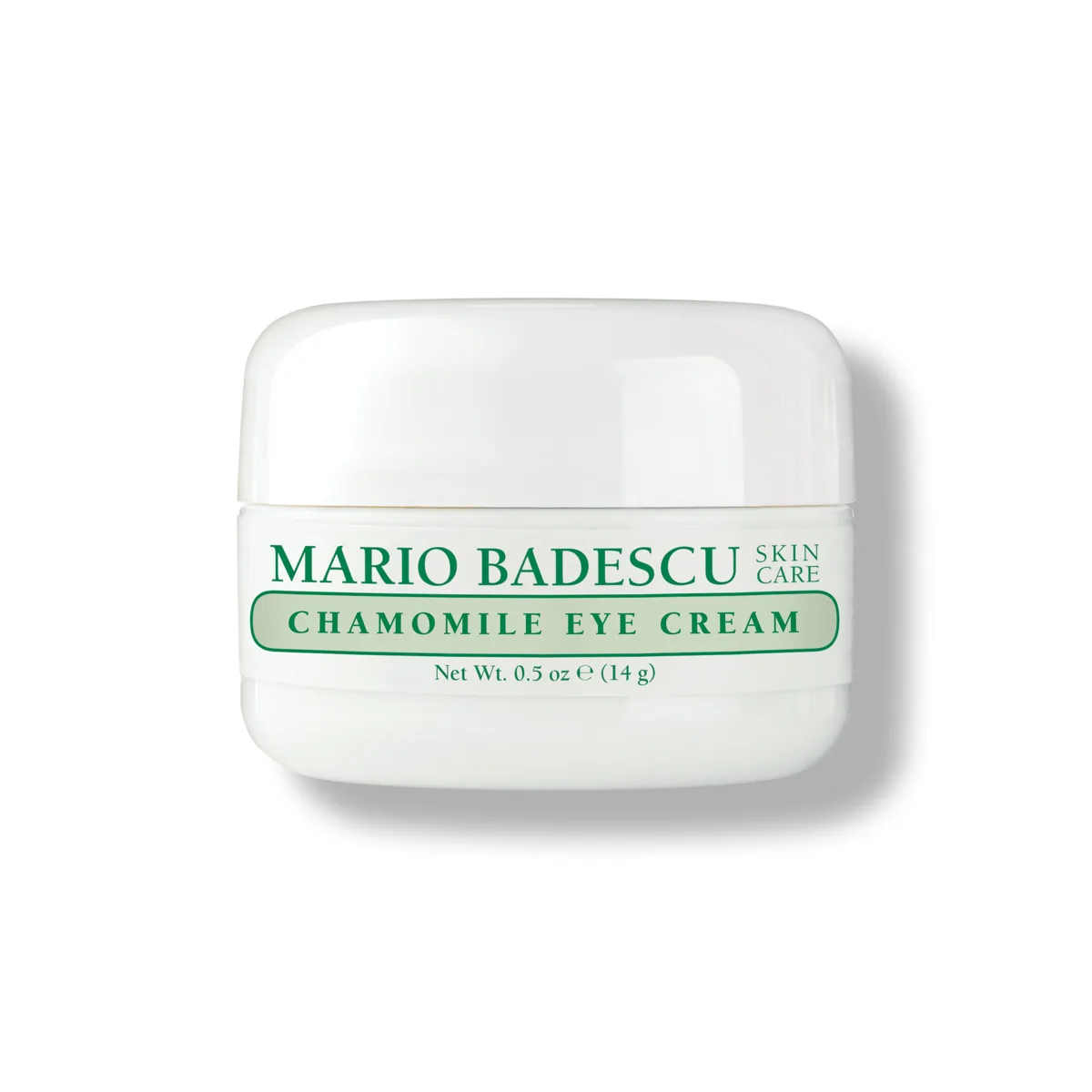
It is a beeswax-borax cold cream, the emulsion technique of the early twentieth century, made for the eye area and sold fragrance-free as the brand's sensitive-skin eye cream; almost nothing on a mainstream shelf is still made this way. Petrolatum, mineral oil and peanut oil do the sealing, vitamin E acetate sits high on the list, and the chamomile is a trace after the preservatives that lends the name and the caramel tint.
A beeswax-borax cold cream for the eyes built on peanut oil, mineral oil and petrolatum, fragrance-free and genuinely effective as an overnight seal for very dry under-eyes, with a trace of chamomile for the name and a trace of retinyl palmitate for the label. Peanut oil third in an eyelid product, a formaldehyde releaser, parabens and borax make it the wrong choice for the sensitive skin it is sold to, and a plain petrolatum does the same job with none of them.
Under a hundred brand-site reviews and retailer feedback describe the overnight softening reliably, but the brand has published no testing, the peanut oil grade is unstated and the chamomile and retinoid are undisclosed traces, so the assessment rests on the well-documented behaviour of petrolatum and on the allergen literature rather than on data on this cream.
Verdicts
How well it fits each concern
Verdict by concern tap a concern for the case
Strong choicefor DrynessIn your profileYou chose · Petrolatum is an approved or monograph active for dryness; this cream carries it high in the ingredient list.Moderate evidenceStandard tolerabilityNo reviews collected yet
The case for it
Petrolatum is a first-line active — approved, monograph-listed or named in current guidelines — for this concern.
It is present at an effective concentration, declared or high in the ingredient list.
The formula carries no trigger this concern is sensitive to, with the cautions noted.
Same rule for everyone. “Strong choice” is the verdict on 1,459 of 45,024 concern verdicts across the catalog; rule R2 decided 892 of them.
As of September 25, 2026, engine 5.1.1.
Also listed for Dehydration — the actives here (Plant & Seed Oils, Petrolatum, Vitamin E, Beeswax) are in our research queue for that concern; there is no verdict until their evidence rows are written. That is a gap in our table, not a mark against the product.
Does the jobDoes what a eye cream is for: safe for eye skin, targets a real eye concern. Not measured from the label: hydrates without heaviness, stays where it's put.
A verdict is DermApproved’s assessment of how well a product’s ingredients fit a concern — never a claim about what the product treats. Evidence dots and collected reviews sit beside it and are never blended in.
Rules 0.5.1 · evidence table ev-2026.09-r228 · how we decide
Assessment
Pros & Cons
Pros
✓ Petrolatum and mineral oil seal very dry under-eyes overnight as well as any modern occlusive
✓ Fragrance-free, unlike the brand's Ceramide Herbal Eye Cream
✓ Tocopheryl acetate seventh gives a real antioxidant dose
✓ Cocoa butter and cetyl esters leave the skin cushioned rather than merely coated
✓ A rice-grain dose stretches the jar to about four months
✓ Consistent reviews on softness from very dry-skinned users
Cons
✗ Peanut oil third in an eyelid product, unsafe for peanut-allergic households
✗ Diazolidinyl urea, a formaldehyde-releasing allergen, on the eyelid
✗ Chamomile is a trace after the preservatives; the tan colour is caramel
✗ Retinyl palmitate last on the list, no anti-wrinkle effect
✗ Two parabens, sodium borate and beeswax in the tail
✗ Far too heavy for daytime, makeup or anything but very dry skin
Review
Full Review
Sodium borate twelfth and beeswax ninth is a fingerprint. Together they are the beeswax-borax emulsion, the way cold creams were made before modern emulsifiers, the wax's free acids reacting with the borax to hold oil and water in a dense, cushioned cream, and almost nothing on a mainstream shelf is still made that way. Mario Badescu's Chamomile Eye Cream is, and once the fingerprint is recognised the rest of the label reads as a period piece: an unspecified vegetable oil and peanut oil as the plant lipids, mineral oil and petrolatum for occlusion, cetyl esters for slip, vitamin E acetate high at seventh, corn oil, cocoa butter, a paraben-and-formaldehyde-releaser preservative system, and at the very end chamomile flower for the name, caramel for the colour and retinyl palmitate for the anti-wrinkle gesture. It is a cold cream in a half-ounce jar, sold as the brand's sensitive-skin eye cream because it has no fragrance.
Judged as an overnight seal for very dry under-eyes, it works. Petrolatum and mineral oil stop water leaving, the oils and cocoa butter fill the surface, and by morning dry, crepey skin under the eye is soft, cushioned and smoother-looking, which the eighty-odd brand-site reviews and larger retailer record report consistently, along with the fact that a rice-grain amount is plenty and the jar lasts months. Vitamin E acetate at seventh is a real antioxidant dose, mostly protecting the peanut and corn oils from going rancid. There is no scent and no sting on intact skin. It is a night product entirely: dense, glossy and slow to settle, it has no business under concealer, and the brand's lighter gel is the daytime choice.
The chamomile is the name, not the function. The flower is third from the end, after the preservatives, and chamomile's genuine anti-inflammatory compounds have data at meaningful concentrations in leave-on creams that a trace in a petrolatum balm does not approach; the caramel beside it supplies the tan tint that suggests the herb is present in quantity. The retinyl palmitate at the very end is the gentlest retinoid ester at a dose that cannot convert to anything active, and the softening of dry lines the brand describes is occlusion, which any petrolatum product delivers. Nothing in the jar affects puffiness, pigment, fat-pad bags or true wrinkles over time.
The passengers are the problem, and on the eyelid they matter more than anywhere else. Peanut oil third is the most serious: refined peanut oil rarely triggers reactions, but the grade is unstated, the topical route has been linked to sensitisation, and the eyelid is the thinnest, most permeable skin on the face; no household with a peanut allergy should have this jar on a shelf. Diazolidinyl urea is a formaldehyde-releasing preservative and a recognised contact allergen, and preservatives are among the leading causes of eyelid dermatitis. Methylparaben and propylparaben are the safest items in the tail. Sodium borate is restricted in EU cosmetics on reproductive-toxicity grounds at higher concentrations, though a cold cream uses very little. Beeswax is an occasional allergen. For resilient, non-allergic dry skin none of this will matter and the cream will simply feel comforting; for the eczema-prone, allergy-prone lids the words sensitive skin on the brand's page are meant to attract, it is three avoidable risks in the one place they do most harm.
It is fair to note what the era got right, because the criticism is about passengers and not purpose. A thick occlusive on very dry eyelid skin at night is precisely what a dermatologist would suggest, and this cream's base delivers it; the salon chose petrolatum and mineral oil decades before the barrier science caught up and confirmed the choice. What the salon did not have was a reason to think about peanut protein near the eyes or formaldehyde releasers on the lids, and the brand has never gone back to add one. The bones are sound; it is the tail that belongs to another decade.
On price, twenty dollars for half an ounce is forty dollars an ounce, in the lower half of the eye-cream market, and because the cream is so dense a rice-grain dose stretches the jar to about four months, so the monthly cost is around five dollars. The materials, water, petroleum, plant oils and wax, are inexpensive, and the price is paying for the brand; a plain petrolatum, which is what does the work here, costs a fraction of that and carries none of the peanut, formaldehyde-releaser or borax questions, and a fragrance-free ceramide eye cream at the same price seals as well with modern preservation.
So the recommendation is narrow. For very dry, non-allergic, non-reactive under-eyes that want a heavy, unscented cold cream to sleep in through winter and do not mind a greasy pillow, this does the job cheaply and has for decades. For everyone else, and above all for the sensitive, eczema-prone or peanut-allergic, the cream's era is the reason to choose something formulated since, and the petrolatum that makes it work can be had on its own.
Formula
Key Ingredients
The hero actives that drive this product's performance.
Fifth on the list, behind three oils, the best-evidenced barrier ingredient in skincare and the honest reason dry under-eyes wake up sealed and soft under this cream; the chamomile has nothing to do with it.
Regulator-approvedfor Dryness · established mechanism
Third, behind an unspecified vegetable oil, the main plant lipid in a cold-cream base; it softens well, and with the refinement grade unstated it makes this eye cream a hard no for any household with a peanut allergy.
Ninth, with the borax further down, the classic beeswax-borax cold-cream emulsion that gives the cream its dense, cushioned body and dates the formulation to the early twentieth century.
Seventh, a high position for vitamin E acetate, giving a real antioxidant dose that protects the peanut and corn oils from rancidity in the jar and adds a mild emollient benefit on the skin.
Third from the end, after the preservatives, the herb in the name at a trace; chamomile's soothing compounds have real data at meaningful doses, and here the flower supplies the name and the caramel-tinted colour rather than an effect.
Last on the list, a trace of the gentlest retinoid ester at a dose that cannot convert to anything active; the anti-wrinkle gesture on the label of a cream whose effect is occlusion.
Not yet assessed
Ingredient standings describe the active at treatment-level doses and
vehicles; this product's own condition grades weigh its actual formula.
A rice-grain amount pressed along the orbital bone at night as the last step; far too rich for daytime under concealer, and a good buffer over a retinoid kept clear of the eye contour.
Results Timeline
Dry, crepey under-eye skin feels sealed and soft by morning from the first night and stays comfortable with nightly use. Nothing beyond that accumulates: the chamomile and retinyl palmitate are traces, and the cream does not affect puffiness, pigment, bags or true wrinkles over time.
The evidence for this cream is the evidence for petrolatum. A 2016 study in the Journal of Allergy and Clinical Immunology found that petrolatum applied to skin does more than sit on it: it upregulated antimicrobial peptides and barrier-differentiation genes and increased stratum corneum thickness, a mechanistic basis for the clinical observation that plain petrolatum is among the most effective barrier-repair moisturizers available. Mineral oil, the plant oils, cocoa butter and beeswax add occlusion and emollience, and vitamin E acetate at an unusually high position protects the unsaturated oils from oxidation; those mechanisms account for the sealed, softened under-eye skin users report and nothing more. Chamomile's bisabolol, chamazulene and apigenin have anti-inflammatory data at meaningful concentrations in leave-on preparations, none of which applies to a trace after the preservatives, and retinyl palmitate at the last position is far below the defined concentrations at which the retinol ester has shown modest photoaging benefit after its inefficient two-step conversion.
The tolerance evidence is specific to the site. The 2021 North American Contact Dermatitis Group analysis of eyelid dermatitis identified preservatives among the most frequent relevant allergens at this uniquely permeable site, and diazolidinyl urea is a formaldehyde-releasing preservative and established sensitiser; the parabens, by contrast, are well studied and safe at cosmetic levels. Peanut oil's topical safety is contested: the Cosmetic Ingredient Review's 2001 assessment found refined peanut oil safe in cosmetics on the basis of low protein content, while a 2007 review in the Journal of the European Academy of Dermatology and Venereology examined case reports and the question of sensitisation through inflamed or thin skin, and with the refinement grade unstated and the application site the eyelid, the prudent reading excludes peanut-allergic households. Sodium borate is restricted in EU cosmetics on reproductive-toxicity grounds at higher concentrations, and chamomile, as an Asteraceae plant, is an occasional allergen in the ragweed-sensitive.
A petrolatum-based occlusive is exactly what clinicians recommend for very dry, eczema-prone eyelid skin, and the absence of fragrance in this cream would be noticed first and approved of; the difficulty is that the same eczema-prone patient is the one most likely to react to what surrounds the petrolatum. Peanut oil at the third position on the most permeable skin of the face would prompt a firm warning for any patient with a peanut allergy at home, and diazolidinyl urea, a formaldehyde releaser that patch-test clinics identify often on the eyelids, would be a second reason to prefer a plain petrolatum ointment or a fragrance-free ceramide eye cream with modern preservation for anyone with atopic tendencies. The chamomile and retinyl palmitate would be described as label decoration, and the heavy oil base as unsuitable for acne-prone or malassezia-prone skin. For a resilient, non-allergic patient with very dry under-eyes who likes it at night, there is no reason to object.
Guidance
Usage & Recommendations
How to Use
As the last step of the evening, take a rice-grain amount per eye on a clean fingertip or spatula, warm it until it softens and press it along the orbital bone from the inner corner outward, stopping short of the lash line; it will sit glossy and settle overnight. Apply any retinoid to the face first, keeping it off the eye contour, then the cream as the buffer. Use a lighter gel in the morning, since this does not work under makeup. Keep it away from anyone with a peanut allergy, patch-test on the jaw for a few nights if preservatives have caused eyelid reactions before, and keep the lid tight and fingers clean.
Value Assessment
Twenty dollars for half an ounce is forty dollars an ounce, in the lower half of the eye-cream market, and because the cold cream is so dense a rice-grain dose stretches the jar to about four months, so the monthly cost is around five dollars. The materials, water, petrolatum, mineral oil, plant oils and beeswax, are inexpensive, and the price is paying for the brand and the chamomile name rather than for anything a plain occlusive lacks. A tube of petrolatum, which does the work here, costs a fraction as much with none of the peanut oil, formaldehyde releaser or borax, and a fragrance-free ceramide eye cream at the same price seals as well with modern preservation; against either, the value is poor for everyone but the brand's dry-skinned loyalists.
Who Should Buy
Very dry, non-allergic, non-reactive under-eyes that want a heavy, unscented cold cream to sleep in through winter, with no peanut allergy in the household and no objection to a greasy pillow, and long-time Mario Badescu users who know the cream and buy it for the comfort.
Who Should Skip
Peanut-allergic households above all; eyelid-eczema-prone, sensitive or contact-allergic skin, given the formaldehyde-releasing preservative; oily, combination, acne-prone or fungal-acne-prone skin; makeup wearers who need a daytime eye product; vegans; and anyone expecting chamomile to soothe or retinyl palmitate to smooth lines.
A dense, pale-tan cold cream that resists the fingertip, warms and melts as it is pressed in, and leaves a glossy, waxy, cushioned film that is still present by morning.
Scent
Unfragranced; a faint waxy, oily base smell with a hint of cocoa that fades once it is on.
Packaging
The brand's small white plastic jar with a domed white screw lid and green lettering, 0.5 oz; fingers in the cream, and the dense texture means a rice-grain dose is plenty.
Finish
glowy
What to Expect on First Use
A heavy first night: a rich, waxy layer that sits on the under-eye for a long time before settling, and soft, cushioned skin in the morning. Dry under-eyes are converted by day three; normal skin finds it a lot, and anyone who tries it under concealer will not try twice. Nothing changes over weeks, and nothing is meant to.
How Long It Lasts
About four months at a rice-grain amount under each eye nightly.
Mario Badescu's salon used chamomile-scented cold creams on its dry, reactive clients, and this jar is that cream reduced to eye size and stripped of fragrance for the eyelid. It has stayed in the range for decades as the rich, unscented option beside the ceramide pair, with the same peanut oil, borax and preservative system it was born with.
About Mario Badescu Legacy Brand (20+ years)
Mario Badescu has sold salon-derived skincare from New York since 1967 and is stocked by Ulta, Nordstrom and its own store. The Chamomile Eye Cream is the sensitive-skin eye cream of its salon-era range, a beeswax-borax cold cream sold unchanged for decades; the brand publishes no clinical testing.
Brand founded: 1967
Myth vs. Reality
Common Myths
Myth
Chamomile in an eye cream calms puffiness and irritation.
Reality
The chamomile flower is third from the end, after the preservatives, at a trace that supplies the name and the tan colour; chamomile's anti-inflammatory compounds have data at meaningful doses in leave-on preparations, and this is not one. The comfort by morning is the petrolatum and oils sealing water in.
Myth
Refined peanut oil is safe for peanut-allergic people, even near the eyes.
Reality
Highly refined peanut oil contains little allergenic protein and rarely reacts, but the refinement grade here is not stated, the topical route has been linked to sensitisation, and the eyelid is the most permeable skin on the face. No peanut-allergic household should have this jar on the shelf.
FAQ
Frequently Asked Questions
Does the Mario Badescu Chamomile Eye Cream contain peanut oil?
Yes, third on the ingredient list, with the refinement grade unstated. Anyone with a peanut allergy, or living with someone who has one, should avoid it.
Is the Mario Badescu Chamomile Eye Cream fragrance-free?
Yes, which sets it apart from the brand's Ceramide Herbal Eye Cream. It does contain methylparaben, propylparaben, diazolidinyl urea, sodium borate and beeswax.
How much chamomile is in the Mario Badescu Chamomile Eye Cream?
A trace. Chamomile flower is third from the end, after the preservatives, and supplies the name and the caramel tint; the cream's softening comes from petrolatum, mineral oil, peanut and corn oils and cocoa butter.
Can I wear the Mario Badescu Chamomile Eye Cream under makeup?
No. It is a dense beeswax-borax cold cream that sits glossy on the skin for a long time; it is a night product, and a lighter gel is the daytime choice.
Does the Mario Badescu Chamomile Eye Cream reduce wrinkles or dark circles?
It softens the look of dry, crepey lines by sealing moisture in overnight, which is temporary. The retinyl palmitate is a trace at the end of the list, and there is no caffeine or pigment, so it does not change true wrinkles, puffiness or dark circles.
Is the Mario Badescu Chamomile Eye Cream vegan?
No. It contains beeswax.
Reviews
What Reviewers Tend to Say
Recurring themes our editors read across retailer reviews of this product — summaries in our words, not quotations, and not a substitute for your own patch test.
Occupational hand dermatitis is one of the most common work-related diseases on earth, it follows a script, and the cheapest fix works only if you start it before the skin splits.
Every post that dismantles a home remedy owes the reader a replacement. The honest replacement list is embarrassingly cheap, and one item on it is cheaper still — it is a bath.
Every word on a plant oil label describes what was left in — including the proteins that sensitise and the compounds that go rancid — and the variable that decided the one head-to-head trial isn't printed anywhere.
The strongest counterexample to blanket botanical scepticism is also one of the more common contact allergens — and holding both facts at once is the only honest way to read it.
Products, answers, therapy guides, tools and articles in one search. Brand names,
slang and abbreviations all work — accutane finds isotretinoin, bacne finds truncal acne.