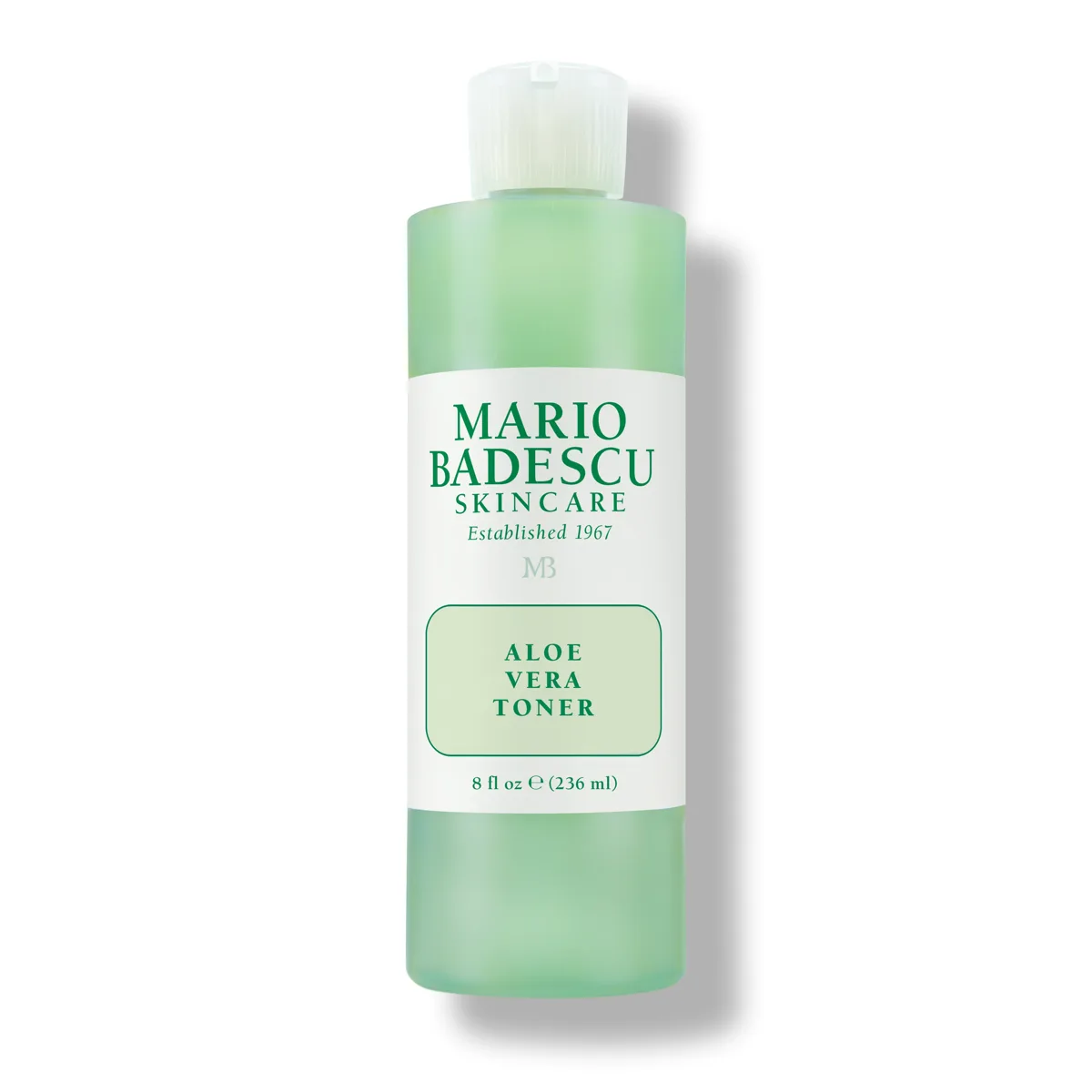
It is the rare toner from a salon-era brand with nothing in it to object to: no alcohol, no fragrance, no witch hazel, no acids, just aloe juice in water with a glycol-and-paraben preservative system and, unfortunately, three dyes. Beside its alcohol-based sibling the Aloe Lotion, it is the same idea with every problem removed, and it costs the same.
Preserved aloe water with a little glycol and, needlessly, three dyes: alcohol-free, fragrance-free, oil-free and about as inoffensive as a toner can be, in a big bottle at two dollars an ounce. It refreshes, removes cleanser residue and leaves the skin damp for what comes next, and it does nothing else, which for sensitive skin is exactly the recommendation.
Good choicefor DehydrationIn your profileYou chose · Aloe Vera is a reference standard by mechanism for dehydration; this liquid carries it high in the ingredient list.Moderate evidenceGentleNo reviews collected yet
The case for it
Aloe Barbadensis Leaf Juice has trial-supported standing for this concern.
It is present at an effective concentration, declared or high in the ingredient list.
The formula carries none of the triggers this concern is sensitive to.
Same rule for everyone. “Good choice” is the verdict on 9,564 of 45,024 concern verdicts across the catalog; rule R5 decided 9,072 of them.
As of September 25, 2026, engine 5.1.1.
Good choicefor SensitivityIn your profileYou chose · No fragrance, drying alcohol, declarable allergens or sensitising preservatives in this liquid — the profile sensitive skin looks for.Not yet assessedGentleNo reviews collected yet
The case for it
Aloe Barbadensis Leaf Juice has no evidence row yet for this concern — it is in the research queue.
The formula carries none of the triggers this concern is sensitive to.
What would change this: A researched evidence row for the lead active would replace this with a verdict.
Same rule for everyone. “Good choice” is the verdict on 1,938 of 45,024 concern verdicts across the catalog; rule F2 decided 1,938 of them.
As of September 25, 2026, engine 5.1.1.
Does the jobDoes what a toner is for: not alcohol-driven, adds something real. Not measured from the label: restores skin pH, plays well with what follows.
A verdict is DermApproved’s assessment of how well a product’s ingredients fit a concern — never a claim about what the product treats. Evidence dots and collected reviews sit beside it and are never blended in.
Rules 0.5.1 · evidence table ev-2026.09-r228 · how we decide
Assessment
Pros & Cons
Pros
✓ Alcohol-free, fragrance-free, oil-free, silicone-free and fungal-acne safe
✓ Aloe second on a thirteen-ingredient list, nothing to react to for most skin
✓ Removes cleanser residue and leaves skin damp for better serum absorption
✓ Sits under retinoids, acids, vitamin C and benzoyl peroxide without conflict
✓ Suits every skin type, including sensitive and rosacea-prone
✓ Sixteen dollars for eight ounces, cheaper per ounce in the jumbo
✓ Decades of consistent reviews on tolerance
Cons
✗ Very little humectant, so the softness fades within minutes
✗ Three dyes added purely to make it look green
✗ Methylparaben in the preservative system for those who avoid parabens
✗ Hexylene and caprylyl glycol can tingle very reactive skin briefly
✗ Does not treat anything; a hydrating toner does more for the money
Review
Full Review
Everything that makes most Mario Badescu toners a gamble is missing from this one. No alcohol, no witch hazel, no fragrance, no acids, no camphor, no menthol: the Aloe Vera Toner is water, aloe leaf juice, a preservative system built on glycols with one paraben and three food-grade acids and salts, a little propylene glycol, and three dyes to make it green. Thirteen ingredients, most of them there to keep the bottle from growing anything, and only one, the aloe, doing anything on the skin. For a brand whose signature is the astringent sting, this is a product defined by its restraint, and the more than two hundred brand-site reviews plus thousands more at retailers describe it the same way: gentle, no sting, no smell, nothing happens, and that is why they keep buying it.
What it does is modest and honest. Swiped on with a cotton pad or pressed on with the palms after cleansing, it lifts the last traces of cleanser and hard-water film, feels cool for a moment, and leaves the face damp with a faint, brief softness from the aloe polysaccharides and the glycols. That dampness is its most useful feature, because serums and moisturizers spread further and absorb more evenly on slightly wet skin, and a toner that wets without stripping is the modern definition of the category. It sits under retinoids, acids, vitamin C and benzoyl peroxide without complaint, because it has nothing to conflict with, and it suits every skin type from oily to dry because it neither adds oil nor removes it.
What it does not do is anything lasting. Aloe juice has a genuine small literature on calming and hydration, mostly from leave-on gels with far more contact time than a water-thin liquid that evaporates in minutes, and this toner should be read as a refreshing wetting step rather than a treatment. There is no humectant load to speak of, propylene glycol sits tenth after the preservatives, so the softness fades quickly and a hydrating serum still has to do the real work. The brand's language about anti-inflammatory and antimicrobial aloe is describing the plant, not the bottle. Anyone expecting the toner to calm rosacea, shrink pores or fix dehydration on its own will be disappointed; anyone who wanted a gentle, neutral first layer will not be.
The two quibbles are small. Hexylene and caprylyl glycol, which do the preserving, occasionally produce a moment of tingle on very reactive skin, which a handful of reviews mention and which passes. And the dyes: Yellow 5, Red 40 and Blue 1 are mixed to turn clear aloe water pale green so that it looks like aloe, and while they are harmless for almost everyone, they are pointless, and their presence is the one sign that this formula was written in the era when a product had to look like its name. Methylparaben rounds out the preservative system; it is among the safest and best-studied preservatives available, and the anxiety around it exceeds the evidence, but it is there for anyone who avoids parabens on principle.
There is a reason this bottle turns up so often as a first recommendation for people who have reacted to everything else, and it is not the aloe. A routine that has gone wrong usually needs to be stripped back to products with nothing in them, and a toner that is essentially preserved water is one of the few that survives that audit; once the skin settles, it can stay in place while the actives are reintroduced around it. That role, a placeholder that never becomes a suspect, is more valuable than any claim on the label.
The comparison the brand invites is with its own Aloe Lotion, the same base with alcohol third, a fragrance and its declared allergens, sold at the same price for oily skin. Set side by side, the Aloe Vera Toner is the Aloe Lotion with every problem removed, and the only thing it gives up is the astringent tightness that modern skincare has learned to do without. For nearly everyone, including most oily skin, this is the one to buy, and it is a little strange that the brand still sells both.
On value the arithmetic is comfortable. Sixteen dollars for eight ounces is two dollars an ounce, the sixteen-ounce jumbo at twenty-six brings that lower, and a bottle lasts two to three months at twice-daily use. The ingredients cost the brand almost nothing, and the price is honest for a preserved aloe water; a hydrating toner with a real humectant dose costs more and does more, but this is cheaper than most of them by a wide margin and gentler than many.
So the recommendation is easy and a little dull, which suits the product. For sensitive, redness-prone, reactive or simply cautious skin that wants a toner it can trust to do nothing wrong, and for anyone building a routine around actives who needs a neutral wetting step underneath, this is a well-priced, well-tolerated basic with a long record. For anyone who wants their toner to treat something, hydrate deeply or replace a serum, it is the wrong category of product, and the money belongs in the next step of the routine.
Formula
Key Ingredients
The hero actives that drive this product's performance.
Second on the list and the only active in a thirteen-ingredient formula, supplying the polysaccharides that give this toner its brief, mild hydrating and calming effect; with no alcohol behind it, the aloe actually gets to stay on the skin.
Listed tenth, after the preservatives, so a small humectant dose; it is the reason the toner leaves a faint softness rather than evaporating to nothing, and the reason the softness does not last long.
Established mechanismfor Dehydration · established mechanism
Hexylene Glycol
Fifth, part of the preservative system with caprylyl glycol and phenoxyethanol, doubling as a light humectant and solvent; it is also the one glycol here that occasionally stings very reactive skin.
Not yet assessed
Ingredient standings describe the active at treatment-level doses and
vehicles; this product's own condition grades weigh its actual formula.
A cotton-pad swipe or a palm press after cleansing, morning and night, before serum; it has no actives to conflict with anything, and it sits comfortably under retinoids, acids and benzoyl peroxide as a plain wetting step.
Results Timeline
A cool, fresh, slightly softer feel on contact that lasts until the water evaporates, which is minutes rather than hours. Nothing accumulates, since the formula has no active beyond aloe; its job is to remove cleanser residue and leave the skin damp for the next step, and it does that from day one.
The evidence for this toner is the evidence for aloe and the evidence for what a toner is, and both are modest. Aloe vera's constituents, the polysaccharides acemannan and glucomannan, various sterols and salicylates, have laboratory and clinical data summarised in a 2008 review in the Indian Journal of Dermatology, covering wound healing, mild anti-inflammatory effects and skin hydration; the review notes that preparation and concentration vary enormously and that most clinical findings come from leave-on gels. A 2006 study in Skin Research and Technology measured hydration after applying freeze-dried aloe extract at different concentrations and found increased water content in the stratum corneum, an effect attributed to the humectant polysaccharides. In a water-thin toner that evaporates within minutes, the contact time is far shorter than in those studies, so the appropriate reading is a brief hydrating and calming touch rather than a therapeutic one.
The more relevant science is about what the toner leaves out. The 2008 Journal of Occupational Medicine and Toxicology safety evaluation of topical ethanol describes the lipid stripping and transepidermal water loss that repeated alcohol application causes, which is the reason alcohol-free toners have displaced astringents in dermatological advice; this product's omission of alcohol is what makes it usable under a retinoid or an acid without compounding irritation. The skin surface is acidic, on average below pH 5 according to the 2006 International Journal of Cosmetic Science analysis, and a water-based toner buffered with citric acid and preserved with organic acids is likely to sit near that range, though the brand does not publish the value.
The preservative system is conventional and well tolerated: phenoxyethanol, caprylyl glycol and hexylene glycol are a standard combination, methylparaben has been repeatedly reviewed and found safe at cosmetic concentrations, and potassium sorbate and sodium benzoate are food-grade. Hexylene glycol is an occasional cause of stinging on damaged skin, which matches the rare tingle users report. The three certified colours have no function beyond appearance.
Toners occupy an optional place in most clinical routines, and when patients ask whether they need one the usual answer is no, unless it is gentle and replaces nothing important. This product fits the version of a toner clinicians do not mind: no alcohol, no fragrance, no acids, and a short ingredient list that a patient with reactive skin, rosacea or a barrier weakened by retinoids can use as a neutral wetting step. Its aloe content would not be regarded as treatment for any condition, and patients with rosacea or dehydration would be told to look to their serum and moisturizer for the actual work. The cautions are minor: hexylene glycol occasionally stings compromised skin, methylparaben matters only to patients avoiding parabens by preference, and the dyes serve no purpose. Beside the brand's alcohol-based Aloe Lotion, this is the one a dermatologist would point to for nearly every patient who wanted a toner from the range.
Guidance
Usage & Recommendations
How to Use
Twice a day once the face is clean, either wet a cotton pad and sweep it over the face and neck to lift the last traces of cleanser, or pour a little into the palms and press it onto the skin, which uses less and avoids any friction on reactive areas. Do not wait for it to dry fully; apply the next serum or treatment while the skin is still slightly damp so it spreads and absorbs evenly, then moisturizer. It can be used under any active, including retinoids and acids, and as often as wanted through the day as a refresh, since it contains nothing that builds up or strips.
Value Assessment
Sixteen dollars for eight ounces is two dollars an ounce, and the sixteen-ounce bottle at twenty-six brings the per-ounce cost down further; at a cotton pad twice a day a bottle lasts two months, and pressed on with the palms it lasts three or more. The ingredients are water, aloe and preservatives, and the price is honest for that rather than generous. Value here is about the alternative: a hydrating toner with a real humectant dose does more for dehydrated skin and costs two or three times as much, while an alcohol astringent at the same price does harm. For sensitive skin that wants a gentle basic, this is money well spent; for skin that wants a toner to hydrate or treat, the money belongs in a better-stocked bottle or in the serum step.
Who Should Buy
Sensitive, redness-prone, reactive or cautious skin of any type that wants an alcohol-free, fragrance-free toner it can trust as a neutral first step, anyone building a routine around retinoids or acids who needs a gentle wetting layer underneath, and budget shoppers who value a big bottle of something reliable over a small bottle of something ambitious.
Who Should Skip
Anyone expecting a toner to hydrate deeply, treat acne, calm rosacea or improve texture, since this has no humectant load and no actives; people who avoid parabens or dyes on principle; and the rare very reactive skin that stings from hexylene glycol. A hydrating toner with glycerin or hyaluronate does more for dehydrated skin.
Water-thin, pale-green liquid that spreads from a pad or the palms with no slip or tack, feels cool for a moment and dries to a faint, brief softness.
Scent
Unfragranced; a barely-there clean, faintly vegetal note from the aloe that is gone as it dries.
Packaging
A tall frosted translucent bottle showing the mint-green liquid, with a ribbed white flip-top cap and the brand's green-on-white label, 8 fl oz, with a 16 fl oz jumbo also sold; the flip cap pours in a controlled stream. It is visually a near-twin of the Aloe Lotion, so check the label.
Finish
invisible
What to Expect on First Use
Uneventful in the way sensitive skin wants: cool, clean, no sting, no scent, and skin that feels damp and ready for serum. Very reactive faces occasionally notice a moment of tingle from the glycols. Nothing changes over weeks, and nothing is supposed to.
How Long It Lasts
About two months at a cotton pad twice a day; three or more pressed on with the palms.
Mario Badescu's salon toned every client after cleansing, and the Aloe Vera Toner was the option for skin too sensitive for the alcohol astringents the brand favoured. It has been a quiet best-seller for decades, the product staff recommend to first-timers who have been burned by stronger toners, and the formula has stayed almost untouched, which for once is not a problem.
About Mario Badescu Legacy Brand (20+ years)
Mario Badescu has sold salon-derived skincare from New York since 1967 and is stocked by Ulta, Nordstrom and its own store. The Aloe Vera Toner is one of its longest-running and best-reviewed basics; the brand publishes no clinical testing, and its standing rests on decades of retail history and a large, consistent user record.
Brand founded: 1967
Myth vs. Reality
Common Myths
Myth
A toner has to tingle or tighten to be doing anything.
Reality
The tingle is alcohol or acid removing the skin's surface lipids, and the tightness is the barrier objecting. A modern toner's job is to leave the skin clean and damp for the next step, which this one does without any of that; the lack of sensation is the point.
Myth
Aloe vera juice heals or repairs the skin over time.
Reality
Aloe's polysaccharides calm and hydrate briefly while wet and have some wound-healing data in leave-on gels, but a water-thin toner evaporates in minutes and leaves little behind. Expect a refreshing wetting step, not a treatment.
FAQ
Frequently Asked Questions
Is the Mario Badescu Aloe Vera Toner alcohol-free and fragrance-free?
Yes to both. Its thirteen ingredients are water, aloe leaf juice, a glycol-and-paraben preservative system, propylene glycol and three dyes; there is no ethanol, witch hazel or added fragrance.
What is the difference between the Mario Badescu Aloe Vera Toner and the Aloe Lotion?
The Aloe Vera Toner is alcohol-free and fragrance-free; the Aloe Lotion is the alcohol-based astringent version with a fragrance. They share a water-and-aloe base and a price, and the Toner is the one to choose for anything but very oily skin.
Is the Mario Badescu Aloe Vera Toner good for sensitive skin?
It is one of the safer choices in the category, with no alcohol, fragrance or actives. Very reactive skin occasionally feels a brief tingle from the hexylene and caprylyl glycols, and the methylparaben and dyes are the only ingredients a sensitive user might prefer to avoid.
Does the Mario Badescu Aloe Vera Toner contain parabens?
Yes, methylparaben, as part of a preservative system with phenoxyethanol, caprylyl glycol, hexylene glycol, potassium sorbate and sodium benzoate. Methylparaben is well studied and considered safe at cosmetic levels, but it is there for anyone who avoids parabens.
Can I use the Mario Badescu Aloe Vera Toner with retinol or acids?
Yes. It has no actives of its own and no alcohol, so it works as a plain wetting step under any treatment; apply it, let the skin stay slightly damp, then the retinoid or acid, then moisturizer.
What does the Mario Badescu Aloe Vera Toner actually do?
It removes cleanser residue, refreshes the skin and leaves it damp and slightly softened for the next product. It does not treat acne, pores, tone or lines; it is a gentle basic rather than an active step.
Reviews
What Reviewers Tend to Say
Recurring themes our editors read across retailer reviews of this product — summaries in our words, not quotations, and not a substitute for your own patch test.
Common Praise
Gentle enough for reactive, redness-prone skin
No sting, no scent, no tightness
Huge bottle that lasts for months
Common Complaints
Does not do much beyond refresh
Faint sting from the glycols on very reactive skin
The burn trials are real and the skeptics who dismiss aloe as folklore are wrong — but the same substance has delayed healing in other wounds, and none of it says anything about what a soothing gel does to intact skin.
The poreless, lit-from-within look is part real barrier health and part genetics, lighting, and a good primer — and chasing it literally can wreck the very skin you're trying to perfect.
Products, answers, therapy guides, tools and articles in one search. Brand names,
slang and abbreviations all work — accutane finds isotretinoin, bacne finds truncal acne.