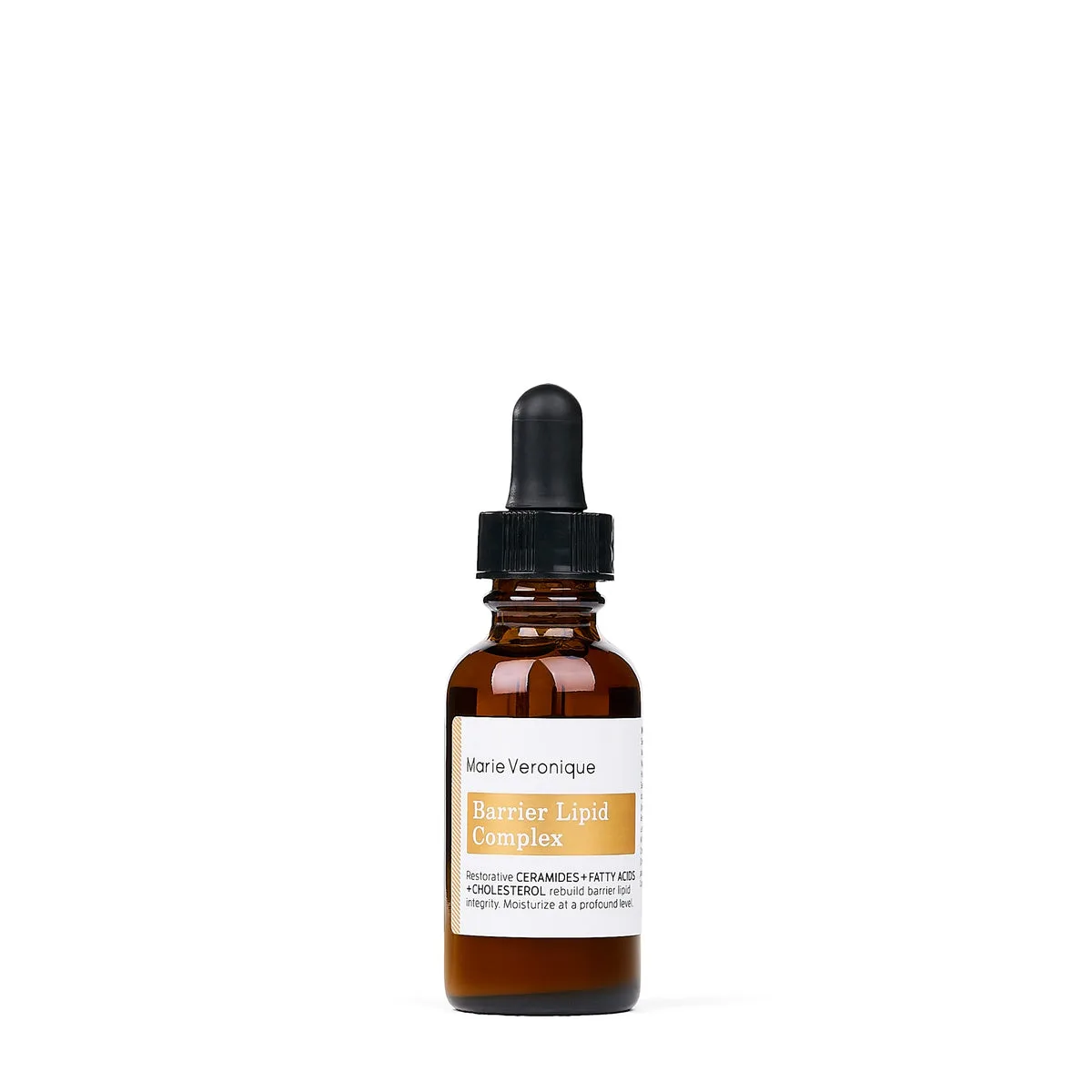
It replicates the skin's own barrier-lipid ratio — ceramides, cholesterol-equivalent phytosterols, and fatty acids — and layers in omega-rich seed oils, algae EPA/DHA, and phospholipids. That physiologically-modeled lipid approach, from a chemist-led brand, makes it a genuinely science-grounded barrier treatment rather than a generic face oil.
A genuinely science-grounded barrier-lipid treatment that replicates the skin's own ceramide-cholesterol-fatty-acid ratio and layers in omega-rich seed oils, algae EPA/DHA, and phospholipids. It nourishes and repairs dry, compromised skin effectively, fragrance-free, and pairs beautifully with the brand's Restore Serum. The catch is the $95 price and a richness that's more than very oily skin needs.
Good choicefor Compromised Skin BarrierIn your profileYou chose · Ceramides is a reference standard by mechanism for compromised skin barrier; this emulsion carries it.Moderate evidenceGentleNo reviews collected yet
The case for it
Physiological Lipid Blend has trial-supported standing for this concern.
It is plausibly present at a working level, though the concentration is not declared.
The formula carries none of the triggers this concern is sensitive to.
What would change this: A declared concentration would move this to a firmer reading of the dose.
Same rule for everyone. “Good choice” is the verdict on 9,564 of 45,024 concern verdicts across the catalog; rule R5 decided 9,072 of them.
Unchanged since September 5, 2026, engine 5.1.1.
R5 — Trial-supported or guideline-supported active, adequately or plausibly dosed. · the full register
Carrying active
Physiological Lipid Blend
Standing
supported — its mechanism is established
Form
plausible — studied range 0.5–1%, from the trials on the row; needs leave-on contact; judge it after ~4 weeks
Tolerability
gentle
Row checked
against its sources on July 17, 2026 (evidence table ev-2026.09-r228)
The studies behind the evidence row
Elias PM, Skin Barrier / Coderch et al., ceramides and skin barrier function — ceramides ~50% of SC intercellular lipid mass, essential to the permeability barrier — reference work
Good choicefor DrynessIn your profileYou chose · Squalane is a reference standard by mechanism for dryness; this emulsion carries it high in the ingredient list.Moderate evidenceGentleNo reviews collected yet
The case for it
Squalane + Sodium Hyaluronate has trial-supported standing for this concern.
It is present at an effective concentration, declared or high in the ingredient list.
The formula carries none of the triggers this concern is sensitive to.
Same rule for everyone. “Good choice” is the verdict on 9,564 of 45,024 concern verdicts across the catalog; rule R5 decided 9,072 of them.
Unchanged since September 5, 2026, engine 5.1.1.
Good choicefor SensitivityIn your profileYou chose · No fragrance, drying alcohol, declarable allergens or sensitising preservatives in this emulsion — the profile sensitive skin looks for.Not yet assessedGentleNo reviews collected yet
The case for it
Squalane + Sodium Hyaluronate has no evidence row yet for this concern — it is in the research queue.
The formula carries none of the triggers this concern is sensitive to.
What would change this: A researched evidence row for the lead active would replace this with a verdict.
Same rule for everyone. “Good choice” is the verdict on 1,938 of 45,024 concern verdicts across the catalog; rule F2 decided 1,938 of them.
Unchanged since September 5, 2026, engine 5.1.1.
Supporting rolefor DehydrationIn your profileYou chose · Nothing here targets dehydration directly; humectant hydration is the recognised companion to treating it, and this emulsion does that without known triggers.Not yet assessedGentleNo reviews collected yet
The case for it
Squalane + Sodium Hyaluronate has no evidence row yet for this concern — it is in the research queue.
The formula carries none of the triggers this concern is sensitive to.
What would change this: A researched evidence row for the lead active would replace this with a verdict.
Same rule for everyone. “Supporting role” is the verdict on 8,197 of 45,024 concern verdicts across the catalog; rule R8 decided 4,250 of them.
Unchanged since September 5, 2026, engine 5.1.1.
R8 — The category's job (barrier care, humectant hydration, gentle cleansing, photoprotection) is the documented supportive role for this concern. This is the honest verdict for a moisturizer on an acne page. · the full register
Supporting rolefor EczemaIn your profileYou chose · Ceramides has early evidence for eczema, and emollient therapy is the recognised companion to treating it — a reasonable supporting choice, short of a recommendation.Moderate evidenceGentleNo reviews collected yet
The case for it
Physiological Lipid Blend has early or mechanistic evidence for this concern, not trial-backed standing.
It is plausibly present at a working level, though the concentration is not declared.
The formula carries none of the triggers this concern is sensitive to.
What would change this: A declared concentration would move this to a firmer reading of the dose.
Same rule for everyone. “Supporting role” is the verdict on 8,197 of 45,024 concern verdicts across the catalog; rule R8a decided 1,489 of them.
Unchanged since September 5, 2026, engine 5.1.1.
R8a — A plausible-tier active in a category with a supportive job: the sentence names the active instead of saying nothing targets the concern (the AmLactin / CeraVe SA case for keratosis pilaris, where no guideline and single trials leave the keratolytics at early evidence). · the full register
Carrying active
Physiological Lipid Blend
Standing
plausible — trials support it
Form
plausible
Tolerability
gentle
Row checked
against its sources on July 17, 2026 (evidence table ev-2026.09-r228)
Emollients and moisturisers for eczema — Cochrane Database of Systematic Reviews — TIER 1, 77 RCTs / 6603 participants, GRADE; CLASS-level, does not name ceramides (2017), opened July 16, 2026
Does the jobDoes what a moisturizer is for: draws in water, softens and smooths.
A verdict is DermApproved’s assessment of how well a product’s ingredients fit a concern — never a claim about what the product treats. Evidence dots and collected reviews sit beside it and are never blended in.
Rules 0.5.1 · evidence table ev-2026.09-r228 · how we decide
Assessment
Pros & Cons
Pros
✓ Replicates the skin's physiological ceramide-cholesterol-fatty-acid ratio
✓ Omega-rich seed oils plus algae EPA/DHA
✓ Phospholipids aid barrier integration
✓ Fragrance-free, gentle, absorbs well for a lipid product
✓ Pairs perfectly with the Barrier Restore Serum
✓ Vegan and cruelty-free
Cons
✗ Premium $95 price
✗ Plant oils make it not fungal-acne safe
✗ Rich for very oily skin
✗ EPA/DHA has lighter topical evidence
✗ Core lipid benefit available in cheaper ceramide creams
Review
Full Review
Here's a distinction that separates serious barrier products from generic face oils: it's not just about adding lipids, it's about adding the right ratio of them. The skin's barrier is built from three lipid classes — ceramides, cholesterol, and free fatty acids — arranged in a specific proportion, and decades of research (much of it associated with dermatologist Peter Elias) show that supplying all three together, in a physiological balance, repairs the barrier far more effectively than flooding it with any single oil. Marie Veronique's Barrier Lipid Complex is built explicitly around that principle, which is what makes it more than a nice face oil.
The formula models the skin's lipid composition: ceramide NP for the ceramide fraction, phytosterols standing in for cholesterol, and free fatty acids from a blend of seed oils — all in a ratio meant to mirror what the barrier actually uses. Then it goes further. The seed oil blend (black raspberry, cranberry, chia, evening primrose, prickly pear, blackberry) is exceptionally rich in omega-3 and omega-6 essential fatty acids, the linoleic and linolenic acids depleted skin needs. It adds algae-derived EPA/DHA omega-3s and phospholipids — an unusual, sophisticated touch with anti-inflammatory and barrier-integrating rationale. Phosphatidylserine sits alongside them, a phospholipid that helps the whole lipid payload organize into structures the stratum corneum can actually incorporate rather than merely wear. Squalane and sodium hyaluronate balance the richness with lightweight emolliency and humectancy, and mixed tocopherols keep the polyunsaturated oils from going rancid, which is a real hazard in a formula this omega-heavy. As a barrier-lipid treatment, it's about as thoughtfully constructed as they come.
In use, it's a creamy lipid emulsion — richer than a typical serum but, notably, it absorbs better than its richness suggests, leaving skin nourished and comfortable rather than greasy. Dry, tight, or compromised skin tends to feel relief quickly, and the barrier benefits (less dryness, flaking, reactivity) build over a few weeks. It's fragrance- and essential-oil-free, with only a faint natural oil note, and genuinely gentle. It arrives in a glass dropper bottle, a few drops per use, which stretches thirty milliliters across two or three months.
Its best use is as a pair with the brand's Barrier Restore Serum: the serum supplies the water-binding natural moisturizing factors and microbiome support, while this supplies the lipids — together addressing both halves of barrier function. Layered over the serum, it's a complete, considered barrier routine. On its own it's a strong lipid moisturizer-treatment, and it slots in after your water-based steps in either direction of the day; by night, a slightly more generous hand seals everything beneath it.
An ingredient worth pausing on is the elderberry extract sitting improbably high in the list, an antioxidant flourish rather than a structural player, and the caprylic/capric triglyceride and jojoba oil that make the emulsion glide instead of drag. Behenyl alcohol and glyceryl stearate give it body. The preservation runs on glyceryl caprylate and glyceryl undecylenate, which is a quietly elegant choice for a formula this lipid-dominant. Nothing here is decorative.
The caveats are minor. It contains plenty of plant oils, so it isn't fungal-acne safe, and very oily skin may find it more lipid than they need (though it absorbs well and combination skin can use a small amount on dry areas). The EPA/DHA, while a sophisticated inclusion, has lighter topical evidence than the core lipid ratio — it's a credible enhancement rather than the proven workhorse. Among the roughly nine hundred reviews it's collected, the recurring note is that the results are subtle and gradual, which is exactly what barrier repair looks like when it's working: nothing dramatic, and then one day your face has stopped complaining.
Which brings up the assumption the product exists to correct. Plenty of people treat any facial oil as interchangeable barrier support — squalane, rosehip, marula, whatever's in the cabinet. Single oils condition, and some of them condition beautifully. But conditioning and rebuilding are different jobs. The lamellar sheets that make up the barrier are assembled from three lipid classes in proportion, and applying one of them in isolation can leave the structure no better organized than it started. The ratio is the mechanism, not the marketing.
Value is the predictable premium-brand friction at $95 for 30ml. That's a serious price for a lipid treatment, and the core benefit — a ceramide-cholesterol-fatty-acid blend — is available in cheaper ceramide creams. What you're paying extra for is the precise physiological ratio, the omega-rich seed oil quality, the EPA/DHA and phospholipid additions, and the chemist-led formulation. For chronically dry or compromised skin that wants the most science-grounded lipid treatment available, that premium is defensible; for basic barrier lipids, a simpler ceramide cream delivers the essentials for far less.
On the brand: Marie Veronique's reputation for science-led, sensitive-skin-appropriate formulation is well earned, and this is one of its most genuinely clinical products. Founded in 2002 and chemist-run, it has spent two decades not chasing trends. There's no hype in the formula — the lipid-ratio science is real. The one reservation is price relative to simpler alternatives.
So this belongs with dry, sensitive, eczema-prone, or barrier-compromised skin that wants a comprehensive, physiologically-modeled lipid treatment, and with anyone building a complete barrier routine alongside the Restore Serum. Very oily or fungal-acne-prone skin should stay away from the plant-oil base, and budget shoppers will do perfectly well with a simpler ceramide cream. As a barrier-lipid treatment, it's among the most thoughtfully formulated you can buy — you're paying for that precision and the brand's expertise.
Formula
Key Ingredients
The hero actives that drive this product's performance.
A blend designed to mirror the skin's own barrier-lipid ratio — ceramides, cholesterol-equivalent phytosterols, and free fatty acids — so it rebuilds the barrier's lamellar structure rather than just coating the surface, the scientific core of the product.
Established mechanismfor Compromised Skin Barrier · established mechanism
A blend of seed oils exceptionally high in omega-3 and omega-6 essential fatty acids that nourishes and reinforces the barrier, supplying the linoleic and linolenic acids depleted skin needs.
Algae-derived omega-3 fatty acids (EPA/DHA) and phospholipids add anti-inflammatory and barrier-integrating lipids, an unusual, sophisticated touch that deepens the barrier-repair effect.
Skin-identical squalane and humectant hyaluronic acid balance the lipid-heavy formula with lightweight emolliency and water-binding, helping it absorb and feel nourishing rather than greasy.
Established mechanismfor Dryness · established mechanism
Ingredient standings describe the active at treatment-level doses and
vehicles; this product's own condition grades weigh its actual formula.
Apply a few drops as a nourishing lipid step after water-based serums, or layer over the Barrier Restore Serum to pair lipids with moisturizing factors. Use morning and night; at night a slightly more generous amount seals in the routine.
Results Timeline
Skin feels nourished and comfortable immediately; barrier improvement — less dryness, flaking, and reactivity — builds over 2-6 weeks of consistent use.
The product's foundation is among the most robust in barrier science: the stratum corneum barrier comprises ceramides, cholesterol, and free fatty acids in a roughly equimolar lamellar arrangement, and research — notably from Elias and colleagues — demonstrates that topical replacement supplying all three lipid classes in physiological proportion repairs the barrier more effectively and avoids the delayed recovery sometimes seen when an incomplete or imbalanced lipid mixture is applied. This complex models that ratio with ceramide NP, phytosterols (a plant-derived cholesterol analog), and fatty acids from omega-rich seed oils (black raspberry, cranberry, chia, evening primrose, prickly pear), which are documented sources of linoleic and gamma-linolenic acids that support barrier function and reduce transepidermal water loss. The phospholipids and phosphatidylserine aid lipid integration and have liposome-forming, barrier-compatible properties. The algae-derived EPA/DHA omega-3s add anti-inflammatory fatty acids with promising but less-extensive topical evidence. Squalane is a well-characterized biomimetic emollient and sodium hyaluronate a validated humectant. The plant-oil content makes it unsuitable for Malassezia-prone skin. The reasonable scientific summary is that this is a genuinely well-founded, physiologically-modeled barrier-lipid treatment whose core ratio is strongly evidenced, with EPA/DHA as a credible, lighter-evidenced enhancement.
Dermatologist Perspective
Dermatologists widely endorse the ceramide-cholesterol-fatty-acid approach to barrier repair, frequently citing the importance of supplying all three lipid classes in physiological proportion rather than a single lipid, so a complex explicitly modeled on that ratio aligns strongly with clinical thinking. Working dermatologists regard the omega-rich seed oils as sound barrier-supporting emollients and the phospholipids as sensible delivery aids, while noting the topical EPA/DHA evidence is more limited. They would consider it well-suited to dry, sensitive, eczema-prone, and compromised skin, fragrance-free and gentle, while flagging that the oils make it unsuitable for fungal-acne-prone skin and potentially rich for very oily skin. For barrier-compromised skin, dermatologists would view it as a sophisticated, evidence-aligned lipid treatment.
Guidance
Usage & Recommendations
How to Use
Apply a few drops as a nourishing lipid step after your water-based serums, or layer it over the Barrier Restore Serum to address both the lipid and moisturizing-factor halves of the barrier. Use morning and night; at night a slightly more generous amount helps seal in the routine. It absorbs better than its richness suggests, but very oily skin should use it sparingly or only on dry areas. Follow with sunscreen by day if it's your last morning step.
Value Assessment
At $95 for 30ml, this is a premium lipid treatment, and the core benefit — a ceramide-cholesterol-fatty-acid blend — exists in considerably cheaper ceramide creams. What the price buys is the precise physiological lipid ratio, the quality and breadth of the omega-rich seed oils, the EPA/DHA and phospholipid additions, and the chemist-led formulation, plus its synergy with the Restore Serum. A bottle lasts a couple of months at a few drops per use. For chronically dry or compromised skin that wants the most science-grounded lipid treatment available, it's a defensible investment; for basic barrier lipids, a simpler ceramide cream delivers the essentials for much less.
Who Should Buy
This is ideal for dry, sensitive, eczema-prone, or barrier-compromised skin wanting a comprehensive, physiologically-modeled lipid treatment, and for anyone building a complete barrier routine alongside Marie Veronique's Restore Serum. Those who appreciate the ceramide-cholesterol-fatty-acid ratio science will value it most.
Who Should Skip
Very oily or fungal-acne-prone skin should avoid the rich plant-oil base, and budget-focused shoppers can get the core barrier lipids from a simpler, cheaper ceramide cream. Those wanting a lightweight gel rather than a lipid emulsion should also look elsewhere.
Ready to try Marie Veronique Barrier Lipid Complex?
Creamy lipid emulsion that's rich but absorbs well
Scent
Fragrance and essential-oil free with a faint natural oil note
Packaging
Glass dropper bottle
Finish
nourishedvelvetysoft
What to Expect on First Use
It's a creamy lipid emulsion — richer than a typical serum but it absorbs better than its richness suggests, leaving skin nourished and comfortable rather than greasy. Dry, tight, or compromised skin tends to feel relief quickly. It's fragrance- and essential-oil-free with only a faint natural oil note, and pairs especially well layered over a water-based barrier serum.
How Long It Lasts
About 2-3 months of daily use per 30ml, given a few drops per use
The Barrier Lipid Complex is the lipid half of Marie Veronique's barrier-repair philosophy, designed as a companion to the moisturizing-factor-and-microbiome Barrier Restore Serum. It models the skin's natural lipid composition and supplements it with the omega fatty acids and EPA/DHA that compromised skin is often short on.
About Marie Veronique Established Brand (5–20 years)
Marie Veronique, the chemist-founded US clinical green-science brand (2002), designed this lipid complex around the skin's own barrier-lipid ratio plus omega-rich seed oils. It's a respected product among barrier-focused and sensitive-skin users, formulated with clinical rationale, at a premium price.
Brand founded: 2002 · Product launched: 2018
Myth vs. Reality
Common Myths
Myth
All face oils are basically the same barrier support.
Reality
Plain single oils condition, but this complex is built to the skin's physiological lipid ratio (ceramides plus cholesterol-equivalents plus fatty acids), which research shows repairs the barrier more effectively than any single lipid class alone. The specific ratio, not just 'oil,' is the point.
FAQ
Frequently Asked Questions
What makes the Barrier Lipid Complex different from a regular face oil?
It's formulated to the skin's own barrier-lipid ratio — ceramides, cholesterol-equivalent phytosterols, and fatty acids — which research shows repairs the barrier more effectively than any single oil. It also adds omega-rich seed oils, algae EPA/DHA, and phospholipids, making it a science-grounded barrier treatment, not just a conditioning oil.
Is it good for compromised or eczema-prone skin?
Yes — it's designed for dry, sensitive, and barrier-compromised skin, supplying the physiological lipids and omega fatty acids that depleted barriers need, fragrance- and essential-oil-free. Those with eczema often benefit, though it isn't a medical treatment.
How does it pair with the Barrier Restore Serum?
They're designed as companions: the Restore Serum delivers natural moisturizing factors and microbiome support, while the Lipid Complex supplies the barrier lipids. Layering the lipid complex over the serum addresses both the water-binding and lipid components of the barrier.
Is the Barrier Lipid Complex too heavy for oily skin?
It's a rich lipid emulsion, so very oily skin may find it more than they need and it isn't fungal-acne safe, but it absorbs better than expected and combination skin often tolerates a small amount well, especially on dry areas.
Is it worth $95?
It's premium, but a genuinely science-grounded barrier-lipid treatment with a physiological lipid ratio and omega oils. For compromised or chronically dry skin that values the specific formulation, it's defensible; simpler ceramide creams deliver core barrier lipids for less.
Is it fragrance-free and vegan?
Yes — it's fragrance- and essential-oil-free, vegan (with algae-derived EPA/DHA), and cruelty-free, fitting the brand's clean clinical positioning.
Reviews
What Reviewers Tend to Say
Recurring themes our editors read across retailer reviews of this product — summaries in our words, not quotations, and not a substitute for your own patch test.
Common Praise
Genuinely repairs dry, compromised skin
Nourishing without heavy grease
Fragrance-free and gentle
Pairs perfectly with the Restore Serum
Common Complaints
Expensive at $95
Oils not fungal-acne safe
Rich for very oily skin
Subtle, gradual barrier results
Notable Endorsements
Chemist-founded clinical brandSkin-mimicking lipid ratioOmega-rich seed oils plus EPA/DHA
Western sensitive skincare works by subtraction — remove the fragrance, remove the alcohol, shorten the list. Japan's answer adds a designed molecule back in, and one of the two bets has a trial literature.
A wrecked barrier is the most common self-inflicted skin condition and the one with the clearest fix — the difficulty is that the routine which caused it feels productive and the one that repairs it feels like giving up.
Eczema care has quietly split into two worlds: the ceramide-and-occlusion basics that manage most cases, and a new class of drugs rewriting what's possible for severe disease. Knowing which world you're in changes the whole plan.
'Barrier damage' has become the internet's all-purpose diagnosis. It's also a real, specific condition with a specific and slightly boring cure: mostly, stop doing things.
May 15, 2026· 5 min
Questions people ask about sensitive skin
Verified answers from our questions library — the nuance a product page cannot carry.
Products, answers, therapy guides, tools and articles in one search. Brand names,
slang and abbreviations all work — accutane finds isotretinoin, bacne finds truncal acne.