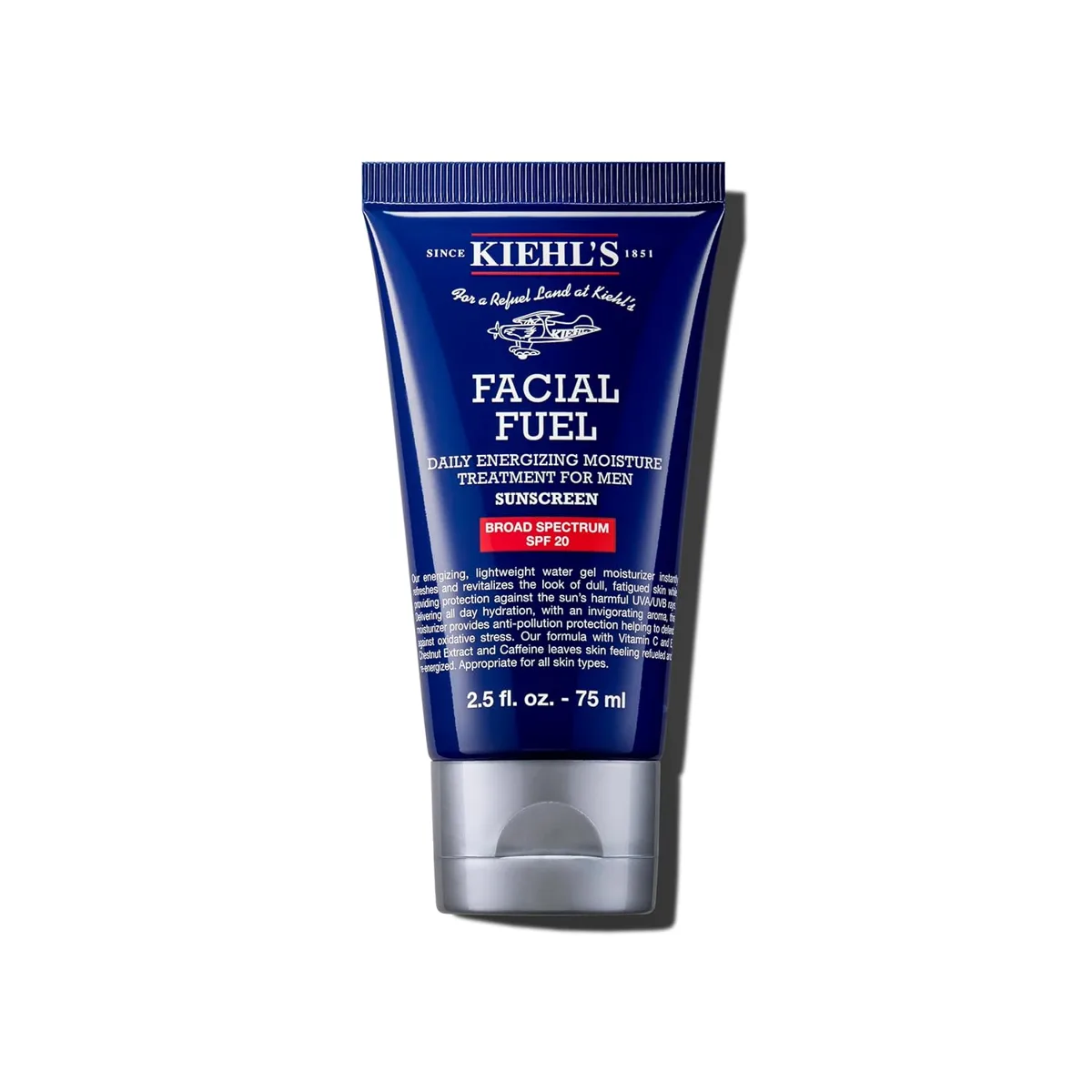
It is the sunscreen version of one of the longest-running men's skincare lines, built to feel like an aftershave lotion rather than a sunscreen: cooling menthyl lactate, a citrus scent, a matte silicone finish and a caffeine-vitamin C-vitamin E antioxidant trio over a four-filter chemical base. The trade for that feel is SPF 20 and a fragranced, alcohol-containing formula, which is an unusual set of priorities for a daily sunscreen.
A pleasant, fast-drying men's morning lotion with a real antioxidant trio and a four-filter chemical base that only reaches SPF 20, wrapped in fragrance, alcohol and a cooling agent that sting the eyes and, thanks to the avobenzone, stain light collars. It works as an indoor-day one-step for men who will not use anything else; as a sunscreen, and at this price, it is outclassed by plainer SPF 30 and 50 products from its own brand.
Basic protectionfor Sun DamageIn your profileYou chose · Broad-spectrum with avobenzone at SPF 20: meets the FDA bar for the early-skin-aging claim (SPF 15+), below the SPF 30 dermatologists recommend for daily use.Moderate evidenceStandard tolerabilityNo reviews collected yet
The case for it
Avobenzone 3% + Homosalate 8.8% + Octisalate 4.9% + Octocrylene 5.9% is a first-line active — approved, monograph-listed or named in current guidelines — for this concern.
It is present at an effective concentration, declared or high in the ingredient list.
The formula carries no trigger this concern is sensitive to, with the cautions noted.
Same rule for everyone. “Basic protection” is the verdict on 175 of 45,024 concern verdicts across the catalog; rule P4 decided 107 of them.
As of September 25, 2026, engine 5.1.1.
P4 — SPF 15–29 broad-spectrum is protection, not the recommended level; 'falls short' would misstate a regulator-recognised product. · the full register
first line — a regulator recognises it for this use; trials support it · per 21 CFR § 352.10 Sunscreen active ingredients (US FDA — 21 CFR Part 352 (Sunscreen Drug Products for Over-the-Counter Human Use), via Cornell Legal Information Institute; part heading marked [STAYED INDEFINITELY], effective date stayed at 66 FR 67485), opened September 1, 2026
Form
adequate (declared 3%) — studied range up to 3%, from the OTC monograph or label; needs leave-on contact
Tolerability
standard
Row checked
against its sources on September 1, 2026 (evidence table ev-2026.09-r228)
21 CFR § 352.10 Sunscreen active ingredients — US FDA — 21 CFR Part 352 (Sunscreen Drug Products for Over-the-Counter Human Use), via Cornell Legal Information Institute; part heading marked [STAYED INDEFINITELY], effective date stayed at 66 FR 67485, opened September 1, 2026
Also listed for Dullness — the actives here (Avobenzone, Vitamin C, Caffeine, menthyl lactate) are in our research queue for that concern; there is no verdict until their evidence rows are written. That is a gap in our table, not a mark against the product.
Does the jobDoes what a SPF moisturizer is for: UVA coverage, holds up in sunlight. Not measured from the label: wearable all day.
A verdict is DermApproved’s assessment of how well a product’s ingredients fit a concern — never a claim about what the product treats. Evidence dots and collected reviews sit beside it and are never blended in.
Rules 0.5.1 · evidence table ev-2026.09-r228 · how we decide
Assessment
Pros & Cons
Pros
✓ Thin, cooling, matte lotion that disappears in a minute with no white cast
✓ Four-filter broad-spectrum system with avobenzone at the full 3 percent
✓ Tocopherol, ascorbyl glucoside and caffeine form a genuine antioxidant layer
✓ One-step morning routine that reluctant sunscreen users actually keep
✓ Oil-free and non-greasy on combination and oily skin
✓ Ceramide and hyaluronate soften an otherwise alcohol-and-silicone base
✓ Available in a 6.8 oz size that makes daily use affordable
Cons
✗ SPF 20 falls below the SPF 30 daily minimum and closer to SPF 10 as applied
✗ Fragrance, alcohol, citrus allergens and menthyl lactate sting the eyes and irritate reactive skin
✗ Avobenzone and octocrylene leave orange marks on light collars
✗ Expensive per ounce in the 2.5 oz tube
✗ Too light to moisturize dry skin on its own
✗ Reformulation has divided long-time users
Review
Full Review
Two groups of people have reviewed this lotion in large numbers, and they disagree so sharply that it is worth starting there. On Amazon it holds a 4.7 from more than six hundred buyers, most of them men who have used it for years and praise how quickly it disappears, how cool it feels and how it lets them skip a step. At Ulta it sits at 2.8, with more one-star reviews than five, and the complaints are specific: it stings the eyes, it turned their shirts orange, it changed. Both groups are describing the same product accurately. What separates them is what they expected a sunscreen to be, and that expectation is the thing Facial Fuel was built to manage.
Kiehl's launched the line in the early 2000s on a simple insight: men would not buy moisturizer, but they would buy something that felt like an aftershave and promised energy. Hence caffeine, vitamin C, a citrus-herbal scent and a menthyl lactate cooling tingle, all of which survive in this SPF version. Applied in the morning it does exactly what the brief demands. It is thin, silicone-slick, cool on contact, matte and invisible within a minute, and it smells like a clean shave. As a piece of sensory engineering for a reluctant audience it is very good, and that is why a large number of men have used it daily for a decade and would not switch.
The sunscreen underneath is competent and modest. DailyMed lists four chemical filters: avobenzone at the full 3 percent for UVA, octocrylene at 5.9 percent, which also stabilises the avobenzone, and homosalate and octisalate for UVB. That is a sensible, broad-spectrum system, and it reaches SPF 20, which in 2026 is a curious number to sell. Dermatology guidance sets SPF 30 as the daily floor, and because almost nobody applies the tested two milligrams per square centimetre, real-world protection from an SPF 20 lotion runs closer to SPF 10. On an office day with a commute it takes the edge off incidental exposure. For lunch outdoors, a drive with the window down or a fair-skinned face, it is not enough on its own, and Kiehl's own SPF 50 products exist for a reason.
The antioxidant layer is the part of the formula that deserves more credit than it gets. Tocopherol sits fifth among the inactives, ascorbyl glucoside is a stable vitamin C derivative, and caffeine, beyond its marketing role, has a small but real literature as a sunscreen adjuvant that absorbs some UV and quiets UV-induced inflammation. An antioxidant trio under chemical filters is exactly the right idea, because filters do not stop every free radical, and this is a better-thought-out version of that idea than most men's products carry. Ceramide NP and sodium hyaluronate appear at low levels to justify the moisturizer half of the name; with glycerin high on the list they keep the alcohol-and-silicone base from feeling drying on normal skin, but this is a light lotion, and dry skin needs something underneath.
Now the Ulta complaints, which are legitimate. Fragrance, limonene, linalool and citral, denatured alcohol and menthyl lactate together make a lotion that stings sharply if it migrates into the eyes, and on a product men apply before sweating through a commute or a run, migration is routine. The orange marks on light collars are avobenzone reacting with the iron in tap water and laundry, helped along by octocrylene; every avobenzone sunscreen can do it, but a thin lotion applied down to the jawline by men in white shirts does it more visibly than most. Neither problem is a defect. Both are consequences of formulating for feel first, and Kiehl's could have chosen otherwise.
The reformulation grumble is harder to adjudicate. The current DailyMed listing shows a tidied inactive list with ceramide and hyaluronate; long-time users say the scent and feel shifted. The filters and the SPF did not. Some of the one-star reviews are grief for a product that no longer exists in quite the same form, which is a real loss to those users even if the chemistry is broadly the same.
On value, thirty-three dollars for 2.5 ounces is steep for a sunscreen of any strength, and at a proper dose the tube lasts five or six weeks; the 6.8-ounce size is much better value and the one daily users should buy. The premium is for the Kiehl's name and the sensory package, not for protection, and the brand's own unscented SPF 50 fluids offer more of the latter for similar money.
So the two reviewer camps are both right. If you are a man who has tried and abandoned every sunscreen and this one is the only thing you will put on your face in the morning, it is a genuine service, with a decent antioxidant layer, and the honest fix is to keep it off the collar line and out of the eyes. If you are shopping for the best protection your money can buy, or your skin objects to fragrance and alcohol, the SPF 20 and the sting settle the question, and there are better tubes on the same shelf.
Formula
Key Ingredients
The hero actives that drive this product's performance.
A four-filter chemical system that reaches only SPF 20, which tells you it was tuned for a light, invisible finish rather than maximum protection. Avobenzone at the full 3 percent supplies the UVA coverage, the octocrylene is there partly to keep the avobenzone from degrading in sunlight, and the two salicylates fill in UVB; the same avobenzone-octocrylene pairing is what leaves orange marks on light collars.
Regulator-approvedfor Sun Damage · emerging certainty
The Facial Fuel signature, placed mid-list after the film-former. Beyond the energising marketing, caffeine has a modest evidence base as a sunscreen adjuvant, absorbing some UV itself and dampening UV-induced inflammation, which makes more sense in an SPF product than in the rest of the line.
A stable, glucose-bound vitamin C derivative that skin enzymes slowly release into ascorbic acid, paired here with tocopherol high on the list to give the sunscreen a daytime antioxidant layer. Its dose is undisclosed and moderate; think of it as reinforcing the filters against the free radicals they cannot block rather than as a brightening treatment.
A mild menthol derivative that gives the lotion its cooling, just-splashed feel on application, the sensation Kiehl's sells as energising. It is gentler than menthol but still a sensory irritant, and with the alcohol and fragrance beside it, it is part of why this lotion stings if it migrates into the eyes.
A barrier lipid and a humectant added at low levels to justify the moisturizer half of the name. With glycerin third among the inactives they keep the alcohol-and-silicone base from feeling drying, but this is a light lotion, and dry skin will want a separate moisturizer beneath it.
Not yet assessed
Castanea Sativa (Chestnut) Seed Extract
A botanical antioxidant Kiehl's has used across the Facial Fuel range, present near the end of the list. It rounds out the antioxidant story with the vitamins C and E but has little independent evidence and is best regarded as a brand signature.
Not yet assessed
Ingredient standings describe the active at treatment-level doses and
vehicles; this product's own condition grades weigh its actual formula.
Apply it as the last morning step over any serum, using a full finger-length for the face, and keep it a finger's width from the eyes because it migrates and stings. On dry skin put a plain moisturizer underneath, and on days outdoors reapply every two hours or top it with a higher-SPF product.
Results Timeline
The cooling feel and a matte, refreshed look are immediate. The antioxidant benefit of caffeine, vitamin C and vitamin E is protective rather than visible, and the SPF 20 reduces daily incidental sun damage from the first application; there is no cumulative change to expect beyond skin that has been consistently protected.
Pairs Well With
A lightweight moisturizer underneath on dry skinA higher-SPF sunscreen for extended outdoor daysKiehl's Facial Fuel Energizing Face Wash
The formula is a standard four-filter organic sunscreen whose choices are well understood. Avobenzone at 3 percent is the only FDA-permitted organic filter that covers long-wave UVA effectively, but it is photounstable on its own, degrading substantially within an hour of sun exposure; octocrylene at 5.9 percent is included partly as a photostabiliser that quenches avobenzone's excited state, and the two salicylates supply additional UVB absorption. A 2025 review in the International Journal of Pharmaceutics on the UV filters the FDA has classified as lacking sufficient data for GRASE status, which includes these four, discusses both the photostability problem and the evidence for systemic absorption that led to the agency's request for more data, a context worth knowing for anyone choosing between chemical and mineral filters (https://pubmed.ncbi.nlm.nih.gov/40451593/). None of that means the filters are unsafe at these levels; it means the science on them is still being completed, and the same review notes the formulation strategies, including stabilising pairs like this one, that address the photostability half of the problem. The SPF 20 rating is the formula's central limitation: SPF is measured at two milligrams per square centimetre, typical application is a quarter to a half of that, and protection falls roughly with the square root of the applied dose, so an SPF 20 lotion used as most people use it delivers protection in the low teens or below. The antioxidant complex has a rational basis. Caffeine has been proposed as a sunscreen adjuvant on the strength of in vitro and animal work showing it absorbs in the UVB range, reduces UV-induced apoptosis signalling and dampens inflammation, as summarised in a 2019 paper in Frontiers in Physiology (https://pubmed.ncbi.nlm.nih.gov/31130869/); ascorbyl glucoside is a stable vitamin C derivative released enzymatically in skin, and tocopherol is the reference lipid-phase antioxidant, so the trio plausibly reduces the free-radical load that filters cannot block, though the doses here are undisclosed and the effect is protective rather than visible. The sensory ingredients carry the tolerability cost: fragrance with declared limonene, linalool and citral, denatured alcohol and menthyl lactate are each capable of irritation, and their combination explains the eye stinging reported across retailers. Fabric staining is a known property of avobenzone, which chelates iron in water to form coloured complexes, and of octocrylene.
The clinical view of a fragranced SPF 20 moisturizer is shaped by two consistent messages in sun-protection guidance: a daily broad-spectrum SPF of at least 30, and a formula the person will actually use every day. This product satisfies the second and not the first, and practitioners tend to treat it accordingly, as a reasonable indoor-day product for a patient who refuses conventional sunscreens and as inadequate for outdoor exposure, driving, sport or fair or photodamaged skin, where a separate SPF 30 to 50 is advised. The avobenzone-octocrylene system provides genuine broad-spectrum coverage, and the antioxidant additions are viewed favourably as a supplement to filtration. The tolerability profile is where cautions concentrate: fragrance, citrus allergens, alcohol and a menthol derivative make the lotion a poor choice for rosacea, eczema, seborrheic dermatitis or any history of contact allergy, and octocrylene itself is an increasingly recognised sensitiser. Eye stinging and shirt staining are expected properties of this filter and excipient combination rather than faults, and patients troubled by either are usually directed to an unscented mineral or higher-SPF alternative.
Guidance
Usage & Recommendations
How to Use
Every morning, after cleansing and any serum, squeeze out a full finger-length of lotion, roughly a quarter teaspoon, and spread it evenly over the face and neck fifteen minutes before going outside; using less than that is the most common way to lose most of the SPF. Keep it a finger's width from the eyes and let it dry fully before pulling on a light-coloured shirt or exercising, since it migrates with sweat and can mark collars. On dry skin apply a plain moisturizer first. Reapply every two hours during outdoor exposure, or use a separate SPF 30 or higher on top for time in the sun, driving or sport. Wash it off thoroughly at night.
Value Assessment
Thirty-three dollars for 2.5 fluid ounces is a high price for any sunscreen and a very high one for SPF 20; at the correct facial dose the tube lasts five to six weeks, which puts the running cost well above drugstore SPF 30 and 50 lotions and above several of Kiehl's own higher-SPF fluids. The 6.8-ounce tube roughly halves the cost per ounce and is the only size that makes daily use sensible. What the premium buys is the Facial Fuel sensory package, the caffeine-vitamin C-vitamin E antioxidant layer and a formula some men have used for a decade without complaint; it does not buy protection, and for a legacy brand under L'Oréal's sunscreen research umbrella, SPF 20 at this price reads as a marketing decision rather than a formulation limit. Buy the large tube if the feel is the reason, and buy something else if protection is.
Who Should Buy
Men with normal, combination or oily skin who spend most of their day indoors, want a single cooling, fast-drying morning step they will actually apply, and are not bothered by fragrance. It suits long-time Facial Fuel users who value the feel and scent and anyone who has abandoned every heavier sunscreen and needs something they will keep.
Who Should Skip
Anyone with sensitive, rosacea-prone, eczema-prone or contact-allergic skin should avoid the fragrance, citrus allergens, alcohol and menthol derivative, and anyone who spends real time outdoors, drives a lot or has fair or photodamaged skin needs SPF 30 or higher. People who wear light collars and sweat through their commute will fight the staining and stinging, and dry skin will find it too thin to stand alone.
Ready to try Kiehl's Facial Fuel Men's SPF 20 Moisturizer?
A thin, white, silicone-slip lotion that spreads fast, cools on contact and dries down in a minute to a matte, slightly powdery finish with no white cast.
Scent
A fresh, citrus-herbal masculine fragrance, noticeable on application and fading within a few minutes; limonene, linalool and citral are declared.
Packaging
A 2.5 fl oz squeeze tube with a flip cap in the Facial Fuel line's silver and blue, with a 6.8 fl oz size for daily users and a 15 mL travel tube.
Finish
mattelightweightinvisible
What to Expect on First Use
The first application is brisk: a cool tingle from the menthyl lactate, a citrus scent and a matte finish within a minute. Anyone who sweats or rubs their eyes will learn quickly that it stings when it migrates, and light-coloured collars can pick up faint orange marks within a week or two of daily wear. There is no adjustment period otherwise.
How Long It Lasts
About five to six weeks of daily face use from the 2.5 oz tube at a proper sunscreen dose; the 6.8 oz lasts three to four months.
Kiehl's launched Facial Fuel in the early 2000s as one of the first prestige men's skincare lines, selling the idea of energising skincare with caffeine and vitamin C to men who would not buy a moisturizer under any other name. The SPF 20 version added L'Oréal's chemical filters to that formula for the man who wanted a single morning step, and its DailyMed listing shows a fairly recent tidy-up of the inactive ingredients that long-time users noticed as a reformulation.
About Kiehl's Legacy Brand (20+ years)
Kiehl's began as a New York apothecary in 1851 and has been part of L'Oréal since 2000, which gives its sunscreens access to one of the largest UV-filter research programmes in the industry. The Facial Fuel line has anchored the brand's men's range for two decades; this SPF 20 version is listed on DailyMed as an OTC sunscreen drug, though Kiehl's publishes no clinical study of it beyond the required SPF testing.
Brand founded: 1851
Myth vs. Reality
Common Myths
Myth
SPF 20 in a daily moisturizer is enough sun protection for most men.
Reality
Dermatology guidelines set SPF 30 as the daily minimum, and real-world application is usually half the tested amount, which drops an SPF 20 lotion closer to SPF 10 in practice. This product reduces incidental sun damage on a commute or office day; it is not adequate on its own for outdoor time, driving with the window down or fair skin.
Myth
The orange stains on shirts mean the sunscreen has gone off.
Reality
The marks come from avobenzone reacting with iron in tap water and laundry, and from octocrylene, in a product that is working normally. Every avobenzone sunscreen can do it; the fix is letting the lotion dry fully before dressing and keeping it off the collar line, not replacing the tube.
FAQ
Frequently Asked Questions
Is SPF 20 in Kiehl's Facial Fuel enough for daily use?
It is below the SPF 30 that dermatology guidelines recommend as a daily minimum, and because most people apply less than the tested amount, the real protection is lower still. It covers incidental exposure on an indoor day; for time outdoors, a separate SPF 30 or higher over or instead of it is the safer choice.
Why does Kiehl's Facial Fuel SPF 20 stain my shirt collars?
The formula uses avobenzone, which reacts with iron in water to leave rust-coloured marks on light fabric, and octocrylene, which can do the same. Let the lotion dry completely before dressing, keep it off the jawline and neck where collars touch, and treat marks before washing; it is a property of these UV filters, not a sign of a bad batch.
Does Kiehl's Facial Fuel SPF 20 Moisturizer sting the eyes?
Yes, and it is the most common complaint. The combination of chemical UV filters, denatured alcohol, fragrance and cooling menthyl lactate stings sharply if the lotion migrates into the eyes with sweat or rubbing. Apply it a finger's width from the eye area and let it set before exercise.
Has Kiehl's Facial Fuel SPF 20 been reformulated?
Long-time users on retailer review sites report a change in feel and scent, and the current DailyMed listing shows a streamlined inactive-ingredient list with ceramide NP and hyaluronate alongside the caffeine and vitamin C. The four chemical filters, avobenzone, homosalate, octisalate and octocrylene, and the SPF 20 rating are unchanged.
Can women use Kiehl's Facial Fuel SPF 20?
Of course; the men's label is marketing, and the formula is a fragranced chemical sunscreen lotion with caffeine and vitamin C that works on any face. The masculine citrus scent and cooling feel are the only gendered features, and the same cautions about eye stinging and fabric staining apply.
What sizes does Kiehl's Facial Fuel SPF 20 come in and which is better value?
It is sold in 2.5 fl oz and 6.8 fl oz tubes, with a 15 mL travel size. At a proper sunscreen dose the small tube lasts five to six weeks, so daily users get much better value from the 6.8 oz, which costs less than twice as much for nearly three times the product.
Reviews
What Reviewers Tend to Say
Recurring themes our editors read across retailer reviews of this product — summaries in our words, not quotations, and not a substitute for your own patch test.
Common Praise
Absorbs fast with a non-greasy, matte finish
One-step moisturizer and sunscreen
Cooling, refreshing feel in the morning
Long-time daily staple for many men
Common Complaints
Stains light collars and shirts orange
Stings badly if it runs into the eyes
Only SPF 20
Expensive for the size; reformulation not to everyone's taste
Western sensitive skincare works by subtraction — remove the fragrance, remove the alcohol, shorten the list. Japan's answer adds a designed molecule back in, and one of the two bets has a trial literature.
The one home formulation with a genuinely coherent case, taken apart on its own terms: the pH window, the oxidation clock, and what a browning serum has actually become.
IPL is a filtered flashlamp, a true vascular laser is one wavelength aimed at haemoglobin, and the choice between them turns on a distinction almost no consult makes: whether your redness is vessels or a state.
Cutting a beard hair takes about a twentieth of a newton. You press with two and stretch your skin by a fifth — which is why almost every shaving problem is a technique problem wearing a hardware costume.
Aug 28, 2026· 10 min
Questions people ask about sunscreen
Verified answers from our questions library — the nuance a product page cannot carry.
Products, answers, therapy guides, tools and articles in one search. Brand names,
slang and abbreviations all work — accutane finds isotretinoin, bacne finds truncal acne.