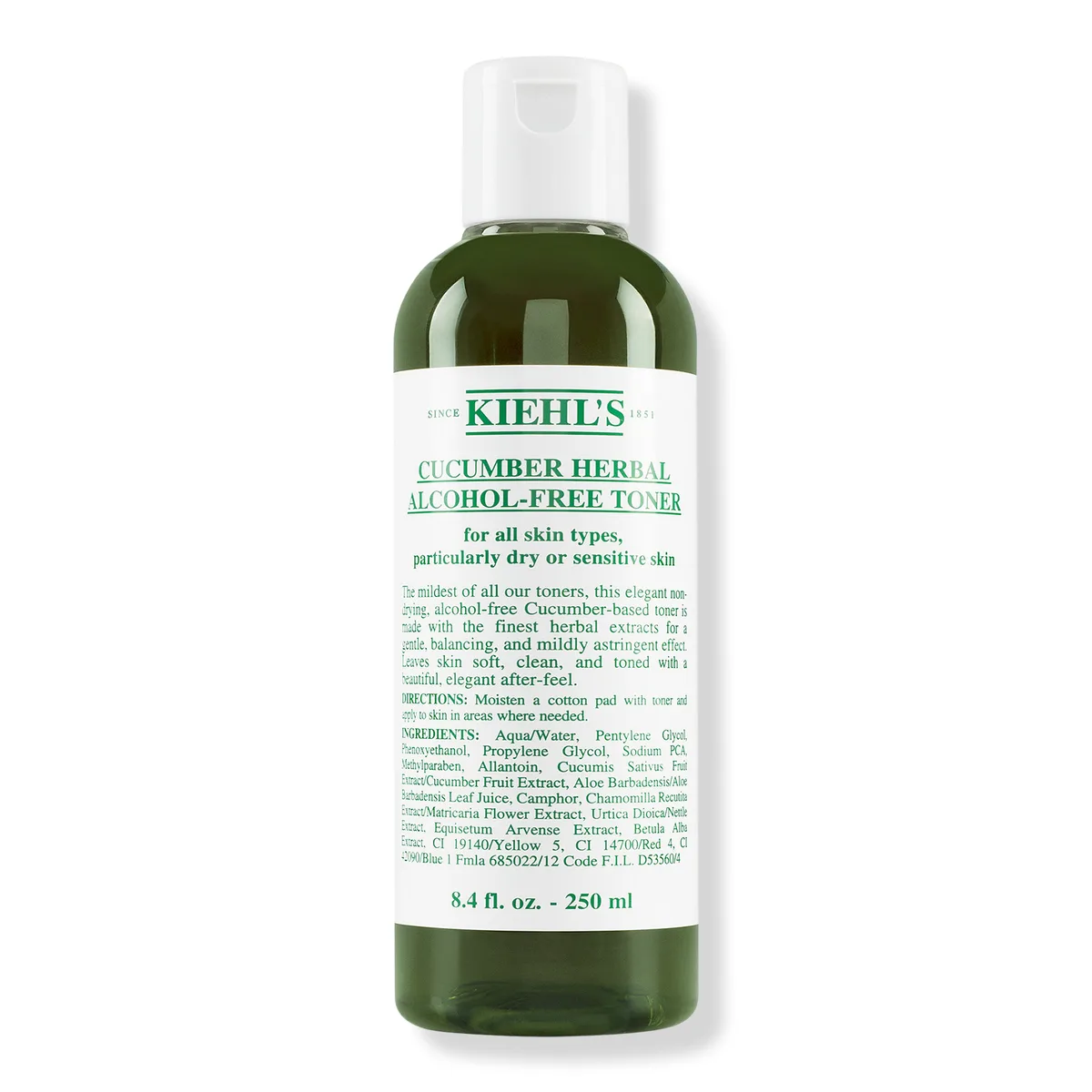
It is a decades-old pharmacy herbal water, cucumber, chamomile, nettle, horsetail and birch in a humectant base with allantoin and no alcohol, that has survived essentially unchanged from the era of hand-mixed toners, dyes and camphor included. The camphor is the tell: this is a traditional astringent water made gentle by removing the alcohol, not a modern soothing toner designed from scratch for reactive skin.
A decades-old apothecary herbal water, alcohol-free, fragrance-free and cooling, that refreshes and lightly hydrates without ever pretending to treat. Allantoin and humectants do the small amount of work; cucumber, nettle and birch supply the character; a dash of camphor and three dyes supply the doubts for a toner sold to sensitive skin. Pleasant, reliable and overpriced for water, it earns its counter space on ritual and heritage rather than on formulation.
Good choicefor DehydrationIn your profileYou chose · Sodium PCA is a reference standard by mechanism for dehydration; this liquid carries it high in the ingredient list.Moderate evidenceGentleNo reviews collected yet
The case for it
Sodium PCA & Propanediol has trial-supported standing for this concern.
It is present at an effective concentration, declared or high in the ingredient list.
The formula carries none of the triggers this concern is sensitive to.
Same rule for everyone. “Good choice” is the verdict on 9,564 of 45,024 concern verdicts across the catalog; rule R5 decided 9,072 of them.
As of September 25, 2026, engine 5.1.1.
Supporting rolefor SensitivityIn your profileYou chose · Mostly gentle: known irritants — usable for sensitive skin with a patch test.Not yet assessedStandard tolerabilityNo reviews collected yet
The case for it
Sodium PCA & Propanediol has no evidence row yet for this concern — it is in the research queue.
The formula carries no trigger this concern is sensitive to, with the cautions noted.
Cautions: known irritants.
What would change this: A researched evidence row for the lead active would replace this with a verdict.
Same rule for everyone. “Supporting role” is the verdict on 8,197 of 45,024 concern verdicts across the catalog; rule F3 decided 183 of them.
As of September 25, 2026, engine 5.1.1.
Does the jobDoes what a toner is for: not alcohol-driven, adds something real. Not measured from the label: restores skin pH, plays well with what follows.
A verdict is DermApproved’s assessment of how well a product’s ingredients fit a concern — never a claim about what the product treats. Evidence dots and collected reviews sit beside it and are never blended in.
Rules 0.5.1 · evidence table ev-2026.09-r228 · how we decide
Assessment
Pros & Cons
Pros
✓ Alcohol-free and fragrance-free, leaving no tightness
✓ Allantoin and chamomile give a mild, real soothing effect
✓ Cool, refreshing feel that works well chilled as a compress
✓ Layers with any serum or active and suits most skin types
✓ Generous 250 mL bottle lasts four to six months
✓ Decades of consistent reviews from a heritage brand
Cons
✗ Camphor in a toner sold to sensitive skin can sting reactive faces
✗ Three synthetic dyes serve no purpose in a soothing formula
✗ Nettle, horsetail and birch are decorative rather than active
✗ Luxury price for what is mostly water and humectants
✗ Does nothing cumulative; it refreshes and stops there
✗ Flip cap pours generously onto pads
Review
Full Review
Twelfth on this toner's ingredient list, between the aloe and the nettle, is camphor. It is a small amount, and most people register it only as the cool, faintly medicinal tingle that makes the bottle feel like a pharmacy product rather than a beauty one, but it is an odd thing to find in a toner sold to sensitive skin, and it tells you what this formula is. Kiehl's Cucumber Herbal Toner is not a modern soothing water designed from scratch for reactive faces; it is one of the brand's oldest formulas, an infusion of cucumber, chamomile, nettle, horsetail and birch from the era when a toner meant an astringent with a bite, made gentle by taking the alcohol out and leaving everything else, camphor and green dye included. Understood that way, it makes complete sense, and so do its limits.
The list is short and almost entirely water. Propanediol and propylene glycol supply humectancy, sodium PCA adds a component of the skin's own moisturising factor, allantoin seventh is the one ingredient with solid soothing evidence, and then the herbs: chamomile, cucumber, aloe, camphor, nettle, horsetail, birch. Three synthetic dyes give the liquid its deep green cast, a preservative system keeps it clean, and there is no alcohol, no fragrance, no oil and no active of any kind. It is a formula from a time before ingredient lists were marketing documents, and its survival through Kiehl's L'Oréal years, with only the parabens removed, is a small act of loyalty to the customers who have bought it for decades.
On the face it is what the name suggests: a cool, clean, faintly green water that evaporates in half a minute and leaves the skin damp, soft and lightly hydrated rather than tight. The camphor tingle is the whole sensory event, and it is pleasant on normal and combination skin, especially chilled, soaked into pads and laid over a hot or puffy face, which is the toner's best trick. Minor redness settles for a while under the allantoin and chamomile. Then serum and moisturiser go on over the damp surface, which is the real function of a hydrating toner, and the ritual is complete. There is nothing to wait for and nothing that accumulates; the bottle maintains a mood rather than changing skin.
It is worth being precise about what a toner like this is for in a modern routine, because the category has drifted. The astringent toners of the toner's own era existed to strip the residue of soap and oil; today's cleansers rinse clean, and a hydrating toner's job is simply to leave the surface damp so that the serum and moisturiser that follow spread better and sink in with less drag. This one does that competently, and the humectants are the reason. Anyone applying a vitamin C or a retinoid afterwards will notice the difference between pressing it into a cucumber-damp face and a dry one, and that, rather than the herbs, is the practical case for keeping the bottle.
The cooling compress is the other case, and regulars swear by it: cotton pads soaked in the toner and chilled for an hour, laid over the face after a hot day, a long flight or too little sleep, take the heat out of the skin and the puffiness out of the eyes for a while. The camphor helps here, oddly, since its cool-then-warm sensation reads as relief on tired skin in a way it does not on irritated skin.
The doubts are specific and small. Camphor at a low dose is a mild irritant, and rosacea-prone, eczema-prone or barrier-compromised faces can feel its tingle as a sting; propylene glycol high on the list and chamomile bother a minority; the dyes are cosmetic and pointless in a product for sensitive skin, and the reviewers who mention them are right. None of these makes the toner harsh, but together they make it a less obvious choice for genuinely reactive skin than its alcohol-free label implies, and for that audience the brand's calendula version or a plainer hydrating toner with fewer variables is often the better fit. The nettle, horsetail and birch, meanwhile, are traditional astringents with little modern evidence and no meaningful dose, present to flavour the formula and honour the name.
The price is where the apothecary charm costs something. Twenty-nine dollars for 250 millilitres is luxury toner money for what is, on any reading of the list, herbal-scented water with a few humectants, and hydrating toners with better-designed humectant systems cost a third as much. The bottle is generous and lasts four to six months, which makes the sum tolerable rather than reasonable, and what the premium buys is the black-and-white label, the green bottle on a bathroom shelf, and the continuity of a product that has looked and felt the same for longer than most of its buyers have been alive.
So the recommendation is affectionate and honest. If you want a cooling, alcohol-free, fragrance-free toner from a heritage brand, enjoy a small pharmacy ritual after cleansing, and have normal or combination skin that reads a camphor tingle as refreshment, this is a pleasant bottle that will never do you harm. If you want a toner to do something, or your skin is reactive enough that camphor and dyes are a risk not worth taking, the water inside is available in plainer bottles for far less, and the herbs were never going to make the difference.
Formula
Key Ingredients
The hero actives that drive this product's performance.
The namesake, tenth on the list behind the glucose, obtained by what Kiehl's calls cryoextraction and contributing the toner's cooling, faintly green character. Cucumber extract is mostly water with trace vitamins and a little soothing evidence; at this placement it is more the mood of the bottle than its mechanism, and the calming that reactive skin feels owes more to the allantoin and chamomile above it.
Seventh on the list, the ingredient with the best evidence for the soothing the toner is sold on: a well-documented skin protectant that calms minor irritation and softens the surface, doing its quiet work at a placement that suggests a real dose in a formula this simple.
Propanediol second, propylene glycol third and sodium PCA fifth are the humectant backbone that lets an alcohol-free toner leave skin feeling toned without tightness; sodium PCA is a component of the skin's own natural moisturising factor, and together they are why the water feels like more than water on the face.
Established mechanismfor Dehydration · established mechanism
Twelfth on the list and the toner's most surprising inclusion for a product sold to sensitive skin: camphor supplies the cool, medicinal tingle that gives the astringent claim its sensation and the bottle its faint pharmacy scent, and it is a mild irritant that reactive and rosacea-prone faces may feel. Its dose is low, but it is why the toner is not the blandest option for the skin it is aimed at.
The herbal quartet that gives the toner its name and its apothecary heritage, spread from eighth to fifteenth on the list. Chamomile has modest anti-inflammatory evidence; nettle, horsetail and birch are traditional astringents with little modern data, present at levels that flavour the formula rather than treat anything.
Not yet assessed
Ingredient standings describe the active at treatment-level doses and
vehicles; this product's own condition grades weigh its actual formula.
Sweep over the face on a cotton pad or press in with the palms straight after cleansing, then move on to serum and moisturiser while the skin is still damp; it has no actives, so it layers with anything, and it can double as a cooling compress when soaked into pads and chilled.
Results Timeline
Skin feels fresh, cool and lightly hydrated at once and stays comfortable through the day. There is no cumulative change; the toner maintains rather than treats, and its soothing effect on minor redness is short-lived.
Pairs Well With
Any serum applied to damp skinHydrating moisturiserSunscreenRetinoid at night, as a buffer step
The toner's measurable effects are humectancy and mild soothing, both from ingredients near the top of a short list. Propanediol and propylene glycol are small-molecule humectants that draw water into the stratum corneum and improve the spreading of subsequent products; sodium PCA is a constituent of the skin's natural moisturising factor with good evidence for increasing surface hydration. Allantoin, seventh on the list, is a recognised skin protectant with evidence for calming minor irritation and promoting smoothness, and chamomile flower extract carries bisabolol and apigenin with modest anti-inflammatory activity in topical studies; together they account for the transient settling of redness users describe. Applied to damp skin and followed by a moisturiser, the toner's main functional role is to leave the surface hydrated and receptive, which is what any alcohol-free hydrating toner does.
The herbal and sensory ingredients are less supported. Cucumber fruit extract is largely water with trace vitamins, flavonoids and a cooling reputation; controlled evidence for a skin effect at cosmetic concentrations is thin. Nettle, horsetail and birch leaf extracts are traditional astringents whose tannin and silica content underlies the folk claim of tightening; at their placement in this formula they contribute little beyond character. Camphor activates TRPV3 and cold-sensing receptors, producing a cooling then warming sensation; it is a recognised mild irritant, is restricted in leave-on cosmetics in several jurisdictions, and at the low dose implied here is tolerable for most skin but a plausible source of stinging on rosacea-prone or barrier-compromised faces. The three synthetic dyes are colourants with no function and a small sensitisation potential.
The absence of alcohol, fragrance, essential oils and actives gives the toner a low irritation profile overall, with camphor, propylene glycol and chamomile as the identifiable exceptions. There is no exfoliating, brightening or treatment mechanism in the formula, and no clinical study of the product has been published; its behaviour is that of a humectant-and-botanical water, effective at hydration and refreshment and inert beyond that.
Dermatologist Perspective
Dermatologists are broadly unbothered by alcohol-free toners and broadly unconvinced they do much; a water with humectants and allantoin applied before moisturiser is harmless and mildly useful, and clinicians would rate this one as a pleasant example with a couple of ingredients they would rather it did not contain. Camphor is the first, a mild irritant with no place in a product marketed to sensitive skin, and the second is the set of dyes, which add sensitisation potential for no benefit; neither is likely to trouble normal skin, but a patient with rosacea, atopic dermatitis or a compromised barrier would usually be steered to a plainer hydrating toner or told to skip the step. Clinicians would also note that the herbal astringents do not tighten pores or reduce oil in any lasting way, that the cucumber is a mood rather than a mechanism, and that a toner is not a treatment for anything. Used as a cooling compress after a procedure or sunburn, chilled and soaked into pads, it is a reasonable comfort measure, camphor permitting.
Guidance
Usage & Recommendations
How to Use
After cleansing, morning and evening, pour a little of the toner onto a cotton pad and sweep it over the face and neck, avoiding the eyes, or pour a small amount into the palms and press it into the skin. Do not rinse; while the skin is still damp, follow with serum and then moisturiser, and sunscreen in the morning. It contains no actives, so it can be used under a retinoid, vitamin C or acid without any wait. For a cooling compress, soak cotton pads with the toner, chill them in the fridge and lay them over the face for a few minutes. Stop if the camphor tingle reads as stinging rather than cooling, which usually signals reactive skin that would do better with a plainer toner. Snap the flip cap shut, since the liquid evaporates.
Value Assessment
At $29 for 250 mL this is a luxury price for a toner whose functional content is water, three humectants and allantoin, and simpler hydrating toners with equal or better humectant systems sell for a third as much. The bottle's generosity, four to six months at a pad-full twice daily, brings the cost per use to a few cents and makes the purchase tolerable, and a smaller travel size exists for trial. The premium buys the Kiehl's label, the green apothecary aesthetic and decades of continuity, which loyal buyers value and which do nothing on the skin. For someone who wants that ritual and has normal skin, the price is a known indulgence; for anyone buying a toner on function, or with reactive skin that camphor and dyes could trouble, the money is better spent elsewhere.
Who Should Buy
People with normal or combination skin who enjoy a cooling, alcohol-free, fragrance-free toner as a daily ritual and like the heritage and look of a Kiehl's bottle on the shelf, and anyone who wants a large, gentle toner to chill as a compress. It suits those who expect refreshment rather than results.
Who Should Skip
Rosacea-prone, eczema-prone or barrier-compromised skin that may feel the camphor as a sting or react to the dyes, and anyone who wants a toner with an active in it. Buyers choosing on value will find plainer hydrating toners with better humectant systems for far less.
Ready to try Kiehl's Cucumber Herbal Alcohol-Free Toner?
A thin, watery, green-tinted liquid with no slip or body, absorbing or evaporating within half a minute and leaving skin cool and faintly hydrated.
Scent
Fragrance-free, with a clean, faintly medicinal camphor note and a hint of cucumber and herbs that fades quickly.
Packaging
A tall 250 mL clear plastic bottle with a white flip-top cap and Kiehl's white label in green lettering, the deep green liquid visible through it; also sold in a smaller travel size. The flip cap pours onto a pad or into the palm.
Finish
lightweightmatte
What to Expect on First Use
The first application is cool and clean with a light camphor tingle that most people read as refreshing and a few as a sting, and the skin is left soft and damp rather than tight. There is nothing to adjust to; reactive skin will know within a day or two whether the camphor is a problem.
How Long It Lasts
Four to six months with a pad-full twice daily; the 250 mL bottle is generous.
Kiehl's has sold herbal toners since its pharmacy days, and the cucumber version, alongside the calendula, is among the oldest formulas still in the range, from a time when a toner meant an infusion of botanicals with a little astringent bite. The brand removed the parabens in a later reformulation and kept the rest, including the camphor and the green tint that regulars recognise across the counter.
About Kiehl's Legacy Brand (20+ years)
Kiehl's has sold herbal toners under its 1851 apothecary name for decades, and the cucumber version is one of its oldest surviving formulas, dating from the era when the brand was still a single Manhattan pharmacy. Owned by L'Oréal since 2000, the brand has reformulated it quietly to drop parabens while keeping its herbal-water character; its claims rest on tradition and on the mild evidence for its botanicals rather than on any trial.
Brand founded: 1851
Myth vs. Reality
Common Myths
Myth
Alcohol-free means a toner cannot irritate sensitive skin.
Reality
Alcohol is the commonest toner irritant but not the only one. This formula carries camphor for its cooling tingle, propylene glycol third on the list and chamomile, all of which bother a minority of reactive faces; alcohol-free is a good start, not a guarantee.
Myth
The herbal extracts tone and tighten pores.
Reality
Nettle, horsetail and birch are traditional astringents with little modern evidence, present here at low levels, and pores do not tighten in any lasting way from a toner. The toned feel is the humectants and the camphor's cooling, which is a sensation rather than a change.
FAQ
Frequently Asked Questions
What is in Kiehl's Cucumber Herbal Alcohol-Free Toner?
Water, propanediol and propylene glycol, a preservative system, sodium PCA, allantoin, chamomile, cucumber and aloe, a small amount of camphor, nettle, horsetail and birch extracts, and three dyes for the blue-green colour. It contains no alcohol, fragrance, oil or actives.
Is Kiehl's Cucumber toner good for sensitive skin?
For most sensitive skin, yes: it is alcohol-free and fragrance-free with allantoin and chamomile. The exceptions are rosacea-prone or very reactive faces that feel the camphor's tingle as a sting, and the small minority who react to propylene glycol or chamomile; patch test if in doubt.
Kiehl's Cucumber toner or Calendula toner, which should I choose?
Both are alcohol-free herbal waters. Cucumber is the cooler, lighter one with a camphor tingle, suited to normal and combination skin that wants refreshment; Calendula is the more soothing, oil-balancing one with calendula petals, usually preferred for oily or blemish-prone skin.
Does Kiehl's Cucumber toner contain camphor?
Yes, camphor is listed twelfth. It provides the cooling, mildly medicinal tingle and is at a low level, but it is the ingredient most likely to bother rosacea-prone or barrier-compromised skin.
How do I use Kiehl's Cucumber Herbal toner?
Moisten a cotton pad and sweep it over the cleansed face and neck, or pour a little into the palms and press it in, then follow with serum and moisturiser while the skin is damp. It can also be soaked into pads and chilled as a cooling compress.
Is Kiehl's Cucumber toner worth twenty-nine dollars?
It is a luxury price for a water-based herbal toner with no actives, but the 250 mL bottle lasts four to six months and the alcohol-free, fragrance-free formula is pleasant and reliable. Buyers who want the ritual and the heritage will find it fair; those buying on function will find simpler hydrating toners for less.
Reviews
What Reviewers Tend to Say
Recurring themes our editors read across retailer reviews of this product — summaries in our words, not quotations, and not a substitute for your own patch test.
Common Praise
Users consistently describe a cool, refreshing feel and no tightness
Alcohol-free and non-stinging on most skin
Large bottle that lasts for months
Layers under anything and doubles as a chilled compress
Common Complaints
Does not do much beyond refreshing
Camphor tingle and medicinal smell bother some sensitive users
Pricey for a water-based toner
Green dye feels unnecessary
Notable Endorsements
A Kiehl's counter staple for decades and a recurring pick in lists of alcohol-free toners
Chamomile's active fraction inhibits the same inflammatory pathways a steroid does, at a fraction of the strength — and the version that works best is grubbed out of Brazilian cerrado, while the synthetic substitute is half inactive by construction.
The fourth most frequent positive patch test in North America is an oxidation product of a molecule that occurs naturally in lavender. Nobody synthesised it into your face cream.
Western sensitive skincare works by subtraction — remove the fragrance, remove the alcohol, shorten the list. Japan's answer adds a designed molecule back in, and one of the two bets has a trial literature.
Irritant and allergic contact dermatitis can look identical on the arm and take opposite instructions — and the single most common mistake in skincare is applying the tolerance-building logic of one to the immune memory of the other.
Jul 20, 2026· 9 min
Questions people ask about sensitive skin
Verified answers from our questions library — the nuance a product page cannot carry.
Products, answers, therapy guides, tools and articles in one search. Brand names,
slang and abbreviations all work — accutane finds isotretinoin, bacne finds truncal acne.