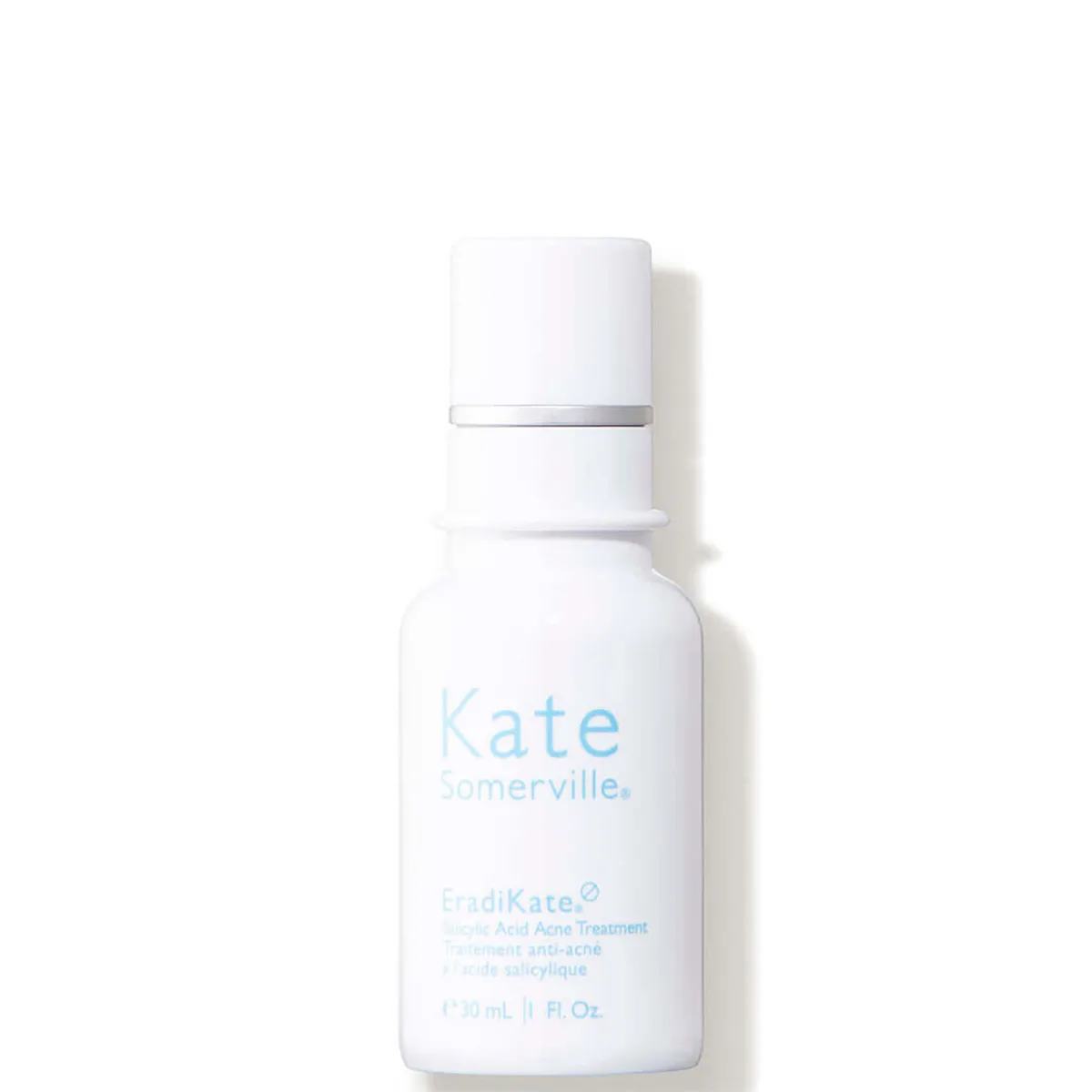
Unlike most salicylic acid products that simply exfoliate and dry, this formula adds retinyl propionate for cell turnover normalization and hexylresorcinol for post-acne brightening — addressing the full acne lifecycle from prevention to active breakouts to post-inflammatory dark marks. The hydrating base (HA, sodium PCA, panthenol) is unusually generous for an acne treatment.
Kate Somerville EradiKate Salicylic Acid Acne Treatment Review
Clinic-Grade Breakout Fighter
treatmentcreamclinicalParaben FreeCruelty Free
A premium all-over acne treatment that goes beyond simple salicylic acid with a multi-active approach targeting prevention, active breakouts, and post-acne marks. The formulation is genuinely sophisticated, but the $72 price for a single ounce is hard to justify when the star ingredient — 2% salicylic acid — is available in excellent formulations at a fraction of the cost.
Strong choicefor AcneIn your profileYou chose · Salicylic Acid is an approved or monograph active for acne; this cream carries it at 2%.Moderate evidenceStandard tolerabilityNo reviews collected yet
The case for it
Salicylic Acid is a first-line active — approved, monograph-listed or named in current guidelines — for this concern.
It is present at an effective concentration, declared or high in the ingredient list.
The formula carries no trigger this concern is sensitive to, with the cautions noted.
Cautions: fragrance; fungal-acne triggers.
Same rule for everyone. “Strong choice” is the verdict on 1,459 of 45,024 concern verdicts across the catalog; rule R2 decided 892 of them.
Unchanged since September 5, 2026, engine 5.1.1.
R2 — A regulator- or guideline-recognised first-line active, declared at an effective strength, in a form the claim supports. · the full register
Carrying active
Salicylic Acid
Standing
first line — a regulator recognises it for this use; trials support it · per § 333.310 Acne active ingredients. (U.S. Food and Drug Administration — 21 CFR Part 333 Subpart D (Topical Acne Drug Products), Code of Federal Regulations via GovInfo), opened July 27, 2026
Form
adequate (declared 2%) — studied range 0.5–2%, from the OTC monograph or label; judge it after ~6 weeks
Tolerability
standard — fragrance load, fungal triggers
Row checked
against its sources on July 27, 2026 (evidence table ev-2026.09-r228)
Strong choicefor BlackheadsIn your profileYou chose · Salicylic Acid is an approved or monograph active for blackheads; this cream carries it at 2%.Moderate evidenceStandard tolerabilityNo reviews collected yet
The case for it
Salicylic Acid is a first-line active — approved, monograph-listed or named in current guidelines — for this concern.
It is present at an effective concentration, declared or high in the ingredient list.
The formula carries no trigger this concern is sensitive to, with the cautions noted.
Cautions: fungal-acne triggers.
Same rule for everyone. “Strong choice” is the verdict on 1,459 of 45,024 concern verdicts across the catalog; rule R2 decided 892 of them.
Unchanged since September 5, 2026, engine 5.1.1.
R2 — A regulator- or guideline-recognised first-line active, declared at an effective strength, in a form the claim supports. · the full register
Carrying active
Salicylic Acid
Standing
first line — a regulator recognises it for this use; trials support it · per 21 CFR § 333.350 - Labeling of acne drug products. (US Code of Federal Regulations (Legal Information Institute, Cornell Law School)), opened July 27, 2026
Form
adequate (declared 2%) — studied range 0.5–2%, from the OTC monograph or label; judge it after ~6 weeks
Tolerability
standard — fungal triggers
Row checked
against its sources on July 27, 2026 (evidence table ev-2026.09-r228)
The studies behind the evidence row
OTC monograph, Topical Acne Drug Products — salicylic acid 0.5–2% recognized as an acne treatment active — US Food and Drug Administration
Not for thisfor Large PoresIn your profileYou chose · The actives here have been researched for large pores and the evidence does not support the claim.Not yet assessedStandard tolerabilityNo reviews collected yet
The case for it
Salicylic Acid has been researched for this concern and the evidence does not support it.
It is present at an effective concentration, declared or high in the ingredient list.
The formula carries no trigger this concern is sensitive to, with the cautions noted.
Same rule for everyone. “Not for this” is the verdict on 488 of 45,024 concern verdicts across the catalog; rule R10 decided 488 of them.
Unchanged since September 5, 2026, engine 5.1.1.
Unprovenfor Excess OilinessIn your profileYou chose · Salicylic Acid has early or mechanistic evidence for excess oiliness — a reasonable bet, not a recommendation; the other actives here are not yet assessed for it.Moderate evidenceStandard tolerabilityNo reviews collected yet
The case for it
Salicylic Acid has early or mechanistic evidence for this concern, not trial-backed standing.
It is present below the studied range.
The formula carries no trigger this concern is sensitive to, with the cautions noted.
Cautions: fungal-acne triggers.
What would change this: A concentration inside the studied range would raise this a step.
Same rule for everyone. “Unproven” is the verdict on 1,111 of 45,024 concern verdicts across the catalog; rule R9 decided 1,111 of them.
Unchanged since September 5, 2026, engine 5.1.1.
R9 — Plausible-tier actives alone do not earn a recommendation, and 'not for this' would overstate the case against them. 'Unproven' with the evidence dots lets the reader judge the bet (added 0.2.0 after the first shadow run put a 10% niacinamide serum at 'not for this' for hyperpigmentation). 0.5.0: the closing clause reads the other heroes — "nothing else here addresses it" only when every other active has a researched 'none' row; "not yet assessed" when that is the truth. Rows whose dots read moderate or better now reach R9p first. · the full register
Carrying active
Salicylic Acid
Standing
plausible — trials support it
Form
sub threshold (declared 2%) — studied range 30%, from the trials on the row; needs leave-on contact; judge it after ~6 weeks
Tolerability
standard — fungal triggers
Row checked
against its sources on July 17, 2026 (evidence table ev-2026.09-r228)
Good choicefor Rough TextureIn your profileYou chose · Salicylic Acid is a reference standard by mechanism for rough texture; this cream carries it at 2%.Moderate evidenceStandard tolerabilityNo reviews collected yet
The case for it
Salicylic Acid has trial-supported standing for this concern.
It is present at an effective concentration, declared or high in the ingredient list.
The formula carries no trigger this concern is sensitive to, with the cautions noted.
Same rule for everyone. “Good choice” is the verdict on 9,564 of 45,024 concern verdicts across the catalog; rule R5 decided 9,072 of them.
Unchanged since September 5, 2026, engine 5.1.1.
A verdict is DermApproved’s assessment of how well a product’s ingredients fit a concern — never a claim about what the product treats. Evidence dots and collected reviews sit beside it and are never blended in.
Rules 0.5.1 · evidence table ev-2026.09-r228 · how we decide
Assessment
Pros & Cons
Pros
✓ Multi-active approach addresses prevention, active breakouts, and post-acne dark marks
✓ Hydrating base with HA, panthenol, and glycerin prevents the dryness typical of acne treatments
✓ 2% salicylic acid provides maximum OTC-allowed BHA concentration for pore clearing
✓ Lightweight, non-greasy texture encourages consistent nightly use
✓ FSA/HSA eligible — can be purchased with pre-tax healthcare dollars
✓ Clinical testing showed visible improvement within 1-2 days
Cons
✗ Extremely expensive at $72 per ounce for a salicylic acid product
✗ Lavender oil and fragrance are unnecessary irritation risks in an acne treatment
✗ Not suitable for sensitive skin or during pregnancy
✗ Isopropyl isostearate has moderate comedogenic potential — counterintuitive in an acne product
✗ Less potent retinoid (retinyl propionate) vs. pure retinol or tretinoin
✗ May cause initial purging phase that lasts 2-3 weeks
Review
Full Review
The original EradiKate was the product that Hollywood publicists kept in their bags during awards season — a sulfur-based spot treatment that could shrink a pimple overnight before a red carpet appearance. The Salicylic Acid Acne Treatment is its more sophisticated sibling: not an emergency spot fix, but a nightly all-over preventive treatment designed to stop breakouts before they start. It's the difference between calling the fire department and installing a sprinkler system.
The foundation is 2% salicylic acid — the maximum concentration allowed in OTC acne products. As a beta-hydroxy acid, salicylic acid is oil-soluble, meaning it can penetrate into the pore lining where sebum and dead cells accumulate to form the plugs that become blackheads and inflammatory acne. This isn't a new or exotic ingredient; it's the gold standard for OTC acne treatment, with decades of clinical evidence supporting its efficacy. What Kate Somerville does with it, though, is more interesting than simply dissolving it in a cream.
The formula layers retinyl propionate — a gentle retinoid ester — alongside the salicylic acid. This is a strategically sound combination: while the BHA clears existing pore congestion, the retinoid helps normalize the skin cell turnover cycle that causes pores to clog in the first place. It's a two-pronged approach that addresses both the symptom and the root cause. Retinyl propionate is considerably gentler than retinol or tretinoin, making the combination more tolerable as a daily treatment, though it's also less potent on its own.
Hexylresorcinol adds a brightening dimension that most acne treatments ignore entirely. Acne's damage doesn't end when the pimple heals — the dark marks (post-inflammatory hyperpigmentation) left behind can persist for months. By including an ingredient that inhibits melanin production, this formula addresses the full lifecycle of a breakout: prevention, treatment, and aftermath. It's a thoughtful touch that reflects clinical experience with real acne patients who care as much about scarring as they do about active pimples.
Tea tree oil (melaleuca alternifolia) provides antimicrobial support, targeting the P. acnes bacteria that contribute to inflammatory acne. A well-known 2007 study in the Indian Journal of Dermatology demonstrated that 5% tea tree oil was comparable to 5% benzoyl peroxide for acne, with fewer side effects. The concentration here isn't disclosed, but its position in the formula suggests it's a supporting player rather than a primary active.
The hydrating infrastructure is where this product truly distinguishes itself from typical acne treatments. Most salicylic acid products operate on a philosophy of drying — strip the oil, dry the skin, treat the acne. This formula takes the opposite approach, embedding the actives in a base rich with sodium hyaluronate, sodium PCA, panthenol, and glycerin. The logic is sound: dehydrated skin often overproduces sebum as a compensatory mechanism, creating a cycle where aggressive treatment actually worsens the underlying condition. By maintaining hydration, the formula allows the BHA to work without triggering defensive oil production.
The texture is pleasantly lightweight — a silky cream that absorbs without residue or heaviness. It doesn't leave the taut, stripped feeling that many acne treatments produce, which makes consistent nightly use much more sustainable. The matte, non-greasy finish means it can be used as a last step without worrying about product transfer to pillowcases.
Now, the price. Seventy-two dollars for one ounce of product is, to put it diplomatically, a conversation. The hero ingredient — 2% salicylic acid — is identical in concentration to products costing ten to fifteen dollars. The supporting actives (retinyl propionate, hexylresorcinol, tea tree oil) add genuine value, but the delta between this and a well-formulated drugstore BHA plus a separate brightening serum is difficult to close at this price premium. You're paying significantly for the Kate Somerville name, the clinical positioning, and the convenience of a multi-active formula.
The inclusion of lavender oil is a puzzling choice. Lavender is a known allergen that can trigger contact dermatitis, and adding it to a product designed for acne-prone (often reactive) skin seems counterproductive. The fragrance, while subtle, serves no clinical purpose and introduces unnecessary irritation risk. For a brand that emphasizes its clinical roots, this is a surprising concession to aesthetics.
One notable strength: this product is FSA/HSA eligible, meaning you can use pre-tax healthcare dollars to purchase it. For those with flexible spending accounts, this meaningfully reduces the effective cost and makes the investment more palatable.
For adult acne sufferers with oily to combination skin who want a single nighttime treatment that does more than just exfoliate, the EradiKate Salicylic Acid Acne Treatment delivers a genuinely multi-dimensional approach. The hydrating base, the retinoid support, and the brightening component set it apart from simpler BHA products. Whether that differentiation is worth the premium depends on your budget and how much you value the convenience of a single-product protocol versus assembling the same benefits from multiple, less expensive products.
Formula
Key Ingredients
The hero actives that drive this product's performance.
The maximum OTC-allowed concentration of this beta-hydroxy acid penetrates into pores to dissolve the sebum and dead skin cell buildup that causes acne. In this all-over treatment format, it provides continuous exfoliation across the entire face rather than targeting individual spots, helping prevent new breakouts from forming while clearing existing ones.
Established mechanismfor Rough Texture · established mechanism
A gentle retinoid ester that supports cell turnover and helps prevent the clogged pores that lead to acne. In this formula, it works alongside salicylic acid to address acne from two angles — BHA clears existing clogs while the retinoid helps normalize skin cell shedding to prevent new ones.
Natural antimicrobial that targets acne-causing P. acnes bacteria. Adds antibacterial action to the formula's exfoliating approach, addressing the bacterial component of acne that salicylic acid alone doesn't directly treat.
Provides essential hydration to offset the drying effects of 2% salicylic acid. Combined with sodium PCA, panthenol, and glycerin, this creates a moisture buffer that allows the acne treatment to work without leaving skin tight, flaky, or compromised.
A skin-brightening agent that helps fade post-inflammatory hyperpigmentation left by acne breakouts. In this treatment, it addresses the dark marks and scarring that often persist after active acne resolves — targeting both current breakouts and their aftermath simultaneously.
Not yet assessed
Ingredient standings describe the active at treatment-level doses and
vehicles; this product's own condition grades weigh its actual formula.
Apply a thin layer to clean, dry skin in the evening. Can be used as a standalone treatment or followed by a lightweight, non-comedogenic moisturizer. Do not layer with additional exfoliating acids or retinol products.
Results Timeline
Clinical testing showed visible breakout improvement within 1 hour and reduced redness and size within 2 days. Ongoing acne prevention requires 2-4 weeks of consistent use. Post-acne dark marks begin fading at 6-8 weeks.
Kate Somerville EradiKate Salicylic Acid Acne Treatment
Lightweight moisturizer (if needed)
Evidence
Science & Expert Perspective
The Science
Salicylic acid at 2% is the cornerstone of this formula and one of the most well-validated OTC acne treatments available. As a lipophilic BHA, it dissolves into the sebaceous material within pores, disrupting the formation of microcomedones — the precursors to visible acne lesions. A comprehensive review published in Clinical Therapeutics (2010) confirmed that salicylic acid at 0.5-2% significantly reduces both inflammatory and non-inflammatory acne lesions.
The retinyl propionate component works through the retinoid receptor pathway to normalize keratinocyte differentiation — the process by which skin cells mature and shed. Abnormal desquamation within the follicle is a primary driver of comedone formation. While retinyl propionate is a less potent retinoid ester compared to retinol or tretinoin, research in the Journal of Cosmetic Dermatology (2015) has demonstrated that retinyl esters can improve skin texture and reduce acne when used consistently over 8-12 weeks.
Tea tree oil's antimicrobial properties against Cutibacterium acnes (formerly Propionibacterium acnes) have been demonstrated in multiple studies. A randomized controlled trial published in the Medical Journal of Australia (1990) showed that 5% tea tree oil was comparable to 5% benzoyl peroxide in reducing acne lesion counts, with slower onset but fewer side effects including less scaling, dryness, and burning.
Hexylresorcinol, the brightening active targeting post-inflammatory hyperpigmentation, has been shown to inhibit tyrosinase activity — the enzyme responsible for melanin synthesis. Published data in the Journal of Cosmetic and Laser Therapy (2013) demonstrated that hexylresorcinol effectively reduced hyperpigmentation with a favorable safety profile.
Dermatologist Perspective
Dermatologists recognize 2% salicylic acid as a first-line OTC treatment for mild to moderate acne, particularly effective for comedonal (blackhead and whitehead) acne. Dermatologists note that the multi-active approach — combining BHA with a retinoid and brightening agent — mirrors what they would prescribe as separate products, consolidated into a single step. The hydrating base is viewed positively, as maintaining skin barrier integrity is increasingly recognized as important in acne management. However, dermatologists express concern about the lavender oil inclusion and note that patients with moderate to severe acne may need prescription-strength treatments rather than OTC formulations.
Guidance
Usage & Recommendations
How to Use
Apply a thin layer to clean, dry skin every evening. Start every other night for the first two weeks to assess tolerance, then increase to nightly use. Can be followed by a lightweight, non-comedogenic moisturizer if additional hydration is needed. Do not use with other exfoliating acids, benzoyl peroxide, or retinol products in the same routine. Apply broad-spectrum SPF 30+ sunscreen every morning.
Value Assessment
At $72 for 1 oz, this is one of the most expensive OTC salicylic acid treatments on the market. The multi-active formula — BHA, retinoid, brightening agent, and hydrating base — provides more than a simple salicylic acid product, but the price premium is substantial. A comparable routine using a drugstore 2% BHA ($12-15) plus a niacinamide or vitamin C serum for brightening ($15-20) would cost roughly half as much and offer similar benefits. The FSA/HSA eligibility provides meaningful savings for those with healthcare spending accounts. The value proposition improves if you genuinely use and appreciate the streamlined single-product approach.
Who Should Buy
Adults with oily to combination skin experiencing mild to moderate acne, particularly those dealing with both active breakouts and post-acne dark marks. Best for users who want a single-step nighttime acne treatment with hydrating support and are willing to invest in the convenience.
Who Should Skip
Budget-conscious shoppers, anyone with sensitive or dry skin, pregnant or breastfeeding individuals, and those with severe acne that likely requires prescription treatment. Also not ideal for anyone with known lavender or fragrance allergies.
Ready to try Kate Somerville EradiKate Salicylic Acid Acne Treatment?
Lightweight, silky cream that absorbs quickly. Not heavy or occlusive — feels more like a light lotion than a thick treatment cream.
Scent
Subtle herbal scent from tea tree and lavender oils. Noticeable on application but fades quickly.
Packaging
Opaque tube with pump dispenser — hygienic and practical for an acne treatment. Protects the retinyl propionate from light degradation.
Finish
lightweightmattenon-greasy
What to Expect on First Use
No immediate stinging or burning for most users. Mild tingling may occur from the salicylic acid. Some users experience a purging phase in weeks 1-2 where existing clogged pores come to the surface as breakouts — this is normal with BHA treatments and typically resolves within 2-3 weeks.
How Long It Lasts
Around 2-3 months when applied nightly to the face
The EradiKate line began with Kate Somerville's original sulfur-based spot treatment, born from her Hollywood clinic where clients needed blemishes resolved before red carpet events. The Salicylic Acid Acne Treatment extended the line from emergency spot treatment to preventive all-over care — a formula for people who want to stop breakouts from happening, not just treat them after the fact.
About Kate Somerville Established Brand (5–20 years)
Kate Somerville launched in 2004 from a Hollywood medispa clinic. The EradiKate line is one of the brand's flagship acne treatment collections, developed from protocols used in the founder's professional practice. The brand was acquired by Unilever in 2015 and later sold to Rare Beauty Brands.
Brand founded: 2004 · Product launched: 2021
Myth vs. Reality
Common Myths
Myth
Acne-prone skin shouldn't use moisturizing ingredients — they'll clog pores
Reality
Dehydrated skin actually produces more sebum as a compensatory mechanism, worsening acne. The hyaluronic acid and glycerin in this formula provide hydration without occlusiveness, helping regulate oil production rather than contributing to it.
Myth
Salicylic acid and retinol can't be used in the same product
Reality
While layering prescription retinoids with BHA can be irritating, this formula uses retinyl propionate — a gentler retinoid ester — at a concentration designed to complement the 2% salicylic acid. The hydrating buffer ingredients help manage the combined irritation potential.
FAQ
Frequently Asked Questions
What's the difference between EradiKate spot treatment and the Salicylic Acid treatment?
The original EradiKate is a 10% sulfur spot treatment designed to be dabbed on individual pimples overnight. The Salicylic Acid Acne Treatment is an all-over face cream with 2% salicylic acid plus retinyl propionate, designed for nightly preventive use across the entire face to prevent breakouts before they form.
Is Kate Somerville EradiKate worth $72?
The multi-active formula combining 2% salicylic acid, retinyl propionate, hexylresorcinol, and a hydrating base is more sophisticated than most acne treatments. However, at $72 per ounce, it's significantly pricier than comparable salicylic acid treatments. The value depends on whether the additional actives and elegant formulation matter to your skin and budget.
Can I use EradiKate Salicylic Acid Treatment with other acne products?
Avoid layering with other exfoliating acids (AHA, additional BHA), benzoyl peroxide, or retinol products in the same routine, as this formula already contains salicylic acid and a retinoid. You can use a gentle cleanser and lightweight moisturizer alongside it. Always use sunscreen in the morning.
Will EradiKate cause purging?
Some users experience an initial purging phase during weeks 1-2, where pre-existing clogged pores come to the surface as breakouts. This is normal with BHA treatments and indicates the salicylic acid is clearing congestion. Purging typically resolves within 2-3 weeks. If irritation (redness, stinging, peeling) persists beyond 3 weeks, reduce frequency or discontinue.
Is EradiKate Salicylic Acid Treatment safe during pregnancy?
No. This formula contains retinyl propionate (a retinoid) and salicylic acid at 2%, both of which are generally advised against during pregnancy. Consult your healthcare provider for pregnancy-safe acne treatment alternatives.
Reviews
What Reviewers Tend to Say
Recurring themes our editors read across retailer reviews of this product — summaries in our words, not quotations, and not a substitute for your own patch test.
Common Praise
Visible reduction in breakout size and redness within 1-2 days
Lightweight texture doesn't feel heavy or cakey on skin
Hydrating formula prevents the dryness typical of acne treatments
Helps fade acne marks over time with continued use
Common Complaints
Very expensive at $72 for only 1 oz of product
Contains lavender oil and fragrance in a treatment for reactive skin
Not as dramatically effective as prescription acne treatments
Some users experience initial purging in the first 1-2 weeks
Notable Endorsements
FSA/HSA eligiblePart of Kate Somerville's bestselling EradiKate line
The whole case for salicylic acid rests on one unglamorous fact of chemistry: it dissolves in oil. Understand that, and you know exactly when it beats a glycolic acid — and when it's overkill.
The strongest counterexample to blanket botanical scepticism is also one of the more common contact allergens — and holding both facts at once is the only honest way to read it.
Essential oils are declared by botanical name rather than as fragrance, which is why the most heavily perfumed products in the natural aisle can carry the reassuring word — and why the bottle gets more sensitising the longer you own it.
Products, answers, therapy guides, tools and articles in one search. Brand names,
slang and abbreviations all work — accutane finds isotretinoin, bacne finds truncal acne.