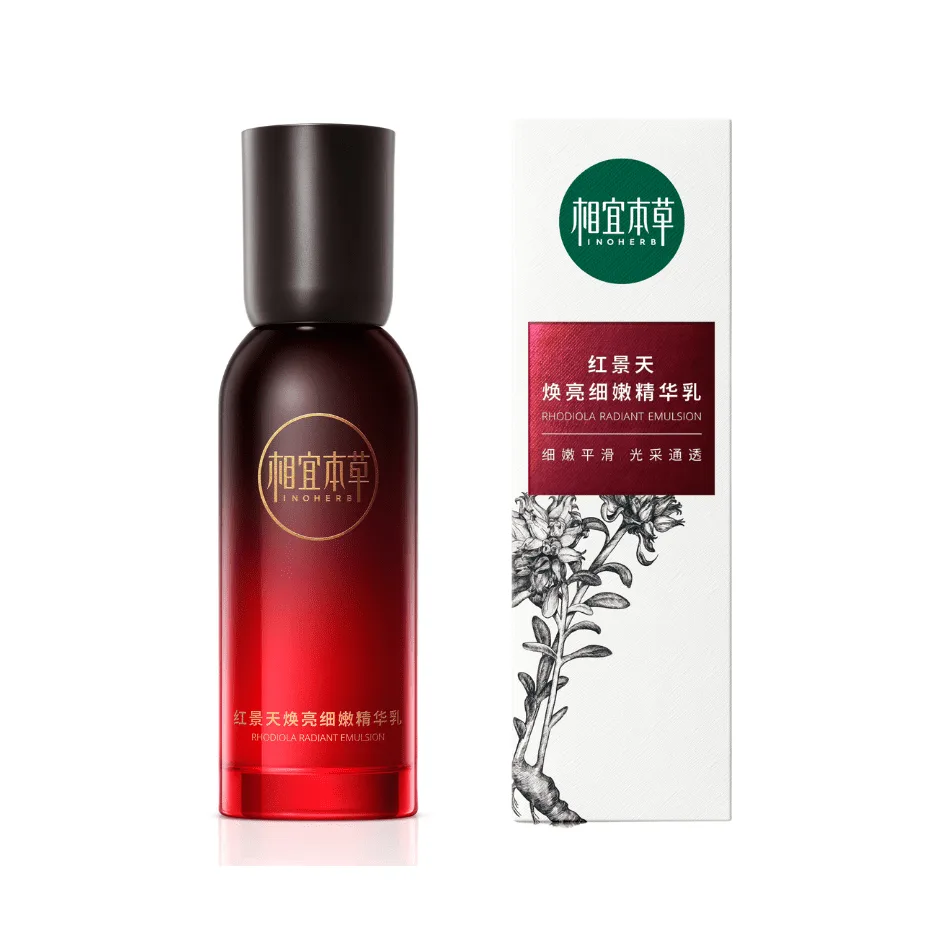
Where most emulsions in TCM-branded lines are simple lotions with herbs added, this one is engineered like a makeup primer — silica and nylon-12 soft-focus powders, two cyclomethicones and a dimethicone crosspolymer — with hydroxyethyl urea and creatine doing the humectant work underneath. It is a blurring day moisturizer wearing a herbal label.
A combination-skin emulsion built like a makeup primer — silica, nylon-12 and cyclomethicones on top, hydroxyethyl urea and creatine doing the hydrating underneath — with ten herbs added as a signature rather than a dose. Pleasant, velvety and useful under sunscreen; the 'radiant' is a blur effect, the perfume is real, and the converted price is merely fair.
There is no overseas review base for this emulsion — the Singapore retailers stocking it publish no ratings and the brand's domestic feedback lives on Chinese platforms. This assessment therefore rests on the complete ingredient list from Metro Singapore, the ordering of the functional ingredients, and Inoherb's long pharmacy record, with no tracked user outcomes behind it.
Verdicts
How well it fits each concern
Verdict by concern tap a concern for the case
Good choicefor Rough TextureIn your profileYou chose · Urea is a reference standard by mechanism for rough texture; this emulsion carries it high in the ingredient list.Moderate evidenceStandard tolerabilityNo reviews collected yet
The case for it
Hydroxyethyl Urea has trial-supported standing for this concern.
It is present at an effective concentration, declared or high in the ingredient list.
The formula carries no trigger this concern is sensitive to, with the cautions noted.
Same rule for everyone. “Good choice” is the verdict on 9,564 of 45,024 concern verdicts across the catalog; rule R5 decided 9,072 of them.
As of September 25, 2026, engine 5.1.1.
Good choicefor DehydrationIn your profileYou chose · Urea is a reference standard by mechanism for dehydration; this emulsion carries it high in the ingredient list.Moderate evidenceStandard tolerabilityNo reviews collected yet
The case for it
Hydroxyethyl Urea has trial-supported standing for this concern.
It is present at an effective concentration, declared or high in the ingredient list.
The formula carries no trigger this concern is sensitive to, with the cautions noted.
Same rule for everyone. “Good choice” is the verdict on 9,564 of 45,024 concern verdicts across the catalog; rule R5 decided 9,072 of them.
As of September 25, 2026, engine 5.1.1.
Also listed for Dullness — the actives here (Silica, Urea, creatine, Botanical Extracts) are in our research queue for that concern; there is no verdict until their evidence rows are written. That is a gap in our table, not a mark against the product.
Does the jobDoes what a moisturizer is for: draws in water, softens and smooths.
A verdict is DermApproved’s assessment of how well a product’s ingredients fit a concern — never a claim about what the product treats. Evidence dots and collected reviews sit beside it and are never blended in.
Rules 0.5.1 · evidence table ev-2026.09-r228 · how we decide
Assessment
Pros & Cons
Pros
✓ Silica and nylon-12 give a genuine soft-focus, pore-blurring finish
✓ Hydroxyethyl urea, glycerin and creatine form a real humectant core
✓ Sets semi-matte in under a minute and layers cleanly under sunscreen and makeup
✓ No alcohol or parabens; mild modern preservative system
✓ Light enough for humid weather and oily-leaning skin
✓ Licorice, calendula and bisabolol add a plausible calming edge
✓ Glass pump bottle doses one-pump portions without waste
Cons
✗ Fragrance is noticeable, with ginger and citrus extracts adding sensitiser routes
✗ Herbal extracts sit after the thickeners at signature-level doses
✗ The 'radiant' effect is an optical blur that washes off
✗ Too light for very dry skin in cold weather
✗ Cyclomethicone-and-ester base is unsuitable for fungal-acne-prone skin
✗ Overseas price is a conversion of the Singapore RRP with no US retailer to anchor it
Review
Full Review
Water, glycerin, glycereth-26, propanediol, silica. That is the opening of the ingredient list on a product whose box carries a botanical line drawing and a brand name that translates as 'suitable herbal medicine', and it tells you what Inoherb's formulators were actually building: a light, blurring, semi-matte day emulsion of the kind Japanese and Korean brands perfected a decade ago, with the herbs arriving twenty-five places later as a signature. That is not a criticism. It is a much better product than a lotion with herbs stirred in would be. But it means the right comparison is a primer-moisturizer, not a medicine cabinet.
The texture is the argument for it. One pump gives a fluid white emulsion that spreads with a silicone glide — cyclopentasiloxane and cyclohexasiloxane are both here — and sets within a minute to a soft, powdery-velvet touch. Silica at fifth place and nylon-12 further down are soft-focus spheres; they scatter light, blur enlarged pores and cut the shine off a combination T-zone in a way a plain milky lotion cannot. Wear a chemical sunscreen over it and there is no pilling; put foundation on top and it goes on more evenly than it does over a dewy cream. For humid weather, oily-leaning skin, or anyone who wants a morning moisturizer that behaves like a base, that finish is the whole point.
Under the surface the hydration is more thoughtful than the silicone content suggests. Hydroxyethyl urea, the thirteenth ingredient, is a non-crystallising urea derivative that pulls water into the upper epidermis without the sting straight urea can bring; beside it are glycerin and glycereth-26 in the top three, creatine as a cell-energy humectant, panthenol and tocopheryl acetate. That is a barrier-friendly core, and after a week or two of use the roughness on cheeks and around the nose softens noticeably. C10-18 triglycerides, caprylic/capric triglyceride and a small amount of squalane keep it from feeling like a purely synthetic film, though the emollient load is deliberately light — very dry skin will feel under-served by January.
Then the herbs. Rhodiola rosea leads a run of ten TCM botanicals — astragalus, saposhnikovia, albizia flower, calendula, gastrodia, forsythia, licorice, ginger — with bisabolol and a glycyrrhizate salt as the soothers among them. They sit after carbomer and the acrylate thickener, which in a typical emulsion means fractions of a percent. Licorice, calendula and bisabolol contribute a plausible calming effect at those levels; rhodiola contributes the name and an antioxidant footnote. The brand's 'patent microencapsulation' explains how the extracts are carried, not how much of them there is. Anyone buying this for the rhodiola should know that the ingredient doing the visible work is silica.
That also settles the 'radiant' question. The immediate luminosity is an optical blur — soft-focus powders diffusing light off a smoother surface — and it washes off with the day. The slower, real improvement is hydration: skin that holds water looks brighter, and the humectant core delivers that over a couple of weeks. Neither is pigment change. The line's whitening essence is the product carrying the Chinese special-cosmetic registration for that claim; this emulsion carries none and makes no such promise, which is to its credit.
Tolerability is middling for a moisturizer. There is no alcohol, no parabens, and the preservation — hydroxyacetophenone with 1,2-hexanediol and ethylhexylglycerin — is modern and mild. But fragrance is the last ingredient and it is not shy, ginger and citrus fruit extracts add two more sensitiser routes, and the cyclomethicone-and-ester base is not what fungal-acne-prone skin should be wearing. Reactive or rosacea-prone faces should patch-test; everyone else will find it comfortable, and the finish is genuinely kind to enlarged pores.
The practical picture after a month on combination skin: a smoother, less shiny T-zone by mid-morning, cheeks that no longer feel tight under sunscreen, and makeup that stays put through a working day. At night it is enough on its own in warm months and a little thin in cold ones, when a cream over it makes more sense. Dry skin can use it as a summer moisturizer or a year-round primer step; oily skin may find it the most useful product in the range.
Price, once more, is a currency conversion: there is no US listing, and Metro Singapore's recommended price translates to about thirty-seven dollars for 100 grams, or thirty-seven cents a gram. That is fair for a well-made primer-emulsion with a real humectant core, and generous compared with prestige blurring moisturizers that do the same job with fewer humectants; it is expensive next to the accessible pharmacy positioning the brand holds at home, and steep resale discounts in Asia-Pacific suggest the overseas RRP is more aspiration than market. Inoherb's twenty-five years of trading vouch for the manufacturing, not for any published efficacy, and the brand's clinical work stays in Chinese.
If you want a velvety, pore-blurring day moisturizer for combination or oily skin and you like a soft perfume, this does that job elegantly and hydrates better than most primers. If you want the herbs to be the point, or your skin is dry, reactive or fungal-acne-prone, the label is promising something the first five ingredients were never built to deliver.
Formula
Key Ingredients
The hero actives that drive this product's performance.
The thirteenth ingredient and the quiet reason the emulsion softens rough texture: a non-crystallising urea derivative that humectifies without the sting of straight urea, working beneath the silicone-and-silica surface layer to keep the skin's own water in place.
Established mechanismfor Rough Texture · established mechanism
Silica at fifth place and nylon-12 lower down are soft-focus powders; they are why this 'radiant' emulsion dries to a velvety, blurred finish on combination skin rather than a shine — an optical smoothing, not a skin change.
The namesake adaptogen leads a run of ten TCM botanicals that starts only after the thickeners, so it is present as the brand's signature antioxidant rather than as a driving dose; the licorice, calendula and bisabolol that follow it do more of the soothing.
An unusual choice in a herbal emulsion, creatine sits mid-list as a cell-energy humectant paired with panthenol and tocopheryl acetate to give the formula a modest barrier-support story beyond its botanicals.
Listed low, after the botanicals, squalane is the light emollient that keeps the silicone-heavy emulsion from feeling purely synthetic; with the triglycerides above it, it makes the finish comfortable on dry cheeks without weighing down an oily T-zone.
Not yet assessed
Ingredient standings describe the active at treatment-level doses and
vehicles; this product's own condition grades weigh its actual formula.
Use it as the moisturizer step after serum; on combination skin it can be the last step at night, while dry skin in winter will want a richer cream over it. Its soft-focus finish makes it a good morning base under sunscreen and makeup.
Results Timeline
Skin looks smoother and more matte-velvet the moment it sets thanks to the powders; genuine hydration improvement shows in one to two weeks, and the brightening the name promises is a subtle, months-long hydration effect rather than pigment change.
The functional chemistry of this emulsion is in its humectants and its powders, not its plants. Hydroxyethyl urea is a urea derivative that retains urea's water-binding capacity while resisting the crystallisation and the stinging that limit straight urea at higher concentrations; supplier data and a small body of published work support it as a skin-conditioning humectant that improves hydration and softness without the pH sensitivity of urea itself. Glycerin and glycereth-26 in the top three ingredients give the formula a substantial humectant base, and creatine — better known from muscle metabolism — has in vitro evidence for supporting keratinocyte energy status and protecting against oxidative stress, with a small number of industry-run topical studies suggesting improvements in firmness; none of that work tests a formulation like this one, so it is best read as a supporting humectant with a plausible mechanism. The soft-focus effect is well understood optics: silica microspheres and nylon-12 powder scatter incident light, reducing the visibility of pores and fine lines at the surface, an effect that lasts only as long as the film. The two cyclomethicones and the dimethicone crosspolymer provide slip and a breathable film that reduces transepidermal water loss modestly without occluding. Among the botanicals, licorice root extract, bisabolol and calendula have documented anti-inflammatory activity in vitro and in small clinical settings, but at their position after the polymeric thickeners their concentrations here are unlikely to exceed a few tenths of a percent. Rhodiola rosea root extract has antioxidant and tyrosinase-inhibition activity in cell assays with no topical human trials in a finished emulsion. The formula should be understood as a well-built hydrating primer with a herbal signature; its measurable benefits are hydration and surface smoothing.
Dermatologist Perspective
Combination-skin patients often struggle to find a moisturizer that hydrates without feeding midday shine, and the clinical view of this emulsion is that it solves that problem with cosmetic engineering rather than herbal magic. Silica and nylon-12 are the same soft-focus powders used in dermatologist-recommended primers, and hydroxyethyl urea is a humectant clinicians increasingly like for rough, dehydrated skin because it avoids the irritation of urea at useful percentages. The herbal list is read as marketing at its position. The fragrance, ginger and citrus extracts are the ingredients a dermatologist would flag for rosacea, eczema or a history of contact allergy, and the cyclomethicone-ester base is a poor fit for Malassezia-prone skin. For oily and combination patients who tolerate perfume, it is a reasonable daytime moisturizer under sunscreen; for dry or barrier-compromised patients the standard advice remains a fragrance-free ceramide cream, and none of the brightening language should be confused with treatment for hyperpigmentation.
Guidance
Usage & Recommendations
How to Use
After toner and any serum, dispense one pump into the palm and warm it between the hands, then press and smooth over the face, working outward from the centre so the powders distribute evenly. Give it a minute to set before sunscreen or foundation; the velvety finish is the base makeup sits best on. At night it can be the final step in warm weather, while dry skin or winter conditions call for a richer cream on top. Avoid the eye contour, where the soft-focus powders can settle into fine lines. Once or twice daily is the brand's guidance, and if the perfume proves too much, use it in the morning only when the blurring finish earns its keep.
Value Assessment
With no US retailer the price here converts Metro Singapore's recommended price to roughly thirty-seven dollars for 100 grams — about thirty-seven cents a gram, which lands between drugstore emulsions and prestige blurring moisturizers. For that you get a properly engineered primer-finish emulsion with a humectant core that many primers lack, elegant glass packaging, and a mild preservative system; you do not get disclosed herbal concentrations, a fragrance-free base or any English-language efficacy data. Inoherb's long domestic history is reassuring on quality control but does not carry the clinical weight a dermatology brand's pricing would. Asia-Pacific resellers regularly cut the price by half or more, and at that level it is a bargain for combination skin. At full overseas RRP it is fair, not compelling.
Who Should Buy
Combination, normal and oily-leaning skin that wants a hydrating day moisturizer with a semi-matte, pore-blurring finish under sunscreen and makeup. It suits people in humid climates, anyone tired of moisturizers that pill under SPF, and readers who enjoy a light perfume and a glass bottle on the shelf.
Who Should Skip
Very dry or barrier-compromised skin will find it too light, and sensitive, rosacea-prone or fungal-acne-prone skin should avoid the fragrance, ginger and cyclomethicone-ester base. Anyone buying it for the rhodiola rather than the finish, or expecting pigment brightening, should look at the ingredient order first.
A light, fluid white emulsion with a silicone glide that spreads thin, sets in under a minute, and leaves a powdery-velvet touch rather than a dewy one.
Scent
A gentle sweet-herbal perfume, stronger than the toner in the same line, fading over ten minutes or so.
Packaging
A gradient-red glass bottle with a dark pump, boxed in white card printed with the line's rhodiola botanical drawing.
Finish
velvetymattelightweight
What to Expect on First Use
The first application feels almost primer-like as the silica and nylon-12 set to a blurred finish; there is no tingling or purging, and the only adjustment is deciding whether the perfume and the semi-matte touch suit you.
How Long It Lasts
A 100 g bottle covers roughly three to four months at one pump twice daily.
Inoherb's Rhodiola range was launched to give the twenty-five-year-old herbal brand a premium, glass-bottled radiance line, and the emulsion is its combination-skin step: the milky toner and the whitening essence in the same line lean rich, so this one was built light and semi-matte. The 'patent microencapsulation' the marketing mentions refers to how the herbal extracts are carried through the silicone base.
About Inoherb Legacy Brand (20+ years)
Inoherb (相宜本草) has sold herbal skincare drawn from the Chinese materia medica through pharmacies and supermarkets since its Shanghai founding in 2000. Its formulas are built on TCM tradition and in-house development; the brand publishes no English-language clinical trials of finished products, so its credibility rests on longevity and scale rather than peer-reviewed evidence.
Brand founded: 2000 · Product launched: 2023
Myth vs. Reality
Common Myths
Myth
The emulsion brightens skin because of the rhodiola.
Reality
The immediate 'radiance' is a soft-focus optical effect from silica and nylon-12, and the longer-term glow is better hydration from hydroxyethyl urea and glycerin; the rhodiola sits behind the thickeners at a signature-level dose.
Myth
A silicone-heavy moisturizer suffocates the skin.
Reality
Cyclopentasiloxane and dimethicone form a breathable, non-occlusive film; they can feel heavy to some people and are best avoided by fungal-acne-prone skin, but they do not block pores or stop the skin 'breathing'.
FAQ
Frequently Asked Questions
Is the Inoherb Rhodiola Radiant Emulsion enough moisturizer on its own?
For combination, normal and oily skin, yes — its glycerin, hydroxyethyl urea and light triglycerides hydrate well, and the silicone film holds water in. Dry skin in cold months will want the line's Radiant & Repairing Cream or another richer layer over it.
Why does the Inoherb Rhodiola emulsion feel like a primer?
Silica is the fifth ingredient and nylon-12 appears further down; both are soft-focus powders that blur texture and cut shine, and with the two cyclomethicones they give a velvety, makeup-ready finish that is closer to a primer than to a classic milky lotion.
Does the Rhodiola Radiant Emulsion contain fragrance?
Yes, fragrance is the final ingredient, and ginger root and citrus fruit extracts are also in the herbal list. Sensitive, rosacea-prone or perfume-averse skin should patch-test or choose a fragrance-free emulsion.
Can the Inoherb Rhodiola Radiant Emulsion be worn under sunscreen and makeup?
It is one of its best uses. The semi-matte, blurred finish sets quickly, does not pill under a chemical sunscreen, and makes foundation sit more evenly on combination skin.
What does hydroxyethyl urea do in the Inoherb Rhodiola emulsion?
It is a gentle humectant derived from urea that draws water into the upper skin without urea's tendency to sting or crystallise; combined with glycerin and creatine it is the ingredient actually responsible for the emulsion's smoothing over the first couple of weeks.
Is the Inoherb Rhodiola Radiant Emulsion safe in pregnancy?
Its ingredient list has no retinoids, salicylic acid or hydroquinone, and the herbal extracts are at trace levels, so nothing raises a pregnancy flag; the fragrance is the only thing some people choose to avoid in that period.
Reviews
What Reviewers Tend to Say
Recurring themes our editors read across retailer reviews of this product — summaries in our words, not quotations, and not a substitute for your own patch test.
Common Praise
Velvety, non-greasy finish that suits combination skin
More products claim to fix dullness than any other concern, which is a strong hint the word means nothing — it is at least four separate mechanisms, and the one nobody sells for is the blood.
Glow isn't a vibe or a filter. It's light bouncing off smooth, hydrated, evenly-toned skin, which means you can reverse-engineer it into a checklist instead of chasing it with a highlighter.
Polyhydroxy acids get filed under 'beginner exfoliant,' as if gentle meant weak. The truth is stranger: their bulk is exactly why they work for the skin everything else sets on fire.
Picking one skin state and selling through hospital dermatology departments is a genuinely smart strategy. Whether the house botanical earns its billing is a separate question, and the answer is not the one either side wants.
Products, answers, therapy guides, tools and articles in one search. Brand names,
slang and abbreviations all work — accutane finds isotretinoin, bacne finds truncal acne.