It is the rare Korean foam that both declares its salicylic acid dose — 5,000 ppm — and builds the lather on amino-acid surfactants with glycerin listed first, which is a thoughtful combination for oily skin. It shares its nine-essential-oil blend and its trace-level hyaluronic and ceramide garnish with the line's cleansing oil, so the two are best understood as a matched pair rather than as separate formulas.
For oily, blackhead-prone skin that is not reactive, this is a good pore foam: amino-acid surfactants, glycerin first, a declared 0.5 percent salicylic acid and soft silica, at twenty dollars for 150 mL. Its sensitive-skin billing is the problem — nine essential oils and a 10 ppm dose of the heartleaf it is named for make 'soothing' a stretch — and the hyaluronic and ceramide claims are label decoration in a rinse-off.
Two years of Korean sales and a presence at K-beauty importers give this foam a real history, but its English-language review base is scattered and there is no Amazon US listing to draw a firm count from, so the figures here are conservative. Scoring leans on the disclosed 76-ingredient formula, the declared salicylic acid dose and the established behaviour of amino-acid surfactant cleansers; how often the essential-oil blend causes reactions in practice is the least settled question.
Verdicts
How well it fits each concern
Verdict by concern tap a concern for the case
Good choicefor BlackheadsIn your profileYou chose · Salicylic Acid is an approved or monograph active for blackheads; this rinse-off foam carries it at 0.5% — short contact still counts for this active, but a leave-on does more.Moderate evidenceStandard tolerabilityNo reviews collected yet
The case for it
Salicylic Acid is a first-line active — approved, monograph-listed or named in current guidelines — for this concern.
It is present at an effective concentration, declared or high in the ingredient list.
The formula carries no trigger this concern is sensitive to, with the cautions noted.
Cautions: fungal-acne triggers.
Same rule for everyone. “Good choice” is the verdict on 9,564 of 45,024 concern verdicts across the catalog; rule R2r decided 408 of them.
As of September 25, 2026, engine 5.1.1.
R2r — Rinse-off exceptions (BPO wash, salicylic acid cleanser) deliver a real but smaller effect than the leave-on form; they cap at 'good choice'. Medicated shampoos for scalp concerns are exempt — the shampoo is the treatment form. Editorial decision 2 Sep 2026, pending advisory review. · the full register
Carrying active
Salicylic Acid
Standing
first line — a regulator recognises it for this use; trials support it · per 21 CFR § 333.350 - Labeling of acne drug products. (US Code of Federal Regulations (Legal Information Institute, Cornell Law School)), opened July 27, 2026
Form
adequate (declared 0.5%) — studied range 0.5–2%, from the OTC monograph or label; judge it after ~6 weeks
Tolerability
standard — fungal triggers
Row checked
against its sources on July 27, 2026 (evidence table ev-2026.09-r228)
The studies behind the evidence row
OTC monograph, Topical Acne Drug Products — salicylic acid 0.5–2% recognized as an acne treatment active — US Food and Drug Administration
Supporting rolefor Excess OilinessIn your profileYou chose · Rinse-off foam: Salicylic Acid gets seconds of contact, so this supports a routine for excess oiliness rather than treating it.Moderate evidenceStandard tolerabilityNo reviews collected yet
The case for it
Salicylic Acid has early or mechanistic evidence for this concern, not trial-backed standing.
It is in a rinse-off product, so it gets seconds of contact rather than the leave-on exposure the evidence assumes.
The formula carries no trigger this concern is sensitive to, with the cautions noted.
Cautions: fungal-acne triggers.
What would change this: The same active in a leave-on form would be judged on its evidence rather than its contact time.
Same rule for everyone. “Supporting role” is the verdict on 8,197 of 45,024 concern verdicts across the catalog; rule R6 decided 2,017 of them.
As of September 25, 2026, engine 5.1.1.
R6 — Contact time cannot deliver a leave-on claim; the product is judged on its job (cleansing without aggravating). Explicit exceptions (BPO wash, SA cleanser, medicated shampoos) never reach this rule because their rows set rinse_off_ok. · the full register
Carrying active
Salicylic Acid
Standing
plausible — trials support it
Form
contact limited — studied range 30%, from the trials on the row; needs leave-on contact; judge it after ~6 weeks
Tolerability
standard — fungal triggers
Row checked
against its sources on July 17, 2026 (evidence table ev-2026.09-r228)
Supporting rolefor Large PoresIn your profileYou chose · Rinse-off foam: Salicylic Acid gets seconds of contact, so this supports a routine for large pores rather than treating it.Not yet assessedGentleNo reviews collected yet
The case for it
Salicylic Acid has been researched for this concern and the evidence does not support it.
It is in a rinse-off product, so it gets seconds of contact rather than the leave-on exposure the evidence assumes.
The formula carries none of the triggers this concern is sensitive to.
What would change this: The same active in a leave-on form would be judged on its evidence rather than its contact time.
Same rule for everyone. “Supporting role” is the verdict on 8,197 of 45,024 concern verdicts across the catalog; rule R6 decided 2,017 of them.
As of September 25, 2026, engine 5.1.1.
R6 — Contact time cannot deliver a leave-on claim; the product is judged on its job (cleansing without aggravating). Explicit exceptions (BPO wash, SA cleanser, medicated shampoos) never reach this rule because their rows set rinse_off_ok. · the full register
Carrying active
Salicylic Acid
Standing
none
Form
contact limited — studied range 0.5–2%, from the OTC monograph or label; needs leave-on contact; judge it after ~6 weeks
Good choicefor AcneIn your profileYou chose · Salicylic Acid is an approved or monograph active for acne; this rinse-off foam carries it at 0.5% — short contact still counts for this active, but a leave-on does more.Moderate evidenceStandard tolerabilityNo reviews collected yet
The case for it
Salicylic Acid is a first-line active — approved, monograph-listed or named in current guidelines — for this concern.
It is present at an effective concentration, declared or high in the ingredient list.
The formula carries no trigger this concern is sensitive to, with the cautions noted.
Cautions: fragrance; fungal-acne triggers.
Same rule for everyone. “Good choice” is the verdict on 9,564 of 45,024 concern verdicts across the catalog; rule R2r decided 408 of them.
As of September 25, 2026, engine 5.1.1.
R2r — Rinse-off exceptions (BPO wash, salicylic acid cleanser) deliver a real but smaller effect than the leave-on form; they cap at 'good choice'. Medicated shampoos for scalp concerns are exempt — the shampoo is the treatment form. Editorial decision 2 Sep 2026, pending advisory review. · the full register
Carrying active
Salicylic Acid
Standing
first line — a regulator recognises it for this use; trials support it · per § 333.310 Acne active ingredients. (U.S. Food and Drug Administration — 21 CFR Part 333 Subpart D (Topical Acne Drug Products), Code of Federal Regulations via GovInfo), opened July 27, 2026
Form
adequate (declared 0.5%) — studied range 0.5–2%, from the OTC monograph or label; judge it after ~6 weeks
Tolerability
standard — fragrance load, fungal triggers
Row checked
against its sources on July 27, 2026 (evidence table ev-2026.09-r228)
Does the jobDoes what a cleanser is for: surfactant mildness, rinses clean without stripping. Not measured from the label: pH match to skin.
A verdict is DermApproved’s assessment of how well a product’s ingredients fit a concern — never a claim about what the product treats. Evidence dots and collected reviews sit beside it and are never blended in.
Rules 0.5.1 · evidence table ev-2026.09-r228 · how we decide
Assessment
Pros & Cons
Pros
✓ Amino-acid surfactants and glycerin-first base rinse without tightness
✓ Fine hydrated silica adds a gentle physical polish on the nose
✓ Dense, creamy lather from a small amount
✓ No sulfates, silicones or drying alcohol
✓ Fair price per millilitre for a dosed acid foam
✓ Vegan formulation
Cons
✗ Nine essential oils make 'soothing' a misnomer for reactive skin
✗ Heartleaf disclosed at just 10 ppm — a name, not a dose
✗ Hyaluronic acids and ceramides are trace decoration in a rinse-off
✗ Tingles around the nostrils and eyes in the first week
✗ Too active for dry skin twice a day
✗ Not sold on major US retailers
Review
Full Review
Goodal prints the doses of a few ingredients on this foam's label, and the three numbers tell the story better than any marketing copy could. Heartleaf extract: 10 parts per million. Hyaluronic acids: mostly hundredths or thousandths of a part per million. Salicylic acid: 5,000 parts per million, or half a percent. In other words, the ingredient the product is named after is present at a homeopathic wink, the ingredients on the front of the box are there in quantities you could not detect, and the one active dosed to do something is an oil-soluble acid that most people buying a 'soothing' cleanser would not expect to find. Once you read the Heartleaf Hyaluron Soothing Pore Cleansing Foam that way — as a salicylic pore foam in soothing-line packaging — it makes a lot more sense, and it turns out to be a rather good one.
The base is where the quality is. Glycerin is the first ingredient, ahead of water, which is unusual for a foam and is the real reason it does not leave skin tight. The surfactants are sodium cocoyl glycinate and sodium lauroyl glutamate, the mild amino-acid pair that Japanese and Korean cleansers have used for years to get a creamy, dense lather without a sulfate, backed by an amphoteric and a betaine further down. Hydrated silica sits fifth and gives the lather an almost imperceptible fine grit that you notice only as a slight polish on the nose. Then, at the very end, the salicylic acid. Half a percent for the minute a lather is on the face is not a treatment, but used twice a day it is a steady nudge on the sebum plugs that become blackheads, and the silica gives it a physical partner. Two to four weeks in, the nose is smoother and the T-zone stays matte until lunch. That is a fair return from a cleanser.
Goodal has been a Clio Cosmetics skincare label since 2010, and the Heartleaf line became its sensitive-skin franchise on Olive Young shelves in 2024. This foam and its sister cleansing oil arrived that summer as the pore-care double cleanse for the range. Two years on it has a steady Korean following and a scattered presence at importers, but no Amazon US listing, which keeps English-language feedback thin.
The formula runs to seventy-six ingredients, and the middle of the list is where the reservations live. Between the fruit extracts that make up the brand's 'green phyto acid' story and the surfactant helpers, there is a block of nine essential oils — fir, rosemary, clary sage, geranium, clove leaf, patchouli, German and Roman chamomile and juniper — identical to the blend in the cleansing oil. They give the lather a green, herbal, faintly medicinal scent that many people will enjoy. They also make this one of the more allergen-rich foams in the category, because clove means eugenol, geranium means geraniol and citronellol, and the conifer and herb oils bring the terpenes that oxidise into sensitisers over the life of a tube. A rinse-off exposure is short, so most people will never react. But a product that carries all of them, plus salicylic acid, while disclosing its soothing botanical at ten parts per million, has no business being sold to reactive skin, and the packaging's 'soothing' should be read as the name of the line rather than a promise.
In practice that means a tingle around the nostrils and the corners of the eyes in the first week for many users, a matte, thorough, slightly tighter-than-cream finish that moisturizer fixes immediately, and, for a minority with fragrance sensitivity, pink cheeks that mean stop. Dry skin will find it a once-a-day cleanser at most. Oily and combination skin will find it exactly what it is: an effective, pleasant, mildly exfoliating foam that keeps pores in better order than a plain cream cleanser would.
The claims that do not survive contact with the ingredient list are the ones on the front. Ten hyaluronic acid species and five ceramides with cholesterol appear in the back third, at trace levels, in a product that is rinsed off after sixty seconds. They cannot hydrate or repair anything on that timescale, and the comfortable afterfeel comes entirely from the glycerin and the surfactant choice. The succinic acid credited with sebum control is likewise a trace in a rinse-off. None of this makes the foam worse; it just makes the box a poor guide to what you are buying.
At twenty dollars for 150 mL — about thirteen cents a millilitre — the price is fair for an amino-acid foam with a declared salicylic dose, and a tube lasts around two months of twice-daily use. It is not a bargain and does not need to be. The right buyer is someone with oily or combination skin, clogged pores, no history of reacting to essential oils, and a leave-on acid already in the routine that this can support in the morning. The wrong buyer is the person the packaging is aimed at: anyone who reached for the word soothing because their skin needs it.
Formula
Key Ingredients
The hero actives that drive this product's performance.
Two amino-acid surfactants in third and fourth place — the mild, creamy-foaming pair that lets this foam lift sebum without the squeak of a sulfate; disodium cocoamphodiacetate and lauryl betaine further down thicken the lather and soften it further.
Declared at 5,000 ppm and listed last, it gives the foam its pore-care credentials: an oil-soluble acid that can loosen the top of a blackhead in the minute the lather is on, though at a rinse-off contact time it is a nudge rather than a treatment.
Unusually, the first ingredient ahead of water — a glycerin-heavy base is what stops the amino-acid surfactants leaving the face tight, and it is the honest reason this foam feels hydrating rather than the trace hyaluronates the box advertises.
Fifth in the list, a very fine, soft silica that gives the foam a faint polishing action on the nose and chin as it is massaged — the physical half of the blackhead claim, gentle enough to be almost imperceptible.
The heartleaf extract on the label, disclosed by the brand at just 10 ppm — enough to justify the name, not enough to soothe a face that also meets nine essential oils in the same lather.
The fruit-extract quartet Goodal credits with plant-based exfoliation; in a foam that is on the face for a minute they are a story that supports the salicylic acid rather than a measurable exfoliant in their own right.
Not yet assessed
Ingredient standings describe the active at treatment-level doses and
vehicles; this product's own condition grades weigh its actual formula.
Works as a morning cleanser on its own or as the second step after an oil cleanse at night. On evenings a leave-on salicylic or glycolic product is planned, a plainer foam is kinder — stacking the 0.5 percent here with a leave-on acid adds irritation without adding benefit.
Results Timeline
Cleaner, less shiny skin from the first wash. Slightly smaller-looking blackheads and fewer clogged pores over two to four weeks of twice-daily use; a clear nose needs a leave-on acid on top.
The one active dosed to matter here is salicylic acid at a declared 0.5 percent, and the honest question is what that does in a cleanser. The evidence that cleansers can move acne at all is thin but real: an eight-week, double-blind, split-face randomized trial published in the Journal of Dermatological Treatment in 2010 compared a base cleanser against the same cleanser with added salicylic acid, triclosan and azelaic acid in thirteen acne patients, and found both sides reduced inflammatory and non-inflammatory lesion counts, with the active side continuing to improve after discontinuation while the plain side rebounded. The study is small and the actives were combined, so it cannot isolate salicylic acid's contribution, but it supports the general claim that a medicated cleanser is more than a wash. Mechanistically, salicylic acid is oil-soluble and can enter the follicle during contact, loosening the corneocyte plug; at half a percent for a minute the effect per wash is small, which is why the benefit shows over weeks and why the foam pairs sensibly with a leave-on acid rather than replacing one.
The surfactant system is the formula's quiet strength. Sodium cocoyl glycinate and sodium lauroyl glutamate are amino-acid-derived anionic surfactants with higher pH tolerance and lower protein-denaturing potential than sulfates, and pairing them with disodium cocoamphodiacetate and lauryl betaine is a standard way to build a dense but mild lather. Glycerin as the first ingredient is a humectant buffer against the barrier lipid loss that any foaming wash causes. Together these are why the product rinses without squeak; the trace hyaluronates and ceramides play no measurable part.
The essential-oil block is the formula's scientific weak point. A 2021 review in the International Journal of Women's Dermatology summarised the rising case literature on allergic contact dermatitis from essential oils and recommended that clinicians ask about them routinely when evaluating suspected contact allergy. Clove leaf oil (eugenol), geranium oil (geraniol, citronellol) and the terpene-rich conifer and herb oils here are all recognised sources of fragrance allergens; rinse-off use reduces but does not remove the risk. Combined with salicylic acid, they make the foam's 'soothing' billing scientifically unsupported, even as the cleansing chemistry underneath it is sound.
In clinical terms this is a mild-surfactant salicylic acid cleanser with a botanical fragrance load, and each of those three facts would be weighed separately. Salicylic acid washes at 0.5 to 2 percent are a common first-line suggestion for comedonal acne and oily skin because they add gentle keratolytic support without the irritation of a leave-on retinoid, and the amino-acid surfactant base here is the kind usually preferred for acne-prone patients who need to cleanse twice daily without stripping. The essential-oil content is the reservation: eugenol, geraniol and oxidised terpenes are among the most frequent positive reactions on fragrance patch-test panels, and a cleanser that combines them with an acid is not one a contact-dermatitis clinic would recommend for rosacea, atopic or otherwise reactive skin, whatever the line is called. For non-reactive oily skin it is a sensible adjunct beside benzoyl peroxide or adapalene, used in the morning so the prescription active has the night. The hyaluronic acid and ceramide claims have no clinical meaning in a rinse-off and should not influence the choice.
Guidance
Usage & Recommendations
How to Use
Wet the face with lukewarm water, squeeze a pea-sized amount into damp palms and work it into a dense lather before it touches the skin. Massage gently for thirty to sixty seconds, spending the extra time on the nose, chin and forehead where the silica and salicylic acid earn their keep, and keep it away from the eyes and nostrils, where it can sting. Rinse thoroughly and follow with toner and moisturizer. Oily skin can use it morning and night; combination skin may prefer it at night only, after an oil cleanse on sunscreen or makeup days; dry skin should treat it as an occasional pore wash. If you use a leave-on salicylic or glycolic product, put that on the opposite end of the day.
Value Assessment
Twenty dollars for 150 mL — roughly thirteen cents a millilitre — puts this at the middle of the Korean foam market and below most Western salicylic acid cleansers of similar size, and a pea-sized dose twice a day gives about two months from a tube. For an amino-acid surfactant base with a declared half-percent salicylic acid and soft silica, that is fair money; the cleansing performance justifies it without help from the ten hyaluronic acids and five ceramides, which add label appeal and nothing else. Goodal's fifteen years and the Heartleaf line's standing at Olive Young support a small premium over anonymous imports. The value collapses only for reactive skin, where the essential-oil blend may leave the tube unusable — the buyer the 'soothing' name is most likely to attract.
Who Should Buy
Oily and combination skin with clogged pores and blackheads that wants a mild-surfactant foam with a real, declared salicylic acid dose, and can tolerate — or enjoys — an herbal essential-oil scent. It suits people building a Korean double-cleanse routine who already have a leave-on acid the foam can complement.
Who Should Skip
Rosacea, eczema, perioral dermatitis and fragrance-allergic skin should choose a fragrance-free foam instead; the soothing name does not offset nine essential oils plus an acid. Dry skin will find it too active for twice-daily use, and anyone buying for the hyaluronic or ceramide claims should redirect that money to a leave-on product.
Ready to try Goodal Heartleaf Hyaluron Soothing Pore Cleansing Foam?
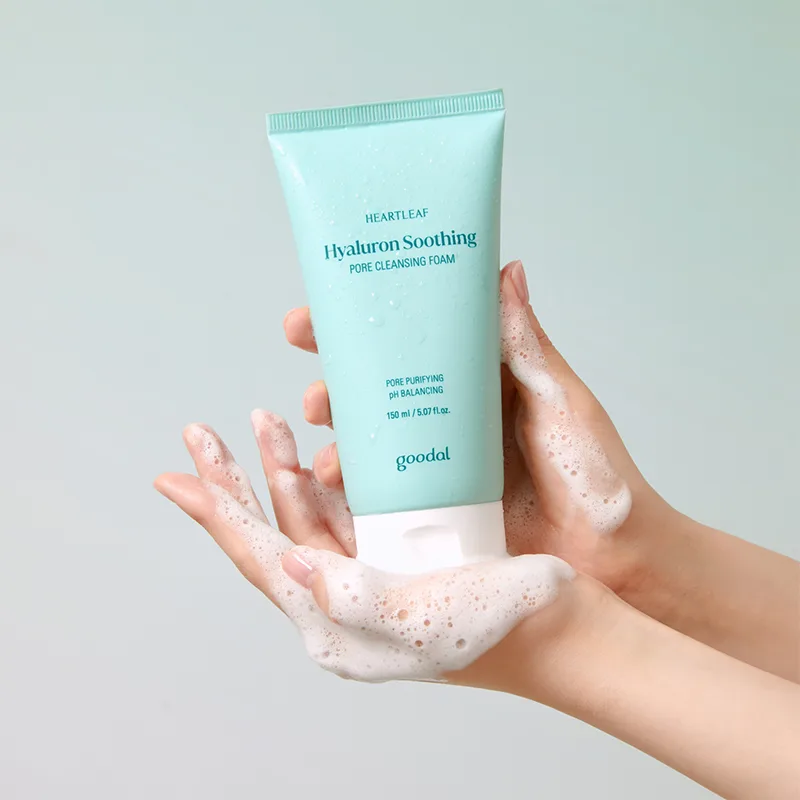
A thick white cream that whips into a dense, slightly grainy lather with a little water — the hydrated silica gives it an almost imperceptible fine grit — and rinses away cleanly.
Scent
A pronounced green-herbal fragrance from the essential oils: rosemary and clary sage up front, clove and patchouli beneath, fading once rinsed.
Packaging
A soft 150 mL mint-green squeeze tube with a white flip cap, sold in a matching carton; the tube stands on its cap and dispenses a clean bead.
Finish
non-greasymatte
What to Expect on First Use
The first wash feels thorough — matte, fresh, and a touch tighter than a plain cream cleanser until moisturizer goes on. A mild tingle around the nostrils from the salicylic acid and essential oils is common in the first week; persistent redness on the cheeks is the sign to retreat to once-daily use or stop.
How Long It Lasts
About two months at a pea-sized amount twice daily; nearer three if used only at night after an oil cleanse.
Goodal added a pair of pore-care cleansers to its Heartleaf line in mid-2024 — this foam and a matching cleansing oil — to give the range a full double-cleanse without borrowing from the brand's older Green Tangerine cleansers. The salicylic acid at half a percent was the differentiator, pitched at the blackhead-prone Olive Young shopper who wanted something stronger than the line's gentle toner.
About Goodal Established Brand (5–20 years)
Founded in 2010 under Clio Cosmetics, Goodal has grown its Heartleaf line into one of Olive Young's steadier sensitive-skin ranges since 2024. The brand discloses declared doses on some actives — here 5,000 ppm salicylic acid — but publishes no independent clinical data on its cleansers.
Brand founded: 2010 · Product launched: 2024
Myth vs. Reality
Common Myths
Myth
The ten hyaluronic acids and five ceramides make this a hydrating, barrier-repairing cleanser.
Reality
Goodal's own disclosure lists most of the hyaluronates at fractions of a part per million, and the ceramides sit in the back third of a rinse-off. The foam feels comfortable because glycerin is the first ingredient and the surfactants are mild — not because of anything those trace additions do.
Myth
Salicylic acid in a cleanser works like a salicylic acid serum.
Reality
Half a percent for the sixty seconds a lather is on the face gives a mild, cumulative pore-loosening effect. Leave-on products at one to two percent stay on the skin for hours and do the real work on blackheads; the foam supports them, it does not replace them.
FAQ
Frequently Asked Questions
How much salicylic acid is in the Goodal Heartleaf Hyaluron Soothing Pore Cleansing Foam?
Goodal declares 5,000 ppm, which is 0.5 percent, and lists it last on the label. That is a useful level for a cleanser — enough to loosen the top of blackheads over weeks of use — but a fraction of what a leave-on exfoliant delivers.
Is the Goodal Heartleaf cleansing foam safe for sensitive skin?
Despite the 'soothing' name, it contains nine essential oils — clove, geranium, rosemary, clary sage and others — plus salicylic acid, and the heartleaf extract is disclosed at only 10 ppm. Reactive, rosacea-prone or eczema-prone skin should patch test and may be better served by a fragrance-free foam.
Does the Goodal pore cleansing foam dry out the skin?
Less than most pore cleansers: the surfactants are amino-acid types and glycerin is the first ingredient, so it rinses without squeak. Oily and combination skin will find it comfortable twice a day; dry skin may prefer it only at night.
Can I use the Heartleaf Pore Cleansing Foam with a salicylic acid serum?
Yes, but stagger them: use the foam in the morning and the leave-on acid at night, or alternate evenings. Stacking a 0.5 percent cleanser directly under a 2 percent serum adds tingle without adding results.
Do I need the Goodal cleansing oil as well as the foam?
Only on days you wear sunscreen or makeup. The foam alone handles a bare-skin morning or a light day; the oil first, then the foam, is the full double cleanse the line is designed around.
Is the Goodal Heartleaf Hyaluron cleansing foam fragrance-free?
No. There is no synthetic perfume, but fir, rosemary, clary sage, geranium, clove, patchouli, juniper and two chamomile oils are listed and give it a strong herbal scent, along with recognised fragrance allergens such as eugenol and geraniol.
Reviews
What Reviewers Tend to Say
Recurring themes our editors read across retailer reviews of this product — summaries in our words, not quotations, and not a substitute for your own patch test.
Common Praise
Dense, creamy lather that rinses without squeak or tightness
Western sensitive skincare works by subtraction — remove the fragrance, remove the alcohol, shorten the list. Japan's answer adds a designed molecule back in, and one of the two bets has a trial literature.
The whole case for salicylic acid rests on one unglamorous fact of chemistry: it dissolves in oil. Understand that, and you know exactly when it beats a glycolic acid — and when it's overkill.
Topically, the molecule the argument tells you to avoid is one the stratum corneum is structurally built from — and in acne-prone skin the documented finding is a shortage of it.
A wrecked barrier is the most common self-inflicted skin condition and the one with the clearest fix — the difficulty is that the routine which caused it feels productive and the one that repairs it feels like giving up.
Aug 5, 2026· 8 min
Questions people ask about Acne
Verified answers from our questions library — the nuance a product page cannot carry.
Products, answers, therapy guides, tools and articles in one search. Brand names,
slang and abbreviations all work — accutane finds isotretinoin, bacne finds truncal acne.