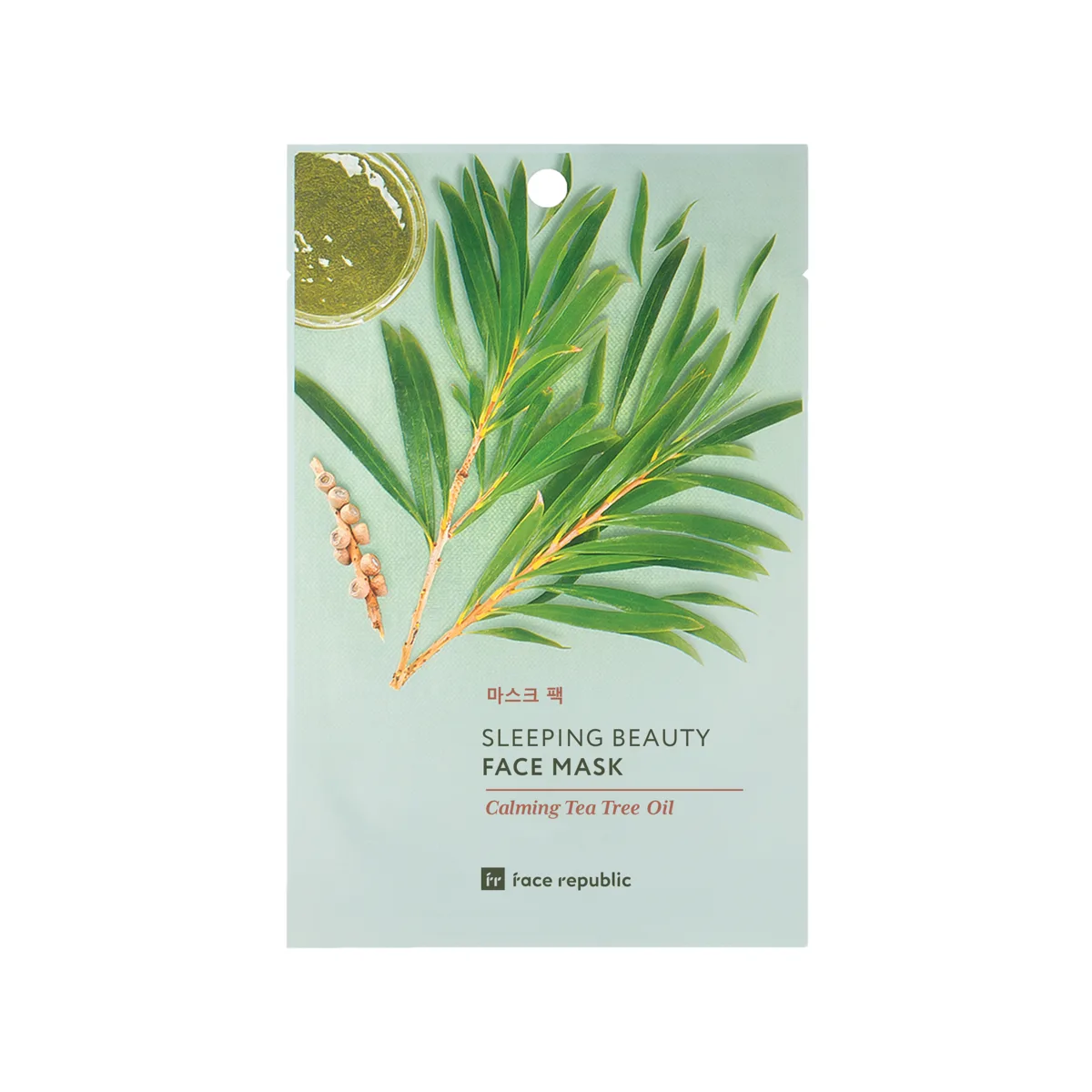
It is the oily, breakout-prone pouch of Face Republic's seven-variant Sleeping Beauty line: the shared aloe, purslane, allantoin and licorice base over glycerin, glycols and a high-placed hyaluronate, in an oil-free watery gel with a tea tree leaf extract fifth for a green medicinal note and a matte-fresh finish. What the label makes clear is that the calming is the purslane, aloe and licorice, and the tea tree is a water-based extract rather than the antimicrobial oil, so the sheet soothes an angry face and treats nothing.
The oily, breakout-prone pouch of Face Republic's budget line: the shared aloe, purslane, allantoin and licorice base over humectants in an oil-free watery gel, with a tea tree leaf extract fifth for a green medicinal note and a matte-fresh finish, so an angry, over-treated face comes out of twenty minutes cooler, calmer and hydrated without shine, at a few dollars a sheet. The tea tree is a water-based extract rather than the antimicrobial oil and treats nothing, the fragrance is left on inflamed skin, and the brand publishes nothing; a good calming sheet for the nights off actives, bought for the base and not the sprig on the pouch.
With scattered English-language reviews, no US retail listing and no published testing behind a sheet sold mainly in the Philippines and through importers, this entry is assessed from the twelve ingredients published for the variant and a tail inferred from the line's shared base, together with the general literature for sheet-mask occlusion, humectants, purslane and tea tree; the price is an importer range rather than a retail figure, and no dose is known for the tea tree extract or anything else.
Verdicts
How well it fits each concern
Verdict by concern tap a concern for the case
Good choicefor DehydrationIn your profileYou chose · Glycerin is a reference standard by mechanism for dehydration; this sheet mask carries it high in the ingredient list.Moderate evidenceStandard tolerabilityNo reviews collected yet
The case for it
Glycerin has trial-supported standing for this concern.
It is present at an effective concentration, declared or high in the ingredient list.
The formula carries no trigger this concern is sensitive to, with the cautions noted.
Same rule for everyone. “Good choice” is the verdict on 9,564 of 45,024 concern verdicts across the catalog; rule R5 decided 9,072 of them.
As of September 25, 2026, engine 5.1.1.
R5 — Trial-supported or guideline-supported active, adequately or plausibly dosed. · the full register
Carrying active
Glycerin
Standing
supported — its mechanism is established
Form
adequate — studied range 20%, from the trials on the row; needs leave-on contact; judge it after ~1 weeks
Tolerability
standard
Row checked
against its sources on July 17, 2026 (evidence table ev-2026.09-r228)
The studies behind the evidence row
USP glycerin monograph / Fluhr et al., glycerol and the skin (review) — glycerin is the reference humectant, drawing and holding water in the stratum corneum — reference work
Avoidfor SensitivityIn your profileYou chose · This formula carries fragrance — the kind of thing reactive skin flags first.Not yet assessedCarries a triggerNo reviews collected yet
The case for it
Glycerin has no evidence row yet for this concern — it is in the research queue.
The formula carries a known trigger for this concern, which decides the verdict before any efficacy question.
Cautions: known irritants.
What would change this: Removing the trigger named above would let the actives be judged on their own.
Same rule for everyone. “Avoid” is the verdict on 1,909 of 45,024 concern verdicts across the catalog; rule F1 decided 605 of them.
As of September 25, 2026, engine 5.1.1.
Also listed for Acne and Excess Oiliness — the actives here (Glycerin, Tea Tree Oil, Purslane Extract, Allantoin) are in our research queue for those concerns; there is no verdict until their evidence rows are written. That is a gap in our table, not a mark against the product.
As a maskNot judged: what a mask is for — works within its wear time, benefit outlasts the mask, comes off cleanly — cannot yet be measured from the ingredient list (only intensity without injury can).
A verdict is DermApproved’s assessment of how well a product’s ingredients fit a concern — never a claim about what the product treats. Evidence dots and collected reviews sit beside it and are never blended in.
Rules 0.5.1 · evidence table ev-2026.09-r228 · how we decide
Assessment
Pros & Cons
Pros
✓ Oil-free, alcohol-free watery gel that hydrates oily, over-treated skin without shine
✓ Purslane, aloe, allantoin and licorice salt calm inflamed skin with real evidence
✓ Sodium hyaluronate placed unusually high for a budget sheet
✓ Matte-fresh finish with nothing to wipe off; vegan and paraben-free
✓ The right sheet for nights off benzoyl peroxide, acids or retinoids
✓ A few dollars a sheet, cheaper in ten-packs
Cons
✗ Tea tree is a water-based leaf extract, not the antimicrobial oil; treats nothing
✗ Green-medicinal fragrance left on inflamed, blemish-prone skin
✗ Tea tree extract and witch hazel water are mild sensitiser notes
✗ Polysorbate 80 is a caution for fungal-acne-prone skin
✗ Too brief on dry skin, which wants the snail pouch's lipids
✗ Almost no review record and no US brand presence
Review
Full Review
The pouch used to say Healing Tea Tree Oil and now says Calming Tea Tree Oil, and that quiet rename is the most accurate thing ever printed on a tea tree sheet mask. Tea tree's clinical reputation rests on the essential oil, terpinen-4-ol-rich, at around five percent in leave-on gels used for weeks, where randomised trials have found it comparable to low-strength benzoyl peroxide for mild acne; this pouch carries a water-based leaf extract at fifth position, soaked into a sheet worn for twenty minutes and left on, which is a scent, a faint astringency and a picture of a sprig, and not an antimicrobial dose of anything. Healing was a claim the extract could not carry. Calming is a claim the rest of the label can, and the honest review is about that rest.
The rest is Face Republic's shared Sleeping Beauty base, which is better than the price. Glycerin second, butylene and propylene glycol, betaine, sodium PCA and, unusually high for a budget sheet, sodium hyaluronate eighth, are the humectants a soaked sheet drives into the surface; aloe sixth and purslane seventh, the Korean soothing staple whose anti-inflammatory chemistry has a small clinical literature including a randomised trial in hand eczema, are backed by allantoin ninth and dipotassium glycyrrhizate, the licorice salt, so the mask settles the heat of an inflamed face for an evening through four ingredients with actual evidence. There is no oil, no alcohol, no silicone, no colourant and no paraben, which for a mask aimed at acne-prone skin is the list of absences that matters most, since alcohol and colourants are what make cheap blemish sheets sting on broken skin; the essence is a watery gel that sets matte-fresh, which is why this is the pouch for oily and combination skin: it puts water into a tight, shiny, over-treated surface without adding anything to wipe off, and dry skin, which wants a lipid, will find the effect brief and should take the snail pouch.
That over-treated surface is the mask's real job. A face on benzoyl peroxide, salicylic acid or a retinoid is usually dehydrated, faintly raw and hotter than it looks, and a cool, oil-free sheet with purslane and allantoin under it on the nights the actives are rested is a better idea than another active; the mistake, which the copy does not warn against, is using a soaked sheet over a fresh dose of any of them, where twenty minutes of occlusion amplifies the irritation. Used correctly, two or three evenings a week on the nights off, it leaves an angry face calmer and plumper by morning with no change to the breakouts, which is exactly what a twenty-minute sheet can do and what a buyer should expect.
There is a practical case for keeping a stack of this pouch specifically, rather than the aloe, in a routine built around acne actives. The matte-fresh finish means nothing sits on the skin under the next morning's benzoyl peroxide or sunscreen, the mild astringency of the extract reads as clean on an oily face where the aloe sheet reads as merely wet, and the green scent, for the buyer who likes it, marks the sheet as the one for the medicine cabinet rather than the spa drawer. None of that is pharmacology; all of it is the reason a person on a treatment routine reaches for this pouch twice a week and finishes the pack.
The reservations are the variant's own. The fragrance, green and medicinal to match the sprig and undeclared as to components, is left on the face after the mask, and on inflamed, blemish-prone skin that is a slightly higher-stakes place for a scent than on a healthy cheek; tea tree extract itself is a mild sensitiser for some; witch hazel water is a lesser note; and polysorbate 80 is the caution for fungal-acne-prone skin, which is a meaningful share of the people who buy tea tree products. Rosacea-prone and eczema-prone faces should take the aloe pouch, which is the same base without the extract and the medicinal scent, and anyone whose spots are cystic rather than surface should expect the cooling and nothing more, since occlusion does not reach a nodule.
On price, two to five dollars a sheet through importers, less in the ten-packs, for a cooling, oil-free calming sheet on a breakout-prone face, is the cheap end of the category and fair for a base this well built; the tea tree is a flavour, and the buyer who understands that is getting the same good mask the aloe pouch delivers with a scent that suits a medicine cabinet. Anyone buying it to treat spots should put the money into a tube of benzoyl peroxide and keep a few of these sheets for the nights the tube is too much, which is the arrangement the rename quietly endorses.
Formula
Key Ingredients
The hero actives that drive this product's performance.
Fifth, the headline ingredient, and a water-based leaf extract rather than the essential oil that carries tea tree's antimicrobial evidence; it contributes a faint green, medicinal note and a mild astringent feel to the essence, and at this dose in a twenty-minute sheet it is a calming story on the pouch rather than the terpinen-4-ol dose that clinical acne studies use.
Seventh, purslane, the Korean soothing staple with real anti-inflammatory chemistry and a randomised trial in hand eczema behind it, paired with aloe sixth, allantoin and licorice salt; on a mask sold as calming it is the ingredient with the evidence, and the reason a blemish-prone face comes out of the sheet settled rather than stripped.
Second, with two glycols, betaine, sodium PCA and sodium hyaluronate behind it, the humectant stack that a soaked sheet drives into the surface under twenty minutes of occlusion; on a tea tree pouch aimed at oily, breakout-prone skin it delivers water without any lipid, which is exactly what dehydrated oily skin wants and dry skin will find brief.
Established mechanismfor Dehydration · established mechanism
Ninth, the skin protectant with a long record for calming abraded and irritated skin, working with dipotassium glycyrrhizate, the licorice salt further down, to take the heat out of an inflamed spot for the evening; the quieter half of the calming claim and the more evidence-backed one.
Last on the label, undeclared as to components and green-medicinal to match the tea tree, left on the face after the sheet; low in dose, and on a mask aimed at inflamed, blemish-prone skin the one ingredient a reactive face should weigh against the otherwise gentle list.
Not yet assessed
Ingredient standings describe the active at treatment-level doses and
vehicles; this product's own condition grades weigh its actual formula.
Full INCI List
Water, Glycerin, Butylene Glycol, Propylene Glycol, Melaleuca Alternifolia (Tea Tree) Extract, Aloe Barbadensis Leaf Extract, Portulaca Oleracea Extract, Sodium Hyaluronate, Allantoin, Betaine, Hamamelis Virginiana (Witch Hazel) Water, Arginine, Carbomer, Phenoxyethanol, Polysorbate 80, Dipotassium Glycyrrhizate, Ethylhexylglycerin, Tocopheryl Acetate, Disodium EDTA, Sodium PCA, Hydroxyethylcellulose, Fragrance. (The first twelve ingredients are as published for this variant; the tail follows the line's shared base as published for its sibling variants.)
An evening sheet after cleansing and toner on a breakout-prone face, fifteen to twenty minutes with the essence patted in and a light, oil-free moisturiser over it; it belongs on the nights a benzoyl peroxide or acid routine is rested, since occlusion would amplify both, and it calms a face that has been over-treated better than it treats one that has not.
Results Timeline
A cooled, calmed, plumped face the moment the sheet comes off, with the heat of inflamed spots settled for the evening and oily skin hydrated without shine; nothing beyond that from a twenty-minute sheet, and no change to breakouts, since a water-based tea tree extract in a mask has no case for the antimicrobial effect of the essential oil. Used twice a week it is a soothing maintenance step for oily, blemish-prone skin, not an acne treatment.
A sheet mask's measurable effect is occlusive hydration: fifteen to twenty minutes under a soaked non-woven sheet limits evaporation and drives humectants into the stratum corneum, raising surface water content for hours, and the evaporative cooling of a water-based essence reduces the sensation of heat on inflamed skin. This mask's humectants, glycerin, butylene glycol, propylene glycol, betaine, sodium PCA and sodium hyaluronate, are all established, and the absence of any lipid suits oily, dehydrated skin and shortens the effect on dry skin. The soothing set has evidence at meaningful doses: aloe's polysaccharides, allantoin as an established skin protectant, dipotassium glycyrrhizate as an anti-irritant with in-vitro and clinical data, and Portulaca oleracea, purslane, whose anti-inflammatory activity a 2024 randomised, placebo-controlled trial in Explore supported for mild to moderate chronic hand eczema.
The tea tree has no case in this format. The antimicrobial and anti-acne evidence for Melaleuca alternifolia concerns the essential oil, standardised for terpinen-4-ol, at concentrations around five percent in leave-on preparations; a 2023 systematic review of randomised controlled trials in Frontiers in Pharmacology and a 2026 meta-analysis in Phytotherapy Research summarise that literature, which supports a modest effect of the oil on mild acne over weeks. A water-based leaf extract at fifth position in a twenty-minute sheet carries little of the volatile terpene fraction and no demonstrated antimicrobial activity at cosmetic levels; its contribution is scent and mild astringency. Tea tree is also a recognised, if uncommon, contact sensitiser, particularly when oxidised.
The remaining risks are fragrance, the leading cosmetic contact allergen, at low dose but left on skin that is already inflamed; witch hazel water as an occasional sensitiser; and polysorbate 80 for fungal-acne-prone skin. Occlusion under a sheet amplifies the penetration of any leave-on active applied beneath it, which is the basis for not using the mask over fresh benzoyl peroxide, salicylic acid or a retinoid. The formula contains no alcohol, oil, parabens or colourants.
Clinicians would describe this as a harmless, oil-free hydrating sheet whose calming comes from purslane, aloe, allantoin and licorice salt and whose tea tree is a label ingredient, since the evidence for tea tree against acne concerns the essential oil at around five percent in leave-on use and a water-based extract in a twenty-minute sheet delivers nothing comparable; anyone seeking to treat breakouts would be redirected to benzoyl peroxide, salicylic acid or a topical retinoid. The mask would be regarded as a reasonable comfort step for the dehydrated, irritated skin that acne treatment produces, used on the nights those treatments are rested and never over a fresh application, and the fragrance and tea tree extract would be the reasons to steer rosacea-prone, eczema-prone and contact-allergic patients to the line's unscented-leaning aloe variant, with a patch test for anyone with a tea tree sensitivity.
Guidance
Usage & Recommendations
How to Use
In the evening after cleansing and toner, on a night when benzoyl peroxide, acids or retinoids are being rested, open the pouch, unfold the sheet and lay it over the face, pressing it flat around the eyes, nose and mouth; leave it fifteen to twenty minutes and remove it before it dries, then pat the leftover essence into the face and neck without rinsing and follow with a light, oil-free moisturiser. Use it two or three evenings a week, never over a fresh acne active, and patch-test on the jaw first if tea tree or fragrance has caused trouble before.
Value Assessment
With no US brand store, the sheet sells through importers at roughly two to five dollars depending on seller and pack size, ten-packs at the low end, so two or three masks a week costs somewhere between six and fifteen dollars a week; that is the cheap end of Korean sheet masks and cheaper than most Western equivalents. The money buys the shared base, which is the part that works, plus a tea tree extract and a scent that are inert; the value is good for oily, breakout-prone skin that wants a cooling, oil-free calming sheet for the nights off actives, and poor for anyone paying for the sprig on the pouch expecting an acne treatment, who would get more from a single tube of benzoyl peroxide than from a year of these sheets.
Who Should Buy
Oily and combination skin that is breakout-prone, dehydrated and faintly raw from acne treatment and wants a cheap, cooling, oil-free calming sheet for the nights off actives, and multipack buyers who like a green medicinal scent; it suits anyone who understands that the mask soothes an angry face and does not treat the spots.
Who Should Skip
Anyone buying it to treat acne, which a water-based tea tree extract in a sheet cannot do; sensitive, rosacea-prone, eczema-prone or fragrance-reactive skin, for which the aloe pouch is the plainer choice; fungal-acne-prone skin, because of the polysorbate; dry skin that wants a lasting film; and anyone about to mask over a fresh dose of benzoyl peroxide, an acid or a retinoid.
Ready to try Face Republic Calming Tea Tree Sheet Mask?
A thin, soft cotton-blend sheet soaked in a clear, watery, lightly slippery gel-essence that feels cool and faintly astringent on the skin and dries down to a light, barely tacky, matte-fresh finish once patted in.
Scent
A faint green, medicinal tea tree fragrance, sharpest at the pouch and fading under the sheet, with a trace left on the face.
Packaging
A single sage-green foil pouch with a tea tree sprig illustration and a hang hole, 23 ml, sold by the sheet or in five- and ten-packs; a spare few millilitres of essence stays in the pouch for the neck.
Finish
lightweightmatte
What to Expect on First Use
Twenty cool, faintly medicinal minutes under a thin sheet that needs pressing flat, then a face that is calmer, plumped and matte-fresh, with the heat of an inflamed spot visibly settled for the evening and no film that oily skin has to wipe off; the breakouts themselves are unchanged, which is what a twenty-minute sheet does. A very reactive face may feel a faint prickle from the fragrance or the extract, and that is the signal to take the aloe pouch instead.
How Long It Lasts
One use per sheet; a ten-pack covers a month at two or three masks a week.
Every Korean mass sheet-mask line carries a tea tree pouch for the oily, blemish-prone customer, because tea tree is the ingredient that market trusts against spots, and Face Republic's version, sold first as Healing Tea Tree Oil and now as Calming Tea Tree Oil on Watsons Philippines shelves, puts a leaf extract into the shared Sleeping Beauty base; the rename from healing to calming is a quiet, accurate correction of the claim, and the K-beauty importers now ship it to Western buyers in ten-packs.
About Face Republic Emerging Brand (2–5 years)
Face Republic is a Korean-made brand built for the Philippine and Southeast Asian mass market, selling vegan, minimal-ingredient formulas at low prices through Watsons and the K-beauty importers. The Sleeping Beauty sheet masks are its cheapest line, one shared base with a headline extract per pouch; the tea tree variant is the shared base plus a tea tree leaf extract, and the brand publishes no clinical testing for any of them.
Brand founded: 2021
Myth vs. Reality
Common Myths
Myth
A tea tree sheet mask treats breakouts.
Reality
The clinical evidence for tea tree against acne concerns the essential oil at five percent in leave-on use over weeks; this mask carries a water-based leaf extract at fifth position for twenty minutes, which scents the essence and adds a mild astringency and nothing antimicrobial. The mask calms an inflamed face for an evening through purslane, aloe, allantoin and licorice salt, and the spots need benzoyl peroxide, salicylic acid or a retinoid.
Myth
Oily skin does not need a hydrating mask.
Reality
Oily skin is often dehydrated, especially under acne treatments, and a watery, oil-free sheet that puts water back without lipid is exactly what settles the tight, shiny, over-treated surface; this pouch is built for that. The trap is using it over a fresh benzoyl peroxide or acid, where the occlusion amplifies the irritation.
FAQ
Frequently Asked Questions
Does the Face Republic Calming Tea Tree Sheet Mask help acne?
It calms the heat and redness of inflamed skin for an evening through purslane, aloe, allantoin and licorice salt, and hydrates oily, over-treated skin without oil; it does not treat the breakouts, since its tea tree is a water-based leaf extract in a twenty-minute sheet rather than the antimicrobial oil at the doses acne studies use. Benzoyl peroxide, salicylic acid or a retinoid do that job, with this mask on the nights off.
Is the Face Republic tea tree sheet mask the same as the Healing Tea Tree Oil mask?
Yes; the pouch was sold as Healing Tea Tree Oil and is now labelled Calming Tea Tree Oil, with the same shared base and tea tree extract. The rename is a more accurate description of what a soothing sheet does.
Is the Face Republic tea tree sheet mask good for sensitive skin?
The base is gentle, but this variant adds a tea tree extract and a green-medicinal fragrance left on the face, which are the two things reactive, rosacea-prone or eczema-prone skin tends to notice; the aloe pouch carries the same soothing base without them and is the safer choice for that skin.
Can the Face Republic tea tree sheet mask be used with benzoyl peroxide or salicylic acid?
Not on the same night: a soaked sheet under occlusion amplifies whatever is under it, and the purpose of a calming mask on acne-prone skin is to rest and rehydrate on the nights the actives are skipped. Use it two or three times a week on those nights, with an oil-free moisturiser over it.
How is the Face Republic tea tree sheet mask used?
After cleansing and toner in the evening, unfold the sheet over the face, press it flat around the nose and eyes, leave it fifteen to twenty minutes and remove it before it dries, then pat the leftover essence in without rinsing and follow with a light, oil-free moisturiser.
How much does the Face Republic tea tree sheet mask cost?
The brand has no US store; importers sell it by the sheet or in five- and ten-packs at roughly two to five dollars a sheet, at the cheap end of Korean sheet masks.
Reviews
What Reviewers Tend to Say
Recurring themes our editors read across retailer reviews of this product — summaries in our words, not quotations, and not a substitute for your own patch test.
Essential oils are declared by botanical name rather than as fragrance, which is why the most heavily perfumed products in the natural aisle can carry the reassuring word — and why the bottle gets more sensitising the longer you own it.
The strongest counterexample to blanket botanical scepticism is also one of the more common contact allergens — and holding both facts at once is the only honest way to read it.
The fourth most frequent positive patch test in North America is an oxidation product of a molecule that occurs naturally in lavender. Nobody synthesised it into your face cream.
Yuka's published rule is that the single worst ingredient sets the score. Not how much of it there is, not what it does in that base — its presence. Here is why that is a defensible design choice and a bad safety verdict.
Aug 28, 2026· 10 min
Questions people ask about Acne
Verified answers from our questions library — the nuance a product page cannot carry.
Products, answers, therapy guides, tools and articles in one search. Brand names,
slang and abbreviations all work — accutane finds isotretinoin, bacne finds truncal acne.