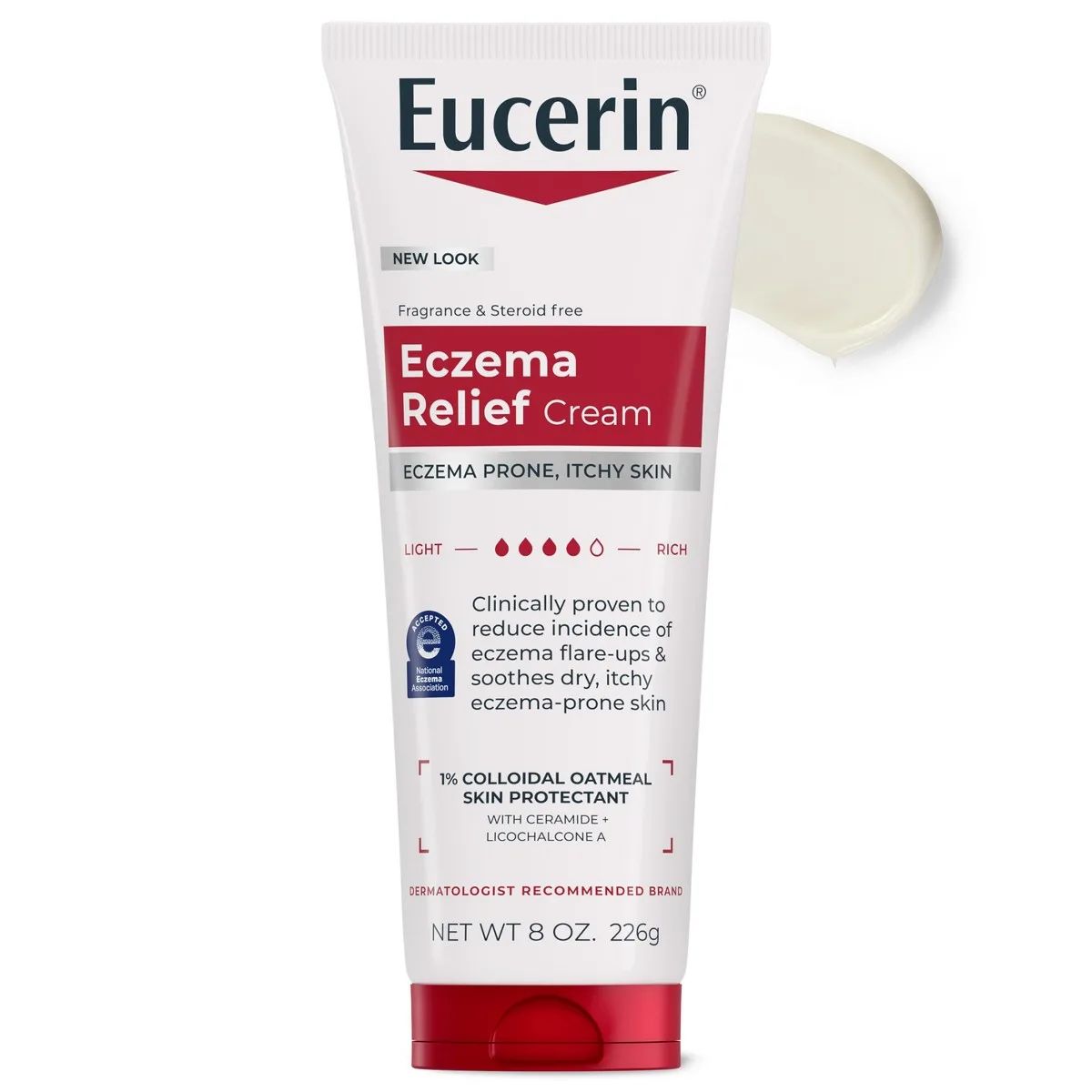
Eucerin Eczema Relief Cream is the rare drugstore product that combines an FDA-recognized skin protectant active (colloidal oatmeal 1%) with prescription-relevant supporting ingredients (ceramide NP for barrier repair, licorice root for steroid-sparing anti-inflammatory activity). Most eczema body creams offer one of these mechanisms; this product layers all three. The price-per-ounce is among the lowest in clinical-grade eczema treatment.
body carecreampharmacy brandParaben FreeNot Cruelty Free
One of the more thoughtful drugstore eczema creams on the market — FDA skin-protectant colloidal oatmeal at 1%, ceramide NP for barrier repair, and licorice root extract for steroid-sparing anti-inflammatory activity, all under $15. The National Eczema Association Seal of Acceptance and over a decade of derm-office recommendations support the formulation. Better-positioned for body than face use.
Strong choicefor EczemaIn your profileYou chose · Colloidal Oatmeal is an approved or monograph active for eczema; this cream carries it at 1%.Moderate evidenceStandard tolerability89% report improvement · n = 102
The case for it
Colloidal Oatmeal 1% is a first-line active — approved, monograph-listed or named in current guidelines — for this concern.
It is present at an effective concentration, declared or high in the ingredient list.
The formula carries no trigger this concern is sensitive to, with the cautions noted.
Cautions: a declarable fragrance allergen.
Same rule for everyone. “Strong choice” is the verdict on 1,459 of 45,024 concern verdicts across the catalog; rule R2 decided 892 of them.
Unchanged since September 5, 2026, engine 5.1.1.
R2 — A regulator- or guideline-recognised first-line active, declared at an effective strength, in a form the claim supports. · the full register
Carrying active
Colloidal Oatmeal 1%
Standing
first line — a regulator recognises it for this use; trials support it · per § 347.50 Labeling of skin protectant drug products (US FDA — 21 CFR 347.50 (via Cornell Legal Information Institute)), opened July 27, 2026
Form
adequate (declared 1%) — studied range 1%, from the OTC monograph or label; judge it after ~2 weeks
Tolerability
standard — allergen count
Row checked
against its sources on July 27, 2026 (evidence table ev-2026.09-r228)
Good choicefor DrynessIn your profileYou chose · Glycerin is a reference standard by mechanism for dryness; this cream carries it high in the ingredient list.Moderate evidenceGentle95% report improvement · n = 43
The case for it
Glycerin has trial-supported standing for this concern.
It is present at an effective concentration, declared or high in the ingredient list.
The formula carries none of the triggers this concern is sensitive to.
Same rule for everyone. “Good choice” is the verdict on 9,564 of 45,024 concern verdicts across the catalog; rule R5 decided 9,072 of them.
Unchanged since September 5, 2026, engine 5.1.1.
Good choicefor Compromised Skin BarrierIn your profileYou chose · Ceramides is a reference standard by mechanism for compromised skin barrier; this cream carries it.Moderate evidenceGentle250 reviews collected
The case for it
Ceramide NP has trial-supported standing for this concern.
It is plausibly present at a working level, though the concentration is not declared.
The formula carries none of the triggers this concern is sensitive to.
What would change this: A declared concentration would move this to a firmer reading of the dose.
Same rule for everyone. “Good choice” is the verdict on 9,564 of 45,024 concern verdicts across the catalog; rule R5 decided 9,072 of them.
Unchanged since September 5, 2026, engine 5.1.1.
R5 — Trial-supported or guideline-supported active, adequately or plausibly dosed. · the full register
Carrying active
Ceramide NP
Standing
supported — its mechanism is established
Form
plausible — studied range 0.5–1%, from the trials on the row; needs leave-on contact; judge it after ~4 weeks
Tolerability
gentle
Row checked
against its sources on July 17, 2026 (evidence table ev-2026.09-r228)
The studies behind the evidence row
Elias PM, Skin Barrier / Coderch et al., ceramides and skin barrier function — ceramides ~50% of SC intercellular lipid mass, essential to the permeability barrier — reference work
Supporting rolefor SensitivityIn your profileYou chose · Mostly gentle: declarable allergens — usable for sensitive skin with a patch test.Not yet assessedStandard tolerability250 reviews collected
The case for it
Colloidal Oatmeal 1% has no evidence row yet for this concern — it is in the research queue.
The formula carries no trigger this concern is sensitive to, with the cautions noted.
Cautions: a declarable fragrance allergen.
What would change this: A researched evidence row for the lead active would replace this with a verdict.
Same rule for everyone. “Supporting role” is the verdict on 8,197 of 45,024 concern verdicts across the catalog; rule F3 decided 183 of them.
Unchanged since September 5, 2026, engine 5.1.1.
Supporting rolefor PsoriasisIn your profileYou chose · Ceramides has early evidence for psoriasis, and emollient therapy is the recognised companion to treating it — a reasonable supporting choice, short of a recommendation.Limited evidenceGentle250 reviews collected
The case for it
Ceramide NP has early or mechanistic evidence for this concern, not trial-backed standing.
It is plausibly present at a working level, though the concentration is not declared.
The formula carries none of the triggers this concern is sensitive to.
What would change this: A declared concentration would move this to a firmer reading of the dose.
Same rule for everyone. “Supporting role” is the verdict on 8,197 of 45,024 concern verdicts across the catalog; rule R8a decided 1,489 of them.
Unchanged since September 5, 2026, engine 5.1.1.
R8a — A plausible-tier active in a category with a supportive job: the sentence names the active instead of saying nothing targets the concern (the AmLactin / CeraVe SA case for keratosis pilaris, where no guideline and single trials leave the keratolytics at early evidence). · the full register
Carrying active
Ceramide NP
Standing
plausible — trials support it
Form
plausible
Tolerability
gentle
Row checked
against its sources on July 17, 2026 (evidence table ev-2026.09-r228)
As a body productNot judged: what a body product is for — real substance, not just slip, realistic to use daily — cannot yet be measured from the ingredient list (only fragrance load can).
A verdict is DermApproved’s assessment of how well a product’s ingredients fit a concern — never a claim about what the product treats. Evidence dots and collected reviews sit beside it and are never blended in.
Rules 0.5.1 · evidence table ev-2026.09-r228 · how we decide
Assessment
Pros & Cons
Pros
✓ FDA-recognized colloidal oatmeal 1% as the active skin protectant
✓ Ceramide NP specifically targets the most-depleted ceramide in eczema-prone skin
✓ Safe for babies 3 months and older, children, and adults
✓ Exceptional drugstore pricing for clinical-grade formulation
✓ 125-year brand heritage in pharmacy-distributed dermatology
Cons
✗ Body-positioned formula too rich for ongoing facial use
✗ Mineral oil content disliked by natural-skincare shoppers
✗ Recent 2026 reformulation concerns in some reviews
✗ Heavier finish than some users prefer for summer
✗ Comedogenic ingredients unsuitable for acne-prone face use
Review
Full Review
When pharmacist Isaac Lifschütz and dermatologist Paul Unna developed Eucerit (the original Eucerin ointment) in 1900 in Hamburg, they were solving a specific problem: hospital dermatologists needed a stable emulsion base for compounding prescription topical treatments. The result became one of the foundational dermatology-pharmacy products of the 20th century, and Beiersdorf — Eucerin's parent company — has spent the last 125 years refining the brand around dermatological credibility rather than cosmetic positioning. The Eczema Relief line, developed in the 2010s, represents what happens when a brand with that pedigree applies modern atopic dermatitis research to drugstore-priced skincare. The architecture is more sophisticated than most consumer eczema products. The active ingredient is colloidal oatmeal at 1% — the FDA-recognized skin protectant concentration that has dermatological backing dating to the 1950s. Colloidal oatmeal contains avenanthramides (anti-inflammatory polyphenols specific to oats) along with beta-glucans, starches, and proteins that form a protective film on skin while providing genuine pharmacological activity. The 'colloidal' designation indicates the oatmeal is milled to a particle size small enough to suspend in water rather than settle out, which is what makes it cosmetically usable. Ceramide NP is the second important active. In healthy skin, ceramide NP makes up roughly 40-50% of the intercellular lipid mortar that holds the stratum corneum together. In atopic dermatitis (eczema) patients, ceramide NP is consistently shown to be the most depleted ceramide subtype, which is why barrier-repair products designed for eczema specifically supplement with this subtype rather than just generic 'ceramides.' Eucerin's inclusion of ceramide NP rather than other ceramide variants reflects the modern research on atopic dermatitis pathophysiology. Glycyrrhiza inflata root extract (licorice root) is the supporting ingredient that distinguishes this from simpler eczema creams. The extract contains glycyrrhetinic acid and licochalcone A — anti-inflammatory polyphenols with documented activity comparable to mild topical corticosteroids in some studies, but without the steroid side effects (skin thinning, HPA axis suppression with prolonged use, rebound flares). For chronic eczema management where you want anti-inflammatory activity without continuous steroid use, this kind of steroid-sparing ingredient is genuinely valuable. The base completes the architecture: glycerin as a humectant at second position, mineral oil and castor oil as occlusives, cetyl alcohol and glyceryl stearate as emulsifiers, with a clean preservative system. There's no fragrance, no parabens, no dyes — the formulation is calibrated specifically for eczema-prone sensitivity. The wear in actual use is what the marketing claims. The cream dispenses as a smooth, medium-thick white emulsion. It spreads easily, absorbs within 1-2 minutes, and leaves a slightly emollient finish that's substantial without being greasy. For active eczema, itch relief is often noticeable within 5-10 minutes — the colloidal oatmeal effect is genuine. Over 1-2 weeks of consistent use, flaking and redness reduce. Over 4-8 weeks, flare frequency decreases. The brand's referenced clinical study reported 4 of 5 children flare-free for 6 months with daily use. Real-world reviews across thousands of users on Amazon, Walmart, and Drugstore.com support these claims. Where the formula needs honest framing is its limits. This is a body-positioned product. The mineral oil and heavier emollient content make it feel too rich for facial daily use, though it's safe for short-term face application during flares. For dedicated facial eczema, Eucerin's Eczema Relief Cream for Face is a more cosmetically appropriate alternative. Recent 2026 reviews have raised concerns about a formula change affecting performance — this is worth tracking, though most users still report consistent results. The mineral oil and other comedogenic-rated ingredients also mean this isn't suitable for acne-prone face use. The fragrance and steroid-free positioning is honest. The formula contains no added fragrance and no corticosteroids. The 'natural alternative' framing some shoppers may expect doesn't apply — mineral oil, PEG-40 stearate, phenoxyethanol, and synthetic preservatives are all present. The clean-beauty positioning doesn't apply here. What does apply is dermatological credibility: the formulation is calibrated for actual eczema management, validated by clinical study, and carries the National Eczema Association Seal of Acceptance. Value is where Eucerin Eczema Relief Cream stands out almost embarrassingly. At under $15 for 8 oz (or $20 for 14 oz), the per-ounce cost is roughly $1.50/oz — among the lowest in any clinical-grade dermatological skincare. For comparison, prescription eczema creams (Eucrisa, Elidel) cost $400-600 monthly without insurance; even drugstore alternatives like CeraVe Eczema Cream ($18 for 8 oz) are slightly more expensive. For the formulation quality, the price is essentially a giveaway. For pediatric use cases, this is one of the most pediatrician-recommended eczema body creams in U.S. drugstores. The fragrance-free, steroid-free composition is appropriate for infants 3 months and older. Pediatric dermatologists frequently recommend it for childhood eczema management as both maintenance treatment and adjunct to prescription options during severe flares. For adults with chronic eczema, the cream works well as a daily maintenance moisturizer between prescribed corticosteroid courses, helping to extend flare-free intervals. The Eucerin brand has spent 125 years building dermatological credibility, and the Eczema Relief Cream is one of the better expressions of that heritage in the drugstore-priced segment. For people managing chronic eczema who don't want to pay luxury prices for clinical efficacy, this remains one of the most consistent recommendations.
Formula
Key Ingredients
The hero actives that drive this product's performance.
The FDA-recognized skin protectant active in this formula — colloidal oatmeal forms a film on skin that traps moisture, contains avenanthramides (anti-inflammatory polyphenols specific to oats), and has been clinically validated for relieving itching and irritation from eczema. The 1% concentration is the standard FDA-acknowledged effective dose.
Replenishes the specific ceramide subtype most depleted in eczema-prone skin — ceramide NP makes up roughly 40-50% of healthy skin's intercellular lipid mortar and is the most commonly absent ceramide in atopic dermatitis patients. Pairs with the colloidal oatmeal to repair the barrier compromise that drives eczema flares.
Established mechanismfor Dryness · established mechanism
Contains glycyrrhetinic acid and licochalcone A — anti-inflammatory polyphenols with documented activity comparable to mild topical corticosteroids without the steroid side effects. Particularly relevant for eczema where chronic inflammation is the underlying driver and steroid-sparing options matter.
Second-position ingredient providing humectant hydration — pulls water into the upper stratum corneum where the ceramide and oatmeal can hold it. The glycerin-plus-occlusive (mineral oil, castor oil) architecture is the classic eczema-friendly hydration system.
Apply liberally to affected areas after bathing while skin is still slightly damp to lock in moisture. Safe for adults, children, and babies 3 months and older. Can be used multiple times per day on active flares. For body use; face application is generally well-tolerated but ceramide-specific face creams (Eucerin Eczema Relief Cream is body-positioned) may be more cosmetically appropriate.
Results Timeline
Immediate itch relief and moisture sealing on first application. Visible reduction in flaking, redness, and rough patches over 1-2 weeks of daily use. Sustained barrier improvement and reduced flare frequency over 4-8 weeks of consistent use. The clinical study referenced by the brand reported 4 of 5 children remaining flare-free for 6 months with daily use.
The colloidal oatmeal active in this formula has one of the deepest research bases in cosmetic dermatology. Avena sativa (oats) contains several bioactive components — avenanthramides (oat-specific anti-inflammatory polyphenols), beta-glucans (humectant-immunomodulatory polysaccharides), starches (film-forming), and proteins. The avenanthramides specifically have been shown to inhibit pro-inflammatory cytokine production in skin, with effects comparable to mild corticosteroids in some in vitro studies. The FDA recognized colloidal oatmeal as a Category I skin protectant active in the early 2000s based on accumulated clinical evidence, and the 1% concentration in this product is at the FDA-acknowledged effective dose. Clinical studies on colloidal oatmeal creams in atopic dermatitis have demonstrated significant reductions in itching, erythema, and SCORAD (Scoring Atopic Dermatitis) scores over 4-8 weeks of consistent use. Ceramide research in atopic dermatitis is similarly well-established. Imokawa and colleagues' landmark work in the 1990s established that atopic dermatitis patients have ceramide deficiency in the stratum corneum, with ceramide NP being the most consistently depleted subtype. Subsequent research has shown that topical ceramide NP supplementation can partially restore barrier function and reduce transepidermal water loss in eczema-prone skin. Eucerin's inclusion of ceramide NP specifically (rather than ceramide AP or EOP variants used by some competitors) reflects this research. Licorice root extract's anti-inflammatory activity is mechanistically well-supported. Glycyrrhetinic acid (the principal active in licorice root extract) has been shown to inhibit 11β-hydroxysteroid dehydrogenase, prolonging the activity of endogenous cortisol and thereby producing mild anti-inflammatory effects without exogenous corticosteroid administration. Licochalcone A is a separate licorice-derived flavonoid with documented anti-inflammatory and anti-pruritic effects. Together, these provide a steroid-sparing alternative pathway for managing chronic inflammation. The overall architecture is layered: colloidal oatmeal as the active film-forming protectant, ceramide NP for barrier repair, licorice root for anti-inflammatory activity, and a glycerin-plus-occlusive base for sustained hydration. It's one of the more clinically reasoned eczema formulations available at drugstore pricing.
Practicing dermatologists and pediatric dermatologists frequently recommend Eucerin Eczema Relief Cream as a first-line maintenance moisturizer for patients with atopic dermatitis. The combination of FDA-acknowledged colloidal oatmeal active, ceramide NP for barrier repair, and licorice root extract for anti-inflammatory activity makes it well-suited for ongoing daily use between prescription corticosteroid courses. Pediatric dermatologists specifically recommend it for childhood eczema management given the steroid-free, fragrance-free formulation safe for infants 3 months and older. Dermatologists typically pair this cream with prescription topical treatments (corticosteroids, calcineurin inhibitors, or PDE4 inhibitors) during active flares, transitioning to this cream as maintenance once flares subside. The National Eczema Association Seal of Acceptance is an additional credibility marker that many dermatologists reference when recommending products. For severe or treatment-resistant eczema, prescription options remain first-line; for mild-to-moderate eczema or maintenance care, this cream is among the most consistently recommended drugstore options.
Guidance
Usage & Recommendations
How to Use
Apply liberally to affected areas at least twice daily — once after bathing while skin is still slightly damp to seal in moisture, and again as needed throughout the day. For active flares, more frequent application is appropriate. Use enough product to lightly cover the affected area; don't ration. The cream is safe for use under clothing, on babies 3 months and older, and for whole-body application. For severe flares, dermatologists may recommend pairing with a prescription topical (corticosteroid or calcineurin inhibitor) applied first, with this cream layered over to seal in the prescription medication.
Value Assessment
At under $15 for 8 oz (roughly $1.85/oz), Eucerin Eczema Relief Cream is one of the most exceptional values in clinical-grade dermatological skincare. The 14 oz size at approximately $20 brings per-ounce cost even lower. Compared to direct drugstore competitors (CeraVe Eczema Cream at $18 for 8 oz, Aveeno Eczema Therapy at $15 for 5 oz), Eucerin's per-ounce value is competitive or better. The clinical-grade formulation (NEA Seal, FDA-recognized active, ceramide NP, licorice root) makes the price-to-quality ratio essentially unmatched at this price point. Compared to luxury 'eczema-friendly' brands ($30-80 for similar functions), the value proposition is even stronger. For families managing chronic childhood or adult eczema, the larger sizes provide months of treatment at low cost.
Who Should Buy
This cream is the standard recommendation for anyone managing atopic dermatitis (eczema), keratosis pilaris, or other chronic dry skin conditions affecting the body. It's especially well-suited for pediatric eczema management, sensitive-skin pregnancy care, and post-procedure recovery on body areas. The drugstore pricing makes it accessible for families needing to use large volumes consistently. Dermatologists frequently recommend it as the daily maintenance step in a multi-step eczema management plan.
Who Should Skip
Pass on this if you need facial-specific eczema treatment (Eucerin Eczema Relief Cream for Face is better positioned), if you have very oily acne-prone facial skin (the mineral oil and emollients may not suit), if you specifically need vegan or cruelty-free certified products (Eucerin doesn't carry these), or if you're managing severe eczema that requires prescription treatment as the primary intervention. For very oily acne-prone face use, CeraVe Foaming Facial Cleanser or other gel-based options are better matched.
Medium-thick body cream with a smooth, slightly greasy feel from the mineral oil and castor oil base — heavier than a lotion, lighter than petrolatum
Scent
Effectively unscented — no added fragrance, with a faint underlying mineral note from the base ingredients
Packaging
Plastic tube with flip cap; 8 oz and 14 oz sizes available. The 14 oz size offers better per-ounce value.
Finish
satinnon-greasy
What to Expect on First Use
Dispenses as a smooth, medium-thick white cream. Spreads easily with some emollient pull and absorbs into a slightly emollient finish within 1-2 minutes. Skin feels immediately more comfortable, with itch relief often noticeable within 5-10 minutes on active eczema flares. No stinging or burning. For chronic eczema sufferers, the difference from prior cleansers/lotions is often immediately noticeable.
How Long It Lasts
1-2 months with daily body application on active eczema; 3-4 months with maintenance use
National Eczema Association Seal of AcceptanceFragrance-FreeSteroid-Free
Background
The Story Behind This Product
Eucerin was founded in 1900 by Beiersdorf chemist Isaac Lifschütz and dermatologist Paul Unna in Germany, originally created as a therapeutic ointment base for prescription compounding. The Eucerin Eczema Relief line was developed in the 2010s as the brand's dedicated eczema treatment family, building on Eucerin's long history of clinically-positioned dermatological care. The colloidal oatmeal plus ceramide plus licorice root architecture reflects the brand's research into atopic dermatitis as a multi-mechanism condition requiring multi-target treatment.
About Eucerin Legacy Brand (20+ years)
Eucerin was founded in 1900 by Beiersdorf in Germany, originally created by pharmacist Paul Unna for therapeutic dermatological use. It's one of the oldest pharmacy skincare brands in the world, with the National Eczema Association Seal of Acceptance on the Eczema Relief line and consistent dermatologist recommendations for over a century.
Brand founded: 1900 · Product launched: 2014
Myth vs. Reality
Common Myths
Myth
Steroid-free eczema creams can't really work — you need prescription steroids.
Reality
While topical corticosteroids remain the prescription standard for severe flares, daily maintenance with colloidal oatmeal plus ceramide formulations like this one is well-validated for preventing flares and reducing flare frequency. The brand's referenced clinical study reported 4 of 5 children flare-free for 6 months with daily use. Steroid-free maintenance is what dermatologists recommend between flares.
Myth
Mineral oil is bad for sensitive skin.
Reality
Cosmetic-grade mineral oil is one of the most thoroughly studied skincare ingredients and is consistently shown to be non-irritating, non-comedogenic at the concentrations used, and effective as an occlusive moisture barrier. The 'mineral oil is bad' claim is unsupported by dermatological evidence and reflects marketing positioning rather than science.
FAQ
Frequently Asked Questions
How is Eucerin Eczema Relief Cream different from regular Eucerin Original Healing Cream?
Eczema Relief Cream contains FDA-recognized active colloidal oatmeal at 1%, plus ceramide NP and licorice root extract specifically targeted at eczema mechanisms (barrier repair plus anti-inflammatory). Original Healing Cream is positioned for general dry skin with a heavier petrolatum-and-mineral-oil base but without the eczema-specific active ingredients. Choose Eczema Relief for diagnosed eczema; Original Healing for general very dry skin.
Can babies and children use this cream?
Yes — the formula is safe for infants 3 months and older, children, and adults. The fragrance-free, steroid-free composition with colloidal oatmeal active makes it commonly recommended by pediatricians and pediatric dermatologists for childhood eczema management.
How does Eucerin Eczema Relief compare to CeraVe Eczema Cream?
Both are excellent drugstore eczema body creams with overlapping mechanisms — colloidal oatmeal active, ceramide content, fragrance-free. Eucerin adds licorice root extract for additional anti-inflammatory activity that CeraVe lacks. CeraVe has a slightly different ceramide blend (NP, AP, EOP rather than just NP) and includes hyaluronic acid. Many dermatologists recommend either based on patient preference; both carry the National Eczema Association Seal.
Can I use this on my face for eczema?
It's safe to use on the face for short-term flare relief, but the body-positioned formulation (with mineral oil and heavier emollients) may feel too rich for facial daily use. For facial eczema, Eucerin's Eczema Relief Cream for Face is a better choice — same actives in a lighter formulation.
Is the cream pregnancy-safe?
Yes — the formula contains no retinoids, salicylic acid, or other typically pregnancy-restricted ingredients. Colloidal oatmeal, ceramides, glycerin, and the supporting emollients are all generally regarded as pregnancy-safe.
How often should I apply Eucerin Eczema Relief Cream?
Apply at least twice daily for active eczema flares — once after bathing on damp skin and again as needed throughout the day. For maintenance between flares, once-daily application is typically sufficient. The brand-cited clinical study used daily application for its 6-month flare-free results.
Does this work for psoriasis?
It's not specifically labeled for psoriasis but the barrier-repair and anti-inflammatory ingredients (ceramide, licorice root, colloidal oatmeal) can provide symptomatic relief for psoriasis flaking and dryness. For active psoriasis treatment, see a dermatologist for prescription options. This cream is best as a maintenance moisturizer alongside dermatology-directed treatment.
Reviews
What Reviewers Tend to Say
Recurring themes our editors read across retailer reviews of this product — summaries in our words, not quotations, and not a substitute for your own patch test.
Common Praise
Genuine itch and flare relief
Safe for babies and children
Drugstore price for clinical-grade formulation
Steroid-free without sacrificing efficacy
Survived multiple winter dryness seasons
Common Complaints
Recent reformulation concerns reported in 2026 reviews
Mineral oil content disliked by some natural-skincare shoppers
Thicker texture can feel heavy in summer
Not suitable for facial use long-term
Bottle dispensing inconsistent
Notable Endorsements
National Eczema Association Seal of AcceptanceAmerican Academy of DermatologyAmerican Academy of Pediatrics
Irritant and allergic contact dermatitis can look identical on the arm and take opposite instructions — and the single most common mistake in skincare is applying the tolerance-building logic of one to the immune memory of the other.
A steroid cream that fails is usually a steroid cream that was never given at a real dose — and the unit that fixes it has existed, defined and measured, since 1991.
Contact allergy has a very long tail and a very short head — and knowing what sits at the head of the distribution, plus the aliases it hides behind, solves more cases than most people's process of elimination ever will.
Jul 19, 2026· 9 min
Questions people ask about Eczema
Verified answers from our questions library — the nuance a product page cannot carry.
Products, answers, therapy guides, tools and articles in one search. Brand names,
slang and abbreviations all work — accutane finds isotretinoin, bacne finds truncal acne.