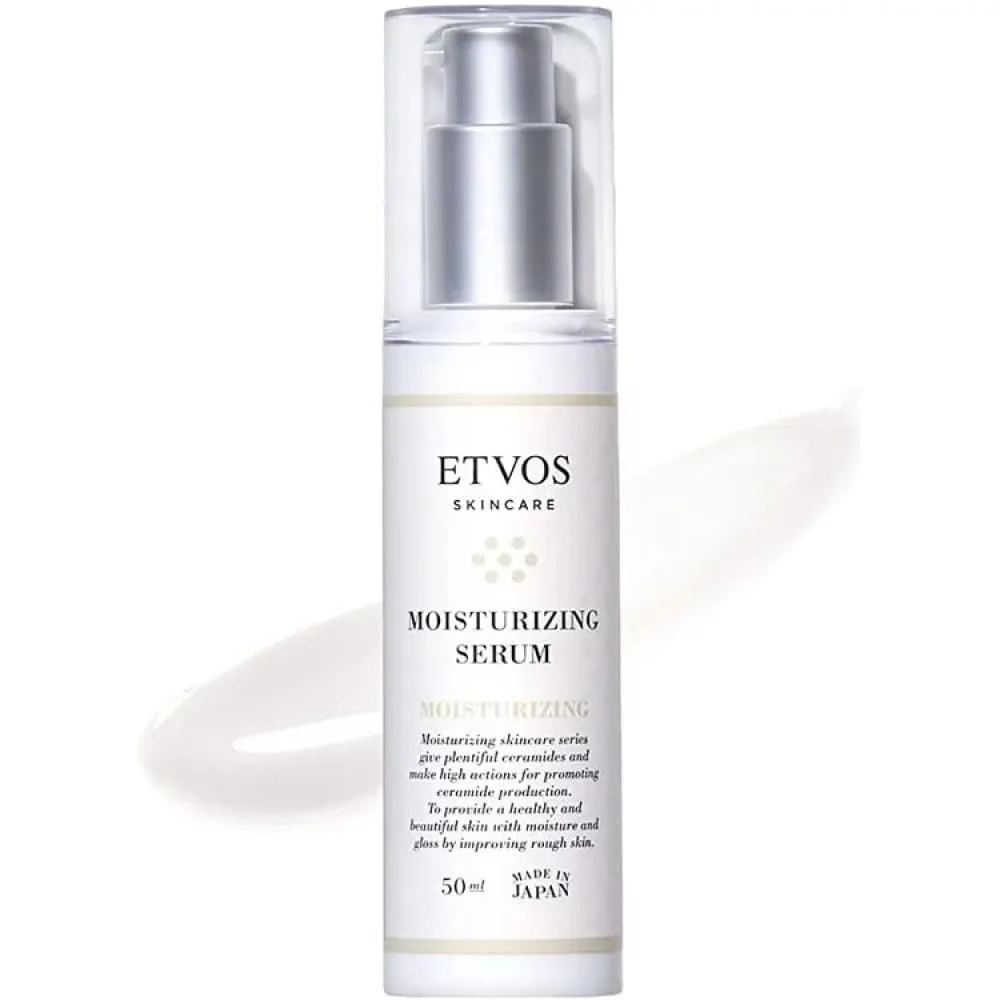
Same five-ceramide chemistry as the matching ETVOS Moisturizing Lotion, layered with a deeper emollient stack (squalane + jojoba + shea butter), a six-flower botanical complex (rose + lily + cornflower + calendula + camellia + geranium), and plant placenta extract. The serum and lotion are designed to work together — same hydration philosophy, different routine slots — with the serum providing the richer leave-on chemistry that complements the watery lotion's first-step humectant deposition.
The leave-on serum companion to ETVOS's Moisturizing Lotion — same five-human-type-ceramide chemistry plus deeper emollient stack (squalane + jojoba + shea butter), six-flower botanical complex, and plant placenta extract. Genuinely depth-rich for a sensitive-skin serum, with the trade-off of a more prominent fragrance load than the matching lotion.
Supporting rolefor DehydrationIn your profileYou chose · Nothing here targets dehydration directly; humectant hydration is the recognised companion to treating it, and this serum does that without known triggers.Not yet assessedStandard tolerabilityNo reviews collected yet
The case for it
Squalane + Jojoba Oil + Shea Butter Emollient Stack has no evidence row yet for this concern — it is in the research queue.
The formula carries no trigger this concern is sensitive to, with the cautions noted.
What would change this: A researched evidence row for the lead active would replace this with a verdict.
Same rule for everyone. “Supporting role” is the verdict on 8,197 of 45,024 concern verdicts across the catalog; rule R8 decided 4,250 of them.
Unchanged since September 5, 2026, engine 5.1.1.
R8 — The category's job (barrier care, humectant hydration, gentle cleansing, photoprotection) is the documented supportive role for this concern. This is the honest verdict for a moisturizer on an acne page. · the full register
Good choicefor DrynessIn your profileYou chose · Squalane is a reference standard by mechanism for dryness; this serum carries it high in the ingredient list.Moderate evidenceStandard tolerabilityNo reviews collected yet
The case for it
Squalane + Jojoba Oil + Shea Butter Emollient Stack has trial-supported standing for this concern.
It is present at an effective concentration, declared or high in the ingredient list.
The formula carries no trigger this concern is sensitive to, with the cautions noted.
Cautions: fragrance.
Same rule for everyone. “Good choice” is the verdict on 9,564 of 45,024 concern verdicts across the catalog; rule R5 decided 9,072 of them.
Unchanged since September 5, 2026, engine 5.1.1.
Avoidfor Compromised Skin BarrierIn your profileYou chose · This formula carries fragrance — a known trigger for compromised skin barrier — so it is not a fit however good its actives are.Moderate evidenceCarries a triggerNo reviews collected yet
The case for it
Five Human-Type Ceramide Complex has trial-supported standing for this concern.
It is plausibly present at a working level, though the concentration is not declared.
The formula carries a known trigger for this concern, which decides the verdict before any efficacy question.
What would change this: Removing the trigger named above would let the actives be judged on their own.
Same rule for everyone. “Avoid” is the verdict on 1,909 of 45,024 concern verdicts across the catalog; rule R1 decided 1,304 of them.
Unchanged since September 5, 2026, engine 5.1.1.
R1 — Safety outranks praise (MASTER-PLAN §1.7). A condition-weighted trigger (multiplier ≥ 2 in condition-fit-matrix) decides the verdict before any efficacy question. · the full register
Carrying active
Five Human-Type Ceramide Complex
Standing
supported — its mechanism is established
Form
plausible — studied range 0.5–1%, from the trials on the row; needs leave-on contact; judge it after ~4 weeks
Tolerability
harsh — fragrance load
Row checked
against its sources on July 17, 2026 (evidence table ev-2026.09-r228)
The studies behind the evidence row
Elias PM, Skin Barrier / Coderch et al., ceramides and skin barrier function — ceramides ~50% of SC intercellular lipid mass, essential to the permeability barrier — reference work
Avoidfor SensitivityIn your profileYou chose · This formula carries fragrance — the kind of thing reactive skin flags first.Not yet assessedCarries a triggerNo reviews collected yet
The case for it
Squalane + Jojoba Oil + Shea Butter Emollient Stack has no evidence row yet for this concern — it is in the research queue.
The formula carries a known trigger for this concern, which decides the verdict before any efficacy question.
What would change this: Removing the trigger named above would let the actives be judged on their own.
Same rule for everyone. “Avoid” is the verdict on 1,909 of 45,024 concern verdicts across the catalog; rule F1 decided 605 of them.
Unchanged since September 5, 2026, engine 5.1.1.
Avoidfor EczemaIn your profileYou chose · This formula carries fragrance — a known trigger for eczema — so it is not a fit however good its actives are.Moderate evidenceCarries a triggerNo reviews collected yet
The case for it
Five Human-Type Ceramide Complex has early or mechanistic evidence for this concern, not trial-backed standing.
It is plausibly present at a working level, though the concentration is not declared.
The formula carries a known trigger for this concern, which decides the verdict before any efficacy question.
What would change this: Removing the trigger named above would let the actives be judged on their own.
Same rule for everyone. “Avoid” is the verdict on 1,909 of 45,024 concern verdicts across the catalog; rule R1 decided 1,304 of them.
Unchanged since September 5, 2026, engine 5.1.1.
R1 — Safety outranks praise (MASTER-PLAN §1.7). A condition-weighted trigger (multiplier ≥ 2 in condition-fit-matrix) decides the verdict before any efficacy question. · the full register
Carrying active
Five Human-Type Ceramide Complex
Standing
plausible — trials support it
Form
plausible
Tolerability
harsh — fragrance load
Row checked
against its sources on July 17, 2026 (evidence table ev-2026.09-r228)
Emollients and moisturisers for eczema — Cochrane Database of Systematic Reviews — TIER 1, 77 RCTs / 6603 participants, GRADE; CLASS-level, does not name ceramides (2017), opened July 16, 2026
Also listed for Aging — the actives here (Squalane, Milk & Silk Proteins, Amino Acids, Calendula Extract) are in our research queue for that concern; there is no verdict until their evidence rows are written. That is a gap in our table, not a mark against the product.
A verdict is DermApproved’s assessment of how well a product’s ingredients fit a concern — never a claim about what the product treats. Evidence dots and collected reviews sit beside it and are never blended in.
Rules 0.5.1 · evidence table ev-2026.09-r228 · how we decide
Assessment
Pros & Cons
Pros
✓ Same comprehensive five-ceramide chemistry as the matching Moisturizing Lotion
✗ More prominent fragrance than the matching lotion
✗ Cetearyl alcohol, glyceryl stearate, and shea butter aren't fungal-acne-safe
✗ Per-bottle price highest in the Moisture Line
✗ 50ml is small for the price
Review
Full Review
The ETVOS Moisturizing Serum exists as the natural companion to the Moisturizing Lotion reviewed elsewhere — same core five-human-type-ceramide chemistry (AG + AP + EOP + NG + NP), same five-amino-acid NMF complex (serine + threonine + proline + alanine + lysine), same POs-Ca proprietary humectant, same multi-HA hydration chassis, same Lavandula angustifolia flower water for the brand's signature scent. What changes is the supporting chassis around the shared core chemistry, designed to complement rather than duplicate the lotion's contribution.
The most meaningful additions are the emollient stack. Squalane sits high in the INCI as the barrier-mimetic emollient that mimics natural sebum. Simmondsia chinensis (jojoba) seed oil contributes wax-ester chemistry that approximates the skin's natural lipid composition more closely than typical plant oils. Butyrospermum parkii (shea) butter adds long-chain fatty acid emollience and a richer leave-on feel. The combined three-oil emollient stack is what gives the serum its slightly viscous, more substantial texture versus the watery lotion — providing the leave-on moisture-sealing that the lotion's pure humectant chassis doesn't deliver.
The second addition is the six-flower botanical complex. Rosa damascena (rose), Lilium candidum (Madonna lily) bulb, Centaurea cyanus (cornflower), Calendula officinalis (calendula), Camellia japonica (camellia flower), and Pelargonium graveolens (rose geranium) extracts are stacked together for supporting anti-inflammatory, antioxidant, and skin-conditioning chemistry. Calendula and rose specifically have well-established sensitive-skin tolerability; the combined approach reflects ETVOS's broader emphasis on plant-based supporting chemistry. The trade-off is a more prominent floral fragrance character than the matching lotion carries — for the most reactive users, this additional botanical-and-fragrance load is a consideration worth weighing. The same weighing applies to the emollient side: cetearyl alcohol, glyceryl stearate, and the shea butter carry mild comedogenic potential, and the lipid load keeps the serum off the fungal-acne-safe list — a mismatch worth noting for a formula otherwise aimed at fragile skin. Pregnancy, at least, raises no concerns.
The plant placenta extract is the third notable addition. Unlike animal placenta extracts used in some prestige Japanese skincare (which contain specific growth-factor-and-protein chemistry), plant placenta provides amino-acid-and-peptide chemistry derived from flower ovaries or plant stem cells. The published cosmetic research treats plant placenta as a credible skin-conditioning supporting ingredient with biological plausibility for the formula's broader skin-conditioning positioning, though it doesn't substitute for animal placenta chemistry in the products that use it.
In use, the experience is satisfyingly understated. The slightly viscous, semi-clear serum with subtle pearlescence from the emollient oils pours easily from the pump bottle and absorbs in 30-60 seconds. The fragrance bloom is more prominent than the matching lotion — more distinctly floral than just lavender — but elegant rather than overwhelming. Skin feels more supple and barrier-supported immediately after application. The combination with the Moisturizing Lotion in the same routine produces the brand's signature 'comfortable resilient' skin feel that defines the ETVOS Moisture Line experience. The white pump bottle is the right vessel for the chemistry — no jar exposure, controlled dosing — though the stated six-month period-after-opening is unusually short for a serum, so this is a buy-when-ready product rather than a stock-up one.
The practical use question is whether the serum justifies the additional $57 expense on top of the $46 lotion. For users with severe reactive skin or chronic atopic-dermatitis-prone barriers, the answer is generally yes — the comprehensive five-ceramide chemistry plus emollient stack plus botanical supporting chemistry produces more meaningful barrier-strengthening than the lotion alone delivers. For users with milder sensitive skin, the lotion alone plus a simpler drugstore ceramide moisturizer can produce comparable outcomes at meaningfully lower total cost. The serum is the upgrade for committed ETVOS users; it's not the universal recommendation for sensitive-skin shoppers.
Value follows the ETVOS prestige pattern. At roughly $57 for the 50ml bottle through Asian-beauty retailers, the per-bottle price is the highest in the Moisture Line (lotion at $46, cream at $50-65) and reflects the comprehensive formulation depth. The 50ml bottle stretches 2-3 months at twice-daily face application, putting the per-month cost at $19-29. The full ETVOS Moisture Line routine (lotion + serum + cream) lands in the $40-50/month range — meaningfully above drugstore sensitive-skin alternatives but defensible for users with severe reactive skin who benefit from the comprehensive ceramide-and-emollient approach.
The broader Moisture Line context matters. ETVOS designed the line as a unified barrier-strengthening routine where each product builds on the same core chemistry while providing complementary contributions at different routine slots. Using the lotion alone delivers the multi-HA humectant chassis and the five-ceramide-plus-amino-acid foundation. Adding the serum extends the chemistry with the emollient stack and botanical depth. Adding the matching cream completes the routine with the heaviest moisture-sealing chassis. For users who experience meaningful benefit from sensitive-skin skincare, the full routine is worth considering; for users with milder concerns, the lotion plus a simpler moisturizer is the better-value entry point. The 3,500 reviews averaging 4.5 stars — anchored by a long-standing sensitive-skin ranking on Japan's @cosme platform — largely validate the line logic: consistent reports of genuinely more comfortable, more resilient skin over weeks, with the recurring dissents being the flower-stacked fragrance risk, the small bottle, and the non-fungal-acne-safe lipids. Notably, the complaints are about who the serum suits, not whether it works.
Formula
Key Ingredients
The hero actives that drive this product's performance.
Same comprehensive five-ceramide chemistry as the matching ETVOS Moisturizing Lotion — pairs with the lotion as the leave-on serum step for sustained barrier-strengthening contribution. The five-ceramide combination mimics the natural stratum corneum lipid matrix more comprehensively than single-ceramide alternatives.
Established mechanismfor Dryness · established mechanism
Three barrier-mimetic emollients stacked to provide leave-on moisture-sealing — squalane mimics natural sebum, jojoba oil has wax-ester chemistry that approximates skin's natural lipid composition, and shea butter contributes long-chain fatty acid emollience. The combined emollient chassis is what distinguishes the serum from the watery lotion in the same Moisture Line.
Established mechanismfor Dryness · established mechanism
ETVOS's signature six-flower botanical stack — six different floral extracts with documented anti-inflammatory, antioxidant, and skin-conditioning effects. Calendula and rose specifically have well-established sensitive-skin tolerability; the combined approach reflects the brand's emphasis on plant-based supporting chemistry.
Botanical equivalent of animal placenta extracts that some prestige Japanese skincare uses — provides amino-acid-and-peptide chemistry with documented skin-conditioning effects. The plant-based version is suitable for vegan and ethical-formulation positioning.
Same multi-HA hydration plus five-amino-acid NMF chemistry as the matching Moisturizing Lotion — provides the humectant base that complements the emollient stack and ceramide chemistry. The combined approach is genuinely depth-rich for a sensitive-skin serum.
Not yet assessed
Ingredient standings describe the active at treatment-level doses and
vehicles; this product's own condition grades weigh its actual formula.
Apply after the ETVOS Moisturizing Lotion (toner step) and before the Moisturizing Cream. Use 2 pumps pressed into face and neck both morning and evening. The serum's slightly richer texture (versus the lotion) provides additional emollient leave-on support.
Results Timeline
Immediate hydration and skin-comfort benefits. Cumulative barrier-strengthening and skin-conditioning improvements typically build over 4-6 weeks of consistent twice-daily use within the broader ETVOS Moisture Line routine.
The core chemistry shared with the ETVOS Moisturizing Lotion (five human-type ceramides + five-amino-acid NMF complex + POs-Ca + multi-HA) provides the same well-validated barrier-strengthening foundation. The serum's specific additions are the emollient stack and the six-flower botanical complex.
The three-oil emollient chassis is built around well-tolerated barrier-mimetic ingredients. Squalane is the saturated, stable form of squalene that mimics natural sebum composition — the published clinical literature treats it as one of the most skin-compatible emollients available, with non-comedogenic profile and excellent stability. Jojoba oil (Simmondsia chinensis seed oil) has the unusual molecular distinction of being a liquid wax ester rather than a triglyceride, giving it a fatty-acid profile that closely mimics the skin's natural sebum composition. Shea butter (Butyrospermum parkii) contributes long-chain fatty acid emollience plus modest amounts of phytosterols and tocopherols.
The six-flower botanical complex provides supporting chemistry through documented polyphenol, flavonoid, and saponin contributions. Rosa damascena (rose) extract has well-established literature for anti-inflammatory and skin-conditioning effects. Lilium candidum (Madonna lily) bulb extract provides polysaccharide humectant chemistry. Centaurea cyanus (cornflower) extract delivers anthocyanin and flavonoid antioxidants. Calendula officinalis (calendula) is one of the most well-studied botanical anti-inflammatory and wound-healing ingredients in cosmetic skincare, with extensive published clinical literature. Camellia japonica flower extract contributes flavonoid antioxidants. Pelargonium graveolens (rose geranium) extract provides essential-oil-derived skin-conditioning chemistry, though it's also one of the more common contact-sensitization risks in botanical skincare.
Plant placenta extract is derived from flower ovaries or plant stem cells and contains amino-acid-and-peptide chemistry with documented skin-conditioning effects. The published cosmetic literature treats plant placenta as a credible supporting ingredient with biological plausibility for the formula's broader positioning, distinct from animal placenta chemistry (which contains different growth-factor profiles that plant-based alternatives can't replicate).
Glucosylceramide is included as a ceramide precursor that the skin can convert to active ceramides through endogenous enzyme activity, providing supporting chemistry for sustained ceramide delivery alongside the direct five-ceramide application.
The polyquaternium-51 inclusion is the same phosphorylcholine-based cationic polymer used in the matching Moisturizing Lotion — contributes barrier-mimetic film deposition. The emulsion chassis (cetearyl alcohol, glyceryl stearate, hydrogenated lecithin, xanthan gum) provides the slightly viscous serum texture without silicones or aggressive emulsifiers.
The lavender flower water and the additional floral extracts (rose, geranium) represent the formula's combined fragrance allergen load — meaningfully higher than the matching lotion. For users with documented contact allergy to rose or geranium essential oils, the serum carries real sensitization risk.
Dermatologist Perspective
Dermatologists working with atopic-dermatitis-prone and chronically sensitive skin generally take the ETVOS Moisturizing Serum as a credible leave-on barrier-strengthening recommendation, with the standard caveat that the six-flower botanical complex and lavender flower water represent a higher fragrance allergen load than the matching Moisturizing Lotion. For patients in stable barrier periods who tolerate the matching lotion well, adding the serum extends the chemistry with meaningful emollient and supporting botanical depth. For patients in active eczema or rosacea flares, the lotion alone is the safer pick during the flare period, with the serum reintroduced once skin is stable. The full ETVOS Moisture Line routine is among the more clinically credible Japanese sensitive-skin skincare investments available.
Guidance
Usage & Recommendations
How to Use
Apply after the ETVOS Moisturizing Lotion (toner step) and before the Moisturizing Cream. Use 2 pumps pressed into face and neck from clean palms, both morning and evening. Wait 30-60 seconds for absorption before layering the cream. Suitable for daily indefinite use; barrier-strengthening contribution builds over weeks within the broader Moisture Line routine.
Value Assessment
At roughly $57 for the 50ml bottle through Asian-beauty retailers, the per-bottle price is the highest in the ETVOS Moisture Line. The 50ml stretches 2-3 months at twice-daily use, putting the per-month cost at $19-29. The full Moisture Line routine (lotion + serum + cream) lands in the $40-50/month range — defensible for users with severe reactive or atopic-dermatitis-prone skin who benefit from the comprehensive ceramide-and-emollient approach. For users with milder sensitivity, the lotion alone plus a simpler moisturizer (CeraVe Moisturizing Cream at $20) delivers comparable outcomes at meaningfully lower total cost. The serum's value depends on commitment to the full ETVOS routine.
Who Should Buy
Users with severe sensitive skin, atopic-dermatitis-prone or compromised barriers, or chronic dryness who want a comprehensive leave-on ceramide-and-emollient serum from a clinically credible Japanese sensitive-skin brand. Best as part of the full ETVOS Moisture Line routine (lotion + serum + cream) rather than as a standalone product.
Who Should Skip
Users with documented contact allergy to rose, geranium, or lavender (the combined fragrance load is meaningful), users actively managing fungal acne (the cetearyl alcohol and shea butter aren't safe), and users with milder sensitivity who could be well-served by the simpler matching Moisturizing Lotion alone or by drugstore ceramide alternatives at lower cost.
Slightly viscous, semi-clear serum with subtle pearlescence from the emollient oil content — visibly richer than the matching Moisturizing Lotion.
Scent
Soft floral with subtle lavender undertones — distinctly ETVOS sensorial signature, more perfumed than the lotion due to the six-flower extract addition.
Packaging
White pump bottle with the brand's sage-green ETVOS label — clinical-looking, designed for sensitive-skin clinical positioning.
Finish
non-greasyfast-absorbing
What to Expect on First Use
First-use impression is the slightly richer texture versus the matching lotion and the more prominent floral fragrance bloom from the six-flower extract complex. The serum absorbs cleanly in 30-60 seconds, leaving skin feeling more supple and barrier-supported. Reactive-skin users tend to appreciate the absence of typical serum irritation despite the deeper formulation chemistry.
How Long It Lasts
Roughly 2-3 months applied morning and night face application for the 50ml bottle.
ETVOS launched the Moisturizing Serum alongside the broader Moisture Line around 2014, building on the five-human-type-ceramide chemistry the brand had developed with the matching Moisturizing Lotion. The serum extended the line's barrier-strengthening positioning with added emollient and botanical depth, designed to be used as the leave-on serum step in the brand's recommended Moisture Line routine.
About ETVOS Established Brand (5–20 years)
ETVOS Moisturizing Serum is the leave-on essence-and-serum hybrid in the brand's signature Moisture Line — pairs the same five-human-type-ceramide chemistry as the matching Moisturizing Lotion with added plant placenta, six flower extracts, and emollient oils (squalane, jojoba, shea butter). Designed to deliver the formulation depth of both an essence and a serum in a single step.
Brand founded: 2007 · Product launched: 2014
Myth vs. Reality
Common Myths
Myth
If you use the ETVOS Moisturizing Lotion, you don't need the matching Serum — they're the same product.
Reality
Same core ceramide-and-amino-acid chemistry, but meaningfully different emollient profiles and supporting chassis. The lotion is the watery toner step with the multi-HA humectant chassis. The serum is the leave-on essence-and-serum hybrid with added squalane, jojoba oil, shea butter, six flower extracts, and plant placenta. Together they're designed to work as complementary routine steps; using both delivers more comprehensive barrier-strengthening than either alone.
Myth
Plant placenta extracts work the same as animal placenta in skincare.
Reality
Different chemistry. Animal placenta (typically pig or sheep) used in some Japanese prestige skincare contains specific growth-factor-and-protein chemistry that plant-based placenta extracts can't replicate. Plant placenta extracts (typically derived from flower ovaries or plant stem cells) provide amino-acid-and-peptide chemistry with documented skin-conditioning effects, but the biological mechanisms are different from animal placenta. ETVOS's plant-based approach is suitable for vegan-leaning positioning but doesn't substitute for animal placenta chemistry.
FAQ
Frequently Asked Questions
Do I need the ETVOS Moisturizing Serum if I'm already using the matching Lotion?
Same core chemistry, different routine slots and depth. The lotion is the watery toner step with multi-HA humectant chassis; the serum is the leave-on essence-and-serum hybrid with added squalane, jojoba oil, shea butter, six flower extracts, and plant placenta. Using both as part of the full ETVOS Moisture Line routine delivers more comprehensive barrier-strengthening than either alone. For users new to the brand, the lotion alone is a defensible starting point; the serum is the upgrade for committed users.
How is the ETVOS Moisturizing Serum different from CeraVe's ceramide serums?
ETVOS uses five human-type ceramides (AG + AP + EOP + NG + NP) plus a deep emollient stack and six-flower botanical complex; CeraVe's ceramide serums typically use three ceramides (1, 3, 6 II) in a simpler chassis with a stronger US dermatologist-recommended positioning. ETVOS is the prestige Japanese sensitive-skin approach with more comprehensive ceramide chemistry; CeraVe is the accessible US dermatologist approach with simpler formulations at meaningfully lower prices.
Can the ETVOS Moisturizing Serum cause fungal acne (Malassezia folliculitis)?
Yes — the cetearyl alcohol, glyceryl stearate, and shea butter components are all Malassezia-feeding. For users actively managing fungal acne, this serum isn't fungal-acne-safe. The matching Moisturizing Lotion is the safer ETVOS pick for fungal-acne-managed sensitive skin, since the lotion doesn't include the emollient oils that drive the fungal acne risk.
Is the ETVOS Moisturizing Serum safe during pregnancy?
Yes — the formula contains no retinoids, salicylates, or pregnancy-restricted ingredients. The ceramide chemistry, amino-acid complex, multi-HA, plant placenta, and botanical extracts are all considered pregnancy-safe at cosmetic concentrations. The lavender flower water and rose extract are the only ingredients worth a conversation with your prenatal-care provider if you have known sensitivities.
Does the ETVOS Moisturizing Serum help with eczema?
It can support eczema-prone skin between flares — the five-ceramide chemistry and amino-acid NMF complex are aligned with what dermatology guidelines recommend for atopic-dermatitis skincare. During active eczema flares, the six-flower extract and fragrance load may be sensitizing; stick to the simpler matching Moisturizing Lotion (which has lower fragrance load) during active flares and add the serum back during stable periods.
Is the 50ml bottle worth $57?
Depends on whether you specifically want the ETVOS prestige sensitive-skin chemistry. The five-ceramide complex plus emollient stack plus six-flower botanical complex is genuinely depth-rich for a sensitive-skin serum. But CeraVe Hydrating Hyaluronic Acid Serum delivers simpler ceramide chemistry for $20, and Bioderma offers comparable barrier-supporting serums in similar price ranges. The ETVOS premium pays for the comprehensive five-ceramide approach and the brand's clinical credibility in the Japanese sensitive-skin space.
Reviews
What Reviewers Tend to Say
Recurring themes our editors read across retailer reviews of this product — summaries in our words, not quotations, and not a substitute for your own patch test.
Common Praise
Five-ceramide chemistry plus emollient stack delivers genuine barrier-strengthening
Pairs naturally with the Moisture Line lotion for the full ETVOS routine
Cetearyl alcohol and shea butter aren't fungal-acne-safe
Notable Endorsements
Routinely recommended alongside ETVOS Moisturizing Lotion in Japanese dermatology listsLong-standing @cosme sensitive-skin serum rankerFeatured in Japanese ceramide-skincare editorial coverage
Western sensitive skincare works by subtraction — remove the fragrance, remove the alcohol, shorten the list. Japan's answer adds a designed molecule back in, and one of the two bets has a trial literature.
A wrecked barrier is the most common self-inflicted skin condition and the one with the clearest fix — the difficulty is that the routine which caused it feels productive and the one that repairs it feels like giving up.
Eczema care has quietly split into two worlds: the ceramide-and-occlusion basics that manage most cases, and a new class of drugs rewriting what's possible for severe disease. Knowing which world you're in changes the whole plan.
Jun 5, 2026· 6 min
Questions people ask about sensitive skin
Verified answers from our questions library — the nuance a product page cannot carry.
Products, answers, therapy guides, tools and articles in one search. Brand names,
slang and abbreviations all work — accutane finds isotretinoin, bacne finds truncal acne.